• 검색 결과가 없습니다.

The Effect of Pressure Belt during PNF Sprinter Pattern Training Using Thera-band on Leg Muscle Strength and Gait in Stroke Patients: One-group Pretest-post Test Design

N/A
N/A
Protected

Academic year: 2021

Share "The Effect of Pressure Belt during PNF Sprinter Pattern Training Using Thera-band on Leg Muscle Strength and Gait in Stroke Patients: One-group Pretest-post Test Design"

Copied!
11
0
0

로드 중.... (전체 텍스트 보기)

전체 글

(1)

교신저자: 김경윤

주소: 58245, 전남 나주시 동신대길 67, E-mail: [email protected]

Original Article

가압벨트 착용이 탄성밴드를 이용한 PNF 스프린터 패턴 훈련 시 뇌졸중 환자의 다리 근력 및 보행에 미치는 영향

이승태, 배세현1), 김경윤1)

순천희망병원 물리치료실, 동신대학교 물리치료학과 교수

1)

The Effect of Pressure Belt during PNF Sprinter Pattern Training Using Thera-band on Leg Muscle Strength and Gait in Stroke Patients: One-group Pretest-post Test Design 7)

Seung-tae Lee, Sea-hyun Bae1), Kyung-yoon Kim1)

Dept. of Physical Therapy, Suncheon Heemang Hospital Dept. of Physical Therapy, Dongshin University1)

ABSTRACT

Background: This study was conducted to investigate the effects of pressure belt during proprioceptive neuromuscular facilitation sprinter pattern training using a Thera-band on leg muscle strength and gait in stroke patients with stroke.

Methods: Nine patients with stroke underwent training five times a week for four weeks, and changes in the muscle strength and walking ability of the paralyzed leg before and after training were measured. Muscle strength was measured using a Digital muscle tester, and walking ability was measured using a G-WAKER and the timed up and go (TUG) test.

Results: Results showed that the quadriceps, hamstring, tibialis anterior, gastrocnemius, cadence, stride length, and stance phase significantly increased (p<.05). The swing phase, gait cycle duration, and TUG test results significantly decreased (p<.05).

Conclusion: This study demonstrated that a pressure belt is a very useful tool for improving muscle strength and walking ability in patients with stroke.

Key Words:

Pressure belt, PNF Sprinter pattern, Thera-band, Muscle strength, Gait ability

(2)

I. 서 론

보행은 일상생활활동과 이동 체계의 중요한 활동 중 하나로 뇌졸중 후 환자들이 겪는 가장 중요한 문제점 중 하나인데(Dragin 등, 2014), 여기에는 관절구축, 마비측 다리의 수의적 조절능력 감소, 관절의 위치감각 장애, 공 간 지각력 및 위치감각 손상, 균형능력 손상 등 여러 요 인이 있다(Anderson, 1990). 특히 뇌졸중 후 편마비 (hemiparesis)는 신체 활동 중 수축과정에서 사용하는 근육량을 급격하게 감소시키며, 편마비로 인한 근 약화 (muscle weakness)는 근섬유 크기 감소, 흥분비율 감 소, 피로 증가, 운동단위의 동원변화 등 이동성 특히, 보 행속도와 지구력 감소에 부정적 영향을 준다(Bohannon, 2007; Wandel 등, 2000).

뇌졸중 후 근 약화는 주로 비활동성과 무사용에 의해 발생하며, 동원 가능한 운동단위 감소와 근 단면적 감소 로 근육에서 만들어 낼 수 있는 힘을 줄어들게 한다 (Ryan 등, 2002; Hara 등, 2000). 이러한 근육의 힘은 근육의 구조 및 역학적 요소와 신경학적 요소에 의해 발 생되는데, 이 두 요소 중 어느 하나라도 이상이 생기면 힘을 만들고 조절하는데 문제가 발생된다(Patten 등, 2004). 뇌손상으로 인한 신경계 조절 문제와 비활동성과 무사용으로 인한 구조적 변화 및 적응, 보상적 패턴 등 근육 변화를 특징으로 하는 중추성 및 말초성 기전 모두 가 근 약화에 영향을 미친다(Cai 등, 2019; Li 등, 2014).

PNF는 근육, 힘줄 및 관절을 자극하여 운동 기능을 향상시키고 근력, 유연성 및 균형을 증가시키는 기술이 다(Klein 등, 2002). PNF에 사용되는 기본 원리는 다양 한 패턴을 나선형 및 대각선(spiral and diagonal di- rection)으로 동시에 적용함으로써 근수축 유도가 가능 하며, 여러 가지 패턴을 동시에 적용시킬 경우 더욱 큰 힘을 발휘시켜 근력 및 안정성에 큰 영향을 준다(Dietz, 2009; Kofotolis와 Kellis, 2006).

Dietz 등(2009)은 보행주기 중 일어나는 운동패턴과 각 분절 패턴을 통합하여 팔다리 간의 협응체계로 정형 화시킨 스프린터 패턴(sprinter pattern)은 기능적인 동 작을 가장 잘 표현한 훈련방법이라고 하였으며, Bruton 와 O`Dwyer(2018)는 신체의 근육과 관절에 존재하는 각 각의 자유도를 패턴화된 동작으로 훈련함으로써 보행 능 력 개선에 효과적이라고 하였다.

저항운동은 더 높은 수준의 신경근 활성화

(neuromuscular activation)를 유도함으로써 근력 향상

에 매우 효과적이며(Andersen 등, 2006) 특히, 탄성밴 드를 이용한 저항운동은 여러 인체 역학적 움직임 방향 에서 전체적 움직임이 수행되는 다양한 각도에서 지속적 이며 적절한 저항이 제공됨으로써 단편적 움직임이 아닌 기능적 움직임과 근력 향상이 가능하다(Kang과 Kim, 2017; Page, 2000). 그러나 이러한 장점에도 불구하고 건강상의 문제로 인한 환자에게 저항운동의 적용이나 그 치료적 효율성을 높이기가 상당히 어렵다.

한편, 가압벨트를 이용한 혈류제한성 운동(blood flow restriction training; BFRT)은 팔다리의 혈액순환을 감 소시키도록 팔다리 윗부분에 압력을 가한 상태에서 단시 간에 저강도로 실시하는 방법(Yasuda 등, 2015)으로 말 초신경계에서의 근수축이 일어나는 동안 활동근에서 심 장까지 혈액이 돌아오기 어렵게 하여 활동근과 활동근 주변조직에서 혈액순환 변화를 일으켜 대사작용을 더욱 활발하게 촉진시키는 원리이다(Takano 등, 2005).

BFRT는 저강도의 근력 트레이닝임에도 불구하고 고강도 운동 효과와 유사한 근력과 근비대 증가를 나타내어 고 강도 저항성 운동의 제한점과 단점을 극복할 수 있는 방 법으로 제안되며(Loenneke 등, 2012), 근력 향상(Jun과 Park, 2015), 근두께 증가(Park 등, 2017), 밀도와 백색 영역지수 증가(Park과 Kim, 2016) 효과적이라고 보고되 었다.

기존의 혈류제한 적용에 대한 연구 대부분은 주로 다 리 폄근인 넙다리네갈래근만을 집중 훈련시켜 근력과 근 비대 증진에 효과적임을 보고하였다(Abe 등, 2005;

Takarada 등, 2002). 그러나 다리의 단순 근력 증가가 보행과 같은 기능적인 움직임까지 개선시킬 수는 없다고 보고하며, 이는 다리의 움직임 수행 시 항상 최대 근력 발생이 필요치 않다고 하였다(Phol 등, 2002).

따라서 기존 혈류제한성 단순 관절운동만을 통한 근력 개선이 아닌 기능적 패턴이 접목된 고강도 저항성 운동 의 대안이 될 수 있는 근력 증가 중재 방법이 필요하다 고 판단하였다. 이에 본 연구에서는 뇌졸중 환자를 대상 으로 다각도 지속적 근 자극이 가능한 탄성밴드 적용과 PNF 스프린터 패턴 훈련 시 가압벨트 착용이 근력 및 보행에 미치는 효과를 알아보고자 하였다.

Ⅱ. 연구방법 1. 연구대상자

본 연구는 순천 소재 H 병원에 입원 중인 뇌졸중 환

(3)

자를 대상으로 진행하였다. 연구대상자 선정은 병원 내 게시판에 공고를 통해 모집하였다. 선정조건에는 뇌졸중 으로 진단을 받고 6개월 이상인 자, 혈압이 140/90 mmHg 이하인 자, MAS 척도 2점 이하인 자, 한국형 간 이정신상태검사(K-MMSE) 점수가 24점 이상인 자, 독립 적으로 선 자세를 1분간 유지할 수 있으며, 10m 이상 보행이 가능한 자, 복부나 몸통에 정형외과적 질환이 없 고 수술한 병력이 없는 자로 하였다.

제외조건은 혈압조절이 불규칙적이며, 담당으로부터 연구 진행이 불가능하다고 판단된 자로 하였다. 본 연구 에 참여한 대상자는 연구목적 및 취지를 이해하고, 자발 적 연구 참여에 동의한 10명이 선정되었으나 중도에 1명 이 탈락하여 최종 9명을 대상으로 하는 단일집단 사전- 사후 설계로 연구를 진행하였다.

2. 연구방법

본 연구는 뇌졸중 환자를 대상으로 탄력밴드를 이용한 PNF 스프린터 패턴 훈련 시 마비 측 다리의 가압벨트 착용이 다리의 근력과 보행에 미치는 영향을 알아보고자 하였다. 훈련은 패턴정렬 완료 후 각 자세를 10초씩 유 지하게 하고, 이를 1세트로 하였다. 각 세트 사이에는 휴식 시간을 20초로 설정하여 이를 1회로 하며, 하루 10 회, 주당 5일, 총 4주간 실시하였다. 측정은 훈련 전과 훈련 4주 후에 마비측 다리의 근력과 보행 능력을 측정 하였다.

1) 탄력밴드 적용

훈련에 사용된 탄력밴드(Thera-band, Hygenic Corporation, USA)의 강도는 밴드에 의해 발생되는 신 장률에 의해 결정하였고(Table 1), 훈련 시작 전 운동가 동범위의 길이를 신장 길이로 하여 {(신장 길이 - 안정 시 길이)/안정시 길이}×100으로 하여 신장률을 산출하였 다. 총 10회 동안 동일한 동작으로 밴드를 잡아당길 수 있는 횟수(10RM)를 기준으로 하여, 해당되는 색깔의 밴 드 힘을 최대저항으로 결정한 후 환자별 수준에 부합되 는 탄력밴드를 사용하였다(Lee 등, 2005). 1주마다 밴드 에 대한 재평가를 실시하여 교체를 하였다.

2) 가압벨트 적용

가압벨트(SONU KAAP Belt, SONU Co. Ltd, Korea) 는 마비측 다리의 대퇴부둘레에 착용하였고, 대퇴부둘레 의 각 5% 정도 감소된 일정한 가압 상태로 PNF 스프린 터 패턴 훈련(하루 10회, 주당 5일, 총 4주) 시 착용하도

록 하였다(Seo, 2012).

Elongati

on Yellow Red Green Blue Black Silver Gold

50% 2 2.5 3 4.5 6.5 8.5 14

100% 3 4 4 7 9.5 13 21.5

150% 4 5 6.5 9 12.5 17 27.5

200% 5 6 8 11 15 21 33.5

250% 6 7 9.5 13.5 17.5 25.5 40 Table 1.

Intensity of therapeutic thera-band

3) 탄력밴드를 이용한 PNF 스프린터 훈련

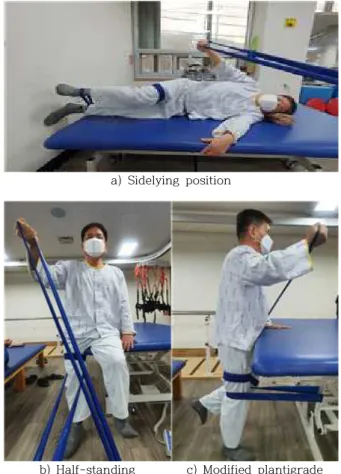
연구대상자들은 사지의 움직임을 동시에 수행할 수 있 는 패턴으로 옆으로 누운 자세(sidelying position), 반 선 자세(half standing position), 수정된 척행자세(mo- dified plantigrade position)에서 수행하였으며, 훈련 전 10분 간 준비운동 후 마비측 팔과 다리에 탄력밴드 (Thera-band, Hygenic Corporation, USA)를 고정한 상태에서 PNF 스프린터 패턴을 실시하였다. PNF 스프 린터 패턴은 마비측 팔은 폄-벌림-안쪽돌림과 어깨뼈의 뒤쪽-아랫쪽 움직임을 시도하며, 동시에 비마비측 다리 의 폄-벌림-안쪽돌림과 엉덩관절의 뒤쪽-아랫쪽 움직임 을 유도하였다. 또한, 비마비측 팔의 굽힘-모음-바깥돌 림과 어깨뼈의 앞쪽-위쪽의 움직임을 시도하며, 마비측 다리의 굽힘-모음-바깥돌림과 엉덩관절의 앞쪽-윗쪽의 움직임을 유도하였다(Dietz, 2009)(Figure 1).

3. 평가도구 및 측정방법

1) 다리 근력 변화

다리 근력 측정은 디지털 근력 측정기(Powertrack

Ⅱ, JTECH Medical, USA)를 이용하였다. 측정은 최대 등척성 수축 시 발생되는 압력으로 하였고, 무릎관절 폄 근의 측정은 발목 앞부분에 측정기의 압력판을 접촉시킨 상태에서 측정하고, 무릎관절 굽힘근은 발 뒤꿈치에 접 촉시켜 측정하였다. 발목관절의 발등 및 발바닥 굽힘 측 정은 발등의 원위부와 발바닥의 원위부에 측정기의 압력 판을 접촉시켜 각각 측정하였다(Bohannon, 2017). 측정 자 내 신뢰도 ICC=.84~.99이다(Kim과 Lee, 1996).

2) 보행분석

(4)

대상자의 시·공간적 보행변수 측정을 위해 무선 3축 가속도계(G-WALK, BTS Inc, Italy)를 이용하였다. 측정 을 위해 대상자의 허리뼈 4~5번 부위에 G-Sensor를 벨 트로 착용시킨 뒤 평소 보행과 동일하게 8m를 보행하도 록 하고, 수집된 자료는 무선으로 컴퓨터에 전송되어 소 프트웨어를 통해 분석하였다(Pau 등, 2014). 측정항목은 보행률(cadence), 한걸음 길이(stride length), 마비측 디딤기(stance phase), 마비측 흔듦기(swing phase), 마비측 보행주기(gait cycle duration)으로 하였다. 측정 자 내 신뢰도 ICC=.81~.93이다(Blosch 등, 2019).

a) Sidelying position

b) Half-standing c) Modified plantigrade

Figure 1. PNF sprinter pattern using thera-band with pressure belt

3) 일어나 걷기 검사(Timed Up & Go test)

일어나 걷기 검사는 환자의 기능적 운동성과 이동능 력, 균형을 빠르게 측정하는 검사방법으로, 팔걸이가 있 는 의자에 앉아 측정 담당자의 ”출발“ 신호와 함께 의자 에서 일어나 3m 거리를 왕복하고 의자에 앉는 시간을 측정하였다(Chan 등, 2017). 측정자 내 신뢰도 ICC=.95

이다(Ng와 Hui-Chan, 2005).

4. 분석방법

통계분석 처리는 SPSS Statistics 22.0 통계 프로그 램을 사용하였다. 연구대상자들의 일반적 특성은 기술통 계를 사용하여 평균과 표준편차로 나타내었다. 그룹 내 측정 시기에 따른 차이 비교를 위해 Wilcoxon signed rank 검정을 실시하였다. 모든 통계학적 유의수준은 α

=.05로 하였다.

Ⅲ. 연구결과

1. 연구대상자의 특성

본 연구에는 9명의 대상자가 참여하였고, 대상자 중 남 성이 5명, 여성이 4명이었다. 일반적 특성은 평균 연령은 66.00±5.58세이었고, 평균 신장은 171.00±3.82㎝, 체중 은 72.85±2.96㎏이었다. 의학적 특성은 뇌경색 6명, 뇌출 혈 3명이며, 오른쪽 반신마비 6명, 왼쪽 반신마비 3명이었 다. 평균 발병기간은 42.3±17.3개월이며, 평균 K-MMSE (Korea- mini mental state examination) 점수는 28.00±1.58점이었다. MAS로 측정한 마비측 강직 정도는 강직 없음이 6명, 1등급이 3명이었다(Table 2).

2. 다리 근력 변화

훈련 전 대퇴사두근은 29.33±10.22 lbs에서 훈련 후 33.42±10.89lbs로, 대퇴삼두근은 13.31±5.38lbs에서 14.05±5.92lbs로, 전경골근은 4.62±.29lbs에서 5.05±.81lbs로, 비복근은 4.64±.25lbs에서 4.77±.31lbs

로 증가하여 모두 유의한 차이를 나타내었다

(p<.05)(Table 3).

3. 보행능력 변화

보행률은 88.49±4.72 steps/min에서 94.76±4.25 steps/min로 증가하였고, 마비측의 한걸음 길이(stride length)는 1.23±.04m에서 1.31±.04m로 증가하였다.

마비측 디딤기는 51.44±3.00%에서 53.82±2.74%로 증

가하였고, 흔듦기는 48.60±3.84%에서 46.55±3.01%로

감소하였고, 보행주기 기간은 1.32±.13s에서 1.23±.10s

로 감소하여 모든 항목에서 유의한 차이를 나타내었다

(5)

(p<.05). 또한, 일어나 걷기 검사에서는 22.32±3.09점에 서 20.46±2.13점으로 감소하여 유의한 차이를 나타내었 다(p<.05)(Table 4, 5).

Ⅳ. 고 찰

뇌졸중 후 마비측 근육에서는 운동단위 수의 지속적 감소, 운동단위 흥분율 장애, 그리고 장기적인 근육 탈신 경(denervation) 등이 나타나는데(Mueangson 등, 2020) 특히, 근육 약화는 뇌졸중 환자에서 나타나는 중 요 증상이며, 정상적인 신체 회복 능력을 늦추는 주요 요인이다(Patten 등, 2004; Cramp 등, 2006).

근력은 운동기능의 중요한 구성 요소이며, 근력 보존 은 뇌졸중 후 최적의 기능을 수행하는데 있어 매우 중요 하다(Bohannon, 2017; Horstman 등, 2008;

Bohannon, 2007). 근력과 보행능력 향상을 위해서는 근력강화가 필수적이라고 할 수 있다(Ada 등, 2006).

본 연구는 뇌졸중 환자를 대상으로 저강도의 운동강도 로 단기간 훈련을 통한 근력증가를 효과적으로 이끌어내 기 위해 탄력밴드를 이용한 PNF 스프린터 패턴 훈련 시 마비측 다리의 가압벨트 착용이 근력과 보행능력에 어떠 한 변화를 주는지 알아보고자 하였다.

뇌졸중 환자를 위한 적절한 치료 전략을 개발하기 위 해서는 운동장애에 대한 근육의 기여와 역할에 대한 정 확한 파악과 정량화된 객관적 평가가 매우 중요하다 (Meskers 등, 2009; Li 등, 2019). 본 연구에서는 훈련 효과를 알아보기 위해 훈련 전과 후에 각각 디지털 근력 측정기로 근력평가와 G-WALK를 이용한 보행분석, 그리 고 TUG를 통한 기능적 평가를 실시하였다.

뇌졸중 환자의 시공간적 보행 양상은 비대칭 및 보행 속도 감소, 마비측 다리의 흔듦기 증가, 비마비측 다리의 디딤기 증가, 한걸음 길이(stride length)의 불균형, 보 행률 감소를 특징으로 한다(Balaban과 Tok, 2014). 이 러한 뇌졸중 후 나타나는 보행에서 Dawes 등(2005)은 Patient no. Age

(yrs) Gender Height (㎝)

Weight

(㎏) Lesion type Affected side

Duration from onset (months)

K-MMSE (point)

MAS (paralyzed

leg)

1 65 Female 165 65 infarction Lt. 60 30 0

2 67 Female 164 69 hemorrhage Rt. 74 28 0

3 56 Female 164 65 infarction Rt. 26 28 0

4 68 Male 176 73 infarction Lt. 48 30 1

5 67 Female 167 63 infarction Rt. 21 28 0

6 73 Male 176 73 hemorrhage Rt. 35 27 1

7 66 Male 175 75 infarction Rt. 30 25 1

8 67 Male 174 80 hemorrhage Lt. 51 29 0

9 65 Male 177 78 infarction Rt. 36 27 0

K-MMSE: Korea-mini mental state examination MAS; Modified Ashworth Scale

Table 2.

General characteristics of the subjects

Muscle Pre-test Post-test ∆

t

p

Quadriceps 29.33±10.22

a

33.42±10.89 4.09±1.42 -7.62 .018

Hamstring 13.31±5.38 14.05±5.92 .73±.68 -2.28 .027

Tibialis Anterior 4.62±.29 5.05±.81 .42±.52 -2.17 .042

Gastrocnemius 4.64±.25 4.77±.31 .12±.12 -2.71 .038

aMean(lbs)±SD

Tested by Wilcoxon signed rank test

Table 3.

Change of muscle strength in paralyzed leg

(6)

보행률, 디딤기와 흔듦기 시간 그리고 보행속도는 다리 폄근의 근력과 매우 밀접한 관련성이 있으며, Werner 등(2002)은 마비측 다리 특히, 무릎 폄근과 엉덩관절 폄 근의 근력 강화가 필요하며, Cramp 등(2006)은 마비측 엉덩관절 굽힘근과 무릎관절 폄근, 발바닥 굽힘근의 힘 은 편안하거나 빠른 보행의 속도를 결정하는 가장 중요 한 요소라고 하였다.

본 연구 결과, 훈련 후 마비측 다리의 근력 변화에서 대퇴사두근은 4.09±1.42lbs, 대퇴삼두근은 .73±.68lbs, 전경골근는 .42±.52lbs, 비복근은 .12±.12lbs의 증가량 을 보여, 엉덩관절 굽힘근과 폄근, 무릎관절 폄근, 발바 닥 굽힘근 등의 주요 근육들에서 유의한 근력 증가를 확 인할 수 있었다.

Oh(2011)는 탄력밴드를 이용한 PNF 스프린터 훈련 시 넙다리곧은근과 안쪽넓은근의 근력향상에 효과적이라 고 하였고, Rhyu 등(2015)은 탄력밴드를 결합한 PNF 패턴 훈련 시 다리의 벌림근에서 폭발적인 근력 향상이 있었음을 보고하였다. 이들은 스프린터 패턴 동작이 PNF의 단순패턴이 아닌 기능적 복합패턴 동작으로써 편 측 훈련이 신체의 다른 부위에 영향을 미치는 교차훈련 효과와 더불어 비마비측 근육들의 안정성 확보 과정에서 반응성 조정 증가로 인한 마비측 근육들의 운동단위 동 원 극대화와 함께 안정근 또는 협력근으로 활용됨으로써

근력이 향상된 것으로 해석하였다(Rhyu 등, 2015; Oh, 2011).

또한, Jang(2012)은 뇌졸중 환자를 대상으로 혈류제한 운동 시 넙다리네갈래근, 뒤넙다리근, 큰볼기근의 근력, 대퇴 근육-뼈 횡단면적, 균형능력 향상이 있었음을 보고 하였다. 이러한 결과는 가압벨트로 인한 혈류제한성 압 박이 근육 내 생리적 환경변화를 일으켜 근위성 세포 증 식을 촉진시키고(Sato 등, 2007), 단백질 합성 개시 증 진(Abe 등, 2012), 순서에 상관없는 다수의 근섬유 동원 과 운동단위 활성도 증가(Yasuda 등, 2015) 등의 원리 로 설명하였으며, 이미 여러 연구에서 혈류제한 운동이 근력증가와 근비대에 효과적임을 보고하였다(Yasuda 등, 2015; Yasuda 등, 2009; Abe 등, 2005; Takarada 등, 2002).

한편, 훈련 후 보행능력 변화 결과에서 보행률은 6.26±1.80 steps/min, 마비측 한걸음 길이는 .08±.01m, 마비측 디딤기는 2.37±1.06%의 증가량을 보였고, 흔듦기는 –2.05±1.43%, 보행주기 기간은 –.08±.05s, 그리고 TUG에서 –1.86±1.63s의 감소량을 보여 마비측 다리의 근력증가가 보행능력 개선에 유의미 한 영향을 주는 것을 확인할 수 있었다. Kim 등(2007)은 뇌졸중 환자를 대상으로 탄력밴드를 이용한 PNF 하지 패턴 훈련 시 보행률에 유의한 차이가 있었음을 보고하

Gait factor Pre-test Post-test ∆ t p

Cadence

(steps/min) 88.49±4.72

a

94.76±4.25 6.26±1.80 -10.40 .008 Stride length

(m) 1.23±.04

a

1.31±.04 .08±.01 -11.03 .017

Stance phase

(%cycle) 51.44±3.00 53.82±2.74 2.37±1.06 -5.88 .018

Swing phase

(%cycle) 48.60±3.84 46.55±3.01 -2.05±1.43 3.79 .018

Gait cycle duration

(s) 1.32±.13 1.23±.10 -.08±.05 3.95 .017

aMean±SD

Tested by Wilcoxon signed rank test

Table 4.

Change of gait ability in paralyzed leg

Pre-test Post-test ∆ t p

Timed up & go test 22.32±3.09

a

20.46±2.13 -1.86±1.63 3.01 .018

aMean(s)±SD

Tested by Wilconxon signed rank test

Table 5.

Change of timed up & go test

(7)

였고, Candace 등(2017)은 노인을 대상으로 4주간 탄성 밴드를 이용한 PNF 패턴 훈련 시 TUG 및 균형에 유의 한 향상이 있었음을 보고하였다.

보행속도를 결정짓는 엉덩관절 굽힘근과 폄근, 무릎관 절 폄근, 발바닥 굽힘근 등의 근력증가(Cramp 등, 2006)가 보행속도를 빠르게 하였고, 보행속도가 빠를수 록 보행주기가 좋아지고, 한발 길이가 증가하면서 보행 의 대칭성이 증가함을 보고한 Lamontagne와 Fung (2004)의 연구와 일치하였다. 또한, 마비측 다리의 한걸 음길이 증가는 보행속도를 증가시키는 직접적인 요소라 고 보고한 de Quervain 등(1996)의 연구와도 일치하였 다.

결국, 마비측 다리의 근력증가로 전반적인 보행 안정 성이 증가하면서 마비측 다리의 한걸음 길이와 한발 길 이가 증가하면서 보행속도, 보행률, 디딤기, 흔듦기에 유 의한 향상이 나타난 것으로 생각되며, 마비측 다리의 한 걸음 길이 증가는 비마비측 다리에 지지 시간을 감소시 키고 양다리의 상호조절 작용 증진으로 보행 관련 생체 역학적 기전을 개선시킨 것으로 생각된다.

또한, 가압벨트로 인한 혈류제한성 압박이 근생리적 자극 환경 촉진과 함께 기저면의 다양한 상황에서 탄성 밴드를 이용한 PNF 스프린터 패턴의 적용이 보행과 관 련된 기능적 안정근이나 협력근에 지속적인 근자극을 강 화하게 하고, 체중 분배와 이동, 다리와 골반의 상호적 움직임, 몸통과 팔다리의 협응 능력을 향상시켜 보행 관 련 인자에 유의한 개선을 시킨 것으로 생각된다(Lim, 2014; Jeong 등, 2011).

본 연구는 다음과 같은 제한점이 있다. 첫째, 연구대 상자의 참여 수가 충분하지 못한 점, 둘째, 비교 대조군 이 부재한 점, 셋째, 연구대상자의 마비측과 비마비측을 비교하지 못한 점, 넷째, 병원에 입원한 환자를 대상으로 하였기 때문에 여러 중재들의 통제기에 제한점이 있었 다. 그러나 이러한 제한에도 불구하고 본 연구는 기존 연구들과 달리 가압벨트 적용이 탄성밴드를 이용한 PNF 스프린터 패턴 훈련 시 기능성 근력과 보행 향상에 매우 효과적임을 입증하였다고 본다.

임상 현장에서 일반적인 물리치료 중재와 함께 가압벨 트를 병행하여 훈련을 한다면, 고강도 저항운동이 어려 운 환자나 단기간에 근력증가가 필요한 환자들에게 저하 된 운동능력 향상시키는데 매우 효과적인 결과를 얻을 수 있을 것으로 판단되며, 뇌졸중 환자만이 아니라 여러 선행 연구들이 보고에서와 같이 다양한 근골격계 질환자 에게 적용한다면 유의미한 중재 결과를 얻을 수 있으리 라 생각된다.

Ⅴ. 결 론

본 연구는 뇌졸중 환자를 대상으로 가압벨트 착용이 탄성밴드를 이용한 PNF 스프린터 패턴 훈련 시 마비측 다리의 근력과 보행에 미치는 효과를 알아보고자 중재 프로그램을 4주간 실시하였고, 다음과 같은 결과를 보였 다.

1. 훈련 후, 뇌졸중 환자의 마비측 다리(대퇴사두근, 대퇴삼두근, 전경골근, 비복근)의 근력은 유의한 차 이가 있었다(p<.05).

2. 훈련 후, 뇌졸중 환자의 보행(보행률, 한걸음 길이, 디딤기, 흔듦기, 보행주기 기간, TUG)은 유의한 차 이가 있었다(p<.05).

참고문헌
Abe T, Loenneke JP, Fahs CA, et al. Exercise in- tensity and muscle hypertrophy in blood flow-restricted limbs and non-restricted muscles: a brief review. Clin Physiol Funct Imaging. 2012;32(4):247-252. https://do- i.org/10.1111/j.1475-097X.2012.01126.x.

Abe T, Beekley MD, Hinata S, et al. Day-to-day change in muscle strength and MRI-meas- ured skeletal muscle size during 7 days KAATSU resistance training: A case study.

International Journal of KAATSU Training Research. 2005;1(2):71-76. https://do- i.org/10.3806/ijktr.1.71.

Ada L, Dorsch S, Canning CG. Strengthening in- terventions increase strength and improve activity after stroke: A systematic review.

Aust J Physiother. 2006;52(4):241-248.

h t t p s : / / d o i . o r g / 1 0 . 1 0 1 6 / s0004-9514(06)70003-4.

Andersen LL, Magnusson SP, Nielsen M, et al.

Neuromuscular activation in conventional therapeutic exercises and heavy resistance exercises: Implications for rehabilitation.

Phys Ther. 2006;86(5):683-697.

Anderson TP. Rehabilitation of patient with com-

(8)

plete stroke. Handbook of physical medicine and rehabilitation, 4th ed, Philadelphia; WB Saunder`s Company. 1990;656-678.

Balaban B, Tok F. Gait disturbances in patients with stroke. PM & R. 2014;6(7):635-642.

https://doi.org/10.1016/j.pmrj.2013.12.017.

Blosch C, Schäfer R, de Marées M, et al.

Comparative analysis of postural control and vertical jump performance between three different measurement devices. Plos one. 2019;14(9):e0222502. https://do- i.org/10.1371/journal.pone.0222502.

Bohannon RW. Reference values for knee ex- tension strength obtained by hand-held dy- namometry from apparently healthy older adults: A meta-analysis. J Frailty Aging.

2017;6(4):199-201. https://doi.org/10.14283/

jfa.2017.32.

Bohannon RW. Muscle strength and muscle train- ing after stroke. J Rehabil Med.

2007;39(1):14-20. https://doi.org/10.2340/

16501977-0018.

Bruton M, O’Dwyer N. Synergies in coordination:

a comprehensive overview of neural, com- putational, and behavioral approaches. J Neurophysiol. 2018;120(6):2761-2774.

https://doi.org/10.1152/jn.00052.2018.

Cai S, Li G, Zhang X, et al. Detecting compensa- tory movements of stroke survivors using pressure distribution data and machine learning algorithms. J Neuroeng Rehabil.

2019;16(1):131-141 https://do- i.org/10.1186/s12984-019-0609-6.

Candance YH, Kennis KW, Evelyn YC, et al. Effect of a 4-week theraband exercise with PNF pattern on improving mobility, balance and fear of fall in community-dwelling elderly. J Korean Soc Phys Med. 2017;12(4):73-82.

https://doi.org/10.13066/kspm.2017.12.4.73.

Chan PP, Si Tou JI, Tse MM, et al. Reliability and validity of the timed up and go Test with a

motor task in people with chronic stroke.

Arch Phys Med Rehabil.

2017;98(11):2213-2220. https://doi.org/

10.1016/j.apmr.2017.03.008.

Cramp MC, Greenwood RJ, Gill M, et al. Low in- tensity strength training for ambulatory stroke patients. Disabil Rehabil.

2006;28(13-14):883-889. https://doi.org/

10.1080/09638280500535157.

Dawes H, Smith C, Collett J, et al. A pilot study to investigate explosive leg extensor power and walking performance after stroke. J Sports Sci Med. 2005;4(4):556-562.

De Quervain IA, Simon SR, Leurgans S, et al.

Gait pattern in the early recovery period af- ter stroke. J Bone Joint Surg Am.

1996;78(10):1506-1514. https://doi.org/

10.2106/00004623-199610000-00008.

Dietz B, Kim T, Lang E, et al. Let`s Sprint, Let`s Skate: Innovationen Im PNF-Konzept.

Heidel-berg. Springer. 2009.

Dragin AS, Konstantinović LM, Veg A, et al. Gait training of poststroke patients assisted by the Walkaround (body postural support). Int J Rehabil Res. 2014;37(1):22-28. https://do- i.org/10.1097/MRR.0b013e328363ba30.

Garber CE, Blissmer B, Deschenes MR, et al.

American college of sports medicine position stand. quantity and quality of exercise for developing and maintaining cardiorespir- atory, musculoskeletal, and neuromotor fit- ness in apparently healthy adults: Guidance for prescribing exercise. Med Sci Sports Exerc. 2011;43(7):1334-1359. https://do- i.org/10.1249/MSS.0b013e318213fefb.

Guo CC. The Effect of Music Therapy on Upper and Lower Limb Function and Gait Function of Stroke Patient. Hansei University.

Doctoral Dissertation. 2021.

Hara Y, Akaboshi K, Masakado Y, et al.

Physiologic decrease of single thenar motor

(9)

units in the F-response in stroke patients.

Arch Phys Med Rehabil. 2000;81(4):418-423.

https://doi.org/10.1053/mr.2000.3872.

Horstman AM, Beltman MJ, Gerrits KH, et al.

Intrinsic muscle strength and voluntary ac- tivation of both lower limbs and functional performance after stroke. Clin Physiol Funct Imaging. 2008;28(4):251-261. https://do- i.org/10.1111/j.1475-097X.2008.00802.x.

Jang DS. The Effects of Blood Flow Restriction Exercise in Stroke Lower Extremity Muscle Strength and Size. Catholic University of Pusan. Master Thesis. 2012.

Jeong WS, Jeong JY, Kim CK, et al. Effect of lower limb muscle activity on balancing through sprinter patterns of PNF. The Journal of the Korea Contents Association.

2011;11(3):281-292. https://doi.org/

10.5392/JKCA.2011.11.3.281.

Jun JY, Park MC. The effect of stair exercise with restriction blood flow on knee extensor muscle. J Korean Soc Phys Med.

2015;10(4):9-14. https://doi.org/10.13066/

kspm.2015.07.14.

Kang SH, Kim SS. Elastic band exercise`s and aerobic exercise`s influences on the elderly people`s health-relevant basic fitness and vascular health. Korean J Phys Educ, 2017;56(1):703-711. https://doi.org/10.23949/

kjpe.2017.01.56.1.51.

Kim JW, Lee KM. Evaluation of isometric shoulder strength in Korean adults using a hand-held dynamometer. Ann Rehabil Med.

1996;20(1):186-193.

Kim JJ, Kim GI, Kim DW, et al. The effect of elas- tic theraband exercise based of PNF L/E pattern on the gait of the chronic hemi- plegic patients. PNF and Movement.

2007;5(2):47-54.

Klein DA, Stone WJ, Phillips WT, et al. PNF train- ing and physical function in assisted-living

older adults. Journal of Aging and Physical Activity. 2002;10(4):476-488. https://do- i.org/10.1123/japa.10.4.476.

Kofotolis N, Kellis E. Effects of two 4-week pro- prioceptive neuromuscular facilitation pro- grams on muscle endurance, flexibility, and functional performance in women with chronic low back pain. Phys Ther.

2006;86(7):1001-1012. https://doi.org/

10.1093/ptj/86.7.1001.

Lamontagne A, Fung J. Faster is better:

Implications for speed-intensive gait training after stroke. Stroke. 2004;35(11):2543-2548.

h t t p s : / / d o-

i.org/10.1161/01.STR.0000144685.88760.d7.

Lee HS, An YH, Kang HJ, et al. Effect of elastic band exercise based of PNF L/E pattern on the balance in the elderly people. J Kor Soc Phys Ther. 2005;17(1):69-79.

Li M, Tian S, Sun L, et al. Gait analysis for post-stroke hemiparetic patient by mul- ti-features fusion method. Sensors (Basel).

2019;19(7):1737-1748. https://do- i.org/10.3390/s19071737.

Li S, Liu J, Bhadane M, et al. Activation deficit correlates with weakness in chronic stroke:

Evidence from evoked and voluntary EMG recordings. Clin Neurophysiol.

2014;125(12):2413-2417. https://doi.org/

10.1016/j.clinph.2014.03.019.

Lim CG. The Effects of proprioceptive neuro- muscular facilitation (PNF) Pattern Exercise Using the Sprinter and the Skater on Balance and Gait Function in the Stroke Patients. J Korean Soc Phys Ther.

2014;26(4):249-256.

Loenneke JP, Fahs CA, Rossow LM, et al. The anabolic benefits of venous blood flow re- striction training may be induced by muscle cell swelling. Med Hypotheses.

2012;78(1):151-154. https://doi.org/10.1016/

j.mehy.2011.10.014.

(10)

Meskers CGM, Schouten AC, de Groot JH, et al.

Muscle weakness and lack of reflex gain adaptation predominate during post-stroke posture control of the wrist. J Neuroeng Rehabil. 2009;6:29-40. https://do- i.org/10.1186/1743-0003-6-29.

Mueangson O, Vongvaivanichakul P, Kamdee K, et al. Malondialdehyde as a useful biomarker of low hand grip strength in commun- ity-dwelling stroke patients. Int J Environ Res Public Health. 2020;17(21):7918-7930.

https://doi.org/ 10.3390/ijerph17217918.

Ng SS, Hui-Chan CW. The timed up and go test:

Its reliability and association with lower-limb impairments and locomotor capacities in people with chronic stroke. Arch Phys Med Rehabil. 2005;86(8):1641-1647. https://do- i.org/10.1016/j.apmr.2005.01.011.

Oh DG. Effects of Elastic Band Exercise using PNF and CNS-Stimulating Exercise on Functional Fitness, EMG, and Gait in Hemiplegic Stroke Patients. Kyung Hee University. Master Thesis. 2011.

Page P. Developing resistive exercise programs using thera-band elastic bands & tubing.

The Hygenic Corporation. 2000;48-60.

Park JC, Park MS, Kim YN. Effects of different size of blood flow restriction areas on changes in muscle thickness. J Kor Phys Ther. 2017;29(2):80-84. https://do- i.org/10.18857/jkpt.2017.29.2.80.

Park JC, Kim YN. Impact of waist stabilization ex- ercise with blood flow restriction on white area index of trunk muscle thickness density. J Kor Phys Ther. 2016;28(2):136-141.

https://doi.org/10.18857/jkpt.2016.28.2.136.

Patten C, Lexell J, Brown HE. Weakness and strength training in persons with poststroke hemiplegia: Rationale, method, and efficacy.

J Rehabil Res Dev. 2004;41(3A):293-312.

https://doi.org/10.1682/jrrd.2004.03.0293.

Pau M, Leban B, Collu G, et al. Effect of light and vigorous physical activity on balance and gait of older adults. Arch Gerontol Geriatr. 2014;59(3):568-573. https://do- i.org/10.1016/j.archger.2014.07.008.

Pohl PS, Duncan P, Perera S, et al. Rate of iso- metric knee extension strength development and walking speed after stroke. J Rehabil Res Dev. 2002;39(6):651-657.

Rhyu HS, Kim SH, Park HS. The effects of band exercise using proprioceptive neuromuscular facilitation on muscular strength in lower extremity. J Exerc Rehabil. 2015;11(1):36-40.

https://doi.org/10.12965/jer.150189.

Ryan AS, Dobrovolny CL, Smith GV, et al.

Hemiparetic muscle atrophy and increased intramuscular fat in stroke patients. Arch Phys Med Rehabil. 2002;83(12):1703-1707.

https://doi.org/10.1053/apmr.2002.36399.

Sato Y, Ishii N, Nakajima T, et al. KAATSU train- ing: Theoretical and practical perspectives.

Japan. Goudan Co. 2007.

Scoenfeld BJ. The mechanism of muscle hyper- trophy and their application to resitance training. J Strength Cond Res, 2010;24(10);2857-2872. https://doi.org/

10.1519/JSC.0b013e3181e840f3.

Seo JW. Analysis of low-intensity resistance ex- ercise with blood flow restriction on physical fitness, body composition, and blood lipids.

Dongguk University. Master Thesis. 2012.

Takano H, Morita T, Iida H, et al. Hemodynamic and hormonal responses to a short-term low-intensity resistance exercise with the reduction of muscle blood flow. Eur J Appl Physiol. 2005;95(1):65-73. https://do- i.org/101007/s00421-005-1389-1.

Takarada Y, Sato Y, Ishii N. Effects of resistance

exercise combined with vascular occlusion

on muscle function in athletes. Eur J Appl

Physiol. 2002;86(4):308-314. https://doi.org/

(11)

10.1007/s00421-001-0561-5.

Wandel A, Jorgensen HS, Nakayama H, et al.

Prediction of walking function in stroke pa- tients with initial lower extremity paralysis:

The copenhagen stroke study. Arch Phys Med Rehabil. 2000;81(6):736-738. https://do- i.org/10.1016/S0003-9993(00)90102-3.

Werner C, Bardeleben A, Mauritz KH, et al.

Treadmill training with partial body weight support and physiotherapy in stroke pa- tients: A preliminary comparison. Eur J Neurol. 2002;9(6):639-644. https://do- i.org/10.1046/j.1468-1331.2002.00492.x.

Yasuda T, Fukumura K, Uchida Y, et al. Effects of low-load, elastic band resistance training combined with blood flow restriction on

muscle size and arterial stiffness in older adults. J Gerontol A Biol Sci Med Sci.

2015;70(8):950-958. https://doi.org/

10.1093/gerona/glu084.

Yasuda T, Brechue WF, Fujita T, et al. Muscle activation during low-intensity muscle con- tractions with restricted blood flow. J Sports Sci. 2009;27(5):479-489. https://do- i.org/10.1080/02640410802626567.

논문접수일(Date received) : 2021년 03월 25일

논문수정일(Date Revised) : 2021년 03월 28일

논문게재확정일(Date Accepted) : 2021년 04월 23일

수치

Figure  1.  PNF  sprinter  pattern  using  thera-band  with  pressure  belt

참조

관련 문서

The Effects of proprioceptive neuromuscular facilitation (PNF) Pattern Exercise Using the Sprinter and the Skater on Balance and Gait Function in the Stroke

Purpose: The purpose of this study was to prove the effects of the PNF patterns combined with whole-body vibration (PWBV) training on muscle strength, balance, walking

Effect of music therapy and rhythmic exercise on quality of life, blood pressure and upper extremity muscle strength in institution dwelling elderly women.. Effect of

Correlations Between Quadriceps Angle, Functional Leg Length Discrepancy and Lower Extremity Muscle Strength of Women University Students in Their Twenties.. Yeon-woo Jung,

Objects: The purpose of this study was to assess the effect of a customized self-exercise program (CSP) to walking function on improving stroke survivors’ muscle strength

The effects of an additional weight aquatic exercise program on balance and lower extremity strength in persons with stroke: randomized controlled study.. Jaeho Park a ,

Effect of a closed chain and open chain resistance exercise on lower extremity muscle activity, balance, gait for the patients with stroke.. The effects of closed kinetic

Effects of a Muscle Strengthening Exercise Program on Muscle Strength, Activities of Daily Living, Health Perception, and Depression in Post-stroke Elders.. Kim, GiYon 1 ·