http://crossmark.crossref.org/dialog/?doi=10.14474/ptrs.2018.7.1.6&domain=pdf&date_stamp=2018-03-25
Received: 25 February, 2018 Revised: 10 March, 2018 Accepted: 11 March, 2018 Corresponding author: Yijung Chung (ORCID http://orcid.org/0000-0002-2431-8895)
Department of Physical Therapy, College of Health Science and Social Welfare, Sahmyook University, 815 Hwarang-ro, Nowon-gu, Seoul 01795, Republic of Korea
Tel: 82-2-3399-1637 Fax: 82-2-3399-1639 E-mail: [email protected]
This is an Open-Access article distributed under the terms of the Creative Commons Attribution Non-Commercial License (http://creativecommons.org/licenses/
by-nc/4.0) which permits unrestricted non-commercial use, distribution, and reproduction in any medium, provided the original work is properly cited.
Copyright © 2018 Korean Academy of Physical Therapy Rehabilitation Science
https://doi.org/10.14474/ptrs.2018.7.1.6 pISSN 2287-7576
eISSN 2287-7584
Phys Ther Rehabil Sci 2018, 7 (1), 6-12 www.jptrs.org
The effects of an additional weight aquatic exercise program on balance and lower extremity strength in persons with stroke: randomized controlled study
Jaeho Park
a, Yijung Chung
baDepartment of Physical Therapy, Chungnam National University Hospital, Daejeon, Republic of Korea
bDepartment of Physical Therapy, College of Health Science and Social Welfare, Sahmyook University, Seoul, Republic of Korea
Objective: The purpose of this study was to investigate the effects of an additional weight aquatic exercise program on the bal- ance and lower extremity strength on aquatic environment in persons with stroke.
Design: Randomized controlled trial.
Methods: All subjects were randomly divided into three groups where thirteen subjects were in the additional weight aquatic ex- ercise group, twelve subjects in the aquatic exercise group, and fifteen subjects in the control group. Subjects received a graded aquatic exercise program for 30 minutes, with 3 sessions per week for 6 weeks, and subjects in all groups received conventional physical therapy. All subjects were assessed with the Medical Research Council (MRC), the Berg Balance scale (BBS), Timed Up and Go test (TUG), and 10-meter walk test (10MWT) pre and post intervention.
Results: The MRC, BBS, TUG, and 10MWT scores significantly improved post-intervention (p<0.05), and the control group al- so had significantly improved in all areas post-treatment (p<0.05). In addition, it has been confirmed that the additional weight aquatic exercise group had significantly improved in MRC, BBS, and TUG scores compared with the aquatic exercise and control group (p<0.05).
Conclusions: The findings of this study suggested that the additional weight aquatic exercise program improves lower extremity and balance in persons with stroke.
Key Words: Balance, Gait, Rehabilitation, Stroke
Introduction
Stroke survivors with motor function loss and muscle weakness due to neurological symptoms, such as sensory abnormality and decreased exercise capacity, show limi- tations in basic mobility such as walking and stair climbing [1,2]. In addition, person with stroke show greater body sway in weight shift compared to normal subjects due to im- proper posture control [3]. Because of these problems, per- sons with stroke who have difficulty in normal walking use various compensatory movements to maintain functional
walking. Such abnormal compensatory movement is in- efficient compared to normal walking and consumes a lot of energy [4]. As a result, stroke survivors exhibit slow walk- ing speed and asymmetric gait pattern due to decreased stride length and ratio in the affected side stance phase [5,6].
Such gait disorders increase the likelihood of secondary
damage such as falls [7]. Therefore, restoring the balance
and walking ability of persons with stroke is essential for
functional independence in everyday life [8]. Therefore,
proper exercise methods are needed to improve walking
ability of stroke patients.
Balance involves maintaining postural stability by main- taining the center of gravity. Such balance has static and dy- namic balance ability to control the stability of the human body during dynamic movement [9]. Park et al. [10] re- ported that aquatic exercise using the special properties of water provides stability and exercise effects that cannot be obtained from ground motion, as a means of recovering this normal balance ability. These effects are not only balanced but also have a positive effect on psychological depression.
In addition, aquatic exercise performed in an aquatic envi- ronment provides significant therapeutic advantages in re- ducing muscle tension, improving stability and functional mobility for posture control. Among the characteristics of water, buoyancy can reduce stress placed onto the muscles and joints and can assist in establishing a rhythmical gait pat- tern in contrast with the over-ground gait training [11,12]. In particular, Park et al. [10] reported that underwater gait training showed a decrease in asymmetric gait patterns com- pared to over-ground gait training. Jung et al. [13], applied weights to the lower limbs during the performance of under- water gait training. The results showed increased stability of the lower limbs due to weight application, which minimized the effects of floatation of the lower limbs. Lam et al. [14] re- ported that the weight loading on the affected limb showed an increase in the walking ability as well as an increase in the swing phase with hip flexor muscle activation. In addition, Arnold et al. [15] and Hinman et al. [16] obtained results showing improved leg strength and balance ability through a combination of an underwater walking training and aquat- ic exercise program. After that, Katsura et al. [17] showed that dynamic balance ability is improved by participating in an underwater exercise program using weights. Although the subject was not a neurologically affected patient, the re- sults showed evidence that the program is an effective ex- ercise method. Although studies on the effect of aquatic ex- ercise programs using various tools on balance and gait abil- ity have been conducted, there are insufficient studies on stroke survivors participating in underwater exercise pro- grams using additional weights. Therefore, the purpose of this study was to investigate the effects of aquatic exercise programs with weight application on the lower extremities and balance ability in persons with stroke.
Methods Participants
This study included a pretest-posttest control group de-
sign where the subjects were divided according into inter- vention methods, such as the additional weight aquatic ex- ercise program group, aquatic exercise program group, or control group. Forty subjects who were admitted in Chungnam National University Hospital in Daejeon. In ad- dition, the subjects were not experienced in aquatic exercise program, and the stroke participants were those who had no overlapping diseases within the past 6 months after the onset of stroke to minimize the possibility of natural restoration.
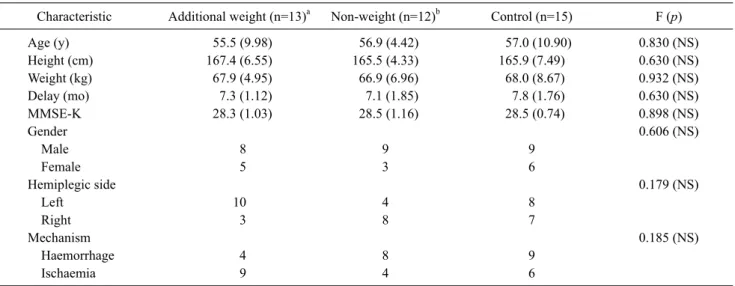
To minimize the selection bias, the following selection cri- teria were applied randomly to the three groups. The in- clusion criteria were as follows: (1) diagnosis of stroke (after minimum 6 months); (2) ability to walk 10 minutes with or without an assistive device; (3) impairment of balance abil- ity (maximum berg balance scale score 45); (4) cognitive abilities enabling communication (minimum Mini-Mental Status Examination score 24); (5) medically stable and free of major cardiovascular or other medical conditions; and (6) no history of orthopedic surgery within the past 6 months and seizure. Subject general characteristics can be viewed in Table 1. This study trained forty-two patients for six weeks, but two patients were discharged. Four therapists intervened to conduct the study on a large number of patients. All groups measured lower extremity strength and balance abil- ities before intervention. For objective evaluation, three therapists with at least five years of clinical experience con- ducted the evaluation. This study was approved by the Institutional Review Board of the Sahmyook University (IRB No. 2-1040781-AB-N-01-2016112HR), and all sub- jects provided their informed consent after being explained of the study details (Figure 1).
Intervention
Aquatic exercise program
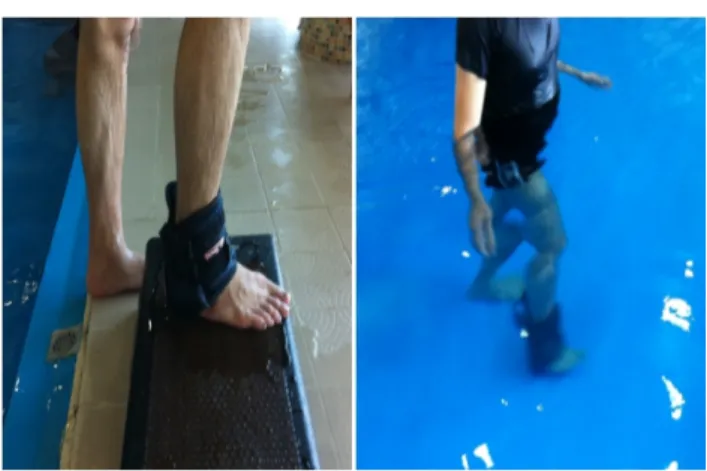
The aquatic exercise program involved wearing a sand-
bag on the affected side ankle that was 5% of the body
weight. For the aquatic exercise program, the exercises were
conducted in a pool with water at chest height depth and tem-
peratures of 30°C to 32°C. The aquatic exercise program ap-
plied in this study was a program that was made by modify-
ing the exercise program from preceding studies conducted
in the form of sufficient stretching and strengthening in the
water. The movements performed were weight shifting, sin-
gle leg stance, and various task-orientated exercises in the
standing posture (climbing, squatting, heel lifting, kicking,
and step up and step down). After 10 minutes of exercise, 20
minutes of gait training was performed (Table 2, Figure 2).
Table 1. Characteristics of participants (clinical features) (N=40) Characteristic Additional weight (n=13)a Non-weight (n=12)b Control (n=15) F (p)
Age (y) 55.5 (9.98) 56.9 (4.42) 57.0 (10.90) 0.830 (NS)
Height (cm) 167.4 (6.55) 165.5 (4.33) 165.9 (7.49) 0.630 (NS)
Weight (kg) 67.9 (4.95) 66.9 (6.96) 68.0 (8.67) 0.932 (NS)
Delay (mo) 7.3 (1.12) 7.1 (1.85) 7.8 (1.76) 0.630 (NS)
MMSE-K 28.3 (1.03) 28.5 (1.16) 28.5 (0.74) 0.898 (NS)
Gender 0.606 (NS)
Male 8 9 9
Female 5 3 6
Hemiplegic side 0.179 (NS)
Left 10 4 8
Right 3 8 7
Mechanism 0.185 (NS)
Haemorrhage 4 8 9
Ischaemia 9 4 6
Values are presented as mean (SD) or number only.
MMSE-K: Mini-Mental Status Examination-Korea, NS: non-significant.
aApplying additional weight aquatic exercise program group, bGeneral aquatic exercise program group.
Figure 1. Enrollment of stroke patients.
For mediation of speed during underwater gait training, researchers used metronomes to adjust to the tempo of the subject’s comfortable walking speed. The intervention peri- ods for the subjects were 6 weeks, 3 times a week, for 30 mi- nutes each. In addition, all patients who participated in the study participated conventional physical therapy for 6 weeks, 5 times a week. For subject safety, guidance during
training was provided by physical therapists with 3 or more years of experience of aquatic exercise training and one as- sistant per subject as research assistants.
Outcome measures
Medical Research Council
The Medical Research Council (MRC) is the clinical
Figure 2. Aquatic exercise program & underwater gait training.
Table 2. Aquatic exercise program
Aquatic exercise program course Time
First. Weight shift and stretching in a static posture in the water 1. Weight shifting in various directions and single leg standing 2. Stretching in various directions
Second. Weight shift and task-oriented training in a single leg standing position in water 1. Hold on Single leg standing position
2. Squatting
3. Step up & Step down
4. Ankle exercise (heel up and down in stand posture) 5. Kicking
Third. Underwater gait training
20 minutes
10 minutes
method for evaluating muscle strength as a sequence scale.
MRC assesses the strength of the agonist and antagonist muscles of a variety of persons with neurological disease, in- cluding stroke. The MRC is divided into six grades: Normal (5), Good (4), Fair (3), Poor (2), Trace (1), and Zero (0). Hip flexion, extension, abduction, knee flexion, extension, ankle dorsiflexion, plantar flexion of affected side lower extremity was assessed and was calculated as 0 points out of a total of 30 points. The mean value was taken from three measure- ments, and to minimize the degree of fatigue, there was a 30-second rest period between measurements.
Berg Balance scale
The Berg Balance Scale (BBS) includes 14 items that can quantitatively assess balance and fall risk. Each item can be scored between 0 to 4 points, with a maximum of 56 points possible. A score of 45 or less represents the need for use of an assistive device, a score of 41 to 44 represents having a low risk of falls, 21 to 40 represents having a greater fall risk, and a score of 0 to 20 represents having a very high fall risk.
The duration of the BBS is approximately 15 minutes and evaluates both static and dynamic balance abilities. The therapist who performed the BBS before and after inter- vention had greater than 3 years of experience in the clinic.
Timed Up and Go test
The Timed Up and Go test (TUG) evaluates the duration of the process of rising from a sitting position, walking 3 me- ters, and then returning to the chair and assuming a complete seated position. The subjects performed the TUG three times in order to obtain an average value. The TUG has a re- liability of r=0.99 and a high inter-rater reliability of r=0.98.
10-meter walking test
The 10-meter walk test (10MWT) is a standardized test used to assess gait ability, and can be used to assess gait dis- abilities in those with neurological damage.
Data analysis
The PASW Statstics ver. 19.0 (IBM Co., Armonk, NY, USA) was used for data analysis. A normality analysis was conducted for the general subject characteristics, and the paired t-test was conducted to analyze the differences be- tween each group before and after intervention. The one-way analysis of variance was performed to investigate for significant changes in balance and gait abilities per group after six weeks, the Duncan post-hoc analysis test was con- ducted, and the level of significant was set at p<0.05.
Results
The general and medical subject characteristics
Both general and medical subject characteristics in the ad-
ditional weight aquatic exercise program group, aquatic ex-
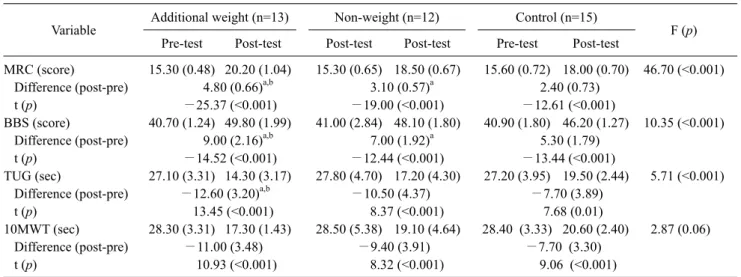
Table 3. Changes in balance ability and muscle strength of the participants in this study (N=40)
Variable Additional weight (n=13) Non-weight (n=12) Control (n=15)
F (p) Pre-test Post-test Post-test Post-test Pre-test Post-test
MRC (score) 15.30 (0.48) 20.20 (1.04) 15.30 (0.65) 18.50 (0.67) 15.60 (0.72) 18.00 (0.70) 46.70 (<0.001)
Difference (post-pre) 4.80 (0.66)a,b 3.10 (0.57)a 2.40 (0.73)
t (p) −25.37 (<0.001) −19.00 (<0.001) −12.61 (<0.001)
BBS (score) 40.70 (1.24) 49.80 (1.99) 41.00 (2.84) 48.10 (1.80) 40.90 (1.80) 46.20 (1.27) 10.35 (<0.001)
Difference (post-pre) 9.00 (2.16)a,b 7.00 (1.92)a 5.30 (1.79)
t (p) −14.52 (<0.001) −12.44 (<0.001) −13.44 (<0.001)
TUG (sec) 27.10 (3.31) 14.30 (3.17) 27.80 (4.70) 17.20 (4.30) 27.20 (3.95) 19.50 (2.44) 5.71 (<0.001)
Difference (post-pre) −12.60 (3.20)a,b −10.50 (4.37) −7.70 (3.89)
t (p) 13.45 (<0.001) 8.37 (<0.001) 7.68 (0.01)
10MWT (sec) 28.30 (3.31) 17.30 (1.43) 28.50 (5.38) 19.10 (4.64) 28.40 (3.33) 20.60 (2.40) 2.87 (0.06)
Difference (post-pre) −11.00 (3.48) −9.40 (3.91) −7.70 (3.30)
t (p) 10.93 (<0.001) 8.32 (<0.001) 9.06 (<0.001) MRC: Medical Research Council, BBS: Berg Balance scale, TUG: Timed Up and Go test, 10MWT: 10-meter walking test.
aSignificant difference compared with control (p<0.05). bSignificant difference compared with non-weight (p<0.05).
ercise group and control were all homogenous (Table 1).
Balance and gait ability changes
Significant increases in MRC, BBS, TUG, and 10MWT scores were observed in the additional weight exercise group, aquatic exercise group, and control group (p<0.05).
In addition, the additional weight aquatic exercise group had significantly improved in MRC, BBS, and TUG scores com- pared with the aquatic exercise and control group (p<0.05).
Also, the aquatic exercise group (Non-weight) had sig- nificantly improved in MRC and BBS scores compared with the control group (Table 3).
Discussion
Functional recovery in persons with stroke is limited by muscle weakness [18]. The weakness of the ankle muscle strength causes problems in balance and walking ability [19]. Based on this evidence, Lee and Kang [20] reported that the loss of balance in persons with stroke was associated with weakening of the ankle muscular strength. This is be- cause the ankle with plantar flexor spasticity does not reach the ground resulting in a shortened stance phase and the push-off not occurring, and the foot-drop is caused at the di- agonal period, resulting in slow walking speed and in- efficient walking. As a result, those affected by stroke showed asymmetric balance ability and increased risk of falls [21]. Therefore, it is necessary to restore the balance and the walking ability with strengthening of the lower ex-
tremities in order to create an effective movement for per- sons with stroke [20]. The purpose of this study was to inves- tigate the effect of applying additional weight during the participation in an aquatic exercise program in persons with stroke. Masumoto et al. [22] suggested that exercises per- formed in the water was more effective for muscle activation than ground motions, and based on this, Miyoshi et al. [23]
found increased movement of the hip joint extensor and knee joint extensor plantar flexor muscles. Subsequently, Barela et al. [24] studied the difference in muscle activity due to environmental changes, such as buoyancy and vis- cosity as evidence for the increase in muscle activity. Based on this evidence, Chu et al. [25] showed the improvement of strength and endurance of stroke survivors through partic- ipating in an aquatic exercise program. The results of this study also showed the improvement of muscle strength.
These changes can be attributed to changes in balance and walking ability based on lower extremity strength. Noh et al.
[26] mentioned that aquatic exercise programs are very ef-
fective in improving the balance ability of those affected by
stroke. As a basis for this, Chu et al. [25] showed that the im-
provement of balance ability was based on the changes in
muscle strength. As a result, the change in balance ability led
to improvement of walking ability. This change is due to the
advantage of the water environment, which reduces the
stress on the joints through buoyancy, which counteracts the
gravity felt by the human body on the ground, enabling
movement with less force compared with the ground motion
[27,28]. It is reported that such underwater gait training im-
proves balance ability by increasing the stance phase and weight transfer ability of the affected side [29,30].
In addition, repetitive task-oriented training in the water has been reported to be an effective intervention for restor- ing balance and gait ability [15,31,32]. Sim and Oh [33]
showed a significant increase in balance and gait ability as a result of applying task-oriented functional training to per- sons with stroke. It was reported that the task-oriented repet- itive training showed an increase in neuro-plasticity focused on the re-organization of the central nervous system and that cerebral cortex and central nervous system activation af- fected movement speed and balance ability [34]. Based on the results, the aquatic exercise program was very effective in improving balancing ability by observing the changes in balance ability between the aquatic exercise group and con- trol group.
Improvement in walking ability for persons with stroke is a major goal of clinical rehabilitation research [35]. Among them, walking speed is used as a measure of the level of functional recovery in order to perform daily life activities [6]. The underwater gait training showed improvements in walking speed by strengthening of the lower extremity mus- cles such as the rectus femoris, biceps femoris, and vastus medialis [36,37]. Also, underwater gait training can be con- ducted easily and with stability by using buoyancy, which al- so provides psychological stability. In this study, we per- formed an aquatic exercise program including underwater gait training with these advantages [38]. Park et al. [30] sug- gested that such underwater gait training is based on the im- provement of stability of the lower extremity. Therefore, Jung et al. [13] mentioned that applying additional weight was used to improve stability by minimizing the floatation of the lower limb. The results of the study also showed sta- bility of the lower limbs and improved walking ability based on appropriate weight shifting. In addition, Lam et al. [14]
found that over-ground gait training with a weight attached to the ankle joint can lead to effective lower limb movement based on activation of the hip flexor muscles. Katsura et al.
[17] also showed a significant increase in walking speed af- ter aquatic exercise program with applying additional weight. Based on these previous studies, the results of this study could be similar. The results of this study showed that the applying additional weight was effective for the weight aquatic exercise group compared with the general aquatic exercise group and showed an effective change in balance ability. However, although the gait ability results showed an effective change compared to the pre-test, there was no sig-
nificant difference between the groups. From these results, it is necessary to include a longer follow-up period and the subsequent course to observe and examine the effects on gait ability.
In conclusion, we conclude that applying additional weight during the performance of aquatic exercise is very effective for improving balance ability due to improvements in lower extremity strength in persons with stroke. However, there are some limitations that affect the results of this study. First, it is difficult to generalize the results due to a small number of subjects. Second, the subjects had various balance and gait abilities. Third, the duration of the study period was six weeks, which was short-term. Fourth, the intervention was performed by several therapists, which may have produced an error in the level of treatment between therapists. Future studies should address these limitations and be conducted for further development of various aspects of aquatic ex- ercise programs for the stroke population.
Acknowledgements
This paper was supported by the Fund of the Sahmyook University in 2017.
Conflict of Interest
The authors declared no potential conflicts of interest with respect to the authorship and/or publication of this article.
References
1. Kim JH. A study on the correlation between static, dynamic standing balance symmetry and walking function in stroke. J Korean Soc Phys Ther 2012;24:73-81.
2. Belgen B, Beninato M, Sullivan PE, Narielwalla K. The associa- tion of balance capacity and falls self-efficacy with history of falling in community-dwelling people with chronic stroke. Arch Phys Med Rehabil 2006;87:554-61.
3. Geiger RA, Allen JB, O'Keefe J, Hicks RR. Balance and mobility following stroke: effects of physical therapy interventions with and without biofeedback/forceplate training. Phys Ther 2001;
81:995-1005.
4. Bang DH, Shin WS, Kim SY, Choi JD. The effects of action ob- servational training on walking ability in chronic stroke patients:
a double-blind randomized controlled trial. Clin Rehabil 2013;
27:1118-25.
5. Plummer-D'Amato P, Altmann LJ, Saracino D, Fox E, Behrman AL, Marsiske M. Interactions between cognitive tasks and gait after stroke: a dual task study. Gait Posture 2008;27:683-8.
6. Kim CM, Eng JJ. The relationship of lower-extremity muscle torque to locomotor performance in people with stroke. Phys Ther 2003;83:49-57.
7. Weerdesteyn V, de Niet M, van Duijnhoven HJ, Geurts AC. Falls in individuals with stroke. J Rehabil Res Dev 2008;45:1195-213.
8. Lee MS, Lee JH, Park SK, Kang JI. The effect of ankle joint tap- ing applied to patients with hemiplegia on their gait velocity and joint angles. J Korean Soc Phys Ther 2012;24:157-62.
9. Tyson SF, Hanley M, Chillala J, Selley A, Tallis RC. Balance dis- ability after stroke. Phys Ther 2006;86:30-8.
10. Park RJ, Kim SS, Kim YG, Park DM, Hanm DW. The effects of aqua-exercise on the balance of one leg stance in the elderly women. J Korean Soc Phys Ther 2002;14:89-98.
11. Vivas J, Arias P, Cudeiro J. Aquatic therapy versus conventional land-based therapy for Parkinson's disease: an open-label pilot study. Arch Phys Med Rehabil 2011;92:1202-10.
12. Melzer I, Elbar O, Tsedek I, Oddsson LI. A water-based training program that include perturbation exercises to improve stepping responses in older adults: study protocol for a randomized con- trolled cross-over trial. BMC Geriatr 2008;8:19.
13. Jung T, Lee D, Charalambous C, Vrongistinos K. The influence of applying additional weight to the affected leg on gait patterns during aquatic treadmill walking in people poststroke. Arch Phys Med Rehabil 2010;91:129-36.
14. Lam T, Luttmann K, Houldin A, Chan C. Treadmill-based loco- motor training with leg weights to enhance functional ambula- tion in people with chronic stroke: a pilot study. J Neurol Phys Ther 2009;33:129-35.
15. Arnold CM, Busch AJ, Schachter CL, Harrison EL, Olszynski WP. A randomized clinical trial of aquatic versus land exercise to improve balance, function, and quality of life in older women with osteoporosis. Physiother Can 2008;60:296-306.
16. Hinman RS, Heywood SE, Day AR. Aquatic physical therapy for hip and knee osteoarthritis: results of a single-blind random- ized controlled trial. Phys Ther 2007;87:32-43.
17. Katsura Y, Yoshikawa T, Ueda SY, Usui T, Sotobayashi D, Nakao H, et al. Effects of aquatic exercise training using water-resist- ance equipment in elderly. Eur J Appl Physiol 2010;108:957-64.
18. Flansbjer UB, Downham D, Lexell J. Knee muscle strength, gait performance, and perceived participation after stroke. Arch Phys Med Rehabil 2006;87:974-80.
19. Menz HB, Morris ME, Lord SR. Foot and ankle characteristics associated with impaired balance and functional ability in older people. J Gerontol A Biol Sci Med Sci 2005;60:1546-52.
20. Lee SB, Kang KY. The effects of isokinetic eccentric resistiance exercise for hip joint on functional gait of stroke patients. J Phys Ther Sci 2013;25:1177-9.
21. de Oliveira CB, de Medeiros IR, Frota NA, Greters ME, Conforto AB. Balance control in hemiparetic stroke patients:
main tools for evaluation. J Rehabil Res Dev 2008;45:1215-26.
22. Masumoto K, Takasugi S, Hotta N, Fujishima K, Iwamoto Y.
Electromyographic analysis of walking in water in healthy humans. J Physiol Anthropol Appl Human Sci 2004;23:119-27.
23. Miyoshi T, Shirota T, Yamamoto S, Nakazawa K, Akai M.
Functional roles of lower-limb joint moments while walking in water. Clin Biomech (Bristol, Avon) 2005;20:194-201.
24. Barela AM, Stolf SF, Duarte M. Biomechanical characteristics of adults walking in shallow water and on land. J Electromyogr Kinesiol 2006;16:250-6.
25. Chu KS, Eng JJ, Dawson AS, Harris JE, Ozkaplan A, Gylfadóttir S. Water-based exercise for cardiovascular fitness in people with chronic stroke: a randomized controlled trial. Arch Phys Med Rehabil 2004;85:870-4.
26. Noh DK, Lim JY, Shin HI, Paik NJ. The effect of aquatic therapy on postural balance and muscle strength in stroke survivors--a randomized controlled pilot trial. Clin Rehabil 2008;22:966-76.
27. Becker BE. Aquatic therapy: scientific foundations and clinical rehabilitation applications. PM R 2009;1:859-72.
28. Park J, Lee D, Lee S, Lee C, Yoon J, Lee M, et al. Comparison of the effects of exercise by chronic stroke patients in aquatic and land environments. J Korean Phys Ther 2011;23:821-4.
29. Cho YM. The effect of hydrotherapy on the balance in stroke pa- tient [Master thesis]. Gwangju: Chonnam National University;
2009.
30. Park SE, Lee ME, Yoon BC, Lee BH, Shin HJ, Choi WS, et al.
Comparison of underwater and overground treadmill walking exercise to improve gait and physical function in people after stroke. J Int Acad Phys Ther Res 2010;1:120-5.
31. Suomi R, Koceja DM. Postural sway characteristics in women with lower extremity arthritis before and after an aquatic exercise intervention. Arch Phys Med Rehabil 2000;81:780-5.
32. Geytenbeek J. Evidence for effective hydrotherapy. Physiotherapy 2002;88:514-29.
33. Sim SM, Oh DW. Effect of dual-task training with cognitive mo- tor task on walking and balance functions in patients with chron- ic stroke: randomized controlled pilot study. Phys Ther Korea 2015;22:11-20.
34. Harvey RL. Improving poststroke recovery: neuroplasticity and task-oriented training. Curr Treat Options Cardiovasc Med 2009;
11:251-9.
35. Ada L, Dean CM, Hall JM, Bampton J, Crompton S. A treadmill and overground walking program improves walking in persons residing in the community after stroke: a placebo-controlled, randomized trial. Arch Phys Med Rehabil 2003;84:1486-91.
36. Masumoto K, Shono T, Hotta N, Fujishima K. Muscle activation, cardiorespiratory response, and rating of perceived exertion in older subjects while walking in water and on dry land. J Electromyogr Kinesiol 2008;18:581-90.
37. Masumoto K, Shono T, Takasugi S, Hotta N, Fujishima K, Iwamoto Y. Age-related differences in muscle activity, stride fre- quency and heart rate response during walking in water. J Electromyogr Kinesiol 2007;17:596-604
38. Kim SH, Lee DK, Kim EK. Effect of aquatic exercise on balance and depression of stroke patients. J Korean Soc Phys Ther 2014;26:104-9.