http://dx.doi.org/10.14405/kjvr.2015.55.4.227
227
<Original Article>
Development of inactivated Akabane and bovine ephemeral fever vaccine for cattle
Dong-Kun Yang*, Ha-Hyun Kim, Hyun-Ye Jo, Sung-Suk Choi, In-Soo Cho Viral disease division, Animal and Plant Quarantine Agency, Anyang 14089, Korea (Received: March 24, 2015; Revised: November 4, 2015; Accepted: November 10, 2015)
Abstract : Akabane and bovine ephemeral fever (BEF) viruses cause vector-borne diseases. In this study, inactivated Akabane virus (AKAV)+Bovine ephemeral fever virus (BEFV) vaccines with or without recombinant vibrio flagellin (revibFlaB) protein were expressed in a baculovirus expression system to measure their safety and immunogenicity.
Blood was collected from mice, guinea pigs, sows, and cattle that had been inoculated with the vaccine twice. Inactivated AKAV+BEFV vaccine induced high virus neutralizing antibody (VNA) titer against AKAV and BEFV in mice and guinea pigs. VNA titers against AKAV were higher in mice and guinea pigs immunized with the inactivated AKAV+
BEFV vaccine than in animals inoculated with vaccine containing revibFlaB protein. Inactivated AKAV+BEFV vaccine elicited slightly higher VNA titers against AKAV and BEFV than the live AKAV and live BEFV vaccines in mice and guinea pigs. In addition, the inactivated AKAV+BEFV vaccine was safe, and induced high VNA titers, ranging from 1 : 64 to 1 : 512, against both AKAV and BEFV in sows and cattle. Moreover, there were no side effects observed in any treated animals. These results indicate that the inactivated AKAV+BEFV vaccine could be used in cattle with high immunogenicity and good safety.
Keywords : Akabane virus, bovine ephemeral fever, cattle, vaccine
Introduction
Akabane and bovine ephemeral fever (BEF) diseases are designated as second-class infectious diseases in the Infec- tious Disease Control and Prevention Act in Korea; both are important arthropod-borne viral diseases in ruminants. Arthro- pod-borne viruses (arboviruses) are widely distributed, from the tropical to temperate zones of the world, and are associ- ated with hematophagous arthropod vectors such as Culi- coides (C.) biting midges and mosquitoes. Particular vector species linked to Akabane virus (AKAV) and Bovine ephem- eral fever virus (BEFV) include C. brebitarsis, C. oxystoma, C. nebuchlsus, and C. nipponensis [5, 8, 17].
AKAV is a member of the genus Orthobunyavirus in the family Bunyaviridae, and contains three segments of single- stranded negative RNA, designated large, medium, and small according to their size [11]. AKAV causes congenital abnor- malities of the central nerve system in ruminants, such as cat- tle, sheep, and goats. AKAV infection has been reported in Australia, Israel, Japan, and Korea. Asymptomatic AKAV infection has been demonstrated serologically in horses and swine in endemic areas [10, 20].
BEFV, an arthropod-borne rhabdovirus, belongs to the
genus Ephemerovirus in the family Rhabdoviridae, and con- sists of a minus-sense single-stranded RNA genome [18].
BEF disease, also known as 3-day sickness, is outbreak in cattle. BEFV causes serious economic losses in a short period, as well as decreased body condition and decreased weight gain in cattle because of high fever. BEF infection has been reported in Japan, Taiwan, and Australia, and a large-scale outbreak of BEF was reported in Turkey in 2010 [16]. The symptoms in infected cattle include a short fever, shivering, lameness, and muscular stiffness [4].
Flagellin causes signal transduction in mammalian cells via Toll-like receptor 5 (TLR5), and has been considered a potent adjuvant for vaccines [2, 9]. A bacterial flagellin, Vibrio vulnificus FalB, has strong mucosal adjuvant activity, induc- ing protective immunity [9]. Many outbreaks of AKAV and BEFV occurred in the southern regions of Korea in 2010 (Korea Animal Health Integrated System, Animal and Plant Quarantine Agency [QIA], Korea). The isolation of various AKAVs has been reported, and the genetic and pathogenic characteristics of AKAV isolates have been described [13, 14, 19]. Live attenuated vaccines for AKAV and BEFV have been used for the prevention of the disease since the 1980s.
In addition, an inactivated vaccine for AKAV, Aino virus
*Corresponding author
Tel: +82-31-467-1783, Fax: +82-31-467-1797 E-mail: [email protected]
(AINV), and Chuzan virus (CHUV) was commercialized in 2011 [5, 6]. However, the inoculation rates of live AKAV or BEFV vaccine and inactivated AKAV, AINV, and CHUV vaccines seem to be low based on a serological survey [7, 12]. Among the arboviruses, AKAV and BEFV are the most significant vector-borne viral agents in Korea.
A follow-up study based on a serological survey after the mass outbreaks of AKAV and BEFV in Korea indicated that mass vaccination would be required to prevent disease caused by AKAV and BEFV. Thus, we prepared an inacti- vated AKAV and BEFV vaccine for cattle, and evaluated its safety and immunogenicity in several animal species.
Materials and Methods
Viruses and cells
Outbreak of Akabane viral infection in a Korean native cattle farm located on Jeju-do was reported to QIA in 2005.
Twelve cattle bloods of the farm were collected and one virus, KV0505 strain, was isolated, was isolated from the blood samples [20]. The AKAV (KV0505 strain) was propa- gated in baby hamster kidney cells (BHK-21), and BEFV (DS11 strain) was also grown in BHK-21 cells. The BHK-21 cells were regularly maintained in α-minimum essential medium (MEM) supplemented with 5% fetal bovine serum (FBS), penicillin (100 IU/mL), streptomycin (10 µg/mL), and amphotericin B (0.25 µg/mL). To propagate the AKAV and BEFV, the BHK-21 cells grown in α-MEM were washed three times with PBS, and the two viruses were inoculated.
After adsorption, α-MEM was added, and the cells were incu- bated until a 90% cytopathic effect (CPE) was observed in the infected BHK-21 cells. After harvesting, the antigens were frozen and thawed three times, and centrifuged (3,000 × g, 30 min) to remove the cellular debris.
Construction and expression of recombinant vibrio flagellin (revibFlaB) baculovirus
A flagellin (FlaB) protein of Vibrio alginolyticus was syn- thesized based on GenBank accession no. FJ617267, and cloned into the pGEM-T easy vector. For the construction of a revibFlaB baculovirus, the Bac-N-Blue DNA (Invitrogen, USA) and 10 µg/µL of purified pFastBacFlaB plasmid DNA was mixed with Cellfectin, a commercial lipid-based trans- fection reagent (Invitrogen), in Grace’s insect medium with- out supplements. After incubation for 15 min at room tem-
perature, the transfection mixture was added to the 60 mm dish, in which Spodoptera frugiperda (Sf9) cells had been cultivated at 27
oC. After 3 days, the supernatant was harvested and the cells were incubated continuously in fresh medium containing FBS.
A plaque assay to purify recombinant baculovirus was per- formed in 1% agarose medium containing 150 µg/mL X-gal.
A PCR assay against revibFlaB baculovirus was performed to confirm the isolation of a pure plaque using specific bacu- lovirus primers (Table 1). Passage of revibFlaB baculovirus was conducted three times using Sf9 cells infected with 0.1 multiplicity of infection. The third passage was used as a viral stock for expression.
For the vaccine adjuvant, the Sf9 cells infected with the revibFlaB baculovirus were frozen and thawed three times, and centrifuged (5,000 × g, 30 min) to remove the cellular debris. The revibFlaB baculovirus was titrated in 96-well microplates using 10-fold dilutions. The viral titer determined by the CPE was calculated according to the Reed and Muench method. The titer of the revibFlaB baculovirus was 10
7.0TCID
50/mL, and the antigen was added to the test vac- cine formula at 10% volume (v/v).
Western blotting
For identification of the expressed revibFlaB protein, the cell lysate, cell culture supernatant, and normal cell lysate were dissolved in SDS-PAGE sample buffer with β-mercap- toethanol, and boiled for 5 min. The three protein samples were separated on a 12.5% Tris-glycine gel, and electro- phoretically transferred onto a nitrocellulose (NC) membrane.
The NC membrane was blocked in 5% skim milk solution for 2 h. After washing three times with Tris-buffered saline Tween-20 (TBST), the NC membrane was incubated with a 1/1,000 dilution of an anti-His
6monoclonal antibody (Sigma, USA) for 1 h. The NC membrane was washed three times, and incubated for 1 h with anti-mouse IgG horseradish per- oxidase conjugate, diluted 1 : 1,000, at room temperature.
After thorough washing with TBST, the membrane was developed in TMB solution.
Virus inactivation
AKAV and BEFV were inactivated with binary ethylene imine (BEI) using the method by Bahnemann [1]. Briefly, 0.1 M BEI was prepared from 2% 2-bromo-ethylamine hydro- bromide (2-BEA) in a solution of 0.2 N NaOH that was incu-
Table 1. Oligonucleotide primers to clone and identify flagellin gene of Vibrio alginolyticus
Primer Oligo nucleotide sequences (5‘- 3’) Genomic region
FlaBF CCGGATCC ATG GCA GTG AAT GTA AAC A
flagellin gene of Vibrio alginolyticus
FlaBR CC CTCGAG ACC TAG AAG ACT TAG CGC T
Bac F TTT ACT GTT TTC GTA ACA ACA GTT TTG
Baculovirus multi cloning site
Bac R CAA CAA CGC ACA GAA TCT AGC
Underlined sequences show restriction enzyme sites (Bam H1 and Xho 1) and start codon.
bated in a 37
oC water bath for 1 h. The final concentration of BEI was adjusted to 0.001 M of antigen, and the pH of the antigen was also adjusted to 8.0 with 1 M NaOH. Inactiva- tion was done at 37
oC for 10 h. A recombinant FlaB baculov- irus was inactivated with 0.2% formaldehyde at 37
oC for 12 h.
BHK-21 and Sf9 cells were used to check whether the viruses had been inactivated. After confirming inactivation of the viruses, the antigens were used for preparation of the vaccine.
Preparation of vaccine
The KV0505 strain of AKAV and the DS11 strain of BEFV, which had undergone five serial passages in BHK-21 cell culture, were used for preparation of the vaccine. Mon- tanide IMS1313VG (Seppic, France) and the revibFlaB bac- ulovirus protein were used for the adjuvant for the inactivated AKAV and BEFV vaccine. For the inactivated AKAV+BEFV vaccine, the AKAV, BEFV, and IMS1313VG adjuvant were blended at 35% : 35% : 30% under agitation. For the inacti- vated AKAV+BEFV vaccine containing revibFlaB baculovi- rus protein, the AKAV, BEFV, revibFlaB baculovirus protein, and IMS1313VG were blended at 40% : 40% : 10% : 10%
under agitation. Commercial live attenuated AKAV and BEFV vaccines produced in Korea were used to compare immuno- genicity in experimental animals. They were all licensed for use in cattle in Korea.
Safety test
Four vaccines (live AKAV vaccine, live BEFV vaccine, inactivated AKAV+BEFV vaccine, and inactivated AKAV+
BEFV vaccine with revibFlaB protein) were inoculated into mice, guinea pigs, sows, and cattle to check the safety of the vaccines. Ten mice were inoculated with 0.5 mL vaccines intraperitoneally, four guinea pigs with 1.0 mL, and three sows and two cattle with 3 mL vaccines intramuscularly (IM). Mice, guinea pigs, sows, and cattle inoculated with the vaccines were observed for 14 days post-inoculation.
Immunogenicity of vaccines
Four groups of six mice were inoculated with 0.2 mL of the four vaccines IM to measure immunogenicity, and four guinea pigs were inoculated twice with 0.5 mL of the vac- cines IM, with a 2-week interval. Blood samples were col- lected 2 weeks after the second immunization. Control mice and guinea pigs received no treatment, except that blood samples were taken. One dose (3 mL) of the inactivated AKAV+BEFV vaccine was inoculated into three sows and two cattle twice with a 2-week interval, and blood was col- lected 2 weeks after the second immunization.
Virus neutralization test
The virus neutralization (VN) test was performed in 96- well plates in duplicate using sera inactivated at 56
oC for 30 min. Then, 50 µL aliquots of two-fold serially diluted serum were mixed with equal volumes of AKAV and BEFV con- taining 200 TCID
50/0.1 mL. After incubation of the mixtures
at 37
oC for 1 h, 100 µL of Vero cell suspension containing 20,000 cells was added to each well. The plates were incu- bated for 3 days in a humidified incubator with 5% CO
2. Each well was examined under a microscope to detect viral- specific CPE. The virus neutralizing antibody (VNA) titers were expressed as the reciprocal of the highest serum dilu- tion that inhibited CPE completely.
Statistical analysis
All data are expressed as means ± SD. A one-way ANOVA test was performed by GraphPad Prism (ver. 6.05; GraphPad Software, USA) for statistical analysis. Statistical signifi- cance was set at p < 0.05.
Results
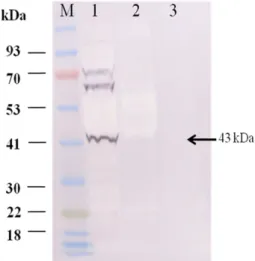
Expression of revibFlaB protein in insect Sf9 cells The FlaB gene (1134 bp) of Vibrio alginolyticus was cloned into the pGEM-T and pFastBac vector, which contains a six- histidine tag in the C-terminal region. After transfection into insect cells, plaque-purified revibFlaB baculovirus was iden- tified by CPE and RT-PCR (Figs. 1 and 2). The revibFlaB protein was identified with Western blotting using specific monoclonal antibodies against His
6, and the molecular weight was ~43 kDa (Fig. 3). The revibFlaB baculovirus revealing titer of 10
7.0TCID
50/mL in Sf9 cells was inactivated with 0.2% formaldehyde, and was added to the inactivated AKAV +BEFV vaccine.
Safety and immune response in animals
Mice and guinea pigs inoculated with the vaccines showed no clinical symptoms 14 days after inoculation. The sows and cattle immunized with one dose of the inactivated AKAV+BEFV vaccine IM showed no symptoms related to non-suppurative encephalitis of a viral infection in the period of observation. Figure 4 shows that the geometric mean VNA titers against AKAV were higher in mice and guinea pigs immunized with the inactivated AKAV+BEFV vaccine
Fig. 1. Identification of flagellin (FlaB) gene in recombinant vibrio flagellin (revibFlaB) baculocvirus. M, 1 kb DNA ladder;
lane 1, revibFlaB gene detected with baculovirus primer sets;
lane 2, normal Sf9 cells; lane 3, revibFlaB gene detected with primer sets for FlaB gene of Virio (V.) alginolyticus.
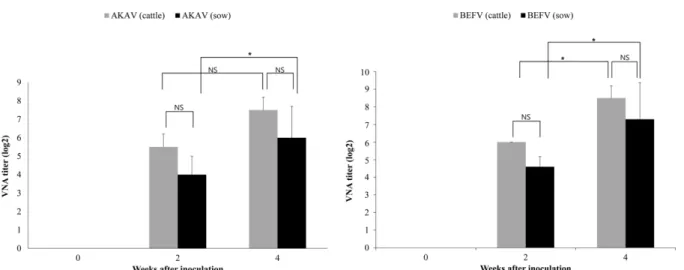
than in those animals inoculated with the vaccine containing revibFlaB protein. Based on the results of immunogenicity tests in mice and guinea pigs, the inactivated AKAV and BEFV vaccine without revibFlaB protein was selected for inoculation in sows and cattle. As shown in Figure 5, the sows and cattle inoculated with the inactivated AKAV+
BEFV vaccine induced high VNA titers against AKAV and BEFV, ranging from 1 : 64 and 1 : 512, and the geometric mean VNA titer was higher in cattle inoculated with the vac- cine than in sows. Moreover, after the second vaccination at day 14, the VNA titers of AKAV+BEFV were significantly increased in the vaccinated animals. These findings indicated that immunization with inactivated AKAV and BEFV vac- cine could induce high level of VNA titers in cattle.
Discussion
When vector-borne viral disease in Korean ruminants occurred, local veterinary authorities have reported the out- break to QIA in accordance with the regulations. Among the arboviral diseases, AKAV and BEFV infections have been reported in Korean cattle continuously (Table 2) and in many other countries, including Japan, China, and Taiwan [5, 21].
However, there has been no outbreak of AINV, CHUV, or IBAV infection in Korea since 2007.
In the present study, an inactivated AKAV and BEFV vac- cine was developed and evaluated for its safety and immuno- genicity in mice, guinea pigs, sows, and cattle inoculated IM.
Generally, as important factors inducing VNA responses in
Fig. 2. Cytopathic effect in insect cells inoculated with revib-FlaB baculovirus (A) and normal Sf-9 cells (B). Identification of revibFlaB baculocvirus using specific monoclonal antibodies against six-his6 (C) and normal insect cells as a control (D).
Magnification: 200× (A-D).
Fig. 3. Identification of the revibFlaB protein with Western blot- ting using specific monoclonal antibodies against six-his6 and the molecular weight was found to be approximately 43 kDa.
M, protein ladder; lane1, revibFlaB-infected cell lysate; lane 2, revibFlaB-infected cell culture supernatant; lane 3, mock-infected insect cell culture supernatant.
Fig. 4. Virus neutralizing antibody (VNA) titers of live Akabane virus (AKAV) and Bovine ephemeral fever virus (BEFV) vaccine, inactivated AKAV+BEFV vaccine with or without revibFlaB protein in mice and guinea pigs (GP). Data shown as expressed mean
± SD of six mice and four guinea pigs in each group. *p < 0.05. NS, not significant (one-way analysis of variance: ANOVA).
animals to vaccines, several factors such as viral strain, viral titer, kind of inactivated agent, and type of adjuvant should be considered [15]. The AKAV and BEFV strains isolated from cattle were propagated in BHK-21 cells, and viruses showing over titer of 10
7.0TCID
50/mL were used to prepare the inactivated vaccine. Generally, a high concentration of antigen in an inactivated vaccine makes the vaccine elicit higher VNA titers in animals.
Recently, it was reported that FlaB proteins in pathogenic bacteria cause signal transduction in mammalian cells via TLR5 and are considered a potent adjuvant for vaccines [9].
Lee et al. [9] reported that FlaB could also elicit strong anti- tumor activity. In addition, Montanide IMS has been used as a ready-to-dilute adjuvant for the production of veterinary vaccines [1, 6]. IMS1313VG does not need any special pro- cedure for manufacturing a vaccine, and can be blended with inactivated antigens.
Our results indicated that the inactivated AKAV+BEFV vaccine could induce high VNA against AKAV and BEFV in mice and guinea pigs, but the inactivated AKAV+BEFV vac- cine containing 10% revibFlaB protein and 10% IMS1313VG induced lower VNA titers in the experimental animals com- pared to the inactivated AKAV+BEFV vaccine containing 30% IMS1313VG. The first reason why the AKAV+BEFV vaccine containing revibFlaB protein induced low VNA titer may be the low percentage of IMS1313VG adjuvant. The adjuvant is recommended for vaccine at a ratio between 30 and 50% according to sensitivity of animal species and reac- tivity of the antigen. The second reason why the revibFlaB protein did not stimulate TLR5 properly in mice and guinea pigs may be the small amount of revibFlaB protein and the source of the FlaB protein, obtained from Vibrio alginolyti- cus. It was reported that a bacterial flagellin, Vibrio vulnifi- cus FlaB, when mixed with antigen and administered
Fig. 5. VNA titers of inactivated AKAV+BEFV vaccine containing 30% IMS1313VG in cattle and pigs. Data shown as expressed mean± SD of two cattle and three sows in each group. *p < 0.05.Table 2. Outbreak case of five vector-borne diseases in Korean cattle, 2002-2014
Year AKAV AINV CHUV IBAV BEFV
2002 8 −* − − 0
2003 2 2 13 0 1
2004 0 2 0 0 0
2005 2 3 1 0 0
2006 2 6 1 0 0
2007 4 0 0 0 1
2008 0 0 0 0 0
2009 1 0 0 0 0
2010 107 0 0 0 92
2011 2 0 0 0 1
2012 1 0 0 0 4
2013 0 0 0 0 8
2014 0 0 0 0 1
*not reported. AKAV, Akabane virus; AINV, Aino virus; CHUV, Chuzan virus; IBAV, Ibaraki virus; BEFV, Bovine ephemeral fever virus.
intranasally, exerted strong mucosal adjuvant activity, by stimulating TLR5 [2, 3]. The difference in origin of bacterial species may lead to different immune responses in animals.
In addition, the inactivated AKAV+BEFV vaccine was found to be safe, and induced high VNA titers, ranging from 1 : 64 to 1 : 512, against both AKAV and BEFV in sows and cattle.
The VNA titer in arboviral infection is related to protection against AKAV and BEFV, and a titer of > 1 : 2 in cattle has been considered to provide protective immunity [7].
In conclusion, the results of those trials demonstrated the ability of the inactivated AKAV+BEFV vaccine to be used in cattle with a high immunogenicity and good safety. Further studies of the efficacy and the duration of immunity in cattle and vibrio FlaB activity are necessary in the field trials.
Acknowledgments
This work was financially supported by a grant from QIA and Korean Institute of Planning & Evaluation for Technol- ogy (IPET) in Ministry of Agriculture, Food and Rural Affairs (MAFRA), Korea.
References
1. Bahnemann HG. Inactivation of viral antigens for vaccine preparation with particular reference to the application of binary ethylenimine. Vaccine 1990, 8, 299-303.
2. Hayashi F, Smith KD, Ozinsky A, Hawn TR, Yi EC, Goodlett DR, Eng JK, Akira S, Underhill DM, Aderem A. The innate immune response to bacterial flagellin is mediated by Toll-like receptor 5. Nature 2001, 410, 1099- 1103.
3. Hong SH, Byun YH, Nguyen CT, Kim SY, Seong BL, Park S, Woo GJ, Yoon Y, Koh JT, Fujihashi K, Rhee JH, Lee SE. Intranasal administration of a flagellin- adjuvanted inactivated influenza vaccine enhances mucosal immune responses to protect mice against lethal infection.
Vaccine 2012, 30, 466-474.
4. Hsieh YC, Chen SH, Chou CC, Ting LJ, Itakura C, Wang FI. Bovine ephemeral fever in Taiwan (2001–2002).
J Vet Med Sci 2005, 67, 411-416.
5. Kato T, Aizawa M, Takayoshi K, Kokuba T, Yanase T, Shirafuji H, Tsuda T, Yamakawa M. Phylogenetic relationships of the G gene sequence of bovine ephemeral fever virus isolated in Japan, Taiwan and Australia. Vet Microbiol 2009, 137, 217-223.
6. Kim YH, Kweon CH, Tark DS, Lim SI, Yang DK, Hyun BH, Song JY, Hur W, Park SC. Development of inactivated trivalent vaccine for the teratogenic Aino, Akabane and Chuzan viruses. Biologicals 2011, 39, 152- 157.
7. Kim YH, Oem JK, Lee EY, Lee KK, Kim SH, Lee MH, Park SC. Seroprevalence of five arboviruses in sentinel cattle as part of nationwide surveillance in South Korea, 2009-2012. J Vet Med Sci 2015, 77, 247-250.
8. Kurogi H, Akiba K, Inaba Y, Matumoto M. Isolation of Akabane virus from the biting midge Culicoides oxystoma in Japan. Vet Microbiol 1987, 15, 243-8.
9. Lee SE, Kim SY, Jeong BC, Kim YR, Bae SJ, Ahn OS, Lee JJ, Song HC, Kim JM, Choy HE, Chung SS, Kweon MN, Rhee JH. A bacterial flagellin, Vibrio vulnificus FlaB, has a strong mucosal adjuvant activity to induce protective immunity. Infect Immun 2006, 74, 694-702.
10. Lim SI, Kweon CH, Tark DS, Kim SH, Yang DK. Sero- survey on Aino, Akabane, Chuzan, bovine ephemeral fever and Japanese encephalitis virus of cattle and swine in Korea. J Vet Sci 2007, 8, 45-49.
11. Nichol ST, Beaty BJ, Elliott RM, Goldbach R, Plyusnin A, Schmaljohn CS, Tesh RB. Family Bunyaviridae. In:
Fauguet CM, Mayo MA, Maniloff J, Desselberger U, Ball LA (eds.). Virus Taxonomy. Eighth Report of International Committee on the Taxonomy of Viruses. pp. 695-716, Academic Press, San Diego, 2005.
12. Oem JK, Kim YH, Kim SH, Lee MH, Lee KK.
Serological characteristics of affected cattle during an outbreak of bovine enzootic encephalomyelitis caused by Akabane virus. Trop Anim Health Prod 2014, 46, 261-263.
13. Oem JK, Lee KH, Kim HR, Bae YC, Chung JY, Lee OS, Roh IS. Bovine epizootic encephalomyelitis caused by Akabane virus infection in Korea. J Comp Pathol 2012, 147, 101-105.
14. Oem JK, Yoon HJ, Kim HR, Roh IS, Lee KH, Lee OS, Bae YC. Genetic and pathogenic characterization of Akabane viruses isolated from cattle with encephalomyelitis in Korea. Vet Microbiol 2012, 158, 259-266.
15. Park JH. Requirements for improved vaccines against foot- and-mouth disease epidemics. Clin Exp Vaccine Res 2013, 2, 8-18.
16. Tonbak S, Berber E, Yoruk MD, Azkur AK, Pestil Z, Bulut H. A large-scale outbreak of bovine ephemeral fever in Turkey, 2012. J Vet Med Sci 2013, 75, 1511-1514.
17. Walker PJ. Bovine ephemeral fever in Australia and the world. Curr Top Microbiol Immunol 2005, 292, 57-80.
18. Wunner WH, Calisher CH, Dietzgen RG, Jackson AO, Kitajima EW, Lafon M, Leong JC, Nichol S, Peters D, Smith JS, Walker PJ. Rhabdoviridae. In: Murphy FA, Fauquet CM, Bishop DHL, Ghabrial SA, Jarvis AW, Martelli GP, Mayo MA, Summers MD (eds). Virus Taxonomy.
Classification and Nomenclature of Viruses. pp. 275-288, Springer-Verlag Wien, New York, 1995.
19. Yang DK, Kim BH, Kweon CH, Nah JJ, Kim HJ, Lee KW, Yang YJ, Mun KW. Serosurveillance for Japanese encephalitis, Akabane, and Aino viruses for Thoroughbred horses in Korea. J Vet Sci 2008, 9, 381-385.
20. Yang DK, Kim YH, Kim BH, Kweon CH, Yoon SS, Song JY, Lee SH. Characterization of Akabane virus (KV0505) from cattle in Korea. Korean J Vet Res 2008, 48, 61-66.
21. Zheng F, Qiu C. Phylogenetic relationships of the glycoprotein gene of bovine ephemeral fever virus isolated from mainland China, Taiwan, Japan, Turkey, Israel and Australia. Virol J 2012, 9, 268.