돼지농장 HACCP 평가항목의 중요도 및 점수 설정에 관한 연구*
1)
남 인 식
**A Study on Importance and Score Setting of HACCP Evaluation Items on Pig Farm
Nam, In-Sik
This study was conducted to improve the score of HACCP evaluation items in pig farm. The importance and score of each HACCP evaluation item was derived through the non-compliance rate and severity of hazard. The total score of evalua- tion items of the pre-requisite section was 200 points and the HACCP section was developed to have a total of 100 points. Implementation of the result of this study to pig farm may help to improve more safety and hygienic pig production. With the result of this study, it is expected that the propose of HACCP system implementation in pig farm will be achieved.
Key words : evaluation standard, HACCP, importance, swine farm
Ⅰ. 서 론
국내 축산농장의 친환경안전축산물인증제도는 크게 친환경축산물인증제도(무항생제, 유 기농)와 HACCP 인증제도 구분된다. 축산식품의 안전성을 확보하기 위하여 개발된 축산물 안전관리인증제도(Hazard Analysis and Critical Control Point, HACCP)의 개념은 축산식품의 생물학적 위해를 제거 또는 허용수준 이하로 낮추기 위한 목적으로 미국 Pillsbury사에서 처음 개발하였다(Adama, 1994). 이러한 HACCP 개념은 CODEX (Codex Alimentarius Com- mission)와 NACMCF (National Advisory Committee on Microbiological Criteria for Food)에 의
**
본 연구는 2015년 식품의약품안전처 연구비 지원으로 수행되었으며, 이에 감사드립니다.
**
한경대학교 고품질친환경축산물생산기술연구센터([email protected])
하여 더욱 발전하였으며(NACMCF, 1992; CODEX, 2001), CODEX의 권고에 따라 1998년 축 산물위생관리법이 개정되면서 국내 축산산업에서도 농림축산식품부(Ministry of Agriculture, Food and Rural Affairs, MAFRA)를 중심으로 HACCP 제도를 도입하게 되었다(MAFRA, 1997). 2007년부터 시작된 돼지농장 HACCP 제도는 농장 및 가축에 대한 병원성 세균 제어, 위생 ․ 안전성 향상, 생산성 향상, 농장 환경 개선, 항생제 등 동물용 의약품 사용 감소 등의 효과로 인하여 소비자에게 안전한 돈육을 제공하기 위한 기반조성에 많은 기여를 하였다 (Cho and Kang, 2009; Lee et al., 2011; Nam et al., 2014).
한편, 돼지농장 HACCP 제도의 평가기준 구성은 선행요건관리와 HACCP 관리 분야 평가 항목으로 나누어지는데 먼저 선행요건관리 분야의 평가항목은 차단방역관리 분야 8개, 농 장시설관리 분야 17개, 농장위생관리 분야 17개, 사료 ․ 동물용의약품 ․ 음수관리 분야 14개, 질병관리 분야 7개, 반입 및 출하관리 분야 7개 등 총 70개로 구성되어 있으며 HACCP 관 리 분야의 평가항목은 위해분석 분야 5개, 중요관리점(Critical Control Point, CCP) 분야 6개 그리고 검증 및 기록 분야 4개 등 총 15개로 구성되어 모두 85개 평가항목으로 구성되어 있다(KFDA, 2016).
현행 돼지농장 HACCP 평가방법은 각 평가항목별로 5점 만점을 부여하고 이를 토대로 5 점(농장 및 기록유지 양호), 3점(비 반복적인 실수 및 경미한 수준의 기록 미흡), 1점(농장 및 기록유지 미흡), 0점(HACCP 미이행 또는 법 위반) 등으로 구분하여 평가 점수를 부여는 체계를 구축하여 운영하고 있다. 평가결과 판단기준은 전체 평가항목 대비 만점의 85% 이 상 취득하면 ‘적합’, 70% 이상 85% 미만일 경우 ‘보완’, 70% 미만일 경우에는 ‘부적합’으로 판정한다(KFDA, 2016).
그러나 현행 평가항목의 점수 체계는 각 평가 항목별로 HACCP 운영 또는 HACCP 준비 에 대한 난이도, 안전하고 위생적인 돼지 생산에 미치는 영향 등이 다름에도 불구하고 모 든 평가항목에 5점씩 동일하게 부여하는 방법은 HACCP 제도의 목적에도 부정적인 영향을 미칠 가능성이 매우 크다고 할 수 있겠다. 본 연구는 현행 동일한 평가점수 체계를 활용하 여 HACCP을 심사하고 있는 돼지농장 HACCP 평가기준에 대한 중요도를 도출하고 이를 기초로 각 평가항목에 대한 차등적인 평가점수를 부여하여 돼지농장 HACCP 평가기준의 합리성을 높이는 방안을 제시하기 위한 목적으로 실시하였다.
Ⅱ. 재료 및 방법
1. 돼지농장 HACCP 평가항목별 중요도 수립 방법본 연구에서 돼지농장 HACCP 평가항목별 중요도 수립에 따라 차등 점수를 부여하기 위
한 방법으로 최근 3년간 HACCP 심사결과 지적사항 발생비율 분석 결과에 따른 점수부여 방법과 각 평가항목별 위해의 심각도 분석결과에 따른 점수부여 방법을 동시에 이용하여 중요도를 수립하고 점수를 차등 부여하였다.
1) 돼지농장 HACCP 심사결과 지적비율 분석
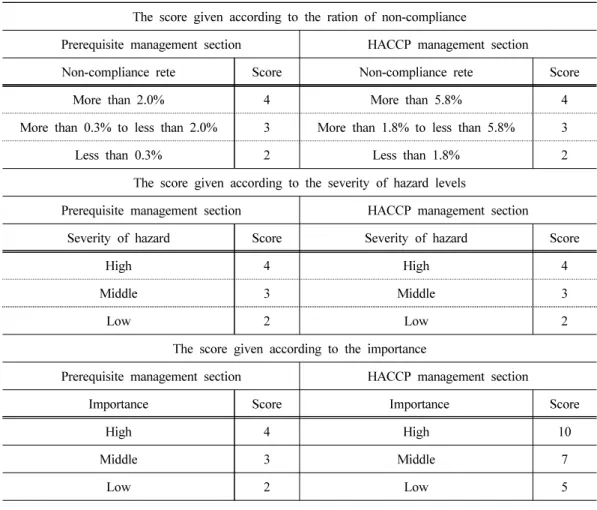
최근 3년간(2012년~2014년) 총 887건의 돼지농장을 심사한 결과 평가항목별로 발생한 선 행요건 평가항목 지적비율(3,321건)과 HACCP 관리 평가항목 지적비율(1,463건)을 분석하 였다(Table 1). 지적비율별로 분석한 결과에 따라, 선행요건 분야 평가항목은 발생비율 0.3
% 미만은 2점, 발생비율 0.3% 이상~2.0% 미만은 3점, 발생비율 2.0% 이상은 3점을 부여하 였다. HACCP 관리 분야 평가항목은 발생비율 1.8% 미만은 2점, 발생비율 1.8% 이상~5.8%
미만은 3점, 발생비율 5.8% 이상은 4점을 부여하였다(Table 2).
Table 1. Total number of non-compliance via pig farm HACCP audit for three years (2012- 2014)
Years Audited
farm numbers
Total number of non-compliance
Prerequisite management section HACCP management section
2012 252 761 402
2013 300 1,041 531
2014 335 1,519 530
Total 887 3,321 1,463
2) 돼지농장 HACCP 평가항목별 위해의 심각도 분석
돼지농장 HACCP 평가항목별 위해의 심각도 수준을 3단계(상, 중, 하)로 구분하여 분석 하였다. 이때 위해의 심각도 ‘상(4점)’은 해당 평가항목이 돼지 또는 인체에 미치는 영향이 안전성에 직접 관련된 경우와 시정조치에 많은 시간이 걸리는 경우, ‘중(3점)’은 해당 평가 항목이 돼지 및 인체에 미치는 영향이 안전성에 간접적으로 관련된 경우(위해정도가 상대 적으로 낮은 경우)와 시정조치에 많이 시간이 걸리는 경우, ‘하(2점)’는 해당 평가항목이 돼 지 및 인체에 미치는 영향이 안전성에 간접 관련된 경우와 즉시 시정이 가능한 경우로 각 평가항목별 위해의 심각도를 구분하여 나열하였다(Table 2).
Table 2. The method for giving scores according to the ration of non-compliance, severity of hazard levels and importance of each HACCP evaluation standard on pig farm
The score given according to the ration of non-compliance
Prerequisite management section HACCP management section
Non-compliance rete Score Non-compliance rete Score
More than 2.0% 4 More than 5.8% 4
More than 0.3% to less than 2.0% 3 More than 1.8% to less than 5.8% 3
Less than 0.3% 2 Less than 1.8% 2
The score given according to the severity of hazard levels
Prerequisite management section HACCP management section
Severity of hazard Score Severity of hazard Score
High 4 High 4
Middle 3 Middle 3
Low 2 Low 2
The score given according to the importance
Prerequisite management section HACCP management section
Importance Score Importance Score
High 4 High 10
Middle 3 Middle 7
Low 2 Low 5
3) 돼지농장 HACCP 평가항목별 중요도 및 점수 설정
지적비율 분석 및 위해심각도 분석 결과를 기초로 하여 각 평가항목의 중요도를 수립하 였다. 선행요건 분야의 경우에는 지적비율 분석결과와 위해의 심각도에 따른 결과를 합산 한 합계점수가 8~7점일 경우 중요도를 ‘상’으로 분류하고 4점을 부여하였으며, 합계점수가 6점은 ‘중’으로 분류하고 3점을 부여하였다. 합계점수가 5점 이하는 ‘하’로 분류하고 점수 를 2점을 부여 하였다. HACCP 관리 분야는 선행요건 분야보다 평가항목의 중요성이 강조 되므로 지적비율 분석결과와 위해의 심각도에 따른 결과를 합산한 합계점수가 8점일 경우 중요도를 ‘상’으로 분류하고 10점을 부여하였으며, 합계점수가 6~7점은 ‘중’으로 분류하고 7점을 부여하였다. 합계점수가 5점 이하는 ‘하’로 분류하고 점수를 5점을 부여하였다(Table 2). 돼지농장 HACCP 평가항목에 대한 총 점수는 300점으로 설정하였는데, 선행요건 분야 의 총 점수는 200점, HACCP 관리 분야는 100점으로 하였다.
Ⅲ. 결 과
1. 돼지농장 선행요건 분야 평가항목 지적비율, 위해의 심각도 결정 및 중요도 설정
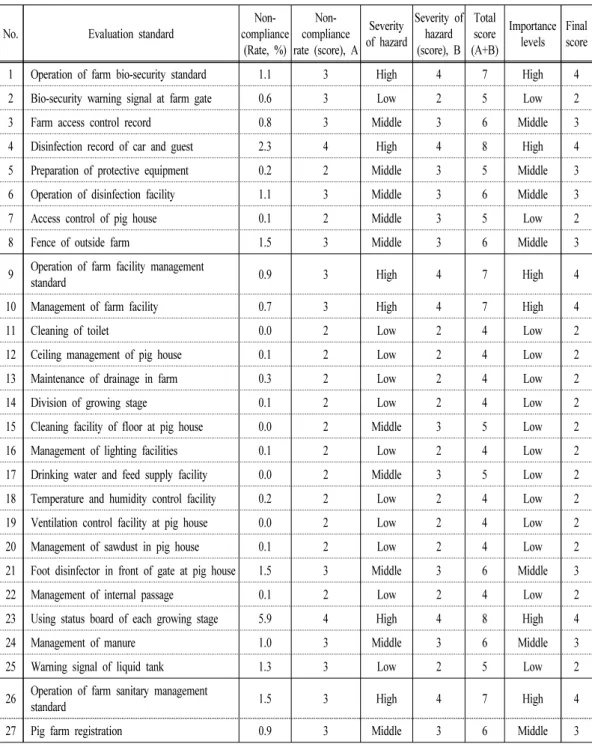
총 70개 평가항목으로 구성된 돼지농장 선행요건 분야에 대한 최근 3년간의 심사결과에 따른 지적비율과 위해의 심각도 분석을 통하여 각 평가항목별 중요도를 수립하였으며 이 에 따른 점수를 부여하였다(Table 3). 최근 3년간 지적비율이 2% 이상 높은 평가항목은 4번 (2.3%), 23번(5.9%), 28번(2.4%), 38번(9.1%), 40번(3.2%), 42번(4.2%), 47번(2.0%), 51번(7.7%), 52번(4.9%), 55번(8.9%), 59번(2.2)인 것으로 나타났다. 따라서 해당 평가항목은 각각 4점을 부여하였다. 지적비율이 0.3% 이상 2.0% 미만인 평가항목은 모두 3점을 부여하였는데, 관 련 평가항목은 1번(1.1%), 2번(0.6%), 3번(0.8%), 6번(1.1%), 8번(1.5%), 9번(0.9%), 10번(0.7
%), 21번(1.5%), 24번(1.0%), 25번(1.3%), 26번(1.5%), 27번(0.9%), 30번(0.6%), 32번(0.9%), 35 번(1.0%), 37번(1.3%), 43번(0.8%), 44번(1.0%), 46번(1.4%), 54번(0.6%), 57번(0.7%), 58번(1.5
%), 60번(1.0%), 62번(1.2%), 63번(0.8%), 64번(1.0%)으로 분석되었다. 나머지 평가항목의 지 적비율은 0.3% 미만으로 나타나 모두 2점을 부여하였다. 위해의 심각도 분석은 ‘해당 평가 항목이 돼지 또는 인체에 미치는 영향이 안전성에 직접 관련된 경우와 시정조치에 많은 시 간이 걸리는 경우’에 해당되는 평가항목을 분석한 결과 1번, 4번, 9번, 10번, 23번, 26번, 33 번, 34번, 38번, 39번, 43번, 44번, 51번, 52번, 55번, 57번, 64번, 70번인 것으로 나타났으며 관련 평가항목은 ‘상(4점)’을 부여하였다. 위해의 심각도 ‘하(2점)’를 부여 가능한 ‘해당 평 가항목이 돼지 및 인체에 미치는 영향이 안전성에 간접 관련된 경우와 즉시 시정이 가능한 경우’에 해당되는 평가항목은 2번, 11번, 12번, 13번, 14번, 16번, 18번, 19번, 20번, 22번, 25 번, 41번, 47번, 67번으로 나타났다. 아울러, 위해의 심각도 ‘중(3점)’ 부여는 ‘해당 평가항목 이 돼지 및 인체에 미치는 영향이 안전성에 간접적으로 관련된 경우(위해정도가 상대적으 로 낮은 경우)와 시정조치에 많이 시간이 걸리는 경우’는 총38개 평가항목이 해당되었다.
평가항목의 지적비율과 위해의 심각도를 통하여 중요도를 도출한 결과 중요도가 높은 평가항목은 1번, 4번, 9번, 10번, 23번, 26번, 33번, 34번, 38번, 39번, 43번, 44번, 51번, 52번, 55번, 57번, 64번으로 나타나 최종 점수를 각각 4점으로 부여하였다. 평가항목 중 33번, 34 번, 39번의 경우 지적비율이 낮아 최종 점수가 각각 6점으로 나왔으나 해당 평가항목이 중 요관리점(Critical Control Point, CCP)과의 연관성이 깊어 최종 중요도를 높음으로 상향 조절 하였다. 중요도가 ‘보통’에 해당되는 평가항목은 3번, 5번, 6번, 8번, 21번, 24번, 27번 28번, 30번, 32번, 35번, 37번, 40번, 42번, 46번, 47번, 48번, 50번, 53번, 54번, 58번, 59번, 60번, 62 번, 63번, 70번이었으며 최종 점수를 각각 3점으로 부여하였다. ‘보통’에 해당되는 평가항목 중 5번, 48번, 50번, 53번은 총 점수가 ‘낮음’에 해당되나 CCP와의 간접 연관성이 깊어 중 요도 및 최종점수를 ‘보통’으로 상향하였다. 나머지 평가항목은 ‘낮음’에 해당되므로 모두
2점씩 부여하였다. 따라서 총 70개 평가항목 중 4점은 17개(24.28%), 3점은 26개(37.15%) 그 리고 2점은 27개(38.57%)로 구성되었다.
Table 3. The result of importance levels and final score of each evaluation standard on pig farm (Prerequisite management section)
No. Evaluation standard
Non- compliance
(Rate, %)
Non- compliance rate (score), A
Severity of hazard
Severity of hazard (score), B
Total score (A+B)
Importance levels
Final score
1 Operation of farm bio-security standard 1.1 3 High 4 7 High 4
2 Bio-security warning signal at farm gate 0.6 3 Low 2 5 Low 2
3 Farm access control record 0.8 3 Middle 3 6 Middle 3
4 Disinfection record of car and guest 2.3 4 High 4 8 High 4
5 Preparation of protective equipment 0.2 2 Middle 3 5 Middle 3
6 Operation of disinfection facility 1.1 3 Middle 3 6 Middle 3
7 Access control of pig house 0.1 2 Middle 3 5 Low 2
8 Fence of outside farm 1.5 3 Middle 3 6 Middle 3
9 Operation of farm facility management
standard 0.9 3 High 4 7 High 4
10 Management of farm facility 0.7 3 High 4 7 High 4
11 Cleaning of toilet 0.0 2 Low 2 4 Low 2
12 Ceiling management of pig house 0.1 2 Low 2 4 Low 2
13 Maintenance of drainage in farm 0.3 2 Low 2 4 Low 2
14 Division of growing stage 0.1 2 Low 2 4 Low 2
15 Cleaning facility of floor at pig house 0.0 2 Middle 3 5 Low 2
16 Management of lighting facilities 0.1 2 Low 2 4 Low 2
17 Drinking water and feed supply facility 0.0 2 Middle 3 5 Low 2
18 Temperature and humidity control facility 0.2 2 Low 2 4 Low 2
19 Ventilation control facility at pig house 0.0 2 Low 2 4 Low 2
20 Management of sawdust in pig house 0.1 2 Low 2 4 Low 2
21 Foot disinfector in front of gate at pig house 1.5 3 Middle 3 6 Middle 3
22 Management of internal passage 0.1 2 Low 2 4 Low 2
23 Using status board of each growing stage 5.9 4 High 4 8 High 4
24 Management of manure 1.0 3 Middle 3 6 Middle 3
25 Warning signal of liquid tank 1.3 3 Low 2 5 Low 2
26 Operation of farm sanitary management
standard 1.5 3 High 4 7 High 4
27 Pig farm registration 0.9 3 Middle 3 6 Middle 3
No. Evaluation standard
Non- compliance
(Rate, %)
Non- compliance rate (score), A
Severity of hazard
Severity of hazard (score), B
Total score (A+B)
Importance levels
Final score
28 Farm recording book 2.4 4 High 2 6 Middle 3
29 Cleanliness management of tools 0.0 2 Middle 3 5 Low 2
30 Control standard manual of each growing stage 0.6 3 High 3 6 Middle 3
31 Management of pig density 0.0 2 Middle 3 5 Low 2
32 Disposal manual of used needles 0.9 3 Middle 3 6 Middle 3
33 Residual confirmation of needles 0.2 2 High 4 6 High 4
34 Management of needle residual pig 0.0 2 High 4 6 High 4
35 Precess manual of dead pig 1.0 3 Middle 3 6 Middle 3
36 Feces and urine control facility in pig house 0.2 2 Middle 3 5 Low 2
37 Rodent and vermin control 1.3 3 Middle 3 6 Middle 3
38 Salmonella spp test 9.1 4 High 4 8 High 4
39 Non-antibiotic feed supply before shipment 0.2 2 High 4 6 High 4
40 Recording card of female pig 3.2 4 High 2 6 Middle 3
41 Hygiene management of casting equipment etc. 0.3 2 Low 2 4 Low 2
42 Education of sanitation and bio-security 4.2 4 Middle 2 6 Middle 3 43 Operation of feed, medicine and water
management standard 0.8 3 High 4 7 High 4
44 Obey of antibiotic residual time in pig 1.0 3 High 4 7 High 4
45 Supplying HACCP certified feed 0.2 2 Middle 3 5 Low 2
46 Carry in management of feed 1.4 3 Middle 3 6 Middle 3
47 Feed inspection report sheet 2.0 4 Low 2 6 Middle 3
48 Cleanliness of feed storage place 0.2 2 Middle 3 5 Middle 3
49 Management of feed supply facility 0.2 2 Middle 3 5 Low 2
50 Cleanliness of feed bean and feed supply
facility 0.2 2 Middle 3 5 Middle 3
51 Recording antibiotic residual time of all pig 7.7 4 High 4 8 High 4 52 Carry in and shipment control of animal
medicine 4.9 4 High 4 8 High 4
53 Post-use management of animal medicine 0.2 2 Middle 3 5 Middle 3
54 Management of expiration date (animal
medicine) 0.6 3 Middle 3 6 Middle 3
55 Test of drinking water in regular time 8.9 4 High 4 8 High 4
56 Cleanliness of water supply facility 0.0 2 Middle 3 5 Low 2
57 Operation of disease management standard 0.7 3 High 4 7 High 4
2. 돼지농장 HACCP 분야 평가항목 지적비율, 위해의 심각도 결정 및 중요도 설정
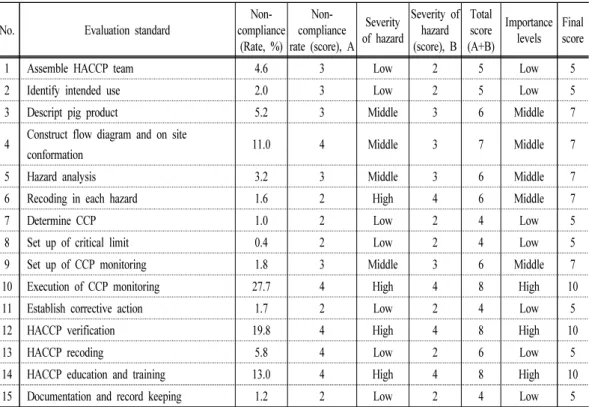
Table 4는 돼지농장 HACCP 분야 평가항목에 대한 최근 3년간 지적비율, 위해의 심각도 를 기초로 중요도 및 최종 평가점수를 도출한 결과를 나타내었다. HACCP 평가항목 중 지 적비율이 4점에 해당되는 평가항목은 4번, 10번, 12번, 13번, 14번으로 분석되었다. 지적비 율 결과 3점에 해당되는 평가항목은 1번, 2번, 3번, 5번, 9번으로 나타났으며, 2점은 6번, 7 번, 8번, 11번, 15번이었다. 위해의 심각도는 ‘높음’에 해당되는 6번, 10번, 12번, 14번에 각 각 4점을 부여하였으며 ‘보통’에 해당되는 3번, 4번, 5번, 9번을 3점을 부여하였다. ‘낮음’으 로 2점에 해당되는 평가항목은 1번, 2번, 7번, 8번, 11번, 13번, 15번이었다. 위의 결과를 기 초로 평가항목별 중요도와 최종 점수를 부여하였는데 중요도가 ‘낮음’ 및 최종점수가 5점 에 해당되는 평가항목은 1번, 2번, 7번, 8번, 11번, 15번으로 나타났다. 13번의 경우 지적 비 율 점수에서 4점, 위해의 심각도에서 2점(낮음)으로 나타나 최종 점수가 6점이 되었으나 중 요도가 낮아 최종 점수를 5점으로 분류하였다. 중요도가 ‘보통’ 및 최종점수가 7점에 해당 되는 평가항목은 3번, 4번, 5번, 6번, 9번으로 나타났다. 중요도가 ‘높음’ 및 최종점수가 10 점에 해당되는 평가항목은 10번, 12번, 14번이었다. 15개 HACCP 관리 분야 평가항목 중 중 요도 ‘높음’에 해당되는 평가항목 비율은 20.00%이며, ‘보통’은 33.33% 그리고 ‘낮음’은 46.67%로 나타났다.
No. Evaluation standard
Non- compliance
(Rate, %)
Non- compliance rate (score), A
Severity of hazard
Severity of hazard (score), B
Total score (A+B)
Importance levels
Final score
58 Keep the paper of semen examination 1.5 3 Middle 3 6 Middle 3
59 Isolate of sick pig 2.2 4 Middle 2 6 Middle 3
60 Disease control and prevention program 1.0 3 Middle 3 6 Middle 3
61 Consultation by veterinarian in regular time 0.0 2 Middle 3 5 Low 2
62 Clinical observation and record keeping 1.2 3 Middle 3 6 Middle 3
63 Worm control 0.8 3 Middle 3 6 Middle 3
64 Operation of carry in and shipment
management standard 1.0 3 High 4 7 High 4
65 Record keeping group of imported pig 0.5 2 Middle 3 5 Low 2
66 Isolation of imported pig 0.5 2 Middle 3 5 Low 2
67 Standard of die out pig 0.1 2 Low 2 4 Low 2
68 All in all out of pig 0.0 2 Middle 3 5 Low 2
69 Pig house management after shipment 0.1 2 Middle 3 5 Low 2
70 Pig shipment and recording book 0.4 2 High 4 6 Middle 3
Table 4. The result of importance levels and final score of each evaluation standard on pig farm (HACCP management section)
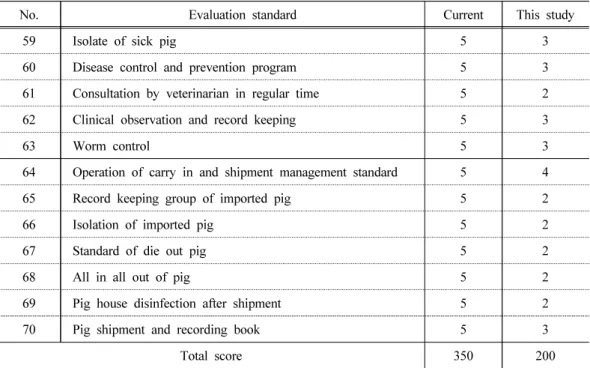
3. 현행 돼지농장 선행요건 및 HACCP 분야 평가항목 점수와 비교
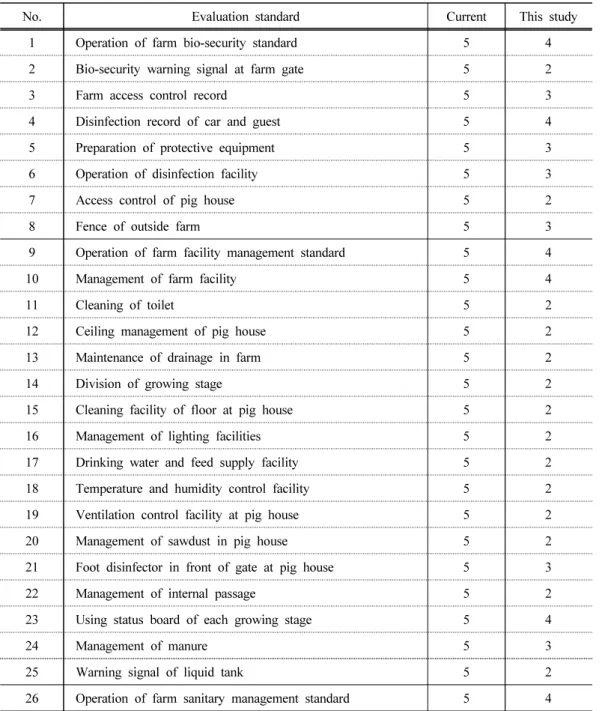
현행 돼지농장 HACCP 심사에 이용하고 있는 평가항목별 점수(선행요건 분야, HACCP 관리 분야)와 본 연구를 통하여 도출된 평가항목별 점수를 비교하였다(Table 5, Table 6). 현 행 돼지농장 평가항목은 심사 결과에 따라 최고 5점을 시작으로 3점, 1점을 거쳐 최저 0점 을 부여하는 체계를 갖추고 있다. 그러나 모든 평가항목은 관리 및 운영의 난이도 또는 CCP에 직 ․ 간접적으로 미치는 영향이 다르므로 차별화된 중요도의 도출이 필요하다. 본 연 구결과에 따르면, 선행요건 평가항목의 점수체계를 중요도에 따라 4점, 3점, 2점 체계를 구 축하여 모든 평가항목에 해당 점수를 부여하였다(Table 5). HACCP 관리 분야 평가항목의 중요도는 선행요건보다 크므로 최고점수 10을 시작으로 7점, 5점 형태로 차등 부여하였다.
특히, CCP모니터링, HACCP 검증, 그리고 HACCP 교육에 대한 평가항목은 다른 평가항목 대비 중요성을 강조하여 현행 해당 평가기준의 점수 대비 100% 증가하게 되었다. 아울러 가축설명서 작성(3번), 농장평면도 및 사양관리절차도(4번), 위해분석(5번), 위해관리(6번), CCP 모니터링(9번) 등도 기존 최고 점수 대비 각각 2점씩 높여 중요성을 강조하였다(Table
No. Evaluation standard
Non- compliance
(Rate, %)
Non- compliance rate (score), A
Severity of hazard
Severity of hazard (score), B
Total score (A+B)
Importance levels
Final score
1 Assemble HACCP team 4.6 3 Low 2 5 Low 5
2 Identify intended use 2.0 3 Low 2 5 Low 5
3 Descript pig product 5.2 3 Middle 3 6 Middle 7
4 Construct flow diagram and on site
conformation 11.0 4 Middle 3 7 Middle 7
5 Hazard analysis 3.2 3 Middle 3 6 Middle 7
6 Recoding in each hazard 1.6 2 High 4 6 Middle 7
7 Determine CCP 1.0 2 Low 2 4 Low 5
8 Set up of critical limit 0.4 2 Low 2 4 Low 5
9 Set up of CCP monitoring 1.8 3 Middle 3 6 Middle 7
10 Execution of CCP monitoring 27.7 4 High 4 8 High 10
11 Establish corrective action 1.7 2 Low 2 4 Low 5
12 HACCP verification 19.8 4 High 4 8 High 10
13 HACCP recoding 5.8 4 Low 2 6 Low 5
14 HACCP education and training 13.0 4 High 4 8 High 10
15 Documentation and record keeping 1.2 2 Low 2 4 Low 5
6). 기존의 선행요건 분야 평가항목의 총 점수는 350점 만점이었으나 본 연구에서는 총 점 수를 200점으로 낮추었으며 반대로 HACCP 관리 분야는 현행 75점 만점에서 100점으로 증 가시켜 HACCP 관리 분야 평가항목의 중요성을 향상시켰다.
Table 5. Comparison between the score resulted from this study and currently using prerequisite evaluation standard on pig farm
No. Evaluation standard Current This study
1 Operation of farm bio-security standard 5 4
2 Bio-security warning signal at farm gate 5 2
3 Farm access control record 5 3
4 Disinfection record of car and guest 5 4
5 Preparation of protective equipment 5 3
6 Operation of disinfection facility 5 3
7 Access control of pig house 5 2
8 Fence of outside farm 5 3
9 Operation of farm facility management standard 5 4
10 Management of farm facility 5 4
11 Cleaning of toilet 5 2
12 Ceiling management of pig house 5 2
13 Maintenance of drainage in farm 5 2
14 Division of growing stage 5 2
15 Cleaning facility of floor at pig house 5 2
16 Management of lighting facilities 5 2
17 Drinking water and feed supply facility 5 2
18 Temperature and humidity control facility 5 2
19 Ventilation control facility at pig house 5 2
20 Management of sawdust in pig house 5 2
21 Foot disinfector in front of gate at pig house 5 3
22 Management of internal passage 5 2
23 Using status board of each growing stage 5 4
24 Management of manure 5 3
25 Warning signal of liquid tank 5 2
26 Operation of farm sanitary management standard 5 4
No. Evaluation standard Current This study
27 Pig farm registration 5 3
28 Farm recording book 5 3
29 Cleanliness management of tools 5 2
30 Control standard manual of each growing stage 5 3
31 Management of pig density 5 2
32 Disposal manual of used needles 5 3
33 Residual confirmation of needles 5 4
34 Management of needle residual pig 5 4
35 Precess manual of dead pig 5 3
36 Feces and urine control facility in pig house 5 2
37 Rodent and vermin control 5 3
38 Salmonella spp test 5 4
39 Non-antibiotic feed supply before shipment 5 4
40 Recording card of female pig 5 3
41 Hygiene management of casting equipment etc. 5 2
42 Education of sanitation and bio-security 5 3
43 Operation of feed, medicine and water management standard 5 4
44 Obey of antibiotic residual time in pig 5 4
45 Supplying HACCP certified feed 5 2
46 Carry in management of feed 5 3
47 Feed inspection report sheet 5 3
48 Cleanliness of feed storage place 5 3
49 Management of feed supply facility 5 2
50 Cleanliness of feed bean and feed supply facility 5 3
51 Recording antibiotic residual time of all pig 5 4
52 Carry in and shipment control of animal medicine 5 4
53 Post-use management of animal medicine 5 3
54 Management of expiration date (animal medicine) 5 3
55 Test of drinking water in regular time 5 4
56 Cleanliness of water supply facility 5 2
57 Operation of disease management standard 5 4
58 Keep the paper of semen examination 5 3
Table 6. Comparison between the score resulted from this study and currently using HACCP evaluation standard on pig farm
No. Evaluation standard Current This study
1 Assemble HACCP team 5 5
2 Identify intended use 5 5
3 Descript pig product 5 7
4 Construct flow diagram and on site conformation 5 7
5 Hazard analysis 5 7
6 Recoding in each hazard 5 7
7 Determine CCP 5 5
8 Set up of critical limit 5 5
9 Set up of CCP monitoring 5 7
10 Execution of CCP monitoring 5 10
11 Establish corrective action 5 5
12 HACCP verification 5 10
13 HACCP recoding 5 5
14 HACCP education and training 5 10
15 Documentation and record keeping 5 5
Total score 75 100
No. Evaluation standard Current This study
59 Isolate of sick pig 5 3
60 Disease control and prevention program 5 3
61 Consultation by veterinarian in regular time 5 2
62 Clinical observation and record keeping 5 3
63 Worm control 5 3
64 Operation of carry in and shipment management standard 5 4
65 Record keeping group of imported pig 5 2
66 Isolation of imported pig 5 2
67 Standard of die out pig 5 2
68 All in all out of pig 5 2
69 Pig house disinfection after shipment 5 2
70 Pig shipment and recording book 5 3
Total score 350 200
Ⅳ. 고 찰
돼지농장의 연도별 HACCP 적용 현황을 보면 2007년 49개, 2008년 96개, 2009년 115개, 2010년 115개, 2011년 141개, 2012년 246개, 2013년 287개, 2014년 203개, 2015년 229개 등 총 1,481개 농장에서 HACCP 제도를 운영하는 것으로 보고되어 전체 전업농 기준 2,943개 돼지농장 대비 50.32%의 HACCP 인증비율을 보이고 있다(Korea Livestock Products HACCP Accreditation Service, 2015). 이와 같이 지속적으로 증가하던 돼지농장 HACCP 인증비율은 2013년을 기점으로 둔화되고 있는 것으로 보여진다. HACCP 인증 비율이 감소하는 이유는 평가항목 수가 많고, 일부 객관성이 결여된 심사 결과와 평가항목의 중요도가 동일하기 때 문인 것으로 판단된다. 이러한 이유로 국내 식품분야 HACCP 평가기준이나 미국의 농장 GAP 평가기준은 각 평가항목별로 중요도 설정하고 이를 기초로 평가항목별로 점수를 차 등화 하여 심사에 활용하고 있다(FDA, 2014; KFDA, 2016). 돼지농장의 HACCP 제도를 더 욱 활성화시키기 위해서는 합리적이고 객관적인 항목별 평가점수를 개발하는 것이 필요하 다. 본 연구를 통하여 수립된 평가항목별 점수부여 방법을 현장에 도입할 경우 보다 안정 적이고 객관적인 심사를 통하여 HACCP 제도 도입의 목적을 달성하는데 큰 효과를 가져다 줄 것으로 판단된다. 아울러 평가점수별 세부기준 마련이 꼭 필요하다. 세부기준이 없을 경 우 심사자의 주관에 따라 평가 점수가 확정되는 오류가 발생할 가능성이 크다. 이에, 돼지 농장 HACCP에 사용되는 평가항목에 대한 객관성을 더욱 확보하기 위해서는 각 평가점수 별 세부기준 수립에 대한 연구가 필요하다.
Ⅴ. 적 요
본 연구는 친환경안전축산물 생산에 기반이 되는 돼지농장의 HACCP 평가항목별 점수부 여 체계의 문제점에 대한 개선방안 도출하여 보다 안전하고 위생적인 돼지 생산에 기초자 료로 활용을 제안하기 위한 목적으로 실시하였다. 현행 돼지농장 HACCP 평가항목은 중요 도의 구분 없이 동일한 점수(5점)를 부여하고 있으나 본 연구에서는 최근 3년간 지적비율, 위해의 심각도 등을 고려하여 평가항목별로 중요도를 도출하였고 그 결과에 따라 평가항 목의 점수를 차등 부여하도록 하였다. 돼지농장의 선행요건 평가항목(70개)은 중요도에 따 라 최대 4점에서 최소 2점의 점수체계를 구축하여 총 점수가 200점이 되도록 하였으며, HACCP 관리 분야 평가항목(15개)은 최대 10점에서 최소 5점 체계를 구축하여 총 점수가 100점이 되도록 개발하였다. 본 연구결과를 현장에 적용할 경우 보다 안전하고 위생적인 돼지의 생산이 가능하여 돼지농장 HACCP 도입의 목적을 보다 효과적으로 달성할 수 있을 것으로 판단된다.
[Submitted, January. 13, 2017 ; Revised, February. 5, 2017 ; Accepted, February. 9, 2017]
References
1. Cho, J. J., S. H. Back, D. G. Lim, S. L. Pyo, W. C. Lee, and I. S. Nam. 2010. Effects of HACCP system implementation on medicine use and productivity of swine farms in Korea.
Korean J. Food Sci. Ani. Resour. 30: 392-396.
2. Cho, K. H. and H. J. Kang. 2009. Production characteristics of HACCP hog farms and its police implications. Korean J. Agri. Manage. and Poli. 36: 610-629.
3. Codex Alimentarius Commission. 2001. Food hygiene basic programs. 3rd. Bernan Associa- tion. Lanham, MD.
4. KFDA. 2016. HACCP evaluation standard of food and livestock products, Ministry of Korea Food and Drug Safety. Notification number 2016-30. Sejong.
5. Korea Livestock Products HACCP Accreditation Service. 2015. Statistics of HACCP imple- mented animal farms. Korea Livestock Products HACCP Accreditation Service. Anyang.
6. Lee, G. Y., Y. J. Lee, S. H. Back, I. J. Hwang, K. S. Lee, Y. S. Kim, B. H. Kim, H. S.
Kim, S. C. Kang, J. J. Cho, M. S. Park, H. J. Suk, and I. S. Nam. 2011. Study on the management level of pathogenic bacteria in HACCP system implemented animal farms. J.
Anim. Sci. and Tech. 53: 67-74.
7. MACMCF. 1992. Hazard analysis and critical control point system. Int. J. Food Microbial.
16: 1-23.
8. MAFRA. 1997. Livestock products sanitary control act. Ministry of Agriculture, Food and Rural affairs. Sejong.
9. Nam, I. S., H. K. Kwak, S. I. Pyo, I. J. Hwang, H. S. Kim, K. S. Lee, H. S. Kim, C. G.
Kang, D. K. Lim, and J. J. Cho. 2008. Productivity analysis of HACCP applied pig farms.
Kor. J. Vet. Publ. Heal. 32: 141-144.
10. Nam, I. S., H. S. Kim, K. M. Seo, and J. H. Ahn. 2014. Analysis of HACCP system implementation on productivity, advantage and disadvantage of laying hen farm in Korea.
Korean J. Poultry Sci. 41: 93-98.
11. NAS. 1985. An evaluation of the role of microbiological criteria for foods and food ingredients. National Academy Press.
12. USDA. 2014. Good agriculture practices good handling practices audit verification checklist.
Version 1.2. Washington.