강화형 복합레진과 수종의 치과용 합금간의 전단결합강도에 관한 연구
단국대학교 치과대학 치과보철학교실 김 정 희 조 인 호․
A Study on the Shear Bond Strength of the Reinforced Com posite Resin to Dental Alloys
Kim, Jung-Hee, Jo, In-Ho
Department of Prosthodontics, Graduate School, Dankook University
The reinforced composte resin as the esthetic operative material continuously has been studied because the porcelain fused metal prosthesis is widely used for its excellent esthetics, rigidity and marginal integrity, but it has low fracture resistance against the tensile strength and stress, attrition of the opposite teeth. The reinforced composite resin is well adapt with the dental alloy but it is low the shear bond strength with the dental alloy vs the porcelain fused metal prosthesis, and then has been studied continuously.
The purpose of the study was to examine how metal was the higher shear bond strength among the dental alloy was used to the reinforced composite resin and to find the effect that the particle size of sandblasting influenced the shear bond strength. We built up the reinforced composite resin with 4 mm in diameter, 3 mm in height on circular alloy with 5 mm in diameter, 2 mm in height. Type II gold, type IV gold, and Ag-Pd alloy was used as alloys and 50 μ m, 110 m, 250 m of the particle size was sandblasted at each alloy in bonding between alloy and resin. We made 90
μ μ
secimens of 10 per each group and we measured the shear bond strength using the Instron(M100EC Ⓡ , Mecmesin Co., England).
The obtained results were as follows :
1. In comparison among each alloys, Ag-Pd alloy had the highest shear bond strength and the shear bond strength was decreased significantly in the sequence of the type II gold and type IV gold(P<0.001).
2. In comparison according to the size of sandblasting particle,
In Ag-Pd alloy, shear bond strength was decreased in the sequence of 110 μ m, 250 μ m, 50 μ m and there were
①
significant difference in all the group. (P<0.05)
In type II gold, it was decreased in the sequence of 250 μ m, 50 μ m, 110 μ m and there were significant
②
difference. (P<0.05)
In type IV gold, it was decreased in the sequence of 110 μ m, 50 μ m, 250 μ m. There were significant difference
③
between the group of 110 μ m and 50 μ m, the group of 110 μ m and 250, but there were no significant difference in the group of 50 μ m and 250 μ m.
3. The highest shear bond strength according to the size of sandblasting particle was 110 μ m in Ag-Pd alloy and type
IV gold, 250 μ m in type II gold.
Ⅰ 서. 론
과학과 기술이 나날이 발달함에 따라 치과에서도 기능회복과 함께 심미적 개선에 관한 관심이 집중 되고 있다 보철치료에서도 심미적 개선을 위해서. 가능한 자연치와 유사한 색조의 심미 수복재에 관 한 연구가 활발히 진행되고 있다.
년 가 최초로 금속 도재 수복물의 심 1709 Böttger -
미적인 특성을 이용하여 인공치아를 제조하려는 시 도이후 Brecker
1)
에 의해 도재를 금속에 전장시킨 도 재전장 주조관을 개발하여 계속가공의치로써 사용 되었으며 이것이 최근까지 널리 사용되어지고 있 다 도재 금속 보철술식이 금속의 견고성 및 변연적. - 합성과 더불어 우수한 도재의 심미성 때문에 오늘 날 광범위하게 사용되어져오고 있으나 도재는 대합 치를 마모시킬 수 있고 파절되기 쉬우며 미세 균열 이 발생하기 쉬운 단점이 있어서2)
최근에는 도재를 대체할 만한 심미 수복재에 대한 많은 연구가 이루 어지고 있다 이런 문제를 해결하기 위한 재료로 레. 진이 개발되었으며 초기 레진은 낮은 마모 저항뿐 아니라 취급성이 불량하였으나 최근에는 우수한 심 미성과 함께 자연치와 유사한 마모도를 가진 간접 복합레진이 개발되어 금속 레진 보철물에 대한 응- 용이 이루어지고 있는데 최근 개발된 Polyglass라 불리는 ceramic polymer는 도재와 복합레진의 새로 운 성분을 포함하여 물성과 심미성이 개선되어진 강화형 간접복합레진으로 분류될 수 있다 강화형. 간접복합레진은 무기질 충전재의 상당한 개선으로 열팽창과 중합수축은 감소하고 굴곡강도도 120 - 로 높으며 자연치와 유사한 마모도 좋은150 MPa ,
생체친화성 수리가 용이하고 치과에서 사용되는, 대부분의 합금과 친화력이 좋다는 장점이 있으며 색조안정성 심미성 등의 이유로 도재수복물을 대, 체할 수 있을만한 수복물로 예상되고 있다
3,4)
. 그러 나 레진과 합금간의 결합강도는 도재전장관에 비, 해 낮으므로 이를 극복하기위한 연구가 계속되고있다
5,6,7,8)
.최근까지 소개되어진 합금과 복합레진과의 결합방법은 크게 기계적인 방법과 화학적인 방 법으로 나눌 수 있다
9)
. 기계적인 방식으로는 납형 제작시 mesh pattern이나 금속표면에 loop, wire, 등의 기계적인 유지형태를 부여하는 방법 금bead ,
속의 표면을 산식각하는 방법 모래를 분사하여 기, 계적인 유지형태를 부여하는 방법등이 있다
10,11,12,13,14)
. 화학적인 방식으로는 4-META함유의 아크릴계 또는 인산 에스테르계 복합레진 접착제를 이용하는 방법과 금속의 표면에silicate층을 제공한 후 silane결합제를 적용하는 방식인 Silicoater 등이 있다 system(Kulzer Co., Wehrheim, Germany)
6,15)
. 최근에는 Sandblasting과 같은 기계적 유지력과금속 표면처리에 의한 화학적 유지력을 동시에 이 용하여 결합력을 증진시키려는 여러 방법이 소개되 고 있다. Artglass
Ⓡ
(Haraeus/Kulzer Co., Wehrheim,의 경우 을 개선한
Germany) Silicoator system Siloc 을 이용하고 있다 이러한 연구되어진 결합방
system .
법에 의해 제작하더라도 금속 레진 보철물의 큰 문- 제점으로써 계면의 결합소실과 하부 금속과의 결합 강도는 금속 도재 보철물보다 낮은 것으로 보고되- 어지는 바 계속된 연구가 필요하다
6), 7)
. Mukai등11)
은sandblasting이 복합레진과 금속의 결합에 미치는 효과에 대한 연구에서sandblasting이 표면적을 넓히강화형 복합레진과 수종의 치과용 합금간의 전단결합강도에 관한 연구
단국대학교 치과대학 치과보철학교실 김 정 희 조 인 호․
그래서 일반 치과용 합금과의veneering 재료로써도 그 가치를 비교해보며 각 종의 합금과의 결합강도 를 비교해보고 또sandblasting시 산화알루미늄의 입 자크기가 결합강도에 미치는 영향에 대해서 평가해 보고자 본 실험에서 간접복합레진과 치과용 합금간 의 결합강도를 비교 분석해보았다.
Ⅱ 실험재료 및 방법. 1. 실험재료
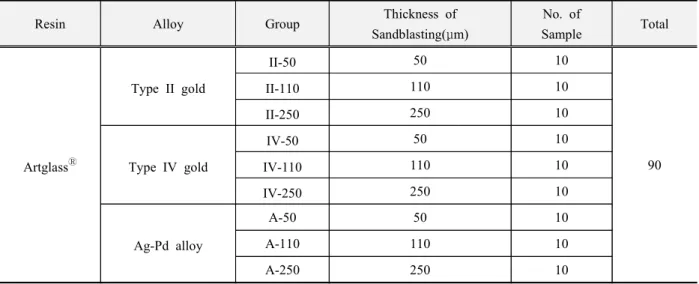
본 실험에서 금속 시편제작을 위한 합금으로써 type II gold(Au 76%, Pt 2%, Ag 12.5%), type IV gold(Au 53%, Pt 2%, Pd 3%, Ag 26%), Ag-Pd 가지 종류를 사용 alloy(Ag 69%, Pd 25%, Au 2%) 3
하였으며 간접복합레진은 Artglass
Ⓡ
(Heraeus/Kulzer 사용하였다Co., Wehrheim, Germany) .
2. 실험방법
합금과 전장재료의 결합 1)
가 금속 시편의 제작) (Fig.1)
직경 5mm, 두께 2mm의 실리콘 몰드(mold)를 이 용하여 원판형 납형(wax pattern)을 제작한 후 알파 덴트사 알파덴트( Co., Korea)의type II gold(Cast-2
Ⓡ
),Table 1. Classification of experimental groups
Resin Alloy Group Thickness of
Sandblasting( m) μ
No. of
Sample Total
Artglass
ⓇType II gold
II-50 50 10
90
II-110 110 10
II-250 250 10
Type IV gold
IV-50 50 10
IV-110 110 10
IV-250 250 10
Ag-Pd alloy
A-50 50 10
A-110 110 10
A-250 250 10
각의 합금을 매몰재인 Hi-Temp 2
Ⓡ
(Whip Mix Co., 에 진공매몰한 후 통법에 따라 용 Louisville, U.S.A.)융주조하여 금속 시편을 제작하였고 주조된 합금, 의 표면을 평평하게 유지하기 위해 주수하에 연마지를 이용하여 번까지 순 Silicone carbide #1000
차적으로 연마한 후 초음파 세척기에서 10분간 세 척하였다 초음파 세척후 복합레진과 도재가 버니. 어링(veneering)될 금속시편의 표면에 수직으로 1
전방에서 초간 의 압력으로 각각
cm 10 3bar 50 μm,
의 산화알루미늄으로
110 μm, 210 μm sandblasting 을 시행하여 각군당 10개씩 시편을 제작하였다 (Table 1).
Fig. 1. Schematic illustration of experimental specimen
Resin Resin Resin Alloy Alloy Alloy
3 mm 3 mm 2 mm 2 mm 4 mm 4 mm
5 mm 5 mm
나 복합레진 축성)
표면 처리된 금속시편에 직경 4 mm, 두께 3 mm 인 투명한 실리콘 몰드를 이용하여dentin레진을 축 성한 후 광중합시켰다 축성 및 중합과정은 제조사. 의 방법에 따라 금속시편의 표면을 붓으로 잘 닦고 를 도포한 후 최소 분 동안 자연 건조시키 siloc-pre 2
고siloc tray에 위치시킨 후siloc unit안에 위치시켰 다 그 과정 후 실온에서 분간 냉각시킨 후. 4 siloc 를 고르게 도포하고 최소 분 동안 자연 건조
bond 5
시키고 Artglass opaque를 도포한 후 광중합 unit인
에서 의 광도로 초간 중합시
Uni XS 450 - 500 nm 90
켰다. 그 후 투명한 실리콘 몰드를 이용하여 을 축성한 후 에서 초간 중 Artglass dentin Uni XS 180 합시켰다.
전단결합강도 측정 2)
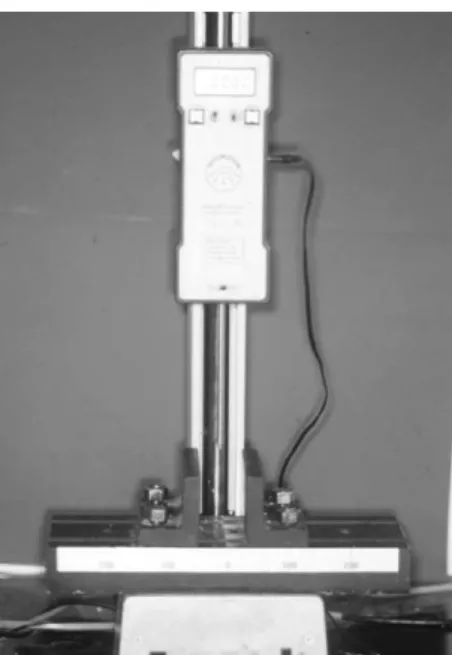
전단결합강도의 측정이 용이하도록 시편의 합금 부분만 복합레진내에 잠기도록 한 후 전단결합강도 측정시 하중이 정확히 가하여 질 수 있도록 복합레 진이 경화되기 전에 다듬어서 레진 블록과 합금면 이 평면이 되게 하였다 전단결합강도는 만능강도. 시험기(Instron M100EC
Ⓡ
, Mecmesin Co., England)로 측정하였다 하중속도는. 2 mm/min으로 하였으며 합금과 간접복합레진과의 분리가 일어나는 단위면 적으로 환산하였다(Fig. 2). 합금의 종류와 sand-시의
blasting Al
2
O3
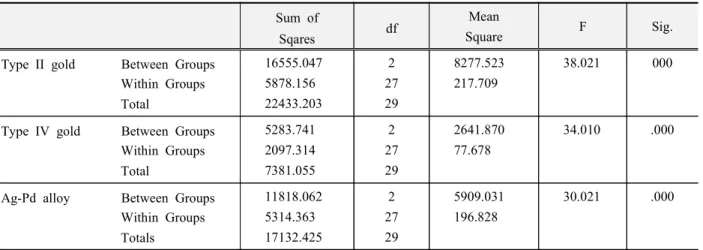
의 두께가 전단결합강도에 미치 는 영향을 알아보기 위해 one way ANOVA 와를 시행하였다 Sheffe's multiple range test .
Table 2. Mean, standard deviation(SD) according to each group.
Group No. Min. Max. Mean SD
II-50 10 212.82 185.51 146.42 19.65
II-110 10 102.71 135.35 119.17 10.91
II-250 10 157.64 195.86 176.69 12.16
IV-50 10 86.78 118.63 103.18 11.55
IV-110 10 114.65 138.09 128.07 7.48
IV-250 10 85.06 106.69 97.51 6.60
A-50 10 143.31 197.71 168.23 18.24
A-110 10 196.66 234.08 216.08 12.70
A-250 10 172.77 199.84 184.71 9.84
Fig. 2. Assembly used to measure shear bond strength
Alloy Artglass
Acrylicresin
shearing load
Ⅲ 실험 결과.
가장 높은 전단결합강도를 보인 금속은 Ag-Pd 와의 결합군이었으며 그중에서도 에서 평
alloy 110μ
균 216.08 kg/cm
2
, 250μ에서 184.71 kg/cm2
, 50μ에 서 168.23 kg/cm2
의 전단결합강도를 나타내었으며, 그다음은 type II gold 결합군으로써 250μ에서 176.69 kg/cm2,
, 50μ에서 146.42 kg/cm2
, 110μ에서 119.17 kg/cm2
을 보였으며, type IV gold에서는 110μ에서 128.07 kg/cm
2
, 50μ에서 103.18 kg/cm2
, 250μ 에서 97.52 kg/cm2
로써 가장 낮은 전단결합강도를 나타내었다(Fig. 3).각 금속의 평균은 type IV gold가 109.59 kg/cm
2
,type II gold가 147.42 kg/cm
2
, Ag-Pd alloy군에서 189.51 kg/cm2
로써 각 군 모두 유의하게 차이가 있 었으며 type IV gold-type II gold-Ag-Pd alloy순으로 강도가 증가하였다(Table 2-8).Sum of
Sqares df Mean
Square F Sig.
Type II gold Between Groups Within Groups Total
16555.047 5878.156 22433.203
2 27 29
8277.523 217.709
38.021 000
Type IV gold Between Groups Within Groups Total
5283.741 2097.314 7381.055
2 27 29
2641.870 77.678
34.010 .000
Ag-Pd alloy Between Groups Within Groups Totals
11818.062 5314.363 17132.425
2 27 29
5909.031 196.828
30.021 .000
Table 4. Results of Scheffe's multiple range test(Unit : kg/cm
2) Particle Size of
Sandblasting
Particle Size of
Sandblasting Sig.
95% Confidence Interval Lower Bound
Type II-gold
50 110
250
.001 .000
10.1583 -47.3567
110 50
250
.001 .000
-44.3397 -74.6057
250 50
110
.000 .000
13.1753 40.4243
Type IV-gold
50 110
250
.000 .368
-35.0907 -4.5327
110 50
250
.000 .000
14.6733 20.3493
250 50
110
.368 .000
-15.8847 -40.7667
Ag-Pd alloy
50 110
250
.000 .046
-64.1014 -32.7314
110 50
250
.000 .000
31.6006 15.1196
250 50
110
.046 .000
.2306
-47.6204
Table 5. Results of multiple range test for shear bond strength according to types of alloy Type IV gold
(109.59±8.54)
Type II gold (147.43±14.24)
Ag-Pd alloy (189.67±13.59) Type IV gold
Type II gold Ag-Pd alloy
*
* *
*Denotes pair of alloy significantly different at the 0.05 level
Table 6. Results of multiple range test for shear bond strength between each groups according to particle size of sandblasting on the type II gold
110 μ m (119.17±10.91)
50 μ m (146.42±19.65)
250 μ m (176.69±12.16) 110 μ m
50 μ m 250 μ m
*
* *
*Denotes pair of groups significantly different at the 0.05 level
Table 7. Results of multiple range test for shear bond strength between each groups according to particle size of sandblasting on the type IV gold
250 μ m (97.51±6.60)
50 μ m (103.18±11.55)
110 μ m (128.07±7.48) 250 μ m
50 μ m 110 μ m
-
* *
*Denotes pair of groups significantly different at the 0.05 level
Fig. 3. Graph of the mean of shear bond strength
0 50 100 150 200 250
s h e a r b o n d s tr e n g th (k g /c m
2)
TypeIV TypeII Ag-Pd Alloy
50micron 110micron 250micron
Ⅳ 총괄 및 고안.
전치부 보철적인 수복은 강도와 심미성이 동시에 요구되므로 도재전장관이 가장 널리 사용되어져 왔 으나 도재는 대합하는 자연치의 마모를 일으키기 쉽고 파절되기 쉬우며 내부금속관과 열팽창계수가 비슷해야 하고 융합온도가 금속의 녹는점보다 낮아 야 하는 등의 내부금속의 제작을 위한 합금의 종류 에 제한되는 등의 단점이 있다 금속 도재 수복물의. - 이러한 문제를 해결하기 위한 대체 재료로써 근래
Fig. 4. Fabricated alloy part of specimen
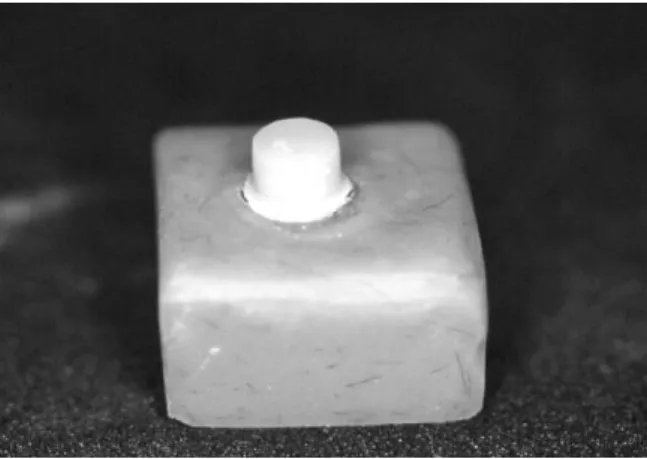
Fig. 5. Photograph of specimen
개선된 전장용 복합레진은 구강내 수리가 용이하고 자연치질과 유사한 마모도를 가지며 대부분의 치과 합금으로 제작이 가능하다는 장점을 갖고 있어 그 에 대한 관심이 커지고 있다 특히 간접법에 의하. , 여 금속 레진 보철물을 제작하는 경우 직접법에 비- 해 더 정확한 해부학적 형태를 부여해 줄 수 있으며
Fig. 6. Curing unit of resin
Fig. 7. Resin block formation for measuring of shear bond strength
변연적합도가 좋은 등 직접법보다 상대적으로 많은 장점을 가지고 있다 간접복합레진은. 80년대의 세1 대와 90년대의 세대로 분류할 수 있는데 세대는2 1 임상적 사용에 문제점을 일으키는 물성을 가졌으나 최근 개발된 Ceramic Polymer(일명 Polyglass,
of sandblasting on the Ag-Pd alloy
50 μ m (168.23±18.24)
250 μ m (184.71±9.84)
110 μ m (216.08±12.70) 50 μ m
250 μ m 110 μ m
*
* *
*Denotes pair of groups significantly different at the 0.05 level
Fig. 8. Mashine used to measure shear bond strength
는 도재와 복합레진의 성분을 조합하여 강 Ceromer)
화된 물성과 심미성을 지녀 강화형 간접복합레진으 로 분류할 수 있다 이러한 강화형 간접복합레진은. 자연치와 유사한 마모도를 가지며 생체 친화성이 있어 구강내 수리가 용이하며 색조 안정성 양호한, 심미성과 함께 치과에서 사용되는 대부분의 합금과 친화력이 좋다는 장점이 있다고 하여 그 합금들 간의 결합력을 연구 조사해 보았다.
최근까지 소개된 레진과 합금 간의 결합방법은 크게 기계적인 방법과 화학적인 방법으로 나눌 수 있는데 기계적인 방법으로는 sandblasting, 금속 표 면의 loop, bead, wire형성, 납형제작시의 mesh 형성 등이 있고 화학적인 방법으로는 금속 pattern
표면의 etching, 4-META함유의 접착제, silane결합 제 이용 등이 있다 이중. sandblasting은 금속 표면에 미세한 요철 부위를 형성하여 레진접촉 면적을 증 가시키고 동시에 표면을 용해시켜 화학적 결합에도 관여한다고 하였다 그리하여. Sandblasting 처리시 입자 크기가 결합력에 미치는 영향에 대한 보고는 상이하여 이에 합금 종류에 따른 결합강도의 차이 를 비교해보고자 하였다. William과 Wiltshire
13)
.에 의하면 110μ 또는 250μ시 50μ보다 더 높은 결합 강도를 보인다고 보고하였다.레진과 도재는 금속의 종류에 따라 결합력에 차
Fig. 9. specimen against to applied load
이를 보인다고 알려져 있다. Twesme등
17)
은 레진과 금속간의 결합에서 Ni-Cr이 가장 높고 Ag-Pd, gold 순으로 결합강도가 감소한다고 보고하였고 AlloyPeutzfeldt 와Asumussen
12)
은Ag-Pd합금과Pd합금에 는sandblasting시sand입자 크기가 결합력에 영향을 미친다고 보고 하였다 최와 방.18)
.의 실험에서는 금속과 레진전장관의 결합에서 이Ni-Cr sandblasting
더욱 효과적이라고 하였으며 50μ과 250μ의 산화 알루미늄으로 sandblasting한 경우 입자크기에 따른 통계적 유의 차는 없게 나타난 것으로 미루어 표면 이 단단한 비귀금속 합금에서는sandblasting시 입자 크기는 표면적을 넓히는데 큰 영향을 주지 않는 것 으로 보고하였다 레진 및 도재는 금속의 종류에 따. 라 결합력에 차이를 보인다고 알려져 있는데 도재 의 경우는 비귀금속보다는 금합금에 대한 결합력이 더 높은 것으로 알려져 있다 본 연구에서는 입상에. 서 사용되고 있는 강화형 복합레진과 종의 치과용3 합금을 이용하여 레진과 금속간의 전단결합 강도를 알아보고자 실험한 결과 Artglass
®
는 gold alloy에서 보다는Ag-Pd alloy에서 더욱 높은 전단결합강도를 나타내었다 금속간의 비교에는. Ag-Pd alloy가 가장 높고type II gold, type IV gold순으로 유의성있게 감 소하였다 각 금속내에서 입자 크기에 따른 결합강. 도를 비교한 결과 type II gold에서는 110 , 50 ,μ μ순으로 유의성있게 증가하였으며
250μ type IV gold
에서는 250 , 50 , 110μ μ μ순으로 전단결합강도가 증가하였으며 250μ과 110 ,μ 50μ과 110μ간에는 유의성이 있었으며 250μ과 50μ간에는 유의성이 없었다. Ag-Pd alloy에서는 50 , 250 , 110μ μ μ순으
결과로 미루어보아 레진과 여러 치과용 합금간의 결합력에서는 Pd alloy의 경우가 우세하며 시 입자크기는 금속의 물리적 성질에 따 sandblasting
라 적절한 것을 선택해야할 것으로 사료되며 레진 과 치과용 합금간의 결합력을 증진시키기 위한 많 은 방법들이 연구 개발되어져 있으나 아직까지 금 속과 도재의 결합강도에 비해 낮은 것으로 보고되 어지는 바 다양한 표면처리 방법과 다른 부가적인 결합방법에 관한 지속적인 연구와 분석이 필요할 것으로 사료된다.
V. 결 론
본 연구는 임상에서 사용되고있는 강화형 간접복 합레진과 종의 치과용 합금을 이용하여 레진과 금3 속간의 전단 결합강도를 알아보고자 각기 50, 110, 두께로 의 표면처리한 후 각 군 250 μm sandblasting
당10개씩 시편을 제작하여 만능강도시험기로 전단 결합강도를 측정하였다. 그리고 금속의 종류와 의 크기가 전단결합강도에 미치는 영향을 분석 sand
하고자 one way ANOVA 와 Sheffe's multiple range 를 시행한 결과 다음과 같은 결론를 얻었다
test .
각 금속간의 비교에서는
1. type IV gold-type II 순으로 전단결합 강도가 유의하 gold-Ag-Pd alloy
게 증가하였다(P<0.001).
같은 금속내에서 시의 입자크기에 따 2. sandblasting
른 전단결합강도를 비교해 본 결과,
에서는 순으로
Type II gold 110, 50, 250 μm
①
증가하였으며 각군 사이에 유의할 만한 차이, 가 있었다(P<0.05).
에서는 입자크기가
Type IV gold 250, 50, 110 μ
②
순으로 증가하였으며 과 과
m , 50 110 μm, 110 간에는 유의한 차이가 있었으나 250 μm
사이에는 유의성이 없었다 (P<0.05) 50, 250 mμ .
에서는 입자크기가
Ag-Pd alloy 50, 250, 110
③
순으로 증가하였으며 각 군사이에 유의 μm
한 차이가 있었다(P<0.05).
와 는 에서 가장
3. Type IV gold Ag-PD alloy 110 μm
결합력이 좋으며 type II gold에서는 250 μm에서 가장 결합력이 강하였다.