Korean J. Soil Sci. Fert.
43(6), 1047-1050 (2010)Effects of Rice Straw Incorporation by Cutting Methods on Soil Properties and Rice Yield in a Paddy Field
Chang-Hyu Yang*, Taek-Kyum Kim, Jin-Hee Ryu, Sang-Bog Lee,
Sun Kim, Nam-Hyun Baek, Weon-Young Choi, Doug-Young Chung
1, and Si-Ju Kim Department of Rice and Winter Cereal Crop, NICS, RDA, Iksan 570-080, Korea
1
Department of Bioenvironmental Chemistry, Chungnam National University, Daejeon 305-764, Korea
This study was to investigate the effects of rice straw incorporation by cutting height on paddy soil fertility.
The average residual amount of rice straw by cutting height were showed 1,420 kg ha
-1, 1,850 kg ha
-1, and 2,400 kg ha
-1for depths of 10 cm, 15 cm, and 20 cm, respectively. For soil physical properties, soil hardness and bulk density were decreased while porosity was increased by rice straw incorporation. But soil organic matter (SOM), available silicate content, and cation exchange capacity (CEC) were significantly decreased when rice straw was removed from the field. These results indicated that the SOM as residual amount of rice straw was influenced by level of cutting height. Milled rice yield was increased by 28% and 32% for cutting heights of 15 cm and 20 cm, compared with that of control, respectively. The number of spikelets per square meter and the percentage of ripeness were increased with increasing incorporation by lower level of cutting height of rice straw. Therefore, incorporation of rice straw practices under cutting method influenced soil improvement and rice yield in paddy field.
Key words: Rice straw, Incorporation, Cutting height, Paddy, Soil fertility, Yield
Received : November 30. 2010 Accepted : December 9. 2010
*Corresponding author : Phone: +82638402272 E-mail: [email protected]
Introduction
The total area of Paddy field with low crop productivity are about 67 percent in Korea (ASI, 1992). The reasons for reduction productivity could be the inferiority of the soil parent material and the soil fertility due to continuous cultivation while there were application of organic matter such as rice straw, barley straw, and so on. Also the relevant reasons were improper soil amendments, leaching of microelements such as iron and manganese, and excessive application of chemical fertilizer. Since rice production is influenced by soil fertility, it is difficult to maintain the soil fertility by reliance on chemical fertilizer.
Therefore, it is desirable to improve and maintain soil fertility by application of organic matter.
Application of organic matter can ameliorate the physical properties: increasing porosity by aggregation of soil structure, and decreasing hardness and bulk density.
Also application of organic matter may improve the work efficiency of agricultural machinery with amelioration of
dynamic properties such as cone penetration resistance, and the Atterberg constant (Kwun et al., 1984; Lee et al., 1986; Shin and Shin, 1975).
Maintenance of soil fertility on paddy soil was mainly done by application of rice straw. But most of rice straw tend to be removed from the field as fodder bail, resulting in lowering the production and soil fertility of paddy soil.
Thus this study was carried to determine optimum cutting height with harvest time for rice straw in maintaining soil fertility of paddy.
Materials and Methods
This study was conducted to Jeonbuk series (fine silty, mixed nonacid Aeric Fluventic Haplaquepts) in paddy field at Honam Agricultural Institute from 2005 to 2008.
Rice straw was harvested by cutting height (10 cm, 15 cm, 20 cm) from the ground with combine rice harvest time.
Conventional practices were used to collect rice straw.
Medium seedlings of Dongjinbyeo I were transplanted at the end of May. Amounts of applied fertilizer were decided after soil testing.
Bulk density was determined by the core method and
Article
Chang-Hyu Yang et al.
1048
Table 1. The average residual amount of rice straw depending on the different levels of cutting height in a paddy field.
10 cm 15 cm 20 cm
--- kg ha
-1---
1,420 1,850 2,400
Fig. 1. The treatment type of rice straw in a paddy field.
Table 2. The change of physical properties in subsoil with incorporation of rice straw.
Division Surface soil
depth Hardness Bulk density Porosity Three phases
Solid Liquid Gaseous
cm mm Mg m
-3--- % ---
Control
†12.0 20.4 1.594 39.9 60.1 39.6 0.3
Cutting height
10 cm 14.0 19.7 1.558 41.2 58.8 40.9 0.3
15 cm 14.0 19.5 1.474 44.4 55.6 43.0 1.4
20 cm 14.0 18.2 1.417 46.6 53.4 44.6 2.0
†
Collection of rice straw.
hardness was measured with a penetrometer (Yamanaka).
Soil chemical properties were observed by the analytical methods for soils and plants (NIAST, 2000). Organic matter, available phsphate and silicate were measured by the Tyurin, Lancaster, and 1N-NaOAc (pH 4.0) extraction method, repectively. Cation exchange capacity (CEC) were analyzed using a kjeldahl indignation apparatus (Kjetec Auto Distillation, FOSS) following a soil extraction with 1M NH
4OAc (pH 7.0).
Investigation on yield and growth of rice were carried out according to the standard of investigation and research on agricultural science technology (RDA 2003).
Results and Discussion
Residual amount and utilization type of rice straw The average residual amount of rice straw by cutting height in soils was showed in Table 1.
The treatment type of rice straw from the paddy field were incineration itself, collection as a bail, and appli- cation as fertilizer sources (Fig. 1). Incorporation of the remaining stubble and straw into the soil is the method to
return the nutrient into soils and help to conserve soil properties even though there are problems such as temporary immobilization of nitrogen, significant increase of methane emission, and buildup of disease problem might be happened with the straw incorporation (Dobber and Fairhurst, 2002)
Change of soil physical properties The change of soil physical properties with rice straw incorporation depending on the different levels of cutting heights of rice straw during rice harvest time are shown in Table 2.
Physical properties were improved by rice straw incor-
poration. The depth of surface soil was deepened as
well as soil hardness and bulk density were decreased
besides increase in porosity. The improvements of physical
properties tended to be higher with decreasing cutting
height of the rice straw. We assumed that application of
organic matter can lead to decrease in soil mass per unit
volume, that is, a soft soil. Application of rice straw in
paddy fields of Fluvio-marine deposits is effective on deep
tillage and the amelioration of drainage with reducing the
imperviousness of the plow pan (Lee et al., 1979).
Effects of Rice Straw Incorporation by Cutting Methods on Soil Properties and Rice Yield in a Paddy Field 1049
Table 3. The change of chemical properties in surface soil with incorporation of rice straw.
Division SOM Avail. P
2O
5Avail. SiO
2CEC
g kg
-1--- mg kg
-1--- cmol
ckg
-1Control
†Δ 1.34 Δ 1 Δ 58 Δ 0.33
Cutting height
10 cm Δ 0.53 Δ 7 Δ 31 Δ 0.28
15 cm Δ 0.49 Δ 10 Δ 27 Δ 0.23
20 cm Δ 0.30 Δ 27 Δ 17 Δ 0.22
†
Collection of rice straw.
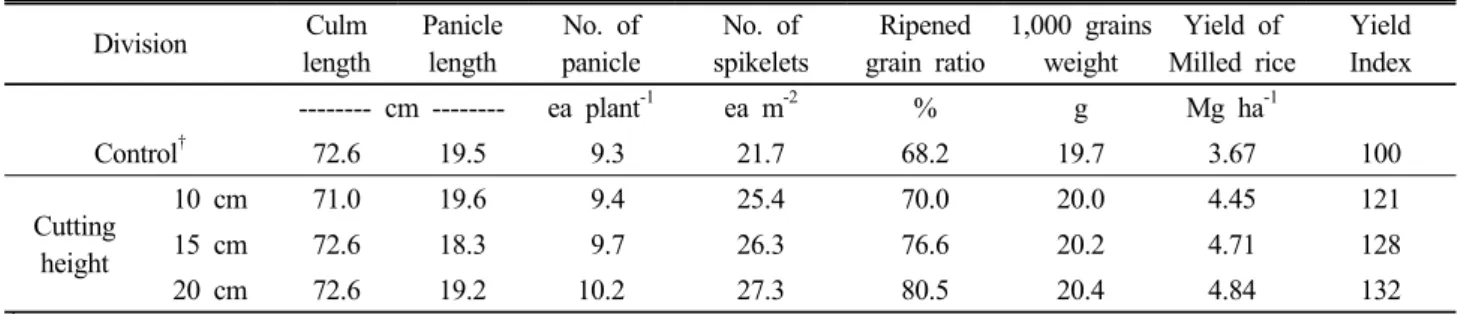
Table 4. Rice yield and yield components with incorporation of rice straw.
Division Culm
length
Panicle length
No. of panicle
No. of spikelets
Ripened grain ratio
1,000 grains weight
Yield of Milled rice
Yield Index --- cm --- ea plant
-1ea m
-2% g Mg ha
-1Control
†72.6 19.5 9.3 21.7 68.2 19.7 3.67 100
Cutting height
10 cm 71.0 19.6 9.4 25.4 70.0 20.0 4.45 121
15 cm 72.6 18.3 9.7 26.3 76.6 20.2 4.71 128
20 cm 72.6 19.2 10.2 27.3 80.5 20.4 4.84 132
†
Collection of rice straw.
Lee et al. (2010) showed that the management practices with rice straw and green mannure application for crop productivity could improve the physical and biological properties of soils in paddy fields.
Change of soil chemical properties (soil fertility) The change of soil chemical properties with rice straw incorporation depending on the different levels of cutting heights of rice straw during rice harvest time is shown in Table 3. Cation exchangeable capacity (CEC) and amounts of available silicate and organic matter were increased with rice straw incorporation, resulting in increasing the holding capacity of nutrients from soils in which organic matter can provide various nutrient sources such as nitrogen, phosphate, potassium, and other inorganic ions.
like (Lee et al., 1995). Therefore, SOM can play a role of nutrient supply and the buffering soil pH.
Rice yield and yield components Rice yield and yield components with rice straw incorporation depending on the different levels of cutting heights of rice straw during rice harvest time are shown in Table 4. The number of spikelets per square meters and the percentage of ripeness were increased with increasing rate of rice straw incorporation. The rice yield compared to conventional method (3.67 Mg ha
-1) was also increased by 32 and 28%
for cutting heights of 20 cm and 15 cm, respectively.
Conclusion
Soil hardness and bulk density were decreased but porosity was increased by rice straw incorporation. Also organic matter, available silicate content, and cation exchange capacity were significantly decreased when rice straw was removed from the rice paddy field. But incorporation of rice straw followed by cutting methods was effective in increase in residual amount of rice straw as organic matter. On the other hand, the number of spikelets/m
2and the percentage of ripeness were influenced by rice straw incorporation.
References
ASI. 1992. General remarks of Korean soils. p.308-610. Published by Agricultural Sciences Institute. Suwon, Korea.
Dobbermann, A. and T. H. Fairhurst. 2002. Rice straw manage- ment. Better Crop Internationl, Special Supplement, 16:7-11.
Kwun, K.C., J.K. Kim, I.Y. Kim, S.H. Park, and D.S. Jo. 1984.
Effects of continuous fertilizations on physical and chemical properties of paddy soil and growth of rice plant. Res. Rept.
RDA (crop) 26:67-76.
Lee, S.Y., D.H. Choi, T.O. Kwon, J.D. So, N.P. Park, and Y.S. Ham. 1979. The effects of the mole drainage and deep plowing with heavy fertilizer, soil amendment application on rice in the degraded Fluvio-Marine Deposit soils. Res. Rept.
RDA (soil & fertilizer) 21:39-55.
Lee, C.H., H.S. Lee, S.L. Choi, W.K. Shin, and R.S. Lee. 1986.
Effects of organic matters application with the different levels
Chang-Hyu Yang et al.
1050
볏짚 혼입이 논 토양개선 및 쌀수량에 미치는 영향