CHE302 Process Dynamics and Control Korea University 4-1
CHE302 LECTURE IV
MATHEMATICAL MODELING OF CHEMICAL PROCESS
Professor Dae Ryook Yang
Fall 2001
Dept. of Chemical and Biological Engineering Korea University
CHE302 Process Dynamics and Control Korea University 4-2
THE RATIONALE FOR MATHEMATICAL MODELING
• Where to use
– To improve understanding of the process – To train plant operating personnel
– To design the control strategy for a new process – To select the controller setting
– To design the control law
– To optimize process operating conditions
• A Classification of Models
– Theoretical models (based on physicochemical law) – Empirical models (based on process data analysis) – Semi -empirical models (combined approach)
CHE302 Process Dynamics and Control Korea University 4-3
DYNAMIC VERSUS STEADY-STATE MODEL
• Dynamic model
– Describes time behavior of a process
• Changes in input, disturbance, parameters, initial condition, etc.
– Described by a set of differential equations
: ordinary (ODE), partial (PDE), differential-algebraic(DAE)
• Steady-state model
– Steady state: No further changes in all variables – No dependency in time: No transient behavior
– Can be obtained by setting the time derivative term zero
Dynamic Model (ODE, PDE) Initial Condition, x(0)
Input, u(t) Output, y(t)
Parameter, p(t)
CHE302 Process Dynamics and Control Korea University 4-4
MODELING PRINCIPLES
• Conservation law
– Within a defined system boundary (control volume)
• Mass balance (overall, components)
• Energy balance
• Momentum or force balance
• Algebraic equations: relationships between variables and parameters
rate of rate of rate of accumulation input output
rate of rate of generation disappreance
= −
+ −
CHE302 Process Dynamics and Control Korea University 4-5
MODELING APPROACHES
• Theoretical Model – Follow conservation laws – Based on physicochemical
laws
– Variables and parameters have physical meaning – Difficult to develop – Can become quite complex – Extrapolation is valid unless
the physicochemical laws are invalid
– Used for optimization and rigorous prediction of the process behavior
• Empirical model
– Based on the operation data – Parameters may not have
physical meaning – Easy to develop – Usually quite simple – Requires well designed
experimental data
– The behavior is correct only around the experimental condition
– Extrapolation is usually invalid
– Used for control design and simplified prediction model
CHE302 Process Dynamics and Control Korea University 4-6
DEGREE OF FREEDOM (DOF) ANALYSIS
• DOF
– Number of variables that can be specified independently – NF = NV- NE
• NF: Degree of freedom (no. of independent variables)
• NV: Number of variables
• NE: Number of equations (no. of dependent variables)
• Assume no equation can be obtained by a combination of other equations
• Solution depending on DOF
– If NF= 0, the system is exactly determined . Unique solution exists.
– If NF> 0, the system is underdetermined. Infinitely many solutions exist.
– If NF< 0, the system is overdetermined. No solutions exist.
CHE302 Process Dynamics and Control Korea University 4-7
LINEAR VERSUS NONLINEAR MODELS
• Superposition principle
• Linear dynamic model:superposition principle holds
– Easy to solve and analytical solution exists.
– Usually, locally valid around the operating condition
• Nonlinear: “Not linear ”
– Usually, hard to solve and analytical solution does not exist.
1 2 1 2
, , and for a linear operator,
Then ( ( ) ( )) ( ( )) ( ( )) L
L x t x t L x t L x t
α β
α β α β
∀ ∈ℜ
+ = +
1 1 2 2
1 2 1 2
1 1 2 2
1 2 1 2
, , ( ) ( ) and ( ) ( )
( ) ( ) ( ) ( )
, , (0) ( ) and (0) ( )
(0) (0) ( ) ( )
u t y t u t y t
u t u t y t y t
x y t x y t
x x y t y t
α β
α β α β
α β
α β α β
∀ ∈ℜ → →
+ → +
∀ ∈ℜ → →
+ → +
CHE302 Process Dynamics and Control Korea University 4-8
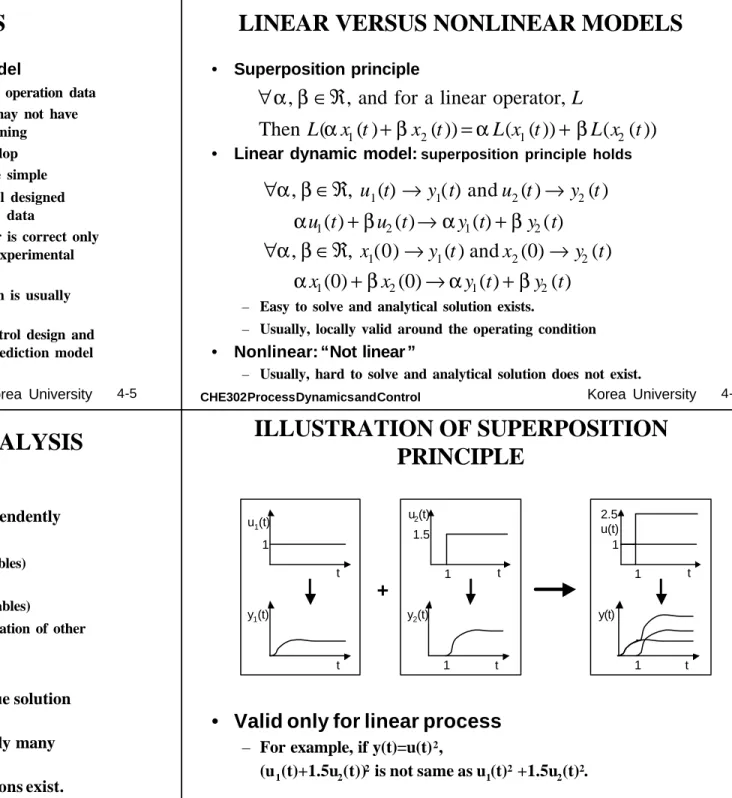
ILLUSTRATION OF SUPERPOSITION PRINCIPLE
• Valid only for linear process
– For example, if y(t)=u(t)2,
(u1(t)+1.5u2(t))2is not same as u1(t)2 +1.5u2(t)2.
u1(t)
t 1
y1(t)
t
u2(t)
t 1.5
1
y2(t)
t 1
y(t)
t 1 u(t)
t 2.5
1 1
+
CHE302 Process Dynamics and Control Korea University 4-9
TYPICAL LINEAR DYNAMIC MODEL
• Linear ODE
• Nonlinear ODE
( ) ( ) ( ) ( and K are contant, 1st order) dy t y t Ku t
τ dt = − + τ
1
1 1 0
1
1 1 0
( ) ( )
( )
( ) ( )
() (nth order)
n n
n n n
m m
m m m m
d y t d y t
a a y t
dt dt
d u t d u t
b b b u t
dt dt
−
− −
−
− −
+ + +
= + + +
K
K
( ) 2
( ) ( )
dy t y t Ku t τ dt = − +
( ) ( ) ( )
dy t y t K u t τ dt = − +
( ) ( ) ( ) s i n ( ) ( ) dy t y t y t y Ku t
τ dt = − +
( ) ( )
y t ( )
dy t Ku t
dt
e
τ = − − +
CHE302 Process Dynamics and Control Korea University 4-10
MODELS OF REPRESENTATIVE PROCESSES
• Liquid storage systems
– System boundary: storage tank – Mass in: qi(vol. flow, indep. var) – Mass out: q (vol, flow, dep. var) – No generation or disappearance
(no reaction or leakage) – No energy balance
– DOF=2 (h, qi) - 1=1
– If , the ODE is linear.
(RV is the resistance to flow)
– If , the ODE is nonlinear.
(CVis the valve constant)
i i
( )
A dh q q q f h dt
= − = −Accumulation rate in tank
Mass in rateMass out rate Outlet flow is a function of head ( ) / V
f h =h R
( ) V / c
f h =C ρgh g
h V qi
q Area = A
Control volume
CHE302 Process Dynamics and Control Korea University 4-11
• Continuous Stirred Tank Reactor (CSTR) – Liquid level is constant(No acc. in tank)
– Constant density, perfect mixing – Reaction: A à B (r = k0exp (-E/RT)cA) – System boundary: CSTR tank
– Component mass balance
– Energy balance
– DOF analysis
• No. of variables: 6 ( q, cA, cAi, Ti, T, Tc)
• No. of equation:2 (two dependent vars.: cA, T)
• DOF=6 – 2 = 4
• Independent variables: 4 ( q, cAi, Ti, Tc)
• Parameters: kinetic parameters, V, U, A, other physical properties
• Disturbances: any of q, cAi, Ti, Tc, which are not manipulatable h V, T cAi, qi, Ti
Cooling medium,Tc
cA, q, T
( )
A
Ai A A
V dc q c c Vkc
dt
= − −( ) ( ) ( )
p p i A c
V C dT q C T T H Vkc U A T T
ρ dt
=ρ
− + −∆ + −CHE302 Process Dynamics and Control Korea University 4-12
STANDARD FORM OF MODELS
• State-space model
– x: states, [cAT]T – u: inputs, [q Tc]T
– d: disturbances, [cAiTi]T
– y: outputs – can be a function of above, y=g(x,d,u), [cAT]T – If higher order derivatives exist, convert them to 1storder.
1 1 1
/ ( , , )
where [ , ,
n] ,
T[ , ,
m] ,
T[ , ,
l]
Td dt
x x u u d d
= =
= = =
x x f x u d
x u d
&
L L L
1
2
( ) ( , , , )
( ) ( ) ( ) ( , , , , )
A
Ai A A A Ai
i A c A c i
p p
dc q
c c kc f c T q c dt V
dT q q UA
T T H kc T T f c T q T T
dt V ρC ρC
= − − =
= − + −∆ + − =
From the previous example
CHE302 Process Dynamics and Control Korea University 4-13
CONVERT TO 1
ST-ORDER ODE
• Higher order ODE
• Define new states
• A set of 1
st-order ODE’s
1
1 1 0 0
( ) ( )
( ) ( )
n n
n n n
d x t d x t
a a x t b u t
dt dt
−
− −
+ + +
K
=( 1) 1
, , , ,
2 3 n nx = x x = x x & = & x &L x = x
−1 2
2 3
1 2 1 0 1 0
n n n n n
x x
x x
x a
−x a
−x
−a x b u
=
=
= − − − − +
&
&
M
& L
CHE302 Process Dynamics and Control Korea University 4-14
SOLUTION OF MODELS
• ODE (state-space model)
– Linear case: find the analytical solution via Laplace transform, or other methods.
– Nonlinear case: analytical solution usually does not exist.
• Use a numerical integration, such as RK method, by defining initial condition, time behavior of input/disturbance
• Linearize around the operating condition and find the analytical solution
• PDE
– Convert to ODE by discretization of spatial variables using finite difference approximation and etc.
1 ( )
L L
w L
HL
T T
v T T
t z τ
∂ = − ∂ + −
∂ ∂
( ) ( 1)
L L L
T T j T j
z z
∂ ≈ − −
∂ ∆
( ) 1 1
( 1) ( )
( 1, )
L
L L w
HL HL
dT j v v
T j T j T
dt z z
j N
τ τ
= −∆ − −∆ + +
= L
CHE302 Process Dynamics and Control Korea University 4-15
LINEARIZATION
• Equilibrium (Steady state)
– Set the derivatives as zero:
– Overbar denotes the steady-state value and is the equilibrium point. (could be multiple)
– Solve them analytically or numerically using Newton method
• Linearization around equilibrium point
– Taylor series expansion to 1storder
– Ignore higher order terms – Define deviation variables:
( , , )
=
0 f x u d
( , , )x u d
( , ) ( , )
( , ) ( , ) ∂ ( ) ∂ ( )
= + − + − +
∂ x u ∂ x u
f f
f x u f x u x x u u
x u L
0
( , ) ( , )
∂ ∂
′= ′+ ′= ′+ ′
∂ x u ∂ x u
f f
x x u Ax Bu
x u
&
′= − , ′= −
x x x u u u
1 1
1
1
n
n n
n
f f
x x
f f
x x
∂ ∂
∂ ∂
∂ =
∂ ∂ ∂
∂ ∂
f x
L
M O M
L Jacobian