Modeling of a Bunsen Reaction with a Chemical Process Simulator
J
. H. Kim, Y. J. Shin, J. H. Chang, and J. K. ParkKorea Atomic Energy Research Institute, 150 Dukjin, Yusung, Daejeon , 305-353, [email protected]
1. Introduction
Water splitting is a technology to produce hydrogen with a high temperature heat source from HTGCR(High Temperature Gas Cooled Reactor). There are three types of water splitting technologies such as thermo-chemical cycle, high temperature electrolysis cycle, and thermo-chemical and electrolysis hybrid cycle.
Water splitting technology to produce hydrogen coupled with nuclear power is more favorable than the conventional fossil fuels in a sense that it is a new alternative clean energy source that has no green house gas emissions. It is less polluting the environments. It also matches with the amendment of Kyoto protocol (1997) which specifies a severe restrictions on CO2 emission to the environments.
Therefore, the hydrogen production coupled with nuclear energy has attracted much attention from researchers because better solution to preserve better environments.
IS(Iodine-Sulfur) process, one of the thermo-chemical water splitting technologies, seems to be regarded as the most probable process that can be achieved in the near future. The researchers from the world have much interests in IS process.
IS process consists of three coupled reactions described in equations (1)~(3). Its net reaction is that one mole of water dissociates into one mole of hydrogen and a half mole of oxygen as in equation (4). The schematic diagram of IS process is shown in Fig. 1.
SO2 + I2 + 2H2O → H2SO4 + 2HI ---(1)
H2SO4 → SO2 + H2O + 1/2 O2 ---(2)
2 HI → I2 + H2 ---(3)
H2O → H2 + 1/2 O2 ---(4) To have a efficient, cost-effective, large-scale hydrogen production system, we need to cope with the current challenges that IS process is faced with. At present, the major challenges to the highly efficient and large-scale hydrogen production system are known as follows;
1) It is difficult to split Bunsen reaction products, into sulfuric acid phase and hydrogen iodide phase.
2) The equilibrium conversion rate of hydrogen iodide is as low as 20%.
3) It is difficult to separate HI from HIx mixture solution.
The purpose of this study is to establish the accurate and reliable simulation model of Bunsen reaction in the IS process using unit and flowsheet models.
Fig. 1. Schematic Diagram of IS Process 2. Modeling of Bunsen Reaction
Schematic diagram of Bunsen reaction is shown in Fig. 2. along with unit models and corresponding flow streams.
Fig. 2. Schematic Diagram of Bunsen Reaction
Flowsheet model has been developed with unit operation models provided by the chemical process simulator. In Bunsen reaction, one mole of iodine, one mole of sulfur dioxide and 2 moles of water react to produce 1 mole of sulfuric acid and 2 moles of hydrogen iodide.
The acidic chemicals involved in Bunsen reaction such as H2SO4 and HI are strongly ionic and tend to dissociate or form complexes in aqueous solutions.
Transactions of the Korean Nuclear Society Autumn Meeting Busan, Korea, October 27-28, 2005
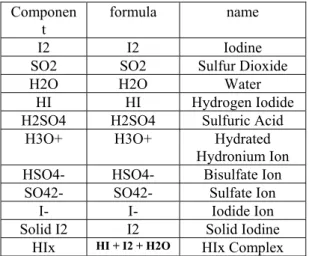
The chemical components including ions and complexes are summarized in Table 1.
Table 1. Chemical Components involved in Bunsen Reaction
Componen
t formula name
I2 I2 Iodine
SO2 SO2 Sulfur Dioxide
H2O H2O Water
HI HI Hydrogen Iodide
H2SO4 H2SO4 Sulfuric Acid
H3O+ H3O+ Hydrated Hydronium Ion
HSO4- HSO4- Bisulfate Ion
SO42- SO42- Sulfate Ion
I- I- Iodide Ion
Solid I2 I2 Solid Iodine HIx HI + I2 + H2O HIx Complex
2.1 Simulatoin Models
Flowsheet model has been developed with unit operation models provided by the chemical process simulator.
Most of Bunsen reaction takes place in the Bunsen reactor. Small amount of Bunsen reaction takes place in reactive columns and 3-phase separator. Two reactive columns are actually scrubbers designed to reclaim the costly Iodine from the stream. The scrubbing process is assumed to be a vapor phase equilibrium reaction. The reactive columns are simulated as a RADFRAC in chemical process simulator.
The reaction in the Bunsen reactor is simulated as a CSTR(Continuous Stirred Tank Reactor) that can control the reaction kinetics in the aqueous solution.
Three-phase separator, one of the most important units in Bunsen reaction, splits the Bunsen reaction products into the heavy HIx phase, light H2SO4 phase, and gas phase. This is simulated as a combination of CSTR and a flash unit.
The other units such as pump, compressor, and valve are simulated with the standard model in the chemical process simulator for this unit. The unit models and streams are connected each other with mixers and splitters.
2.2 Chemistry Models
Chemistry models have been used to accurately describe the complex chemical behaviors such as dissociation or complexation in the non-ideal solution. In Bunsen reaction, chemistry models are used to accurately describe phase separation phenomena.
It is more practical to use chemistry models together with reaction models, because they leads to a better model convergence.
2.3 Reaction Models
Reaction models have been used to describe Bunsen reaction reactor model , and the acid production in distillation column models. The Bunsen reactor and acid production are modeled as a liquid phase kinetic re model. Reaction models are able to describe Bunsen reaction phenomena more accurately, when used together with chemistry models.
2.4 Thermophysical Properties
Several kinds of and Chemistry models and Reaction models are involved in the Bunsen reaction, There is only one universal set of thermodynamic parameters in Bunsen reaction. The set of thermodynamic parameters is modeled to fit the equilibrium data between reactants and products in the Bunsen reaction.
3. Results
Unit models and flowsheet models have been developed for the Bunsen reaction with chemical process simulator. The optimum operation condition will be obtained through sensitivity analysis in near future.
ACKNOWLEDGEMENTS
This study has been carried out under the Nuclear R & D Program supported by the Ministry of Science and Technology (MOST) of Korea.
REFERENCES
[1] K. Onuki, N. Akino, S. Shimizu, H. Nakajima, S. Higashi and S. Kubo, Safety Considerations for Continuous Hydrogen Production Test Apparatus with Capacity of 50 N-Liter Hydrogen per Hour, Japanese Atomic Energy Research Institute, JAERI-Tech 2001-032, 2001.
[2] J. H. Norman, G. E. Besenbruch, L. C. Brown, D. R. O’keefe, and C. L. Allen, Thermo-chemical Water-splitting Cycle, Bench-scale Investigations, and Process Engineering, General Atomic Company, GA-A16713, 1982.