Received: June 29, 2017 Revised: September 22, 2017 Accepted: September 25, 2017
Address for Correspondence: Abolfazl Fattah, Semnan University of Medical Sciences, Basij Blvd, Semnan 35195-163, Iran Tel: +9891233215707, Fax: +982335225129, E-mail: [email protected]
Original Article
pISSN: 2288-6478, eISSN: 2288-6761 https://doi.org/10.6118/jmm.2017.23.3.160 Journal of Menopausal Medicine 2017;23:160-165
J MM
Introduction
Given the increased life expectancy, women often spend a third of their life in the postmenopause era. In Iran, it is estimated that the number of postmenopausal women will reach 5 million in 2021.1 Menopause indicates the termi- nation of a woman’s reproductive life. It is defined as the permanent cessation of menstruation induced by the loss of ovarian follicular activity.2 Menopause represents an impor- tant stage in female lives, which is often associated with a plethora of complaints and sufferings.3 Mood disturbances, especially anxiety and depression, are commonly associated with menopause.4
The adoption of preventive measures for proper manage- ment of menopause can improve the quality of life of women.5
There are growing evidences on the effectiveness of hor- mone therapy in alleviating menopausal symptoms and other age-related conditions.6,7 The use of hormone replacement therapy (HRT) was hampered with unexpected findings re- ported in the Women’s Health Initiative (WHI) according to which HRT regimen was associated with increased risk of cardiovascular events and breast cancer.8 Benzodiazepines and antidepressants are commonly used for mood distur- bances, but they have proved side effects. For example, benzodiazepines are characterized by drowsiness, prolonged reaction time, and antidepressants are anticholinergic and cardiotoxic effects.4 Given the side effects of HRT, benzo- diazepines and anti-depressants, many users have with- drawn from HRT. Instead, many former users of HRT have been attracted to herbal medicine such as soy, hops and red
Effect of Phytoestrogen on Depression and Anxiety in Menopausal Women: A Systematic Review
Abolfazl Fattah
Semnan University of Medical Sciences, Semnan, Iran
Objectives: In this systematic review, the effectiveness of herbal medicines in improving depression and anxiety in menopausal women was assessed.
Methods: Three following databases were individually searched: MEDLINE (1966-March 2017), SCOPUS (1990-March 2017), and the Cochrane Library (Cochrane Central Register of Controlled Trials; 2017).
Results: A total of 9 trials were included in this systematic review. Overall, soy was found to have a beneficial effect. Also, fennel had a significant positive effect on menopausal women with depression and anxiety disorder, but not on healthy women. Red clover showed varying effects ranging from significant to non-significant on depression and anxiety. Moreover, kava was found to have a significant beneficial effect on depression and anxiety at dose of 200 mg/days.
Conclusions: Our study demonstrated that herbal medicines could improve anxiety and depression in among menopausal women. However, the beneficial effect still remains indefinite due to the poor methodology. (J Menopausal Med 2017;23:160-165) Key Words: Anxiety · Depression · Menopause · Phytoestrogens
Abolfazl Fattah. Phytoestrogen on Depression and Anxiety
clover as a way of handling menopausal symptoms. This review seeks to investigate the effect of herbal medicines on alleviating the effect of anxiety and depression.
Materials and Methods
Three databases including MEDLINE (1966-March 2017), SCOPUS (1990-March 2017), and the Cochrane Library (Cochrane Central Register of Controlled Trials; 2017) were individually searched to review trials investigating the ef- fect of herbal medicines on depression and anxiety. Also the same terms put into each database and hand-searching the references of publications were performed to find relevant publications
For this purpose, a number of keywords such as de- pression AND anxiety, depression OR anxiety, complemen- tary treatments, alternative treatments. evening primrose oil, hypericum perforatum, herbal treatments herbs, St.
John’s wort, phytomedicine, racemosa rhizome, Salvia of- ficinalis Trigonella foenum-graecum, Avacado plus, Black cohosh, cimicifuga, Evening primrose oil, flaxseed, fenu- greek, dong quai, Ginseng, licorice red, Red clover, Vitex agnus-castus, kava, Piascledine and yam were searched.
The search was performed without any language restriction.
1. Inclusion criteria
Randomized controlled trials (RCT) were included in the systematic review if they met the following criteria: 1) in- cluding perimenopausal, and postmenopausal women; 2) studying parallel or crossover groups; and 3) including par- ticipants with depression or anxiety.
2. Assessment of study quality
Consort Checklist was used to assess the quality of in- cluded RCTs. This checklist include items such as blinding, drop-out rate, randomization technique, and intention to treat report.
3. Data extraction
The data extracted by two separate authors included sample size, type of intervention and control, duration of treatment, dose, and results. Disagreements were resolved
by consensus-based discussion.
Results
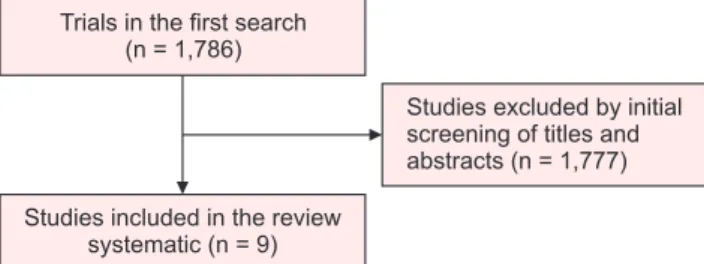
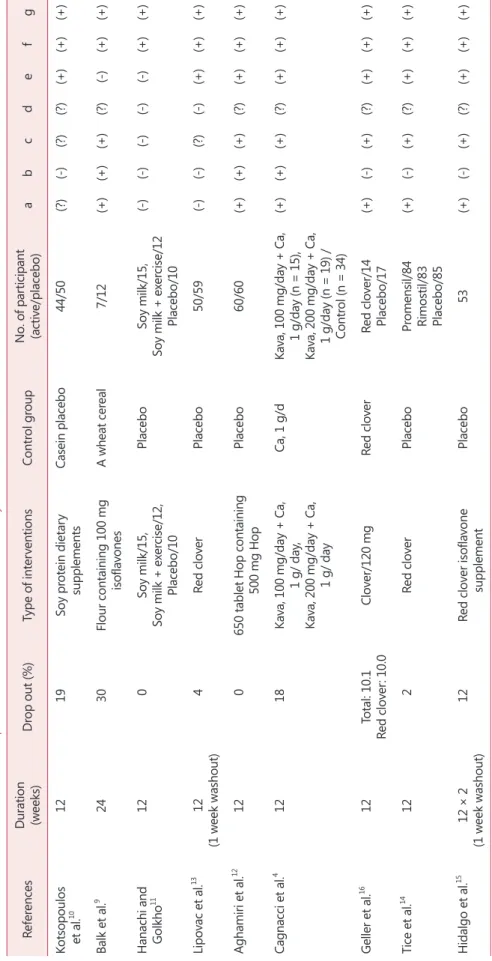
The process of searching and selecting RCTs is shown in Fig. 1. The 1786 studies were found in the first search. 1,777 studies were excluded by initial screening of titles and ab- stract. 9 final trials were included in this systematic. Char- acteristics of trials are shown in Table 1.
1. The effect of soy on depression and anxiety Balk et al.9 compared the effect of soy flour contain- ing 100 mg isoflavones and wheat cereal as placebo on 19 menopausal women. There was no statistical difference be- tween groups regarding depression symptoms (P = 0.58) at the end of a six-month period. Also, the two groups did not show any improvement compared to the baseline.
Kotsopoulos et al.10 examined the effectiveness of soy on menopausal women. They randomized menopausal women in two groups of Soy protein dietary supplements (n = 44) and Casein placebo (n = 50). The score of depression dropped by 25% in soy group but it remained unchanged in placebo group. The score of anxiety dropped by 17% in the soy group and 16% in the placebo group. Statistical analysis by multivariate analysis of covariance (MANOCA) showed no significant differences between groups for psychological symptoms (irritability, depression, anxious, tiredness and sleeplessness). Hanachi and Golkho11 designed a random- ized three-group study comparing the efficacy: 1) soymilk supplementation; 2) soymilk supplementation and exercise;
and 3) placebo on depression and anxiety. Both groups were not different from placebo group regarding anxiety and de- pression. The effect on soymilk supplementation and exer-
Studies included in the review systematic (n = 9)
Studies excluded by initial screening of titles and
bstracts (n = 1,777) a
Trials in the first search (n = 1,786)
Fig. 1. Search strategy of the study.
Journal of Menopausal Medicine 2017;23:160-165
J MM
Table 1. Characteristics of 9 randomized placebo-controlled trials included in our systematic review References Duration (wNo. oant ticiparf p erventionsfedcbaDrop out (%)Type of intoupol grContrg (active/placebo)eeks)
Kotsopoulos et al.
101219Soy protein dietary supplementsCasein placebo44/50(?)(-)(?)(?)(+)(+)(+) Balk et al.9 2430Flour containing 100 mg isoflavonesA wheat cereal7/12(+)(+)(+)(?)(-)(+)(+)
Hanachi and Golkho
11120Soy milk/15, Soy milk + exercise/12, Placebo/10
PlaceboSoy milk/15, Soy milk + exercise/12 Placebo/10
(-)(-)(-)(-)(-)(+)(+) Lipovac et al.13 12 (1 week washout)4Red cloverPlacebo50/59(-)(-)(?)(-)(+)(+)(+) Aghamiri et al.12 120650 tablet Hop containing 500 mg HopPlacebo60/60(+)(+)(+)(?)(+)(+)(+) Cagnacci et al.4 1218Kava, 100 mg/day + Ca, 1 g/ day, Kava, 200 mg/day + Ca, 1 g/ day
Ca, 1 g/dKava, 100 mg/day + Ca, 1 g/day (n = 15), Kava, 200 mg/day + Ca, 1 g/day (n = 19) / Contr
ol (n = 34)
(+)(+)(+)(?)(+)(+)(+) Geller et al.16 12Total: 10.1 Red clover: 10.0Clover/120 mgRed cloverRed clover/14 Placebo/17(+)(-)(+)(?)(+)(+)(+) Tice et al.14 122Red cloverPlaceboPromensil/84 Rimostil/83 Placebo/85
(+)(-)(+)(?)(+)(+)(+) Hidalgo et al.15 12 × 2 (1 week washout)12Red clover isoflavone supplementPlacebo53(+)(-)(+)(?)(+)(+)(+) Ca: calcium
Journal of Menopausal Medicine 2017;23:160-165 Abolfazl Fattah. Phytoestrogen on Depression and Anxiety
cise on depression and nervousness was less significant than Soymilk supplementation. To sum up, soy improved slightly anxiety and depression.
2. Effect of Hops (Humulus lupulus L.) depression and anxiety
A study by Aghamiri et al.12 compared the efficiency of Hops with placebo. Intervention group received 500 mg hop once daily for 12 weeks. The Hops group showed a statisti- cally significant decrease in anxiety compared to the placebo group in three intervals at 2 (P < 0.001), 4 (P < 0.001), 8 (P <
0.001) and 12 (P < 0.001) weeks. The corresponding values for depression were 2 (P < 0.001), 4 (P < 0.001), 8 (P < 0.001) and 12 (P < 0.001) respectively.
3. Effect of Kava (Piper methysticum rhizoma) on depression and anxiety
In Cagnacci et al. study,4 all patient received 1 g/day of calcium and then were randomized into three groups of control group (no treatment), 100 mg Kava and 200 mg Kava. Mean score of depression dropped from 37.0 ± 1.8 to 34.9 ± 1.7 in the calcium d, from 38.2 ± 2.4 to 33.7 ± 1.4 in Kava-Kava (100 mg) and from 38.7 ± 2 to 33.5 ± 1.9 in Kava (200 mg) groups. The reduction between the baseline and 3-month follow-up was only significant in the group of Kava 200 mg. Comparison of the three groups using ANOVA test did not show any statistically significant differ- ence between groups in terms of depression score. The score anxiety remained unchanged in the calcium group. In 100 mg and 200 mg groups, anxiety score dropped significantly from 47.3 ± 2.2 to 22.5 and from 46.6 ± 1.6 to 41.3 ± 1.6 respectively.
4. Effect of red clover (Trifolium pratense L.) depression and anxiety
Lipovac et al.13 conducted a double-blind, randomized, crossover study (with a wash-out period of one week) on two groups (red clover and placebo) for 12 weeks. After ad- ministering red clover, Hospital Anxiety subscale decreased from (9.98 ± 4.65 to 2.40 ± 2.53) in red clover group and from 9.98 ± 4.65 to 8.05 ± 4.76 (P < 0.001) in placebo group (P < 0.001). Hospital depression subscale decreased from 6.91 ± 4.02 to 1.50 ± 2.06 (P < 0.001) in red clover
group and from 6.91 ± 4.02 to 5.23 ± 3.65 (P < 0.001) in placebo group. Zung Self-Rating Depression Scale revealed a significant decrease (P < 0.001 compared to baseline and placebo). Tice et al.14 compared three groups of Promensil (82 mg red clover-derived isoflavones), Rimostil (82 mg red clo- ver- derived isoflavones) and placebo. They did not find any significant improvement in subscale of ‘depression’ either in Promensil (P = 0.23) or Rimostil (0.79) groups compared to the placebo group. The corresponding values for subscale of anxiety were (P = 0.33) and (P = 0.80) respectively. Hidalgo et al.15 conducted a double-blind, randomized, crossover study (with a wash-out period of one week) on two groups of red clover (80 mg) and placebo for 90 days. Accord- ing to Kupperman index, the subscales of ‘depression’ and
‘nervousness’ revealed a significant improvement in the red clover group compared to the placebo group (both, P = 0.05). Geller et al.16 randomized menopausal women into four groups of black cohosh, red clover, placebo and 0.625 mg conjugated equine estrogens (CEE) plus 2.5 mg me- droxyprogesterone acetate (MPA) (CEE/MPA; n = 89). The comparison of two groups in terms of Greene Anxiety Score did not show any significant difference after 12 weeks (P = 0.12); however, at 12 months, significant levels (P = 0.04) were observed. The comparison between Placebo and Black cohosh was non-significant. However, there was a signifi- cant improvement in CEE/MPA group compared to placebo at 3 months and 12 months.
Discussion
This paper was designed to assess the efficacy of herbal medicines on two psychological variables of depression and anxiety. Overall, soy was found to have a beneficial effect on these subscales. The effect of red clover on depression and anxiety varied from significant to non-significant. Kava also had a significant at 100 mg dose, but this effect became significant only at 200 mg dose. According to only one trial, Hops had a positive effect on depression and anxiety.
1. Mechanism of phytoestrogen action on depression and anxiety
In their study, Bu and Lephart17 investigated the levels of
Journal of Menopausal Medicine 2017;23:160-165
J MM
brain Bcl-2-associated death protein (a proapoptotic mem- ber of Bcl-2 protein family) and neuron-specific β-III tu- bulin (an early marker of neuronal differentiation/survival) in male rats, which were fed with either a standard chow rich of soy isoflavones (Phyto-600) or isoflavones free of soy (Phyto-free) in their entire life (since conception until tissue collection). In the group of rats fed with the Phyto-600 diet, a significant decline in the levels of β-III tubulin was ob- served in amygdala, frontal cortex, hippocampus and medial basal hypothalamus (MBH) compared to Phyto-free group.
In short, the results of this study provided evidences for the neuroprotective power of soy isoflavones in the amygdala, frontal cortex, hippocampus and MBH. This suggests that soy isoflavones can potentially improve learning and memo- ry, behaviors related to anxiety, and recovery from trauma.
Koppula and Kumar18 conducted a study on anti-stress and memory-enhancing features of fennel extract in lab rats. Fennel is a phytoestrogen. The extract was adminis- tered orally with an orogastric tube at doses of 50, 100, and 200 mg/kg body weight. The anti-stress activity of rats was assessed based on urinary levels of vanillylmandelic acid (VMA) and ascorbic acid. Daily administration of Foenicu- lum vulgare (F. vulgare) extract 1 h before the induction of stress had a significant effect (P < 0.05) of alleviating stress-induced urinary biochemical levels of VMA. It should be noted that these changes were in a dose-dependent fashion. As such, F. vulgare could be useful in the manage- ment of stress and stress-related disorders.
2. Suggestions for future trials
Future studies can compare the effect of herbal medicines and current treatments such as Fluoxetine. Given the weak methodology of this study, it is recommended that future studies adopt a design based on Consolidated Standards of Reporting Trials (CONSORT) guidelines.
3. Limitations
There were several limitations in our study including poor methodology (such as inadequate treatment allocation, small sample size and unclear blinding method), few clinical tri- als and limited review of relevant studies. Only one study 13 measured depression and anxiety level by specific question- naire. The rest of studies measured the anxiety and depres-
sion symptoms base on menopausal symptom questionnaire.
The random sequence generation, Allocation concealment and blinding of outcome assessment was either not per- formed or not reported in sufficient detail in most of studies.
The overall methodological quality was moderate to high.
Conclusion
Our study demonstrated that herbal medicines could im- provement depression and anxiety in menopausal women.
However, beneficial effects still remain indeterminate due to poor methodology, limited RCTs and small sample size.
Conflict of Interest
No potential conflict of interest relevant to this article was reported.
References
1. Direkvand-Moghadam A, Delpisheh A, Montazeri A, Sayehmiri K. Quality of life among Iranian infertile women in postmenopausal period: A cross-sectional study. J Menopausal Med 2016; 22: 108-13.
2. Golshiri P, Akbari M, Abdollahzadeh MR. Age at natural menopause and related factors in Isfahan, Iran. J Meno- pausal Med 2016; 22: 87-93.
3. Abdi F, Mobedi H, Roozbeh N. Hops for menopausal vaso- motor symptoms: Mechanisms of action. J Menopausal Med 2016; 22: 62-4.
4. Cagnacci A, Arangino S, Renzi A, Zanni AL, Malmusi S, Volpe A. Kava-Kava administration reduces anxiety in perimenopausal women. Maturitas 2003; 44: 103-9.
5. Kwak EK, Park HS, Kang NM. Menopause knowledge, at- titude, symptom and management among midlife employed women. J Menopausal Med 2014; 20: 118-25.
6. Zweifel JE, O’Brien WH. A meta-analysis of the effect of hormone replacement therapy upon depressed mood. Psy- choneuroendocrinology 1997; 22: 189-212.
7. Ghazanfarpour M, Kaviani M, Abdolahian S, Bonakchi H, Najmabadi Khadijeh M, Naghavi M, et al. The relationship between women’s attitude towards menopause and meno- pausal symptoms among postmenopausal women. Gynecol
Journal of Menopausal Medicine 2017;23:160-165 Abolfazl Fattah. Phytoestrogen on Depression and Anxiety
Endocrinol 2015; 31: 860-5.
8. Rossouw JE, Anderson GL, Prentice RL, LaCroix AZ, Kooperberg C, Stefanick ML, et al. Risks and benefits of estrogen plus progestin in healthy postmenopausal women:
principal results from the Women’s Health Initiative ran- domized controlled trial. JAMA 2002; 288: 321-33.
9. Balk JL, Whiteside DA, Naus G, DeFerrari E, Roberts JM.
A pilot study of the effects of phytoestrogen supplementa- tion on postmenopausal endometrium. J Soc Gynecol In- vestig 2002; 9: 238-42.
10. Kotsopoulos D, Dalais FS, Liang YL, McGrath BP, Teede HJ. The effects of soy protein containing phytoestrogens on menopausal symptoms in postmenopausal women. Climac- teric 2000; 3: 161-7.
11. Hanachi P, Golkho S. Assessment of soy phytoestrogens and exercise on lipid profiles and menopause symptoms in menopausal women. J Biol Sci 2008; 8: 789-93.
12. Aghamiri V, Mirghafourvand M, Mohammad-Alizadeh- Charandabi S, Nazemiyeh H. The effect of Hop (Humulus lupulus L.) on early menopausal symptoms and hot flashes:
A randomized placebo-controlled trial. Complement Ther Clin Pract 2016; 23: 130-5.
13. Lipovac M, Chedraui P, Gruenhut C, Gocan A, Stammler M,
Imhof M. Improvement of postmenopausal depressive and anxiety symptoms after treatment with isoflavones derived from red clover extracts. Maturitas 2010; 65: 258-61.
14. Tice JA, Ettinger B, Ensrud K, Wallace R, Blackwell T, Cummings SR. Phytoestrogen supplements for the treat- ment of hot flashes: the Isoflavone Clover Extract (ICE) Study: a randomized controlled trial. JAMA 2003; 290:
207-14.
15. Hidalgo LA, Chedraui PA, Morocho N, Ross S, San Miguel G.
The effect of red clover isoflavones on menopausal symp- toms, lipids and vaginal cytology in menopausal women: a randomized, double-blind, placebo-controlled study. Gyne- col Endocrinol 2005; 21: 257-64.
16. Geller SE, Shulman LP, van Breemen RB, Banuvar S, Zhou Y, Epstein G, et al. Safety and efficacy of black cohosh and red clover for the management of vasomotor symptoms: a randomized controlled trial. Menopause 2009; 16: 1156-66.
17. Bu L, Lephart ED. Soy isoflavones modulate the expression of BAD and neuron-specific beta III tubulin in male rat brain. Neurosci Lett 2005; 385: 153-7.
18. Koppula S, Kumar H. Foeniculum vulgare Mill (Umbelliferae) attenuates stress and improves memory in wister rats. Trop J Pharm Res 2013; 12: 553-8.