Printed in the Republic of Korea
http://dx.doi.org/10.5012/jkcs.2011.55.6.978
Synthesis and Characterization of Lactobionic Acid Grafted Phenylalanyl-Glycyl-Chitosan
He-Ping Li*, Shan Li, Zhou-Dong Wang, and Long Qin
College of Chemical and Biologic Engineering, Changsha University of Science and Technology, Changsha 410004, China. *E-mail: [email protected]
(Received June 29, 2011; Accepted September 14, 2011)
ABSTRACT. In order to enhance the target action of chitosan-based drug, this paper firstly prepared phenylalanyl-glycyl- chitosan (Phe-Gly-CS) by grafting the key intermediate, bromoacetyl-phenylalanine (BA-Phe) onto chitosan. Then the target sugar molecule, lactobionic acid (LA), was grafted to Phe-Gly-CS and the topic compound lactobionic acid grafted phe- nylalanyl-glycyl-chitosan (Phe-Gly-CS-LA) was finally obtained in a yield of 78.8%. The product were characterized by FT- IR, MS and 1H NMR. The preparing condition of BA-Phe was optimized as follows: the best pH was 10-11, the optimum temperature was -4oC, the reaction time was 1.5 h.
Key words: Grafted chitosan, Drug carrier, prepare, Lactobionic acid
INTRODUCTION
Chemotherapy for cancer has been developed and improved over last half century, till now it is still one of the major treatment ways. However, most anticancer drugs have severe side-effects, which limited their clinical applications.1 According to the principle of pharmacok- inetics, the cure benefits have some connections with the drug concentration in the action site and time available for drug absorption.2 In order to improve the efficiency of pharmaceutical agents, the targeted drug delivery systems that release drugs at the desired site of action, reduce ther- apeutic dose and toxicity, has attracted many chemical researchers’ attention in recent years.3
Chitosan, a linear aminopolysaccharide composed of randomly distributed (1→4) linked D-glucosamine and N-acetyl-D-glucosamine units,4 has prompted the impe- tus for the development of safe and effective drug deliv- ery systems due to its good documented biocompatibility, low toxicity, and degradability by human enzymes.5 It has been widely utilized as drug delivery systems for low molecular drugs, peptides and genes.6
At present, the majority of therapeutic drugs are pri- marily low molecular weight drugs which are being devel- oped and marketed.7 Thus, it is very important to successfully deliver the low molecular drugs to their respective targets in therapeutics. In this paper, we focused on synthesis of a new target-specific drug carrier based on chitosan. A series of chemical modifications of chitosan were con- ducted as follows: Firstly, through a reaction between bro-
moacetyl bromide and phenylalanine, BA-Phe was prepared to be grafted onto the C2-amino group of CS, which could improve the hydrophilicity and the stability of CS in an acid-base condition. Then the synthetic conditions of BA- Phe were optimized since it is a key intermediate com- pound in the whole synthesis. Then, lactobionic acid, a proposed ASGPR recognized sugar molecule, was fur- ther introduced into C2-amino group of dipeptide chito- san via an amide linkage. The structures of all compounds were characterized by IR, MS or 1H NMR.
EXPERIMENTAL
Synthesis of BA-Phe
0.4 g (2.5 mmol) phenylalanine (Phe) and 0.1 g (2.5 mmol) NaOH were dissolved in distilled water, and the mixture was stirred for 0.5 h with an salt-ice-water bath.
10 mL toluene which contained 0.6 g (3.0 mmoL) bro- moacetyl bromide was added dropwise. And the mixture was allowed to stir until the reaction was complete. In the whole process, addition of 2 mol·L-1 NaOH solution was to keep pH within the range of 10~11. After the reaction completed, the mixture was filtered, 36% HCl added to the filtrate for PH=1,8 freezed at 4oC for 12 h, filtered again, the white solid was washed 3 times with ice-water, then evaporated in vacuo. The yield was 78.8%, m.p:
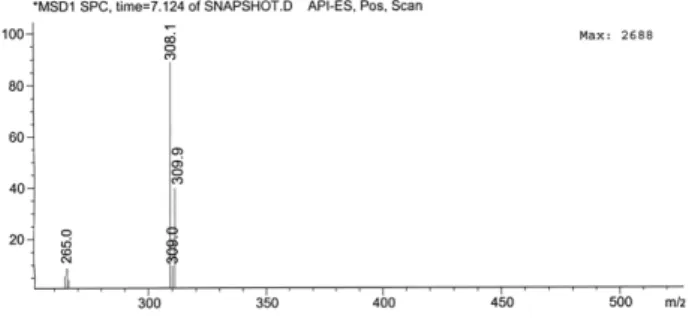
111~112oC. IR(KBr): 1719 cm-1 (C=O stretching of -COO), 1621 cm-1 (C=O stretching of -CONH), 1340 cm-1 (C-H axial deformation of Br-CH2-), 637, 612 and 586 cm-1 (C- Br trans and cis stretching); MS: 308.1 (M+Na)+.
Synthesis of Phe-Gly-CS
0.1130 g (0.7 mmol of -NH2) chitosan was dissolved in 60 mL (0.025 mol·L-1) HCl containing 0.4 g (1.4 mmol) BA-Phe, a prescribed amount of NaHCO3 was then added to keep PH within the range of 8~8.5 and the reactions were allowed to proceed at 60oC under magnetic stirring for 0.5 h. Then a catalyst amount of KI was added, con- tinue stirring for 12 h.9 The products were purified by dial- ysis against deionised water for 3 days, and then freeze- dried. White sponge solid was obtained. IR(KBr): 3347 cm-1 (-OH and N-H), 1641 cm-1 (C=O of -CONH), 1538 cm-1 (C=C of benzene ring), 1384 cm-1 (O-H), 751 and 703 cm-1 (C-H of benzene ring).
Synthesis of Phe-Gly-CS-LA
0.2010 g (0.56 mmol) Lactobionic acid, 0.1075 g (0.56 mmol) EDC·HCl, 0.0645 g (0.56 mmol) NHS were mixed with Phe-Gly-CS,10 adding 0.1 mol·L-1 HCl to adjust PH at 6, the reation temperature at 25oC under magnetic stir- ring for 48 h. The products were purified by dialysis against deionised water for 3 days, and then freeze-dried.
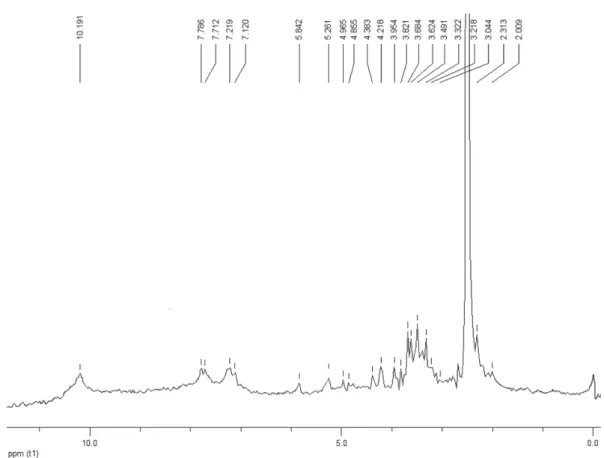
White sponge solid was obtained. IR(KBr) : 3384 cm-1 (-OH and N-H), 1653 cm-1 (C=O of -CONH), 1558 cm-1 (C=C of benzene ring), 1397 cm-1 (O-H), 900 cm-1 (pyran ring of CS and LA); 1H NMR(F3COOD-DMSO-d6, 20) d/ppm:
2.009 (NH), 2.78~2.86 (C6H6CH2), 3.044 (C2H of CS and C4H of LA), 4.77~4.86 (C6H6CH2CH), 5.26 (C1H and NH2 of CS), 7.10~7.30 (benzene ring), 7.71 (CONH of LA), 7.79 (CONH of dipeptide), 10.19 (COOH of dipeptide).
RESULTS AND DISCUSSIONS
Synthesis and characterization of Phe-Gly-CS-LA The synthesis procedure of Phe-Gly-CS-LA is shown in Scheme 1.
In the last step, EDC which is the polymer-supported carbodiimide and NHS that is to synthesize an NHS-acti- vated acid were added for promoting amide linkege for- mation. EDC is added as a coupling reagent to form a highly unstable activated acid intermediate, NHS reacts to form a less labile activated acid as SuO-. In Thermaody- namics, amide is more stable than ester, so the product can be smoothly obtained under the reaction condition. The structure of Phe-Gly-CS-LA was characterized by IR spectra.
The FTIR spectra of Phe-Gly-CS-LA has similar FTIR spectra with Phe-Gly-CS. While the peak at 1598 cm-1 of N-H bending was prominently weaker than that of Phe-
Gly-CS, which provided the evidence of loss of C2-amino group of CS. Another evidence for the formation of Phe- Gly-CS-LA was based on the two peaks at 1397 and 1072 cm-1, corresponding to -OH, its intensity was prominently enhanced due to increase of -OH group of LA. The chem- ical structure of Phe-Gly-CS-LA was further determined by 1H NMR spectroscopy (Fig. 1).
The peaks at 10.19 ppm and 7.10~7.30 ppm were assigned to the COOH of depeptide and H of benzene ring, which efficiently comfirmed that BA-Phe grafted CS. The peak at 4.97 ppm was due to C1H of LA pyran ring, respectively. Its peak is in the low field compared with other H of LA pyran ring, as the oxygen atoms around, the electron screening is weaker. From the FTIR spectra and 1H NMR spectra of Phe-Gly-CS-LA, it can be concluded the successful synthesis of Phe-Gly-CS-LA.
Synthesis and characterization of Phe-Gly-CS KI was used as the catalyst in this step for preparing BA-Phe and Phe-Gly-CS. It was desired to displace Br- with I- , improve the reaction rate. The structure of BA- Phe and Phe-Gly-CS were also characterized by IR.
Compared with the IR spectra of CS and the spectra of Phe-Gly-CS, the spectra of Phe-Gly-CS display new important absorption speaks at 1641, 751 and 703 cm-1, which were assigned to the acetyl and benzene ring of BA-Phe. This shift could effectively prove that BA-Phe was grafted onto C2-amino group of CS.
Synthesis and characterization of BA-Phe
The preparation of BA-Phe is crucial for the following Scheme 1. Synthesis of Phe-Gly-CS-LA.
steps in the whole process. In this study the effects of some reaction conditions such as temperature, reaction time and PH value for synthesis of BA-Phe were optimized. The results were analyzed as described below.
Effect of reaction temperature
The effect of temperature was studied by changing the reaction temperature from -10 to 8oC and keeping the reaction time for 1.5 h, PH at 11 and other reaction con- ditions constant (Table 1).
Table 1 shows that the yield of reaction increased as the temperature rose from -10 to -4oC, then, decreased as the temperature rose from 1 to 8oC. The reaction occurred between bromoacetyl bromide and phenylalanine via an amide linkage is an exothermic reaction. So low temper- ature is good for reaction and restraining the hydrolysis of bromoacetyl bromide. However, when the temperature is below -7oC, the molecular motion slowed down, colli-
sions between molecules also reduced, which led to a decrease in yield.
Effect of reaction time
The effect of reaction time was studied by changing the time from 1.5 to 3.5 h and keeping the temperature at -4oC, PH at 11 and other reaction conditions constant (Table 2).
From Table 2, it is clearly found that the yield increased sharply as the reaction time was extended to 1.5 h. While after 1.5 h, the yield efficiency increased very slowly.
Fig. 1. 1H NMR spectra of Phe-Gly-CS-LA in F3COOD-DMSO-d6 at 20oC.
Table 1. The effect of temperature on yield of reaction
Number 1 2 3 4 5 6
Temperature/oC 7~8 3~4 0~1 -3~-4 -7<-8 <-10
Yield/% 33.4 58.7 74.3 78.2 63.7 /
Table 2. The effect of reaction time on yield of reaction
Number 1 2 3 4
Drop time (h) 0.5 1.0 1.5 2.0
Stir time (h) 0.5 0.5 1.0 1.5
Yield (%) 44.5 78.8 79.2 79.6
Effect of pH
In this step, HBr was prepared as by-product. In order to make the reaction carry out completely and improve pro- ductivity, the reaction should be under alkaline condi- tions. The effect of pH was studied while keeping the temperature at -4oC, reaction time of 1.5 h and the other reaction conditions constant (Table 3).
Table 3 shows the yield of reaction was increased as the increase of PH up to 10-11, then, the yield was decreased as the increase of PH over 11. The decrease in the reaction yield over pH=11 could be explained by the nucleophilic reaction of -OH and -NH2 with C=O of bromoacetyl bro- mide simultaneously. In a similar study, the observed lower reaction yield at PH=8-9 was attributed to the neu- tralization reaction of HBr can not be fully completed under the weak base condition.
Characterization of BA-Phe
BA-Phe was prepared by Phe and bromoacetyl bromide via an amide linkage, which is a significant feature com- pared with Phe. So the reaction happened or not can be decided by its absorption peak in IR spectra. The spec- trum of Phe presents the following bands: N-H stretching vibration at 3297 cm-1, O-H and N-H stretching vibration (hydrogen bond ) at 3068 cm-1, C-H stretching vibration at 2953 cm-1, -C=O at 1621.79 cm-1, benzene ring stretching vibration at 1585 and 1499 cm-1, C-N and -NH3+ stretch- ing vibration at 1213 cm-1, N-H bending vibration at 853 cm-1, C-H axial deformation of benzene ring at 743 and 698 cm-1. In comparison to the Phe IR spectrum, The BA- Phe spectra display a new absorption peak at 637, 612, 586 cm-1, respectively, corresponding to the C-Br tra and cis stretching vibration. The interpretation of the -C=O
(NH-C=O) stretching is at 1621 cm-1, the -C=O (-COOH) stretching is at 1720 cm-1, the O-H (-COOH) stretching is at 1245 and 3550 cm-1, the amide N-H bending region is not trivial contribute to bands in this region. The molec- ular weight of BA-Phe is 286.12, we measured [M+Na]+
=308.1 by MS (Fig. 2).
From all above, we can conclude that the produce is as originally desired.
CONCLUSION
We successfully prepared BA-Phe as the key interme- diate, then grafted it onto CS, and obtained Phe-BA-CS.
The lactobionic acid (LA) was grafted the Phe-Gly-CS and the Phe-Gly-CS-LA was obtained. The product were characterized with IR, MS and 1H NMR. The preparing condition of BA-Phe was optimized, involving the pH 10- 11, the temperature -4oC, the reaction time 1.5 h and the yield is 78.8%.
Acknowledgements. This work was supported by the National Natural Science Foundation of China (No.
20775010), the Natural Science Foundation of Hunan Province of China (06JJ2038) and Graduate Innovation Fund of Hunan Province of China.
REFERENCES
1. Sui, W. P.; Chen, G. H.; Gao, X. C.; Shang, C. Q.; Sun, M. K. Chem. J. Chinese Univ. 2001, 22, 133.
2. Jia, J. T.; Dong, C. D.; Zhang, W. L.; Cui, Y. X.; Liu, J.
P. Pharmaceutical and Biomedical Analysis 2011, 55, 342.
3. Lin, W. J.; Chen, T. D.; Liu, C. W. Polymer 2009, 50, 4166.
4. (a) Kumar, M. N.; Muzzarelli, R.A.; Muzzarelli, C.; Sash- iwa, H.; Domb, A. J. Chem. Rev. 2004, 104, 6017. (b) Patale, R. L.; Patravale, V. B. Carbohydr. Polym. 2011, 85, 105.
5. (a) Knapczyk, L. K. J.; Krzck, J.; Brzeski, M.; Nirnberg, E.; Schenk, D.; Struszcyk, H. Chitin and Chitosan:
Sources, Chemistry, Biochemistry, Physical Properties and Applications; In Requirements of Chitosan for Pharma- ceutical and Biomedical Applications; G. Skak-Braek, T.
Anthonsen, P. Sandford, Eds.; Elsevier: London, 1989, p 657. (b) Illum, L. Pharm. Res. 1998, 15, 1326. (c) Felt, O.; Buri, P.; Gurny, R. Drug. Dev. Ind. Pharm. 1998, 24, 979. (d) Bhattarai, N.; Gunn, J.; Zhang, M. Q. Advanced Drug Delivery Reviews 2010, 62, 83. (e) Lao, S. B.;
Zhang, Z. X.; Xu, H. H.; Jiang, G. B. Carbohydr. Polym.
2010, 82, 1136.
6. (a) Yoo, H. S.; Lee, J. E.; Chung, H.; Kwon, I. C.; Jeong.
Table 3. The effect of pH value on yield of reaction
Number 1 2 3 4
pH 8~9 10~11 12~13 14
Yield (%) 40.5 78.6 77.4 64.2
Fig. 2. MS spectra of BA-Phe.
S. Y. J. Control Release 2005, 103, 235. (b) Amidi, M.;
Romeijn, S. G.; Borchard, G.; Junginger, H. E.; Hennink, W.E.; Jiskoot, W. J. Control Release 2006, 111, 107. (c) Kim, J. H.; Kim, Y. S.; Park, K.; Lee, S.; Nam, H. Y.;
Min, K. H.; Jo, H. G.; Park, J. H.; Choi, K.; Jeong, S. Y.;
Park, R. W.; Kim, I. S.; Kim, K.; Kwon, I. C. Control Release 2008, 127, 41.
7. (a) Overington, J. P.; Al-Lazikani, B.; Hopkins, A. L.
Drug Discov. 2006, 5, 993. (b) Park, J. H.; Saravanaku- mar, G.; Kim, K.; Kwon, I. C. Advanced Drug Delivery Reviews 2010, 62, 28.
8. Li, M. L.; Xu, Y. J.; Jiang, L. Q.; Chen, L. G. Chemistry 2006, 3, 179.
9. (a) Batista, M. K. S.; Pinto, L. F.; Gomes, C. A. R.;
Gomes, P. Carbohydr. Polym. 2006, 64, 299. (b) Gomes, P.; Gomes, C. A. R.; Batista, M. K. S.; Pinto, L. F. P.;
Silva, A. P. Carbohydr. Polym. 2008, 71, 54.
10. (a) Park, J. H.; Cho, Y. W.; Chung, H.; Kwon, I. C.;
Jeong, S. Y. Biomacromolecules 2003, 4, 1087. (b) Sun, L.; Dai, J. H.; Baker, G. L.; Bruening, M. L. Chem. Mater.
2006, 18, 4033.