http://dx.doi.org/10.4093/jkd.2015.16.4.252 ISSN 2233-7431
Abstract
Glucagon-like peptide 1 (GLP-1) is an incretin hormone that is released from enteroendocrine L-cells upon nutrient absorption; it stimulates glucose-dependent insulin secretion from pancreatic beta- cells. GLP-1 has pleiotropic effects including deceleration of gastric emptying, decreased appetite, and increased satiety. Treatment with GLP-1 receptor agonists (GLP-1RAs) improves glycemic control in patients with type 2 diabetes without increasing the risk of hypoglycemia or weight gain. Current GLP- 1RAs can be classified by their structure (exendin-4-based or human GLP-1-based), duration of action, and molecular size. Different GLP-1RAs exhibit different pharmacokinetics and pharmacodynamics.
Herein we review the characteristics of available GLP-1RAs and discuss current issues such as insulin combination therapy and anti-obesity effects.
Keywords:
Glucagon-like peptide 1, Obesity, Type 2 diabetes mellitus
글루카곤양 펩티드-1 수용체 작용제의 임상적 적용
민세희, 조영민
서울대학교 의과대학 내과학교실
Clinical Application of Glucagon-Like Peptide-1 Receptor Agonists
Se Hee Min, Young Min Cho
Department of Internal Medicine, Seoul National University College of Medicine, Seoul, Korea
Corresponding author: Young Min Cho
Department of Internal Medicine, Seoul National University College of Medicine, 101 Daehak-ro, Jongno-gu, Seoul 03080, Korea, E-mail: [email protected] Received: Oct. 28, 2015; Accepted: Nov. 4, 2015
This is an Open Access article distributed under the terms of the Creative Commons Attribution Non-Commercial License (http://creativecommons.org/licenses/by-nc/3.0) which permits unrestricted non-commercial use, distribution, and reproduction in any medium, provided the original work is properly cited.
Copyright ⓒ 2015 Korean Diabetes Association
서론
글루카곤양 펩티드-1 (glucagon-like peptide 1, GLP-1) 은 경구로 섭취한 음식이 소화흡수될 때 위장관 상피의 L 세포에서 분비되는 인크레틴 호르몬으로서, 포도당 자극
에 의한 인슐린 분비를 촉진하고 글루카곤 분비를 억제한다 [1]. 특히 췌장 베타세포에서 포도당 농도에 의존적으로 인 슐린 분비를 증가시키며 이외에도 중추신경계에 작용하여 식욕 억제 및 체중 감소에 대한 효과가 있고 위 배출 시간을 지연시켜 식후 혈당의 과도한 상승을 막고 포만감이 지속
되게 한다. 그러나 체내에서 생성되는 GLP-1은 dipeptidyl peptidase-4 (DPP-4)에 의해 수분 이내에 빠르게 분해되 어 활성을 잃게 되며, 일부는 GLP-1의 작은 분자량(약 3.4 kDa)으로 인해 콩팥을 통해 쉽게 여과되어 제거된다[2,3].
따라서 치료제로 쓰이는 GLP-1 수용체 작용제(GLP-1 receptor agonist, GLP-1RA)는 사람의 GLP-1과 같은 역 할을 하면서도 이러한 요인들에 의해 제거되지 않도록 만들 어진 제제이다. DPP-4에 의한 분해를 막기 위한 GLP-1RA 로는 자연적으로 DPP-4에 저항성을 갖는 아메리카독도마 뱀(Heloderma suspectum)의 타액 유래 물질인 exendin-4 및 그 유사체와 GLP-1 (7-37)의 제8번 아미노산을 변경 하여 DPP-4 효소가 인식하지 못하도록 합성한 제형(예:
albiglutide, dulaglutide)이 있으며[4] GLP-1RA에 지방산 사슬을 부착하여 알부민과 결합하도록 하여 DPP-4에 의해 잘려지는 부위를 은폐하는 liraglutide 등이 있다[5]. 또한 큰 분자 구조와 결합함으로써 사구체에서 쉽게 여과되지 못 하도록 한 GLP-1RA로는 재조합된 사람의 알부민과 결합 시킨 albiglutide[4]와, immunoglobulin G4 (IgG4) 면역 글로불린의 Fc 부위와 결합시킨 dulaglutide가 있다[6]. 그 외에도 exenatide once-weekly와 같이 DPP-4에 의해 분 해되지 않는 GLP-1RA를 생분해성 마이크로스피어에 넣 어 지속적인 약물 방출이 가능하도록 개발된 서방형 제제 가 있다[7]
본론
1. GLP-1 수용체 작용제(GLP-1RA)의 종류와 특징
GLP-1RA는 크게 두 가지로 나눌 수 있는데, exendin-4 를 기반으로 개발된 exenatide, lixisenatide, 그리고 exenatide once-weekly가 있으며 사람의 GLP-1을 기반으 로 합성된 liraglutide, albiglutide, 그리고 dulaglutide가 있 다[8]. 이들은 종류에 따라 약물역동학적 특징에 조금씩 차 이가 있지만, 공통적으로 우수한 혈당강하 효과와 함께 체 중 감소 효과를 나타내면서도 저혈당의 발생이 적다. 흔한
부작용으로는 구역, 구토, 설사와 같은 위장관계 증상이 있 다.
1) Exenatide
Exenatide는 자연적으로 DPP-4의 분해에 저항성을 가 지는 아메리카독도마뱀의 타액에서 유래한 exendin-4를 기반으로 합성된 제제로서 GLP-1과 53%의 상동성을 가 지며 피하주사 후 반감기는 약 3.3~4.0시간이다[9]. 초 회 용량은 최소 1개월간 5 μg을 1일 2회 주사하며 이후 혈 당 조절을 더욱 개선시키기 위해 10 μg을 1일 2회로 증량 할 수 있다. 아침 및 저녁 식사 전에 투약하거나, 약 6시 간 이상 간격을 둔 하루 중 2회의 주요 식사 전 60분 이내 에 투약한다. Exenatide는 생활 습관 교정, 설폰요소제, thiazolidinediones, 메트포민의 단독 또는 병합요법으로 혈 당이 잘 조절되지 않는 제2형 당뇨병 환자에서 혈당 조절을 개선시켰으며[10], 장시간 작용 인슐린인 글라진과 비슷한 혈당 강하효과를 보였다[11]. 공복 혈당 강하 효과를 주로 보이면서 체중이 증가하고 저혈당 위험이 증가하는 글라진 과는 달리 exenatide는 식후 혈당을 주로 감소시키고, 체중 을 줄이며 저혈당 발생률이 낮았다[11].
2) Lixisenatide
Exendin-4 유사체로서 카르복시 말단부위를 변형시킨 것 이다[12]. Lixisenatide의 혈중 반감기는 약 2.7~4.3시간 으로 exenatide와 크게 차이가 나지는 않는다고 알려져 있 으나[13], 20 μg 1회 주사 요법이 10 μg 2회 주사 요법과 당 화혈색소 강하 효과가 비슷하여 20 μg 1일 1회 요법으로 사 용된다[14]. 인슐린과 설폰요소제 치료에도 혈당 조절이 충 분치 않은 제2형 당뇨병 환자를 대상으로 하였던 연구에서 lixisenatide를 투여하였을 때 당화혈색소와 식후 혈당의 유 의한 감소를 보이면서도 저혈당 발생 빈도는 위약군과 차 이가 없었으며[15], 심혈관계 안전성 측면에 있어서는 최 근 급성 관동맥 증후군을 경험하였던 제2형 당뇨병 환자군 을 대상으로 한 연구에서 lixisenatide가 위약군과 비교하여 주요 심혈관 사건을 증가시키지 않는 것으로 나타났다[16].
이 약은 식사 전 1시간 이내에 투여하며 아침, 점심, 저녁 식 사 중 가장 적당한 시기를 정해서 매일 그 식사 이전에 투여 한다. 초회 용량으로 10 μg을 1일 1회 14일 동안 투여한 이 후 고정 유지 용량인 20 μg을 1일 1회로 투여한다.
3) Liraglutide
지방산 사슬을 결합시킨 GLP-1RA로서 사람 GLP-1과 97% 상동성을 가지고 있으며, 피하주사 후 알부민과 결 합하여 중합체를 형성함으로써 DPP-4에 의한 분해와 사 구체를 통한 여과를 방지한다[5]. Liraglutide의 반감기는 11~15시간으로 1일 1회 식사와 관계없이 피하 주사로 투 여하며, 초회 용량 0.6 mg으로 시작해서 1주일 이상의 간격 을 두고 1.2 mg으로 증량하며 최대 1.8 mg까지 사용할 수 있다. 제2형 당뇨병 환자(n = 4,625)를 대상으로 26주간 liraglutide와 기타 당뇨치료제를 투여한 결과를 메타분석 하였을 때, 당화혈색소가 7% 이하로 감소하면서도 체중 증 가 및 저혈당의 발생이 없었던 환자는 liraglutide 1.8 mg, liraglutide 1.2 mg, 위약 및 활성대조군에서 각각 40%, 32%, 6~25%였다[17]. 따라서 안전하면서 효과적인 혈당 조절이 가능함을 알 수 있다. 또한 liraglutide의 배설은 간 기능이나 신기능에 의존적이지 않으므로 이에 따른 용량 조 절이 일반적으로 필요치 않으나 사용 경험이 제한적이므로 주의가 요구된다[18,19].
4) Exenatide once-weekly
Exenatide를 0.06 mm 직경의 생분해성 마이크로스피어 에 결합시킴으로써 피하 주사 후 서서히 흡수되도록 하여 체내 반감기를 길게 만든 제제이다[20]. Exenatide once- weekly와 인슐린 글라진의 혈당 조절 효과를 비교했던 연 구에서 exenatide once-weekly는 인슐린에 비하여 우수하 면서도 오래 지속되는 혈당 조절 효과를 보였으며 체중이 줄었고 저혈당증의 위험도 낮았다[21]. 매주 같은 날에 주 1 회 2 mg을 피하투여하며 주사하는 날 하루 중 언제든지 식 사와 관계없이 투약할 수 있다. 만약 투여를 잊은 경우, 가 장 빠른 시점에 투여하며 이후 주 1회 투여 일정을 재개하면
된다. 주 1회 투여를 시작한 지 2주 내에 최소 유효 혈중 농 도에 도달하며, 6~7주 후에는 항정 상태에 이른다. 이러한 특징으로 기존의 exenatide 제제에 비해 위장관 부작용이 적다.
5) Albiglutide
유전공학으로 GLP-1 이합체를 사람 알부민과 결합시켜 만든 fusion peptide이다. 2014년 4월 미국식품의약국의 승 인을 받았으며 DPP-4에 의해 분해가 되지 않고 73 kDa의 큰 분자량으로 사구체에서 쉽게 여과되지 않는다. 반감기는 약 6~8일로 혈중에서 오랫동안 머무르기 때문에 주 1회 용 법으로 식사와 관계없이 투약한다. 만약 투약시기를 놓쳤다 면 투약 예정일에서 3일이 지나기 전에 투약하면 된다. 초회 용량 30 mg으로 시작해서 50 mg까지 증량할 수 있다.
6) Dulaglutide
DPP-4에 분해되지 않는 GLP-1 유사체 두 분자를 IgG4 의 Fc 부위에 결합시켜 분자량을 63 kDa로 크게 만듦으로 써 반감기를 늘린 제제이다. 2014년 9월 미국식품의약국의 승인을 받았다. 혈중 반감기는 약 4일이며 주 1회 용법으로 투약한다. 초회 용량 0.75 mg으로 시작하여 1.5 mg까지 증 량할 수 있다. GLP-1RA 중 유일하게 liraglutide에 대해서 비열등성을 증명한 바 있다[22].
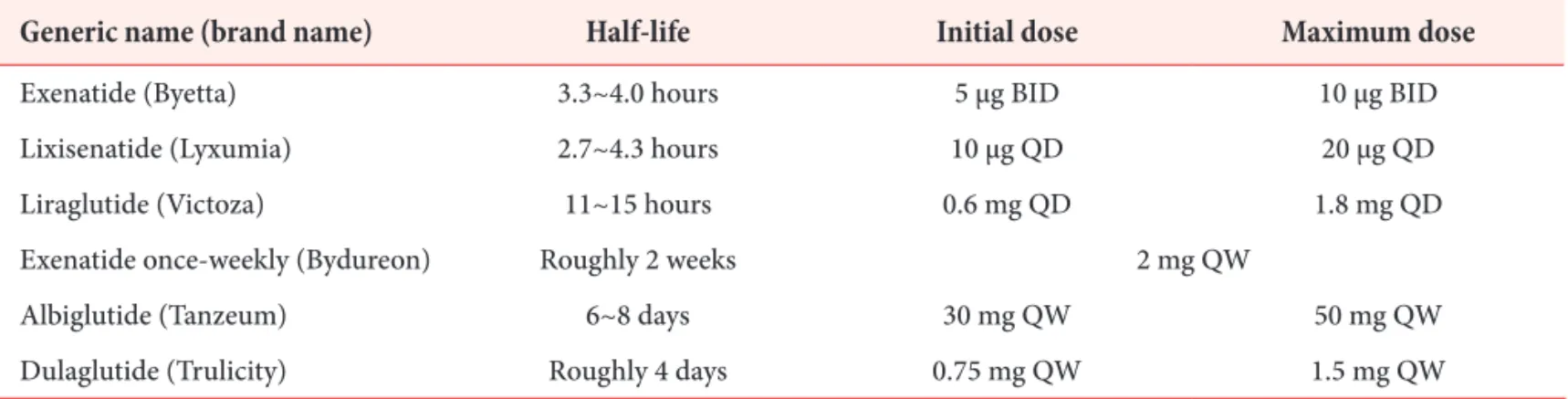
이상의 약제들에 대한 반감기 및 사용법에 관하여 Table 1에 정리하였다.
2. GLP-1 수용체 작용제(GLP-1RA)와 관련된 최근 이슈들
1) 작용 시간에 따른 분류와 특징
GLP-1RA는 앞서 exendin-4 또는 GLP-1 구조 중 어 느 것을 기반으로 하느냐에 따라 나누어 설명한 바 있는 데, 작용 시간에 따라서 단시간 작용제와 장시간 작용제 로 나눌 수 있다. 단시간 작용제의 종류에는 exenatide와 lixisenatide가 있으며 피하 주사 후 약 6시간까지 작용한다.
이러한 단시간 작용제는 위 배출 지연 작용이 뚜렷하여 식
후 혈당 상승을 방지하는 데 효과가 있으며 이 경우 오히려 식후 인슐린 분비는 감소한다[12,23,24].
이에 비해 장기간 작용제인 liraglutide, exenatide once- weekly, albiglutide, dulaglutide는 단시간 작용제에 비해 몇 가지 다른 특성을 가지고 있다. 첫째, 투약과 투약 사이 에 약물의 혈중 농도가 뚜렷이 감소하지 않기 때문에, 단시 간 작용제에 비해 공복 및 야간 혈당 조절 효과가 우수하며
당화 혈색소의 감소 효과도 일반적으로 더 크다[7,25]. 둘 째, GLP-1 수용체가 지속적으로 활성화되면 위배출시간 지 연 작용에 대한 속성 내성(tachyphylaxis)이 발생하므로 장 시간 GLP-1 작용제를 투여할 경우 위 배출 지연에 대한 효 과는 서서히 감소한다. 따라서 단시간 작용제에 비하여 장 시간 작용제는 식후 혈당 감소효과가 적고 식후 인슐린 분 비는 증가한다[26]. 그러나 두 작용제 모두 위 배출 지연과
Table 1. Half-life and recommended dosage of GLP-1 receptor agonists
Generic name (brand name) Half-life Initial dose Maximum dose
Exenatide (Byetta) 3.3~4.0 hours 5 μg BID 10 μg BID
Lixisenatide (Lyxumia) 2.7~4.3 hours 10 μg QD 20 μg QD
Liraglutide (Victoza) 11~15 hours 0.6 mg QD 1.8 mg QD
Exenatide once-weekly (Bydureon) Roughly 2 weeks 2 mg QW
Albiglutide (Tanzeum) 6~8 days 30 mg QW 50 mg QW
Dulaglutide (Trulicity) Roughly 4 days 0.75 mg QW 1.5 mg QW
BID, twice a day; QD, once a day; QW, once a week.
Table 2. Comparison of short-acting versus long-acting GLP-1 receptor agonists
Variable Short-acting GLP-1 receptor agonist Long-acting GLP-1 receptor agonist
Compounds Exenatide Liraglutide
Lixisenatide Exenatide once-weekly
Albiglutide Dulaglutide
Half-life 2~5 hours 12 hours to several days
Effects
Fasting plasma glucose ↓ ↓↓
Postprandial hyperglycemia ↓↓ ↓
Fasting insulin secretion ↑ ↑↑
Postprandial insulin secretion ↓ ↑
Gastric emptying rate Deceleration No effect
Body weight reduction 1~5 kg 2~5 kg
Nausea 20~50% 20~40%
GLP-1, glucagon-like peptide 1.
관계없이 중추신경계에 작용하여 식욕을 억제하는 작용이 있기 때문에 체중 감소에 대한 효과는 유지된다[7,25]. 장시 간 작용제와 단시간 작용제에 대한 특성을 비교하여 Table 2에 정리하였다.
2) 인슐린 병용요법
일반적으로 제2형 당뇨병 환자의 베타세포 기능이 점진 적으로 감소하기 때문에 종국에는 인슐린 사용을 피하기 어 렵다. 인슐린은 용량을 증가시킬수록 혈당을 더욱 강력하게 조절할 수 있지만 반대로 저혈당과 체중 증가의 부작용이 있기 때문에 실제 임상에서는 인슐린의 용량을 늘리는 것이 의사나 환자 모두에게 부담이다. 따라서 인슐린과 병용함으 로써 효과적인 혈당 조절을 하면서도 체중 증가와 저혈당 의 위험을 줄일 수 있는 약제의 필요성이 대두되었다. 이 점 에서 GLP-1RA와 기저 인슐린의 병합 요법은 이론상의 여 러 장점이 있는데, 식후 혈당 감소 효과로 기저 인슐린의 약 점을 보완할 수 있고, GLP-1의 혈당 의존성 인슐린 분비 및 체중 감소 효과로 인하여 인슐린의 부작용인 저혈당 및 체 중 증가에 대한 부담을 줄일 가능성이 있다. 인슐린과 GLP- 1RA를 병용한 15개의 임상시험을 메타분석하였을 때 병용 요법이 다른 치료(GLP-1RA 단독 또는 기저인슐린 단독 또 는 다른 경구 혈당 강하제와 병용)에 비해 평균 0.44%의 당 화혈색소 감소 효과를 보였으며 체중 또한 3.22 kg 감소하 였으나, 저혈당의 위험도는 두 그룹에 차이가 없었다[27].
기저 및 식전 인슐린 요법(basal bolus insulin therapy) 과 비교하였을 때에는 평균 0.1%의 당화혈색소 감소 효과 를 보였으나 5.66 kg의 체중 감소 효과가 있었고 저혈당에 대한 위험도가 낮았다[27]. 국내에서는 2015년 10월부터 GLP-1RA와 인슐린을 병용할 때 보험급여를 받을 수 있도 록 개정안이 발표되어 GLP-1RA와 인슐린 병합요법은 제2 형 당뇨병 치료에 있어 좋은 대안이 될 수 있을 것으로 생각 된다.
3) 비만치료제로서의 역할
최근 고용량 liraglutide가 혈당 조절뿐만 아니라 비만 환
자의 체중 감소에 효과적이라는 임상시험 결과가 발표되었 다[28,29]. 기존에 경구혈당 강하제를 투여하던 제2형 당뇨 병 환자들을 대상으로 56주간 liraglutide 3.0 mg, 1.8 mg, 위약을 매일 투여하면서 식이요법 및 운동을 병행하였을 때, 각각 6.4, 5.0, 2.2 kg의 체중 감소 효과를 보였다[28].
또한 기존에 당뇨가 없던 과체중 또는 비만 환자들을 대상 으로 liraglutide 3.0 mg과 위약을 투여하여 비교한 연구에 서는 각각 8.4 kg, 2.8 kg 의 체중 감소 효과를 보였으며 연 구 종료 시점에서 당뇨병으로 새로 진단된 환자의 비율도 liraglutide 투여군에서 유의하게 적었다[29]. 이러한 결과 를 바탕으로 2014년 12월 liraglutide 일일 3 mg 제제는 비 만치료제로 미국식품의약국의 승인을 받았다.
결론
GLP-1RA는 강력한 인슐린 분비 자극 효과가 있으면서 혈당 의존성으로 인슐린 분비를 증강시키는 특징이 있어서 혈당 조절 효과가 우수할 뿐 아니라 저혈당이 잘 생기지 않 고 식욕 억제, 체중 감소 등의 장점을 가지고 있어서 제2형 당뇨병의 치료에 새로운 지평을 열고 있다. GLP-1RA는 단 독 요법부터 인슐린 병용에 이르는 다양한 치료 단계에서 효과와 안전성이 확인된 바 있다. 또한 최근 lixisenatide가 심혈관질환 위험이 매우 높은 제2형 당뇨병 환자군에서 심 혈관계 사건 발생 위험을 증가시키지 않았다는 연구 결과가 발표된 바 있고, 다른 GLP-1RA들의 심혈관계 안전성 평가 를 위한 임상시험이 현재 진행 중이므로 이들이 심혈관 안 전성을 넘어서서 심혈관 보호효과를 증명할 수 있을지도 기 대되는 바이다. 특히 GLP-1RA의 효과를 아시아인과 비 아 시아인을 대상으로 비교하였던 메타분석에서 당화혈색소 감소 효과가 아시아인 위주의 연구에서 1.16%로 비 아시아 인 위주의 연구의 0.83%에 비해 유의하게 높았으며 목표 당화혈색소에 도달률도 아시아인 위주의 연구에서 더 큰 경 향을 보였다[30]. 이는 체질량지수가 더 낮은 아시아인에 대한 GLP-1의 효과가 서양인에 비해 더욱 크다는 점을 시 사하는 것으로[31] 최근 GLP-1RA의 경구제제 병용 요법
에 관한 국내 보험 급여 기준에서도 체질량 지수 30 kg/m2 이하인 환자에서 25 kg/m2 이하인 환자로 조절된 것은 크게 반길 일이다. 또한 비만치료제로서의 liraglutide의 새로운 가능성이 확인되면서 향후 국내에서도 GLP-1RA의 임상적 적용이 더욱 확대될 것으로 전망된다. 유사하지만 각기 다 른 GLP-1RA들의 다양한 특성과 차이점을 기반으로 개별 화된 접근을 통해 제2형 당뇨병 및 비만 환자의 치료 전략을 세워야 할 것이다.
REFERENCES
1. Cho YM, Wideman RD, Kieffer TJ. Clinical application of glucagon-like peptide 1 receptor agonists for the treatment of type 2 diabetes mellitus. Endocrinol Metab (Seoul) 2013;28:262-74.
2. Meier JJ, Nauck MA, Kranz D, Holst JJ, Deacon CF, Gaeckler D, Schmidt WE, Gallwitz B. Secretion, degradation, and elimination of glucagon-like peptide 1 and gastric inhibitory polypeptide in patients with chronic renal insufficiency and healthy control subjects. Diabetes 2004;53:654-62.
3. Cho YM, Fujita Y, Kieffer TJ. Glucagon-like peptide-1:
glucose homeostasis and beyond. Annu Rev Physiol 2014;76:535-59.
4. Bush MA, Matthews JE, De Boever EH, Dobbins RL, Hodge RJ, Walker SE, Holland MC, Gutierrez M, Stewart MW. Safety, tolerability, pharmacodynamics and pharmacokinetics of albiglutide, a long-acting glucagon- like peptide-1 mimetic, in healthy subjects. Diabetes Obes Metab 2009;11:498-505.
5. Knudsen LB, Nielsen PF, Huusfeldt PO, Johansen NL, Madsen K, Pedersen FZ, Thøgersen H, Wilken M, Agersø H. Potent derivatives of glucagon-like peptide-1 with pharmacokinetic properties suitable for once daily administration. J Med Chem 2000;43:1664-9.
6. Barrington P, Chien JY, Showalter HD, Schneck K, Cui S, Tibaldi F, Ellis B, Hardy TA. A 5-week study of the pharmacokinetics and pharmacodynamics of LY2189265, a novel, long-acting glucagon-like peptide-1 analogue, in patients with type 2 diabetes. Diabetes Obes Metab 2011;13:426-33.
7. Drucker DJ, Buse JB, Taylor K, Kendall DM, Trautmann M, Zhuang D, Porter L; DURATION-1 Study Group.
Exenatide once weekly versus twice daily for the treatment of type 2 diabetes: a randomised, open-label, non-inferiority study. Lancet 2008;372:1240-50.
8. Cho YM, Merchant CE, Kieffer TJ. Targeting the glucagon receptor family for diabetes and obesity therapy.
Pharmacol Ther 2012;135:247-78.
9. Kolterman OG, Kim DD, Shen L, Ruggles JA, Nielsen LL, Fineman MS, Baron AD. Pharmacokinetics, pharmacodynamics, and safety of exenatide in patients with type 2 diabetes mellitus. Am J Health Syst Pharm 2005;62:173-81.
10. Tahrani AA, Piya MK , Kennedy A, Barnett AH.
Glycaemic control in type 2 diabetes: targets and new therapies. Pharmacol Ther 2010;125:328-61.
11. Heine RJ, Van Gaal LF, Johns D, Mihm MJ, Widel MH, Brodows RG; GWAA Study Group. Exenatide versus insulin glargine in patients with suboptimally controlled type 2 diabetes: a randomized trial. Ann Intern Med 2005;143:559-69.
12. Werner U, Haschke G, Herling AW, Kramer W.
Pharmacological profile of lixisenatide: a new GLP- 1 receptor agonist for the treatment of type 2 diabetes.
Regul Pept 2010;164:58-64.
13. Christensen M, Knop FK , Holst JJ, Vilsboll T.
Lixisenatide, a novel GLP-1 receptor agonist for the treatment of type 2 diabetes mellitus. IDrugs 2009;12:503-13.
14. Ratner RE, Rosenstock J, Boka G; DRI6012 Study Investigators. Dose-dependent effects of the once-daily GLP-1 receptor agonist lixisenatide in patients with Type 2 diabetes inadequately controlled with metformin:
a randomized, double-blind, placebo-controlled trial.
Diabet Med 2010;27:1024-32.
15. Seino Y, Min KW, Niemoeller E, Takami A; EFC10887 GETGOAL-L Asia Study Investigators. Randomized, double-blind, placebo-controlled trial of the once-daily GLP-1 receptor agonist lixisenatide in Asian patients with type 2 diabetes insufficiently controlled on basal insulin with or without a sulfonylurea (GetGoal-L-Asia).
Diabetes Obes Metab 2012;14:910-7.
16. Cho YM. Cardiovascular effects of the incretin-based therapy: the good, the bad, or the ugly? J Diabetes Investig 2015;6:597-9.
17. Zinman B, Schmidt WE, Moses A, Lund N, Gough S.
Achieving a clinically relevant composite outcome of an HbA1c of <7% without weight gain or hypoglycaemia in type 2 diabetes: a meta-analysis of the liraglutide clinical trial programme. Diabetes Obes Metab 2012;14:77-82.
18. Flint A, Nazzal K, Jagielski P, Hindsberger C, Zdravkovic M. Influence of hepatic impairment on pharmacokinetics of the human GLP-1 analogue, liraglutide. Br J Clin Pharmacol 2010;70:807-14.
19. Jacobsen LV, Hindsberger C, Robson R, Zdravkovic M. Effect of renal impairment on the pharmacokinetics of the GLP-1 analogue liraglutide. Br J Clin Pharmacol 2009;68:898-905.
20. DeYoung MB, MacConell L, Sarin V, Trautmann M, Herbert P. Encapsulation of exenatide in poly-(D,L- lactide-co-glycolide) microspheres produced an investigational long-acting once-weekly formulation for type 2 diabetes. Diabetes Technol Ther 2011;13:1145-54.
21. Diamant M, Van Gaal L, Guerci B, Stranks S, Han J,
Malloy J, Boardman MK, Trautmann ME. Exenatide once weekly versus insulin glargine for type 2 diabetes (DURATION-3): 3-year results of an open-label randomised trial. Lancet Diabetes Endocrinol 2014;2:
464-73.
22. Dungan KM, Povedano ST, Forst T, González JG, Atisso C, Sealls W, Fahrbach JL. Once-weekly dulaglutide versus once-daily liraglutide in metformin-treated patients with type 2 diabetes (AWARD-6): a randomised, open-label, phase 3, non-inferiority trial. Lancet 2014;384:1349-57.
23. Kolterman OG, Buse JB, Fineman MS, Gaines E, Heintz S, Bicsak TA, Taylor K, Kim D, Aisporna M, Wang Y, Baron AD. Synthetic exendin-4 (exenatide) significantly reduces postprandial and fasting plasma glucose in subjects with type 2 diabetes. J Clin Endocrinol Metab 2003;88:3082-9.
24. Linnebjerg H, Park S, Kothare PA, Trautmann ME, Mace K, Fineman M, Wilding I, Nauck M, Horowitz M.
Effect of exenatide on gastric emptying and relationship to postprandial glycemia in type 2 diabetes. Regul Pept 2008;151:123-9.
25. Buse JB, Rosenstock J, Sesti G, Schmidt WE, Montanya E, Brett JH, Zychma M, Blonde L; LEAD-6 Study Group. Liraglutide once a day versus exenatide twice a day for type 2 diabetes: a 26-week randomised, parallel- group, multinational, open-label trial (LEAD-6). Lancet 2009;374:39-47.
26. Nauck MA, Kemmeries G, Holst JJ, Meier JJ. Rapid tachyphylaxis of the glucagon-like peptide 1-induced deceleration of gastric emptying in humans. Diabetes 2011;60:1561-5.
27. Eng C, Kramer CK, Zinman B, Retnakaran R. Glucagon- like peptide-1 receptor agonist and basal insulin combination treatment for the management of type 2 diabetes: a systematic review and meta-analysis. Lancet 2014;384:2228-34.
28. Davies MJ, Bergenstal R, Bode B, Kushner RF, Lewin A, Skjøth TV, Andreasen AH, Jensen CB, DeFronzo RA; NN8022-1922 Study Group. Efficacy of liraglutide for weight loss among patients with type 2 diabetes:
the SCALE diabetes randomized clinical trial. JAMA 2015;314:687-99.
29. Pi-Sunyer X, Astrup A, Fujioka K, Greenway F, Halpern A, Krempf M, Lau DC, le Roux CW, Violante Ortiz R, Jensen CB, Wilding JP; SCALE Obesity and Prediabetes NN8022-1839 Study Group. A randomized, controlled
trial of 3.0 mg of liraglutide in weight management. N Engl J Med 2015;373:11-22.
30. Kim YG, Hahn S, Oh TJ, Park KS, Cho YM. Differences in the HbA1c-lowering efficacy of glucagon-like peptide-1 analogues between Asians and non-Asians: a systematic review and meta-analysis. Diabetes Obes Metab 2014;16:900-9.
31. Cho YM. Incretin physiology and pathophysiology from an Asian perspective. J Diabetes Investig 2015;6:495-507.