Ⅰ. INTRODUCTION
In order to simplify the clinical procedures and improve the quality of the bonding, a self-etching primer was introduced. It etches and primes the tooth surface simultaneously, also avoiding the risk of collagen collapse1). The self-etching adhe- sives have some advantages over total etching
Priming time and etching effect on shear bond strength of self-etching adhesive
In-Joo Kang, Jeong-Won Park*
Department of Conservative Dentistry, School of Dentistry, Kyungpook National University
프라이머 처리시간과 산부식이 자가산부식 접착제의 접착강도에 미치는 영향
강인주∙박정원*
경북대학교 치과대학 치의학과 보존학교실
자가산부식 접착제 (self-etching primer)는 법랑질과 상아질을 동시에 산부식과 프라이머 처리를 함으로 임상 시술 시간을 단축시킬 뿐만 아니라, 임상과정 중 발생할 수 있는 술자의 실수 및 타액등에 의한 오염의 가능성을 줄일 수 있 는 장점을 가지고 있다. 그러나 약산을 이용한 산부식법이 법랑질에 대해 탈회효과 및 접착강도에 있어 논란이 되고 있 다. 이에 본 연구에서는 인산을 이용한 추가적인 산부식 및 자가산부식 접착제의 적용시간을 달리할 경우 법랑질에 대한 접착강도의 변화를 알아보고자 하였다.
135개의 발거한 우치의 법랑질 면을 #600 사포로 연마한 후 9개의 군으로 분류하였다. 각 군은 부가적인 32% 인산 을 처리하지 않은 군 (1~3군), 15초간 처리한 군 (4~6군), 60초간 처리한 군 (7~9군)으로 나누고, 이를 다시 Clearfil SE Bond의 프라이머로 5초 (1, 4, 7군), 20초 (2, 5, 8군), 60초 (3, 6, 9군)간 처리한 군으로 분류하였다.
접착제 처리한 면에 Clearfil AP-X 복합레진을 접착하고 24시간 경과 후 전단응력 강도를 측정하였다. 결과는 One- way ANOVA 처리 후 Duncan’s multiple range test로 사후검증하였다.
동일한 자가산부식 프라이머 처리 시간을 가진 군에서 산 부식을 한 경우가 그렇지 않은 군에 비해 높은 접착강도를 나타내었으며 인산부식 시간의 차이에 의한 영향은 없었다 (1 < 4,7군/ 2 < 5,8군/ 3 < 6,9군).
자가산부식제의 프라이머 적용 시간에 의한 효과는 1군 (5초 적용)을 제외한 나머지 군의 경우 동일한 인산 처리군에 서는 차이가 없는 것으로 나타났다 (1군 < 2, 3군/ 4 = 5 = 6군/ 7 = 8 = 9군).
Clearfil SE Bond 접착제의 법랑질에 대한 접착강도는 부가적인 산부식을 통하여 증가시킬 수 있으며 프라이머의 적 용 시간에 의한 효과는 제조자의 지시에 의한 시간 이상 적용할 경우 차이가 없는 것으로 나타났다. [J Kor Acad Cons Dent 29(2):185-190, 2004]
주요어 : Self-etching primer, Acid etching, Priming time, Shear bond strength 국문초록
Corresponding author: Jeong-Won Park Department of Conservative Dentistry,
School of Dentistry, Kyungpook National University 101, Dongin-dong 2-ga, Joong-gu, 700-422 Daegu, Korea Tel : 82-53-420-5931 Fax : 82-53-426-8958 E-mail : [email protected]
※ This work was supported by BioMedical Research Institute grant, Kyungpook National University Hospital (2002)
adhesives. The application step was reduced and the technique sensitivity associated with varia- tions in the state of hydration of a demineralized collagen matrix is also eliminated2-4).
The mechanism of SEP is different from the total etching systems. The acidic part of the primer is neutralized by calcium and phosphate ions released during demineralization. When water is evaporated during air-drying, the con- centrations of solubilized calcium and phosphate within the primer may exceed the solubility prod- uct constants for a number of calcium and phos- phate. Thus it is conceivable that residues of the primer or possibly precipitates of calcium phos- phates could remain on the tooth surface and thereby masked the etching pattern. Therefore, demineralization is self-limiting, in that the high concentration of these ions tends to inhibit fur- ther dissolution of hydroxyapatite5). For this rea- son, Gordan et al.6) reported that self-etching primer systems showed minimal or no adhesive penetration of the enamel surface, while acid etching prior to their application created more consistent resin tag penetration.
The bond strength of SEP to dentin seems to be adequate7). However, clinical usage of self-etching primer system in enamel bonding has been a con- troversial issue. Some published researches offered evidence that a SEP could be used for composite to enamel bonding without phosphoric acid treatment8-10). However, Hara et al.11) reported that bonding of self-etching adhesives to ground enamel was inferior when compared with single- bottle and multiple step, total-etch systems that utilize phosphoric acid as separate conditioner.
Itou et al.12) reported the priming time influenced the morphologies of the tooth-resin interfaces; the extended priming time resulted in more severe decalcification of the tooth substrates to create thicker resin tags into enamel and a thicker hybrid layer at the resin-dentin interface, but it is uncer- tain that these morphologic changes can increase the bond strength of resin-enamel adhesion.
In this study, the influence of different applica- tion time of self-etching primer and enamel etch- ing before priming on the adhesion of resin com-
posite to bovine enamel was examined by measur- ing the shear bond strength between resin com- posite and tooth substrate.
Ⅱ. MATERIALS AND METHODS
One hundred and thirty five extracted bovine anterior teeth without any defect of enamel were chosen. The teeth were sectioned at cemento- enamel junction and embedded in auto-polymeriz- ing acrylic resin (Orthodontic Resin, Dentsply/
Detrey, Konstanz, Germany) molds so that the prepared enamel surfaces were 2 mm above acrylic resin cylinders, and placed in tap water to reduce the temperature rise from the exothermic polymerization reaction.
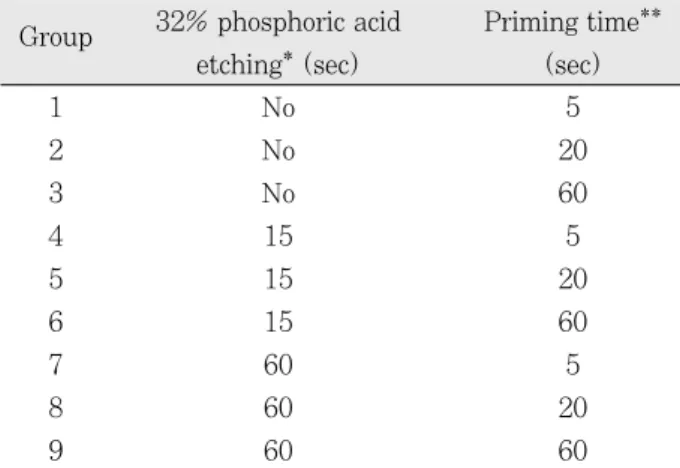
After the resin had completely polymerized, the labial surfaces of the teeth were ground with model trimming wheel and 600-grit abrasive paper under wet conditions so that flat enamel surfaces were acquired. After ultrasonic cleaning with distilled water for 3 minutes to remove the excess debris, these surfaces were washed and dried with oil-free compressed air (Hotman, Dentro, Tokyo, Japan). The teeth were randomly divided into nine groups of 15 teeth and treated in the manner shown in Table 1.
Table 1.Experimental groups following the surface treatment methods
Group 32% phosphoric acid Priming time**
etching* (sec) (sec)
1 No 5
2 No 20
3 No 60
4 15 5
5 15 20
6 15 60
7 60 5
8 60 20
9 60 60
* 32% phosphoric acid with benzalkonium chloride (UNI-ETCH BAC, Bisco, Inc., Schaumburg, IL, USA)
** Clearfil SE Bond primer (Kuraray Co., Ltd., Osaka, Japan)
After the etching procedure, the bonding surface was fully rinsed with running water for 10 sec- onds and dried. Clearfil SE Bond (Kuraray Co., Ltd., Osaka, Japan) primer was applied to the tooth surface with Microbrush (Int’l, Co., Ltd., Dungarvan, Waterford, Ireland) for 5, 20, 60 sec- onds for each group.
After primed tooth surface was dried with oil- free compressed air for 5 seconds, the bonding agent was applied to the surface and air-thinned.
Then irradiated with curing light (SpectrumTM 800, Dentsply DeTrey GmbH, Konstanz, Germany) for 10 seconds, with the intensity set at 400 mW/cm2.
A mounting jig (Ultradent Product Inc., South Jordan, Utah, U. S. A.) was placed against the tooth surface and stabilized with an alignment tube. Hybrid resin composite (Clearfil AP-X, Kuraray Co., Ltd., Osaka, Japan) was packed into the mold and light-cured for 40 seconds.
After polymerization, the alignment tube and mold were removed and the specimens were placed in 37℃, 100% humidity. Twenty-four hours after storage, the specimens were tested in shear mode using a chisel-shaped rod in an Instron testing machine (Type 4202, Instron Corp., Canton, MA, USA) at crosshead speed of 1 mm/minute.
The data for each group were subjected to one- way ANOVAs followed by Duncan’s multiple range tests at p < 0.05 to make comparisons among the groups.
Ⅲ. RESULTS
The results of the shear bond strength were shown in Table 2.
Following the result of statistical analysis, 32%
phosphoric acid etching before SEP primer appli- cation (Groups 4-9) increased the bond strength compared to non-etching group (Groups 1-3) (p <
0.05). The increased additional etching time (15 to 60 sec) did not affect to the shear bond strength of SEP to enamel.
In non-etching groups, Group 1 showed signifi- cant lower bond strength than Groups 2 and 3.
Increased priming time - longer than the manu- facturer’s recommendation - had no significant effect on bond strength (p > 0.05). However, in 15 and 60 sec etching groups, the effect of priming time was not significant (Groups 4=5=6 and Groups 7=8=9).
In 5 sec, 20 sec and 60 sec priming groups, the additional phosphoric acid etching would increase the bond strength of SEP (p < 0.05).
Ⅳ. DISCUSSION
Recently, multi-functional primers, so-called self-etching primers (SEP), have been introduced for the simultaneous conditioning/priming of both enamel and dentin without being rinsed off. The rationale behind these acidic monomers is the for- mation of a continuum between the tooth surface and the adhesive material by the simultaneous demineralizaton and resin penetration of the enamel and dentin surface with acidic molecules that can be polymerized in situ12).
SEP used weaker acid (Clearfil SE Bond pH = 1.9) than conventional phosphoric acid (32%
UNI-ETCH pH = 0.1), so it’s abilities of acid Table 2.Shear bond strengths of resin composite to ena- mel with Clearfil SE Bond(mean ± S.D. in MPa, n = 15)
Group n Shear bond Duncan’s strength (MPa) grouping
1 15 17.5 ± 6.8 A
2 15 24.6 ± 4.3 B
3 15 23.4 ± 7.8 B
4 15 30.5 ± 7.0 CD
5 15 31.9 ± 5.3 CD
6 15 27.9 ± 6.7 C
7 15 30.3 ± 7.2 CD
8 15 32.6 ± 4.8 D
9 15 32.3 ± 7.1 D
* Statistically significant difference by one-way ANOVA (p < 0.05).
Groups denoted with the same letters are not signifi- cantly different at p < 0.05.
etching and bonding were controversial. Shimada et al.13)reported that the Clearfil SE Bond system exhibited high enamel bond strengths in spite of its mild etching effect. Length of resin tags has been shown to contribute little to the bond strength of resin to enamel and bonding is mainly attributable to the ability of the resin to pene- trate between the enamel crystallites and rods14,15). On the contrary, Torii et al.16) reported that enamel etching pattern of SEP appears to be less retentive than that produced by phosphoric acid etching. Thus the decalcifying ability of self- etching primer against enamel may be insufficient for the creation of tight adhesion.
The results of this study showed that the addi- tional phosphoric acid etching groups increased bond strengths (19~74%) on enamel when they were compared in the same priming time groups.
It can be explained that there was a great differ- ence in the morphology of enamel surfaces treated with phosphoric acid versus self-etching primer when observed with SEM16). Phosphoric acid etch- ing created a deep etching pattern on the enamel surface as previously reported, while self-etching primer seemed to selectively decalcify the inter- prismatic enamel. When comparing the morpholo- gies of resin-enamel interfaces, the specimens conditioned with phosphoric acid showed thick tag-like extensions, whereas those conditioned with the self-etching primers presented thin ones.
When compared the bond strength of 15 sec and 60 sec phosphoric etching groups, there was no difference. This agreed with the previous reports that shear bond strengths and marginal microleakage are similar for 15- and 60-second etching times17-19). Also SEM study indicated that 15 sec etching times provided the same surface roughness as a 60 second etching20).
Another object in this study was evaluation of the effect of priming time of SEP on the enamel bond strength. Based on the Ferrari’s report21) - increased priming time of Clearfil Liner Bond 2 resulted in less leakage score of enamel margins than the shorter ones - we hypothesized that if the priming time with self-etching primer were extended, it might show higher decalcification
against enamel to improve enamel adhesion with- out an adverse effect on dentin adhesion.
In Clearfil Liner Bond 2 system, the perfor- mance of self-etching primer can be enhanced by multiple primer application22)and prolonged action of the primer21). Clearfil Liner Bond primer con- tains phosphoric acid ester monomer (Phenyl-P) and salicylic acid derivative monomer (5-NMSA), which promotes the affinity to collagen fiber (Kuraray Co., Ltd) and shown to desensitize hypersensitive dentin23). Because the resin tags and adhesive lateral branches are well formed after the Clearfil Liner Bond 2 primer for 60 sec- onds than 30 seconds, the 60-second application time seems to be more reliable than a shorter conditioning time clinically21).
However, the results showed that increased application time of SEP was not effective to increase the bond strength, except in Group 1 - application time was shorter than manufacturer’s recommendation. This result agreed with the pre- vious report12). We can deduce the reason of the similar bond strengths to the enamel by the self- limit effect of SEP.
The primer of SEP is not rinsed after applica- tion, but air-dried only. The calcium and phos- phate ions that were dissolved from the hydroxya- patite crystals must be suspended in the watery solution of the primer24). Presumably minerals will precipitate within the primer and tend to limit further dissolution of the apatite due to the com- mon ion effect of calcium and phosphate and thereby limit the depth of enamel surface dem- ineralization. Moreover, it is very likely that the binding of calcium ions to the phosphate residues in primer molecules contributes to the inactiva- tion of the molecule’s acidity. In addition, evapo- ration of water during air drying, as well as light curing of the primer and subsequently applied bonding agents, will restrict and inhibit the self- etching effect of the primer molecules16). Thus extended application of SEP did not increase the bond strength.
Hayakawa et al.5) reported that when enamel was treated with the self-etching primer contain- ing MDP, the prolongation of the application time
had no significant influence on its adhesion. And he also observed the patterns from the MDP self- etching primer treatment were different from those with the Phenyl-P self-etching primer;
There were no distinct structures on the enamel surface, but many precipitates were observed. It was difficult to identify the precipitate materials, which are either the reaction products of MDP and enamel or the dissolution materials from the enamel.
In 5 sec application of SEP groups, the effect of additional phosphoric acid etching was more sig- nificant than 20 sec or 60 sec SEP application groups. In 5 sec priming groups, increase of bond strengths were 73~74%, but in 20 and 60 sec priming groups, increase were 19~38%. This means that SEP has less demineralization ability to enamel.
Recently, Kubo et al.25) noted the presence of leakage at the enamel site of cervical restorations performed using Clearfil Liner Bond 2 following manufacturer’s instructions. In order to avoid leakage at the enamel site they recommended the use of 37% phosphoric acid as an enamel etchant in combination with Clearfil Liner Bond 2 bonding system for the cervical restorations that involve enamel margins. In this study, the bond strength of the composite resin to bovine enamel attained by Clearfil SE Bond system was clinically accept- able (over 25 MPa) but additional acid etching can significantly increase bond strength.
For the evaluation of the clinical performance of self-etching primer systems on enamel bonding, further studies are needed by various products and various test methods include the evaluation of microleakage at the enamel margins with and without loading and appraisement of adverse effect of thermocycling may be needed.
Ⅴ. CONCLUSION
The purpose of this study was to investigate combined effect of additional phosphoric acid etching and priming time of self-etching primer (SEP) on enamel shear bond strengths.
The labial surfaces of 135 bovine teeth were
ground with a 600-grit abrasive paper under wet conditions so that flat enamel surfaces were exposed. The surfaces were treated with following groups ; Group 1 (no etch, 5s prime), Group 2 (no etch, 20s prime), Group 3 (no etch, 60s prime), Group 4 (15s etch, 5s prime), Group 5 (15s etch, 20s prime), Group 6 (15s etch, 60s prime), Group 7 (60s etch, 5s prime), Group 8 (60s etch, 20s prime), Group 9 (60s etch, 60s prime). In Groups 4-9, 32% phosphoric acid (UNI-ETCH, Bisco, Inc., Schaumburg, IL, USA) was applied before SEP treatment. Clearfil SE Bond (Kuraray Co., Ltd., Osaka, Japan) were used as a self-etching bonding agent and Hybrid composite (Clearfil AP-X, Kuraray Co., Ltd., Osaka, Japan) was packed into the mold and light-cured for 40 seconds. Twenty-four hours after storage, the specimens were tested in shear bond strength mode. The results were statistically analyzed by one-way ANOVA and Duncan’s mul- tiple range tests.
The result were as the following:
In the same SEP priming group, additional phosphoric acid etched groups showed higher shear bond strength, and difference between 15 sec and 60 sec groups were not significant (1 <
4,7 Groups/ 2 < 5,8 Groups/ 3 < 6,9 Groups).
The effect of SEP primer application time was not significant except Group 1 (shorter than rec- ommended time).
In conclusion, enamel etching before priming showed significant increase on shear bond strength of SEP system, and etching time or priming time was no significant effect.
REFERENCES
1. Ferrari M, Goracci G, Garcia-Godoy F. Bonding mech- anism of three “one-bottle”systems to conditioned and unconditioned enamel and dentin.Am J Dent 10:224- 230, 1997.
2. Jin MU, Kim YK, Park JW. The influence of moisture control on bond strength of composite resin treated with self-etching adhesive system. J Kor Acad Cons Dent 27:363-369, 2002.
3. Milia E, Lallai MR, Garcia-Godoy F. In vivo effect of a self-etching primer on dentin. Am J Dent 12:167-171, 1999.
4. Pashley DH Tay FR. Aggressiveness of contemporary
self-etching adhesives Part II: etching effects on unground enamel. Dent Mater 17:430-444, 2001.
5. Hayakawa T, Kikutake K, Nemoto K. Influence of self- etching primer treatment on the adhesion of resin com- posite to polished dentin and enamel. Dent Mater 14:
99-105, 1998.
6. Gordan VV, VargasMA, Denehy GE. Interfacial ultra- structure of the resin-enamel region of three adhesive systems. Am J Dent 11:13-16, 1998.
7. Haller B. Recent developments in dentin bonding. Am J Dent 13:44-50, 2000.
8. Gordan VV, Vargas MA, Cobb DS, Denehy GE.
Evaluation of adhesive systems using acidic primers.
Am J Dent 10:219-223, 1997.
9. Hannig M, Reinhardt KJ, Bott B. Self-etching primer vs phosphoric acid; An alternative concept for compos- ite-to-enamel bonding. Oper Dent 24:172-180, 1999.
10. Perdigao J, Lopes L, Lambrechts P, Leitao J, Van Meerbeek BV, Vanherle G. Effects of self-etching primer on enamel shear bond strengths and SEM mor- phology. Am J Dent 10:141-146, 1997.
11. Hara AT, Amaral CM, Pimenta LA, Sinhoreti MA.
Shear bond strength of hydrophilic adhesive systems to enamel. Am J Dent 12:181-184, 1999.
12. Itou K, Torii Y, Takimura T, Chikami K, Ishikawa K, Suzuki K. Effect of priming time on tensile bond strength to bovine teeth morphologic structure of inter- faces created by self-etching primers. Int J Prosthod 14:225-230, 2001.
13. Shimada Y, Senawongse P, Harnirattisai C, Burrow MF, Nakaoki Y, Tagami J. Bond strength of two adhe- sive systems to primary and permanent enamel. Oper Dent 27:403-409, 2002.
14. Kanemura N, Sano H, Tagami J. Tensile bond strength and SEM evaluation of ground and intact enamel sur- faces. J Dent 27:523-530, 1999.
15. Shinchi MJ, Soma K, Nakabayashi N. The effect of phosphoric acid concentration on resin tag length and
bond strength of a photo-cured resin to acid-etched enamel. Dent Mater 16:324-329, 2000.
16. Torii Y, Itou K, Hikasa R, Iwata S, Nishitani Y.
Enamel tensile bond strength and morphology of resin- enamel interface created by acid etching system with or without moisture and self-etching priming system. J Oral Rehabil 29:528-533, 2002.
17. Crim GA, Shay JS. Effect of etchant time on microleakage.J Dent Child 54:339-340, 1987.
18. Gilpatrick RO, Ross JA, Simonsen RJ. Resin-to-enamel bond strengths with various etching times. Quintessence Int 22:47-49, 1991.
19. Shaffer SE, Barkmeier WW, Kelsey WP 3rd. Effects of reduced acid conditioning time on enamel microleak- age. Gen Dent 35:278-280, 1987.
20. Barkmeier WW, Shaffer SE, Gwinnett AJ. Effects of 15- vs 60-second enamel acid conditioning on adhesion and morphology. Oper Dent 11:111-116, 1986.
21. Ferrari M, Mannocci F, Vichi A, Davidson CL. Effect of two etching times on the sealing ability of Clearfil Liner Bond 2 in Class V restorations. Am J Dent 10:66-70, 1997.
22. Ogata M, Nakajima M, Sano H, Tagami J. Effect of dentin primer application on regional bond strength to cervical wedge-shaped cavity walls. Oper Dent 24:81- 88, 1999.
23. Mandras RS, Thurmond JW, Latta MA, Matranga LF, Kildee JM, Barkmeier WW: Three-year clinical evalua- tion of the Clearfil Liner Bond system. Oper Dent 22:266-270, 1997.
24. Yoshiyama M, Matsuo T, Ebisu S, Pashley D. Regional bond strengths of self-etching/self-priming adhesive systems. J Dent 26:609-616, 1998.
25. Kubo S, Konish Y, Yokota H, Watanabe T, Ohsawa M.
Effect of enamel etching with phosphoric acid on mar- ginal sealing of current adhesive system. J Dent Res 75:394 (Abstract 3015), 1996.