In vitro
Screening of Jeju Medicinal Plants for Cosmeceutical Materials
Sang-Suk Kim
1, Chang-Gu Hyun
3,*, Jongsung Lee
2, Jihee Lim
2, Ji-Young Kim
3and Deokhoon Park
2,*
1SkinCure Cosmetics Inc., and 2Biospectrum Life Science Institute (BLSI)., JeJu Bio-Industry Development Center R-204, JeJu 690-121, Korea
3Laboratory of Bioresources, Jeju Biodiversity Research Institute (JBRI), Jeju 697-943, Korea Received July 4, 2007; Accepted November 1, 2007
One of the important functions of skin is protection from harmful environments. Many studies have explored how to prevent skin from wrinkling and the occurrence of pigmentation changes.
Skin wrinkling and pigmentation changes could be caused by unusual disruption of connective tissue, the formation of free radicals and ultraviolet radiation. In this study, extracts obtained from 254 different kinds of Jeju medicinal plants were screened for inhibitory effects on tyrosinase and elastase, and for free radical scavenging effects. Four herbs, Phormium tenax, Morus bombycis, Morus alba, and Cudrania tricuspidata, were potent inhibitors of tyrosinase (IC50 values 4.62, 5.46, 8.17, and 64.17µg/mL, respectively). Aleurites fordii [IC50: 5.29µg/mL, 1,1-diphenyl-2-picrylhydrazyl (DPPH)], Distylium racemosum (IC50: 6.14µg/mL), Acer palmatum (IC50: 5.44µg/mL), and Spiraea salicifolia (IC50: 5.25µg/mL) showed good antioxidative effects. Furthermore, Distylium racemosum (IC50: 7.51µg/mL), Diospyros kaki (IC50: 15.1µg/mL), Cornus macrophylla (IC50: 16.59µg/mL), and Psidium guajava (IC50: 40.25µg/mL) exhibited potent inhibitory effects on elastase. These results suggest that medicinal plants possessing several biological activities may be potent inhibitors of the processes involved in pigmentation increases and aging. Further investigations will focus on in vivo assays and on the chemical identification of the major active components responsible for whitening and anti-aging activity in the screened efficacious extracts.
Key words:DPPH, Elastase, Jeju medicinal plants, Tyrosinase
The pigment melanin is the major determinant of the color of human skin. It is secreted by melanocyte cells in the basal layer of the epidermis. Melanin may be overproduced with chronic sun exposure, melasma, or other hyperpigmentation diseases [Briganti et al., 2003].
Therefore, a number of depigmenting agents have been developed for undesirable skin discoloration. Apart from avoiding ultraviolet (UV) exposure, application of tyrosinase inhibitors may be the least invasive procedure for maintaining skin whiteness; such agents are increasingly used in cosmetic products [Kadekaro et al., 2003].
Aging has been associated with free radical formation
in many reports. Oxidative stresses can be generated in the connective tissues and the skin cells by photodamage and inflammatory processes. When the skin is exposed to UV or visible light, it will produce free radicals, which can then induce skin damage such as occurs in phototoxicity and aging. Moreover, several studies have demonstrated that skin aging is significantly correlated with decreased elastase activity [Leu et al., 2006].
Recently, a number of studies have investigated the interactions between elastase and its inhibitors. It has been proposed, but as yet not proven, that the topical application of specific inhibitors onto the surface of human skin may have beneficial effects on UV-irritated and dry skin. Furthermore, plant sources have been evaluated for their potential as a source of natural antioxidants that may be of use in anti-aging and anti- wrinkle treatments [An et al., 2005].
Traditional herbal medicines provide an interesting, largely unexplored source for the development of potential new drugs. The potential use of traditional herbal medicines as a basis for new skin-care cosmetics
*Corresponding authors
Phone: +82-64-720-2811; Fax: +82-64-720-2801 E-mail: [email protected]
Phone: +82-64-702-8005; Fax: +82-64-702-8006 E-mail: [email protected]
Abbreviation: DPPH, 1,1-dipheny-2-picrylhydrazyl; DMSO, dimethyl sulfoxide; ESIV, N-succinyl-Ala-Ala-Ala-p-nitroanil- ide; PPE, porcine pancreatic elastase.
has been emphasized recently [Kiken and Cohen, 2002].
It is of great interest to know whether preparations used cosmetically in folk medicine have activities that might be useful in modern formulations. In our efforts to find new functional ingredients for skin-whitening, anti- wrinkle, and anti-oxidant preparations, we investigated 254 plants indigenous to Jeju Island, evaluating their in
vitro anti-tyrosinase, anti-elastase, and radical scavenging activities.
Materials and Methods
Chemicals. 1,1-dipheny-2-picrylhydrazyl (DPPH), tyrosinase, tyrosine, elastase, dimethyl sulfoxide (DMSO) and N-succinyl-Ala-Ala-Ala-p-nitroanilide (ESIV) were purchased from Sigma Chemical Co. (USA). All chemicals and solvents were analytical grade.
Plant materials. The ethnobotanical survey was carried out in Jeju Island of South Korea during July to October 2005. The freshly picked parts of the plants were air-dried at room temperature for 2 weeks, with no direct sunlight.
The voucher specimens were identified by Dr. G. Kim and deposited in the JeJu Bio-Industry Development Center of the Jeju Hi-Tech Industry Development Institute (Jeju, South Korea).
Preparation of medicinal plant extract. All plants, used in this study, were shredded and powdered. The powdered samples were extracted with 70% (v/v) ethanol. After the sample was filtered through two layers of cheesecloth, the filtered cakes were extracted and filtered three more times to increase the extraction yield.
All the extracts were mixed together and then filtered using a sheet of Whatman No. 1 filter paper. The filtrates were concentrated under reduced pressure, freeze-dried, and stored in a closed container until.
Tyrosinase inhibition assay. Each plant extract was assayed for tyrosinase inhibition by measuring its effect on tyrosinase activity in a 96-well reader (Model: spectra MAX 340). The reaction was carried out in 100 mM sodium phosphate buffer (pH 6.7) containing 1 mM L- tyrosine and 80 unit/mL mushroom tyrosinase at 37oC.
The reaction mixture was pre-incubated for 10 min before adding substrate. The change of the absorbance at 475 nm was measured. The percent inhibition of tyrosinase was calculated as follows:
Inhibition (%) = [(A−B)/A]×100
Where A is absorbance at 475 nm without plant extract and B is the change in absorbance at 475 nm with plant extract.
Elastase inhibition assay. The activity of porcine pancreatic elastase (PPE; Sigma Chem. Co., Type IV)
was examined using N-Suc-(Ala)3-nitroanilide as the substrate, and measuring the release of γ-nitroaniline at 410 nm. The reaction was carried out in 200 mM Tris- HCl buffer (pH 8.0) containing 0.2 mM N-Suc-(Ala)3- nitroanilide and 0.104 unit/mL elastase. Each plant extract was added to the reaction mixture to give a final concentration of 100 mg/mL and the elastase inhibition was assessed at 25oC. The reaction mixture was pre- incubated for 10 min before adding substrate. The change of the absorbance was measured at 410 nm in a 96-well reader. The percent inhibition of elastase was calculated as follows:
Inhibition (%) = [(A−B)/A]×100
Where A is absorbance at 410 nm without plant extract and B is the change in absorbance at 410 nm with plant extract.
DPPH radical scavenging assay. The reaction was carried out in 100% ethanol containing 0.1 mM DPPH and 100 mg/mL of plant extract. The scavenging effect against DPPH radical was assessed at room temperature for 10 min. The change of the absorbance was measured at 517 nm in a 96 well reader. The percent scavenging effect on DPPH radical was calculated as follows:
Scavenging effect on DPPH radical (%)=[(A−B)/A]×100 Where A is the absorbance at 517 nm without plant extract and B is the change in absorbance at 517 nm with plant extracts incubation.
Statistical analysis. In vitro experimental results were expressed as mean ± S.D. of five parallel measurements, and data were evaluated using one-way analysis of variance (Tukey test). P values <0.05 were regarded as significant and P values <0.01 as very significant. The regression analysis was performed using Excel (Microsoft Co.).
Results and Discussion
Since tyrosinase catalyzes melanin synthesis, tyrosinase inhibitors are important in cosmetic skin-whitening.
Oxidative stress contributes to skin aging and can adversely affect skin health, thus antioxidants active in skin cells may promote skin health [Wang et al., 2006]. We examined 254 traditional Jeju herbal medicines that might be useful for skin-whitening and skin health. In the present study, these materials were selected based on compiled ethnobotanical data that revealed which agents are usually used clinically as skin applications. We evaluated their effects on tyrosinase and elastase activities, and free radical scavenging. The 254 selected traditional Jeju herbal medicines were extracted with 70% ethanol, with extract yields ranging from 2.0 to 30.0% (data not shown).
Inhibitory effect of Jeju medicinal plants on mushroom tyrosinase. In previous papers, inhibition of tyrosinase by a variety of compounds has been studied, with the result that several inhibitors are now used as cosmetic additives or as medicinal products for hyper- pigmentation [Rescigno et al., 2002; An et al., 2005].
Recently, natural substances such as green-plant products have been in increased demand in the global market for new agents for depigmenting, cosmeceutical, and skin- lightening purposes [Aburjai and Natsheh, 2003].
Traditional herbal medicines have been used in clinical practice for centuries; they are often used to maintain good health or to treat various diseases [Wang et al., 2006].
Table 1 summarizes the results of the assessment of mushroom tyrosinase inhibition by 254 plant extracts, with inhibition expressed as IC50 values. This study revealed that 243 of the 254 extracts had a poor anti- tyrosinase activity (IC50 less than 300µg/mL) compared to the reference, Morus alba extract. With the exception of Morus alba extract, which was the positive control (IC50, 8.10µg/mL), 11 extracts had IC50 values lower than 300µg/mL. Out of these 11 plants, three were strong
inhibitors of tyrosinase with values similar to the positive control. These three plants were Phormium tenax (IC50 4.62µg/mL), Morus bombycis (IC50 5.46µg/mL), and Cudrania tricuspidata (IC50 64.17µg/mL). To our knowledge, previous phytochemical investigations of Phormium tenax and Morus bombycis did not reveal the presence of natural anti-tyrosinase compounds. These plants could represent potential sources of new anti-tyrosinase inhibitory agents. Further biological investigations on human melanocytes must be done in order to confirm these activities. The isolation and the structural elucidation of the active constituents of these three selected plants will provide useful leads in the development of skin- whitening agents.
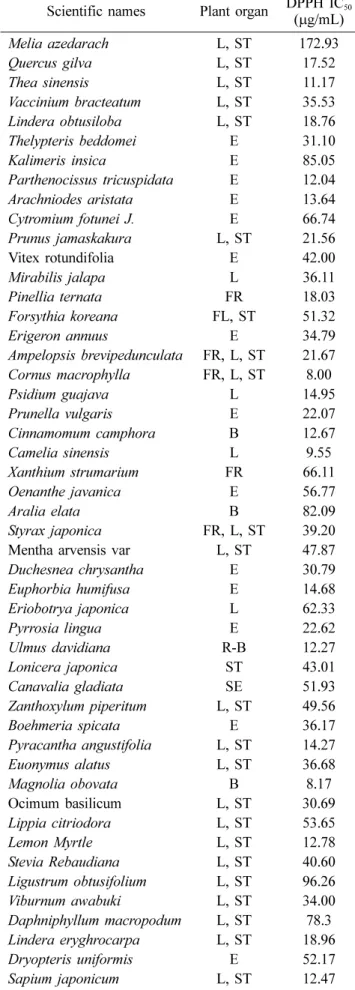
Scavenging effects of Jeju medicinal plants on DPPH radicals. DPPH is a stable radical that is used in a popular method for screening free radical-scavenging ability of compounds and the antioxidant activity of plant extracts. One hundred sixteen out of the 254 extracts were found to have excellent antioxidant activity, with inhibitions greater than 60% seen with 100µg/mL. The most active plants examined were Cornus macrophylla, Camelia sinensis, Aleurites fordii, Distylium racemosum, Magnolia obovata, Vitis coignetiae, Acer palmatum, Carpinus tschonoskii and Spiraea salicifolia with inhibitions of 83.76, 85.73, 81.38, 81.58, 86.32, 80.14, 82.24, 82.04, and 82.83% at 100µg/mL, respectively, and IC50 values of 8.0, 9.55, 5.29, 6.14, 8.17, 9.10, 5.44, 7.18, 5.25µg/
mL, respectively. The IC50 values of the 116 plants with good antioxidant activity were calculated and are presented in Table 2. The IC50 values of nine plants were lower than 10µg/mL (Table 2). The results imply that these active extracts may contain constituents with strong proton- donating abilities [Sawai et al., 2005].
Among the species displaying high antioxidant activity, Acer palmatum [Kim et al., 2005] and Camelia sinensis [Katsube et al., 2004] have been already reported for their antioxidant activity. The samples collected in Jeju Island may differ from samples from other locations. Furthermore, the significant oxidation inhibition exhibited by the seven other plant extracts is described here for the first time.
Inhibitory effect of Jeju medicinal plants on elastase. The 254 medicinal plants were also investigated for elastase inhibition. Of these 254 plants, 237 did not inhibit porcine pancreatic elastase (PPE) activity.
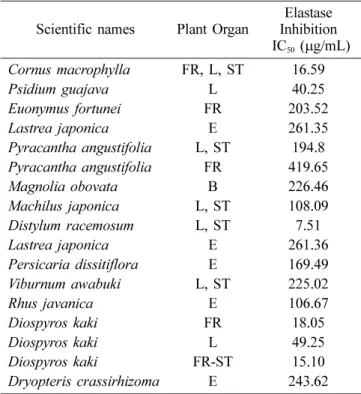
Inhibition of PPE by the other 17 active plant extracts in the initial screening is shown in Table 3. In this assay, several plant extracts, including Cornus macrophylla, Psidium guajava, Distylum racemosum, and Diospyros kaki, showed more than 15% inhibition at 100µg/mL. In order to determine the IC50 values of the 17 plant extracts showing high biological activities, experiments to determine Table 1. Inhibitory effect of JeJu medicinal plants on
mushroom tyrosinase
Scientific names Plant organ Tyrosinase Inhibition IC50 (µg/mL)
Morus bombycis L, ST 5.46
Distylium racemosum L, ST 104.99
Phormium tenax ST 4.62
Erigeron annuus E 278.56
Morus alba FR 46.07
Morus alba L, ST 9.90
Morus alba R 8.17
Albizzia julibrissin L, ST 213.15 Cornus macrophylla FR, L, ST 142.47 Maackia floribunda L, ST 134.67 Cudrania tricuspidata L, ST 64.17 The reaction was carried out in 100 mM sodium phosphate buffer (pH 6.7) containing 1 mM L-tyrosine and 80 unit/
mL mushroom tyrosinase at 37oC. The reaction mixture was pre-incubated for 10 min before adding substrate. The change of the absorbance at 475 nm was measured. In order to determine IC50 values of the 11 plant extracts showing high biological activities, experiments to determine the dose-response relationship were performed.
Results are mean ± S.D. of five parallel measurements.
Abbreviation: Entire plants (E), Roots (R), Stems or Twigs (ST), Fruits (FR), Barks (B), Flowers (FL), Seeds (SE), Silks (SI), Leves (L), Flower buds (FB), Sprout (SP).
Table 2. Continued
Scientific names Plant organ DPPH IC(µg/mL)50
Melia azedarach L, ST 172.93
Quercus gilva L, ST 17.52
Thea sinensis L, ST 11.17
Vaccinium bracteatum L, ST 35.53
Lindera obtusiloba L, ST 18.76
Thelypteris beddomei E 31.10
Kalimeris insica E 85.05
Parthenocissus tricuspidata E 12.04
Arachniodes aristata E 13.64
Cytromium fotunei J. E 66.74
Prunus jamaskakura L, ST 21.56
Vitex rotundifolia E 42.00
Mirabilis jalapa L 36.11
Pinellia ternata FR 18.03
Forsythia koreana FL, ST 51.32
Erigeron annuus E 34.79
Ampelopsis brevipedunculata FR, L, ST 21.67 Cornus macrophylla FR, L, ST 8.00
Psidium guajava L 14.95
Prunella vulgaris E 22.07
Cinnamomum camphora B 12.67
Camelia sinensis L 9.55
Xanthium strumarium FR 66.11
Oenanthe javanica E 56.77
Aralia elata B 82.09
Styrax japonica FR, L, ST 39.20
Mentha arvensis var L, ST 47.87
Duchesnea chrysantha E 30.79
Euphorbia humifusa E 14.68
Eriobotrya japonica L 62.33
Pyrrosia lingua E 22.62
Ulmus davidiana R-B 12.27
Lonicera japonica ST 43.01
Canavalia gladiata SE 51.93
Zanthoxylum piperitum L, ST 49.56
Boehmeria spicata E 36.17
Pyracantha angustifolia L, ST 14.27
Euonymus alatus L, ST 36.68
Magnolia obovata B 8.17
Ocimum basilicum L, ST 30.69
Lippia citriodora L, ST 53.65
Lemon Myrtle L, ST 12.78
Stevia Rebaudiana L, ST 40.60
Ligustrum obtusifolium L, ST 96.26
Viburnum awabuki L, ST 34.00
Daphniphyllum macropodum L, ST 78.3
Lindera eryghrocarpa L, ST 18.96
Dryopteris uniformis E 52.17
Sapium japonicum L, ST 12.47
Table 2. IC50 values of selected JeJu medicinal plants against DPPH free radicals
Scientific names Plant organ DPPH IC(µg/mL)50
Melia azedarach L, ST 172.93
Dryopteris crassirhizoma E 29.53
Morus bombycis L, ST 42.79
Thelypteris japonica E 28.13
Callicarpa japonica L, ST 23.51
Mallotus japonicus L, ST 10.19
Neolitsea aciculata E 27.58
Styrax obassia L, ST 22.39
Meliosma Myriantha L, ST 57.75
Zanthoxylum ailanthoides L, ST 147.13
Albizzia julibrissin L, ST 82.68
Plantago major E 26.15
Torilis japonica E 74.29
Lysimachia chlethroides E 73.45
Plantago lanceolata E 90.95
Cyratia japonica E 45.21
Tilia taquetii L, ST 16.71
Trichosanthes kiriowii E 52.52
Prunus buergeriana L, ST 54.6
Ilex cornuta Lindley L, ST 38.43
Machilus japonica L, ST 29.70
Aleurites fordii L, ST 5.29
Distylium racemosum L, ST 6.14
Maackia floribunda L, ST 155.10
Teucrium viscidum var. E 27.97
Lespedeza cuneata E 49.08
Dendropanax morbiferum L, ST 24.04 Chrysanthemum frutescens L, ST 47.35
Vitis coignetiae L, ST 9.10
Vitis ficifolia var. sinuata L, ST 12.13 Indigofera pseudo-tinctoria E 52.34
Potentilla chinensis E 15.44
Vitex rotundifolia L, ST 33.50
Clematis mandshurica E 127.75
Acer palmatum L, ST 5.44
Illicium anisatum L, ST 41.82
Polystichum ovato-paleaceum E 22.79
Boehmeria platanifolia . E 57.09
Cyclosorus acuminatus E 35.66
Cercidiphyllum japonicum L, ST 10.15
Actinidia arguta (c) L, ST 41.09
Cornus kousa Buerger L, ST 29.08
Carpinus tschonoskii L, ST 7.18
Boehmeria Sieboldiana E 67.54
Pourthiaea villosa var. L, ST 17.84
Neolitsea sericea L, ST 51.53
Caryopteris divaricata E 80.52
Ligustrum ovalifolium L, ST 45.55
the dose-response relationship were performed. The IC50 values of 17 plants were calculated and are presented in Table 3. Except Diospyros kaki, as far as can be ascertained from a survey of the literature, the 14 other plant extracts which demonstrated a significant capability to inhibit elastase, are described here for the first time regarding this biological property. From these results, it is evident that 14 plant extracts showed inhibitory effects on elastase activity, at least in vitro. Therefore, it is suggested that topical application of plant based inhibitors of non- specific elastase in cosmetics may provide beneficial effects on UV-irradiated and dry skin.
Conclusions. In the present study, 254 selected Jeju herbal medicines were investigated for potential effectiveness as skin-whitening agents and in maintaining skin health. Extracts of three herbal preparations were
shown to be potent tyrosinase inhibitors. In addition to extracts of Morus alba, which are currently in use as cosmetic additives, results of this study indicate that extracts of Phormium tenax, Morus bombycis, and Cudrania tricuspidata, are likely to be useful for cosmetic applications and products. We also calculated the IC50 values of 114 plant extracts with anti-oxidant activity and 17 plant extracts that inhibit elastase, which may be of value in the development of anti-aging cosmetics.
This is almost the first systematic report on Jeju Island plants as candidates for cosmetic materials. This work has provided a better knowledge of the medicinal plants of Jeju Island and compelling evidence for the rational exploration of indigenous medicinal plants as a source of Table 3. Inhibitory effect of JeJu medicinal plants on elastase
Scientific names Plant Organ Elastase Inhibition IC50 (µg/mL) Cornus macrophylla FR, L, ST 16.59
Psidium guajava L 40.25
Euonymus fortunei FR 203.52
Lastrea japonica E 261.35
Pyracantha angustifolia L, ST 194.8 Pyracantha angustifolia FR 419.65
Magnolia obovata B 226.46
Machilus japonica L, ST 108.09
Distylum racemosum L, ST 7.51
Lastrea japonica E 261.36
Persicaria dissitiflora E 169.49
Viburnum awabuki L, ST 225.02
Rhus javanica E 106.67
Diospyros kaki FR 18.05
Diospyros kaki L 49.25
Diospyros kaki FR-ST 15.10
Dryopteris crassirhizoma E 243.62 The reaction was carried out in 200 mM Tris-HCl buffer (pH 8.0) containing 0.2 mM N-Suc-(Ala)3-nitroanilide and 0.104 unit/mL elastase. Each plant extract was added to the reaction mixture to give a final concentration of 100 mg/mL and the elastase inhibition was assessed at 25oC.
The reaction mixture was pre-incubated for 10 min before adding substrate. The change of the absorbance was measured at 410 nm in a 96-well reader. In order to determine IC50 values of the 17 plant extracts showing high biological activities, experiments to determine the dose-response relationship were performed. Results are mean ± S.D. of five parallel measurements. Abbreviation:
Entire plants (E), Roots (R), Stems or Twigs (ST), Fruits (FR), Barks (B), Flowers (FL), Seeds (SE), Silks (SI), Leves (L), Flower buds (FB), Sprout (SP).
Table 2. Continued
Scientific names Plant organ DPPH IC(µg/mL)50
Elaeagnus umbellata L, ST 71.82
Eurya japonica L, ST 28.41
Quercus serrata L, ST 10.89
Stauntonia hexaphylla E 54.72
Rhus javanica Linne L, ST 15.94
Myrica rubra Sieb.. L, ST 14.86
Camellia japonica FL 33.69
Diospyros kaki L 28.47
Diospyros kaki FR 13.51
Diospyros kaki FR-ST 19.14
Rhododendron weyrichii L, ST 20.21
Persicaria dissitiflora E 24.23
Leptogramma mollisima E 32.15
Mosla dianthera E 35.46
Clinopodium chinensis E 18.93
Phacelurus latifolius E 107.80
Microlepia strigosa E 71.82
Spiraea salicifolia E 5.25
Euphorbia helioscopia E 18.64
Potentilla chinensis E 15.40
The reaction was carried out in 100% ethanol containing 0.1 mM DPPH and 100 mg/mL of plant extract. The scavenging effect against DPPH radical was assessed at room temperature for 10 min. The change of the absorbance was measured at 517 nm in a 96 well reader. In order to determine IC50 values of the 115 plant extracts showing high biological activities, experiments to determine the dose-response relationship were performed. Results are mean ± S.D. of five parallel measurements. Abbreviation:
Entire plants (E), Roots (R), Stems or Twigs (ST), Fruits (FR), Barks (B), Flowers (FL), Seeds (SE), Silks (SI), Leves (L), Flower buds (FB), Sprout (SP)
cosmetic materials. Considering that most regional plants have not been investigated chemically or pharmaceutically, they remain an untapped potential source for cosmetic materials. Further investigations will focus on in vivo assessment of the biological activity of these plant extracts and on chemical identification of the major active components responsible for whitening and anti-aging activity in the screened efficacious extracts. Moreover cultivation and preservation of these promising plants are needed. In our laboratories we are actually carrying out bioassay-guided fractionations with these active extracts to isolate and identify the bioactive constituents.
Acknowledgments. This research was partially supported by the Regional Technology Innovation Program (RTI04- 02-07) and the Research Fund of Small and Medium Business Administration (S1005813), which are managed by the Ministry of Commerce, Industry, and Energy of the Korean Government.
References
Aburjai T and Natsheh FM (2003) Plants Used in Cosmet- ics. Phytother Res17, 987-1000.
An BJ, Kwak JH, Park JM, Lee JY, Park TS, Lee JT, Son JH, Jo C, and Byun MW (2005) Inhibition of enzyme activities and the antiwrinkle effect of polyphenol iso- lated from the persimmon leaf (Diospyros kaki folium) on human skin. Dermatol Surg31, 848-854.
Briganti S, Camera E, and Picardo M (2003) Chemical and instrumental approaches to treat hyperpigmentation. Pigm
Cell Res16, 101-110.
Katsube T, Tabata H, Ohta Y, Yamasaki Y, Anuurad E, Shi- waku K, and Yamane Y (2004) Screening for antioxi- dant activity in edible plant products: comparison of low-density lipoprotein oxidation assay, DPPH radical scavenging assay, and Folin-Ciocalteu assay. J Agric Food Chem52, 2391-2396.
Kadekaro AL, Kanto H, Kavanagh R, and Abdel-Malek ZA (2003) Significance of the melanocortin 1 receptor in regulating human melanocyte pigmentation, prolifera- tion, and survival. Ann NY Aca. Sci 994, 359-365.
Kiken DA and Cohen DE (2002) Contact dermatitis to botanical extracts. Am J Cont Dermat13, 148-152.
Kim JH, Lee BC, Kim JH, Sim GS, Lee DH, Lee KE, Yun YP, and Pyo HB (2005) The isolation and antioxidative effects of vitexin from Acer palmatum. Arch Pharm Res
28, 195-202.
Leu SJ, Lin YP, Lin RD, Wen CL, Cheng KT, Hsu FL, and Lee MH (2006) Phenolic constituents of Malus doumeri var. formosana in the field of skin care. Biol Pharm Bull
29, 740-745.
Rescigno A, Sollai F, Pisu B, Rinaldi A, and Sanjust E (2002) Tyrosinase inhibition: General and applied aspects.
J Enz Inhibit Med Chem17, 207-218.
Sawai Y, Moon JH, Sakata K, and Watanabe N (2005) Effects of structure on radical-scavenging abilities and antioxidative activities of tea polyphenols: NMR analyti- cal approach using 1,1-diphenyl-2-picrylhydrazyl radi- cals. J Agric Food Chem53, 3598-3604.
Wang KH, Lin RD, Hsu FL, Huang YH, Chang HC, Huang CY, and Lee MH (2006) Cosmetic applications of selected traditional Chinese herbal medicines. J Ethnop- harmacol106, 353-359.