Agric. Chem. Biotechnol.49(1), 21-23 (2006) Article
Enantiomeric Compounds with Antileishimanial Activities from a Sponge, Plakortis sp .
Chi Won Lim*, Yeon-Kye Kim, Ho Dong Youn
1and Hee-Yeon Park
Biotechnology Research Center, National Fisheries R & D Institute, Pusan 619-902, Korea
1Aquaculture Environment Institute, National Fisheries R & D Institute, Tongyong 650-160, Korea Received October 25, 2005; Accepted December 12, 2005
As part of a program to discover bioactive natural products from marine organisms, two new enantiomers, ent-3,6-Epidioxy-4,6,8,10-tetraethyltetradeca-7,11-dienoic acid and ent-[3,5-Diethyl-5-(2-ethyl-hex-3-enyl)- 5H-furan-2-ylidene]-acetic acid methyl ether, were isolated from a sponge Plakortis sp. These compounds showed strong in vitro antiproliferative effects on promastigotes of Leishmania mexicania, flagellate protozoan that causes leishmaniasis. Structures were assumed by interpretation of NMR spectroscopic data and optical rotation. Both compounds exhibited significant antileishmanial activities in vitro with IC50 of 1.0-23.0 µg/ml.
Key words: antileishmaniasis, enantiomer, antibacterial, sponge Leishmania and malaria are occur widely in the tropical and
subtropical regions.1,2) Leishmaniasis is breaking out in many poorest countries, where estimated 1.5 to 2 million people are infected each year.3,4) In the central and South Americas, the causative agent is the protozoan Leishmania mexicana, L.
mexicana utilizes intermediate as host and is transmitted by flies. The most commonly used drugs for the treatment of leishmaniasis contain pentavalent antimonials and these drugs generally unacceptable side effects. The urgent need for alternative compounds has led to a program to screen natural products for potential use in the therapy of these leishmainasis.
Marine sponge has been proven to be a valuable resource for various bioactive substances and sponges of the genus Plakortis are well known for their ability to produce cyclic peroxides and related metabolites.5-8)
In this paper, we describe the isolation and identification of two new enantiomeric compounds, with antileishmanial and antifungal activites from a sponge of Plakortis sp.
Materials and Methods
Sample.
The sponge was collected from rocks at a depth of−40 m off of Jeju seashore on March 2004. The sponge formed a moderately thick encrustation of very soft, liver-like and very easily-torn texture. The sponge was an undescribed species of Plakortis. Vaucher specimen of these sponge has been deposited at the Natural History Museum, London, United Kingdom.
Extraction and Isolation.
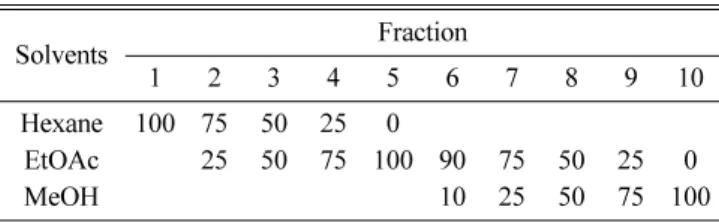
Sample of Plakortis sp. (1.3 kg, wet wt) was extracted with 6l of ethanol in a blender. Theextract (1.5 g) was subjected to silica flash chromatography (Merck, column 150×3 cm, gel size 230-400 mesh, 450 g) using a gradient elution with hexane, ethyl acetate and finally methanol (Table 1). Fractions 2-6 were further fractionated using gel permeation chromatography on Sephadex LH-20 (Pharmacia, column 4.9×76 cm) with methanol. Further purification was carried out using reverse-phase HPLC elution (Phenomenex Ultracarb 5µm, ODS 30, 250×21.5 mm) using a linear gradient with CH3CN-H2O as an eluent (flow rate: 10 ml/min, UV detection: 230 nm). This process yielded ent-3,6-epidioxy-4,6,8,10-tetraehtyltetradeca-7,11-dienoic acid (compound 1, 13.4 mg, oil) and ent-[3,5-Diethyl-5-(2- ethyl-hex-3-enyl) -5H-furan-2-ylidene]-acetic acid methyl ether (compound 2, 21.1 mg, oil).
Structure analysis.
IR and UV spectra were obtained using an AATI Mattson Genesis Series FTIR and Perkin-Elmer Lambda 3B UV/Vis spectrophotometer. Optical rotations were measured with an AUTOPOL IV autopolarimeter. 1D and 2D NMR spectra were recorded on a Bruker Avance DRX-400 spectrometer. Chemical shift (δ) values were expressed in ppm and are referenced to the residual solvent signals with resonances at δH/δC 7.26/77.0 (CDCl3). The samples were processed on an ESI-FTMS 30es ion cyclotron HR HPLC-FT spectrometer with direct injection into an electrospray interface and positive or negative ion mode.*Corresponding author
Phone: 82-51-720-2458; Fax: 82-51-720-2456 E-mail: [email protected]
Table 1. Solvent compositions for extraction from the sponge
(%)
Solvents Fraction
1 2 3 4 5 6 7 8 9 10
Hexane 100 75 50 25 0
EtOAc 25 50 75 100 90 75 50 25 0
MeOH 10 25 50 75 100
22 Chi Won Lim et al.
Biological assay. The bioassay employed parasites of the trypanosomatide family characterized by Ramirez and Guevara9) as Leishmania mexicana (NR strain). The cells were cultured in liver infusion tryptose medium (LIT), supplemented with 10% fetal calf serum (GIBCO) and transferred into a fresh medium at 5-day intervals. The bioassays were carried out in triplicate repetition. Different concentrations of the drugs dissolved in DMSO were added to 10 ml PBS (pH) contains 2×10⁶ cells. DMSO was used as a control. The cultures were placed in a New Bauer chamber and monitored daily for 96 hrs using light dispersion at 560 nm to determine cell density. The cells were also monitored using a Nikon-diaphot microscope to determine the mobility of the parasite and the integrity of the membrane.
Results and Discussion
3,6-Epidioxy-4,6,8,10-tetraethyltetradeca-7,11-dienoic acid (compound 1) has previously been isolated by others from a sponge,4)Plakortis aff. angulospiculatus. Its molecular formula and [α]D of compound 1 was C22H39O4 by HRFABMS m/z 367.2859 (calcd. 367.2848, [M+H]) and +164 (c 2.4, CHCl3).
[3,5-Diethyl-5-(2-ethyl-hex-3-enyl)-5H-furan-2-ylidene]- acetic acid methyl ether (compound 2) has also been purified from a sponge, P.halichondrioides and obtained as a major compound (3.0% dry weight). Its molecular formula and [α]D was C19H30O3 as revealed by HRMS m/z 306. 2201 (calcd.
306.2195) and +175 (c 1.40, CCl4). The IR spectrum
contained a complex group of bands at 1710, 1690, 1640, 1280, 1170 and 980 cm−1).10)
ent-3,6-Epidioxy-4,6,8,10-tetraehtyltetradeca-7,11-dienoic acid (ent-compound 1) was obtained as a colorless oil and its molecular formula was determined to be C22H39O4, using positive ion HR-ESIMS [M+H] 367.2770 (calcd. 367.2961).
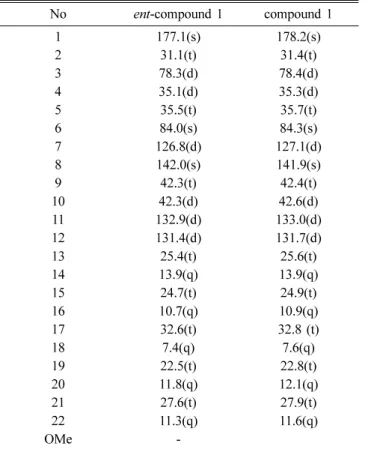
The IR and UV spectra indicated its physical and spectral characteristics were identical to those of the already known 3,6-epidioxy-4,6,8,10-tetraethyltetradeca-7,11-dienoic acid, except for their optical rotation values (Table 2). ent- Compound 1 was characterized by an [α]D25 of −165 (c 2.4, CHCl3), whereas compound 1 rotates +164 with the same solvent. Also, ent-compound 2 was almost the same to Fig. 1. Structure of ent-compound 1.
Fig. 2. Structure of ent-compound 2.
Table 2. Comparison of 13C NMR assignments for ent-com- pound 1 and compound 1 in CDCl3
No ent-compound 1 compound 1
1 177.1(s) 178.2(s)
2 31.1(t) 31.4(t)
3 78.3(d) 78.4(d)
4 35.1(d) 35.3(d)
5 35.5(t) 35.7(t)
6 84.0(s) 84.3(s)
7 126.8(d) 127.1(d)
8 142.0(s) 141.9(s)
9 42.3(t) 42.4(t)
10 42.3(d) 42.6(d)
11 132.9(d) 133.0(d)
12 131.4(d) 131.7(d)
13 25.4(t) 25.6(t)
14 13.9(q) 13.9(q)
15 24.7(t) 24.9(t)
16 10.7(q) 10.9(q)
17 32.6(t) 32.8 (t)
18 7.4(q) 7.6(q)
19 22.5(t) 22.8(t)
20 11.8(q) 12.1(q)
21 27.6(t) 27.9(t)
22 11.3(q) 11.6(q)
OMe -
Table 3. Comparison of 13C NMR assignments for ent-com- pound 2 and compound 2 in CDCl3
No ent-compound 2 compound 2
1 172.4(s) 166.9(s)
2 83.6(d) 83.7(d)
3 167.2(s) 171.7(s)
4 140.6(s) 140.0(s)
5 139.5(d) 139.8(d)
6 98.1(s) 98.0(s)
7 43.8(t) 41.7(t)
8 40.0(d) 27.1(d)
9 132.4(d) 134.4(d)
10 134.3(d) 129.0(d)
11 29.7(t) 23.0(t)
12 11.7(q) 14.1(q)
13 25.9(t) 18.6(t)
14 12.1(q) 12.1(q)
15 32.6(t) 31.7(t)
16 14.2(q) 8.1(q)
17 18.8(t) 34.3(t)
18 8.3(q) 10.6(q)
OMe 50.7(q) 50.5(q)
Enantiomeric Compounds with Antileishimanial Activities from a Sponge, Plakortis sp. 23
spectral data (1H, 13C NMR, MS, IR and UV) of compound 2, except for their optical rotation values (Table 3). ent- Compound 2 provided an [α]D25 of -179o, whereas compound 2 rotates +175o with the both samples measured in CCl4. These data supported our conclusion that ent-compounds 1 and 2 are the enantiomers of the known 3,6-epidioxy- 4,6,8,10-tetraethyltetradeca-7,11-dienoic acid and the [3,5- Diethyl-5-(2-ethyl-hex-3-enyl)-5H-furan-2-ylidene]-acetic acid methyl ether.
The relative stereochemistry for C-6 of compound 1 has not yet been determined in the results that was reported by Compagnone et al (1998).9) On the basis of NOE correlation, the configuration of C-7 was determined as β position, while the ethyl group at C-6 was in the α position: H-7 (δ 5.15) to H-5 (δ 1.71) and H-4β (δ 2.09), H-2 (δ 3.06) to H-5α (δ 1.25) and H-17 (δ 0.85).
Enantiomers are generally called optical isomers because their solutions rotate the plane of polarized light passing through them. If one enantiomer rotates light in the clockwise direction, a solution of the other enantiomer will rotate it in the opposite direction. Differences in biological activities between pairs of enantiomers have frequently been observed.11,12) With nuclear magnetic resonance, elucidation of D and L enantiomer without addition of a chiral reagent or solvent is difficult.13)
ent
-3,6-epidioxy-4,6,8,10-tetraehtyltetradeca-7,11- dienoic acid (
ent-compound 1)
: Clear, colorless oil; [α]D25 =−165 (c 0.18, CHCl3); IR Vmax 3442, 2963, 2933, 2876, 1713, 1461, 1289, 976/cm; HRESIMS m/z 367.2770 ([M+H], calcd.
for C22H39O4, 367.2961); For 13C NMR (CDCl3) data see Table 3.
ent
-
α,
β-unsaturated ester (
ent-compound 2)
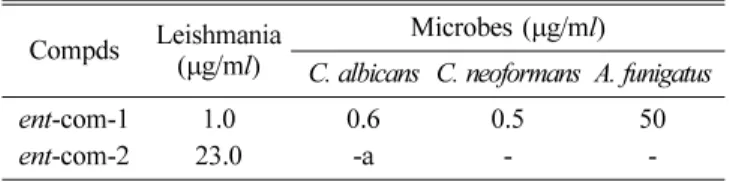
: Light yellowish oil, [α]D25 = −179 (c 1.40, CCl4); IR Vmax 1714, 1688, 1626, 1161, 973, 85/cm HRESIMS m/z 307.2235 ([M+H], calcd. for C19H31O3, 307.2273); For 13C NMR (CDCl3) data see Table 4.ent-Compound 1 was examined for its effects on the proliferation of L. mexicana promastigotes (Table 4).
Compound 1 was very potent against the protozoan (IC50 1.00
µg/ml) and ent-compound 1 also showed good activity at the same concentration. These data compare well with the antileishmanical activity to the sponge metabolite ilimaquinone (IC50 5.6µg/ml) but seem less effective than ketoconozole (IC50 0.06µg/ml). In case of compound 2, their effect was potent giving IC50 of 2.71 µg/ml, whereas ent-compound 2 shows at shows at IC50 value of 23.0 µg/ml. ent-Compounds 1 and 2 were also assayed for activities against Candica albicans, Cryptococcus neoformans and Aspergillus funigatus. ent-
Compound 1 exhibited significant antifungal acitivites in vitro with IC50 values of 0.5-50µg/ml, but ent-compound 2 has no activities for those fungi.
Acknowledgment
This work is funded by a grant from the National Fisheries Research and Development Institute (RP-2005-BT-013).
References
1. Lim, C. W., Park, Y. B. and Lee, J. S. (2004) Isolation of dibromosceptrin with antimalarial activity from the unidenti- fied sponge, Agelas sp. Kor. J. Pharmacogn. 35, 189-193.
2. Yousaf, M., El Sayed, K. A., Rao, K. V., Lim, C. W., Hu, J. F., Kelly, M., Franzblau, S. G., Zhang, F., Peraud, O., Hill, R. T. and Hamann, M. T. (2002) 12,34-Oxaman- zamines, novel biocatalytic and natural products from manxamine producing Indo-Pacific sponge. Tetrahedron. 58, 7397-7402.
3. Sianne, S. and van Heeden, F. R. (2002) Antimalarial activ- ity of plant metabolites. Nat. Pro. Rep. 19, 672-692.
4. Compagnone, R. S., Pina, I. C., Rangel, H. R., Dagger, F., Suarez, A. I., Reddy, M. V. R. and Faulkner, D. J. (1998) Antileishmanial cyclic peroxides from the Palauan sponge Plakortis aff. angulospiculatus.Tetrahedron. 54, 3057-3068.
5. Hu, J. F., Gao, H. F., Kelly, M. and Hamann, M. T. (2001) Plakortides I-L, four new cyclic peroxides from an unde- scribed Jamaican sponge Plakortis sp. (Homosclerophorida, Plakinidae). Tetrahedron. 57, 93799383.
6. Chen, Y., Brain, K., MaCarthy, P. J., Schimoler, R., Chil- son, K., Selitrennikoff, C., Pomponi, S. A. and Wright, A.
E. (2001) Three new peroxides from the sponge Plakinas- trella species. J. Nat. Prod.64, 262-264.
7. Stierle, D. B. and Faulkner, D. J. (1979) Metabolites of the marine sponges Chondrosia collectrix. J. Org. Chem. 44, 964-968.
8. Manes, L. V., Bakus, G. J. and Crews, P. (1984) Bioactive marine sponge norditerpene and norsesterpene peroxides.
Tetrahdron Letters. 25, 931-934.
9. Ramirez, J. L. and Guevara, P. (1987) The ribosomal gene spacer as a tool for the taxonomy of Leishmania. Mol. Bio- chem. Parasitol. 22, 177-183.
10. Stierle, D. B. and Faulkner, D. J. (1980) Metabolites of three marine sponges of the genus Plakortis. J. Org. Chem.
45, 3396-3401.
11. Ekborg-Ott, K. H. and Armstrong, D. W. (1997) Chiral sep- arations, applications and technology, American Chemical Society, Washington, DC. 201.
12. Ruiz del Castillo, M. L., Blanch, G. P. and Herraiz, M.
(2004) Natural variability of the enanthiomeric composition of bioactive chiral terpenes in Mentha piperita. J. Chro- matogr. A 1054, 87-93.
13. Buchingham, A. D. (2004) Chirality in NMR spectroscopy.
Chem. Phys. Lett.398, 1-5.
Table 4. Biological activity IC50 data for ent-compound 1 and ent-compound 2
Compds Leishmania (µg/ml) Microbes (µg/ml)
C. albicans C. neoformans A. funigatus
ent-com-1 1.0 0.6 0.5 50
ent-com-2 23.0 -a - -
a-: Not active