ISSN 2234-3806 • eISSN 2234-3814
353
http://dx.doi.org/10.3343/alm.2013.33.5.353 www.annlabmed.org
Ann Lab Med 2013;33:353-355
http://dx.doi.org/10.3343/alm.2013.33.5.353
Brief Communication
Clinical Microbiology
An Increase in the Clinical Isolation of Acquired AmpC β-Lactamase-Producing Klebsiella pneumoniae in
Korea from 2007 to 2010
Min-Jeong Park, M.D.1, Taek-Kyung Kim, M.S.2, Wonkeun Song, M.D.1, Jae-Seok Kim, M.D.1, Han-Sung Kim, M.D.1, and Jacob Lee, M.D.3
Departments of Laboratory Medicine1 and Internal Medicine3, Hallym University College of Medicine, Chuncheon; Department of Laboratory Medicine2, Kangnam Sacred Heart Hospital, Seoul, Korea
We investigated the occurrence and genetic basis of AmpC β-lactamase (AmpC)-mediated antibiotic resistance, by examining Escherichia coli, Klebsiella pneumoniae, and Proteus mirabilis isolates at a university hospital, from 2007 to 2010. The ampC genes were detect- ed by multiplex AmpC PCR, and AmpC-positive strains were subjected to DNA sequenc- ing. Extended-spectrum β-lactamase (ESBL) production was assessed using the ESBL disk test based on the utilization of boronic acid. Carbapenem-resistant isolates were fur- ther investigated by the modified Hodge test, a carbapenemase inhibition test and SDS- PAGE experiments. AmpC expression was detected in 1.6% of E. coli (39 DHA-1, 45 CMY- 2, and 1 CMY-1) isolates, 7.2% of K. pneumoniae (39 DHA-1, 45 CMY-2, and 1 CMY-1) isolates, and 2.5% of P. mirabilis (8 CMY-2 and 1 CMY-1) isolates. Of the 198 acquired AmpC producers, 58 isolates (29.3%) also produced an ESBL enzyme. Among the ac- quired AmpC-producing K. pneumoniae isolates, the minimum inhibitory concentration (MIC) MIC50/MIC90 values for cefoxitin, cefotaxime, cefepime, imipenem, and meropenem were >32/>32, 16/>32, 1/16, 0.25/0.5, and <0.125/0.125 µg/mL, respectively. The MIC values for carbapenem were ≥2 µg/mL for 2 K. pneumoniae isolates, both of which car- ried the blaDHA-1 gene with a loss of OmpK36 expression, but were negative for carbapene- mase production. The acquisition of AmpC-mediated resistance in K. pneumoniae isolates increased, as did the proportion of AmpC and ESBL co-producers among the hospital iso- lates. The accurate identification of isolates producing AmpCs and ESBLs may aid in in- fection control and will assist physicians in selecting an appropriate antibiotic regimen.
Key Words: Klebsiella pneumoniae, AmpC β-lactamases, DHA-1, CMY-2
Received: April 15, 2013 Revision received: May 6, 2013 Accepted: June 18, 2013
Corresponding author: Wonkeun Song Department of Laboratory Medicine, Hallym University College of Medicine, Kangnam Sacred Heart Hospital, 1 Singil-ro, Youngdeungpo-gu, Seoul 150-950, Korea
Tel: +82-2-829-5259 Fax: +82-2-847-2403 E-mail: [email protected]
© The Korean Society for Laboratory Medicine.
This is an Open Access article distributed under the terms of the Creative Commons Attribution Non-Commercial License (http://creativecom- mons.org/licenses/by-nc/3.0) which permits unrestricted non-commercial use, distribution, and reproduction in any medium, provided the original work is properly cited.
Unlike other β-lactamases, AmpC β-lactamases (AmpCs) are not inhibited by β-lactamase inhibitors and cephamycins. AmpC- producing organisms are generally resistant to broad-spectrum penicillins, oxyimino- and 7-α-methoxy-cephalosporins, and az- treonam, but are susceptible to cefepime, cefpirome, and car- bapenems [1]. Although AmpC acquisition was first detected in Korea in 1988 [2], there remains a lack of awareness about its importance. One reason for this is that most clinical laboratories
do not attempt to detect and report this resistance mechanism.
Previously, we reported an increased trend in the acquisition of AmpC-mediated resistance in K. pneumoniae isolates in a hos- pital in Korea, from 2002 to 2004 [3]. In this study, we investi- gated the occurrence and genetic basis of AmpC-mediated an- tibiotic resistance by examining Escherichia coli, Klebsiella pneumoniae, and Proteus mirabilis isolates at the same hospi- tal, from 2007 to 2010.
Park M-J, et al.
Increase in occurrence of AmpC-producing K. pneumoniae
354 www.annlabmed.org http://dx.doi.org/10.3343/alm.2013.33.5.353 Between 2007 and 2010, we collected a total of 6,932 consec-
utive, non-duplicate E. coli (n =5,152), K. pneumoniae (n = 1,438), and P. mirabilis (n=367) isolates. Microbial identification was carried out using the Vitek 2 system (bioMerieux Vitek, Ha- zelwood, MO, USA). Cefoxitin nonsusceptibility (minimum in- hibitory concentration [MIC] ≥16 µg/mL) was used as an indi- cator for AmpC acquisition. The cefoxitin-nonsusceptible iso- lates were tested by multiplex AmpC PCR [4]. AmpC detection by PCR was further confirmed by ampC gene sequencing. Se- quence alignment and analysis was performed on-line using the National Center for Biotechnology Information BLAST algorithm.
AmpC PCR-positive isolates were further investigated for β- lactamase production, as well as susceptibility to various antimi- crobial agents. Susceptibility was determined by the broth mi- crodilution test, according to the guidelines prescribed by CLSI [5]. The antimicrobial agents used were cefoxitin (Sigma-Aldrich Co., Steinheim, Germany), cefotaxime (Sigma-Aldrich Co.), ce- fepime (Boryung Co., Ltd., Seoul, Korea), imipenem (Merck &
Co., West Point, PA, USA), and meropenem (Yuhan Co., Ltd.,
Seoul, Korea). AmpC PCR-positive isolates were also analyzed by the boronic acid (BA) disk test [6]. Following the combina- tion disk method (CLSI) extended-spectrum β-lactamase (ESBL) confirmatory methodology, an increase in zone diameter by≥5 mm of CAZ-CA and/or CTX-CA in combination with BA (CAZ- CA-BA and/or CTX-CA-BA) over that of CAZ and/or CTX-con- taining BA (CAZ-BA and/or CTX-BA) was considered a positive test result for ESBL. Carbapenem-nonsusceptible isolates were further investigated by the modified Hodge test [7] and the car- bapenemase inhibition test [8] for carbapenemase production, and were additionally investigated by SDS-PAGE for alterations in outer membrane protein expression [9].
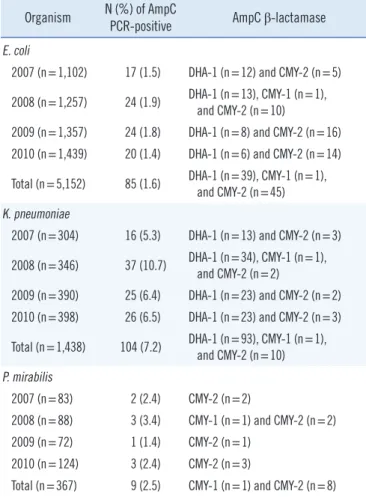
AmpCs (DHA-1, CMY-2, and CMY-1) were detected in 1.6% (85/5,152; 39 DHA-1, 45 CMY-2, and 1 CMY-1) of E. coli isolates, 7.2% (93/1,438; 93 DHA-1, 10 CMY-2, and 1 CMY-1) of K. pneu- moniae isolates, and 2.5% (9/367; 8 CMY-2 and 1 CMY-1) of P.
mirabilis isolates (Table 1). In Korea, the isolation rate of AmpC- producing E. coli was 1.5% in 2002 [10]. Our previous study re- vealed that the isolation rate of AmpC-producing K. pneumoniae from 2002 to 2004 was 2.9%, and no AmpC-producing P. mira- bilis strains were isolated during that period [3]. While the distri- bution of AmpC genotypes is similar to that obtained in the pre- vious study [3], of the 198 acquired AmpC producers, 58 iso- lates (29.3%) also produced an ESBL (data not shown). This rate is much higher than that (8.7%) observed in our previous study [3]. In the case of the acquired AmpC-producing K. pneu- moniae isolates, MIC50/MIC90 values for cefoxitin, cefotaxime, ce- fepime, imipenem, and meropenem were >32/ >32, 16/ >32, 1/16, 0.25/0.5, and <0.125/0.125 µg/mL, respectively (Table 2).
MIC values for carbapenem were≥2 µg/mL, for only 2 of the K.
pneumoniae isolates. Both isolates carried the blaDHA-1 gene with a loss of OmpK36 expression, but were negative for carbapene- mase production (data not shown). In Korea, AmpC (DHA-1) ex- Table 1. Prevalence and genotypic analysis of acquired AmpC-β-
lactamase-producing Enterobacteriaceae isolates at a university hospital from 2007 to 2010
Organism N (%) of AmpC
PCR-positive AmpC β-lactamase E. coli
2007 (n=1,102) 17 (1.5) DHA-1 (n=12) and CMY-2 (n=5) 2008 (n=1,257) 24 (1.9) DHA-1 (n=13), CMY-1 (n=1),
and CMY-2 (n=10)
2009 (n=1,357) 24 (1.8) DHA-1 (n=8) and CMY-2 (n=16) 2010 (n=1,439) 20 (1.4) DHA-1 (n=6) and CMY-2 (n=14) Total (n=5,152) 85 (1.6) DHA-1 (n=39), CMY-1 (n=1),
and CMY-2 (n=45) K. pneumoniae
2007 (n=304) 16 (5.3) DHA-1 (n=13) and CMY-2 (n=3) 2008 (n=346) 37 (10.7) DHA-1 (n=34), CMY-1 (n=1),
and CMY-2 (n=2)
2009 (n=390) 25 (6.4) DHA-1 (n=23) and CMY-2 (n=2) 2010 (n=398) 26 (6.5) DHA-1 (n=23) and CMY-2 (n=3) Total (n=1,438) 104 (7.2) DHA-1 (n=93), CMY-1 (n=1),
and CMY-2 (n=10) P. mirabilis
2007 (n=83) 2 (2.4) CMY-2 (n=2)
2008 (n=88) 3 (3.4) CMY-1 (n=1) and CMY-2 (n=2) 2009 (n=72) 1 (1.4) CMY-2 (n=1)
2010 (n=124) 3 (2.4) CMY-2 (n=3)
Total (n=367) 9 (2.5) CMY-1 (n=1) and CMY-2 (n=8)
Table 2. In vitro activities of selected antimicrobial agents against 84 acquired AmpC β-lactamase-producing K. pneumoniae isolates
Agent MIC (µg/mL)
Range 50% 90%
Cefoxitin 16->32 >32 >32
Cefotaxime 0.25->32 16 >32
Cefepime <0.125->32 1 16
Imipenem* 0.125->32 0.25 0.5
Meropenem* <0.125-8 <0.125 0.125
*The MICs of 2 carbapenem-nonsusceptible K. pneumoniae isolates for imipenem and meropenem show >32 and 8 µg/mL and 16 and 4 µg/mL, respectively.
Abbreviation: MIC, minimum inhibitory concentration.
Park M-J, et al.
Increase in occurrence of AmpC-producing K. pneumoniae
355
http://dx.doi.org/10.3343/alm.2013.33.5.353 www.annlabmed.org
pression, in combination with a loss in OmpK35/36 expression contributes to the carbapenem resistance observed in Entero- bacteriaceae, and this phenotype is associated with a poor clini- cal outcome [11, 12].
In summary, there has been an increase in the clinical isola- tion of acquired AmpC-producing K. pneumoniae, as well as an increase in the isolation of AmpC and ESBL co-producers in re- cent years in Korea. DHA-1 was the predominant AmpC en- zyme in the K. pneumoniae isolates, while CMY-2 was predomi- nantly found in E. coli and P. mirabilis isolates. The accurate identification of isolates producing AmpCs and ESBLs may aid in infection control, and will provide valuable guidance while se- lecting an appropriate antibiotic regimen.
Authors’ Disclosures of Potential Conflicts of Interest
No potential conflicts of interest relevant to this article were re- ported.
REFERENCES
1. Philippon A, Arlet G, Jacoby GA. Plasmid-determined AmpC β- lactamases. Antimicrob Agents Chemother 2002;46:1-11.
2. Bauernfeind A, Chong Y, Schweighart S. Extended broad spectrum β- lactamase in Klebsiella pneumoniae including resistance to cephamy- cins. Infection 1989;17:316-21.
3. Song W, Kim JS, Kim HS, Yong D, Jeong SH, Park MJ, et al. Increasing trend in the prevalence of plasmid-mediated AmpC β-lactamases in Enterobacteriaceae lacking chromosomal ampC gene at a Korean uni-
versity hospital from 2002 to 2004. Diagn Microbiol Infect Dis 2006;55: 219-24.
4. Pérez-Pérez FJ and Hanson ND. Detection of plasmid-mediated AmpC β-lactamase genes in clinical isolates by using multiplex PCR. J Clin Mi- crobiol 2002;40:2153-62.
5. Clinical and Laboratory Standards Institute. Performance standards for antimicrobial susceptibility testing. Nineteenth informational supple- ment, M100-S21. Wayne, PA: CLSI, 2011.
6. Song W, Jeong SH, Kim HS, Kim HS, Shin DH, Roh KH, et al. Use of bo- ronic acid disk methods to detect the combined expression of plasmid- mediated AmpC β-lactamases and extended-spectrum β-lactamases in clinical isolates of Klebsiella spp., Salmonella spp., and Proteus mirabilis.
Diagn Microbiol Infect Dis 2007;57:315-8.
7. Anderson KF, Lonsway DR, Rasheed JK, Biddle J, Jensen B, McDougal LK, et al. Evaluation of methods to identify the Klebsiella pneumoniae carbapenemase in Enterobacteriaceae. J Clin Microbiol 2007;45:2723-5. 8. Giske CG, Gezelius L, Samuelsen Ø, Warner M, Sundsfjord A, Woodford
N. A sensitive and specific phenotypic assay for detection of metallo-β- lactamases and KPC in Klebsiella pneumoniae with the use of merope- nem disks supplemented with aminophenylboronic acid, dipicolinic acid and cloxacillin. Clin Microbiol Infect 2011;17:552-6.
9. Kaczmarek FM, Dib-Hajj F, Shang W, Gootz TD. High-level carbapenem resistance in a Klebsiella pneumoniae clinical isolate is due to the com- bination of blaACT-1β-lactamase production, porin OmpK35/36 insertional inactivation, and down-regulation of the phosphate transport porin PhoE. Antimicrob Agents Chemother 2006;50:3396-406.
10. Song W, Kim JS, Kim MN, Kim EC, Park YJ, Yong D, et al. Occurrence and genotypic distributions of plasmid-mediated AmpC β-lactamase- producing Escherichia coli and Klebsiella pneumoniae in Korea. Korean J Lab Med 2002;22:410-6.
11. Song W, Suh B, Choi JY, Jeong SH, Jeon EH, Lee YK, et al. In vivo se- lection of carbapenem-resistant Klebsiellae pneumonia by OmpK36 loss during meropenem treatment. Diagn Microbiol Infect Dis 2009;65:447-9. 12. Shin SY, Bae IK, Kim J, Jeong SH, Yong D, Kim JM, et al. Resistance to
carbapenems in sequence type 11 Klebsiella pneumoniae is related to DHA-1 and loss of OmpK35 and/or OmpK36. J Med Microbiol 2012;61: 239-45.