I. Introduction
Joint arthroplasty is one of the most common procedures performed in the United States. It is estimated that the num- ber of total hip arthroplasties (THA) will increase by 174%
and that of total knee arthroplasties (TKA) will increase by
673% per year in the Unite States by 2030 [1]. Despite the increasing frequency of these procedures, continuing follow- up assessments are essential. Routine follow-up is essential to detect asymptomatic patients suffering from important issues (e.g., ‘silent’ osteolysis) and treat them accordingly to avoid deterioration of the clinical condition [2-4].
Many studies [5-9] have investigated the frequency of follow-up assessments and the importance of supporting pa- tients after THA or TKA. The minimum requirements sug- gested by the British Orthopaedic Association are radiologic assessments every 5 years for TKA, and at 12 months, 7 years postoperatively and every 3 years thereafter for THA [10,11].
In this paper, we adapt the mobile-based healthcare system proposed by Bitsaki et al. [12] for offering services to arthro- plasty patients who are subject to surgical procedures and need follow-up support. The proposed system uses a com- bination of cloud- and service-oriented computing, online services, data analysis, and mhealth applications to connect patients to their physicians. The system is able to monitor
Cost-Effective Mobile-Based Healthcare System for Managing Total Joint Arthroplasty Follow-Up
Marina Bitsaki, PhD1, George Koutras, MSc1, Hansjoerg Heep, MD, PhD2, Christos Koutras, MD, MHCM, PhD2
1Research and Innovation Department, OpenIT, Heraklion, Greece; 2Department of Orthopaedics and Trauma Surgery, University of Duisburg-Essen, Essen, Germany
Objectives: Long-term follow-up care after total joint arthroplasty is essential to evaluate hip and knee arthroplasty out- comes, to provide information to physicians and improve arthroplasty performance, and to improve patients’ health condi- tion. In this paper, we aim to improve the communication between arthroplasty patients and physicians and to reduce the cost of follow-up controls based on mobile application technologies and cloud computing. Methods: We propose a mobile- based healthcare system that provides cost-effective follow-up controls for primary arthroplasty patients through questions about symptoms in the replaced joint, questionnaires (WOMAC and SF-36v2) and the radiological examination of knee or hip joint. We also perform a cost analysis for a set of 423 patients that were treated in the University Clinic for Orthopedics in Essen-Werden. Results: The estimation of healthcare costs shows significant cost savings (a reduction of 63.67% for readmis- sion rate 5%) in both the University Clinic for Orthopedics in Essen-Werden and the state of North Rhine-Westphalia when the mobile-based healthcare system is applied. Conclusions: We propose a mHealth system to reduce the cost of follow-up assessments of arthroplasty patients through evaluation of diagnosis, self-monitoring, and regular review of their health status.
Keywords: Replacement Arthroplasty, Cost-Benefit Analysis, Mobile Applications, Database Management Systems
Healthc Inform Res. 2017 January;23(1):67-73.
https://doi.org/10.4258/hir.2017.23.1.67 pISSN 2093-3681 • eISSN 2093-369X
Submitted: October 2, 2016
Revised: 1st, November 9, 2016; 2nd, December 19, 2016 Accepted: December 29, 2016
Corresponding Author Marina Bitsaki, PhD
Research and Innovation Department, OpenIT, Idaiou Androu 9, Her- aklion 71202, Greece. Tel: +30-6972003446, E-mail: [email protected]
This is an Open Access article distributed under the terms of the Creative Com- mons Attribution Non-Commercial License (http://creativecommons.org/licenses/by- nc/4.0/) which permits unrestricted non-commercial use, distribution, and reproduc- tion in any medium, provided the original work is properly cited.
ⓒ 2017 The Korean Society of Medical Informatics Reviewed
January February March April May June July August September October November December
patients and promptly recognize impeding complications, resulting in the reduction of cost and time spent by doctors, patients, and patient escorts.
A number of studies have evaluated the use of telemedicine for the follow-up of arthroplasty patients. Wood et al. [13]
conducted a randomized trial on arthroplasty patients com- paring an electronic clinic with standard clinic visits. The re- ported travel costs were $20 for an outpatient clinic and $18 for an electronic clinic.
Marsh et al. [14] showed statistically significant differ- ences between web-based and in-clinic follow-up assessment groups in the mean travel costs (Can$10.45 vs. Can$21.36).
Sharareh and Schwarzkopf [9] used Skype calls for the follow-up of total joint arthroplasty patients and found a sta- tistical significant reduction in unplanned clinic visits (14 vs.
3) and calls (40 vs. 6).
Jeong and Kim [15] developed a web-based computer- tailored education program for the promotion of self-care for THA patients. The validity of the developed program’s content and design was confirmed through an expert evalua- tion.
Various studies have provided evidence for the usefulness of mobile applications in orthopedics. A systematic review of the literature [16] described all validated accelerometer-, magnetometer-, and photographic-based smartphone ap- plications used as goniometers for peripheral joints and the spine. Researchers in Australia [17] more accurately mea-
sured the rotational deformity of a correction osteotomy using an application for iPhone. Peters et al. [18] used an iPhone for acetabular cup placement in THA. Hawi et al. [19]
accurately estimated the femoral anteversion on cadaveric femora using the gyroscope of an iPhone. Roberts et al. [20]
used a reminder letter, a reminder SMS (short message ser- vice), and access to a tablet computer in clinic.
The most interesting feature of our approach that has not been considered in other studies is its ability to support data processing by means of cloud computing technologies to help physicians dynamically adjust treatments and share pa- tient information in a cost-effective way.
II. Case Description
We propose a mHealth system that provides health services to both patients and physicians as described below. The patients will give the written consent, download the applica- tion, and register during the first follow-up visit.
The follow-up and the interactions of the patients, the doc- tors, and the system are described by the following algorithm of action:
A. Inclusion of the clinical, medical, and operation details in a central database.
B. Education of patients
C. Monitoring patient symptoms:
1. Patient answers the questions:
Smartphone Browser
Frontend Patient
app Doctor's
pp a
Health status
Health
(& SMS)risk Recommendations
Backend Doctor's
portal Patient
portal Smartphone
notificationPush (& SMS) Enquiries Enquiries
Health API (RESTful)
Orchestations Health
services Analytics Health
data
Management & provisioning engine Health server
Figure 1. Overall architecture.
a) Do you have any symptoms in your replaced joint?
b) Do you have any problems in your other hip or knee?
2. Patient completes the Western Ontario and McMaster Universities Osteoarthritis Index (WOMAC) [21] and the SF-36v2 [22] questionnaire.
3. Patient undergoes a radiological examination.
4. Review overall status of the patient.
D. Evaluate the need for in-clinic assessment.
1. System Architecture
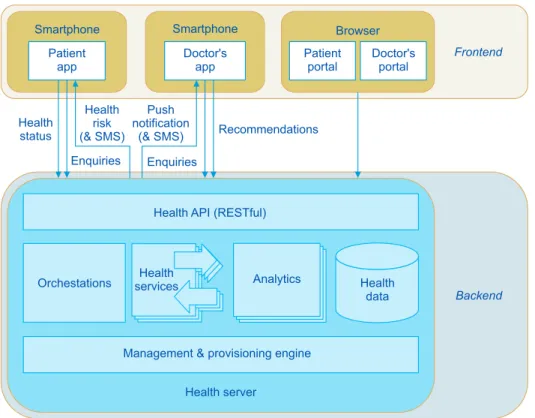
The environment that we will use to implement our services in this paper has been presented by Bitsaki et al. [12]. It consists of a frontend (iOS and Android smartphone mobile application) and a backend (Health Server) as shown in Fig-
ure 1. The publisher’s permission to use the Figures 1–4 was obtained. Through the application, patients securely trans- mit follow-up data to their doctors and have feedback on a scheduled basis.
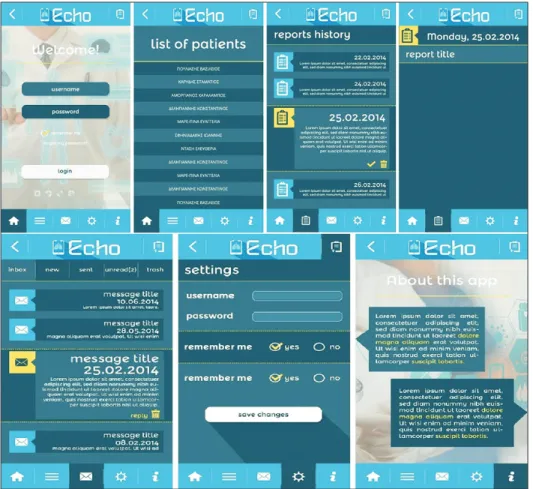
The graphical user interface of the application (Figures 3, 4) consists of screens: “Login”, “Report” (for patient), or “List of patients” (for doctor), “Reports history”, “Message”, and “Set- tings”.
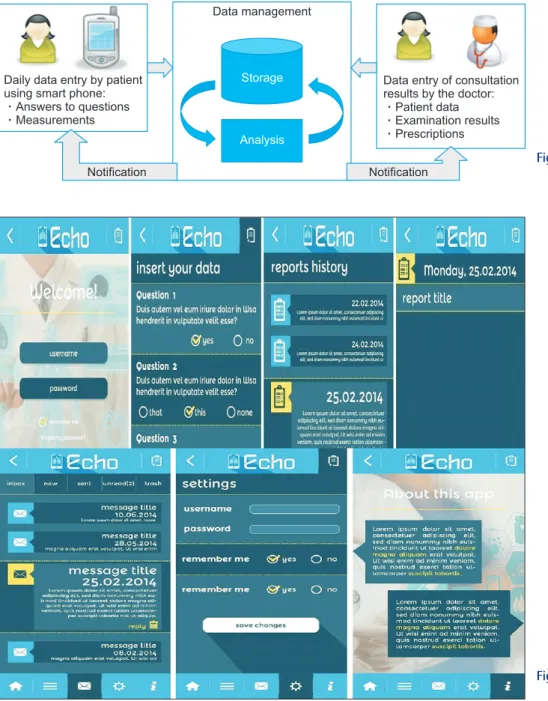
All healthcare data (entered by doctors or patients) are stored in the Health Data component of the Health Server.
Health Services and Analytics Services manage and process the healthcare data, such as patient data, insurance data, pre- scriptions, etc.
Data management
Daily data entry by patient using smart phone:
Answers to questions Measurements
Data entry of consultation results by the doctor:
Patient data Examination results Prescriptions Storage
Analysis
Notification Notification Figure 2. Health data sources and data
management and analytics.
Figure 3. Mock-ups of the mobile ap- plication for patients.
2. Economic Analysis
A cost analysis was performed to compare the proposed mHealth solution with the traditional way of supporting follow-up in terms of healthcare and travel costs per patient (per year).
The cost estimations were based on input taken from pri- mary hip and knee replacement surgeries performed at the University Clinic for Orthopedics in Essen-Werden per year (Table 1). For the estimation of the healthcare costs we con- sidered that patients subscribe to the application one year Table 1. Healthcare costs based on the University Clinic for Orthopedics in Essen-Werden
Evangelical Hospital Essen-Werden/University Clinic for Orthopedics, Essen, 2013 Hip Knee
Number of patients 232 191
Rate of private insured patients 0.18 0.20
Private insured patients 42 38
Public insured patients 190 153
Costs for the insurance company of follow-up assessment (including orthopedic consultation, the radiological examination and assessment by radiologist)
Private insured patients €125.00 €125.00
Public insured patients €33.00 €33.00
Costs for the insurance company of orthopedic follow-up assessment
Private insured patients €80.00 €80.00
Public insured patients €23.00 €23.00
Costs for the insurance company of radiological examination (AP and lateral hip or knee view)
Private insured patients €45.00 €45.00
Public insured patients €10.00 €10.00
Figure 4. Mock-ups of the mobile ap- plication for doctors.
after their operation and they adopt a follow-up scheme (a radiological examination and perhaps a visit to the hospital) that requires a new assessment once a year for the next 10 years. Visits can be avoided depending on the radiological assessment, the scores of the questionnaires, and the answers to the questions provided by the application as defined in the Algorithm of Action. For our analysis we assumed that the readmission rate r (percentage of patients that are rec- ommended to visit their physician at the hospital) fluctu- ates within the range [0.01, 0.1]. In Table 2 we provide the standard costs and the reduced costs due to the use of the mHealth platform for the 423 patients of Table 1 for one follow-up assessment for r = 0.05. The total cost reduction with the proposed approach is €13,578.
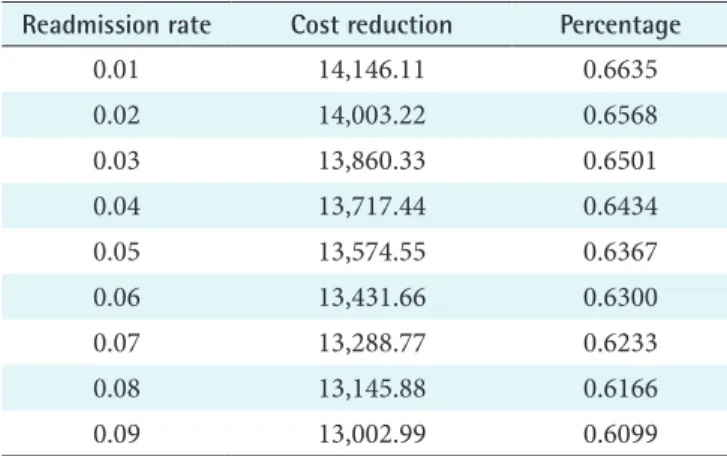
In Table 3, we present the cost reduction for various values of r per year. Figure 5 shows the graphical representation of the cost reduction as a function of r. These results show sig- nificant cost savings. For example, for a readmission rate of 5%, the cost reduction reaches the percentage of 63.67% of the standard healthcare total cost of all hip and knee replace- ment patients.
To show the degree of cost reduction on a wider scale, we
performed our cost analysis for the whole population of the state of North Rhine-Westphalia in Germany (17,638,098 inhabitants) [23]. For the analysis, we considered that in North Rhine-Westphalia the current rate of patients who undergo hip and knee replacement is the same as in all of Germany, which is 284/100,000 inhabitants for hip replace- ment and 206/100,000 for knee replacement [24]. The results are shown in Table 4.
Table 2. Cost analysis for level of readmission rate at 0.05
Hip Knee Total cost (€)
Type of insurance Private Public Private Public
Standard costs per patient (€) 125 33 125 33
Number of patients 42 190 38 153
Standard costs for all patients (€) 5,250 6,270 4,750 5,049 21,319
Reduced costs per patient (€) 125 45 33 10 125 45 33 10
Number of patients 2 40 9 181 2 36 8 145
Reduced costs for all patient (€) 250 1,800 297 1,810 250 1,620 264 1,450 7,741
Costreduction
1 16,000 14,000 12,000 10,000 8,000 6,000 4,000 2,000
Readmission rate
Cost savings by using mHealth platform
0 2 3 4 5 6 7 8 9
Figure 5. Cost reduction as a function of readmission rate.
Table 3. Cost reduction for various readmission rates in the Uni- versity Clinic for Orthopedics in Essen-Werden
Readmission rate Cost reduction Percentage
0.01 14,146.11 0.6635
0.02 14,003.22 0.6568
0.03 13,860.33 0.6501
0.04 13,717.44 0.6434
0.05 13,574.55 0.6367
0.06 13,431.66 0.6300
0.07 13,288.77 0.6233
0.08 13,145.88 0.6166
0.09 13,002.99 0.6099
Table 4. Cost reduction in North Rhine-Westphalia
Readmission rate Cost reduction Percentage
0.01 2,887,457.76 0.6635
0.02 2,858,291.52 0.6568
0.03 2,829,125.28 0.6501
0.04 2,799,959.04 0.6434
0.05 2,770,792.80 0.6367
0.06 2,741,626.56 0.6300
0.07 2,712,460.32 0.6233
0.08 2,683,294.08 0.6166
0.09 2,654,127.84 0.6099
Note that the percentages of cost reduction in Tables 3 and 4 are the same because the rates of patients subject to hip and knee replacement are taken to be the same in the two groups.
III. Discussion
Our approach will spur innovation across a number of in- dustries. Mobile applications for health services will get a boost from their ability to connect to data that can be man- aged and analyzed by specialized services running on the proposed platform. In addition, our approach will encourage innovation in the fields of data analytics, risk models, etc.
to be applied across a broad spectrum of interventions. We anticipate that our approach will accelerate societal and pos- sibly economic change in several areas. First and foremost, patients will feel strongly empowered to self-manage their disease in cooperation with their healthcare providers. Our approach to personalized care will increase the level of edu- cation of patients and caregivers regarding ICT solutions and will strengthen the knowledge about patients’ behavior relat- ed to the prevention of complications. We also expect that in the long-term overall health costs and insurance premiums will fall, improving the management of follow-up controls by reducing the number of severe episodes, hospital emergency visits, and complications.
In addition, the scientific community will be able to use the data collected through our platform for research purposes.
The electronic platform could also be used after modifica- tions for the collection of data in national arthroplasty regis- tries.
The results of the present study depend on the fact that the follow-up intervals for arthroplasty patients show great vari- ation internationally. Another restriction is that the readmis- sion rate cannot be estimated accurately. Lack of data urged us to make the assumption that in North Rhine-Westphalia the current rate of patients who undergo total hip and knee arthroplasty is the same as that in all of Germany. Finally, the generalization of the results may not be appropriate in different countries with great differences in their insurance systems.
Conflict of Interest
No potential conflict of interest relevant to this article was reported.
References
1. Kurtz S, Ong K, Lau E, Mowat F, Halpern M. Projections of primary and revision hip and knee arthroplasty in the United States from 2005 to 2030. J Bone Joint Surg Am 2007;89(4):780-5.
2. Haddad FS, Ashby E, Konangamparambath S. Should follow-up of patients with arthroplasties be carried out by general practitioners? J Bone Joint Surg Br 2007;
89(9):1133-4.
3. Lavernia CJ. Cost-effectiveness of early surgical inter- vention in silent osteolysis. J Arthroplasty 1998;13(3):
277-9.
4. Lindahl H, Oden A, Garellick G, Malchau H. The excess mortality due to periprosthetic femur fracture: a study from the Swedish national hip arthroplasty register.
Bone 2007;40(5):1294-8.
5. Hacking C, Weinrauch P, Whitehouse SL, Crawford RW, Donnelly WJ. Is there a need for routine follow-up after primary total hip arthroplasty? ANZ J Surg 2010;
80(10):737-40.
6. Maru M, Auyeung J, Irwin L. Primary total hip replace- ment follow-up study. Eur J Orthop Surg Traumatol 2005;15(4):286-8.
7. Lieberman JR, Leger RR, Tao JC, Clohisy JC, Meneghini RM. Total hip arthroplasty surveillance: when do we see our patients postoperatively? J Arthroplasty 2011;26(8):
1161-4.
8. Teeny SM, York SC, Mesko JW, Rea RE. Long-term fol- low-up care recommendations after total hip and knee arthroplasty: results of the American Association of Hip and Knee Surgeons' member survey. J Arthroplasty 2003;18(8):954-62.
9. Sharareh B, Schwarzkopf R. Effectiveness of telemedical applications in postoperative follow-up after total joint arthroplasty. J Arthroplasty 2014;29(5):918-922.e1.
10. British Orthopaedic Association. Primary total hip re- placement: a guide to good practice. London: British Orthopaedic Association; 2006.
11. British Orthopaedic Association. Knee replacement: a guide to good practice. London: British Orthopaedic Association; 1999.
12. Bitsaki M, Koutras C, Koutras G, Leymann F, Steimle F, Wagner S, et al. ChronicOnline: Implementing a mHealth solution for monitoring and early alerting in chronic obstructive pulmonary disease. Health Infor- matics J 2016 Apr 21 [Epub]. http://doi.org/10.1177/
1460458216641480.
13. Wood G, Naudie D, MacDonald S, McCalden R, Bourne R. An electronic clinic for arthroplasty follow-up: a pilot study. Can J Surg 2011;54(6):381-6.
14. Marsh J, Bryant D, MacDonald SJ, Naudie D, Remtulla A, McCalden R, et al. Are patients satisfied with a web- based followup after total joint arthroplasty? Clin Or- thop Relat Res 2014;472(6):1972-81.
15. Jeong YW, Kim JA. Development of computer-tailored education program for patients with total hip replace- ment. Healthc Inform Res 2014;20(4):258-65.
16. Milani P, Coccetta CA, Rabini A, Sciarra T, Massazza G, Ferriero G. Mobile smartphone applications for body position measurement in rehabilitation: a review of go- niometric tools. PM R 2014;6(11):1038-43.
17. Graham D, Suzuki A, Reitz C, Saxena A, Kuo J, Tetsworth K. Measurement of rotational deformity: us- ing a smartphone application is more accurate than con- ventional methods. ANZ J Surg 2013;83(12):937-41.
18. Peters FM, Greeff R, Goldstein N, Frey CT. Improv- ing acetabular cup orientation in total hip arthroplasty by using smartphone technology. J Arthroplasty 2012;
27(7):1324-30.
19. Hawi N, Kabbani AR, O'Loughlin P, Krettek C, Citak M,
Liodakis E. Intraoperative measurement of femoral ante- torsion using the anterior cortical angle method: a novel use for smartphones. Int J Med Robot 2013;9(1):29-35.
20. Roberts N, Bradley B, Williams D. Use of SMS and tab- let computer improves the electronic collection of elec- tive orthopaedic patient reported outcome measures.
Ann R Coll Surg Engl 2014;96(5):348-51.
21. Bellamy N. Osteoarthritis: an evaluative index for clini- cal trials [master’s thesis]. Hamilton, Canada: McMaster University; 1982.
22. Ware JE Jr, Sherbourne CD. The MOS 36-item short- form health survey (SF-36). I: Conceptual framework and item selection. Med Care 1992;30(6):473-83.
23. Official population of Nordrhein-Westfalen [Internet].
Dusseldorf: IT.NRW.com; c2015 [cited at 2017 Jan 3].
Available from: https://www.it.nrw.de/presse/presse- mitteilungen/2015/pres_241_15.html.
24. Wengler A, Nimptsch U, Mansky T. Hip and knee re- placement in Germany and the USA: analysis of indi- vidual inpatient data from German and US hospitals for the years 2005 to 2011. Dtsch Arztebl Int 2014;111(23- 24):407-16.