I. Introduction
The ‘smart connected world’ is an environment in which various objects can store, process, and exchange informa- tion seamlessly using Internet of Things (IoT) technologies.
IoT technologies have been applied to various fields, such as manufacturing, energy, the automobile industry, and healthcare, and IoT-based products and services are being produced and used in the market. In particular, the IoT is predicted to cause many changes in the manufacturing and healthcare industries [1,2]. In addition, the mobile-based healthcare service market is expected to rapidly expand with the growing prevalence of smartphones and the improve-
How to Sustain Smart Connected Hospital
Services: An Experience from a Pilot Project on IoT-Based Healthcare Services
Arum Park, PhD, Hyejung Chang, PhD, Kyoung Jun Lee, PhD
School of Management, Kyung Hee University, Seoul, Korea
Objectives: This paper describes an experience of implementing seamless service trials online and offline by adopting Inter- net of Things (IoT) technology based on near-field communication (NFC) tags and Bluetooth low-energy (BLE) beacons.
The services were provided for both patients and health professionals. Methods: The pilot services were implemented to enhance healthcare service quality, improve patient safety, and provide an effective business process to health professionals in a tertiary hospital in Seoul, Korea. The services to enhance healthcare service quality include healing tours, cancer informa- tion/education, psychological assessments, indoor navigation, and exercise volume checking. The services to improve patient safety are monitoring of high-risk inpatients and delivery of real-time health information in emergency situations. In addi- tion, the services to provide an effective business process to health professionals include surveys and web services for patient management. Results: Considering the sustainability of the pilot services, we decided to pause navigation and patient moni- toring services until the interference problem could be completely resolved because beacon signal interference significantly influences the quality of services. On the other hand, we had to continue to provide new wearable beacons to high-risk pa- tients because of hygiene issues, so the cost increased over time and was much higher than expected. Conclusions: To make the smart connected hospital services sustainable, technical feasibility (e.g., beacon signal interference), economic feasibility (e.g., continuous provision of new necklace beacons), and organizational commitment and support (e.g., renewal of new al- ternative medical devices and infrastructure) are required.
Keywords: Smartphone, Mobile Applications, Radio Frequency Identification Device, Internet, Patient Safety
Healthc Inform Res. 2018 October;24(4):387-393.
https://doi.org/10.4258/hir.2018.24.4.387 pISSN 2093-3681 • eISSN 2093-369X
Submitted: September 28, 2018 Revised: October 23, 2018 Accepted: October 23, 2018 Corresponding Author Kyoung Jun Lee, PhD
School of Management, Kyung Hee University, 26 Kyungheedae- ro, Dongdaemun-gu, Seoul 02447, Korea. Tel: +82-2-961-0490, E- mail: [email protected] (https://orcid.org/0000-0002-7774-6551)
This is an Open Access article distributed under the terms of the Creative Com- mons Attribution Non-Commercial License (http://creativecommons.org/licenses/by- nc/4.0/) which permits unrestricted non-commercial use, distribution, and reproduc- tion in any medium, provided the original work is properly cited.
ⓒ 2018 The Korean Society of Medical Informatics
ment of the mobile communication network environment [3], such LTE and 5G. IoT-based products consist of physi- cal, smart, and connectivity elements.
IoT-based products and services provide functions such monitoring, remote-control, optimization, and autonomy.
In particular, in the healthcare industry, IoT-based products and services create value by providing monitoring functions for high-risk patients and those with chronic illnesses [4,5].
However, the healthcare industry still lacks appropriate IT support. There are still problems regarding misidentification of patients or drugs or improper management of medical equipment. Moreover, problem regarding data inaccuracy and inconsistency occur with unintegrated data manage- ment systems [6].
Based on active research of IoT technology-based service models [7], this study aims to provide new value to patients by implementing services that monitor high-risk patients, inpatients, and outpatients particularly based on RFID tag technology (near-field communication [NFC]) and Blue- tooth low-energy (BLE) beacon technology. By providing new information that could not be acquired in the past to health professionals, they are expected to enhance decision- making capability. In particular, this paper describes the experience of providing services through web and mobile application to outpatients and inpatients to provide effective
work processes to health professionals.
As a result of this pilot project, patients could acquire rich health information offline, and the service improved their experience with new types of services. In particular, the healthcare services were designed to be continuously provid- ed to patients even after leaving the hospital. Thus, the hos- pital could have a continuous relationship with the patients, and we expected that patients would have higher satisfaction with these services.
II. Case Description
Services were developed for the purpose of improving healthcare, enhancing patient safety, and improving the work processes of health professionals. Herein, we describe the services, user interface (UI), and service effects.
1. Services for Healthcare Service Quality
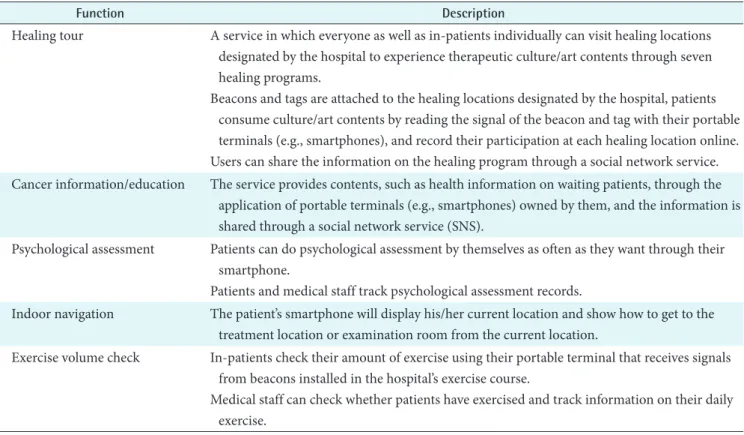
The functions for healthcare service quality include healing tours, cancer information/education, psychological assess- ments, indoor navigation, and exercise volume checks. The functions are summarized in Table 1, and UIs of smart- phones are presented in Figure 1.
(1) Healing tours regularly provide psychotherapy for cancer patients about twice a year at six healing locations. However,
Table 1. Descriptions of functions for healthcare services
Function Description
Healing tour A service in which everyone as well as in-patients individually can visit healing locations designated by the hospital to experience therapeutic culture/art contents through seven healing programs.
Beacons and tags are attached to the healing locations designated by the hospital, patients consume culture/art contents by reading the signal of the beacon and tag with their portable terminals (e.g., smartphones), and record their participation at each healing location online.
Users can share the information on the healing program through a social network service.
Cancer information/education The service provides contents, such as health information on waiting patients, through the application of portable terminals (e.g., smartphones) owned by them, and the information is shared through a social network service (SNS).
Psychological assessment Patients can do psychological assessment by themselves as often as they want through their smartphone.
Patients and medical staff track psychological assessment records.
Indoor navigation The patient’s smartphone will display his/her current location and show how to get to the treatment location or examination room from the current location.
Exercise volume check In-patients check their amount of exercise using their portable terminal that receives signals from beacons installed in the hospital’s exercise course.
Medical staff can check whether patients have exercised and track information on their daily exercise.
the health professionals had to pay a lot of time and cost because they had to accompany their patients. Therefore, we designed and implemented a self-service function that al- lows patients to check the location information of each heal- ing location through a smartphone application and to read the healing program information. In addition, it provides additional functions that can be shared through social media (e.g., KakaoTalk, Facebook) so that these programs can be promoted. Patients can use the services whenever they want, and the health professionals could focus on other high-risk patients. Health professionals can acquire information on which healing locations are popular based on how often pa-
tients touch the tag and receive the record of a beacon signal.
This information could be utilized to improve services in the future.
(2) ‘Cancer information/education’ provides appropriate contents based on information regarding the location at which the patient is waiting in the hospital. For example, patients in the waiting room of dermatology may have skin diseases, so the service provides useful content, such as tips to prevent skin diseases. It could be more cost effective than providing paper-based information and is even more effi- cient in terms of storing and distributing information in real time.
A B
C D
E
Introduction
Cancer information /education 1. Information on
disease 2. Guide for patient 3. Dietary
management 4. Exercise therapy 5. Cancer stress 6. Cancer
management program 7. FAQ
1. Information on disease
2. Guide on daily living 3. Dietary
management
NCC Psychological assessment
Patient ID :10015
1-1. What was your level of insomnia the last week?
1-2.
: :
Results
Date 02.28 02.27 : :
State stable unstable
Starting point destination
Indoor navigation
Exercise volume check
Start --- Result
Start
Pause Finish
Distance Calorie Hours Healing tour
1. Kyung Hee Medical Center
2. Peace Democratic Hill
3. School of Dance 4. Natural History
Museum 5. Grand Peace Hall
Grand Peace Hall
Figure 1. Service user interfaces for healthcare service qual- ity: (A) healing tour, (B) cancer information/edu- cation, (C) psychological assessment, (D) indoor navigation, and (E) exer- cise volume check.
(3) ‘Psychological assessment’ is a self-service that allows cancer patients to check their psychological state anytime, anywhere. This information could be also sent to health pro- fessionals so that they can recommend the appropriate edu- cation program to patients according to their psychological state.
(4) The hospital where the pilot study was implemented pro- vides both western medicine and oriental medicine services.
It is not easy for patients to find a clinic or treatment room.
‘Indoor navigation’ is a service that enables outpatients to easily find their destination by inputting the starting point and destination. Therefore, health professionals could be less interrupted by outpatients’ requests for directions on how to get to specific locations.
(5) ‘Exercise volume check’ was developed for health profes- sionals to prescribe exercise to patients and to check whether the exercise is performed based on digitally recorded infor- mation (beacon signal receiving record) rather than asking patient whether or not they have exercised. A patient wears a necklace beacon, and the beacon signal is caught by the bea- con scanner. It is attached to the exercise course so that the health professionals and the patient can check the exercise time, distance, and calorie consumption. Therefore, health professional can monitor the effect of movement therapy.
2. Services for Patient Safety
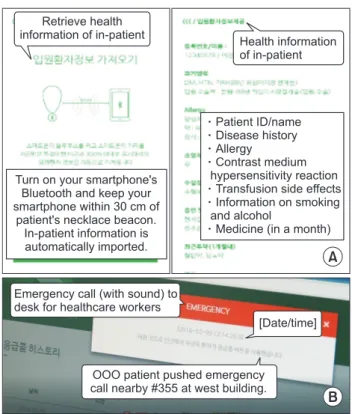
The functions for patient safety consist of monitoring high- risk inpatients and delivering real-time health information of inpatients in emergency situations. The function descrip- tions and UIs are presented in Table 2 and Figure 2, respec- tively.
(1) A high-risk inpatient wear a necklace beacon, and when an emergency button is pressed, the patient’s information and location information is delivered to the health profes- sionals with sound. Therefore, it is possible to detect patient emergency situations early and respond quickly.
(2) The delivery of real-time health information of inpatients in emergency situations is a service that can check the health information needed to cope with the emergency situation right on the spot. Previously, it was necessary to go to the health professionals’ workstations to check patient informa- tion and return to the patient, but this service allows health professionals to use the smartphone application to catch the signal from the patient’s necklace beacon. The patient’s information can be sent immediately to their smartphones, and they can quickly copy with emergency situations.
Table 2. Service descriptions of functions for patient safety
Function Description
Delivering real-time health information of in-patients in emergency situations
In-patients with chronic diseases are asked to wear a beacon in a necklace form.
Information on the patient’s current condition, medication, and precautions is pro- vided to doctors or nurses on their smartphones.
Safe and effective first aid is possible when an emergency occurs.
Monitoring high-risk in-patients Each patient wears a beacon in a necklace form. When a patient needs help from the medical staff, he/she can press the button on the beacon, which sends a signal to a beacon scanner installed in a certain location in the hospital, which then delivers the patient’s name and location to the medical staff.
Figure 2. Service user interfaces for patient safety: (A) delivery of real-time health information of in-patients in emergency situations and (B) monitoring of high-risk in-patients.
A
B
Retrieve health information of in-patient
Health information of in-patient
Turn on your smartphone's Bluetooth and keep your smartphone within 30 cm of
patient's necklace beacon.
In-patient information is automatically imported.
Patient ID/name Disease history Allergy
Contrast medium hypersensitivity reaction
Transfusion side effects Information on smoking and alcohol
Medicine (in a month)
Emergency call (with sound) to desk for healthcare workers
[Date/time]
OOO patient pushed emergency call nearby #355 at west building.
A B C
D
E F
Satisfaction survey
1. Age 2. Disease :
:
History of psychological assessment
Date 02.28
Psychological status stable
History of exercise
Date 02.28
Time 1 hour
Calorie 1000 kcal
Distance 1000 m
Tag/Wearable beacon/Fixed beacon/Navigation/Emergency call/Patients/Healthcare workers/Statistics Mobile beacon
management
New beacon registration
Patient ID/Name/NCC/Beacon number/Note Patient
management Patient registration
Discharges patients
Enter ID
Password
Staff registration
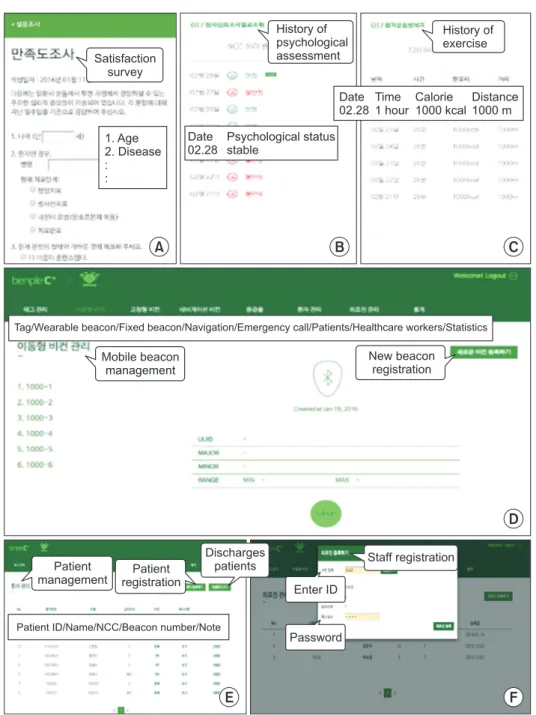
Figure 3. Service user interfaces for work process of health- care workers: (A) survey, (B) psychological assess- ment history, (C) exercise check history, (D) tag and beacon management service, (E) patient man- agement service, and (F) healthcare worker man- agement service.
Table 3. Service descriptions of functions for work process of healthcare workers
Function Description
Survey Staff can conduct a satisfaction survey of cancer patients regarding treatment programs through the application of portable terminals (e.g., smartphones) owned by cancer patients or tablet PCs provided by the hospital.
Staff can share the result with others.
Web service for patient management Information is provided on psychological assessments, exercise volume checks, satisfaction with educational programs, etc.
Web services also include services for tag and beacon management, patient management, and healthcare worker management.
3. Services for Work Process of Health Professionals The functions to assist the work process of health profes- sionals include surveys and web services for patient manage- ment. Table 3 and Figure 3 present the functions and UIs, respectively.
(1) The pilot study hospital provides 14 education programs for cancer patients. After completion of each program, a survey is conducted through the smartphone application instead of paper-based survey. This could improve work ef- ficiency and ensures the accuracy of information by elimi- nating the process by which health professionals digitize the results of paper-based surveys.
(2) ‘Web service for patient management’ provides service results, such as exercise volume checks, psychological as- sessments, the popularity of specific healing locations, and satisfaction with educational programs. To provide beacon and tag-based services, information such as the ID of each tag and beacon and the location attached to them should be uploaded to the web (beacon and tag management service).
The information should be uploaded to the web to see which patient is wearing a specific beacon (patient management service). Finally, health professionals’ information is entered into the system to grant them access to the web service (health professional management service).
III. Discussion
With the emergence of IoT sensor technologies, widely adopted smartphones and wearable devices now enable pa- tients and health professionals to communicate information conveniently and effectively [8]. We developed a pilot service to mitigate the problems that hospitals are struggling with by applying IoT, thereby to enhance customer satisfaction and improve hospital competitiveness. This is expected to lead to an increase in customer confidence and to have a positive impact on sales growth. The pilot study hospital is expected to show increased productivity due to effective improvement of the existing work process.
However, the pilot services are no longer available. We can think of many reasons why the innovative services could not be sustained. First, the technologies are not mature enough for the hospital to invest their efforts to sustain the new ser- vices. NFC tags are not accessible through most iPhones yet, and its alternative BLE beacons suffer from the necessity of battery change. In the near future, every iPhone will be able to read NFC tags and solar-powered BLE beacons will be developed. Time will solve these technical problems. Second, the pilot project was started as a government-supported
R&D initiative. Therefore, economic feasibility was not se- riously considered. The hospital did not invest its private budget for ongoing services. The aim of the pilot project was to investigate the technical and economic feasibility of the services. Therefore, the project’s goal was accomplished. If the technical and economic feasibility were proved positive, the hospital would commit to implementing the services at an organizational level. Therefore, the decision making of the hospital can be considered rational.
The emergence of new technologies and infrastructures has led to the emergence of new business models and the decline of existing business models [4,9,10]. For example, blood glu- cose self-monitoring product and services, such as ‘Dexcom CGM, iBG Star’ have already been launched and can replace healthcare services of hospitals for this purpose [11,12].
Hospitals need to develop differentiated services; therefore, business model innovation of hospitals is necessary. For such business model innovation, we expect that the pilot project described in this paper, can provide useful insights to stake- holders.
Conflict of Interest
No potential conflict of interest relevant to this article was reported.
Acknowledgments
This work was supported by the Ministry of Education of the Republic of Korea and the National Research Foundation of Korea (No. NRF-2017S1A5B8059804).
References
1. Evans D. Internet of Things: the evolution of the in- ternet changing everything [Internet]. San Jose (CA):
Cisco IBSG; 2011 [cited at 2018 Oct 1]. Available from:
https://www.cisco.com/c/dam/global/ko_kr/assets/ex- ecutives/pdf/internet-of-things-iot-ibsg-0411final.pdf.
2. International Telecommunications Union. The Internet of Things [Internet]. Geneva, Switzerland: International Telecommunications Union; 2005 [cited at 2018 Oct 1]. Available from: https://www.itu.int/net/wsis/tunis/
newsroom/stats/The-Internet-of-Things-2005.pdf.
3. Deloitte Insights. The Internet of Things: a technical primer [Internet]. New York (NY): Deloitte Insights;
2018 [cited at 2018 Oct 1]. Available from: https://
www2.deloitte.com/content/dam/insights/us/arti-
cles/4420_IoT-primer/DI_IoT-Primer.pdf.
4. Porter ME, Heppelmann JE. How smart, connected products are transforming competition. Harv Bus Rev 2014;92(11):64-88.
5. Porter ME, Heppelmann JE. How smart, connected products are transforming companies. Harv Bus Rev 2015;93(10):96-114.
6. Yao W, Chu CH, Li Z. The adoption and implementa- tion of RFID technologies in healthcare: a literature re- view. J Med Syst 2012;36(6):3507-25.
7. Park A, Chang H, Lee KJ. Action research on develop- ment and application of Internet of Things services in hospital. Healthc Inform Res 2017;23(1):25-34.
8. Kim J, Kam HJ, Park YR, Yoo S, Oh JS, Kim YH, et al. Enchanted life space: adding value to smart health by integrating human desires. Healthc Inform Res
2018;24(1):3-11.
9. Lee KJ, Jun JH. Internet of Things and business oppor- tunity [Internet]. Seoul, Korea: Dong-A Business Re- view; 2014 [cited at 2018 Sep 24]. Available from: http://
dbr.donga.com/article/view/1101/article_no/6593.
10. Chesbrough H, Rosenbloom RS. The role of the busi- ness model in capturing value from innovation: evi- dence from Xerox Corporation's technology spin‐off companies. Ind Corp Change 2002;11(3):529-55.
11. Dexcom G5 mobile CGM system [Internet]. San Diego (CA): Dexcom Inc.; c2018 [cited at 2018 Sep 13]. Avail- able from: https://www.dexcom.com/g5-mobile-cgm.
12. BGStar [Internet]. Paris, France: Sanofi; c2018 [cited at 2018 Sep 13]. Available from: https://www.mystarsanofi.
com/products/bgstar.