Comparing infective complications from transrectal ultrasound guided prostate biopsy following
transition to single dose oral ciprofloxacin prophylaxis
Matthew Farag1,*, Sophie Riddell1,*, John Daffy2, Lih-Ming Wong1,3
Departments of 1Urology, 2Infectious Diseases, St Vincent's Hospital Melbourne, Victoria, 3Department of Surgery, University of Melbourne, Victoria, Australia
Purpose: To examine the incidence of infective complications post Transrectal Ultrasound Guided Prostate Biopsy (TRUSPB), after transition to preoperative administration of single dose oral ciprofloxacin.
Materials and Methods: A retrospective study of 766 consecutive patients undergoing TRUSPB at St Vincent's Hospital Melbourne (2002–2016). Antibiotic prophylaxis between 2002–2014 consisted of 3 days of perioperative oral norfloxacin±intravenous (IV) antibiotics (Group A, n=687). From November 2014 patients received a single dose of oral 750 mg ciprofloxacin pre-biopsy (Group B, n=79), to align with the American Urological Association (AUA) and a Cochrane Database Systematic Review on Antibiotic Prophy- laxis for TRUSPB. Groups were compared for all postoperative complications requiring representation and/or readmission within 30 days of biopsy.
Results: In Group A, 10 of 687 patients (1.5%) re-presented with post-procedural fever (temperature >38ºC), requiring readmis- sion and IV antibiotic treatment, compared to 4 of the 79 patients (5.1%) in Group B (p=0.02). Positive blood cultures were isolated in 0.9% (n=6, Group A) versus 3.8% (n=3, Group B) (p=0.02). The 4 infectious readmissions in Group B had no prior genitourinary infections, no recent travel and all had a Charlson Comorbidity Index scores <2. Two patients in Group B cultured Escherichia coli sensitive to ciprofloxacin despite receiving preoperative ciprofloxacin.
Conclusions: Antibiotic prophylaxis using single dose ciprofloxacin is associated with higher infective complications post TRUSPB.
The episodes of ciprofloxacin sensitive E. coli bacteraemia in Group B suggest consideration of a longer course of perioperative an- tibiotic prophylaxis.
Keywords: Antibiotic prophylaxis; Biopsy; Ciprofloxacin; Fluoroquinolones; Prostate
This is an Open Access article distributed under the terms of the Creative Commons Attribution Non-Commercial License (http://creativecommons.org/licenses/by-nc/4.0) which permits unrestricted non-commercial use, distribution, and reproduction in any medium, provided the original work is properly cited.
Received: 14 September, 2018 • Accepted: 29 October, 2018 Corresponding Author: Matthew Farag
Department of Urology, St Vincent’s Hospital Melbourne, 41 Victoria Parade, Fitzroy, Victoria 3065, Australia TEL: +61-401537395, FAX: +61-392314737, E-mail: [email protected]
ORCID: https://orcid.org/0000-0003-3306-1531
*These authors contributed equally to this study and should be considered co-first authors.
ⓒ The Korean Urological Association
www.icurology.org
Investig Clin Urol 2019;60:54-60.
https://doi.org/10.4111/icu.2019.60.1.54 pISSN 2466-0493 • eISSN 2466-054X
INTRODUCTION
Antibiotic prophylaxis for patients undergoing Trans
rectal Ultrasound Guided Prostate Biopsy (TRUSPB) remains controversial. Given that 18,263 prostate biopsies were completed in Australia in the last financial year, it is important to appropriately address this topic. Whilst infection rates following TRUSPB are traditionally low, estimated between 1% to 4% [16], when infection occurs it can be severe and even life threatening. A number of risk factors for infection have been established such as prior infections, overseas travel and a Charlson Comorbidity Index (CCI) score greater than two [5,710].
In recent times, guidelines regarding the best practice antibiotic prophylaxis prior to TRUSPB have changed.
In 2011 the Cochrane Database of Systematic Reviews released a publication on Antibiotic Prophylaxis for Transrectal Prostate Biopsy. It outlined the significant benefit of prophylactic antibiotics for TRUSPB, with the most evidence for fluoroquinolones [4]. This reflected the American Urological Association's (AUA) best practice policy statement from 2008, which now provides the most current clinical recommendation on antimicrobial prophylaxis for TRUSPB. It recommends fluoroquinolones or 1st/2nd/3rd generation cephalosporins for ≤24 hours (level of evidence 1b) [11]. The lack of benefit seen from longer antibiotic regimes and the potential for pharmacological side effects from an increased duration of treatment formed the basis of this recommendation. As a result, many hospitals around the world transitioned to a single dose antibiotic regime [1214].
To align with the AUA guideline and the Cochrane Re
view our institution adopted a preoperative regime of ad
mi ni stering 750 mg single dose oral ciprofloxacin prior to TRUSPB, as of November 2014.
However, due to growing concerns within our institution that a single dose of ciprofloxacin was not an adequate duration of antibiotic prophylaxis, this study was proposed.
Our aim was to compare the incidence of infective compli
cations before and after the transition, and to evaluate the antibiotic sensitivities of bacterial pathogens in patients with positive cultures post TRUSPB.
MATERIALS AND METHODS
1. Patient selection
A retrospective study of patients undergoing TRUSPB at a single tertiary referral institution; St Vincent’s Hospital Melbourne, Australia, was undertaken. Patients were identified from surgical procedure codes, between 2002 and
2016. Readmissions within 30 days were found by manually reviewing the ‘hospital attendance’ component of patient online records. Approval was gained from the St Vincent’s Hospital Melbourne ethics committee.
Patient characteristics included age at biopsy and pre
biopsy prostate specific antigen (PSA). Charlson Comorbidity Index (CCI) scores were collected from the hospital admission database to identify any predisposing comorbidities such as diabetes, cerebrovascular or cardiac disease. Age related mortality risk and CCI were used to calculate a combined score, which in turn provides an estimated 10year survival (Table 1). No patients were excluded from the study.
2. Method
Patients undergoing TRUSPB between May 2002 and November 2014 were prescribed 3 days of perioperative fluoroquinolone (norfloxacin); prescriptions were provided at the preadmission clinic with compliance confirmed on day of biopsy. Intraoperative, intravenous (IV) antibiotics such as 1 g ceftriaxone or 240 mg gentamicin, were given at the discretion of the treating urologist (Group A).
From November 2014 the antibiotic prophylaxis protocol was changed to a single dose of fluoroquinolone (oral ciprofloxacin 750 mg), administered by the surgical team, 1 hour before the patient’s TRUSPB (Group B). All patients with additional risk factors for infection who received individualised antibiotic regimens throughout the study period were included in Group A as they were ineligible for single dose oral ciprofloxacin alone. All patients undertook a prebiopsy urine microscopy, culture and sensitivity, and positive cultures were treated appropriately.
Surgeons performed TRUSPB techniques in a standard extended template. A doublelayered transducer cover was placed over the ultrasound probe (BK medical US probe 8818K or Mindray US probe model 65EC10EA). Biopsies were usually performed using 18G trucut needle (Bard 18 g core biopsy needle gun). Preoperative rectal swabs were not taken, and no enemas or iodine suppositories were administered.
The microbiological methods for collection, processing and culture of specimens remained similar throughout the study period. Blood cultures were processed using the BACTEC (BD Diagnostics, Sparks, MD, USA). Both blood and urine were subcultured onto routine bacteriology media with subsequent isolates being identified by Vitek2 (bioMérieux, Marcyl’Étoile, France) (2002–2012) or Matrix assisted laser desorption time of flight mass spectrometry (MALDI
TOF; Bruker Daltonics, Bremen, Germany) (2012–2016).
Antimicrobial susceptibility testing was performed using
Vitek2. Clinical and Laboratory Standards Institute (CLSI) interpretive criteria were applied [15]. The CLSI breakpoint for ciprofloxacin susceptibility for Enterobacteriaecea remained the same throughout the study period at ≤1 µg/mL.
The primary outcome was readmission to our institution within 30 days following TRUSPB. Readmissions were further stratified into planned and unplanned, with unplanned then divided into febrile and nonfebrile categories. Postprocedural fever was defined as temperature
>38ºC. Secondary outcomes were the incidence of bacteraemia (positive blood culture) and urinary tract infection (UTI), i.e., a positive urine culture with fever, dysuria and/or polyuria.
Antibiotic sensitivities for positive urine and blood cultures for patients readmitted with fever were recorded.
3. Statistical analysis
Calculations were performed using Stata/MP version 13.0 for Mac (Stata Co., College Station, TX, USA). Variables were checked for skewness and kurtosis to determine normality.
Clinical and demographic features are presented as medians [interquartile range] and means (±standard deviation) for nonparametric and parametric data respectively. Differences between continuous parametric variables were examined with the ttest; the Wilcoxon ranksum test or the Wilcoxon
MannWhitney test were used for nonnormally distributed continuous and ordinal variables, while differences between dichotomous variables were evaluated with the χ2 test or the Fishers exact test (Tables 1, 2). A pvalues throughout the results were two sided.
RESULTS
A total of 766 consecutive patients underwent TRUSPB.
Group A included 687 patients (89.7%) and Group B, 79 patients (10.3%). Patients in both groups were statistically alike regarding demographic characteristics (Table 1). The mean age of patients was 66.86±8.69 and 65.89±8.05 in Groups A and B, respectively (p=0.34). TRUSPB characteristics including PSA prior to biopsy, total cores, number of positive cores and highest Gleason score were also statistically similar (Table 1). There was no difference in combined age–
CCI score or estimated 10year survival between the groups (p=0.50) (Table 1).
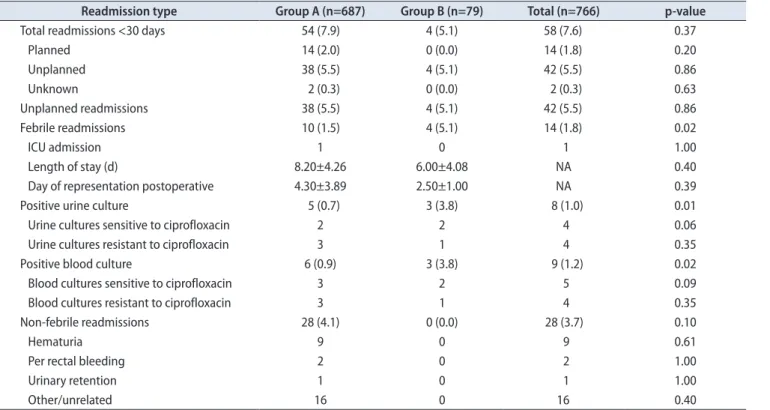
Comparison of readmissions within 30 days post TRUSPB is shown in Table 2. There was no statistical diffe rence in total 30 day unplanned readmissions between Group A (n=38, 5.5%) and Group B (n=4, 5.1%). The incidence of nonfebrile unplanned readmission including hematuria, per rectal bleeding and urinary retention was not significantly different between the two groups (Table 2).
Febrile readmissions occurred significantly more fre
quently in patients receiving single dose oral ciprofloxacin (Group A= 1.5%, Group B= 5.1%, p=0.02). Febrile readmissions yielding a positive blood culture were significantly higher in Group B (3.8%) than in Group A (0.9%) (p=0.02). Febrile readmissions yielding a positive urine culture were also significantly higher in Group B (3.8%) than in Group A (0.7%) (p=0.02) (Table 2). There was no difference between lengths of stay for postprocedure febrile readmissions between the Table 1. Patient and biopsy characteristics (n=766)
Characteristic Group A Group B p-value
Number of patients 687 (89.7) 79 (10.3)
Age (y) 66.86±8.69 65.89±8.05 0.34
PSA at diagnosis (ng/mL) 9.0 (6.0–15.7) 8.2 (6.0–12.6) 0.16
CCI 0.0 (0.0–2.0) 0.0 (0.0–2.0) 0.05b
Age related mortality risk 2.0 (2.0–3.0) 2.0 (2.0–3.0) 0.30
Combined age–CCI scorea 3.0 (2.0–5.0) 3.0 (2.0–5.0) 0.50
Estimated 10 year survival 78.0 (21.0–90.0) 78.0 (21.0–90.0) 0.50
Biopsy characteristic
Total cores 16.0 (13.0–19.0) 14.0 (12.0–18.0) 0.09
Patients with positive cores 334 (48.6) 50 (63.3)
Number of positive cores 5.00 (2.0–9.0) 4.0 (2.0–8.0) 0.64
Highest Gleason score 3.0 (3.0–4.0) 3.5 (3.0–4.0) 0.81
Values are presented as number (%), mean±standard deviation, or median (interquartile range).
PSA, prostate specific antigen; CCI, Charlson Comorbidity Index.
a:Combined score=single prognostic variable combining age related mortality risk and CCI, that is indicative of subsequent risk.
b:The two sample Wilcoxon-Mann-Whitney test was used for non-normally distributed continuous and ordinal variables, this p-value approaches significance (0.05), few subjects in Group B had multiple comorbidities placing them outside of the interquartile range and increasing Group B’s rank sum (without affecting median and interquartile range).
groups. Overall, only one patient required intensive care unit (ICU) admission and there was no mortality in our cohort.
Across all febrile readmissions, no patients had docu
mented travel history within 12 months preTRUSPB.
The four patients in Group B who were readmitted with fever were further evaluated for potential risk factors (Supplementary Table 1) [5,710]. All four patients had a CCI less than 2. One patient who grew ciprofloxacinsensitive
Escherichia coli was on aspirin and had undergone an uncomplicated TRUSPB one year prior. No identifiable risk factors were found in the remaining 3 patients.
Comparison between antibiotic administration and bacterial sensitivity in all febrile patients is shown in Table 3.
E. coli was responsible for all readmissions with bacteraemia and/or bacteriuria except one patient in Group A, who grew Streptococcus constellatus and Bacteroides fragilis in blood Table 2. Readmissions within 30 days post TRUSPB
Readmission type Group A (n=687) Group B (n=79) Total (n=766) p-value
Total readmissions <30 days 54 (7.9) 4 (5.1) 58 (7.6) 0.37
Planned 14 (2.0) 0 (0.0) 14 (1.8) 0.20
Unplanned 38 (5.5) 4 (5.1) 42 (5.5) 0.86
Unknown 2 (0.3) 0 (0.0) 2 (0.3) 0.63
Unplanned readmissions 38 (5.5) 4 (5.1) 42 (5.5) 0.86
Febrile readmissions 10 (1.5) 4 (5.1) 14 (1.8) 0.02
ICU admission 1 0 1 1.00
Length of stay (d) 8.20±4.26 6.00±4.08 NA 0.40
Day of representation postoperative 4.30±3.89 2.50±1.00 NA 0.39
Positive urine culture 5 (0.7) 3 (3.8) 8 (1.0) 0.01
Urine cultures sensitive to ciprofloxacin 2 2 4 0.06
Urine cultures resistant to ciprofloxacin 3 1 4 0.35
Positive blood culture 6 (0.9) 3 (3.8) 9 (1.2) 0.02
Blood cultures sensitive to ciprofloxacin 3 2 5 0.09
Blood cultures resistant to ciprofloxacin 3 1 4 0.35
Non-febrile readmissions 28 (4.1) 0 (0.0) 28 (3.7) 0.10
Hematuria 9 0 9 0.61
Per rectal bleeding 2 0 2 1.00
Urinary retention 1 0 1 1.00
Other/unrelated 16 0 16 0.40
Values are presented as number (%), number only, or mean±standard deviation.
TRUSPB, Transrectal Ultrasound Guided Prostate Biopsy; ICU, intensive care unit; NA, not applicable.
Table 3. Febrile readmissions; comparison of antibiotic administration to bacterial sensitivity Microbiology No. Oral FQa given Sensitive to
FQa
IV ceft or gent given
Sensitive to ceft or gent
Resistant to all Abx given
Sensitive to all Abx given Group A (n=10)
Positive BC only 3b 3 3 2 2 0 3
Positive UC only 2 2 2 2 2 0 2
Positive BC+UC 3 3 0 0 3 3 0
Negative cultures 2 2 - 2 - - -
Group B (n=4)
Positive BC only 0 0 0 0 0 0 0
Positive UC only 0 0 0 0 0 0 0
Positive BC+UC 3 3 2 0 3 1 2
Negative cultures 1 1 - 0 - - -
FQ, fluoroquinolone; IV, intravenous; ceft, ceftriaxone; gent, gentamycin; Abx, antibiotics; BC, blood cultures; UC, urine cultures.
a:FQ given in Group A=oral norfloxacin, 400 mg, twice a day, for 3 days perioperatively. Group B=oral ciprofloxacin, 750 mg, 1 hour preoperatively.
b:One patient from this group was non-compliant with preoperative oral antibiotics. One patient in this group cultured Streptococcus constellatus and Bacteroides fragilis, all other bacteria were Escherichia coli.
only. In Group B, 2 of the 3 patients readmitted with fever subsequently cultured organisms from blood and urine sensitive to ciprofloxacin despite preoperative single dose oral ciprofloxacin. Three patients in Group A (0.4%) and one patient in Group B (1.3%) cultured bacteria resistant to fluoroquinolones. A detailed summary of all febrile readmissions is presented in Supplementary Table 2.
DISCUSSION
In our institution, the incidence of postprocedural fever following TRUSPB significantly increased following transition to the single dose oral fluoroquinolone regime (1.5% vs. 5.1%, p=0.02). Results from The Department of Health’s ‘Victorian Admitted Episodes Dataset’, showed that between 2007 to 2012, statewide readmissions resulting from infection, within seven days of biopsy, was 1.7%
[1]. Thus, prior to the transition to single dose antibiotic prophylaxis, our institution had comparative infection rates to local standards (1.5%), even with a wider 30day (cf. 7day) readmission window.
In the literature, post TRUSPB infection rates range from 1% to 4% [5,6]. Variation is attributable to differences in antibiotic prophylaxis regimens, local bacterial antibiotic sensitivities, cohort exclusion criteria and methods of reporting such as 7 versus 30day windows. Incidence of infective complications post TRUSPB using single dose ciprofloxacin prophylaxis is limited. Lundström et al.
[10] completed a large (n=51,321) national Swedish study reviewing patients with prostate cancer undergoing TRUSPB. Of these patients, 6% were prescribed antibiotics within 30 days, but only 1% of patients were hospitalised for infection. A national Swedish audit at the time stated 83% of antibiotic prophylaxis used was ciprofloxacin and 64% was a single dose of oral antibiotics immediately before biopsy [10].
In another study by Lindstedt et al. [9], they reported one of the lowest rates of complications in a cohort receiving single dose ciprofloxacin prophylaxis, with 0.9% for UTI and 0.3%
for hospital admission post TRUSPB. However, this study looked at healthy subjects only, excluding 16% of their initial cohort due to identifiable risk factors for infection. Eight of the 12 patients readmitted with infection were then found to have infective risk factors on further analysis. Hence, these low infection rates following single dose ciprofloxacin prophylaxis are not generalisable to an average population such as our study cohort.
Our institution’s antibiotic prophylaxis regime was altered to follow the AUA best practice policy statement 2008 and the Cochrane Systematic Review from 2011. The
Cochrane Systematic Review supports the use of antibiotic prophylaxis, in particular fluoroquinolones [4,13]. In the systematic review no individual randomised controlled trial (RCT) showed a statistically significant benefit of single dose over multidose treatment for reducing fever, UTI or bacteraemia. A forest plot comparison within the systematic review incorporating four RCT’s, supported multidose as opposed to single dose antibiotic prophylaxis in reducing bacteriuria (relative risk, 1.98; 95% confidence interval, 1.18;
3.33) [4]. Furthermore, forest plot comparisons all favoured multi over single dose antibiotic prophylaxis for reducing fever, UTI and hospitalisation [4]. The trend from the Cochrane Systematic Review is that multi dose antibiotic prophylaxis is favoured, however, large scale RCTs would be required to further evaluate an appropriate duration.
The AUA policy advising <24 hours of antibiotic prophylaxis is based on three studies, the largest of which had 363 participants. In the RCT (n=231) by Aron et al.
[12], they compared placebo to ciprofloxacin (500 mg) and tinidazole (600 mg) either as a single dose or as a three day bidaily course. Infective complications in the three day perioperative antibiotic group (10.3%) offered no statistically significant benefit over single dose (7.5%) [12]. Shigemura et al. [3], in a nonrandomised prospective study (n=236) compared one day of levofloxacin 600 mg to a threeday 300 mg regimen and found infective complications were equivalent in each group, 1.6% and 1.79%, respectively.
The oneday regimen included two postoperative doses at two and eight hours [3]. Finally, Sabbagh et al. [2] also compared a oneday versus threeday antibiotic regimen in a randomised open label trial (n=363). Seven days post biopsy telephone follow up recorded levels of infection at only 0.55%
for both groups. In all three trials, the lack of benefit seen from the longer antibiotic regimens formed the basis of the recommendation of <24 hours of antibiotic prophylaxis.
Our results support longer course antibiotic prophylaxis.
For patients receiving single dose ciprofloxacin, two of the four patients that were readmitted with fever cultured organisms sensitive to ciprofloxacin. Neither patient had had previous genitourinary infections or recent travel and both had a CCI of less than two. This suggests a longer course of ciprofloxacin would have been required to prevent these infections, and accounts for the significantly increased infection rate in Group B compared to Group A.
Three of the patients in Group A (0.4%) and one of the patients in Group B (1.3%) cultured bacteria that was resistant to all the antibiotics they received. In changing our antibiotic prophylaxis policy, consideration was made for the resistant organisms found in Australia due to our
proximity to South East Asia. A recent review of antibiotic resistance in Australia has indicated ciprofloxacin resistance in 6.2%–8.7% of E. coli isolates including both community and hospital settings [16]. As antibiotic resistance increases, a trans perineal approach should be considered in highrisk patients.
The limitations of our study include the retrospective nature and lack of randomisation. The separation of Groups A and B with respect to time may have influenced results due to changing local bacterial profiles. We did not retrieve missing data from pre electronic records for risk factors for infection, nor the exact antibiotics given for patients in Group A. The low number of biopsies per year of approximately fifty may be a possible source of bias. There may be a cohort of patients who did not represent to our institution for their biopsy complications and hence have not been captured.
CONCLUSIONS
Consensus regarding the most effective course of prophylaxis for TRUSPB has not yet been reached. Further investigation with prospective trials is required, ideally comparing 24 hours to 3 days of oral antibiotic prophylaxis [17]. Extended duration of therapy to reduce infective complications must be weighed against pharmacological side effects and risk of resistant organism propagation. Our study suggests that single dose ciprofloxacin is inadequate prophylaxis for TRUSPB. This finding requires a targeted prospective trial, accounting for the increasing antibiotic resistance that is now widely acknowledged in the medical field. A multidose antibiotic regime has since been instituted at our hospital in consultation with our infectious diseases department.
CONFLICTS OF INTEREST
The authors have nothing to disclose.
ACKNOWLEDGMENTS
St Vincent’s Pathology Laboratory, St Vincent’s Hospital Melbourne, Australia.
SUPPLEMENTARY MATERIALS
Scan this QR code to see the supplementary materials, or visit https://www.icurology.org/src/sm/icurology6054s001.pdf.
REFERENCES
1. Roth H, Millar JL, Cheng AC, Byrne A, Evans S, Grummet J.
The state of TRUS biopsy sepsis: readmissions to Victorian hospitals with TRUS biopsy-related infection over 5 years. BJU Int 2015;116 Suppl 3:49-53.
2. Sabbagh R, McCormack M, Péloquin F, Faucher R, Perreault JP, Perrotte P, et al. A prospective randomized trial of 1-day versus 3-day antibiotic prophylaxis for transrectal ultrasound guided prostate biopsy. Can J Urol 2004;11:2216-9.
3. Shigemura K, Tanaka K, Yasuda M, Ishihara S, Muratani T, Deguchi T, et al. Efficacy of 1-day prophylaxis medication with fluoroquinolone for prostate biopsy. World J Urol 2005;23:356- 60.
4. Zani EL, Clark OA, Rodrigues Netto N Jr. Antibiotic prophy- laxis for transrectal prostate biopsy. Cochrane Database Syst Rev 2011;(5):CD006576.
5. Loeb S, Vellekoop A, Ahmed HU, Catto J, Emberton M, Nam R, et al. Systematic review of complications of prostate biopsy.
Eur Urol 2013;64:876-92.
6. Wagenlehner FM, van Oostrum E, Tenke P, Tandogdu Z, Çek M, Grabe M, et al. Infective complications after prostate bi- opsy: outcome of the Global Prevalence Study of Infections in Urology (GPIU) 2010 and 2011, a prospective multinational multicentre prostate biopsy study. Eur Urol 2013;63:521-7.
7. Aus G, Ahlgren G, Bergdahl S, Hugosson J. Infection after transrectal core biopsies of the prostate--risk factors and anti- biotic prophylaxis. Br J Urol 1996;77:851-5.
8. Bruyère F, Malavaud S, Bertrand P, Decock A, Cariou G, Doublet JD, et al. Prosbiotate: a multicenter, prospective analy- sis of infectious complications after prostate biopsy. J Urol 2015;193:145-50.
9. Lindstedt S, Lindström U, Ljunggren E, Wullt B, Grabe M.
Single-dose antibiotic prophylaxis in core prostate biopsy:
impact of timing and identification of risk factors. Eur Urol 2006;50:832-7.
10. Lundström KJ, Drevin L, Carlsson S, Garmo H, Loeb S, Stat- tin P, et al. Nationwide population based study of infections after transrectal ultrasound guided prostate biopsy. J Urol 2014;192:1116-22.
11. Wolf JS Jr, Bennett CJ, Dmochowski RR, Hollenbeck BK, Pearle MS, Schaeffer AJ; Urologic Surgery Antimicrobial Pro- phylaxis Best Practice Policy Panel. Best practice policy state-
ment on urologic surgery antimicrobial prophylaxis. J Urol 2008;179:1379-90.
12. Aron M, Rajeev TP, Gupta NP. Antibiotic prophylaxis for tran- srectal needle biopsy of the prostate: a randomized controlled study. BJU Int 2000;85:682-5.
13. Kapoor DA, Klimberg IW, Malek GH, Wegenke JD, Cox CE, Patterson AL, et al. Single-dose oral ciprofloxacin versus place- bo for prophylaxis during transrectal prostate biopsy. Urology 1998;52:552-8.
14. Antibiotic Expert Groups [Internet]. Therapeutic guidelines;
2014 Nov [cited 2016 Feb 8]. Available from: https://tgldcdp- tg-org-au.ezp.lib.unimelb.edu.au/viewTopic?topicfile=surgical- prophylaxis#toc_d1e1921.
15. Patel JB; Clinical and Laboratory Standards Institute. Per-
formance standards for antimicrobial susceptibility testing:
twenty-fifth informational supplement. Wayne: Clinical and Laboratory Standards Institute; 2015.
16. Australian Commission on Safety and Quality in Health Care (ACSQHC). AURA 2016: first Australian report on antimicro- bial use and resistance in human health. Sydney: Australian Commission on Safety and Quality in Health Care (ACSQHC);
2016.
17. Which strategies are effective for reducing the risk of infective complications in men undergoing prostate biopsy? [Internet].
National Institute for Health Research; 2015 Sep 21 [cited 2016 Feb 12]. Available from: http://www.crd.york.ac.uk/PROS- PERO/display_record.php?ID=CRD42015026354.
Supplementary Table 1. Risk factors for febrile readmissions in Group B
Risk factor Patient 1 Patient 2 Patient 3 Patient 4
CCI >2 No- 2 (77.5% estimated
10 y survival)
No- 0 (90.1% estimated 10 y survival)
No- 2 (53.4% estimated 10 y survival)
No- 2 (21.4% estimated 10 y survival)
Prior infection (6 mo preceding biopsy) No No No No
Diabetes No No No No
Pharmacological treatment of LUTS/BPH No No No No
Antiplatelets No No Yes (aspirin) No
Increased number of cores >7 Yes (21) Yes (14) Yes (13) Yes (14)
Positive urine MSU/dipstick preoperative No No No No
IDC No No No No
Prostatitis No No No No
Steroids No No No No
Travelled overseas (12 mo preceding biopsy)
No No No No
Used antibiotics (4 wk preceding biopsy) No No No No
Non-compliance with preoperative
Antibiotics No No No No
Previous TRUSPB No No Yes- 1 previous TRUSPB
1 y preceding this TRUSPB
No
CCI, Charlson Comorbidity Index; LUTS, lower urinary tract symptoms; BPH, benign prostatic hypertrophy; MSU, mid-stream urine; IDC, indwelling catheter; TRUSPB, Transrectal Ultrasound Guided Prostate Biopsy.
Supplementary Table 2. Details for febrile readmissions within 30 days post TRUSBP No.AgeDate of TRUS BPAntibiotics on inductionAntibiotics postoperativeDate of readmission PresentationCultures 1633/12/02IV gentNorflx 400 mg BD for 5/74/12/02 ED LOS: 16 d Fever Back pain-bony mets, cancer of unknown origin
MSU: nil growth BC: nil growth 26510/8/04NilNorflx 400 mg BD for 3/712/8/04 ED LOS: 6 d
Fever, sweats, rigors Lethargy and intermittent hema- turia.
MSU: Escherichia coli R: amox, cipro S: cefaz, gent BC: E. coli R: amox, norflx, cipro S: cefaz, gent 35126/9/06IV gentNorflx 400 mg BD for 3/74/10/06 ED LOS: 5 d
Fever, frequency, flank pain, PR bleed and hematuriaMSU: E. coli R: amox, ceph, Aug S: ceft, gent, cipro BC: nil growth 48313/3/07IV gentNorflx 400 mg BD for 3/716/3/07 ED LOS: 7 d
Fever, rigors, chillsMSU: nil growth BC: Streptococcus const latus and E Frgillis R: ceft S: penicillin, vanc, cipr 5688/8/07IV gentNorflx 400 mg BD for 2/79/5/07 ED LOS: 8 d
Fever and rigorsMSU: nil growth BC: E. coli R: nil S: gent, amp, cipro 6 (same as 3)5329/7/08IV gent+amp, norflx 400 mg night before.Norflx 400 mg BD for 3/730/7/08 ED LOS: 7 d ICU: 1 d Fever, rigors, nausea and vomiting, hypotension not responsive to IV fluids.
MSU: nil growth BC: nil growth 76917/3/09NilNorflx 400 mg BD for 2/719/3/09 ED LOS: 7 d
Fever, sweats, chills and muscle crampsMSU: E. coli R: amox, norflox, cipro S: cefaz, gent BC: E. coli R: amox, norflx, cipro S: gent, aug 8677/9/10IV gentNorflx 400 mg BD, unknown duration18/9/10 ED LOS: 4 d
Fever, dysuria, sweatsMSU: E. coli R: amox, ceph, trim S: aug, gent, cipro BC: nil growth 95810/5/11Nil induction, 1 d norflx 400 mg BD.Norflx 400 mg BD for 2/720/5/11 ED LOS: 6 d Fever, sweats, chills, hematuria, dysuriaMSU: nil growth BC: E. coli R: nil S: gent, amp, cipro
Supplementary Table 2. Continued No.AgeDate of TRUS BPAntibiotics on inductionAntibiotics postoperativeDate of readmission PresentationCultures 107920/12/12Nil induction, 1 d norflx 400 mg BD.Norflx 400 mg BD for 3/724/12/12 ED LOS: 16 d
Fever, generalised fatigueMSU: E. coli R: amox, trim, cipro S: cefaz, gent BC: E. coli R: amox, norflx, cipro S: gent, aug 115718/08/15Cipro 750 mg PO 1 h preoperative Nil20/08/15 ED LOS: 4 d
Fevers, sweats, rigorsMSU: E. coli R: amox, trim, cipro S: ceft, gent BC: E. coli R: amox, norflx, cipro S: gent, ceft 126324/9/15Cipro 750 mg PO 1 h preoperative Nil26/09/15 ED LOS: 12 d
Fever, hypotensive, NSTEMI (found unconscious at home)MSU: E. coli R: cotrimox, trim S: amp, gent, cipro BC: E. coli R: cotrimox, trim S: amp, gent, cipro 137016/11/15Cipro 750 mg PO 1 h preoperative Nil18/11/15 ED LOS: 3 d
Fever, urinary and faecal incontinenceMSU: E. coli R: cotrimox, trim S: amp, gent, ceft, cipro BC: E. coli R: cotrimox, trim S: ceft, amp, gent, cipro 14712/12/15Cipro 750 mg PO 1 h preoperativeNil6/12/15 ED LOS: 5 d
Fever, sweats and chillsMSU: nil growth BC: nil growth TRUSPB, Transrectal Ultrasound Guided Prostate Biopsy; IV, intravenous; gent, gentamycin; amp, ampicillin; norflx, norfloxacin; BD, bis in die (twice a day); cipro, ciprofloxacin; PO, oral; ED, emergenc department; LOS, length of stay; ICU, intensive care unit; PR, per rectal; NSTEMI, non-ST elevation myocardial infarction; MSU, mid-stream urine; BC, blood cultures; R, resistant; amox, amoxycillin; S, sensitive; cefaz, cefazolin; cotrimox, cotrimoxazole; ceph, cephalexin; trim, trimethoprim; vanc, vancomycin; aug, augmentin duo forte.