Received: August 30, 2013, Revised: October 16, 2013, Accepted: October 21, 2013 ISSN 1598-4478 (Print) / ISSN 2233-7679 (Online)
†Correspondence to: Hyun-Ok Lee
Department of Dental Hygiene, Wonkwang Health Science University, 514, Iksan-daero, Iksan 570-750, Korea Tel: +82-63-840-1265, Fax: +82-63-840-1269, E-mail: [email protected]
Copyright © 2013 by the Korean Society of Dental Hygiene Science
일부 대학생의 흡연실태와 흡연신념과의 관련성
이현옥†ㆍ송지연1
원광보건대학교 치위생과, 1전북과학대학교 치위생과
Relationship of the State of Smoking to Smoking Beliefs among College Students
Hyun-Ok Lee
†and Ji-Yeon Song
1Department of Dental Hygiene, Wonkwang Health Science University, Iksan 570-750, 1Department of Dental Hygiene, Jeonbuk Science College, Jeongeup 580-712, Korea
The purpose of this study was to examine the state of smoking among college students and the relationship between their state of smoking and smoking beliefs in an effort to provide information on the development and utilization of smoking-prevention and antismoking programs geared toward stepping up the health promotion of college students. The subjects in this study were 1,696 people at 10 different universities located in North Jeolla Province. A survey was conducted from May 1 to June 1, 2012, and the collected data were analyzed. The findings of the study were as follows: 1. Smoking status was as follows: smoking was 23.7% for students with experience, the first one when smoking was the highest 42.1%
in high school and a four-year duration of smoking was highest in at least 46.1%. 2. As for smoking beliefs by general characteristics, the respondents whose monthly allowance was between 300 and 390 thousand Korean won and 400 thousand Korean won or more got 1.91 (p
<0.001), Concerning the relationship between smoking and oral health, the biggest group that replied there was no relationship between the two got 2.00, which was the highest score (p<0.001). 3. Regarding the links between the state of smoking and smoking belief, the respondents who answered elementary school days in the time to begin smoking got 2.66, which was the highest score, and the one who answered four out of their five close friends were smoking got 2.60, which was the highest score (p<0.05). 4. As to the relationship of smoking dependence and intention of quitting smoking, the respondents who answered they were quite dependent on smoking got 2.75 (p<0.001), which was the highest score.
And the respondents who answered they had no intention to give up smoking got 2.68, which was the highest score (p<0.01).
Key Words: College students, Smoking beliefs, The state of smoking
서 론
최근 사회가 발달함에 따라 건강에 대한 관심과 중요성이 강조되고 있으며, 건강한 생활을 향상시키기 위한 건강증진 행위가 더욱 증가하고 있다. 건강과 관련된 행동이나 습관 은 오랫동안 형성되며 이미 형성된 행동이나 습관을 단번에 수정하는 것은 매우 어려운 일이다. 따라서, 대학생 시기의 건강행위는 성인기의 건강과 향후 지역사회 및 국가의 건강
에도 영향을 줄 수 있으므로, 대학생의 건강증진을 위해 올 바른 건강습관을 가질 수 있도록 돕는 것은 매우 중요하다 고 생각된다.
건강과 관련한 생활양식으로는 음주, 흡연, 영양, 운동, 스
트레스 등이 있으며
1), 이 중 흡연은 전신건강과 구취, 치아
우식증, 치주병, 치아마모증과 치아변색, 상처치유지연, 백
반증, 구강암 등의 구강질환 발생에 영향을 준다
2). 2011년
상반기 흡연 실태 조사 결과
3)에 의하면 만 19세 이상 성인
남성과 여성의 흡연율이 2010년 상반기에는 각각 42.6%, 2.8%에서 2011년 상반기에는 각각 39.0%, 1.8%로 감소되 고 있는 것으로 나타났으며, 20∼29세의 성인에서 남성 흡 연율은 40.5%, 여성 흡연율은 3.6%로 높게 보고되었다. 또 한, 최초 흡연 시작연령은 20.6세, 규칙적인 흡연 시작연령 은 21.2세로 보고
3)되어 대학생 시기에 해당되는 연령에서 흡연행동이 높게 나타났음을 알 수 있다. 청년기에 해당하 는 대학생은 생애주기상 가장 건강한 시기이지만 활동적이 고 호기심도 강하며 학업으로 인한 스트레스와 장래 및 취 업에 대한 고민 등으로 인하여 건강을 위협할 수 있는 흡연, 음주 등을 많이 경험하게 되며 무분별하게 행동하기도 한 다. 특히, 우리나라의 대학생들은 고등학교시절에서의 억압 된 제약으로부터 벗어나 시간이나 생활면에서 여유로워져 흡연과 음주에 쉽게 노출되어 흡연 행동이 시작되고 이 행 동이 습관적인 행동으로 변화될 가능성이 높다
4). 흡연으로 인한 건강장애는 오랜 기간 이후에 나타나기 때문에 20대 연령에서의 흡연행위는 일생 동안의 건강을 유지하는 데에 좋지 않은 영향을 준다
5). 이러한 건강관련 위험 행동은 행동 으로 야기되는 잠재적 결과에 대한 개인의 인지적 평가에 의해 결정되고, 그 예가 신념체계이며
6), 신념이란 개인이 특 정 대상에 대하여 갖는 직접적 또는 간접적인 지적 평가라 고 할 수 있다
7). 이에 흡연신념은 흡연을 통해 기대하는 결 과에 대하여 믿는 것을 의미한다고 볼 수 있다. Tuakli 등
8)은 흡연에 대한 신념 중 흡연은 사람을 편안하게 해주고, 스 트레스를 감소시켜 주며, 지루함을 달래준다고 하였다. 이 렇게 흡연에 대한 신념이 바람직하지 못할수록 흡연으로 인 한 위험이 증가하므로 흡연에 대한 잘못된 신념을 올바른 신념으로 변화시키고, 이를 바탕으로 개별적인 금연중재와 금연교육 및 훈련 등을 통하여 대학생의 흡연율을 감소시키 기 위한 노력이 필요하다고 생각된다. 현재까지는 대학생의
흡연실태
9,10)와 지식, 태도
11-13)에 관한 연구는 많이 있으나
흡연실태와 접목한 흡연신념에 관한 연구는 미비하다. 이에 본 연구에서는 일부 대학생의 흡연실태를 조사하고 흡연실 태에 따른 흡연신념을 파악하여 대학생의 건강증진에 도움 이 될 수 있도록 흡연 예방 및 금연 프로그램 개발과 활용에 필요한 기초자료를 제공하고자 한다.
연구대상 및 방법
1. 연구대상
본 연구는 2012년 5월 1일부터 6월 1일까지 전라북도에 위치하고 있는 10개 대학교의 1, 2, 3, 4학년 학생을 대상으 로 하였으며, 사전교육을 받은 조사요원 6명이 연구목적과
취지를 설명하고 자료수집에 동의를 구하였다. 동의한 학생 들을 대상으로 편의표본추출법에 의한 자기기입식으로 설 문에 응답하게 한 후 바로 회수하였다. 총 1,696명의 설문지 중 기재가 누락되었거나 응답이 미흡한 18명의 설문지를 제 외한 1,678명의 설문지를 최종 분석에 사용하였다.
2. 연구방법
설문지는 Lee 등
14), Lee와 Chun
15), Cha 등
16), Choi
17)의 연구를 본 연구의 목적에 맞게 수정ㆍ보완하여 사용하였다.
설문지의 내용은 일반적 특성 5문항, 흡연실태 8문항, 흡연 신념 6문항, 흡연의존도와 금연의도 각각 1문항으로 구성하 였다. 결과분석 과정에서 흡연경험은 ‘예(현재흡연, 과거흡 연)’, ‘아니오(비흡연)’로 재분석하였다. 흡연신념은 Likert 4점 척도를 사용하였고, ‘매우 그렇다’ 4점, ‘대체로 그렇다’
3점, ‘대체로 그렇지 않다’ 2점, ‘전혀 그렇지 않다’ 1점으로 하였으며, 그 점수를 총합하여 점수가 높을수록 조사대상자 들의 흡연에 대한 신념이 긍정적인 것으로 평가하였다.
3. 통계처리
통계분석은 SPSS 12.0 (SPSS Inc., Chicago, IL, USA)을 이용하였다. 흡연신념의 Cronbach's α값을 구하기 위해서 는 신뢰도 분석을, 일반적 특성과 흡연실태를 분석하기 위 해서는 빈도분석을 실시하였다. 흡연경험 유무에 따른 흡연 신념은 t-test를 실시하였고, 일반적 특성에 따른 흡연신념, 흡연실태에 따른 흡연신념, 흡연의존도와 금연의도에 따른 흡연신념은 t-test 또는 일변량분산분석법(one-way ANOVA) 을 시행한 후 Scheffe의 사후검정을 실시하였다.
결 과
1. 조사대상자의 일반적 특성
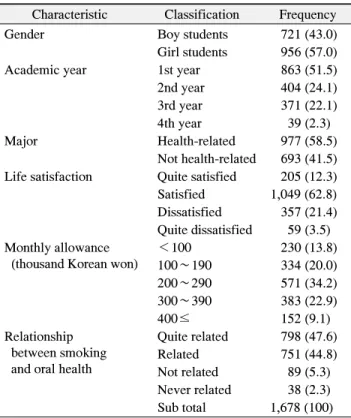
성별은 남학생이 43.0%, 여학생이 57.0%이었고, 학년에 서는 1학년이 51.5%, 2학년이 24.1%, 3학년이 22.1%, 4학 년이 2.3%이었다. 전공은 보건계열이 58.5%, 일반계열이 43.5%이었고, 생활만족도는 ‘만족한다’가 62.8%로 가장 높았고, ‘매우 불만족한다’가 3.5%로 가장 낮았다. 한 달 용 돈은 20만원∼29만원이 34.2%로 가장 높았고, 40만원 이 상이 9.1%로 가장 낮았다. 흡연과 구강건강 관련성은 ‘매우 그렇다’가 47.6%로 가장 높았고, ‘전혀 그렇지 않다’가 2.3%로 가장 낮았다(Table 1).
2. 흡연실태
흡연실태에서 흡연경험은 ‘예’가 23.7%, ‘아니오’가
Characteristic Classification Frequency
Gender Boy students 721 (43.0)
Girl students 956 (57.0)
Academic year 1st year 863 (51.5)
2nd year 404 (24.1)
3rd year 371 (22.1)
4th year 39 (2.3)
Major Health-related 977 (58.5)
Not health-related 693 (41.5) Life satisfaction Quite satisfied 205 (12.3) Satisfied 1,049 (62.8) Dissatisfied 357 (21.4) Quite dissatisfied 59 (3.5) Monthly allowance
(thousand Korean won)
<100 230 (13.8)
100∼190 334 (20.0)
200∼290 571 (34.2)
300∼390 383 (22.9)
400≤ 152 (9.1)
Relationship between smoking and oral health
Quite related 798 (47.6)
Related 751 (44.8)
Not related 89 (5.3) Never related 38 (2.3) Sub total 1,678 (100) Values are presented as n (%).
There is missing value in 1 people for gender, in 1 people for academic year, in 8 people for major, in 8 people for life satisfaction, in 8 people for monthly allowance and in 2 people for the relationship between smoking and oral health.
Table 1. The General Characteristics of the Subjects
Classification Frequency
Smoking experience
Yes 391 (23.7)
No 1,257 (76.3)
The time to begin smoking
Elementary school days 23 (5.9)0
Middle school days 120 (30.8)
High school days 164 (42.1)
College days 81 (21.0)
The period of smoking (yr)
1 24 (14.5)
2 29 (17.6)
3 36 (21.8)
4≤ 76 (46.1)
Daily average amount of smoking (cigarette)
<10 276 (80.9)
10≤ 65 (19.1)
Smoking place
Home 40 (14.5)
School 83 (30.1)
Houses of friends 16 (5.8)0
PC bangs (internet cafes) 42 (15.2)
Street 71 (25.7)
Coffee shop 8 (2.9)0
Bar or Noraebang (karaoke) 16 (5.8)0
Smoking motivation
Out of curiosity 153 (41.0)
To get rid of stress 98 (26.3)
Advice from friends 93 (25.0)
It looks pretty nice. 21 (5.6)0
To go on a diet 7 (1.9)0
The number of smoker among five close friends
Zero 31 (8.1)0
One 34 (8.9)0
Two 61 (16.0)
Three 82 (21.5)
Four 62 (16.2)
Five 112 (29.3)
Smoker(s) among family members
aFather 196 (67.1)
Mother 13 (4.5)0
Brother 63 (21.6)
Sister 5 (1.7)0
Grandfather 11 (3.8)0
Grandmother 4 (1.4)0
Values are presented as n (%).
a
Multiple responses were allowed about smoker(s) among family members.
There is missing value in 3 people for the time to begin smoking, in 226 people for the period of smoking, in 50 people for daily average amount of smoking, in 115 people for smoking place, in 19 people for smoking motivation, in 9 people for the number of smoker among five close friends.
Table 2. The State of Smoking
76.3%이었다. 흡연학생 중에서 처음 흡연한 시기는 고등학 교가 42.1%로 가장 높았고, 흡연기간은 4년 이상이 46.1%
로 가장 높았다. 평균 하루 흡연량은 10개비 미만이 80.9%
이었고, 흡연장소는 학교가 30.1%로 가장 높았다. 흡연동기 로는 호기심이 41.0%로 가장 높았고, 다음으로 스트레스 해 소가 26.3%, 친구의 권유가 25.0%, 멋있어 보여서가 5.6%, 다이어트가 1.9% 순으로 조사되었다. 친한 친구 5명 중 흡 연하는 친구는 5명이 29.3%가 흡연을 한다고 하였고, 8.1%
가 없다고 하였다. 가족 내 흡연자는 아버지가 67.1%로 가장 높았고, 남자형제는 21.6%, 어머니는 4.5%이었다(Table 2).
3. 흡연신념
흡연신념은 1.80점이었고, 세부항목으로 ‘흡연은 스트레
스를 줄여준다’가 1.93점으로 가장 높았고, ‘흡연은 무료하
거나 지루함을 달래준다’가 1.87점, ‘흡연은 어색한 분위기
를 감소시켜준다’가 1.86점으로 거의 유사하였으며, ‘흡연하
면 체중을 줄일 수 있다’는 1.65점으로 가장 낮았다(Table 3).
Classification Smoking experience Mean±SD t p-value
It's okay to smoke for one or two years. Yes 2.29±0.968 14.821 0.000***
No 1.50±0.709 14.821 0.000***
Smoking makes one feel at ease. Yes 2.48±0.872 18.284 0.000***
No 1.58±0.772 18.284 0.000***
Smoking serves to relieve stress. Yes 2.65±0.875 18.866 0.000***
No 1.70±0.844 18.866 0.000***
Smoking helps break the ice. Yes 2.62±0.930 19.444 0.000***
No 1.61±0.785 19.444 0.000***
Smoking makes it possible to lose weight. Yes 1.92±0.916 6.979 0.000***
No 1.56±0.774 6.979 0.000***
Smoking helps one to be less bored or less tedious. Yes 2.66±1.007 18.486 0.000***
No 1.62±0.805 18.486 0.000***
p-value was calculated by conducting t-test. ***p<0.001.
Table 4. The Relationship between Smoking Experience and Smoking Beliefs (n=1,678)
Item Mean±SD Cronbach's α
It's okay to smoke for one or two years.
1.70±0.853 0.888
Smoking makes one feel at ease. 1.80±0.889 Smoking serves to relieve stress. 1.93±0.946 Smoking helps break the ice. 1.86±0.933 Smoking makes it possible to
lose weight.
1.65±0.821
Smoking helps one to be less bored or less tedious.
1.87±0.966
Total 1.80±0.901
Table 3. Smoking Beliefs
4. 흡연경험 유무에 따른 흡연신념
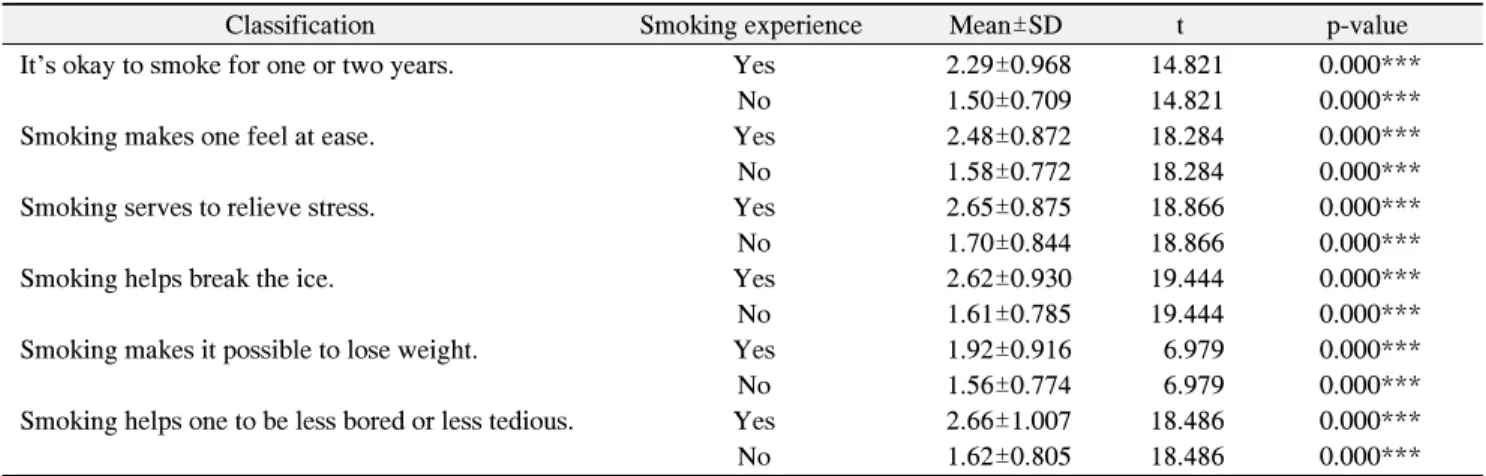
흡연경험 유무에 따른 흡연신념에서 ‘1∼2년 정도 흡연 하는 것은 괜찮다’는 ‘예’가 2.29점, ‘아니오’가 1.50점이었 고(p<0.001), ‘흡연은 사람을 편안하게 해준다’는 ‘예’가 2.48점, ‘아니오’가 1.58점이었다(p<0.001). ‘흡연은 스트 레스를 줄여준다’는 ‘예’가 2.65점, ‘아니오’가 1.70점이었 고(p<0.001), ‘흡연은 어색한 분위기를 감소시켜준다’는
‘예’가 2.62점, ‘아니오’가 1.61점이었다(p<0.001). ‘흡연 하면 체중을 줄일 수 있다’는 ‘예’가 1.92점, ‘아니오’가 1.56점이었고(p<0.001), ‘흡연은 무료하거나 지루함을 달 래준다’는 ‘예’가 2.66점, ‘아니오’가 1.62점이었다(p<0.001, Table 4).
5. 일반적 특성에 따른 흡연신념
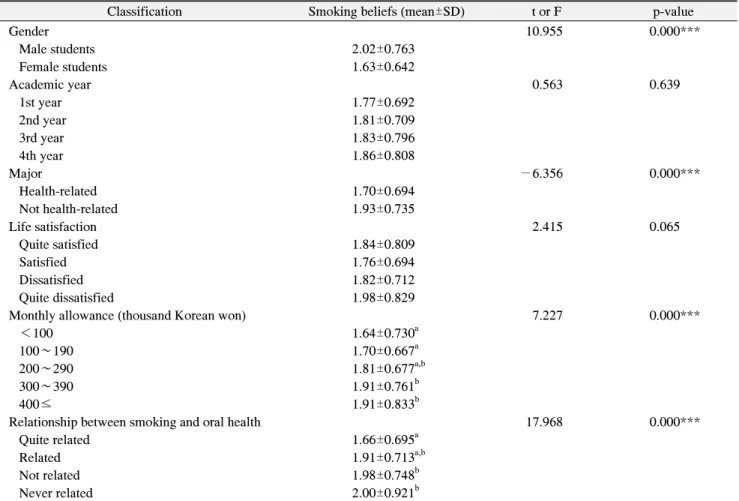
흡연신념은 4점 만점 중 남학생이 2.02점, 여학생이 1.63 점으로 남학생이 높았고(p<0.001), 학년에서는 4학년이 1.86점, 3학년이 1.83점, 2학년이 1.81점, 1학년이 1.77점으
로 학년이 높을수록 흡연신념이 높았다. 전공에서는 보건계 열이 1.70점, 일반계열이 1.93점으로 일반계열이 높았고(p<
0.001), 생활만족도에서는 ‘매우 불만족한다’가 1.98점으로 흡연신념이 가장 높은 반면 ‘만족한다’고 응답한 군에서는 1.76점으로 흡연신념이 가장 낮았다. 한 달 용돈에서는 30∼
39만원과 40만원 이상이 1.91점으로 흡연신념이 가장 높은 반면 10만원 미만이 1.64점으로 흡연신념이 가장 낮았다(p<
0.001). 흡연과 구강건강 관련성에서는 ‘전혀 그렇지 않다’
가 2.00점으로 흡연신념이 가장 높은 반면 ‘매우 그렇다’가 1.66점으로 흡연신념이 가장 낮았다(p<0.001, Table 5).
6. 흡연실태에 따른 흡연신념
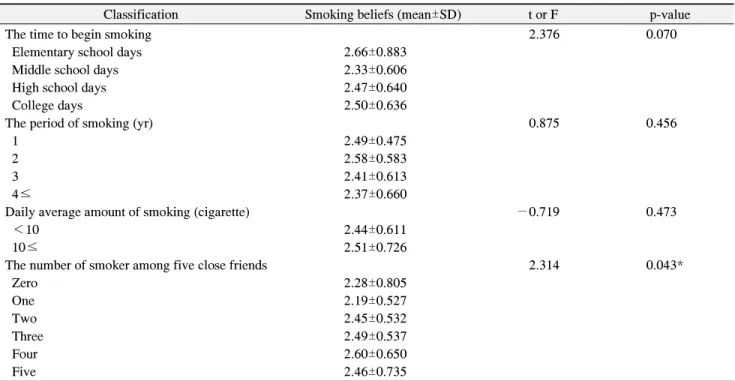
흡연실태에 따른 흡연신념은 처음 흡연한 시기에서 초등 학교가 2.66점으로 가장 높았고, 중학교가 2.33점으로 가장 낮았다. 흡연기간은 2∼3년 미만이 2.58점으로 가장 높았고 4년 이상이 2.37점으로 가장 낮았다. 평균 하루 흡연량은 10 개비 미만이 2.44점, 10개비 이상이 2.51점이었다. 친한 친 구 5명 중 흡연하는 친구는 4명이라고 응답한 군이 2.60점 으로 가장 높았고, 3명 2.49점, 5명 2.46점, 2명 2.45점, 없다 2.28점, 1명 2.19점이었다(p<0.05, Table 6).
7. 흡연의존도와 금연의도에 따른 흡연신념
흡연의존도와 금연의도에 따른 흡연신념에서 흡연의존 도는 ‘매우 그렇다’가 2.75점, ‘그렇다’가 2.55점, ‘그렇지 않다’가 2.36점, ‘매우 그렇지 않다’가 2.10점으로 흡연의존 도가 높을수록 흡연신념이 높았다(p<0.001). 금연의도는
‘금연하지 않음’이 2.68점, ‘담배값이 1∼2만원 이상 오르
면 금연’이 2.58점, ‘취업 후 금연’이 2.50점, ‘1년 이내 금
연’이 2.37점, ‘지금 바로(한 달 이내) 금연’이 2.30점이었다
Classification Smoking beliefs (mean±SD) t or F p-value
Gender 10.955 0.000***
Male students 2.02±0.763
Female students 1.63±0.642
Academic year 0.563 0.639
1st year 1.77±0.692
2nd year 1.81±0.709
3rd year 1.83±0.796
4th year 1.86±0.808
Major −6.356 0.000***
Health-related 1.70±0.694
Not health-related 1.93±0.735
Life satisfaction 2.415 0.065
Quite satisfied 1.84±0.809
Satisfied 1.76±0.694
Dissatisfied 1.82±0.712
Quite dissatisfied 1.98±0.829
Monthly allowance (thousand Korean won) 7.227 0.000***
<100 1.64±0.730
a100∼190 1.70±0.667
a200∼290 1.81±0.677
a,b300∼390 1.91±0.761
b400≤ 1.91±0.833
bRelationship between smoking and oral health 17.968 0.000***
Quite related 1.66±0.695
aRelated 1.91±0.713
a,bNot related 1.98±0.748
bNever related 2.00±0.921
ba,b
Scheffe post-hoc analysis, it means that there were no statistically significant intergroup differences when the values are marked with the same letters (p<0.05).
p-value was calculated by conducting t-test or one-way ANOVA. ***p<0.001.
Table 5. The Relationship between General Characteristics and Smoking Beliefs
(p<0.01, Table 7).
고 찰
일생 중 대학생들은 최고의 건강상태를 향유하는 시기이 지만 건강의 진가를 경시하는 경향이 있어 오히려 건강의 위험을 안고 있다
18). 건강에 위험을 주는 요인 중에서 흡연 은 일상 학교생활 및 사회생활의 건강에 문제가 된다. 흡연 은 폐암의 가장 큰 유발요인으로 흡연기간과 흡연량에 따라 그 위험도가 증가하게 되는데
19), 청소년과 여성흡연 및 대학 생들 사이에서 일반적인 습관행위로 흡연이 매년 증가하고 있는 실정이다
20). 흡연을 시작하는 연령이 어릴수록, 흡연 의 양이 많을수록, 흡연기간이 길수록 습관성 흡연자가 될 가능성이 높고 흡연으로 인한 피해가 크다
21). 그러므로, 흡 연을 시작하고 오랫동안 유지하도록 하는 흡연에 대한 올바
른 신념을 이해시키고 교육한다면 대학생의 흡연발생을 최 소로 예방할 수 있을 것이라 생각된다. 이에 본 연구에서는 일부 대학생의 흡연실태를 조사하고 흡연실태에 따른 흡연 신념을 파악하여 대학생의 건강증진에 도움이 될 수 있도록 흡연 예방 및 금연 프로그램 개발과 활용에 필요한 기초자 료를 제공하고자 한다.
본 연구결과를 보면 전체 대상자 1,678명 중 흡연 경험이 있다고 응답한 학생이 391명(23.7%)이었다. Kim
22)의 연구 에서 조사된 40.9%와 비교 시 낮은 흡연율을 보였지만 29.5%가 흡연을 한다고 응답한 Lee
23)의 연구와는 비슷하 였다. 그리고, 42.1%가 고등학교 때 처음 흡연을 하였고, 46.1%가 4년 이상 흡연을 하였다고 응답하였는데, Paek과 Kwon
4)의 연구에서는 흡연시작 연령 39.7%가 17∼19세로 나타나 본 연구와 비슷하게 나타났고, 흡연기간 48.7%가 5∼
9년 동안 흡연을 하였다고 보고한 바 있다. 본 연구대상자인
Classification Smoking beliefs (mean±SD) t or F p-value
The time to begin smoking 2.376 0.070
Elementary school days 2.66±0.883
Middle school days 2.33±0.606
High school days 2.47±0.640
College days 2.50±0.636
The period of smoking (yr) 0.875 0.456
1 2.49±0.475
2 2.58±0.583
3 2.41±0.613
4≤ 2.37±0.660
Daily average amount of smoking (cigarette) −0.719 0.473
<10 2.44±0.611
10≤ 2.51±0.726
The number of smoker among five close friends 2.314 0.043*
Zero 2.28±0.805
One 2.19±0.527
Two 2.45±0.532
Three 2.49±0.537
Four 2.60±0.650
Five 2.46±0.735
Scheffe post-hoc analysis was made, but no marks were added since there were no statistically significant intergroup differences (p>
0.05).
p-value was calculated by conducting t-test or one-way ANOVA. *p<0.05.
Table 6. The Relationship between the State of Smoking and Smoking Beliefs
Classification n (%) Smoking beliefs (mean±SD) F p-value
Smoking dependence 8.527 0.000***
Quite dependent
032 (8.6)2.75±0.966
cDependent 188 (50.3) 2.55±0.572
b,cNot dependent 120 (32.1) 2.36±0.516
a,bQuite not dependent
034 (9.1)2.10±0.756
aIntention of quitting smoking 4.667 0.001**
Will quit smoking immediately (in a month).
081 (22.4)2.30±0.671
aWill quit smoking in a year.
078 (21.5)2.37±0.525
a,bWill quit smoking after getting a job.
043 (11.9)2.50±0.588
a,bWill quit smoking when the price of cigarette goes
up 10 or 20 thousand Korean won.
096 (26.5)
2.58±0.553
a,bWon't quit smoking.
064 (17.7)2.68±0.760
ba∼c
Scheffe post-hoc analysis, it means there were no statistically significant differences when the values are marked with the same letters (p<0.05).
p-value was calculated by conducting one-way ANOVA. **p<0.01, ***p<0.001.
Table 7. The Relationship of Smoking Dependence and Intention of Quitting Smoking to Smoking Beliefs
대부분의 대학생들은 청소년 시기에 흡연이 시작되었고 장 기간 동안 흡연을 해 왔음을 짐작할 수 있다. 빠른 시기에 흡 연을 시작할수록 성인이 될 때까지 니코틴이 축적되어 흡연 과 관련된 질병을 얻게 되므로
24), 대학생의 건강을 위해 대 학생 시기에 맞는 금연 프로그램을 마련하여 가정과 학교에 서의 조기금연을 위한 교육이 강화되어야 할 것으로 생각된
다. 조사대상자들의 흡연장소로는 30.1%가 학교이며, 흡연
동기는 41.0%가 호기심, 26.3%가 스트레스 해소 때문이라
고 응답하였다. 그리고, 흡연신념 중 ‘흡연은 스트레스를 줄
여준다’로 응답한 경우가 가장 높게 나타났다. 이와 같은 결
과는 흡연장소로 학교가 41.4%, 흡연동기로 호기심이
40.0%로 응답한 Park 등
25)의 연구와 비슷하였고, 흡연동기
로 호기심이 53.6%로 가장 높게 나타난 Kim
22)의 연구와도 비슷하였다. Hahm 등
26)은 흡연이 실제로 스트레스를 감소 시키는 효과가 없음에도 불구하고, 흡연에 대한 신념이 긍 정적으로 나타났다고 보고한 바 있다. 이와 같은 결과는 학 업과 취업문제 그리고 생활만족도에 대한 스트레스가 또래 집단을 통해 학교 공동체 안에서 공유되면서 호기심으로 작 용하기 때문에 흡연에 대한 행동이 흡연 신념에 긍정적인 영향을 주는 것으로 생각된다. 친한 친구 5명 중 흡연하는 친구는 5명이 29.3%로 가장 높았고 가족 내 흡연자는 67.1%가 아버지라고 응답하였는데, 이와 같은 결과는 친구 흡연자 중 5명 이상이 73.2%로 가장 높게 응답한 Kang 등
27)
의 연구와 부모 흡연자 중 45.2%가 아버지라고 가장 높게 응답한 Lee
23)의 연구와 비슷하였다. 대학생을 대상으로 한 Lee
23)의 연구에서 아버지가 흡연을 할 경우, 어머니가 흡연 에 대해 허용적일수록, 친한 친구들 가운데 담배를 피우는 친구의 수가 많을수록 흡연을 할 가능성이 높다고 하였는 데, 본 연구에서는 친한 친구 5명 중 흡연하는 친구의 수가 4 명이라고 응답한 군에서 흡연에 대한 신념이 긍정적이었다 (p<0.05). 이와 같은 결과는 부모와 주위 친구들의 흡연행 동이 호기심과 연계되어 흡연에 쉽게 노출됨으로써 대학생 의 흡연신념에 긍정적인 영향을 주는 것으로 생각된다.
흡연과 구강건강관련성은 ‘전혀 그렇지 않다’가 2.00점 으로 가장 높게 나타나 흡연과 구강건강의 관련성이 없다고 생각할수록 흡연에 대한 신념이 긍정적이었다(p<0.001).
Shin과 Kim
28)은 청소년의 흡연자는 우식경험 영구치 수가 4.71개, 비흡연자는 6.59개라고 하였고, Kim 등
24)은 흡연 경험군이 비흡연군에 비해 치은염에 이환될 확률이 5.5배로 높다고 하였다. 이와 같은 결과로 볼 때 흡연과 구강건강은 밀접한 관련이 있음에도 불구하고 흡연이 구강건강에 주는 악영향을 인지하지 못하고 있음을 알 수 있다. 먼저는 흡연 예방프로그램을 통하여 대학생들이 흡연으로 인한 폐해에 대해 인식하고 흡연에 대한 바람직한 태도와 신념을 갖도록 하여 흡연이 습관화되지 않도록 해야 할 것이다. 또한, 보건 계열학생보다 일반계열학생이 흡연에 대한 신념이 긍정적 이었는데(p<0.001), 일반계열학생에게는 건강과 관련한 교양강좌개설 확대 및 교양프로그램을 활성화시켜 통합적 인 금연교육의 효과를 높이고 지속적인 교육이 이루어질 수 있도록 해야 할 것으로 생각된다. 흡연의존도는 ‘매우 그렇 다’라고 응답한 군에서 2.75점으로 가장 높게 나타나 흡연 에 대한 의존도가 높을수록 흡연에 대한 신념이 긍정적으로 나타났다(p<0.001). 이와 같은 결과는 남자 대학생의 니코 틴 의존도의 평균 점수가 4.03점으로 평균적으로 가벼운 니 코틴 의존성향을 보여준다고 한 Park 등
25)의 연구와는 다소
차이가 있었고, 중학생에서 흡연기간이 길수록 흡연일수가 많을수록 니코틴 의존도에 영향을 준다고 한 Lee 등
14)의 연 구와는 비슷하였다. 금연의도에서는 ‘금연하지 않음’이 2.68점으로 금연에 대한 생각이 없을수록 흡연에 대한 신념 이 긍정적이었다(p<0.01). 대학생을 대상으로 한 Kim
22)의 연구에서는 87.3%가 향후 금연계획이 있고, 담배값 인상 시 금연하겠다고 하였으며 55.8%가 대학 내 흡연예방보건교 육이 필요하다고 하였다. 따라서 흡연을 하는 대학생이 금 연을 실천하기 위해서는 흡연으로 인해 발생되는 건강의 유 해성과 심각성을 스스로 깨닫고 금연에 대한 확실한 의도와 구체적인 계획을 세워 금연을 실행할 수 있도록 흡연 행위 에 대한 체계적인 관리가 이루어져야 할 것으로 생각된다.
이상의 결과를 살펴보면, 대학생들은 금연할 의지가 약한 것으로 나타나 근본적으로 금연의지를 높일 수 있는 방안이 필요하다고 생각되며, 흡연신념에 부정적 영향을 주는 여러 요인들을 바로 잡아 금연중재를 위한 대학 내에서의 흡연예 방 보건교육프로그램이 실행되어야 할 것으로 생각된다. 본 연구는 저자의 편의에 의해 일부 대학생을 연구대상자로 선 정하였으므로 일반화하여 해석하기에 제한이 따를 수 있어 서 표본을 확대한 연구가 필요할 것으로 생각되며, 향후 흡 연신념이 구강건강에 미치는 요인에 대한 구체적인 연구가 이루어져서 대학생들의 올바른 흡연신념과 흡연예방을 통 해 건강증진을 도모하고 구강건강을 함께 유지할 수 있도록 하는 제도적인 방안이 마련되어야 할 것으로 생각된다.
요 약
본 연구는 일부 대학생의 흡연실태와 흡연실태에 따른 흡 연신념을 파악하여 대학생의 건강증진에 도움이 될 수 있는 흡연 예방 및 금연 프로그램 개발과 활용에 필요한 자료를 제공하고자 2012년 5월 1일부터 6월 1일까지 전라북도에 위치하고 있는 10개 대학교 학생 중 1,696명을 대상으로 분 석한 결과 다음과 같은 결론을 얻었다.
1. 흡연실태는 흡연경험이 있는 학생은 23.7%였고, 처음 흡연한 시기는 고등학교가 42.1%로 가장 높았고, 흡연기간 은 4년 이상이 46.1%로 가장 높게 나타났다.
2. 일반적 특성에 따른 흡연신념은 한 달 용돈이 30만원∼
39만원과, 40만원 이상에서 1.91점으로 가장 높았고(p
<0.001), 흡연과 구강건강 관련성은 ‘전혀 그렇지 않다’가 2.00점으로 가장 높게 나타났다(p<0.001).
3. 흡연실태에 따른 흡연신념은 처음 흡연한 시기에서 초
등학교가 2.66점으로 가장 높았고, 친한 친구 5명 중 흡연하
는 친구는 4명이 2.60점으로 가장 높게 나타났다(p<0.05).
4. 흡연의존도와 금연의도에 따른 흡연신념은 흡연의존도 에서 ‘매우 그렇다’가 2.75점으로 가장 높았고(p<0.001), 금연의도는 ‘금연하지 않음’이 2.68점으로 가장 높게 나타 났다(p<0.01).
감사의 글
이 논문은 2013년도 원광보건대학교 연구비 지원에 의하 여 수행된 결과로 이에 감사드린다.
References