Effects of Plasma Treatment on Mechanical Properties of Jute Fibers and Their Composites with Polypropylene
Yang Il Huh, Mensah Bismark*, Sungjin Kim*, Hong Ki Lee**, and Changwoon Nah*
,†Department of Polymer and Fiber System Engineering, Chonnam National University, Kwangju 500-757, Republic of Korea
*Department of Polymer Nano Science & Technology, Jeonbuk National University, jeonju 561-756, Republic of Korea
**Fuel Cell Regional Innovation Center, Woosuk University, Chonbuk 565-701, Republic of Korea (Received August 21, 2012, Revised September 7, 2012, Accepted September 17, 2012)
황마섬유 및 황마-폴리프로필렌 복합체의 특성에 미치는 플라즈마 처리영향
허양일 ․ 멘사비스마르크*
․ 김성진
*․ 이홍기
**․ 나창운
*,†전남대학교 고분자섬유시스템공학과,
*전북대학교 고분자 ․ 나노공학과†,
**우석대학교 지역혁신센터 접수일(2012년 8월 21일), 수정일(2012년 9월 7일), 게재확정일(2012년 9월 17일)
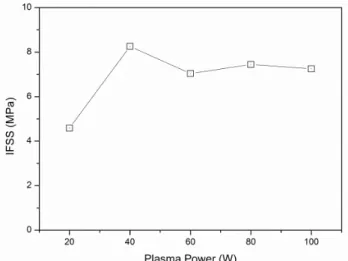
ABSTRACT:A jute fiber surface was modified with argon gas in a cylinder type RF plasma generator to enhance the interfacial bond strength and to optimize the plasma treatment condition. The plasma power, gas pressure, and treat time were varied to figure out any effect of those parameters on the morphology and mechanical strength of jute fibers, and the interfacial bond strength for a model composite with polypropylene resin. As the severity of plasma treatment was increased, the surface of jute fibers became rougher. Gas pressure was less effective in roughening of the surface compared with those of treat time and plasma power. Approximately 25% drop in tensile strength of jute fibers was observed for the parameters of treat time and plasma power, while little deterioration was found for gas pressure, with increasing the severity. Based on the interfacial shear strength (IFSS), the optimum plasma treatment condition was determined to be treat time of 30 s, plasma power of 40 W, and gas pressure of 30 mTorr.
요 약:계면접착력 향상을 위해 실린더형 RF 플라즈마 발생기를 이용하여 Jute fiber의 표면을 아르곤가스로 처리하였 고 최적 처리조건을 설정하였다. 플라즈마 강도, 가스압력, 및 처리시간을 변경한 후 이러한 인자들이 황마섬유 표면모 폴로지, 섬유 인장강도, 및 폴리프로필렌과의 모델복합체에서 계면접착강도에 미치는 영향을 조사하였다. 플라즈마 처리인자에 따라 황마섬유의 표면은 거칠어졌다. 가스압력의 영향은 처리시간 및 플라즈마 강도의 영향보다 다소 낮게 나타났다. 플라즈마 강도와 시간에 따라 황마섬유의 강도는 약 25% 감소한 반면, 가스압력의 영향은 크게 나타나 지 않았다. 계면전단강도 (IFSS)를 기준으로 결정된 최적 플라즈마 처리조건은 처리시간 30 s, 전력 40 W, 가스압력 30 mTorr로 나타났다.
Keywords:plasma, jute fiber, polypropylene, composite, interfacial strength
†
Corresponding Author. E-mail: [email protected]
Ⅰ . Introduction
With the increasing demands for echo-friendly materials and bio-degradability in nature, various attempts have been made in polymer composites of replacing the synthesized fibers from petroleum oils with natural fibers like cellulose, wood, jute, kenaf, and hemp, etc.
1Even though the carbon and glass fibers
have been successfully and widely used as reinforcing materi-
als in polymer composites, they have drawbacks of high cost
and more fragile nature causing brittle catastrophic failures
compared with those of natural fibers. Since the natural fibers
are lower density materials, they can give considerably light-
weight composites with highly specific properties such as elec-
trical resistance, fracture toughness, heat resistance and sound-
proof.
2,3They also offer significant cost advantages and bene-
fits associated with their processing compared to synthetic
fibers.
Figure 1. Schematic diagram and real photo of a RF cylinder type plasma reactor.
One of the major drawbacks of natural fibers-reinforced pol- ymer composites is their poor interfacial strength between fi- bers and base polymers because of great difference in hydro- philic nature. For instance, natural fibers are hydrophilic, while polymers resins are hydrophobic.
4Thus, the surface mod- ification of natural fibers is one of efficient ways to improve the bulk properties of the resulting polymer composites, since the interfacial adhesive strength plays a crucial role in the me- chanical performance. Various modification methods have been suggested.
5-7They include electrochemical vapor deposi- tion,
8)solution method,
9,10monomer or oligomer chemicals,
11,12plasma etching
13-18and plasma polymerization coating me- thod.
19-25When the surface of natural fibers are modified by chemical methods, the interfacial properties can be efficiently improved, but the process needs somewhat complex steps of treatments including removal and recycling of the chemicals leading to additional process cost.
Plasma etching and plasma polymerization coating techni- ques have been suggested as one of the most efficient and clean techniques to resolve the interfacial problems for re- inforcing fillers including hydrophilic particles such as silica
26and natural fibers like jute fibers. It has been reported that the plasma treatment is efficient in modification of the hydro- philic nature of natural fibers to the hydrophobic nature, which is similar to that of polymer resins.
27,28Relatively, little liter- ature is available for the surface modification of jute fibers with plasma.
In this study, the plasma etching technique is selected to modify the surface of jute fibers and to give rise to the im- provement of interfacial adhesion between jute fibers and poly-
propylene (PP) resin. The surface characteristics is investigated with Fourier-transform infrared (FT-IR) spectroscopy, scan- ning electron microscopy (SEM). The tensile strength of jute fibers is measured depending on various conditions of plasma treatments to figure out any deterioration due to the plasma etching. A droplet test is carried out for measuring the inter- facial shear strength (IFSS) to optimize the plasma treatment parameters of treatment time, plasma power, and gas pressure.
Ⅱ . Experimental
Natural jute fibers are supplied from Bangladesh and poly- propylene (PP, J-170 grade, density of 0.9 g/cm
3, melt flow index of 28.0 g/10 min, Homan Petrochemical Co. Korea).
Ar gas was used as a carrier gas.
The plasma etching was carried out with a cylinder type RF plasma generator (HPPS-300, Hanatek Co. Korea). Figure 1 shows the schematic and real photograph of the plasma ma- chine system which is composed of a tubular type reactor, blade type stirrer, manual impedance matching system and a mass flow controller. Initially the chamber is cleaned by wip- ing the chamber with an acetone to avoid possible contami- nation. Jute fibers with the length of more than 6 cm are se- lected and they are charged in the reactor chamber, and a vac- uum is then applied in the chamber. To find out the optimum condition of main parameters for the plasma treatment, treat- ment time, electrical power, and gas pressure are varied: 30
~ 120 s, 40 ~ 100 W, 30 ~ 90 mTorr, respectively.
The surface morphology of untreated and treated jute fibers
is investigated with scanning electron microscopy (SEM,
(a) (b) (c)
(d) (e)
(a) (b) (c)
(d) (e)
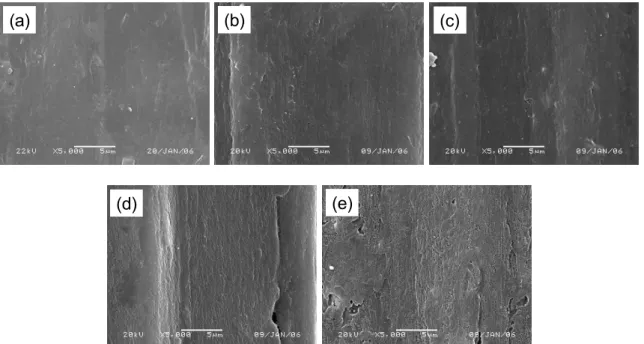
Figure 3. SEM micrographs of the surface of untreated- and plasma-treated jute fibers with variable treat times: (a) untreated, (b) 30 s, (c) 60 s, (d) 90 s, and (e) 120 s. The plasma power and gas pressure are set to 50 W and 60 mTorr, respectively.
JEOL JSM 5900, Japan). The chemical change in the surface is analyzed with Fourier-transform infrared (FT-IR, Shimadzu- 8101, Japan) spectroscopy. To figure out any effect of plasma treatment on the degradation of mechanical strength of fibers, tensile strength is monitored for untreated and treated jute fi- bers using a universal tensile tester (LRX Plus, Lloyd Instru- ment). To measure the interfacial shear strength (IFSS), a sin- gle fiber is embedded in the vertical center line of a droplet shape of molten PP resin and it is cooled to room temperature to make a composite. The single fiber is then pulled off in the tensile tester for measuring the maximum force to adhesive failure. The force is then reported as stress after dividing by cross-sectional area of fibers, together with modulus and elon- gation at break. Jute fibers of diameters ranging between 30~40 μm are selectively chosen for a better accuracy. The reported values are averaged one for 5 measurements for each specimen.
Ⅲ. Results and Discussion
1. Effect of Plasma Conditions on Properties of Jute Fibers
To figure out any changes in chemical structure of surfaces of jutes fibers after plasma treatment, the surface of jute fibers under two treatment conditions (Condition I: Treat Time= 120 s, Plasma Power= 60 W, Gas Pressure= 50 mTorr, Condition II: Treat Time = 30 s, Plasma Power= 100 W, Gas Pressure=
50 mTorr) was analyzed using FT-IR. The FT-IR spectrums
are represented in Figure 2. The stretching vibration of the O-H bond was observed at the ranges from 3,000 to 3,500 cm
-1. This is typical for jute fibers since the surfaces are com- posed of hydroxyl functions leading hydrophilic nature of them. After plasma treatments these peaks became more pronounced. A possible reason for this is that the surface area is increased after strong etching effects by plasma treatment.
The peaks observed at 2,893 cm
-1for C-H stretching, at 1,300-1,700 cm
-1for CH
2bending, and at 1,000-1,100cm
-1for C-O stretching and vibration were not much changed in terms
Figure 2. FT-IR spectra of untreated and treated jute fibers.
(a) (b) (c)
(d) (e)
(a) (b) (c)
(d) (e)
Figure 4. SEM micrographs of the surface of untreated- and plasma-treated jute fibers with variable plasma powers: (a) untreated, (b) 40W, (c) 60W, (d) 80W, and (e) 100W. The treat time and gas pressure are set to 30 s and 60 mTorr, respectively.
(a) (b) (c)
(d) (e)
(a) (b) (c)
(d) (e)
Figure 5. SEM micrographs of the surface of untreated- and plasma-treated jute fibers with variable gas pressure: (a) untreated, (b) 30 mTorr, (c) 50 mTorr, (d) 70 mTorr, and (e) 90 mTorr. The treat time and plasma power are set to 30 s and 40W.
of either intensity or peak position. This strongly indicates that the plasma treatment in Ar atmosphere does not change the chemical structure of jute fibers.
Figures 3-5 show the morphology change of jute fibers after plasma treatments of treat time, plasma power, and gas pres- sure, respectively. Initially the surface of jute fiber was smooth,
and it became rougher and rougher as with increasing the plas-
ma treatment parameters. Relatively smaller effect was ob-
served for the gas pressure parameter, compared with other
two parameters of treat time and plasma power. The observed
roughening behavior is clearly seen for a single jute fiber sur-
face (Figure 6). The roughening is expected to affect positively
Figure 6. SEM micrographs of pristine (left) and plasma-treated jute fiber under the condition: plasma power of 100 W, treat time of 30 s, and gas pressure of 60 mTorr, respectively.
Table 1. Changes in Tensile Properties of Jute Fibers Depending on Various Conditions of Plasma Treatments Plasma Treatment Condition
Fiber Diameter (μm)
Tensile Properties Treat Time(s) Plasma Power(W) Gas Pressure
(mTorr)
Tensile Strength
(GPa) Modulus (GPa) Elongation at break (%) 0
60 50
25.7± 4.3 1.37±0.153 89.4±14.7 1.5±0.4
30 36.0±8.8 1.27±0.237 92.4±33.64 1.5±0.4
60 39.9±8.1 1.30±0.200 100.0±48.8 1.5±0.3
90 35.2±4.5 1.01±0.137 92.9±29.6 1.2±0.4
120 37.4±4.4 1.01±0.110 76.4±20.3 1.5±0.3
30
0
50
25.7±43 1.37±0.153 89.4±14.7 1.5±0.4
40 32.8±5.4 1.25±0.110 83.0±29.4 1.6±0.4
60 36.0±8.8 1.27±0.237 92.4±34.3 1.5±0.4
80 34.5±6.1 1.06±0.153 91.8±32.7 1.3±0.4
100 36.7±6.0 1.01±0.117 69.2±14.0 1.6±0.5
30 40
0 25.7±4.3 1.37±0.153 89.4±14.7 1.5±0.4
30 34.4±9.7 1.43±0.187 97.2±44.3 1.3±0.3
50 31.1±7.1 1.50±0.143 105.0±36.7 1.2±0.3
70 34.7±7.0 1.39±0.117 100.0±48.4 1.4±0.4
90 35.0±7.0 1.42±0.157 103.5±54.9 1.2±0.3
to the interfacial bonding strength because of increased phys- ical interlocking. However, it adversely affects the strength of fibers themselves.
Table 1 shows the mechanical properties of jute fibers with and without plasma treatment along with the diameter. Gene- rally, the fiber diameter increased slightly after plasma treat- ment. The ultimate strength such as tensile strength and elon- gation at break decreased for severer plasma treatment con- dition. To distinguish such effect in more detail, the changes in tensile strength are plotted as a function of severity of plas- ma treatments (Figure 7). It clearly shows the severer deterio- ration effect (approximately 25% reduction) for two parame-
ters (plasma power and treat time) compared with that of gas pressure. This indicates that the plasma power plays a greater role in etching effect than gas pressure. In the case of gas pressure experiment, the plasma power is set to 40 W, which is the lowest case. In the treat time experiment, it was set to somewhat higher level of 60 W. Thus, the treat time may give more strong etching effect than that of gas pressure.
2. Optimization of Plasma Conditions based on Interfacial Shear Strength