제 2 회 첨단 사이언스 교육 허브 개발(EDISON) 나노물리 경진대회
Theoretical Electronic Structure of PTCDA and PTCDI Molecules
현정민
숙명여자대학교 물리학과, 서울특별시 140-742, 대한민국 e-mail: [email protected]
Self-assembly of the molecular system of perylene-3,4,9,10-tetracarboxylic-3,4,9,10-dianhydride (PTCDA) and the amide analogue (PTCDI) is of potential importance for organic semiconductor devices. Therefore we studied the density of states (DOS), the charge densities, and intermolacular bond lengths for PTCDA and PTCDI using the density functional theory calculations.
INTRODUCTION
Self-assembly of organic molecules received scientific interest due to their potential applications in organic [1] and molecular electronic devices [2]
and biosensors [3]. Especially, perylene-3,4,9,10- tetracarboxylic-3,4,9,10-dianhydride (PTCDA) and the amide analogue (PTCDI) have been studied on their absorption mechanism on different metal and semiconductor substrates [4-8].
Although organic molecules on the metallic and the insulating surfaces have been extensively studied, little is known about them on nano- structured metal-semiconductor hybrid substrates such as the Si(111)In-4×1 surface [9]. Theoretical analysis is highly required to understand issues such as the molecule-substrate interaction and the molecule-molecule interaction, which may affect the molecular adsorption mechanism and the subsequent self-assembly pattern formation on the metal/semiconductor hybrid surfaces
In this paper, we studied the electronic structure of the neutral PTCDA and PTCDI molecules using density functional theory (DFT) calculations for our further researches on the molecule-surface interaction and the substrate-mediated intermolecular interaction.
METHODS
We employed the density functional theory (DFT) code, the Spanish Initiative for Electronic Simulations with Thousands of Atoms (SIESTA), as implemented on the EDISON nanophysics web site [10]. We used the generalized gradient approximation (GGA) by Perdew, Burke, and Ernzerhof [11] and the norm-conserving
pseudopotentials of Troullier and Martins [12]. A double-zeta basis set was used for all atoms. The localized basis set was made up of numerical atomic orbitals which induced an energy shift in each orbital of 0.02 Ry. We used the energy cutoff with 100Ry and a 1×1×1 mesh of k points for integrations over the Brillouin zone, and the PTCDA and PTCDI molecules were placed in a supercell of 27×31×20 Å
3.
RESULTS and DISCUSSION
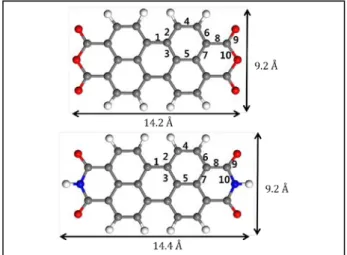
PTCDA and PTCDI molecules are of the planar arrangement including five carbon rings, as shown in Fig. 1. Both molecules share common structural characteristics consisting of a perylene core, but the anhydride end groups in PTCDA is replaced by the imide groups in PTCDI. Overall dimensions of the flat molecules are 14.2 Å × 9.2 Å (length × width) for PTCDA and 14.4 Å × 9.2 Å for PTCDI.
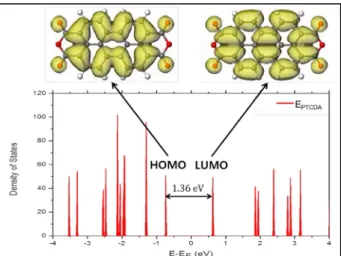
We obtained the total density of states (DOS) for the PTCDA and PTCDI molecules and the energy levels of the two molecules were aligned.
The total DOSs of PTCDA and PTCDI, shown in Fig. 2 and 3, are made up of molecular orbitals which are generated from strongly localized s and p orbitals of the carbon (C), oxygen (O), and nitrogen (N) atoms. In case of PTCDA, the highest occupied molecular orbital (HOMO) lies 1.36 eV below the lowest unoccupied molecular orbital (LUMO). PTCDI has the HOMO LUMO gap of 1.40 eV. The charge densities related to the HOMO and LUMO which are depicted in Fig. 2 and 3 are mainly distributed over the perylene core and have π character. The HOMO and the LUMO orbitals of PTCDA and PTCDI are delocalized throughout the molecules, except for the two end
22 221
제 2 회 첨단 사이언스 교육 허브 개발(EDISON) 나노물리 경진대회
anhydride or imide groups. The distribution of charge densities for these molecules can help understand the bonding and anti-bonding transition.
Some of the C-C bonding regions of the HOMO are replaced by the repulsive nodes in the LUMO.
On the other hand, the major anti-bonding nodes of the HOMO, the central anti-bonding plane along the long axis of the molecules and the C-O anti-bonding regions, are preserved in the LUMO over the entire two molecules.
The calculated bond-length data are presented in Table 1 along with the previous calculations [13, 14]. The labeling of the bonds is shown in Fig. 1.
PTCDA and PTCDI show C-C bond lengths between 1.41 Å and 1.49 Å and between 1.41 Å and 1.51 Å, respectively, indicating varying degrees of π conjugation and double-bond character. Since the HOMO has maxima at the C- C bonds 2 and 6, the bond character of these bonds is enhanced and the bond length is shortened by this mechanism. On the other hand, the HOMO is of antibonding character for bonds 1, 4, and 8 where the HOMO has nodes, which are elongated due to occupations of the HOMO.
CONCLUSION
We have examined the electronic DOS and the HOMO/LUMO orbital characters of PTCDA and PTCDI using the first-principles calculations. The DOS and HOMO/LUMO orbitals are similar in both molecules, which suggest that the molecule- substrate interaction and the intermolecular interaction might be similar for PTCDA and PTCDI.
ACKNOWLEDGEMENT
We are grateful to Prof. Jinwoo Park for enlightening discussions on SIESTA code and to the contributors to the EDISON nanophysics applications.
R
EFERENCES[1] Christos D. Dimitrakopoulos and Patrick R. L. Malenfant, Adv. Mater. 14, 99 (2002).
[2] Christian Joachim and Mark A. Ratner, Proc. Natl. Acad.
Sci. U.S.A. 102, 8801 (2005).
[3] Nathaniel L. Rosi and Chad A. Mirkin, Chem. Rev. 105, 1547 (2005).
[4] S. Antohe, N. Tomozeiu, and S. Gogonea, Phys. Status Solidi A 125, 397 (1991).
[5] A. Hauschild, K Karki, B.C.C. Cowie, M. Rohlfing, F. S.
Tautz, and M. Sokolowski, Phys. Rev. Lett. 94, 036106 (2005).
[6] L.G. Kaake, Y. Zou, M.J. Panzer, C.D. Frisbie, and X.-Y.
Zhu, J. Am. Chem. Soc. 129, 7824 (2007).
[7] D.R.T. Zahn, G. Salvan, B.A. Paez, R. Scholz, J. Vac. Sci.
technol. A 22, 1482 (2004).
[8] G. Salvan, S. Silaghi, M. Friedrich, C. Himcinschi, D.R.T.
Zahn, J. Optoelectron, Adv. Mater. 8, 604 (2006).
[9] Zheng Wei, Heechul Lim, and Geunseop Lee, Appl. Phys.
Lett. 98, 071912 (2011).
[10] http://nano.edison.re.kr.
[11] J. P. Perdew, K. Burke, and M. Ernzerhof, Phys. Rev.
Lett. 77, 3865 (1996).
[12] N. Troullier and J. L. Martins, Phys. Rev. B 43, 1993 (1992).
[13] Michael Rohlfing, Ruslan Temirov, and Frank Stefan Tautz, Phys. Rev. B 76, 115421 (2007)
[14] Mircea Oltean, Adrian Calborean, George Mile, Mihai Vidrighin, Monica Iosin, Loredana Leopold, Dana Maniu, Nicolae Leopold, and Vasile Chis, Spectrochim. Acta A
97, 703 (2012)
Fig. 1. The structure of PTCDA (top) and PTCDI (bottom).
Gray, white, red, and blue sphere correspond to carbon (C), hydrogen (H), oxygen (O), and nitrogen (N) atoms, respectively. PTCDA and PTCDI molecules share the perylene core, but the anhydride end groups in PTCDA is replaces by the imide groups in PTCDI. Each label of the two molecules refers to the interatomic bonds whose bond lengths as given in Table 1.
23 222
제 2 회 첨단 사이언스 교육 허브 개발(EDISON) 나노물리 경진대회
Fig. 2. Total DOS of PTCDA and the charge density contours of the HOMO and the LUMO.
Fig. 3. Total DOS of PTCDI and the charge density contours of HOMO and LUMO.
Table 1. The intramolecular bond lengths (in Å) of PTCDA and PTCDI in the gas phase. Our calculations were performed within DFT-GGA. The bond labels are indicated in Fig. 1.
24 223