http://dx.doi.org/10.5916/jkosme.2016.40.2.96 Original Paper
Radhesive
Thermal resistance between the dielectric
layers and the spreader (℃/W)
Rcore
Thermal resistance between LED chips and
the dielectric (℃/W)
Rdielectric
Thermal resistance between the core and
the adhesive (℃/W)
Rspread
Thermal resistance between the tube and
ambient (℃/W)
Rtotal
The sum of the individual thermal
resistances (℃/W)
△T The sum of the individual temperature
differences (℃)
P Individual power dissipation (W)
† Corresponding Author (ORCID: http://orcid.org/0000-0002-1679-7961): Department of Refrigeration and Air-Conditioning Engineering, Pukyong National University, 375, Sinseon-ro, Nam-gu, Busan, 608-739, Korea, E-mail: [email protected], Tel: 051-629-6182
Analysis of the thermal management of a high power LED package with a heat pipe
Jong-Soo Kim1․ Eun-Pil Kim†
(Received November 11, 2015; Revised December 15, 2015;Accepted February 18, 2016)
Abstract: The thermal management of high-power LED components in an assembly structure is crucial for the stable operation and proper luminous function. This study employs numerical tools to determine the optimum thermal design in LEDs with a heat sink consisting of a crevice-type vapor-chamber heat pipe. The effects of the MCPCB are investigated in terms of the substrate thicknesses on which the LEDs are mounted. Further, different placement configurations in a system module are considered. This study found that for a confined area, a power of 40 W/LED is applicable to a high-power package.
Furthermore, the thermal conductivity of dielectric layer materials should ideally be greater than 0.9 W/m.K. The temperature conditions of the vapor chamber in a heat pipe greatly affect the thermal performance of the system. At an offset distance of 9.0 mm and a 2 °C increase in the temperature of the heat pipe, the resulting maximum temperature increase is approximately 1.9 °C for each heat dissipation temperature. Finally, at a thermal conductivity of 0.3 W/m.K, it was found that the total ther- mal resistance changes dramatically. Above 1.2 W/m.K, the resistance change reduces exponentially.
Keywords: Vapor chamber heat pipe, LEDs, Heat dissipation, Numerical method
Nomenclature
1. Introduction
High-power light-emitting diodes (LEDs) are receiving increasing attention in many lighting industries. A high-powered LED light system has more usability compared to conventional lighting instruments. However, its drawback is that this type of LED system generates a large quantity of heat. With time, this heat deteriorates the lifespan, luminance and durability of the LED electronic system. This
means that the thermal management of the LED system is one of the most important factors to consider when designing LED packages. One LED alone generates little heat. However, many high-power LEDs may be assembled together in an array, because one LED alone is insufficient to provide a high enough level of illumination for certain applications, thereby consuming a large amount of power.
Multiple LEDs, with the use of large LED arrays, are therefore used in contexts where high illumination is required. The high heat fluxes generated require excellent thermal management for the correct operation of the system [1]. Weng [2] studied thermal management of packages in an LED system. This study showed an operational heat transfer enhancement with a decrease of 20%–30% of the thermal resistance compared with conventional package geometries. Christensen and Graham [3] investigated the package and system-level temperature distribution of high-power LEDs using a numerical method. They showed the results of the impacts of LED array density, LED power density, and active and passive cooling methods on device operation. Yung, Liem, Choy, and Bin investigated the cooling performance of a crevice-type vapor-chamber heat pipe (CVCHP) for a vehicle LED headlamp [4]. They gave
detailed thermal criteria for setting up an LED array system.
Law, Perman and Devarajan [5] presented the thermal characterization of high-power LEDs. They showed the effects of the thickness of the substrate on which the LEDs are mounted. They found that an increase in the substrate thickness improved the thermal and optical performance of the package. Juntunen et al. [6] investigated the thermal performance of a high-power chip-on-board multichip LED module. They showed the excellent thermal performance of a high-power COB LED module based on a Cu MCPCB (metal-core printed circuit board) substrate. A passive-cooling method of heat dissipation was conducted using heat pipes with simple frames and large heat-dissipation capacities [7].
Kim et al. performed a thermal analysis of the cooling performance in a high-power vehicle LED package. The CVCHP with a falling-film-type geometrical design in the vapor chamber was applied to the LED chips, which were mounted in a vertical direction [9]. This type of cooling method performed excellentlyin cooling down the heat generated from the LED package. Therefore, the optimum design of a high-power LED package is needed to obtain the ideal performance with this kind of a high-capacity cooling method.
In this paper, a high-power LED package module was in- vestigated by comparing various different thicknesses of layers and geometries in a PCB. Furthermore, a compact LED array mounted on an MCPCB heat spreader was analyzed with vary- ing LED separation distances in the system. Finally, the ef- fects of convection-cooling methods with various LED offsets were studied in order to determine the ideal cooling geometry of a heat spreader.
2. Thermal modeling
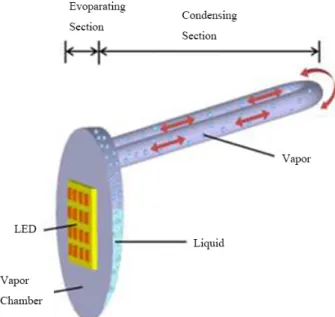
Numerical analysis was applied to a high-power vehicle LED package in order to determine the optimum design of an LED system. Figure 1 shows an overall schematic diagram of the heat pipe with an LED module [8]. The LED module is positioned in a vertical direction. The LED panel is located in front of the vapor chamber. Thus, heat will mainly flow from the LEDs to the heat-dissipation section of the heat pipe. To remove the heat generated by the LED package, the heat pipe, which uses the passive cooling method, is attached as shown in Figure 1. In order to obtain a better heat-dissipation per- formance, a CTVCHP was selected for this study. The cooling temperature is approximately 18% lower compared to that of a conventional heat pipe.
The heat dissipation using this type of Phase- Change method shows greatly improved results over that of con- duction, natural convection, and forced convection types. In this study, commercial high-power Cree Xlamps MX6 LEDs are selected to simulate the thermal performance of a high-powered system. The 4 x 4 LED array is simulated with different pitches between each LED. The heat generated from the LEDs, which are attached to the vertical vapor chamber, flows to the vapor chamber of the heat pipe. The LED size is 4.65 mm x 4.65 mm x 1.35 mm, with different powers being tested.
Figure 1: Schematic of a heat dissipation system
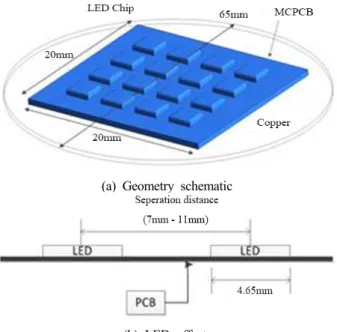
Proper PCB thermal optimization can reduce the thermal resistance of an LED assembly. This will reduce the junction temperature in the system. The thermal conductivity, as well as the geometry and layer thickness need to be taken into account in the layout when designing MCPCBs. The total operational LED powers vary from 16 W to 56 W as the minimum and maximum limits, respectively. Heat generated from LEDs is used to simulate the LED and PCB thermal response with various sets of conditions. The FR4 thermal properties in MCPCB layers are considered. Furthermore, the MCPCB thickness is varied to determine the thermal impact of the system. The size of the MCPCB substrate sample is 40 mm x 40 mm. A general schematic of the package ge- ometry is shown in Figure 2. The detailed material proper- ties of the MCPCB board are shown in Table 1. The heat-dissipation section of the CVCHPconsists of 1-mm-thick copper walls.
(a) Geometry schematic
(b) LED offsets
Figure 2: Thermal modeling diagram of an LED array
Material
Thermal conductivity
(W/m.K)
Layer thickness
(μm) MCPCB
Core Copper 385 2000
Dielectric FR4 0.88 70
Conductors Copper 385 35
Adhesive H20E 3 50
Table 1: Material properties
Over 80% of the electrical power consumed in an LED is dissipated as heat. This causes an LED’s lifespan and lumi- nous performance to deteriorate. In such a confined area con- taining LEDs, the greater heat generated affects the LEDs more than for those in a more spacious area, resulting in high- er junction temperatures,. In order to determine the spatial ef- fects on the board, the pitches between LEDs are varied with equal distances. Therefore, the LEDs should be spaced as far apart as possible in order to minimize junction temperatures.
In this study, the offset distance varies from 7 mm to 11 mm.
In this study, the finite volume method (FVM) of ANSYS Fluent is used for a 3-D geometry heat transfer simulation [9].
The package design parameters with different configurations of LED arrays, ambient conditions, LED powers, and PCB effects are considered. These design parameters may possibly result in different thermal performances (see Figure 3). This thermal performance can be described as a thermal resistance network.
The overall thermal resistance includes many system parame- ters that contribute to the thermal performance of the LED package. Thus, an investigation of the individual resistors may be able to predict the overall thermal performance. The ther- mal resistance can be calculated by where R is the
the power. For a given geometry, a junction-to-vapor-chamber resistance is described using the thermal resistance R as fol- lows:
Figure 3: Thermal resistance network
3. Results and discussion
To investigate several parameters affecting the thermal per- formance of an LED package, first the convection heat-transfer coefficients are considered for various LED powers. Figure 4 shows the thermal performance of an LED system for varying LED powers. The heat pipe is used as the heat dissipation method to cool down junction temperatures. The temperature of the vaporized surface is 61.5 °C [8]. Except for the contact surface with the heat pipe, natural and forced convection con- ditions are applied.
Figure 4: Junction temperature distribution with varying LED powers
The junction temperatures of the LED system decreased al- most linearly with increasing convection heat transfer coefficients. This suggests that heat transfer modes in this LED system were not an important parameter. When the total LED power was increased in steps from 16 W, 24 W, 40 W, up to 56 W, the maximum temperatures increased from 77.3
°C, 88.9 °C, 105.6 °C, and 126.1 °C, respectively. The relative luminous flux of Cree Xlamps MX6 linearly decreased with an increase of the junction temperature of the LED. When the junction temperature was over 125 °C, the relative luminous
means that the total luminous flux of an LED package will be lost owing to the increased temperature of the LEDs. Kim et al. [8] used high-power LEDs of 40 W, and the LED power showed a stable temperature over the entire heat transfer ranges.
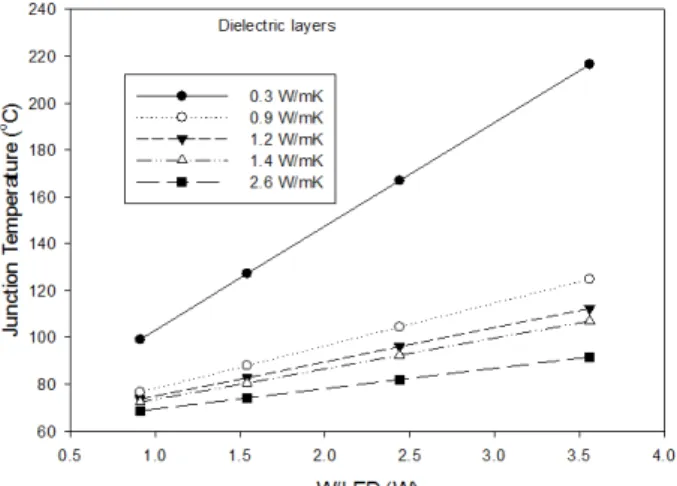
Figure 5 shows the change in junction temperatures for varying dielectric layers. Dielectric materials of five different thermal conductivities were selected, and the junction temperatures for the different LED powers were compared.
The dielectric layer had a thickness of 70 . The LED power-per-unit was increased from 0.9 W to 3.56 W. The 16 LEDs were mounted on the MCPCB with different dielectric layers, with properties given in Table 1. For a thermal conductivity of 0.3 W/m.K, the junction temperature increased dramatically with increasing LED power. For this thermal conductivity of the dielectric layer, the thermal heat dissipation was insufficient when the LED power was increased. The junction temperature increased more rapidly when the LED power was 3.5 W/LED. The resulting temperatures for thermal conductivities of 0.3 W/m.K and 0.9 W/m.K were too high to be used. The other cases showed a moderate increase with increasing LED power. At a total LED power of 40 W, the maximum junction temperature was 104.5 °C at a thermal conductivity of k = 0.9 W/m.K. At this temperature, LEDs show less than 80%
relative luminous flux [10]. Thus, a thermal conductivity greater than 1.2 W/m.K is recommended for the dielectric layer. Since the LED junction temperature on the MCPCB will influence the LED output illuminance, a good thermal conducting material from the heat generating LEDs to the thermal dissipation heat pipe is required in order to improve the LED optical performance.
Figure 5: Junction temperature distribution with varying di- electric layers
Figure 6 shows the maximum temperature distribution with varying distances of separation between LEDs. When the separation distances between LEDs increase, the maximum temperatures of the LED system decrease gradually. Yung et al. [8] showed that the proper location of LEDs is important for the optimum operation of the system.
They found out that different offset distances altered the maximum temperature in an LED package. In this study, the heat dissipation temperature of the vapor chamber is considered to be a constant. At 61.5 °C, the maximum temperature decreased relatively rapidly with increased separation distance compared to the other heat dissipation temperatures. However, the increase in separation distance in Figure 6 does not dramatically alter the junction temperature. This is considered to be because the heat dissipation method using a CVCHP is an effective passive tool in heat transfer modes. At the an offset distance of 9.0 mm and a 2 °C temperature increase in the heat pipe, the resulting maximum junction temperature increase is approximately 1.9 °C for each heat dissipation temperature.
These results show that a CVCHP has an important effect in controlling the temperature.
Figure 6: Junction temperature distribution with varying heat dissipation conditions
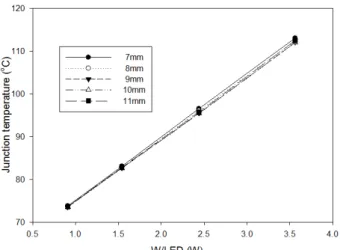
Figure 7 shows the maximum junction temperature distribution with varying offset distances. As shown previously in Figure 6, even if offset distances increase, the resulting temperature decrease is not large. This confirms that the offset distances of LEDs are not a major design parameter in a high-power LED package with a heat-pipe dissipation method.
Figure 8 shows the junction temperature distribution with varying heat-pipe boundary conditions. When the total LED power is 56 W, the maximum junction temperature was too high over the entire range of heat pipe boundary conditions.
When the total LED power was 40 W, the junction temperature changed from 96.5 °C to 104.2 °C as the heat pipe boundary conditions changed from 61.5 °C to 69.5 °C, respectively. These results mean that approximately 5% of the relative luminous flux will be lost owing to vapor-chamber temperature conditions. The control of the temperature of the vapor chamber of a heat pipe is an important parameter to be taken into account for a proper LED output.
Figure 7: Junction temperature distribution with varying LED offset distances
Figure 8: Junction temperature distribution with varying LED powers
To understand the relationship of all the resistors from heat source to heat dissipation, a thermal resistance network was investigated. A detailed thermal resistance network is shown in Figure 3.
Table 2 shows the thermal resistances of an LED package with various dielectric thermal conductivities at a total LED power of 40 W. The dielectric material properties are consid- ered in order to investigate the effect of heat transfer flow characteristics. The total thermal resistance for the 0.3 W/m.K
°C/W for the 1.2 W/m.K dielectric layer. The resistance de- creased dramatically with increased thermal conductivity. After 1.2 W/m.K, the resistance change reduced exponentially.
Dielectric thermal conductivity
[W/m.K] 0.3 0.9 1.2 1.4 2.6
Thermal resistance
[℃/W] 2.7 1.1 0.9 0.8 0.5
Table 2: Thermal resistances of a LED package
Figure 9 shows the thermal resistance with varying heat dissipation conditions. First, when the LED power was reduced from 3.56 W/LED to 2.44 W/LED, the thermal resistance changed rapidly. However, the resistance did not change significantly when the LED power was reduced from 2.44 W/LED to 1.54 W/LED. Further, at 1.54 W/LED, the higher dissipation conditions showed relatively good thermal resistance results.
Figure 9: Thermal resistance with varying heat dissipation conditions
4. Conclusions
High-power LED arrays require various design consid- erations in order to provide optimal thermal performance in an LED package. Taking these design parameters into account will produce high luminous output. In a confined area, it was shown that a power of 40 W/LED was applicable for a high-power package. In addition, dielectric layer materials with thermal conductivity properties greater than 0.9 W/m.K were recommended. Furthermore, the boundary conditions of the va- por chamber in a heat pipe greatly affected the thermal per- formance of the system. This means that thermal dissipation using a heat pipe was an excellent passive-cooling tool, espe- cially for a high-power LED package. Finally, the results con- firmed that LED position density was not an important param-
Acknowlegments
“This work was supported by the Pukyong National University Research Abroad Fund in 2011 (PS-2011-013)”
References
[1] N. Gu, Y. Narendran, and H. Hosseinzadeh, Solid-state lighting: failure analysis of white LEDs, Journal of Crystal Growth, pp. 449-456, 2004.
[2] C. Weng, Advanced thermal enhancement and man- agement of LED packages, International Communication in Heat and Mass Transfer, pp.
245-248, 2009.
[3] A. Christensen and S. Graham, Thermal effects in packaging high power light emitting diode arrays, Applied Thermal Engineering, pp. 364-371, 2009.
[4] K. C. Yung, H. Liem, H. S. Choy and W. K. Lum, Thermal performance of high brightness LED array package on PCB, International Communication in Heat and Mass Transfer, pp. 1266-1272, 2010.
[5] S. B. Law, A. Permal and M. Devarajan, Effective heat dissipation of high power LEDs mounted on MCPCBs with different thickness of aluminum sub- strates, IEEE-ICSE2012, pp. 707-710, 2012.
[6] E. Juntunen, O. Tapaninen, M. Jamsa, and V.
Heikkinen, “Copper-core MCPCB with thermal vias for high-power COB LED modules,” IEEE Transactions on Power Electronics, vol. 29, pp.
1410-1417, 2014.
[7] T. Yong, D. Xinrui, and Y. Binhai, L. Zongtao, and L. Bin, A high power LED divice with chips directly mounted on heat pipes, Applied Thermal Engineering, pp. 632-639, 2014.
[8] J. S. Kim, J. Y. Bae, and E. Kim, “Analysis on the experimental cooling performance of a high power LED package with a crevice-type vapor chamber heat pipe,” Journal of the Korean Society of Marine Engineering, vol. 39, no. 8, pp. 801-806, 2015.
[9] ANSYS Inc., Ver. 16, www.ansys.com, 2015.
[10] Lumileds Inc., Thermal management considerations for SuperFlux LEDs, 2015.