Paper
Water Uptake and Tensile Properties of Plasma Treated Abaca Fiber Reinforced Epoxy Composite
Marissa A. Paglicawan*, Blessie A. Basilia*, Byung Sun Kim**†
ABSTRACT: This work presents the tensile properties and water uptake behavior of plasma treated abaca fibers reinforced epoxy composites. The composites were prepared by vacuum assisted resin transfer molding. The effects of treatment on tensile properties and sorption characteristics of abaca fiber composites in distilled water and salt solution at room temperature were investigated. The tensile strength of the composites increased with plasma treatment. With plasma treatment, an improvement of 92.9% was obtained in 2.5 min exposure time in plasma. This is attributed to high fiber-matrix compatibility. Less improvement on tensile properties of hybrid treatment of sodium hydroxide and plasma was obtained. However, both treatments reduced overall water uptake in distilled water and salt solution. Hydrophilicity of the fibers decreased upon plasma and sodium hydroxide treatment, which decreases water uptake.
Key Words: water uptake, plasma treatment, abaca fiber, composite
1. INTRODUCTION
The increasing interest in environmentally-friendly green composite has stimulated the use of degradable, renewable and inexpensive reinforcing materials. Among the natural fibers that have potential for reinforcement of composite is abaca. It is widely known as “Manila Hemp”, which is obtained from the pseudo-stem of banana family (Musa Textilis Nee) with rel- atively good mechanical properties. The Philippines is the worldwide leader in the production of abaca fibers with 85%
of the market share [1]. Abaca offers great potential for dif- ferent applications due to high tensile strength, specific flex- ural strength, rot and salt resistance [2-6]. Abaca fiber reinforced composites are becoming one of the recent interests in the composite industry due to the innovative application in under- floor protection of passenger cars by Daimler Chrysler [4-7].
The main drawback of natural fiber as reinforcement for com- posite is the poor compatibility of the fibers and the matrix and the degrading behavior of the composites when exposed to environmental conditions such as sunlight, humidity and microorganism. The hydrophilic nature of natural fibers is the main disadvantage of fibers as reinforcement for composites
which leads to incompatibility and poor wettability with hydrophobic polymers, and thus poor bonding at fibers/
matrix interfaces [8-11]. The poor resistance of the fibers to moisture has unfavorable effect on the long term properties of the composite and this can only be reduced if there is good fiber-matrix interaction. Several chemical modifications on the surface of fibers were done. To our knowledge, there is no information on the effect of plasma treatment on the water uptake of abaca/epoxy composites manufactured by vacuum assisted resin transfer molding. A detailed investigation on the effect of abaca treated with plasma on the water uptake and tensile properties of abaca reinforced epoxy composites were carried out. The results were compared with untreated and with hybrid treatment. The interfacial adhesion between the fiber and the matrix was determined from the fractured sur- face morphology of abaca fiber/epoxy composite.
2. EXPERIMENTAL
2.1 Materials
The abaca fibers used in this study were selected from the variety of S-1 and S-2 from the Bicol region of the Philippines
접수: 2013년 5월 10일, 수게재승인: 2013년 5월 15일
*
**†
Industrial Technology Development Institute, Philippines
Korea Institute of Materials Science, Corresponding author (E-mail: [email protected])
[1]. The fibers were weaved into fabrics consisting of 3-ply in weft and 1 ply in warp direction. The YD 128 standard liquid resin (EEW: 184-190, room temperature viscosity: 11,500- 13,500 cps) a diglycidyl ether of bisphenol A (DGEBA) as the matrix and KBH 1089 anhydride type as curing agent were used and purchased from Kukdo Chemicals. Other chemical such as sodium hydroxide and acrylic acid were used without further purification.
2.2 Processing
Plasma treatment was generated in a glow discharge manner which was operated in closed and semi-automatic systems.
The sample was placed on the ground electrode in the middle of the reactor. The abaca fabric was placed between the elec- trode plates where the plasma polymerization is being done.
Helium was used as a carrier gas and acrylic acid was used as a monomer to modify the surface property by plasma poly- merization. Acrylic acid was used as precursors to create a hydrophobic fabric surface [12]. The frequency and voltage were 20 KHz and 3 KV respectively. The fabric was exposed to plasma for 1, 2 and 2.5 minutes. Another set of fabric which was previously treated with 2% NaOH for 60 minutes was then exposed to plasma for 1, 2 and 2.5 min.
2.3 Preparation of composite
Five layers of abaca fabric were stacked up in the fabrication of composite using vacuum assisted resin transfer molding.
Epoxy resin which previously mixed with curing was used as the matrix. After filling up the surfaces of the fabric, the com- posites were cured at 120oC for 120 minutes. The fabric weight contents for plasma treated specimens were 30.5%, 31%, 30.8%
for 1, 2 and 2.5 min, respectively. Those for hybrid treatment of 2% NaOH were 28.5%, 28% and 27.8% for 1, 2 and 2.5 min plasma treatment, respectively.
2.4 Characterization
Tensile tests were carried out on universal testing machine model Instron 5882 equipped with a 5 kg load cell in accor- dance with ASTM standard D3029 with crosshead speed of 5 mm/min. All the samples were cut in weft direction. The average values of the mechanical properties were obtained from 6 specimens. The water uptake was determined in accor- dance with ASTM D5229. Prior to absorption experiments, five specimens were first dried in an oven for 24 hrs at 102 ± 3oC. The specimens were immersed in distilled water and in a salt solution (35 ppm sodium chloride) at room tem- perature and the weight change was monitored as a function of time. The values of water absorption in percentage were cal- culated as follows:
WA (%)t = (Mc − Mo)/Mo × 100 (1)
where WA (t) is the water absorption at time t, Mo is the mass of the dried specimen and Mc is the mass of the specimen as a
function of immersion time. The photomicrograps were recorded using SEM with a JEOL model # JSM-J310 to study the changes in the surface morphology after immersion in dis- tilled water.
3. RESULTS AND DISCUSSION
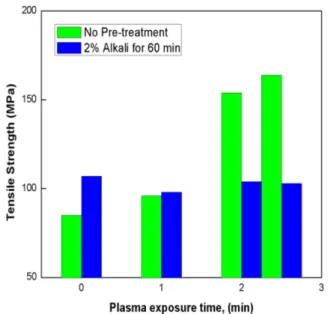
To determine the effectiveness of surface treatment, the ten- sile properties were determined. The tensile strength and Young’s modulus as a function of plasma exposure time are shown in Fig. 1 and Table 1. The tensile strength of untreated abaca composite is about 85 MPa while that of the plasma treated one is about 96 MPA, showing an improvement of 12.9%. A tensile strength value of 164 MPa was obtained with 2.5 min plasma exposure time, which represents an improve- ment of 92.9%. This increase in tensile strength was due to the plasma treatment of the fiber resulting in a better compatibility of the fiber and the matrix. No further improvement was seen in the hybrid treatment of abaca. It is clearly seen that the hybrid treatment resulted in lower tensile strength compared to those with plasma treatment. In Table 1, the Young’s mod- ulus of both plasma and hybrid treatment were almost the same.
Water is one of the major concerns of natural polymer com- posite for industrial application since natural fibers absorb moisture when immersed in water or in humid environment.
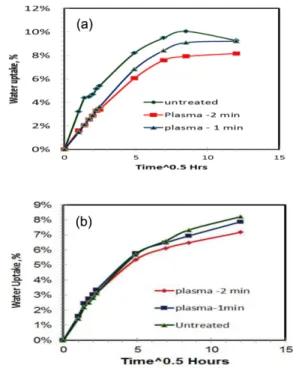
For this particular experiment, the water immersion test was done to evaluate the effect of plasma treatment on water uptake of abaca fiber reinforced epoxy composite. Fig. 2 shows the percentage water uptake as a function of square root of time for plasma treated fiber composites at different deposi-
Fig. 1.Tensile strength of abaca fiber reinforced epoxy compos- ite as a function of plasma exposure time Note: no treat- ment prior to plasma and 2%NaOH was first done before plasma treatment.
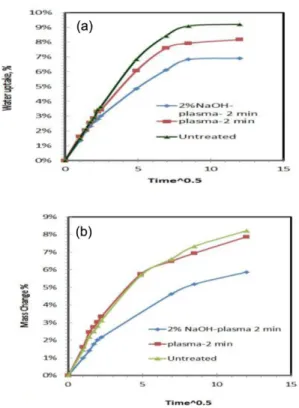
tion times. The moisture uptake increased with time indicat- ing that the water molecules penetrate into the composites thus gaining weight. At early time, the weight abruptly increased showing the rapid water penetration into the com- posites. It was observed that the behavior of water uptake of plasma treated abaca composite was dependent on the type of medium. The curves in Fig. 2(a) in which the composites were immersed in distilled water have reached their saturation state after prolonged time with maximum moisture while the com- posites immersed in salt solution (Fig. 2b) showed continuous increasing of weight. Increasing the plasma exposure time showed lower water uptake in distilled water whereas very slight difference in salt solution. However, it is interesting to note the water uptake of composite in salt solution is lower than in distilled water. Fig. 3 shows the water uptake behavior of composite made up of abaca fiber which undergone pre- treatment of 2% NaOH prior to plasma treatment. Similar to plasma treated abaca composite at initial time, the weight sharply increased both in distilled water and salt solution.
However, saturation stage was observed in distilled water com- pared to a continuous weight increase in the salt solution. It is clearly seen that the treated fibers resulted in much lower water uptake than with no treatment.
The comparison of water uptake of hybrid treatment and plasma treated for 2 min and treated and hybrid treatment is shown in Fig. 4. It can be seen that the water uptake both in distilled and salt solution of hybrid treatment is lower water uptake than treated only with plasma. This is attributed to the removal of lignin and hemicelluloses after alkali treatment, thus increasing the fiber roughness in which mechanical inter- locking, and also the amount of cellulose exposed. However, all the composites immersed in salt solution did not reach sat- uration after prolonged time suggesting non-Fickian behavior compared in distilled water almost plateau value after 100 hrs.
SEM micrographs in Fig. 5 show the effect of water uptake on the surfaces of untreated, plasma treated for 1 and 2 min. It is clear from Fig. 5 (a and b) that microcracks were formed on the surface of the matrix. The abaca is hydrophilic and readily absorbs water that developed internal stresses between the fiber and the matrix. The effect of water absorption resulted to fiber debonding, as shown in the arrow (Fig. 5b). No micro- cracking and debonding was observed in Fig. 5(c). Matrix
microcracking, poor interfacial between the fibers and the matrix and anatomical characteristics of abaca fibers, as shown Table 1.Young’s modulus of abaca fiber reinforced epoxy com-
posite Plasma exposure
time, min
Young’s Modulus, GPa No pretreatment 2% NaOH
O 2.59 2.67
1 2.82 2.75
2 2.76 2.77
2.5 2.64 2.72
Fig. 2.Water uptake of plasma-treated abaca fiber reinforced epoxy composite in (a) distilled water (b) salt solution.
Fig. 3.Water uptake of hybrid treatment of 2%NaOH and plasma abaca fiber reinforced epoxy composite in (a) dis- tilled water (b) salt solution.
in Fig. 5(d), are the factors that responsible in poor composites properties in humid conditions.
4. CONCLUSION
The following conclusions could be drawn from the results:
The tensile properties of the abaca/epoxy composites were improved by treating the abaca fibers with flasma.
The tensile strength of the composites treated with plasma was significantly superior to those with hybrid treatment and no treatment.
The amount of water uptake was clearly dependent on the medium of solution.
The water absorption of the composite was reduced with increasing plasma exposure time and further reduced with hybrid treatment of NaOH and plasma.
ACKNOWLEDGMENT
The authors are grateful to the Korea Institute of Materials Science for the financial support as part of KIMS-ITDI Coop- erative Research on Plasma-treated Abaca Fiber Reinforced Composite for Industrial Application and to Ms Darlene Pido- lin for the determination of water uptake of the composites.
REFERENCES
1. http://fida.da.gov.ph/Templates/abaca_production_and_market_
scenario.htm. 2011. Fiber Industry Development Authority.
Abaca Production and Market.
2. Bledzki, A.K., Mamun, A.A., and Faruk, O., “Abaca Fibre Rein- forced PP Composites and Comparison with Jute and Flax Fibre PP Composites,” eXPRESS Polymer Letters, Vol. 1, 2007, pp. 755-762.
3. Huang, G., “Tensile Behaviours of the Coir Fibre and Related Composites after NaOH Treatment,” Materials and Design, Vol.
30, 2005, pp. 3931-3934.
4. Bledzki, A.K., Faruk, O., and Sperber, V.E., “Cars from Bio- fibres,” Macromolecular Materials and Engineering, Vol. 291, 2005, pp. 449-457.
5. Scherubi, B., “An Innovative Composite Solution in the New Mercedes a Class-a Successful Story about the Natural Fibre ABACA,” In: Proceedings of Sixth Global Wood and Natural Fibre Composites Symposium, Kassel, A 12, April 2006.
6. Eichholzer, W., Natural Fibre Applications in Automotive Man- ufacturing In: Proceeding of Sixth Global Wood and Natural Fiber Composites Symposium Kassel A11, April 2006.
7. Hintermann, W., Automotive Exterior Parts from Natural Fibers. RIKO 2005. Hannover, Germany 2005.
8. Li, X., Tabil, L.G., and Panigrahi, S., “Chemical Treatments of Natural Fiber for Use in Natural Fiber-reinforced Composites:
A Review,” Journal of Environmental Polymer Degradation, Vol.
15, 2007, pp. 25-33.
9. Corrales, F., Vilaseca, F., Llop, Girones, M., Mendez, J.A., and Mutje, P., “Chemical Modification of Jute Fibers for the Pro- duction of Green Composites,” Journal of Hazardous Materials, Fig. 4.Comparison in water uptake of plasma treated and
hybrid treatment in (a) distilled water (b) salt solution.
Fig. 5.SEM micrographs of (a) untreated (b) plasma treated for 1 min (c) plasma treated for 2 min after water uptake experiment (d) plasma treated for 2 min before immer- sion in distilled water. Magnification of a-c : 100 µm and d: 650 µm.
Vol. 144, 2007, pp. 730-735.
10. Rana, A.K., Manda, A., Mitra, B.C., Jacobson, R., Rowell, R., and Banerjee, A.N., “Short Jute Fiber-reinforced Polypropylene Composites: Effect of Compatibilizer,” Journal of Applied Poly- mer Science, Vol. 69, 1997, 329-338.
11. Seki, Y., Sever, S., Sarikanat, M., Gulec, H.A., and Tavman, I.H.,
“The Influence of Oxygen Plasma Treatment of Jute Fibers on Mechanical Properties of Jute Fiber Reinforced Thermoplastic Composites”, 5th International Advanced Technologies Sympo- sium (IATS’09), Karabuk, Turkey. May 13-15, 2009.
12. Yasuda, H., Plasma Polymerization, Academic Press, Orlando, Florida, 1985.