Fatigue resistance, debonding force, and failure type of fiber-reinforced composite, polyethylene ribbon-reinforced, and braided stainless steel wire lingual retainers in vitro
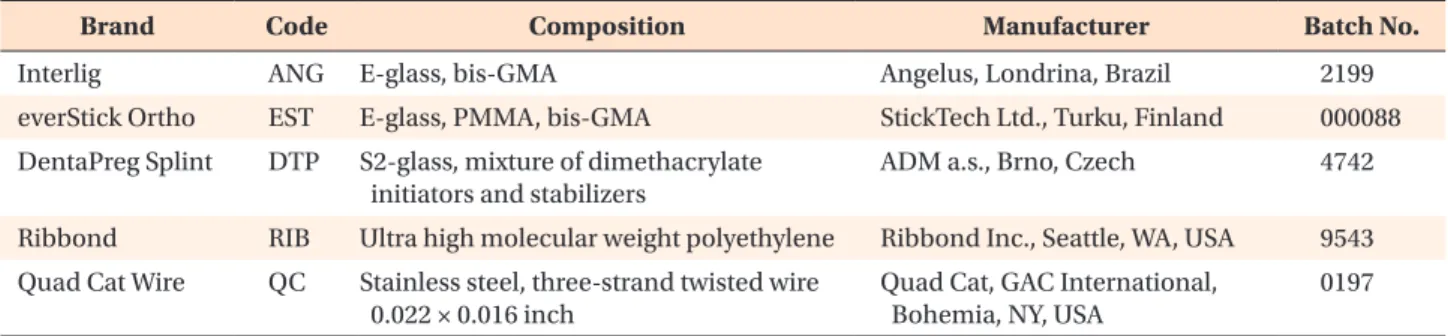
Objective: To analyze the fatigue resistance, debonding force, and failure type of fiber-reinforced composite, polyethylene ribbon-reinforced, and braided stainless steel wire lingual retainers in vitro. Methods: Roots of human mandibular central incisors were covered with silicone, mimicking the periodontal ligament, and embedded in polymethylmethacrylate. The specimens (N = 50), with two teeth each, were randomly divided into five groups (n = 10/
group) according to the retainer materials: (1) Interlig (E-glass), (2) everStick Ortho (E-glass), (3) DentaPreg Splint (S2-glass), (4) Ribbond (polyethylene), and (5) Quad Cat wire (stainless steel). After the recommended adhesive procedures, the retainers were bonded to the teeth by using flowable composite resin (Tetric Flow). The teeth were subjected to 10,00,000 cyclic loads (8 Hz, 3 - 100 N, 45
oangle, under 37 ± 3
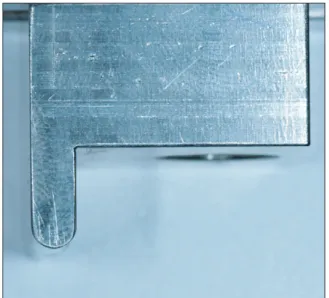
oC water) at their incisoproximal contact, and debonding forces were measured with a universal testing machine (1 mm/min crosshead speed). Failure sites were examined under a stereomicroscope (×40 magnification). Data were analyzed by one-way analysis of variance. Results:
All the specimens survived the cyclic loading. Their mean debonding forces were not significantly different (p > 0.05). The DentaPreg Splint group (80%) showed the highest incidence of complete adhesive debonding, followed by the Interlig group (60%). The everStick Ortho group (80%) presented predominantly partial adhesive debonding. The Quad Cat wire group (50%) presented overlying composite detachment. Conclusions: Cyclic loading did not cause debonding.
The retainers presented similar debonding forces but different failure types.
Braided stainless steel wire retainers presented the most repairable failure type.
[Korean J Orthod 2013;43(4):186-192]
Key words: Lingual, Bonding, Relapse, Retention Dave Lie Sam Foek
aEnver Yetkiner
bMutlu Özcan
ca
Department of Orthodontics, University Medical Center Groningen, University of Groningen, Groningen, The Netherlands
b
Department of Orthodontics, Faculty of Dentistry, University of Ege, Izmir, Turkey
c
Dental Materials Unit, Clinic for Fixed and Removable Prosthodontics and Dental Materials Science, Centre for Dental and Oral Medicine, University of Zurich, Zurich, Switzerland
Received April 23, 2013; Revised May 22, 2013; Accepted May 22, 2013.
Corresponding author: Enver Yetkiner.
Assistant Professor, Department of Orthodontics, Faculty of Dentistry, University of Ege, TR-35100 Izmir, Turkey
Tel +90-232-311-4592 e-mail [email protected]
© 2013 The Korean Association of Orthodontists.
The authors report no commercial, proprietary, or financial interest in the products or companies described in this article.
This is an Open Access article distributed under the terms of the Creative Commons Attribution Non-Commercial License (http://creativecommons.org/licenses/by-nc/3.0) which permits unrestricted non-commercial use, distribution, and reproduction in any medium, provided the original work is properly cited.