• 검색 결과가 없습니다.

High Temperature Properties of Fiber Reinforced Composites under the Different Loading Conditions

N/A
N/A
Protected

Academic year: 2021

Share "High Temperature Properties of Fiber Reinforced Composites under the Different Loading Conditions"

Copied!
5
0
0

로드 중.... (전체 텍스트 보기)

전체 글

(1)

Paper

High Temperature Properties of Fiber Reinforced Composites under the Different Loading Conditions

Hu Weiguang*, Soo-Jeong Park**, Yun-Hae Kim***

ABSTRACT: The mechanical properties of composites are significantly affected by external environment. It is essential to understand the degradation of material performance and judge the material’s lifetime in advance. In the current research, changes in mechanical properties of glass fiber and unsaturated polyester composite materials (GFRP, Glass fiber reinforced plastic) were investigated under different bending stress and submerged in hot water at a temperature of 80°C. Loading time of 100 H (hours), 200 H, 400 H, 600 H, 800 H for testing under stresses equal to 0% (stress- free state), 30%, 50% and 70% of the ultimate strength was applied on the GFRP specimens. From the values of bending stress, obtained from three-point bending test, fracture energy, failure time, and life curve were analysed.

Moreover, a normalized strength degradation model for this condition was also developed. It was observed that within 100 H, the decline rate of the bending strength was proportional to the pressure.

Key Words: GFRP, Three-point bending test, Fracture energy, Life curve

1. INTRODUCTION

Fiber-reinforced polymers (FRPs) are well-known compos- ite materials that are light-weight yet strong and are produced by using high-strength fibers as a reinforcing agent with poly- meric compounds [1,2]. FRPs have been widely used as struc- tural materials related to the aquatic environment, such as fishing trawlers, ships, reservoirs, undersea pipes, mainly due to their excellent water resistance and corrosion resistance, high strength, high elastic modulus and light-weight [3,4].

However, the mechanical properties of FRPs have been found to be frequently affected by different external environmental factors, including temperature, humidity and ultraviolet radi- ation [5,6], leading to degradation in performance. Moreover, the by-products formed cause serious economic losses and sometimes even threatening to human life. So, it is imperative to study the changes in mechanical properties of FRPs under different external conditions.

Some studies have been carried out on the effects of the external factors, such as temperature, humidity and external pressure on the mechanical properties of FRPs. Lv Xiaojun, et

al. investigated the mechanical properties of carbon fiber/

epoxy resin composites at 30°C and 80°C, and observed that performance of the composites decreased at 80°C [7]. In another study, Sun Bo, and Li Yan showed that the mechanical properties of glass fiber reinforced epoxy matrix composites at different temperatures of water aging decreased significantly in the first eight weeks. The rate of decline was fast in the first four weeks, after which no decrease was observed in a year later [8]. A study by Mahmood M. Shokrieh and Mahdi Memar on stress corrosion cracking of basalt/epoxy compos- ites under different bending loadings showed that degradation of mechanical properties was accelerated when loading was more than 50% of the ultimate strength [9].

In the present research, the GFRP, fabricated via vacuum- assisted resin transfer molding (VaRTM) method [10], was submerged in hot water at a temperature of 80°C [7] for 100 H (hours), 200 H, 400 H, 600 H, 800 H. The specimens were kept under various stresses- 0%, 30%, 50% and 70% of the material ultimate strength to study the decrease in bending stress and fracture energy with respect to external stress and time. Also, failure time and life curve were analyzed [9,11].

Received 12 April 2017, received in revised form 18 June 2017, accepted 28 June 2017

** *

***

Department of Material Engineering, Chungnam National University, Daejeon, Republic of Korea

Department of Material Engineering, Graduate School, Korea Maritime and Ocean University, Busan, Republic of Korea

Department of Mechanical Engineering, College of Engineering, Korea Maritime and Ocean University, Busan, Republic of Korea

(E-mail: [email protected])

(2)

2. EXPERIMENTAL WORK

2.1 Specimens Manufacturing

As shown in Fig. 1, the glass fibers (Plain, MSC Korea Ltd.) as a reinforcement were placed on the mold carefully. The unsaturated polyester (LSP-8020, Polynt Composites Korea Co., Ltd.) and hardener mixture were then passed through the glass fibers layered through a plastic tube from one side to the other side slowly under the action of vacuum. The proportion of resin and hardener were 100:1 and the GFRP were fabri- cated at room temperature.

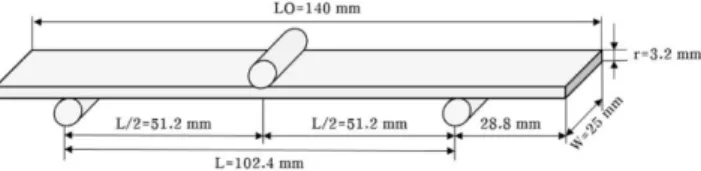
Specimens for further testing were cut according to ASTM D790-2010 standard. The span-to-depth ratio was equal to 32:1 and the detailed size parameters of the specimen are shown in Fig. 2.

2.2 Application of Bending Stress

The bending strength of the material was estimated via three-point bending test from the corresponding displacement the specimen underwent. Following this method, the bending stress could be controlled by displacement [9]. In the above test, the pressure was kept constant, as shown in Fig. 3, and 0%, 30%, 50% and 70% of the ultimate material strength were applied on the specimen to obtain different displacements.

2.3 Water Environment

The specimens, under applied constant pressure, were placed in a water tank at 80 ± 1°C for 100 H, 200 H, 400 H, 600 H, and 800 H.

2.4 Three-Point Bending Test

The samples were removed after the specified time, and the impact strength of external conditions i.e. pressure on the mechanical properties of the materials was analyzed via three- point bending test using a universal testing machine (UTM).

The rate of crosshead motion was equal to 5.46 mm/min which was calculated according to ASTM D790-2010 standard.

3. ANALYSIS AND RESULTS

3.1 Bending Strength

Each dot in Fig. 4 shows the residual bending strength of the material under different pressure and at a different time.

The distribution of the dots in Fig. 4 shows that the residual bending strength of the material reduced with an increase in pressure and time. When the pressure was applied, the residual bending strength of the material decreased rapidly within the first 100 H, and the rate of decrease of the residual bending strength was directly proportional to the rate of pressure increase. However, between 100 H and 800 H, the rate of decrease of the residual bending strength was slow and was showed a tiny decline (all below 10%) with the change in pres- sure. The specimen degradation strength was fitted to an

Fig. 3. Pressure fixture

Table 1. a, b, c and d constants and statistical values for residual bending strength degradation curves

Curve a b c d R-Square

0% 12.66 -1.643 344.1 -0.0006808 0.9935 30% 59.6 -0.03735 297.1 -0.0007107 0.9783 50% 179.6 -0.01558 177.4 -0.00035757 0.9967 70% 210.3 -0.01788 147.3 -0.0003889 0.9982 Fig. 4. Residual bending strength degradation under differed

states of stress with time Fig. 1. VaRTM method technology

Fig. 2. Schematic of specimen

(3)

exponential function y = ae

bx

+ ce

dx

[9]. Table 1 shows a, b, c, and d constants and statistical values for residual bending strength degradation curves which were solved by Matlab soft- ware. The strength degradation curves for four states of stress are shown in Fig. 4.

Furthermore, swelling of the unsaturated polyester upon immersing in water can cause swelling stress due to absorption of water by GFRP. Such swelling stress can counteract the effect of residual bending strength decrease in the material.

Moreover, the secondary curing reaction of resin can occur in GFRP if it is not sufficiently cured at high temperature, which in turn can help in improving the mechanical properties of the material. However, a specimen can withstand shear stress under bending stress, when the stress reaches a certain mag- nitude larger than the fiber/matrix interfacial bond strength. It makes interfacial debonding and stratification easier. Lower transmission capacity moisture leads plasticization of the matrix macromolecules, which increases the distance between the molecular chains and can destroy intermolecular van der Waals force. After diffusion of water occurs within the resin, matrix, certain polar reactions occur resulting in hydrolysis of the substrate, or chain scission, which weakens the chemical bonds between molecules. Due to the factors mentioned above, the reduction of material mechanical properties was observed.

3.2 Fracture Energy

According to the theoretical crack model, fracture energy is the energy required to produce a unit area of crack (fully broken). The model assumes that no energy is consumed out- side the cohesive force distribution area. It implies that spec- imen fracture energy is completely provided by the external force. If a specimen is statically fractured and the work applied to fracture the interface (W

F

) is measured, the approximate interface fracture energy (G

F

) can be computed as:

(1)

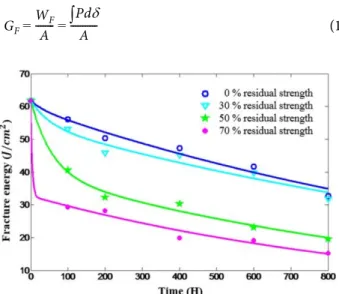
where A is the area of specimen fracture section, P is the exter- nal force, δ is the displacement [9]. The variation of fracture energy was found to be similar to bending stress, and the attenuation was also fitted with an exponential function form y = ae

bx

+ ce

dx

. Each point represented the fracture energy under different bending stress at various times, and the fitting curves are shown in Fig. 5. All constants and sta- tistical values were solved by Matlab software and shown in Table 2.

3.3 Extrapolation of Time to Failure (T

F

)

Time to failure (T

F

) is the time when the residual strength of samples reaches to the magnitude of applied stress. For exam- ple, at 30% stress state, T

F

is the time when the magnitude of the residual strength of the sample is equal to 30% of the ulti- mate material strength. It is impossible to measure the T

F

directly from displacement control test [9]. So, the samples were submerged in hot water at a temperature of 80°C for a specific time and then removed from the water. The residual bending strength of the sample was then measured via three- point bending test. Using cubic spline method and extrap- olation of the data, time to failure under the different state of stress were calculated [9]. The results are summarized in Table 3.

3.4 Life Curve (S-T)

An S-T curve was derived from the T

F

points for the sam- ples under bending stress equal to 30%, 50% and 70% of the material ultimate strength states and static strength of the material (Fig. 6). The S-T curve was fitted to an exponential function y = ae

bx

+ ce

dx

, using the T

F

values from Table 3. Fig. 6 also shows strength degradation curves for three states of stress. Table 4 shows the values of a, b, c, and d constants and the statistical values for the S-T curves [9].

G

F

W

F

--- AP d δ

--- A

= =

Fig. 5. Fracture energy degradation with time under different bending stress

Table 2. Constants and statistical values for fracture energy deg- radation curve

Curve a b c d R-Square

0% 2.168 -0.02787 59.58 -0.000672 0.9745 30% 7.42 -0.01912 54.37 -0.0005961 0.9637 50% 22.23 -0.01781 39.55 -0.000859 0.9926 70% 29.11 -0.263 32.63 -0.0009715 0.9947

Table 3. T

F

values in different stress states

The stress state 0 30% 50% 70%

Residual strength

(MPa) 356.725 107.018 178.363 249.708 Time to failure

(h) - 1223.3 163.5 40.8

(4)

3.5 Optical Microscope and SEM Observation

Fig. 7 shows the cross-section of the specimen after the three-point bending test before and after submerging for 0 H and 800 H respectively at 80°C of the hot water. It can be observed that specimen tensile area was more seriously dam- aged than the pressure area. There were obvious cracks between the layers, and a large crack developed vertically between the layers. More fracture cracks were observed for specimen immersed in water for 800 H because the mechan- ical properties of the material reduced largely under bending stress in hot water. The fiber and the resin separated easily due to the water molecules, and the transferred stress became weak. With the increase in time, the fiber and resin bonding became more and weaker, and layers formed.

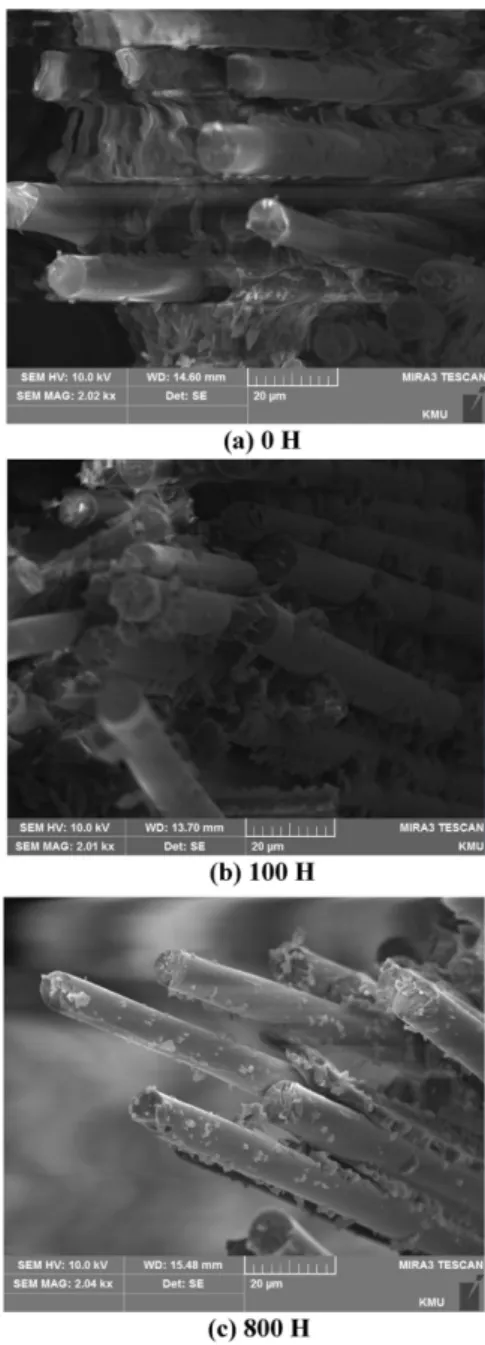
Fig. 8 from a top (0 H) to bottom (800 H) sequentially shows that the specimen fractured after the three-point bend- ing test without submerging in hot water (0 H) and immersed for 100 H and 800 H at 80°C of the hot water. A subtle dif- ference between the content of the fiber and the resin can be

observed at the broken cross-section. More resin can be seen at the surface of specimen 0 H than 100 H, and 800 H. Addi- tionally, the gaps between the fiber were also larger in 100 H and 800 H, indicating a decrease in the mechanical properties.

Brittleness was seen for 0 H, and damage mechanism mainly involved matrix cracking. After treating the specimen at high temperature in water, the fracture of the specimens showed more fibers and less adhesive resin. The failure mechanism of these specimens involved mainly matrix cracking and inter- face debonding.

4. CONCLUSIONS

To conclude, the residual bending strength of the GFRP Fig. 6. Strength degradation for different stress states and S-T

curve

Table 4. a, b, c and d constants and statistical values for S-T curves

Curve a b c d R-Square

S-T 168.3 -0.02339 188.4 -0.0004623 1

Fig. 7. Cross sections of specimen observed by optical micro- scope

Fig. 8. Cross sections of specimen observed by SEM

(5)

composite materials under bending strength in high-tempera- ture water environment showed a deterioration with increase in pressure. The bending strength degradation followed an exponential decay. Within 100 H, the bending strength decline rate was proportional to the rate of pressure increase.

The fracture energy reduction was also similar to the resid- ual bending strength reduction, and the degree of attenuation followed an exponential decay.

By calculating material failure time under different pres- sures, an S-T life curve was constructed. The damage mech- anism mainly involved matrix cracking before water treatment, whereas it changed to matrix cracking and interface debond- ing after placing the specimens in the high-temperature water environment.

ACKNOWLEDGEMENT

This research was supported by the Ministry of Trade, Industry & Energy(MOTIE), Korea Institute for Advancement of Technology(KIAT) through the IDEA FACTORY Research Grant of N0001410.

REFERENCES

1. Ray, H., Webster’s New World Telecom Dictionary, Wiley-Inter- science Pub. Co., New York, U.S.A, 2008.

2. Subrata, C.D., and Enamul, H.N., “Applications of Fibber Rein- forced Polymer Composites (FRP) in Civil Engineering,” Inter- national Journal of Advanced Structures and Geotechnical

Engineering, Vol. 3, No. 3, 2014, pp. 299-309.

3. NIIR Board of Consultants and Engineers, The Complete Tech- nology Book on Fibre Glass, Optical Glass and Reinforced Plastics, Asia Pacific Business Press Inc., Delhi, India, 2006.

4. Huang, G., “Behaviors of Glass Fibre/Unsaturated Polyester Composites under Seawater Environment,” Materials and Design, Vol. 30, 2009, pp. 1337-1340.

5. Earl, J.S., and Shenoi, R.A., “Hydrothermal Ageing Effects on FRP Laminate and Structural Foam Materials,” Composites:

part, Vol. 25, 2004, pp. 1237-1247.

6. Liao, K., Schultheisz, C.R., and Hunston, D.L., “Effect of Envi- ronmental Aging on the Properties of Pultruded GFRP,” Com- posites: Part B, Vol. 30, 1999, pp. 485-493.

7. Lv, X., Zhang, Q., and Ma, Z., “Study of Hydrothermal Aging Effect on Mechanical Properties of Carbon Fiber/Epoxy Resin Composites,” Materials Engineering, 2005, pp. 50-53.

8. Sun, B., and Li, Y., “The Study on Hydrothermal Aging Behav- ior of Composites and the Prediction Model of Durability,”

FRP/CM, 2013, pp. 28-34.

9. Mahmood, M.S., and Mahdi, M., “Stress Corrosion Cracking of Basalt/Epoxy Composites under Bending Loading,” Applied Composite Materials, Vol. 17, No. 2, 2010, pp. 121-135.

10. Menta, V.G.K., Chandrashekhara, K., and Schuman, T.P.,

“Manufacturing of Transparent Composites using Vacuum Infusion Process,” Proceedings of the 4th Annual ISC Research Symposium (ISCRS), April. 2010, pp. 1-4.

11. Hu, W., Effect of Hot Water Environment under Different Bend-

ing Stress on the GFRP Mechanical Property, Master’s thesis,

Korea Maritime and Ocean University, Korea, 2015.

수치

Table 1. a, b, c and d constants and statistical values for residual bending strength degradation curves
Table 2. Constants and statistical values for fracture energy deg- deg-radation curve  Curve a b c d R-Square 0% 2.168 -0.02787 59.58 -0.000672 0.9745 30% 7.42 -0.01912 54.37 -0.0005961 0.9637 50% 22.23 -0.01781 39.55 -0.000859 0.9926 70% 29.11 -0.263 32.6
Fig. 7 shows the cross-section of the specimen after the three-point bending test before and after submerging for 0 H and 800 H respectively at 80°C of the hot water

참조

관련 문서

The aim of this in vitro study was to evaluate the mechanical properties (bending strength and hardness) of seven different fiber reinforced composite posts, in relation to

Self-Healing Properties of Fiber-Reinforced Cement Composite (FRCC) Depending on Various Curing Conditions..

Abstract: In this paper, optimal designs of bicycle frame were studied for weight reduction of bicycle using carbon- fiber-reinforced plastic

In this study, the mechanical properties of injection-molded glass-fiber- reinforced polymer were assessed at a temperature of 85°C and the maximum

ABSTRACT: In this study, the transverse mechanical properties of the unidirectional fiber reinforced composite modeled with fiber, matrix, and interphase is predicted

In this study, the effect of surface modification of jute fibers by alkali treatment has been investigated and short Jute fiber reinforced polypropylene matrix

The evaluation of the lateral load performance for larch glulam portal frames was carried out using glass fiber reinforced plastic (GFRP) as connector in two different systems:

According to Double Cantilever Beam theory, the stress intensity factor was 1.08 ∼1.38 for sheet glass fiber reinforced plastic reinforced laminated timber and 1.38 ∼1.86 for