콩나물의 품종, 뿌리발생 및 재배일수에 따른 asparagine 함량 변이
정연신
**
․박희준*
․Krishna Hari Dhakal*
․이정동***
․이인중*
․황영현*
*경북대학교 식물생명과학부․**경북대학교 농업과학기술연구소․
***Univ. of Missouri-Delta Center
Change of asparagine content in soybean sprouts by variety, root growth, and cultivation period
Yeon-Shin Jeong
**
․Hee Joon Park*
․Krishna Hari Dhakal*
․Jeong-Dong Lee***
․In-Jung Lee*
and Young-Hyun Hwang*
* Division of Plant Biosciences, Kyungpook National University, Daegu 702-701, Korea
** Institute of Agricultural Science and Technology, Kyungpook National University, Daegu 702-701, Korea ***
Univ. of Missouri-Delta Center, P.O. Box 160, Portageville, Mo 63873 U.S.A
Abstract
The varietal difference, effect of root amounts and cultivation duration on the asparagine content of soybean sprouts, which is known to have the excellent detoxifying effect of ethanol, were investigated for developed varieties and indigenous sprout lines to establish cultivation methods of increasing the asparagine content and to develop soybean varieties having high asparagine content. Some of the research results obtained are summarized as follows;
1. Range and mean of asparagine content of 174 germplasm were 0.38 ~1.67% and 0.99%, respectively, on fresh weight basis.
2. Developed sprout-soybean varieties showed somewhat higher asparagine content of 1.29% than that of indigenous sprout lines of 0.96% on fresh weight basis.
3. No significant difference in asparagine content among the seed size groups was recognized though the highest asparagine content, 1.02% on fresh weight basis was observed in the seed size of 8.1 ~10.0g/100 seeds.
4. Among the seed coat color groups, soybean of brown seed coat color showed the highest asparagine content (1.15%) on fresh weight basis. No difference was observed among other groups of seed coat color.
5. Range of asparagine content of 174 varieties was 4.08 ~6.24% on dry weight basis. Soybean varieties that showed high asparagine content were Dawonkong, Sobacknamulkong, Sowonkong, and Somyungkong, with the contents of 6.24%, 6.21%, 5.95%, and 5.85%, respectively.
6. Amount of roots which have the highest asparagine content out of sprout parts was greatly increased up to 10 days of sprout cultivation.
7. Highly significant difference in asparagne content of sprout was recognized between those grown for five and ten days, with the asparagine content of 0.68% and 1.21%, respectively, on fresh weight basis.
8. Asparagine content of hypocotyle part was also highly proportional to days to cultivation; it increased from 2.91% at 2 days of cultivation to 15.68% on fresh weight basis at 14 days of cultivation.
Key words:Soybean, soy-sprout, asparagine content, soy-sprout root,
Glycine maxⅠ. 서 론
대두(
Glycine maxL. Merrill.)는 콩과식물에 속하며 원산지는 한국, 중국 및 만주지방으로서 농경의 시작 과 함께 수천 년 동안 재배되어 왔을 것으로 추정되며, 기원전 4~5세기경에 이미 우리나라에 재배되어 온 것으로 기록되어져 있다(Kim, 1976; Kwon, 1972). 예 로부터 콩은 우리나라를 비롯한 동양권에서는 일상생 활에 중요한 영양공급원으로써 직접 또는 가공식품으 로 이용되어 왔으며, 최근에는 동서양을 막론하고 범 세계적으로 단백질, 유지 및 사료의 원료로 다양하게 이용되고 있다.
콩나물은 고려시대 이전부터 이용되어 오던 고유의 전통식품으로(Chang, 1992), 콩나물이 자라는 과정 중 체내대사가 이루어짐으로써 지방이 현저하게 감소되 는 반면 비타민의 함량이 크게 증가하는데 그 중에서 도 원료콩에는 없던 비타민 C가 콩 100g중 16㎎정도 가 합성되므로(Lee and Hwang, 1996) 주식인 쌀에서 부족되기 쉬운 주요 영양분의 공급원이 되며 가격이 저렴하고 년중 이용할 수 있어 주년채소로써도 중요 한 위치에 있는 우리 국민의 중요한 전통식품이라 할 수 있다(Suh et al., 1994; Suh et al., 1996). 콩의 발아는 향과 영양가를 개선시키고 소화율을 증진시키 면서 장내 가스 발생인자나 항영양인자, trypsin inhibitor 등의 역할을 감소시킨다고 보고하였다 (Aminah et al., 1984). 콩나물은 하배축이 길고 근장이 짧으며, 세근의 발생이 적은 것이 양질 콩나물로 취급 되어지고 있으나(Suh et al., 1994; Eldridge and Kwolek, 1983) 실제적으로 연간 소비되는 콩나물의 양은 1인당 12~13kg에 이르는 것으로 추정된다.
콩나물의 수율과 품질은 가공조건 뿐만 아니라 콩 품종에 의하여 많은 영향을 받는데(Kim et al., 1994).
콩나물 생장조절 물질 처리와 생육관계, 재배관련 연 구를 통해 우수하고 경쟁력있는 콩나물 재배책이 모 색되어 왔으나 콩나물의 품질을 평가하기 위해서는 근본적으로 나물콩 품종에 관한 연구가 선행되어야 한다.
콩나물에서는 aspartic acid가 배축부에서 경시적으 로 현저히 증가하는 것으로 나타났고(양차범, 1981),
콩나물 재배 중 대두의 종실에 적게 함유되었던 aspartic acid가 가장 많이 증가되어 6일째에는 asparagine함량이 건물량의 22.7%에 달했으며, 15일 째는 최고 25%까지 증가하였다. 특히 대두를 암소에 서 발아시킬 경우 asparagine의 축적이 많다는 것이 알려져 있으며, 재배중 광을 조사하게 되면 콩나물의 색깔이 푸르게 변하면서 asparagine의 양은 급격히 감 소하므로 asparagine함량을 증가시키기 위해서는 암 소에서 재배하여야 한다(변시명, 1977).
술을 마시면 인체에 흡수된 ethanol은 독성이 강한 acetaldehyde로 되는데, NAD
+에 의해 다시 무해한 acetate로 대사과정을 거쳐 최종적으로 물과 탄산가스 등으로 분해가 된다. 그러나, 과음을 하게되면 aspartate-malate shuttle에서 생성된 NAD
+가 고갈되어 체내에 독성이 강한 astealdehyde가 축적되고 이 것이 숙취에 이르게 된다. 술을 마신 후 asparagine 함량이 많은 콩나물을 먹거나 콩나물국을 마시면 NAD
+를 보충하여 주어 체내 흡수된 ethanol을 무해한 acetate 로 분해하여 숙취에 이르지 않도록 해 주는 작용을 한다(Park et al., 1994; Park, 1993; Park, 1994). 그러나 콩나물 속에 함유되어 있는 숙취해독에 탁월한 효과 를 지니는 asparagine에 관한 연구는 다소 미비한 실정 으로 앞으로 많은 연구가 있어야 할 것으로 생각된다.
따라서 본 연구는 숙취해독에 탁월한 효과를 지닌 것으로 알려진 asparagine 함량의 콩나물 계통간 차이 와 뿌리 발생량에 따른 차이 및 콩나물 재배기간에 따른 차이를 구명하여 고 asparagine을 가지는 기능성 콩나물 생산과 나물콩 품종 육성의 기초자료로 활용 하고자 수행하였다.
재료 및 방법
공시된 KLG11078외 174품종 및 계통을 콩나물 재
배기(100cm × 40cm)에서 재배실 온도 20±1℃, 수온
18±1℃, 살수조건은 8회/일, 4분/회의 조건에서 5일간
재배하여 콩나물의 상태를 조사한 후 종피색, 백립중
및 수집지역에 따른 콩나물의 asparagine 함량을 분석
하였다. 분석방법은 5일간 재배한 콩나물 일정량을
막자사발에 넣고 완전히 마쇄한 후 그 즙을 이용하여 희석한 후 분석시료로 사용하였다.
본 시험에 공시된 나물콩 175품종 및 계통을 종피색 과 수집지역별로 분류하면 표 1과 같다. 공시된 나물 콩 품종 및 계통 중 장려품종은 16품종이었고, 재래 계통은 158계통이었다. 종피색별 분포는 황색종피종 이 60계통으로 가장 많았고, 흑색종피종, 혼합종피종, 녹색종피종, 갈색종피종 순이었다. 수집지역별 분포 는 경북이 51계통으로 가장 많았고, 강원, 전북, 경남 순이었다.
Table 1. Seed coat color and collected area of soybean lines used in the experiment.
Seed coat color
Collected area Black Brown Green Mixed Yellow Total
39 4 35 36 60 174
Kangwon(32), Kyonggi(7), Gyeongbuk(51), Gyeongnam(18),
Jeonbuk(20), Jeonnam(9), Chungnam(7), Chungbuk(5), Improved variety(16), Others(9)
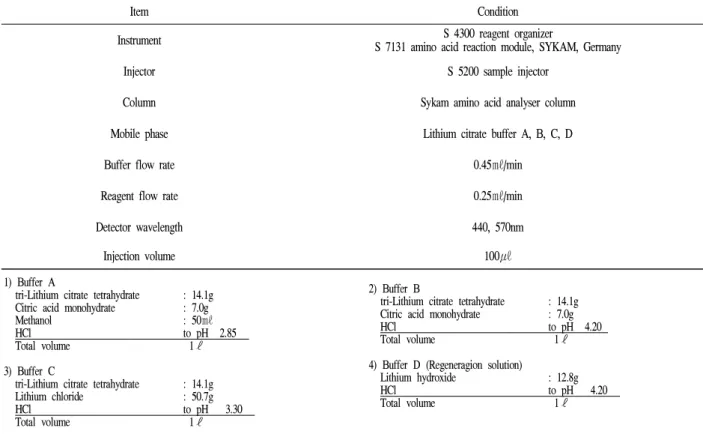
Table 2. Operating condition of amino acid analyzer for analysis of asparagine.
Item Condition
Instrument S 4300 reagent organizer
S 7131 amino acid reaction module, SYKAM, Germany
Injector S 5200 sample injector
Column Sykam amino acid analyser column
Mobile phase Lithium citrate buffer A, B, C, D
Buffer flow rate 0.45㎖/min
Reagent flow rate 0.25㎖/min
Detector wavelength 440, 570nm
Injection volume 100㎕
1) Buffer A
tri-Lithium citrate tetrahydrate : 14.1g Citric acid monohydrate : 7.0g
Methanol : 50㎖
HCl to pH 2.85
Total volume 1ℓ
3) Buffer C
tri-Lithium citrate tetrahydrate : 14.1g
Lithium chloride : 50.7g
HCl to pH 3.30
Total volume 1ℓ
2) Buffer B
tri-Lithium citrate tetrahydrate : 14.1g Citric acid monohydrate : 7.0g
HCl to pH 4.20
Total volume 1ℓ
4) Buffer D (Regeneragion solution)
Lithium hydroxide : 12.8g
HCl to pH 4.20
Total volume 1ℓ
국내에서 육성된 장려 나물콩 품종인 은하콩 외 15품종을 공시재료로 하여 콩나물을 재배한 후 콩나 물 일반 특성과 asparagine 함량을 분석하였다.
Asparagine 분석은 건조된 콩나물 분말 1g에 75%
Ethanol 30ml을 첨가하여 30분간 가수분해한 후 filter paper로 여과하고, 다시 75% Ethanol 20ml을 첨가하여 20분간 2회 가수분해하여 filter paper로 여과한 후 rotary evaporator로 감압농축하였다. 감압농축된 것을 lithium citrate (pH 2.2)로 녹여낸 후, diethyl ether를 첨가하여 지방층을 분리하고, 다시 rotary evaporator 로 감압농축한 후 lithium citrate로 녹여내여 희석한 후 분석시료로 사용하였다.
Asparagine 분석을 위한 아미노산 분석기의 분석조 건은 표 2와 같다.
국내 재래 계통인 KLG11041외 29계통을 공시재료로 하여 콩나물 재배기간(5, 10일)에 따른 콩나물 특성과 뿌리발생량을 조사한 후 asparagine 함량을 분석하였다.
장려품종인 풍산나물콩을 재료로 하여 콩나물 재배
일수(2, 4, 6, 8, 10, 12, 14일)에 따른 콩나물 하배축
부위의 asparagine 함량을 분석하였다.
결과 및 고찰
공시된 나물콩 174품종 및 계통을 이용하여 콩나물 생체의 asparagine 함량을 분석한 결과 그 범위 및 평균 은 표 3과 같다. Asparagine 함량의 범위 및 평균은 각각 0.38~1.67%와 0.99%로 나타났으며 계통간 다양 한 변이를 보여 고 asparagine을 가지는 우수한 계통의 선발이 가능하였다.
Table 3. Range and mean of asparagine content of soybean sprout for Korean indigenous lines and improved varieties.
Asparagine content(%, fresh basis)
Range 0.38~1.67
Mean±SE 0.99±0.21
공시재료중 재래 나물콩 계통과 장려품종간 콩나물 생체의 asparagine 함량을 비교한 결과는 표 4와 같다.
재래 나물콩 계통과 장려품종의 asparagine 함량의 평 균은 각각 0.96%와 1.29%로 그 차이가 0.33%이었으 며, 장려품종의 함량이 재래 나물콩 계통에 비해 높게 나타났고 고도의 유의적인 차이가 인정되었다. 그러 나, 재래 계통중에서 몇 계통은 장려품종보다 asparagine함량이 높았다.
Table 4. Comparison of asparagine content between indigenous lines and improved varieties.
Asparagine content(%, fresh basis)
Indigenous lines 0.96
Improved varieties 1.29
t-test **
공시된 나물콩 174계통 및 품종의 백립중에 따른 콩나물의 asparagine 함량은 표 5와 같다. 백립중별 asparagine 함량은 8.1~10.0g, 8.0g이하, 10.1~12.0g, 14.1g 이상, 12.1~14.0g 순이었고, 그 함량은 각각 1.02, 0.99, 0.97, 0.93, 0.90%로 나타났으나 입중의 군 간에 유의적인 차이는 인정되지 않았다.
Table 5. Effect of seed size on asparagine content in soybean sprout.
Seed size (Wt. / 100seeds) Asparagine content(%, fresh basis)
~8.0g(n=8)† 0.99a
8.1~10.0g(n=31) 1.02a
10.1~12.0g(n=62) 0.97a
12.1~14.0g(n=42) 0.90a
14.1g~(n=15) 0.93a
†
Number of lines tested.
- Means in a column followed by a common letter are not significantly different at 5% level by DMRT.
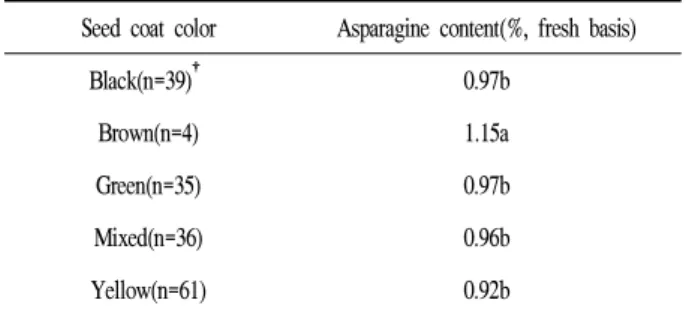
공시된 나물콩 174계통 및 품종의 종피색에 따른 콩나물의 asparagine 함량은 표 6과 같다. 종피색별 asparagine 함량은 갈색종피종이 1.15%로 가장 높게 나타났고, 황색종피종이 가장 낮게 나타났다. 갈색종 피종, 흑색종피종, 녹색종피종, 혼색종피종 및 황색종 피종 순이었으며 각각 1.15, 0.97, 0.97, 0.96 및 0.92%
이었다.
Table 6. Effect of seed coat color on asparagine content in soybean sprout.
Seed coat color Asparagine content(%, fresh basis)
Black(n=39)† 0.97b
Brown(n=4) 1.15a
Green(n=35) 0.97b
Mixed(n=36) 0.96b
Yellow(n=61) 0.92b
†
Number of lines tested.
- Means in a column followed by a common letter are not significantly different at 5% level by DMRT.
공시재료 중 장려품종인 남해콩 외 15품종의 콩나
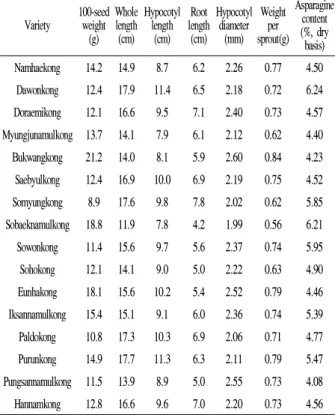
물 특성과 asparagine 함량은 표 7과 같다. 콩나물 특성
은 품종들 간에 다양한 변이를 보였고, asparagine 함
량의 범위는 4.08~6.24%로 나타났으며, 다원콩이
6.24%로 가장 높게 나타났고 소백나물콩, 소원콩, 소
명콩 순으로 나타났다. 이 (Lee and Hwang, 1996) 등이
보고한 5일간 재배한 성주 2외 2품종의 asparagine 함
량이 4.47~6.05g/100g 즉, 4.47~6.05%로 나타난 결과
와 비슷한 결과를 보였다.
Table 7. Variation of sprout characteristics and asparagine content in improved varieties.
Variety 100-seed weight
(g) Whole length (cm)
Hypocotyl length
(cm) lengthRoot
(cm) Hypocotyl
diameter (mm)
Weight sprout(g)per
Asparagine content (%, dry basis) Namhaekong 14.2 14.9 8.7 6.2 2.26 0.77 4.50 Dawonkong 12.4 17.9 11.4 6.5 2.18 0.72 6.24 Doraemikong 12.1 16.6 9.5 7.1 2.40 0.73 4.57 Myungjunamulkong 13.7 14.1 7.9 6.1 2.12 0.62 4.40 Bukwangkong 21.2 14.0 8.1 5.9 2.60 0.84 4.23 Saebyulkong 12.4 16.9 10.0 6.9 2.19 0.75 4.52 Somyungkong 8.9 17.6 9.8 7.8 2.02 0.62 5.85 Sobaeknamulkong 18.8 11.9 7.8 4.2 1.99 0.56 6.21
Sowonkong 11.4 15.6 9.7 5.6 2.37 0.74 5.95
Sohokong 12.1 14.1 9.0 5.0 2.22 0.63 4.90
Eunhakong 18.1 15.6 10.2 5.4 2.52 0.79 4.46 Iksannamulkong 15.4 15.1 9.1 6.0 2.36 0.74 5.39 Paldokong 10.8 17.3 10.3 6.9 2.06 0.71 4.77 Purunkong 14.9 17.7 11.3 6.3 2.11 0.79 5.47 Pungsannamulkong 11.5 13.9 8.9 5.0 2.55 0.73 4.08 Hannamkong 12.8 16.6 9.6 7.0 2.20 0.73 4.56
콩나물 뿌리발생량에 따른 콩나물 특성과 asparagine 함량은 표 8과 같다. 5일간 재배한 콩나물 에 비해 10일간 재배한 콩나물은 콩나물 특성에서 하배축 직경이 각각 2.29와 2.35mm로 서로간에 유의 적인 차이가 인정되지 않았지만 나머지 특성에서는 10일 재배한 콩나물이 5일 재배한 것 보다 높게 나타 나 고도로 유의적인 차이가 인정 되었고, 특히 asparagine 함량은 10일 재배한 것이 1.21%(생체수준) 로 나타나 5일 재배한 것 보다 0.53% 높게 나타나 재배일수간에 고도로 유의적인 차이가 인정되었다.
Table 8. Mean of sprout characteristics and asparagine content of roots grown for five and ten days for 30 indigenous soybean lines.
Culturing period Whole length (cm)
Hypocotyl length
(cm)
lengthRoot (cm)
Hypocotyl diameter
(mm)
No. of root hairs per sprout
Weight per sprout
(g)
Weight per 10 roots
(g)
Asparagine content of roots (%, fresh weight basis)
5days(A) 20.1 12.6 7.5 2.29 4.6 0.86 0.73 0.68
10days(B) 29.7 20.5 9.3 2.35 29.1 1.26 1.41 1.21
B-A 9.6 7.9 1.8 0.06 24.5 0.40 0.68 0.53
t-test ** ** ** ns ** ** ** **
콩나물 재배일수에 따른 콩나물 하배축 부위의 asparagine 함량의 변화를 보면 그림 5와 같다. 콩나물 하배축 부위의 asparagine 함량은 재배 후 2일경에는 2.91%였으나 재배일수가 증가할수록 asparagine 함량 이 증가하여 재배 후 14일에는 15.68%까지 증가하였 다. 변 등
25)은 15일 동안 재배한 콩나물의 asparagine 함량이 건물중의 25%라고 하여 본 시험의 결과와 비 슷한 결과를 보고하였는 바, 최근 시중에 유통되고 있는 순수 정제한 asparagine의 가격을 감안하면 경제 적인 asparagine의 추출 정제가 가능할 것으로 생각되 며 정제효율이 다른 어느 성분에 비하여 상당히 높을 것으로 기대된다.
0 2 4 6 8 10 12 14 16 18
0 3 6 9 12 15
Culturing period(days)
A s p a ra g in e c o n te n t(% )
0 2 4 6 8 10 12 14 16 18
0 3 6 9 12 15
Culturing period(days)
A s p a ra g in e c o n te n t(% )
Fig 5. Changes of asparagine content in hypocotyl of
soybean sprout.
적 요
숙취해독에 탁월한 효과를 지니는 asparagine 함량 의 콩나물 계통간 차이와 뿌리 발생량에 따른 차이 및 콩나물 재배기간에 따른 차이를 구명하여 고 asparagine을 가지는 기능성 콩나물 생산과 품종육성 을 위하여 국내재래 콩나물 계통의 asparagine 함량을 분석한 결과를 요약하면 다음과 같다.
1. 공시된 나물콩 174품종 및 계통의 콩나물에서의 asparagine 함량의 범위 및 평균은 0.38~1.67%, 0.99%(생체수준)로 각각 나타나 다양한 변이를 보 였다.
2. 공시된 장려품종과 재래계통의 asparagine 함량은 각각 1.29, 0.96%(생체수준)로 재래계통보다 장려 품종에서 높게 나타났다.
3. 백립중별 asparagine함량은 8.1~10.0g범위에서 1.02%(생체수준)로 가장 높은 경향이었으나 유의 적인 차이는 인정되지 않았다.
4. 종피색별 asparagine 함량은 갈색종피종이 1.15%
(생체수준)로 가장 높았으며 다른 종피종들은 비슷 한 경향으로 나타났다.
5. 공시된 장려품종의 asparagine 함량의 범위는 4.0 8~6.24%(건물수준)로 나타났고, 다원콩(6.24%), 소백나물콩(6.21%), 소원콩(5.95%), 소명콩 (5.85%) 순이었다.
6. 콩나물의 재배일수를 10일로 한 경우 asparagine 함량과 관계가 깊은 뿌리발생량이 크게 증가하였 다.
7. 재배일수에 따른 asparagine함량은 5일재배와 10일 재배에서 각각 0.68%, 1.21%(생체수준)로 나타나 재배일수간 asparagine 함량에는 고도의 유의적인 차이가 인정되었다.
8. 콩나물의 하배축 부위에서 재배일수가 증가할수 록 asparagine 함량도 증가하여 2일 재배시 2.91%
(건물수준)이던 것이 14일 재배시에는 15.68%까지 증가하였다.
인용문헌