Mechanical properties related to the microstructure of seven different fiber reinforced composite posts
Víctor Alonso de la Peña1, Iria L Darriba1*, Martín Caserío Valea1, Francisco Guitián Rivera2
1Department of Surgery and Medical and Surgical Specialties, Faculty of Medicine and Dentistry, University of Santiago de Compostela, Santiago de Compostela, A Coruña, Spain
2Instituto de Cerámica, University of Santiago de Compostela, Santiago de Compostela, A Coruña, Spain
PURPOSE. The aim of this in vitro study was to evaluate the mechanical properties (bending strength and hardness) of seven different fiber reinforced composite posts, in relation to their microstructural characteristics.
MATERIALS AND METHODS. Two hundred eighty posts were divided into seven groups of 40, one group for each type of post analyzed. Within each group, 15 posts were subjected to three-point bending strength test, 15 to a microhardess meter for the Knoop hardness, and 10 to Scanning Electron Microscope in order to determine the diameter of the fibers and the percentage of fibers embedded in the matrix. To compare the flexural strength in relation to the type of fiber, matrix, and the hardness of the posts, a Kruskal-Wallis H test was used. The Jonckheere-Terpstra test was used to determine if the volume percent of fibers in the post influenced the bending strength. RESULTS. The flexural strength and the hardness depended on the type of fibers that formed the post.
The lower flexural strength of a post could be due to deficient bonding between the fiber and the resin matrix.
CONCLUSION. According to the results, other factors, besides the microstructural characteristics, may also influence the mechanical properties of the post. The feature that has more influence on the mechanical properties of the posts is the type of fiber. [J Adv Prosthodont 2016;8:433-8]
KEYWORDS. Fiber post; Flexural strength; Hardness; Mechanical properties; SEM-evaluation
INTRODUCTION
Restoration of a tooth with extensive destruction may require a post to retain the restorative material securely and promote an even distribution of forces in the root.1-4 A post does not strengthen the tooth, thus the decision to use a post is depen- dent on whether the remaining tooth structure is sufficient to retain the final restoration.5
There are two main types of prefabricated posts, a metal
post and a fiber reinforced composite (FRC) post.
For optimal results, the post material must have physical and mechanical properties similar to dentin (i.e. be able to join dental structures and be biocompatible).1,5 In addition, the mechanical properties of the different posts can result in the failure of the restoration.2 For example, a flexible post may lead to a loss of marginal integrity, with the risk of marginal discoloration, secondary caries, and possible debonding.6 By contrast, a rigid post can better support a coronal restoration through a more uniform force distribu- tion, but when the tooth is overloaded, due to the post’s rigidity and low plastic deformation, a root fracture can occur.1,4,7,8 The lower elastic modulus of the post, the great- er the probability of a restoration failure, but the higher the probability of a root surviving.9 The FRC posts have a modulus of elasticity similar to dentin while the moduli of the metal posts are much higher.10 According to Stewardson et al.,10 the FRC posts have a modulus 2 - 6 times, and metal 4 - 10 times, higher than dentin.
The FRC posts usually consist of a matrix of epoxy res- in or derivatives into which fibers are embedded to rein-
Corresponding author:
Iria L Darriba
Department of Surgery and Medical and Surgical Specialties, Faculty of Medicine and Dentistry, University of Santiago de Compostela, Entrerríos s/n. 15782, Santiago de Compostela. A Coruña. Spain Tel. +34881812349: e-mail, [email protected] Received March 12, 2016 / Last Revision July 26, 2016 / Accepted October 11, 2016
© 2016 The Korean Academy of Prosthodontics
This is an Open Access article distributed under the terms of the Creative Commons Attribution Non-Commercial License (http://creativecommons.
org/licenses/by-nc/3.0) which permits unrestricted non-commercial use, distribution, and reproduction in any medium, provided the original work is properly cited.
force the structure and improve its properties.5,7 Through scanning electron microscopy (SEM), numerous authors have found that the average diameter, density, orientation, fiber length, fiber-matrix bond, and matrix type in which the fibers are embedded are factors that influence the mechani- cal properties of posts.11-13
The aim of this in vitro study was to assess the mechani- cal properties (bending strength and hardness) of seven dif- ferent FRC posts, in relation to their microstructural charac- teristics.
MATERIALS AND METHODS
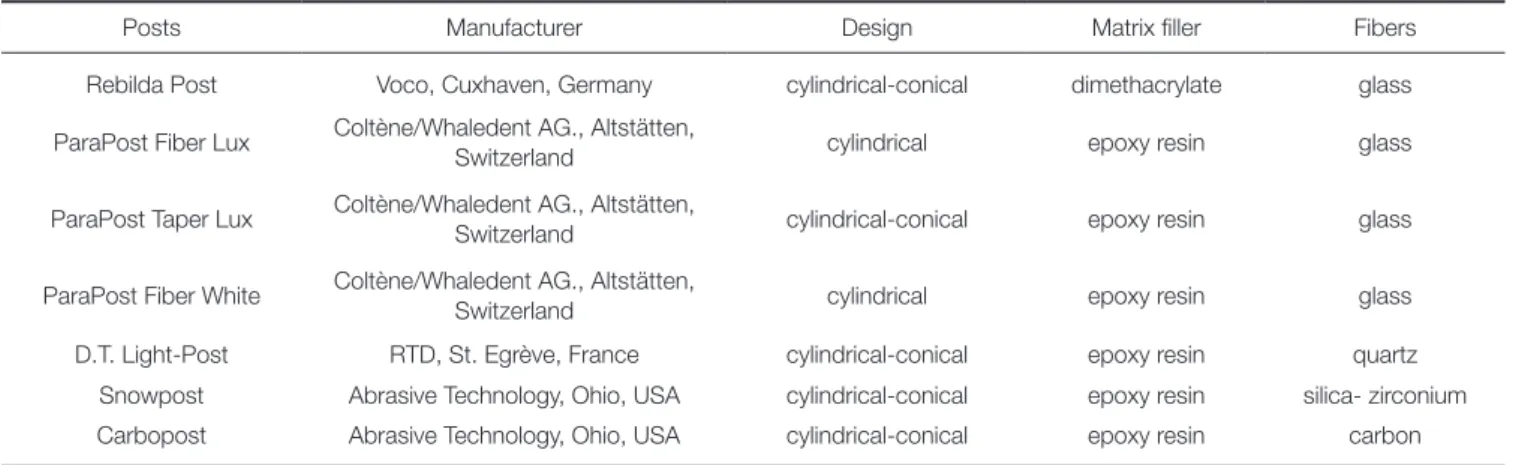
The posts used for this study are described in Table 1. Two hundred eighty posts were analyzed. Within each group, 15 posts were subjected to bending strength tests, 15 to hard- ness tests, and 10 to electron microscopy. The major diame- ter of the posts ranged from 1.50 mm to 2.20 mm.
In order to determine the diameter of the fibers and the percentage of fibers embedded in the matrix, each post sample was metallized with 15 nm of Au-Pd and studied with a Scanning Electron Microscope (SEM) (JEOL JSM- 6400. Jeol, Tokyo, Japan) on cross-sections at 2000× magni- fication. An approximation of the volume occupied by fibers was determined by adding the surface occupied by all the fibers and dividing by the total surface of the micro- graph.14 The fractured area of the post after being subjected to the bending test was also observed under SEM.
The bending resistance of the posts was analyzed by submitting them to three-point bending test in a universal testing machine (Suzpecar MEM-103/5. Suzpecar, Madrid, Spain). The load was applied with a loading angle of 90°
and a crosshead speed of 0.5 mm/min until fracture. The distance between the two supports was 10 mm. As the investigated posts had different diameters, a central area with a diameter of 1.30 mm was selected as the area of load application. The assessment was made with a digital caliper (Absolute Coolant Proof Caliper 500-731-10. Mitutoyo
Table 1. Fiber reinforced composite post used in this study
Posts Manufacturer Design Matrix filler Fibers
Rebilda Post Voco, Cuxhaven, Germany cylindrical-conical dimethacrylate glass
ParaPost Fiber Lux Coltène/Whaledent AG., Altstätten,
Switzerland cylindrical epoxy resin glass
ParaPost Taper Lux Coltène/Whaledent AG., Altstätten,
Switzerland cylindrical-conical epoxy resin glass
ParaPost Fiber White Coltène/Whaledent AG., Altstätten,
Switzerland cylindrical epoxy resin glass
D.T. Light-Post RTD, St. Egrève, France cylindrical-conical epoxy resin quartz
Snowpost Abrasive Technology, Ohio, USA cylindrical-conical epoxy resin silica- zirconium Carbopost Abrasive Technology, Ohio, USA cylindrical-conical epoxy resin carbon
America Co., Aurora, IL, USA). The flexural strength (σ), in MPa, of the post was computed using the following formula:
σ = , where Fm is the maximum load applied at break, L is the span length between the supports (in mm), and D is the diameter of the posts (in mm).
For the hardness test, posts were placed longitudinally into a sample holder with a resin mixture (Bepox 1159.
Gairesa, A Coruña, Spain) and were left to set for eight hours. After this step, the sample’s surface was polished.
The Knoop hardness (HK) was measured with a micro- hardness meter (Matsuzawa MXT 50. Matsuzawa, Tokyo, Japan). Ten indentations were made on the polished surface of each sample with a pyramidal diamond point with a rhomboidal base, formed by two mutually perpendicular faces with angles of 172º 30’ and 130º. The load applied was 50 g for a load time of 5 seconds. The long axis of the rhomboidal footprint was measured by microscopy. The KH is described by the formula: HK = , where P is the applied load (in Kgf), L is the indentation length along its long axis, and Cp is the correction factor related to the shape of the indenter. The result was multiplied by 10 to obtain a result in MPa.
Nonparametric tests were used because data exhibited a non-normal distribution (Kolmogorov-Smirnov test). To compare the flexural strength according to the type of fiber, matrix, and the hardness of the posts, a Kruskal-Wallis H test was used. The Jonckheere-Terpstra test was used to determine if the volume percent of fibers in the post influ- enced the bending strength. P < .05 was considered statisti- cally significant. All calculations were performed using the statistical software SPSS 21 (SPSS Inc., Chicago, IL, USA).
RESULTS
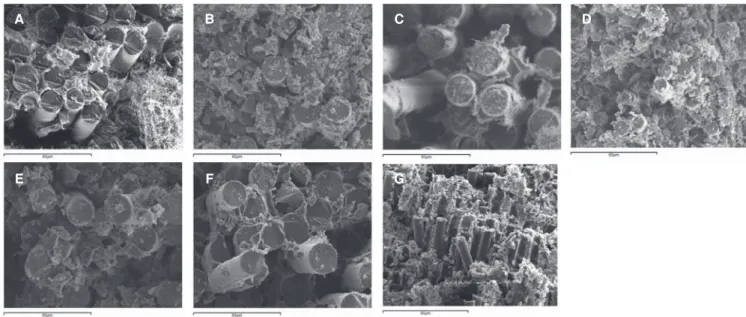
Examination of post cross sections with SEM revealed dif- ferent fiber diameters and irregular fiber distributions within
8FmL πD3
P CpL2
the same post (Fig. 1). The results of the diameters of the fibers and the fiber-matrix ratio are shown in Table 2. The posts with the smallest diameter of fibers were ParaPost Fiber White and Carbopost.
In the bending test, the posts with higher resistance were ParaPost Fiber Lux and ParaPost Taper Lux (P < .05).
The glass fiber post showed a higher resistance to fracture, with statistically significant differences with other types of fibers (quartz, silica-zirconia, and carbon) (P < .05). However, no significant difference between the carbon and the silica- zirconium fibers was found (P = .437). These two posts had the lowest bending strength. In analyzing the flexural strength in relation to the fibers-matrix ratio, no statistically significant differences were found among the groups (P >
.05). Between the dimethacrylate matrix and the epoxy resin matrix, there was no statistically significant difference (P = .672).
Table 2. Diameters of fibers and fiber-matrix ratio of the FRC posts obtained with the analysis of the SEM photographs
Post Diameter of fibers (µm) Fibers/matrix ratio (%)
Rebilda Post 14.76 (0.86) 75
ParaPost Fiber Lux 16.97 (0.75) 55
ParaPost Taper Lux 19.15 (3.30) 55
ParaPost Fiber White 8.83 (0.83) 40
D.T. Light-Post 17.63 (0.60) 75
Snowpost 17.46 (1.90) 55
Carbopost 6.57 (0.15) 65
In the analysis of the fracture area with SEM, differenc- es were observed at the junction between the matrix and fibers (Fig. 2). The Carbopost presented very clean fibers, indicating a poor fiber-matrix bond. By contrast, in the ParaPost Fiber White, many adhesions between the two components are observed, indicating a better fiber-matrix bond.
Regarding the KH, the hardest post was Snowpost, which was composed of silica-zirconia fibers, and the least hard post was ParaPost Fiber White, with glass fibers. No statistically significant differences with regard to the matrix compound were found (P = .619). However, the post hard- ness varied depending on the type of fiber (549.2 - 1046.8 MPa), with statistically significant differences among the posts (P < .05), except between carbon fiber posts and glass fiber posts, the two types having lower hardness (P = .673).
The values obtained in each test for the different posts are shown in Table 3.
Fig. 1. SEM micrographs of the cross sections of the fiber posts. (A) Rebilda Post, (B) ParaPost Fiber Lux, (C) ParaPost Taper Lux, (D) ParaPost Fiber White, (E) D.T. Light-Post, (F) Snowpost, and (G) Carbopost.
D
E F
A B C
G
DISCUSSION
It has been explained that the mechanical properties of a fiber-reinforced composite post depend on structural char- acteristics such as the direction of the fibers, the volume ratio of the fibers,7,11-13 the bonding between the matrix res- in and the fibers, and the individual properties of the fibers and the matrix.11-13,15 Related to the results obtained, besides the microstructural characteristics, there are other factors that influence the mechanical properties of the post.
The in vitro bending test better simulates and predicts what may happen to materials in vivo.16 Usually, the fatigue test used for this purpose is the three-point bending test,17 as used in this study.
There have been several studies in which the flexural strengths of fiber posts were analyzed with tests similar to those used in this evaluation, giving variable results.12-14,18 The discrepancy in flexural strengths reported for similar materials can be attributed to differences in experimental design, method of specimen preparation, and thickness and shape of the posts.7,19
The results implied that the compound of the matrix did not affect the mechanical properties of the posts.
Drummond and Bapna concluded that the bending force was not affected by the composition of the reinforcing fibers in the posts, as they all had approximately the same elastic modulus.11 However, in this study, the flexural strength of the post showed statistically significant differ- ences depending on the type of fiber. The carbon fiber post and the silica-zirconium fiber post achieved the lowest val- ues of flexural strength, like in another study.18 Even though one study showed the quartz-fiber post having greater flex- ural strength values than the glass fiber post,13 this study’s Table 3. Mean (standard deviation in parenthesis)
physical properties of the different posts, and according to the type of fiber, matrix, and the fiber-matrix ratio (%)
Flexural strength (MPa)
Hardness (MPa) Post
Rebilda Post 871.7 (242.1) 637.6 (115.9)
ParaPost Fiber Lux 1622.5 (370.6) 581.9 (86.9) ParaPost Taper Lux 1181.4 (118.2) 699.3 (145.9) ParaPost Fiber White 813.8 (124.9) 376.5 (102.3) D.T. Light Post 838.4 (212.1) 798.4 (124.8)
Snowpost 705.5 (69.4) 1046.8 (162.7)
Carbopost 664.3 (140.4) 549.2 (64.3)
Materials
Dimethacrylate 871.7 (242.1) 637.6 (115.9)
Epoxi Resin 962.4 (385.4) 676.9 (243.2)
Carbon fiber 664.3 (140.4) 549.2 (64.3)
Glass fiber 1122.3 (397.7) 573.6 (166.6)
Quartz fiber 838.4 (212.1) 798.4 (124.8)
Silica-Zirconium fiber 705.5 (69.4) 1046.8 (162.7) 40% fiber-matrix ratio 813.8 (124.9) 376.5 (102.3) 55% fiber-matrix ratio 1027.3 (439.7) 722.8 (233.0) 65% fiber-matrix ratio 871.7 (242.1) 637.6 (115.9) 75% fiber-matrix ratio 838.4 (212.1) 798.4 (124.8)
Fig. 2. SEM micrographs of the failure area of the fiber posts. (A) Rebilda Post, (B) ParaPost Fiber Lux, (C) ParaPost Taper Lux, (D) ParaPost Fiber White, (E) D.T. Light-Post, (F) Snowpost, and (G) Carbopost.
D
E F
A B C
G
results showed the highest flexural strength in glass fiber post.
Taking into account that the primary function of posts is to retain the core,1,5 a high flexural strength is essential to enhance the durability of the restoration during function.
Also, a low flexural modulus may avoid stress concentration and effectively prevent root fractures.19 Teeth restored with less rigid posts tend to have fewer catastrophic failures,20,23 which are more likely to be restorable.24 Therefore, accord- ing to the results of flexural strength, glass fiber posts should be chosen.
No statistically significant difference was found in the flex- ural strength among different fiber-matrix ratios. It has been published that the higher content of glass fibers in the post contributed to the greater strength displayed.20,25 However, other authors argued that the fiber density contributed only partly to mechanical performance15 or that it did not affect flexural strength.19 Perhaps in this study, there were not dif- ferences among the posts because the analyzed posts dif- fered in more characteristics than the fiber-matrix ratio. One study analyzed only the fiber-matrix ratio, in the same unidi- rectional glass fiber reinforced composite, finding that it influenced the mechanical properties.26
The KHs of the carbon fiber and glass fiber posts are similar, showing the lowest values; however, glass fiber posts have significantly more resistance to flexion than car- bon fiber posts. Therefore, the hardness does not seem to influence the bending strength of these posts. The lowest hardness values have also been associated with the smallest diameters of the reinforcing fibers,15 a statement that is cor- roborated by our results.
Cross-sectional examination with SEM revealed differ- ent fiber diameters and irregular fiber-matrix distribution within the same post, a finding which has also been report- ed by other authors.13,15,19 However, fiber diameters are homogenous, as seen from the value of the standard devia- tions.15 When comparing different posts with glass fibers, it is observed that the greater the fiber diameter and the fiber- matrix ratio, the greater the flexural strength.15 The relation- ship between the matrix and the fibers in the fracture zone varies depending on the post. Carbon and silica-zirconia fibers are separated from the matrix, as noted by Plotino et al.18 The lower flexural strength of a post could be due to deficient bonding between the fiber and the resin matrix12-14 because it has been seen that failure begins at the interface between matrix and fibers.26 Glass and quartz fibers remain attached to the matrix after fracture, and the posts made of them have higher flexural strength. Achieving a good inter- facial bonding allows load transfer from the matrix to the fibers.12,25,27 By contrast, an inappropriate adhesion causes voids, increasing water sorption, and reducing the mechani- cal properties.28 Accordingly, the interfacial adhesion between fibers and matrix11,19,27,29 or the manufacturing pro- cess12,13 may contribute to the flexural strength of glass fiber posts.
With elastic posts, the tooth, cement, and post will all deform during function.6,30 Failure will appear at the weakest
point, which seems to be the adhesive joints at the core- dentin and post-cement-dentin interfaces.30 By the factors mentioned above, the most frequent failures of teeth restored with FRC posts are post and core debonding.31-33 Some authors demonstrated that the bond strength between dentin walls, luting resin, and FRC post was more affected by the rigidness of FRC post than the type of luting agent used.34,35
Future investigations would determine the influence of fiber-matrix ratio and fiber diameter within the same glass fiber posts on the fatigue resistance, as well as the ideal flex- ural strength that permit the flexion and avoid debonding of the post-core system.
CONCLUSION
Besides the microstructural characteristics, the mechanical properties of the posts are influenced by other factors such as the adhesive interface between the matrix and fibers. The feature that has more influence on the mechanical proper- ties of the posts is the type of fiber. The hardness of the glass fiber post does not affect the bending strength. Within the limitations of this in vitro study, the posts with the most adequate properties for the clinical use are the glass fiber posts.
ORCID
Iria L Darriba http://orcid.org/0000-0002-9159-6406 REFERENCES
1. Fernandes AS, Shetty S, Coutinho I. Factors determining post selection: a literature review. J Prosthet Dent 2003;90:556-62.
2. Asmussen E, Peutzfeldt A, Heitmann T. Stiffness, elastic lim- it, and strength of newer types of endodontic posts. J Dent 1999;27:275-8.
3. Schwartz RS, Robbins JW. Post placement and restoration of endodontically treated teeth: a literature review. J Endod 2004;30:289-301.
4. Al-Wahadni AM, Hamdan S, Al-Omiri M, Hammad MM, Hatamleh MM. Fracture resistance of teeth restored with dif- ferent post systems: in vitro study. Oral Surg Oral Med Oral Pathol Oral Radiol Endod 2008;106:e77-83.
5. Cheung W. A review of the management of endodontically treated teeth. Post, core and the final restoration. J Am Dent Assoc 2005;136:611-9.
6. Ree M, Schwartz RS. The endo-restorative interface: current concepts. Dent Clin North Am 2010;54:345-74.
7. Lassila LV, Tanner J, Le Bell AM, Narva K, Vallittu PK.
Flexural properties of fiber reinforced root canal posts. Dent Mater 2004;20:29-36.
8. Forberger N, Göhring TN. Influence of the type of post and core on in vitro marginal continuity, fracture resistance, and fracture mode of lithia disilicate-based all-ceramic crowns. J Prosthet Dent 2008;100:264-73.
9. Sirimai S, Riis DN, Morgano SM. An in vitro study of the
fracture resistance and the incidence ofvertical root fracture of pulpless teeth restored with six post-and-coresystems. J Prosthet Dent 1999;81:262-9.
10. Stewardson DA, Shortall AC, Marquis PM, Lumley PJ. The flexural properties of endodontic post materials. Dent Mater 2010;26:730-6.
11. Drummond JL, Bapna MS. Static and cyclic loading of fiber- reinforced dental resin. Dent Mater 2003;19:226-31.
12. Galhano GA, Valandro LF, de Melo RM, Scotti R, Bottino MA. Evaluation of the flexural strength of carbon fiber-, quartz fiber-, and glass fiber-based posts. J Endod 2005;31:
209-11.
13. Seefeld F, Wenz HJ, Ludwig K, Kern M. Resistance to frac- ture and structural characteristics of different fiber reinforced post systems. Dent Mater 2007;23:265-71.
14. Mannocci F, Sherriff M, Watson TF. Three-point bending test of fiber posts. J Endod 2001;27:758-61.
15. Cheleux N, Sharrock PJ. Mechanical properties of glass fiber- reinforced endodontic posts. Acta Biomater 2009;5:3224-30.
16. Dietschi D, Romelli M, Goretti A. Evaluation of post and cores in the laboratory: rationale for developing a fatigue test and preliminary results. Compend Contin Educ Dent Suppl 1996;S65-73.
17. Boksman L, Pameijer CH, Broome JC. The clinical signifi- cance of mechanical properties in retentive posts. Compend Contin Educ Dent 2013;34:446-55.
18. Plotino G, Grande NM, Bedini R, Pameijer CH, Somma F.
Flexural properties of endodontic posts and human root den- tin. Dent Mater 2007;23:1129-35.
19. Zicari F, Coutinho E, Scotti R, Van Meerbeek B, Naert I.
Mechanical properties and micro-morphology of fiber posts.
Dent Mater 2013;29:e45-52.
20. Newman MP, Yaman P, Dennison J, Rafter M, Billy E.
Fracture resistance of endodontically treated teeth restored with composite posts. J Prosthet Dent 2003;89:360-7.
21. Dietschi D, Duc O, Krejci I, Sadan A. Biomechanical consid- erations for the restoration of endodontically treated teeth: a systematic review of the literature-Part 1. Composition and micro- and macrostructure alterations. Quintessence Int 2007;
38:733-43.
22. Ferrari M, Cagidiaco MC, Goracci C, Vichi A, Mason PN, Radovic I, Tay F. Long-term retrospective study of the clini- cal performance of fiber posts. Am J Dent 2007;20:287-91.
23. Cagidiaco MC, Goracci C, Garcia-Godoy F, Ferrari M. Clinical studies of fiber posts: a literature review. Int J Prosthodont 2008;21:328-36.
24. Bitter K, Kielbassa AM. Post-endodontic restorations with adhesively luted fiber-reinforced composite post systems: a review. Am J Dent 2007;20:353-60.
25. Grandini S, Goracci C, Monticelli F, Tay FR, Ferrari M.
Fatigue resistance and structural characteristics of fiber posts:
three-point bending test and SEM evaluation. Dent Mater 2005;21:75-82.
26. Abdulmajeed AA, Närhi TO, Vallittu PK, Lassila LV. The ef- fect of high fiber fraction on some mechanical properties of unidirectional glass fiber-reinforced composite. Dent Mater 2011;27:313-21.
27. Vallittu PK. The effect of void space and polymerization time on transverse strength of acrylic-glass fibre composite. J Oral Rehabil 1995;22:257-61.
28. Miettinen VM, Vallittu PK, Docent DT. Water sorption and solubility of glass fiber-reinforced denture polymethyl meth- acrylate resin. J Prosthet Dent 1997;77:531-4.
29. Chieruzzi M, Pagano S, Pennacchi M, Lombardo G, D’Errico P, Kenny JM. Compressive and flexural behaviour of fibre re- inforced endodontic posts. J Dent 2012;40:968-78.
30. Torbjörner A, Fransson B. A literature review on the pros- thetic treatment of structurally compromised teeth. Int J Prosthodont 2004;17:369-76.
31. Naumann M, Koelpin M, Beuer F, Meyer-Lueckel H. 10-year survival evaluation for glass-fiber-supported postendodontic restoration: a prospective observational clinical study. J Endod 2012;38:432-5.
32. Balkenhol M, Wöstmann B, Rein C, Ferger P. Survival time of cast post and cores: a 10-year retrospective study. J Dent 2007;35:50-8.
33. Baba NZ, Golden G, Goodacre CJ. Nonmetallic prefabricat- ed dowels: a review of compositions, properties, laboratory, and clinical test results. J Prosthodont 2009;18:527-36.
34. Bottino MA, Baldissara P, Valandro LF, Galhano GA, Scotti R. Effects of mechanical cycling on the bonding of zirconia and fiber posts to human root dentin. J Adhes Dent 2007;9:
327-31.
35. Kurtz JS, Perdigão J, Geraldeli S, Hodges JS, Bowles WR.
Bond strengths of tooth-colored posts, effect of sealer, den- tin adhesive, and root region. Am J Dent 2003;16:31A-36A.