Vol. 38, No. 4, 379–384 (2010)
전통 장류에서 세포외효소 분비능이 우수한 미생물의 분리 및 생리활성 특성
백성열1·윤혜주1·최혜선1·구본성2·여수환1*
1농촌진흥청 국립농업과학원 농식품자원부, 2농촌진흥청 국립농업과학원 농업생명자원부
Isolation and Physiological Characteristics of Microorganisms Producing Extracellular Enzymes from Korean Traditional Soybean Sauce and Soybean Paste. Baek, Seong Yeol1, Hye Ju Yun1, Hye Sun Choi1, Bon-Sung Koo2, and Soo-Hwan Yeo1*. 1Department of Agro-food Resource, National Academy of Agricul- tural Science, RDA, Suwon 441-853, Korea, 2Department of Agricultural Biotechnology, National Academy of Agricultural Science, RDA, Suwon 441-853, Korea − We isolated microorganisms presenting high enzymatic activities for amylase, cellulase, protease, lipase or fibrinolysis from Korean traditional soybean sauce and paste. Then, the physiological properties and 16S rRNA sequences of isolated microorganisms were analyzed.
All of the isolated 13 strains possessing high extra cellular enzyme activities have higher amylase and cellu- lase activities than Bacillus subtilis KACC 10114. All the selected strains have protease activities except for D2-14. Except D8-8 and K4-1, other strains have lipase activity. D2-7, D8-8 and K4-1 strains have higher fibrinolytic activities than others, while D8-2 strain has no activity. Most of the selected strains showed anti- bacterial activity even in gram positive and gram negative bacteria and yeast. Gene sequence analysis of 16S rRNA from isolated strains revealed that all the selected strains were member of Bacillus species.
Key words: Bacillus sp., soybean sauce, soybean paste, extracellular enzyme, physiological activity
서 론
전통 장류는 예로부터 전승된 우리나라의 대표적인 대두 발효 식품으로서 곡류 단백질에서 부족되기 쉬운 필수아미 노산, 지방산, 유기산, 미네랄 및 비타민류 등의 영양소를 보 충해줌으로서 영양학적으로 중요한 기능을 가진다[2, 3]. 최 근, 전통발효식품에 대한 새로운 인식과 관심이 높아짐에 따 라 이에 대한 연구가 활발히 이루어지고 있다[3, 15]. 특히, 장류에서 생리활성 물질과 항암효과에 대한 많은 연구 결과 로 장류에 대한 이미지가 새롭게 변화하고 있고[15], 발효과 정 중 미생물이 생산하는 2차 대사산물은 단백질 분해 활성 과 혈전용해능, 항산화능, 항암활성의 면역증가와 혈압강하 및 항균효과 등 각종 생리활성이 보고됨에 따라 기능성 식 품으로 관심이 증가하고 있는 추세이다[1, 17].
된장과 간장에 서식하는 주요 세균은 Bacillus subtilis, B.
licheniformis, B. pumilus 및 B. citreas 등이 보고되고 있다 [4, 5, 13, 24]. 이들 미생물은 발효과정 중에 다양한 효소에 의해 단백질과 같은 고분자 물질을 분해하여 맛과 향기에 영 향을 미친다. 최근, 대두발효식품의 연구 방향이 맛과 영양 이라는 1차적인 관점에서 생리 기능성으로 전환되고 있다[10].
우리나라를 포함한 세계 각국의 콩 발효식품에서 혈전용
해, 항산화, 혈압강하 그리고 동맥경화 저해 등 기능성 연구 가 활발하게 이루어지고 있다[6, 9, 19]. 현재, 혈전증 (thrombosis) 치료에 널리 사용되는 용해제로는 plasmin을 절 단하는 효소인 urokinase, tPA(tissue type plasminogen activator)가 알려져 있고, 심장과 발작증 치료에 이용되는 미 생물 유래의 streptokinase가 있지만 고가로 판매되고 있다.
Urokinase를 제외한 용해제는 경구투여가 불가능하다. 이 문 제를 해결하고자 식품 섭취를 통해 심근경색, 혈전증 등을 미연에 방지하고 개선할 수 있는 신물질 탐색 연구와 발효 미생물에 의해 생성되는 혈전용해제에 관심이 집중되고 있 다[12, 25]. 따라서 본 연구에서는 콩으로 만든 한국 전통발 효식품인 간장과 된장에서 미생물을 분리하여 세포외효소 분비능이 뛰어난 우수 균주를 선발하고자 한다.
재료 및 방법 시료
본 실험에 사용한 간장과 된장은 경기도와 충청도의 재래 시장에서 시판되는 제품을 수집하여 사용하였다. 분석에 사 용한 시약은 Sigma aldrich (Sigma, ST. Louis, USA)에서 구입하여 사용하였다.
균주 배양 및 선발
재래시장에서 수집한 간장과 된장시료 10 g을 0.85%
NaCl용액으로 현탁하여 nutrient agar배지에 100 µL 도말하
*Corresponding author
Tel: 82-31-299-0580, Fax: 82-31-299-0554 E-mail: [email protected]
여 30oC 24시간 배양하였다. 배양된 미생물의 형태적 차이 를 이용하여 1차 선별한 다음, 다시 순수 배양하여 균주를 선별하였다.
세포외효소 분비능 측정
Amylase 분비능은 R2A broth (yeast extract 0.05%, pro- teose peptone No.3 0.05%, casamino acids 0.05%, dextrose 0.05%, soluble starch 0.05%, sodium pyruvate 0.03%, di- potassium phosphate 0.03%, magnesium sulfate 0.005%) 에 amylase 생성 유도물질인 0.5% soluble starch와 1.2%
plant agar에 균을 접종한 후, Gram's iodine 용액(Iodine crystal 0.1 g, Potassium iodine 0.2 g, D.W 30 mL)으로 염색하여 starch 분해활성을 clear zone으로 관찰하였다. Pro- tease 분비능은 R2A broth에 1% skim milk와 1.2% plant agar를 첨가하여 분리균을 접종한 후, clear zone을 관찰하였 다. Cellulase 분비능은 R2A broth에 0.4% CMC(carboxy methyl cellulose)와 1.2% plant agar에 분리균을 접종하고, 0.1% congo red로 염색한 후, 1 M NaCl로 세척하고 clear zone을 관찰하였다. Lipase 분비능은 R2A broth 450 mL에 1.2% plant agar를 첨가한 것과 TBN (glyceryl tributyrate) 5 mL, 0.5 M CaCl2 1 mL, 5 M NaCl 2 mL, Gum arabic (from acacia tree) 2.5 g을 넣고 증류수로 50 mL로 맞춘 후, Mixer (BRAUN, 후드믹서(MR5550MCA, Germany)로 혼합하 여 멸균한 후, 섞어서 배지를 만들고 균을 접종하여 clear zone을 관찰하였다.
혈전용해 활성 측정
Astrup과 Mullertz 방법[2]을 변형하여 5 mL 인산완충용 액(10 mM, pH 7.8, 0.15 M NaCl)에 fibrinogen을 0.3%가 되도록 용해시키고 1% agarose 용액을 동량 첨가하여 혼합 하였다. 여기에 thrombin(100 NHI/mL)을 100 µL 첨가하여 실온에서 고화시키고 지름 5 mm 정도의 구멍을 뚫은 후, 배양액 5 µL를 분주하여 37oC에서 24시간 반응시켜 fibrin plate 용해면적을 측정하였으며 대조구는 정제된 혈전용해효 소인 plasmin(1.0 unit/mL)을 사용하여 다음과 같은 식으로 혈전 용해능을 계산하였다.
항균활성 측정
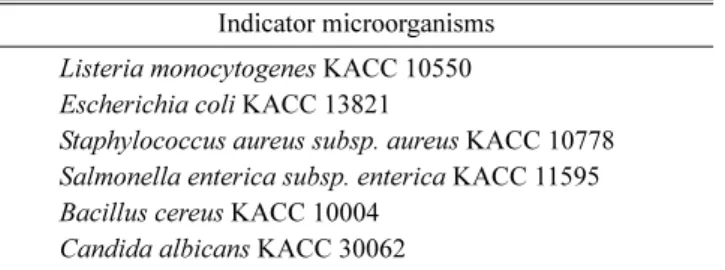
항균활성 측정에 사용한 표준 미생물은 농촌진흥청 한국 농업미생물보존센터(Korean Agricultural Culture Collection) 에서 분양받아 사용하였으며(Table 1), Candida albicans는 YM broth에서 25oC로 24시간 배양하였고 이를 제외한 병 원성 세균은 nutrient broth를 사용하여 37oC에서 24시간 배 양하여 사용하였다. 항균활성 측정은 nutrient agar에 배양된 표준 미생물 100 µL를 도말평판법으로 접종한 후, 지름 5
mm 구멍을 뚫은 후, 배양액 5 µL를 접종하여 배양하였다.
분리균주의 16S rRNA 유전자 염기서열 분석
16S rRNA 유전자 염기서열 분석은 Universal PCR primer 27F(5'-AGAGTTTGATCCTGGCTCAG-3')와 1492R (5'-GGTTACCTTGTTACGACTT-3')로 합성하여 분리균의 16S rRNA 유전자 단편을 PCR로 증폭시켰다. PCR산물의 염기서열은 Solutions for Generic Technologies (Solgent)사 에 의뢰하여 염기서열을 분석하였다. Phylogenetic tree 작성 은 Lasergene사의 DNASTAR pro software (SeqMan Pro) 와 The National Center for Biotechnology Information(NCBI, http://www.ncbi.nlm.nih.gov/)에서 제공하는 Advanced Blast Search 프로그램을 통하여 GenBank에 보고 된 유사 균주와 의 염기서열을 비교하여 계통분류학적 유연관계를 분석한 후, MEGA v4.0을 이용하여 Tamura-Nei distance model 과 neighbor-joining method에 의해 계통도를 만들었다.
결과 및 고찰 세포외효소 분비능이 우수한 균주 선발
전통 장류인 된장이나 간장은 발효과정에서 미생물의 다 양한 효소(amylase, protease, cellulase 및 lipase)에 의해 콩 에 함유된 단백질, 올리고다당류, 이소플라본, 지질 등이 소 화되기 쉬운 형태의 아미노산, 유리당, 이소플라본 아글리콘, 지방산 등으로 분해되어 항산화 및 혈전용해 기능을 갖는 2 차산물이 생성된다[20, 21, 24]. 된장과 간장 시료로부터 표 준희석법을 이용하여 200여종의 균주를 선발하고 세포외효 소 분비능이 우수한 13종을 선발하였다. 장류의 구수한 맛 은 주로 단백질이 분해된 아미노산에서 유래한다. 특히, glutamate의 함량에 따라 구수한 맛이 증가하며 체내에 흡수 되기 쉬운 형태로 바뀌는 것으로 보고되어 있다[8]. Protease 분비능은 D2-14균주를 제외한 모든 선발균주에서 활성이 나 타났다(Table 2). Cellulose는 미생물에 의해 분해되어 이용 된다. 곰팡이 및 세균 등에 의하여 분비되는 cellulase 성분 으로는 endo-1,4-β-D-glucanase, exo-1,4-β-glucanase, β- glucosidase가 있으며, 콩 발효과정에서는 β-glucosidase에 의 하여 isoflavones 배당체가 aglycon으로 전환되어 항산화 등 의 기능을 나타내는 것으로 알려져 있다[20]. Amylase는 발 Fibrinolytic activity (%) Area of sample
Area of plasmin ---
⎝ ⎠
⎛ ⎞ 100×
=
Table 1. The list of pathogenic bacteria used in this study.
Indicator microorganisms Listeria monocytogenes KACC 10550 Escherichia coli KACC 13821
Staphylococcus aureus subsp. aureus KACC 10778 Salmonella enterica subsp. enterica KACC 11595 Bacillus cereus KACC 10004
Candida albicans KACC 30062
효 시 당화작용으로 전분질에서 저분자 당류로 가수분해되 어 장류의 단맛 형성에 기여한다[8]. 선발균주의 cellulase와 amylase 분비능은 모든 선발균주에서 표준균주인 Bacillus subtilis KACC 10114보다 높게 나타났다. 각종 장류 발효에 서 생산되는 lipase는 유도효소로 보고되어 있다[8]. 특히 콩 에 함유된 약 20% 정도의 지방은 된장 발효과정에서 미생 물이 분비하는 lipase에 의해 다양한 지방산을 생성한다[18].
본 연구에서 K4-1과 D8-8을 제외한 선발균주에서는 다른 효소보다 lipase 활성은 낮았다(Table 2).
혈전용해 활성
세포외효소 분비능이 우수한 13종의 균주로부터 혈전용해 활성을 측정하기 위하여 R2A broth에서 24시간 배양하여 fibrin plate에서 혈전용해 활성을 측정하였다. Fig. 1은 fibrin
plate에서 혈전용해효소에 의한 clear zone 생성 유무를 나타 내고, Table 3은 혈전용해 활성을 보여준다. 선발 균주 중 D8-2와 선택균주 Bacillus subtilis KACC 10114는 혈전용해 활성이 없었으나 나머지 선발 균주에서는 혈전용해 활성이 나타났다. K4-1과 D8-8이 64.2%, D2-7이 57.8%로 혈전용 해 활성이 높게 나타났으며, 나머지 선발 균주에서도 30~
40% 이상의 활성이 있었다. 한편, Bacillus 속 미생물들은 일반적으로 extracellular protease를 생산하는 것으로 알려져 있고, protease에 의해 fibrin으로 분해되는데[11], 1% skim milk를 첨가한 배지에서 protease 활성이 없는 D2-14가 fibrin plate에서 fibrin 분해 활성이 나타났다. 특히, D2-14 균주는 단백질 분해활성에 비하여 fibrin 분해활성이 높아 다 른 선발균주보다 혈전용해 활성이 높을 것으로 생각된다. 일 본의 대표적인 콩 발효식품인 낫토에서 유래한 nattokinase 을 경구투여로 생체내 혈전 용해능을 높일 수 있다는 보고 도 있어[7, 22] 심혈관 질환 예방 및 치료를 위한 건강 기능 성 식품으로 각광 받고 있다. 우리나라의 콩 발효식품인 된 장과 청국장에서도 이들 효소에 대한 연구가 활발하게 이루 어지고 있다[14, 18]. 따라서 향후, 전통 장류에서 분리한 혈 전용해효소 분비 균주로부터 효소 특성에 대한 연구가 더 진 Table 2. Activities of extracellular enzymes from strains isolated
from Korean traditional soybean sauce and soybean paste.
Strains Formation of clear zone
Amylase Cellulase Lipase Protease
D2-7 +++ ++ + ++
D2-14 +++ +++ + -
D3-14 +++ +++ + ++
D8-2 ++ +++ + +++
D8-8 +++ +++ - ++
K2-2 +++ ++ + +
K3-2 +++ +++ + ++
K4-1 +++ +++ - +++
K11-1-4 +++ +++ + +
K11-1-6 ++ +++ + +
K11-7 +++ +++ + ++
K12-3 ++ +++ + +++
K14-9 +++ +++ + ++
KACC10114 + - - -
symbols : −; not shown, +; less than 0.10 mm, ++; 0.11~0.30 mm, +++; more than 0.31 mm.
Fig. 1. Fibrinolytic activities of the strains isolated from Korean traditional soybean sauce and soybean paste. Symbols : 1;
KACC10114, 2; D8-8, 3; D8-2, 4; D3-14, 5; D2-7, 6; D2-14, 7; K12-3, 8; K14-9, 9; K11-7, 10; K11-1-4, 11; K11-1-6, 12; K2-2, 13; K4-1, 14; K3-2.
Table 3. Fibrinolytic activities of the culture supernatants from the strains isolated from Korean traditional soybean sauce and soybean paste.
Strains Fibrinolytic
activity (Unit: %) Strains Fibrinolytic activiy (Unit: %)
D2-7 57.77±0.00 K4-1 64.19±5.56
D2-14 38.51±0.00 K11-1-4 28.89±0.00
D3-14 32.09±5.56 K11-1-6 38.51±0.00
D8-2 - K11-7 38.51±0.00
D8-8 64.19±5.56 K12-3 48.14±0.00
K2-2 32.09±5.56 K14-9 41.72±11.12
K3-2 38.51±0.00 KACC10114 -
symbols : -; not shown.
행되어야 할 것이다. 또한 삼투압 등의 배양조건 변화[12]와 첨가된 질소원, 탄소원 등의 종류에 따른 혈전용해 활성이 증가되는 보고[16, 21]도 있어 추후의 연구를 통하여 혈전용 해 활성을 증가시키는 것이 가능할 것으로 판단됨에 따라 선 발균주의 혈전용해 활성을 최적화하기 위한 배양조건 확립 과 혈전용해효소의 특성을 규명하기 위한 연구를 진행할 것 이다.
항균활성
세포외효소 분비능이 우수 균주의 항균활성 결과를 Table
4에 나타내었다. 된장 및 간장에서 분리한 균주 중에서 K3- 2, K4-1, K11-1-4, K11-1-6, K11-7, K12-3 와 K14-9 균주 에서 그람양성세균인 B. cereus, Listeria monocytogenes, Staphylococcus aureus와 그람음성세균인 E. coli와 Sal- monella enterica, Candida albicans에서 높은 항균활성을 보였다(Fig. 2). 이는 Mah 등[16]의 김치로부터 분리한 B.
subtilis-430 항균활성 연구결과와 유사한 결과이다. 이상의 결과에서 K3-2, K4-1, K11-1-4, K11-1-6, K11-7, K12-3 와 K14-9 균주가 분비하는 항균물질은 항균 스펙트럼이 광 범위하여, 간장 및 된장 숙성에 관여하는 발효미생물 상의 조절능력을 가지며, L. monocytogenes와 같은 저온성 병원 미생물의 성장 억제에도 효과적일 것으로 예상된다. 따라서 단백질 및 전분분해력이 뛰어나고 항균물질 생산성이 높은 균주를 선발하여 발효에 이용하면 생리활성이나 저장성이 증진된 기능성 장류의 개발이 가능할 것으로 여겨진다.
분리 균주의 속 동정
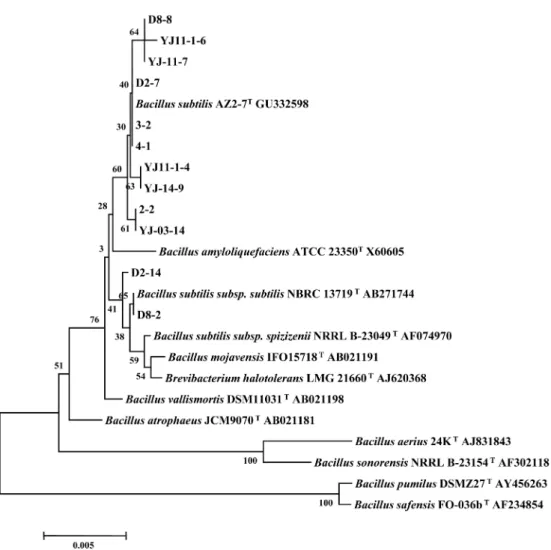
장류 시료에서 세포외효소 분비능이 우수한 균주를 선발 하여 16S rRNA 유전자 염기서열을 분석한 결과, 거의 Bacillus sp.로 나타났다. 분리된 균주들의 계통학적 유연관 계는 16S rRNA 유전자의 염기서열을 기초로 Bacillus 속의 표준 종들과의 similarity를 조사한 결과, 선발된 균주 대부 분이 서로 유사하였고 D2-7, D8-8, K3-2, K4-1, K11-1-6와 K11-7은 B. subtilis로 D3-14, K2-2, K11-1-4와 K14-9는 B. amyloliquefaciens에 속하였다(Fig. 3).
본 연구결과, 전통장류의 발효과정에 Bacillus sp. 미생물 이 주로 관여하였다. Bacillus sp.에 속하는 B. subtilis, B.
amyloliquefaciens의 정확한 종 동정이 필요한 것으로 사료 된다. 특히, 발효과정에서 세포외 효소분비능과 생리활성이 우수한 미생물을 분리, 확보함으로써 장류의 고급화, 다양화 등 품질 향상과 제조공정의 표준화가 가능할 것으로 여겨진 다. 또한 D8-8, K4-1 균주는 fibrinolytic enzyme의 분비가 강하므로 활용할 가치가 있을 것으로 추정된다.
Table 4. Antibacterial activities from strains isolated from Korean traditional soybean sauce and soybean paste.
Strains Clear zone
B C E L Sa St
D2-7 - ++ + ++ +++ -
D2-14 - + - - - -
D3-14 - +++ - - - -
D8-2 - +++ - - + -
D8-8 - ++ + - ++ -
K2-2 + +++ + - - -
K3-2 + +++ +++ + ++ +
K4-1 + ++ +++ + + +
K11-1-4 ++ ++ ++ +++ +++ +++
K11-1-6 + ++ +++ ++ +++ +
K11-7 + +++ +++ ++ +++ ++
K12-3 + +++ ++ + +++ +
K14-9 +++ ++ ++ + +++ +
KACC10114 +++ - - + - +
symbols : -; not shown, +; less than 0.10 mm, ++; 0.11~0.30 mm, +++; more than 0.31 mm, B; Bacillus cereus KACC 10004, C; Can- dida albicans KACC 30062, E; Escherichia coli KACC 13821, L;
Listeria monocytogenes KACC 10550, Sa; Salmonella enterica subsp. enterica KACC 11595, St; Staphylococcus aureus subsp.
aureus KACC 10778.
Fig. 2. Antibacterial activities about candida albicans of the strains isolated from Korean traditional soybean sauce and soybean paste. Symbols : 1; KACC10114, 2; D8-8, 3; D8-2, 4; D3-14, 5; D2-7, 6; D2-14, 7; K12-3, 8; K14-9, 9; K11-7, 10; K11-1-4, 11; K11-1-6, 12; K2-2, 13; K4-1, 14; K3-2.
요 약
수집한 전통 장류에서 세포외효소(amylase, protease, cellulase, lipase and fibrinolytic enzyme) 분비능이 우수한 미생물을 분리한 후, 16S rRNA 유전자분석과 생리활성 특 성을 조사하였다. amylase와 cellulase 분비능은 모든 선발균 주에서 표준균주인 Bacillus subtilis KACC 10114보다 높게 나타났다. Protease 분비능은 D2-14균주를 제외한 모든 선 발균주에서 활성이 있었으며, lipase 분비능은 D8-8과 K4-1 을 제외한 균주에서 활성이 나타났다. 혈전용해 활성은 D8- 2를 제외한 모든 선발균주에서 활성이 나타났으며, D8-8과 K4-1이 가장 높은 활성을 나타냈다. 선발균주인 K3-2, K4- 1, K11-1-4, K11-1-6, K11-7, K12-3 와K14-9은 그람 양성 세균과 그람 음성세균 그리고 효모에서도 높은 항균활성을 나타내었다. 간장 및 된장에서 분리한 균주들을 동정하기 위 해 분자수준에서 16S rRNA 유전자 염기서열을 분석한 결 과, 거의 Bacillius sp.로 나타났다. 발효과정에서 세포외효소 분비능과 생리활성이 우수한 미생물을 분리, 확보함으로써
전통 장류의 고급화 및 품질향상과 제조공정의 표준화가 가 능할 것으로 여겨진다.
감사의 글
본 연구는 농촌진흥청 국가연구개발사업(과제번호 : PJ006763)의 지원에 의해 이루어진 결과의 일부로서 이에 감사드립니다.
REFERENCES
1. Ahn, Y. S., Y. S. Kim, and D. H. Shin. (2006) Isolation, identification and fermentation characteristics os Bacillus sp.
with high protease activity from traditional cheonggukjang.
Kor. J. Food Sci. Technol. 38: 82-87.
2. Astrup, T. and Mullertz. (1952) The fibrin plate method for estimating fibrinolytic activity. Archives Biochem. Biophysics.
40: 346-351.
3. Bernard, F. G., Z. Alexandre, M. Robert, and M. Catherine.
Fig. 3. Phylogenetic tree based on 16S rRNA sequences showing the positions of the strains producing extracellular enzymes iso- lated from Korean traditional soybean sauce and soybean paste.
(2004) Production and characterization of bioactive peptides from soy hydrolysate and soy-fermented food. Food Res.
International. 37: 123-131.
4. Cho, D. H. and W. H. Lee. (1970) Microbiological studies of Korean native soy sauce fermentation (I). J. Kor. Agric.
Chem Soc. 13: 35-38.
5. Cho, D. H. and W. H. Lee. (1971) Microbiological studies of Korean native soy sauce fermentation (II). J. Kor. Agric.
Chem Soc. 14: 137-141.
6. Deepak, V., K. Kalishwaralal, S. Ramkumarpandian, B. S.
Venkatesh, and S. R. Senthilkumar. (2008) Optimization of media composition for nattokinase production by Bacillus subtilis using response surface methodology. Bioresource Technol. 99: 8170-8174.
7. Fujita, M., K. Hong, Y. Ito, R. Fujii, K. Kariya, and S.
Nishimuro. (1995) Thrombolytic effect of nattokinase on a chemically induced thrombosis model in rat. Biol. Pharm.
Bulletin. 18: 1387-1391.
8. Ham, S. N., S. W. Kim, J. H. Lee, and P. S. Chang. (2008) Changes in enzymatic activities during Eoyukjang fermenta- tion. Kor. J. Food Sci. Technol. 40: 251-256.
9. Kim, S. B., D. W. Lee, C. I. Cheigh, E. A. Cheo, S. J. Lee, YT. H. Hong, H. J. Choi, and Y. R. Pyun. (2006) Purifica- tion and characterization of a fibrinolytic subtilisin-like protease of Bacillus subtilis TP-6 from an Indonesian fer- mented soybean, Tempeh. J. Ind. Microbiol. Biotechnol. 33:
436-444.
10. Kim, S. H. (1998) New trends of studying on potential activities of doen-jang. Korea Soybean Digest. 15: 8-15.
11. Kim, S. J., J. H. Yoon, M. S. Lee, and H. B. Kim. (1997) Isolation and characterization of Bacillus cereus secreting proteases from Korean soybean paste. Kor. J. Microbiol. 33:
136-141.
12. Kim, Y. T., W. K. Kim, and H. I. Oh (1995) Screening and identification of the fibrinolytic bacterial strain from Chungkook-jang. Kor. J. Appl. Microbial. Biotechnol. 23: 1- 5.
13. Kwon, H. Y., H. Y. Ryu, C. S. Kwon, S. H. Lee, and H. Y.
Sohn. (2007) Optimization of culture conditions of Bacillus pumilus JB-1 for Chungkookjang fermentation in soybean boiling-waste liquor medium. Kor. J. Microbiol Biotechnol.
35: 304-309.
14. Lee, D. G., N. Y. Kim, M. K. Jang, B. H. Yoo, K. Y. Kim, S.
G. Kim, Y. K. Jeong, and S. H. Lee. (2006) Isolation of a fibrinolytic bacterium from cheongkukjang and characteriza-
tion of its bioactivity. Kor. J. Microbiol. Biotechnol. 34: 299- 305.
15. Lee, Y. N., M. j. Sin, and B. N. Kim. (1991) A study on the present state of traditional food. Kor. J. Dietary. Culture. 6:
71-81.
16. Mah, J. H., K. S. Kim, J. H. Park, M. W. Byun, Y. B. Kim, and H. J. Hwang. (2001) Bacteriocin with a broad antimicro- bial spectirum, produced by Bacillus sp. isolated from Kimchi. Kor. J. Microbiol. Biotechnol. 11: 577-584.
17. Oh, J. h., B. J. Lee, H. R. Paik, S. C. Jung, K. S. Baik, and S. K. Choi. (2009) Isolation of bacteria from chunggukjang prepared by rice straw and identification of protease secreted. J. Life Science. 19: 397-402.
18. Oh, Y. S., J. E. Park, H. J. Oh, J. H. Kim, M. C. Oh, C. K.
Oh, Y. J. Oh, and S. B. Lim. (2010) Isolation and character- istics of microorganisms producing extracellular enzymes from jeju traditional fermented soybean paste (Doenjang). J.
Kor. Soc. Food Sci. Nutr. 39: 47-53.
19. Phromraksa, p., h. Nagano, T. Boonmars, and C. Kam- boonruang. (2008) Identification of proteolytic bacteria from Thai traditional fermented foods and their allergenic reducing potentials. J. Food. Sci. 73: 189-195.
20. Ra, K. S., S. H. Oh, J. M. Kim, and H. J. Suh. (2004) Isolation of fibrinolytic enzyme and β-glucosidase producing strains from Doenjang and optimum conditions of enzyme production. J. Kor. Soc. Food Sci. Nutr. 33: 439-442.
21. Ryu, B. H. (2003) Development of functional Doenjang for antioxidative and fibrinolytic activity. Kor. J. Life Sci. 13:
559-568.
22. Sumi, H., H. Hamada, K. Nakanishi, and H. hiratani. (1990) Enhancement of the fibrinolytic activity in plasma by oral administration of nattokinase. Acta haematologica. 84: 139- 143.
23. Yang, S. H., M. R. Choi, J. K. Kim, and Y. G. Chung. (1992) Characteristics of the taste in traditional Korean soybean paste. J. Kor. Soc. Food. Nutr. 21: 443-448.
24. Yoo, S. K., W. H. Cho, S. M. Kang, and S. H. Lee. (1999) Isolation and identification of microorganisms in korean traditional soybean paste and soybean sauce. Kor. J. Appl.
Microbiol. Biotechnol., 27: 113-117.
25. Yoshinori, M., H. K. W. Ada, and J. Bo. (2005) Fibrinolytic enzymes in asian traditional fermented foods. Food Re- search International. 38: 243-250.
(Received Oct. 11, 2010/Accepted Nov. 22, 2010)