Introduction
Autism spectrum disorders (ASDs) are characterized by impaired development of social interactions, communication difficulties, repetitive patterns of movements and behaviors
that include restricted interests and activities.
1)Recent esti- mates of the prevalence of ASDs are in the range of 6.5–6.6 per 1000 individuals, with a male to female ratio of 4:1.
2,3)The primary treatments for ASDs, including educational in- terventions, behavioral strategies, and social skills instruc- tion, are used to relieve the core features of ASDs. Despite positive results, several limitations and feasibility issues re- main when considering the cost, amount of time required, and practitioner availability required for behavior interven- tions. Although pharmacotherapy has not been proven to cor- rect the core deficits, it has been used in patients with ASDs.
4)Behavioral problems, such as aggression, impulsivity, self- injurious behavior, irritability and hyperactivity, are common
Risperidone Monotherapy in Children and Adolescents with Autism Spectrum Disorders : A Naturalistic Study
Eun-Kyung Won, M.D. 1) *, Jin-Park Park, M.D. 2) *, Young-Ryul Lee, M.D. 3) , Yoon-Young Nam, M.D., Ph.D. 2) , He-Ji Min, M.D. 4) , and Yeni Kim, M.D., Ph.D. 1)
1)
Department of Child Psychiatry, Center for Child and Adolescent Psychiatry, Seoul National Hospital, Seoul, Korea
2)
Division of Planning and Public Relations, Seoul National Hospital, Seoul, Korea
3)
Center for Child and Adolescent Psychiatry, Seoul National Hospital, Seoul, Korea
4)
Department of Adolescent Psychiatry, Center for Child and Adolescent Psychiatry, Seoul National Hospital, Seoul, Korea
Objectives:We retrospectively investigated the efficacy and tolerability of risperidone monotherapy in subjects with au- tism spectrum disorder (ASD). In addition, we did mixed effect model analysis of the effects of risperidone in patients with ASDs naturalistically treated in a routine clinical setting to determine whether the clinical effects were maintained and the side effects were tolerable.
Methods:This retrospective study assessed children and adolescents with ASD, who were on risperidone monotherapy from July 2010 to July 2011 at the Child and Adolescent ASD Clinic at Seoul National Hospital. Outcome measures included the Clinical Global Impression-Severity of Illness (CGI-S) and the CGI-Improvement (CGI-I) scales along with other clinical indi- ces: dosage, target symptoms, and side effects.
Results:The mean dose of risperidone in 47 children and adolescents with ASD (40 males, 7 females; age range 5–19 years) who were on risperidone monotherapy was 1.6±0.8 mg/day, and the mean duration of the treatment period was 20.2±17.3 months.
Aggressive behavior, stereotypic behavior, irritability, and self-injurious behavior were the most frequent target symptoms of ris- peridone. The most common side effects were weight gain followed by somnolence and extrapyramidal symptoms. In a mixed ef- fects model analysis of CGI-I scores, the mean CGI-I score at the 1 month follow-up was significantly different from the mean CGI-I score of the 3-month follow-up (p=.046), and the CGI-I scores were equally maintained over 3 to 48 months [F(6, 28.9)=4.393, p=.003]. Of the 47 patients, 33 patients (70.2%) were identified as the response group, showing an end point CGI-I rating of 3 or under and having continued risperidone treatment for at least 6 months. The baseline CGI-S score showed significant association with clinical response to risperidone (p=.005), the mean baseline CGI-S was higher in the response group compared to the non-response group.
Conclusion:In this study, clinical improvement of risperidone stabilized around 3 months and was equally maintained up to 48 months with tolerable side effects, supporting maintenance of risperidone treatment in children and adolescents with ASDs.
KEY WORDS :A dolescents ㆍ Auti sm Spectrum DisorderㆍChildrenㆍClinical Global ImpressionㆍMaintenanceㆍRisperid one .
Date received : August 26, 2015 Date of revision : October 19, 2015 Date accepted : October 21, 2015
Address for correspondence : Yeni Kim, M.D., Ph.D., Department of Child Psychiatry, Center for Child and Adolescent Psychiatry, Seoul National Hos- pital, 398 Neungdong-ro, Gwangjin-gu, Seoul 04933, Korea
Tel : +82.2-2204-0301, Fax : +82.2-2204-0355 E-mail : [email protected]
*Both authors contributed equally to the manuscript.
in individuals with ASDs and are associated with caregiver stress.
The appropriate use of medications in patients with ASDs can improve some maladaptive behaviors and increase pa- tients’ abilities to benefit from psychosocial interventions.
4)The pharmacological approach is primarily aimed at reduc- ing problematic behaviors, such as aggression, self-injurious behavior, stereotypic behavior, and tantrums.
5)Low dose an- tipsychotics have been shown to reduce repetitive behaviors and social withdrawal as well as a number of related symp- toms, such as hyperactivity, aggression, self-injurious behav- ior, labile mood and irritability.
6)In October 2006, the Food and Drug Administration approved risperidone for the treat- ment of maladaptive behaviors in autistic children and ado- lescents.
6)Risperidone is the most extensively studied antipsy- chotic for use in children with ASDs. Most studies were con- ducted on children and adolescents with maladaptive behaviors.
7)In many studies, the efficacy and safety of risperidone tr- eatment has been evaluated. These previous studies showed that risperidone was superior to a placebo in controlling be- havioral disturbances in more than half of the participants.
8,9)Risperidone has also been associated with adjuvant agents with the aim of treating maladaptive behaviors in autism.
10)Pharmacotherapy with a low dose of risperidone in addition to parental training resulted in a greater reduction in mal- adaptive behaviors.
11)Although there is increased use of anti- psychotics in child and adolescent group, the randomized con- trolled trials on the long-term efficacy of antipsychotics on these populations are inherently difficult due to ethical, logis- tical, economical and epidemiological reasons. The efficacy of risperidone in ASDs has been reported in long-term stud- ies,
9,12,13)which divided outcomes into short-term (less than three months) and long term (over three months). But there were several limitations in these studies. The data collection period was a maximum of 8 months and the study group was comparatively small.
In this study, we retrospectively investigated the clinical improvement with risperidone in patients with ASDs natu- ralistically treated in a routine clinical setting using mixed- effect analysis to determine whether the clinical improve- ment were maintained and the side effects tolerable.
Methods
1. Subjects
This retrospective study assessed children and adolescents with ASD, who were on risperidone monotherapy from July 2010 to July 2011 in the Child and Adolescent ASD Clinic
at Seoul National Hospital. Patients with ages ranging from 5 to 19 years old were included, and total follow-up periods ranged from 1 month to 48 months. All participants were di- agnosed with autistic disorder, pervasive developmental dis- order not otherwise specified (PDD NOS), or Asperger’s dis- order according to the criteria in the Diagnostic and Statistical Manual of Mental Disorders, Fourth Edition, Text Revised.
1)Diagnoses were based on a clinical interview of the parent and the child by a child and adolescent psychiatrist. The di- agnosis was confirmed by another psychiatrist through re- view of psychiatric records. The clinical variables including medication history, intelligence quotient (IQ), Social Maturi- ty Scale (SMS) and Childhood Autism Rating Scale (CARS)
14)scores, were obtained from medical records. The study proto- col was approved by the Institutional Review Board at Seoul National Hospital (IRB No. 2011-7).
2. Measurements
Previously, it was shown that the Clinical Global Impres- sion (CGI) scale has good psychometric properties for chil- dren and adolescents
15)and it is one of the most economic tools in assessing clinical change in autism.
16)Most clinical drug trials in children with autism have used clinician report of improvement based on the CGI scale.
17)We also utilized CGI to evaluate global symptom severity and symptom im- provement.
Changes in illness severity were measured using the Clini- cal Global Impression-Severity of Illness (CGI-S) scale (1=
normal, not at all ill; 2=borderline ill; 3=mildly ill; 4=moder- ately ill; 5=markedly ill; 6=severely ill; and 7=among the most extremely ill). CGI-Improvement (CGI-I) scales were used to evaluate target symptom improvement at 1 month, 3 months, 6 months, 12 months, 24 months, 36 months, and 48 months of risperidone treatment (1=very much improved;
2=much improved; 3=minimally improved; 4=no change;
5=minimally worse; 6= much worse; and 7=very much worse).
A psychiatrist (Jin-Park Park) conducted the rating of CGIs on all subjects.
The response group was defined by CGI-I scores and tr- eatment duration based on outcome measures used in previ- ous studies.
18)The responders were defined by an end point CGI-I rating of 3 or under, and treatment continuation for at least 6 months.
3. Statistical analysis
Descriptive analyses were used as appropriate. Indepen-
dent-sample t-tests and chi-square tests were used to compare
demographic and clinical characteristics between response
and non-response groups. Fisher exact test was used for non- parametric data. A mixed-effects model of repeated measu- rement was used to compare changes of mean CGI-I scores according to follow-up intervals. We considered p<.05 to be statistically significant. All statistical analyses were perform- ed using SPSS version 18.0 (SPSS Inc., Chicago, IL, USA).
Results
1. Clinical characteristics of participants
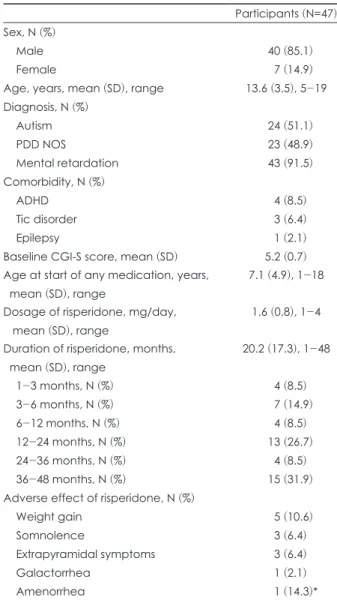
Forty seven patients (40 male; 13.6±3.5 years) were includ- ed in the analysis; the patients ranged in age from 5 to 19 years old. The dosage of risperidone ranged from 1–4 mg/
day (1.6±0.8 mg/day). The mean duration of the risperidone treatment period was 20.2±17.3 months. Forty three (91.5%) patients had IQ of blow 70, and the mean IQ of the subjects was 37.7±11.7. The mean SMS was 34.3±19.7, and the mean CARS was 33.9±7.0. Twenty four patients (51.1%) were diag- nosed with autistic disorder, 23 patients (48.9%) were diag- nosed with PDD NOS. Aggressive behavior, irritability, im- pulsivity, and stereotypic behavior were most frequent target symptoms of risperidone. The most common adverse effect of risperidone was weight gain (10.6%) followed by somno- lence (6.4%) (Table 1).
2. Clinical improvement of risperidone
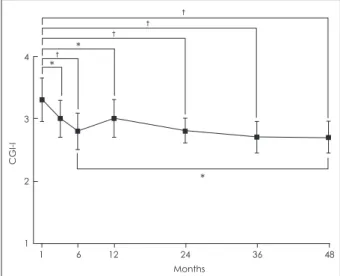
In assessing the clinical efficacy of risperidone in 47 chil- dren and adolescents with ASD, the mean CGI-I score at the 1-month follow-up was significantly different from the 3- month follow-up (p=.046), 6-month follow-up (p=.001), 12- month follow-up (p=.015), 24-month follow-up (p<.001), 36- month follow-up (p<.001), and the 48-month follow-up (p=
.003) scores. The mean CGI-I score at the 3-month follow-up was significantly different from the 36-month follow-up (p<
.039) score (Fig. 1).
Of the 47 subjects, 33 children (70.2%) were identified as the responders to risperidone, showing an end point CGI-I rating of 3 or under, and having continued treatment for at least 6 months. When we explored the moderators of risperi- done response, we found that subjects in the response and non-response groups had comparable demographics and clin- ical characteristics, e.g., sex, the age at start of medication, target symptom, level of mental retardation, mean CARS score, mean SMS score and dosage of risperidone (Table 2).
However, the baseline CGI-S score was significantly associ- ated with clinical response to risperidone (p=.005). There was no significant difference between the percentage of pa- tients reporting side effects in both response and non-re-
sponse groups.
Discussion
In this study, we observed the clinical improvement of ris- peridone monotherapy in 47 children and adolescents with ASD (40 males, 7 females; age range 5–19 years). We found that the mean CGI-I score at 3 months was significantly dif- ferent compared to the 1 month follow up, and the CGI-I sc- ore was equally maintained over 3 to 48 months, supporting the long-term use of risperidone beyond 6 months. Moreover, the mean duration of the treatment period for total subjects was 20 months and for response group was 27 months. Our
Table 1. Clinical characteristics of children and adolescents treated with risperidone
Participants (N=47) Sex, N (%)
Male 40 (85.1)
Female 7 (14.9)
Age, years, mean (SD), range 13.6 (3.5), 5-19 Diagnosis, N (%)
Autism 24 (51.1)
PDD NOS 23 (48.9)
Mental retardation 43 (91.5)
Comorbidity, N (%)
ADHD 4 (8.5)
Tic disorder 3 (6.4)
Epilepsy 1 (2.1)
Baseline CGI-S score, mean (SD) 5.2 (0.7) Age at start of any medication, years,
mean (SD), range
7.1 (4.9), 1-18
Dosage of risperidone, mg/day, mean (SD), range
1.6 (0.8), 1-4
Duration of risperidone, months, mean (SD), range
20.2 (17.3), 1-48
1-3 months, N (%) 4 (8.5)
3-6 months, N (%) 7 (14.9)
6-12 months, N (%) 4 (8.5)
12-24 months, N (%) 13 (26.7)
24-36 months, N (%) 4 (8.5)
36-48 months, N (%) 15 (31.9)
Adverse effect of risperidone, N (%)
Weight gain 5 (10.6)
Somnolence 3 (6.4)
Extrapyramidal symptoms 3 (6.4)
Galactorrhea 1 (2.1)
Amenorrhea 1 (14.3)*
* : amenorrhea was observed in one subject out of seven fe-
male subjects resulting in 14.3%. CGI-S : Clinical Global Impres-
sion-Severity, PDD NOS : pervasive developmental disorder not
otherwise specified, SD : standard deviation, ADHD : attention-
deficit hyperactivity disorder
findings suggest that the continued use of risperidone brings about significant improvement in the disruptive behavioral symptoms of ASDs and that the clinical improvement after risperidone stabilizes around 3 months and is maintained till 48 months supporting the long-term use of risperidone be-
yond 6 months. In a similar note, a previous multisite study of risperidone in children aged 5 to 17 years, the discontinu- ation after 6 months was associated with a rapid return of disruptive behavior in most subjects.
13)Our exploration of moderators of risperidone response in children with ASDs showed that the baseline CGI-S score was significantly associated with clinical response to risperi- done (p=.005) and that the mean baseline CGI-S being higher in the response group compared to the non-response group.
These results are similar to previous findings, which showed that a high score in the initial Aberrant Behavior Checklist Irritability subscale was a significant moderator of response rate for risperidone.
19)In this study, 33 out of 47 patients (70.2%) were identified as the response group, showing end point CGI-I rating of 3 or under and having continued risperidone treatment for at least 6 months. The 70.2% response rate of risperidone in this study, was similar to previous clinical trials of risperidone in children and adolescents with autism which reported 64–
69% response rate to risperidone in ASDs.
9,17)A multisite, double-blind, placebo-controlled trials in children and ado- lescents with autism revealed a 69% response rate with a 57%
decrease in irritability as measured by the Aberrant Behav- ior Checklist (ABC) irritability subscale.
20)In another ran- domized study of 79 children with PDD, risperidone-treated subjects exhibited a 64% improvement in irritability as mea- sured by the ABC irritability subscale.
9)Table 2. Clinical characteristics of the responders and non-responders according to CGI-I scores
Response (N=33) Non-response (N=14) p*
Gender, N (%) .658
Male 28 (84.8) 12 (85.7)
Female 5 (15.2) 2 (14.3)
Age, years, mean (SD) 13.2 (3.7) 14.7 (2.7) .115
Target symptom, N (%) .616
Aggression 12 (36.4) 4 (28.6)
Irritability 9 (27.3) 2 (14.3)
Impulsivity 6 (18.2) 4 (28.6)
Stereotypies 6 (18.2) 4 (28.6)
Level of mental retardation, N (%) .658
Mild to moderate 3 (9.1) 1 (7.1)
Severe to profound 30 (90.9) 13 (92.9)
SMS, mean (SD) 34.0 (19.1) 35.1 (22.7) .909
CARS, mean (SD) 33.2 (5.1) 35.8 (10.6) .519
Baseline CGI-S, mean (SD) 5.0 (0.7) 5.6 (0.5) .005
Dosage of risperidone, mg/day, mean (SD) 1.7 (0.9) 1.5 (0.6) .316
Duration of risperidone, months, mean (SD) 27.1 (16.1) 3.9 (3.7) <.001
Side effects, N (%) 9 (27.3) 4 (28.6) .596
* : comparisons were performed using t-tests and the Fisher exact test. CARS : Childhood Autism Rating Scale, CGI-I : Clinical Glob- al Impression-Improvement, CGI-S : Clinical Global Impression-Severity, SD : standard deviation, SMS : Social Maturity Scale Fig. 1. The clinical improvement of the patients on risperidone
stabilizes at 3 months follow-up and is maintained up to 48 month follow-up. The mean CGI-I score at the 1 month follow- up was significantly different from the mean CGI-I scores of the 3 month follow-up (p=.046), 6 month follow-up (p=.001), 12 month follow-up (p=.015), 24 month follow-up (p<.001), 36 month follow-up (p<.001), and the 48 month follow-up [F(6, 28.9)=4.393, p=.003]. The mean CGI-I score at the 3 month fol- low-up was significantly different from those of the 36 month fol- low-up (p=.039). * : p<.05,
†: p<.005. CGI-I : Global Impression- Severity-Improvement
4
3
2
1
1 6 12 24 36 48 Months
CGI-I
*
*
†
*
†
†
†