Association between Serum Fibroblast Growth Factor 21 and Coronary Artery Disease in Patients with Type 2 Diabetes
The aim of this study was to evaluate the association of plasma fibroblast growth factor (FGF)-21 with angiographically significant coronary artery disease (CAD) in patients with type 2 diabetes mellitus. Serum FGF-21 was measured in 120 patients undergoing coronary angiography. Patients were divided into 4 groups based on the presence/absence of type 2 diabetes mellitus and of significant CAD. The atherosclerotic burden was obtained by two angiographic scores: Gensini score (GS) and Extent score (ES). FGF-21 levels were higher in type 2 diabetes mellitus than in non-diabetic patients (P = 0.014). FGF-21 levels were significantly correlated with GS (r = 0.358, P < 0.001) and ES (r = 0.324, P < 0.001) in univariate analysis with all patients. After adjusting for several confounding factors, both GS and ES were associated with FGF-21 in all patients (r = 0.271, P = 0.014; r = 0.217, P = 0.041, respectively). However, FGF-21 lost significant correlation with both GS and ES with type 2 diabetes mellitus in the final model. The patients with type 2 diabetes mellitus and CAD feature had elevated FGF-21 levels. Despite of a limited role in diabetic patients, FGF-21 levels are independently associated with angiographic severity and extent of CAD.
Keywords: Fibroblast Growth Factor-21; Diabetes Mellitus, Type 2; Coronary Artery Disease Won Jin Kim,1,2* Sang Soo Kim,1,2*
Han Cheol Lee,1 Sang Heon Song,1 Min Jung Bae,3 Yang Seon Yi,4 Yun Kyung Jeon,1,2 Bo Hyun Kim,1,2 Yong Ki Kim,3 and In Joo Kim1,2
1Department of Internal Medicine and 2Biomedical Research Institute, Pusan National University Hospital, Busan; 3Kim Yong Ki Internal Medicine Clinic, Busan; 4Busan Veterans Hospital, Busan, Korea
* Won Jin Kim and Sang Soo Kim contributed equally to this study.
Received: 14 April 2014 Accepted: 12 December 2014 Address for Correspondence:
In Joo Kim, MD
Division of Endocrinology and Metabolism, Department of Internal Medicine, Pusan National University Hospital, 179 Gudeok-ro, Seo-gu, Busan 602-739, Korea Tel: +82.51-240-7224, Fax: +82.51-254-3127 E-mail: [email protected]
Funding: This work was supported by Sanofi-Aventis (2011117).
http://dx.doi.org/10.3346/jkms.2015.30.5.586 • J Korean Med Sci 2015; 30: 586-590
INTRODUCTION
Fibroblast growth factors (FGFs) have diverse biologic functions, such as cell differentiation, cell growth, angiogenesis and wound healing (1). FGF-family consists of 22 members and most are demonstrated to play an important role as paracrine factors (2).
Recently, a subfamily which include FGF-19, FGF-21 and FGF- 23 are considered to be endocrine factors (3). FGF-21 is an im- portant metabolic regulator with beneficial effects on glucose and lipid metabolism (4). In animal model, FGF-21 is expressed mainly in the liver and stimulates glucose uptake in adipocyte by induction of GLUT1 (5). According to a recent study, skeletal muscle is other important source of FGF-21 production (6). FGF- 21 is expressed and secreted from human skeletal muscle in re- sponse to hyperinsulinemia, suggesting FGF-21 is an insulin- regulated myokine. Based on positive metabolic effects, FGF-21 is considered as a potential therapeutic agent to treat impaired glucose homeostasis in metabolic diseases (5).
In human study, increased level of FGF-21 are found in obese individuals (7) and are closely associated metabolic syndrome, type 2 diabetes mellitus and coronary artery disease (CAD) (8,
9). However, the role of FGF-21 in development of atheroscle- rosis related to glucose and lipid metabolism remains unclear.
The aim of this study was to evaluate the association of plasma FGF-21 with angiographically significant CAD in patients with type 2 diabetes mellitus and non-diabetic patients.
MATERIALS AND METHODS Subjects
A total of 120 pateints were recruited from patients who under- went coronary angiography due to chest pain between June 2009 and May 2011. Age of patients ranged from 18 to 80 yr old.
Subjects with following criteria were excluded: 1) severe liver and renal dysfunction (AST and ALT of three times above the normal limit, creatinine > 2 mg/dL), 2) heart failure (left ven- tricular ejection fraction < 40%), 3) a history of acute myocar- dial infarction, 4) a history of coronary artery disease underwent coronary angiography, 5) a recent history of hematologic dis- ease, 6) connective tissue disease, 7) valvular heart disease, and 8) pregnancy.
CAD was diagnosed angiographically and defined as a ste-
nosis of > 50% of the luminal diameter in at least one of the cor- onary arteries or their major branches. Patients were divided into 4 groups based on the presence/absence of type 2 diabetes mellitus and of significant CAD.
Measurement of FGF-21
Specimens for this study were provided by Pusan National Uni- versity Hospital, a member of the National Biobank of Korea, which is supported by the Ministry of Health and Welfare. Se- rum samples were centrifuged for 20 min at 3,000 rpm and re- moved serum and stored at ≤ -70°C. Serum concentrations of FGF-21 were analyzed by a commercial ELISA kit. Human FGF- 21 immunoassay kits were purchased from BioVendor Labora- tory Medicine, Modrice, Czech Republic. The assays were con- ducted according to the manufacturer’s protocol. The samples were diluted with dilution buffer before the assay (1:1 dilution).
The samples generated values higher than the highest standard were further diluted with dilution buffer and repeated the assay.
All samples were run as duplicates and were within the range of the standard curve. The standard curve range for the assays was 30-1,920 pg/mL, and limit of dectection was 7 pg/mL.
Coronary angiography and quantitative scoring
All patients were catheterized percutaneously via the radial ar- tery or via the femoral artery. The atherosclerotic burden was obtained by two independent angiographic scores: Gensini Score and Extent Score.
The Gensini score defined by narrowing of the lumen of the coronary arteries (10). With diameter reductions of 25%, 50%, 75%, 90%, 99%, and 100%, the Gensini scores were given 1, 2, 4, 8, 16, and 32, respectively. The score was mulitiplied based on the relative amount of myocardium supplied by the segment:
the left main coronary artery, 5; the proximal segment of the left anterior descending (LAD) coronary artery or left circumflex (LCX) artery, 2.5; the mid segment of the LAD or LCX coronary artery, 1.5; the distal segment of LAD and LCX, first diagonal branch, first obtuse marginal branch, right coronary artery, pos- terior descending artery, 1; and intermediate artery, and the second diagonal and second obtuse marginal branches, 0.5.
This score represents both severity and extent of coronary ath- erosclerosis.
The extent score was used to measure the percentage (0% to 100%) of the coronary surface involved by atheroma (11). This scoring system defined that the proportion of each vessel involv- ed by angiographically detectable atheroma, as identified by lumen irregularity. The score was multiplied by a factor for each vessel: left main, 5; left anterior descending, 20; main diagonal branch 10; first septal perforator, 5; left circumflex, obtuse mar- ginal, and posterolateral vessels, 10; right coronary, 20; and main posterior descending branch, 10. When the major lateral wall branch was a large obtuse marginal or intermediate vessel, the
factor was given 20, and the left circumflex artery, the factor was given 10. Occluded vessels which were not filled with contrast medium and the distal vessel was not visualized, the proportion of the vessel not visualized was given the mean score of the re- maining vessels.
Statistical analyses
Statistical analyses were performed using SPSS version 15.0 (SPSS, Chicago, IL, USA). Data were presented as mean ± SD for normally distributed values and median (interquartile range) for nonparametric values. Differences between the groups were analyzed by ANOVA. Categorical variables were reported as frequencies and proportions. Pearson’s chi-square test was per- formed to analyze categorical data as appropriate. We perform- ed multiple regression analysis with the coronary artery disease severity and extent (Gensini score and extent score) as depen- dent variables and serum FGF-21 as independent variables, re- spectively. Several models were gradually built to adjust multi- ple confounding factors. A P value of < 0.05 was considered statistically significant.
Ethics statement
This study was approved by the institutional review board of Pusan National University Hospital (IRB number, 1109-004-001).
Informed consent was exempted by the board.
RESULTS
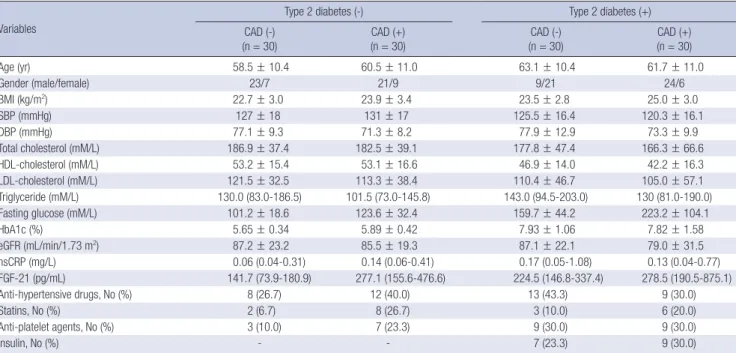
The baseline characteristics of the subjects are shown in Table 1. Metabolic and laboratory parameters were compared accord- ing to the presence/absence of type 2 diabetes mellitus and cor- onary artery disease. Serum FGF-21 levels were significantly higher in diabetic patients than in non-diabetic patients (P = 0.014). A significant difference existed among non-diabetic pa- tients, according to the presence or absence of significant CAD (P = 0.001). However, there was no significant difference be- tween CAD groups among diabetic patients (P = 0.069) (Fig. 1).
Serum FGF-21 levels were significantly correlated with GS (r = 0.358, P < 0.001) and ES (r = 0.324, P < 0.001) in all patients (Table 2). In non-diabetic patients, serum FGF-21 levels was significantly correlated with GS (r = 0.337, P = 0.008), but lost significant correlation with ES (r = 0.250, P = 0.054). In diabetic patients, serum FGF-21 had significant correlation with both GS (r = 0.384, P = 0.002) and ES (r = 0.381, P = 0.003).
After adjusting for age, sex, BMI, history of antihypertensive, lipid-lowering and anti-platelet agents, and significant clinical parameters, both GS and ES were significantly associated with serum FGF-21 in all patients (r = 0.271, P = 0.014; r = 0.217, P = 0.041, respectively). In non-diabetic patients, serum FGF-21 lev- els significantly correlated with only GS in final model (r = 0.262, P = 0.043). However, serum FGF-21 lost significant correlation
with both GS and ES (r = 0.332, P = 0.055; r = 0.296, P = 0.084, respectively) with diabetic patients in the final model (Table 2).
DISCUSSION
In the present study, serum FGF-21, which is a regulator of car- bohydrate and lipid metabolism, was elevated in patients with CAD and type 2 diabetes mellitus. Despite limited role in pa- tients with type 2 diabetes mellitus, serum FGF-21 showed sig- nificant correlation with the extent and severity of CAD in all patients.
FGF-21 was known to have unique role in the regulation of carbohydrate and lipid metabolism in the liver, adipocyte and pancreas (12). There were relatively large evidence of the role of FGF-21 in animal studies. FGF-21 is expressed in the murine liver during fasting and induces gluconeogenesis, fatty acid oxi- dation and ketogenesis as an adaptive response through a per- Table 1. Baseline characteristics of metabolic and laboratory parameters according to the presence/absence of type 2 diabetes mellitus and coronary artery disease
Variables
Type 2 diabetes (-) Type 2 diabetes (+)
CAD (-)
(n = 30) CAD (+)
(n = 30) CAD (-)
(n = 30) CAD (+)
(n = 30)
Age (yr) 58.5 ± 10.4 60.5 ± 11.0 63.1 ± 10.4 61.7 ± 11.0
Gender (male/female) 23/7 21/9 9/21 24/6
BMI (kg/m2) 22.7 ± 3.0 23.9 ± 3.4 23.5 ± 2.8 25.0 ± 3.0
SBP (mmHg) 127 ± 18 131 ± 17 125.5 ± 16.4 120.3 ± 16.1
DBP (mmHg) 77.1 ± 9.3 71.3 ± 8.2 77.9 ± 12.9 73.3 ± 9.9
Total cholesterol (mM/L) 186.9 ± 37.4 182.5 ± 39.1 177.8 ± 47.4 166.3 ± 66.6
HDL-cholesterol (mM/L) 53.2 ± 15.4 53.1 ± 16.6 46.9 ± 14.0 42.2 ± 16.3
LDL-cholesterol (mM/L) 121.5 ± 32.5 113.3 ± 38.4 110.4 ± 46.7 105.0 ± 57.1
Triglyceride (mM/L) 130.0 (83.0-186.5) 101.5 (73.0-145.8) 143.0 (94.5-203.0) 130 (81.0-190.0)
Fasting glucose (mM/L) 101.2 ± 18.6 123.6 ± 32.4 159.7 ± 44.2 223.2 ± 104.1
HbA1c (%) 5.65 ± 0.34 5.89 ± 0.42 7.93 ± 1.06 7.82 ± 1.58
eGFR (mL/min/1.73 m2) 87.2 ± 23.2 85.5 ± 19.3 87.1 ± 22.1 79.0 ± 31.5
hsCRP (mg/L) 0.06 (0.04-0.31) 0.14 (0.06-0.41) 0.17 (0.05-1.08) 0.13 (0.04-0.77)
FGF-21 (pg/mL) 141.7 (73.9-180.9) 277.1 (155.6-476.6) 224.5 (146.8-337.4) 278.5 (190.5-875.1)
Anti-hypertensive drugs, No (%) 8 (26.7) 12 (40.0) 13 (43.3) 9 (30.0)
Statins, No (%) 2 (6.7) 8 (26.7) 3 (10.0) 6 (20.0)
Anti-platelet agents, No (%) 3 (10.0) 7 (23.3) 9 (30.0) 9 (30.0)
Insulin, No (%) - - 7 (23.3) 9 (30.0)
Data are expressed as mean ± SD for parametric variables and median (interquartile range) for nonparametric variable. BMI, body mass index; CAD, coronary artery disease;
DBP, diastolic blood pressure; eGFR, estimated glomerular filtration rate; HDL-C, high-density lipoprotein-cholesterol; LDL-C, low-density lipoprotein-cholesterol; SBP, systolic blood pressure.
Fig. 1. Serum FGF-21 levels (mean + SD) in different groups according to CAD and T2DM. CAD, coronary artery disease; T2DM, type 2 diabetes mellitus.
Serum FGF-21 levels (pg/mL)
CAD (-), T2DM (-)
CAD (+), T2DM (-)
CAD (-), T2DM (+)
CAD (+), T2DM (+) 800
600 400 200 0
P < 0.001
P < 0.001
P < 0.069
Table 2. Multiple regression analysis for coronary artery disease severity and extent as a dependent variable
Model 1 Model 2 Model 3 Model 4
Standard β P Standard β P Standard β P Standard β P
Gensini score All (n = 120)
Type 2 diabetes (-) (n = 60) Type 2 diabetes (+) (n = 60)
0.358 0.337 0.384
< 0.001 0.008 0.002
0.340 0.337 0.371
< 0.001 0.013 0.004
0.353 0.361 0.403
< 0.001 0.010 0.002
0.271 0.262 0.332
0.014 0.043 0.055 Extent score All (n = 120)
Type 2 diabetes (-) (n = 60) Type 2 diabetes (+) (n = 60)
0.324 0.250 0.381
< 0.001 0.054 0.003
0.313 0.276 0.370
< 0.001 0.047 0.003
0.321 0.273 0.389
< 0.001 0.047 0.002
0.217 0.101 0.296
0.041 0.422 0.084 Model 1, crude; Model 2, adjusted for age and sex; model 3, adjusted for history of antihypertensive, lipid-lowering and anti-platelet agents; Model 4, adjusted for clinical pa- rameters.
oxisome proliferator-activated receptor α (13-15). Kharitonen- kov et al. (5) reported that FGF-21 is a potent stimulator of glu- cose uptake in mouse 3T3-L1 adipocytes and therapeutic ad- ministration of FGF-21 reduced glucose and triglycerides in both ob/ob and db/db mice.
Our study showed that serum FGF-21 levels were elevated in patients with type 2 diabetes mellitus. The high levels of serum FGF-21 levels were associated with adverse lipid profile, obesi- ty, and metabolic syndrome in other human studies (4, 9, 10).
The cause of paradoxical increase of serum FGF-21 is not ex- plained clearly. It is suggested the possibility of a compensatory response or resistance to FGF-21 (4).
Recently, An et al. (16) demonstrated that serum FGF-21 was elevated in patients with type 2 diabetes mellitus. The study also evaluated presence of diabetic complication including carotid plaque using carotid artery ultrasonography. Elevated serum FGF-21 was an independent risk factor of carotid intima-media thickness in Chinese subjects (17). This result is consistent with our report. However, we performed coronary angiography to evaluate directly the severity and extent of atheroma.
In diabetic patients, serum FGF-21 showed loss of correlation with the extent and severity of CAD in final model. However, in another study, patients with type 2 diabetes mellitus were divid- ed according to serum FGF-21 median value of 240.7 pg/mL (18). Patients with the above level of median value were associ- ated with a increased combined cardiovascular morbidity and mortality during a follow-up of 24 months (HR, 4.7; 95% CI, 1.67- 13.24).
There were some limitations in this study. First, the present study was a cross sectional design, which had cautious inter- pretation about direction of causality. Second, the relatively small numbers of patients were enrolled in this study. Our study show- ed that loss of correlation between serum FGF-21 and extent and severity of CAD in type 2 diabetes mellitus patients after adjusting clinical parameters. A large sample size may be re- quired for more comprehensive results with sufficient statistical power. Third, the blood samples for this study were obtained during a coronary angiography. We excluded patients with a history of heart failure, acute myocardial infarction, and other coronary artery disease. However, acute event such as chest pain could affect serum FGF-21 levels. Despite these limitations, it is notable that this is the first study using the GS and ES to eval- uate atherosclerotic burden. The severity and extent of coronary atheroma was evaluated by quantitative methods.
In conclusion, the patients with type 2 diabetes mellitus and CAD feature elevated serum FGF-21 levels. Despite a limited role in diabetic patients, serum FGF-21 levels are independent- ly associated with angiographic severity and extent of CAD. Se- rum FGF-21 level is a predictor of the presence or severity of CAD at high risk patients including type 2 diabetes mellitus. Fu- ture long-term follow-up studies are required to evaluate if se-
rum FGF-21 level is a marker as predictor of progression or death of CAD patients.
ACKNOWLEDGMENTS
The biospecimens used in this study were provided by the Pu- san National University Hospital, a member of the National Bio- bank of Korea which has been supported by the Ministry of Heal th and Welfare.
DISCLOSURE
The authors have no conflicts of interest to disclose.
AUTHOR CONTRIBUTION
Conception and coordination of the study: Kim IJ, Kim SS, Kim WJ. Design of ethical issues: Lee HC, Song SH, Kim IJ, Kim BH, Jeon YK. Acquisition of data: Bae MJ, Yi YS. Data review: Kim YK, Kim IJ. Statistical analysis: Kim SS, Kim WJ. Manuscript prep- aration: Kim WJ, Jeon YK, Kim SS, Kim BH, Kim IJ. Manuscript approval: all authors.
ORCID
Won Jin Kim http://orcid.org/0000-0002-8918-2925 Sang Soo Kim http://orcid.org/0000-0002-9687-8357 Han Cheol Lee http://orcid.org/0000-0002-7236-4204 Sang Heon Song http://orcid.org/0000-0002-8218-6974 Min Jung Bae http://orcid.org/0000-0002-8506-944X Yang Seon Yi http://orcid.org/0000-0002-3544-2795 Yun Kyung Jeon http://orcid.org/0000-0002-4319-5181 Bo Hyun Kim http://orcid.org/0000-0001-9632-9457 Yong Ki Kim http://orcid.org/0000-0001-9321-1736 In Joo Kim http://orcid.org/0000-0003-1307-6146 REFERENCES
1. Itoh N, Ornitz DM. Evolution of the Fgf and Fgfr gene families. Trends Genet 2004; 20: 563-9.
2. Presta M, Dell’Era P, Mitola S, Moroni E, Ronca R, Rusnati M. Fibroblast growth factor/fibroblast growth factor receptor system in angiogenesis.
Cytokine Growth Factor Rev 2005; 16: 159-78.
3. Nishimura T, Nakatake Y, Konishi M, Itoh N. Identification of a novel FGF, FGF-21, preferentially expressed in the liver. Biochim Biophys Acta 2000; 1492: 203-6.
4. Lin Z, Wu Z, Yin X, Liu Y, Yan X, Lin S, Xiao J, Wang X, Feng W, Li X. Se- rum levels of FGF-21 are increased in coronary heart disease patients and are independently associated with adverse lipid profile. PLoS One 2010; 5: e15534.
5. Kharitonenkov A, Shiyanova TL, Koester A, Ford AM, Micanovic R, Gal- breath EJ, Sandusky GE, Hammond LJ, Moyers JS, Owens RA, et al. FGF-
21 as a novel metabolic regulator. J Clin Invest 2005; 115: 1627-35.
6. Hojman P, Pedersen M, Nielsen AR, Krogh-Madsen R, Yfanti C, Aker- strom T, Nielsen S, Pedersen BK. Fibroblast growth factor-21 is induced in human skeletal muscles by hyperinsulinemia. Diabetes 2009; 58: 2797- 801.
7. Zhang X, Yeung DC, Karpisek M, Stejskal D, Zhou ZG, Liu F, Wong RL, Chow WS, Tso AW, Lam KS, et al. Serum FGF21 levels are increased in obesity and are independently associated with the metabolic syndrome in humans. Diabetes 2008; 57: 1246-53.
8. Li H, Bao Y, Xu A, Pan X, Lu J, Wu H, Lu H, Xiang K, Jia W. Serum fibro- blast growth factor 21 is associated with adverse lipid profiles and gam- ma-glutamyltransferase but not insulin sensitivity in Chinese subjects. J Clin Endocrinol Metab 2009; 94: 2151-6.
9. Mraz M, Bartlova M, Lacinova Z, Michalsky D, Kasalicky M, Haluzikova D, Matoulek M, Dostalova I, Humenanska V, Haluzik M. Serum concen- trations and tissue expression of a novel endocrine regulator fibroblast growth factor-21 in patients with type 2 diabetes and obesity. Clin Endo- crinol (Oxf) 2009; 71: 369-75.
10. Gensini GG. A more meaningful scoring system for determining the se- verity of coronary heart disease. Am J Cardiol 1983; 51: 606.
11. Sullivan DR, Marwick TH, Freedman SB. A new method of scoring coro- nary angiograms to reflect extent of coronary atherosclerosis and improve correlation with major risk factors. Am Heart J 1990; 119: 1262-7.
12. Dostálová I, Haluzíková D, Haluzík M. Fibroblast growth factor 21: a novel metabolic regulator with potential therapeutic properties in obesi-
ty/type 2 diabetes mellitus. Physiol Res 2009; 58: 1-7.
13. Badman MK, Pissios P, Kennedy AR, Koukos G, Flier JS, Maratos-Flier E.
Hepatic fibroblast growth factor 21 is regulated by PPARalpha and is a key mediator of hepatic lipid metabolism in ketotic states. Cell Metab 2007; 5: 426-37.
14. Inagaki T, Dutchak P, Zhao G, Ding X, Gautron L, Parameswara V, Li Y, Goetz R, Mohammadi M, Esser V, et al. Endocrine regulation of the fast- ing response by PPARalpha-mediated induction of fibroblast growth fac- tor 21. Cell Metab 2007; 5: 415-25.
15. Seo JA, Kim NH. Fibroblast growth factor 21: a novel metabolic regula- tor. Diabetes Metab J 2012; 36: 26-8.
16. An SY, Lee MS, Yi SA, Ha ES, Han SJ, Kim HJ, Kim DJ, Lee KW. Serum fi- broblast growth factor 21 was elevated in subjects with type 2 diabetes mellitus and was associated with the presence of carotid artery plaques.
Diabetes Res Clin Pract 2012; 96: 196-203.
17. Chow WS, Xu A, Woo YC, Tso AW, Cheung SC, Fong CH, Tse HF, Chau MT, Cheung BM, Lam KS. Serum fibroblast growth factor-21 levels are associated with carotid atherosclerosis independent of established car- diovascular risk factors. Arterioscler Thromb Vasc Biol 2013; 33: 2454-9.
18. Lenart-Lipińska M, Matyjaszek-Matuszek B, Gernand W, Nowakowski A, Solski J. Serum fibroblast growth factor 21 is predictive of combined cardiovascular morbidity and mortality in patients with type 2 diabetes at a relatively short-term follow-up. Diabetes Res Clin Pract 2013; 101:
194-200.