38
골관절염 치료제 히알우론산 임상연구결과의 Systemic Review
방준석 LG생명과학㈜
Systemic Review of Hyaluronate for the Treatment of Osteoarthritis
Joon Seok Bang, PharmD
Pharmaceutical Division, LG Life Sciences, Ltd., Seoul, Korea
Background: The multitude of the therapeutic usefulness of intra-articular injection of hyaluronate on oateoarthritis of the knee is still in question. The objective of this systemic review was to elucidate both the therapeutic efficacy and the safety of intra-articular administration of hyaluronic acid for degenerative osteoarthritis of the knee joints.
Methods: I searched MEDLINE and Korea Medical Database (KMbase) from January 1990 to April 2007 using a com- bination search terms for knee osteoarthritis and hyaluronic acid and a filter for randomized controlled trials. I extracted data on pain at rest, and during or just after movement, on joint function, and on adverse events.
Results: Ten trials that reported usable quantitative information on any of the predefined end points were identified and included in the systemic review. Intra-articular injection of hyaluronic acid can decrease symptoms of osteoarthritis of the knee. The study revealed significant improvements in pain and functional outcomes with few adverse effects. How- ever, there was significant between-study heterogeneity in the estimates of the efficacy of hyaluronic acid. Sub-group analysis showed that lower methodological quality such as a single-blind or single-center design resulted in higher esti- mates hyaluronic acid efficacy, and that patients older than sixty years of age and those with the most advanced radio- graphic stage of osteoarthritis were less likely to benefit from intra-articular injection of hyaluronic acid.
Conclusion: According to the currently available evidence, intra-articular hyaluronic acid has been proven clinically effective for the patients bearing the knee osteoarthritis with NSAID-induced GI troubles or inapplicable to any sur- gery, and may be associated with lower risk of adverse events.
□ Key words – hyaluronic acid, hyaluronate, osteoarthritis, 히알우론산 , 골관절염
퇴행성관절염 이라고도 불리는 골관절염(osteoarthritis, 이 하 OA)은 55세 이상 인구의 약 10%가 보유하며, 60세 이 상 환자의 25%에서 심한 동통과 관절운동장애를 동반한다.
특히 인구의 고령화 추세에 따라 유병률이 빠르게 상승하고 있는 대표적인 근골격계 질환이다.1-4)
주요한 OA 치료방법으로는 체중감량, 하지근육 강화운동, 물리치료와 같은 비약물요법과 함께, Acetaminophen 혹은 비스테로이드성 소염진통제류(non-steroidal anti-inflammatory drugs, NSAIDs)의 복용 또는 외용과, 스테로이드 약물의 관 절강내 주사와 같은 약물요법, 그리고 관절치환술과 같은 수 술요법 등이 사용되고 있다.5-7) 하지만, 가장 흔히 적용되는 약물요법 중에서 NSAID는 위장관 장애 등이 빈발하며, 스 테로이드는 전신 부작용 및 반복주사에 따른 연골의 파괴
또는 감염의 위험이 상승하므로 장기간 사용이 곤란하다는 단점 외에, 무엇보다도 이 약물들이 OA의 통증만을 완화시 킬 뿐 적극적인 질병치료 수단으로서는 미흡한 점이 많다.
2,4,5,8)
미국류마티스학회(American College of Rheumatology)는 1995년 발표한 OA의 치료지침에, 약물요법으로서 Cyclo- oxygenase-2 (이하 Cox-2) 억제제의 복용과 히알우론산 (Hyaluronic Acid 또는 Hyaluronate, 이하 HA)을 관절강 내 부로 주사하는 것을 신규로 추가하였다.2,6,9) Cox-2 억제제는 진통효과가 강화되고 위장관 부작용이 대폭 감소된 우수한 NSAID이기 때문이고, 관절강 내부로 HA를 직접 주사하는 방안은 원래 점탄성(Visco-elasticity)을 지닌 생체유래 활액성 분인 HA를 OA 환자의 활액낭 내부로 직접 보충한다는 치 료개념으로써(Visco-supplementation), 주입된 HA가 OA환자 의 소실된 연골조직에 의한 관절운동시 충격을 완화시켜주고 윤활작용을 도와 관절의 통증경감과 기능의 정상화는 물론, 빈용 약물들의 불가피한 부작용까지 피할 수 있다는 장점을 가진다.2,3,5-7)
Correspondence to :방준석
(LG트윈타워 동관 17층) LG생명과학㈜
150-721 서울특별시 영등포구 여의도동 20 번지 Tel: 02-3773-7190, Fax: 02-3773-3132
E-mail: [email protected]
HA는 1930년대 실체와 물성이 처음 규명됐으나, 50여년이 경과하여 일본에서 1987년, 한국은 1991년, 유럽에서는 1995년, 그리고 미국에서는 1997년부터 OA 치료용 제품의 시판이 허가되었다.2) 이미 HA가 국내외에서 OA치료의 일 환으로 활용된 지 15년여가 경과했기에, 저자는 그간 국내외 에서 발표된 임상연구 문헌을 수집, 분석하여 HA가 지닌 OA 치료효과와 안전성에 관한 최신 지견을 얻고, 그 임상적 의미를 고찰하고자 한다.
연구방법
본 연구를 위한 자료의 취득은, 선진국에서 HA 사용이 허 가된 시점을 고려하여 1985년부터 2007년까지 국내외 의약 정보 데이터베이스에 등재된 문헌을 5개 키워드를 이용하여 검색, 국내외 문헌을 각각 5건씩을 선정하여 분석에 이용하 였으며, 그 선정과정은 다음과 같다.
국외문헌은 PubMed search (MEDLINE)를 통해 1985년 1 월부터 2007년 4월까지 기간에 등재된 인체대상의 Clinical Trial, Editorial, Letter, Meta-analysis, Practice Guideline, Randomized Controlled Review 범주의 영문작성 자료중 MeSH (Medical Subject Headings)인 osteoarthritis, hyaluronate, hyaluronic acid를 중심어휘로 선정하여 ‘osteoarthritis AND hyaluronate OR hyaluronte’ 라는 조합으로 검색하여 총 50 건의 문헌을 추출하였다. 이중에서 1990년 이전에 등재된 임 상시험연구 및 동기간에 수행된 임상시험연구를 활용한 메타 분석의 경우, 무릎관절이 아닌 부위에 HA를 사용한 경우,
NSAID나 스테로이드 약물과의 효과비교 연구의 경우, 치료 가 아닌 예방효과에 치중한 연구의 경우, 시험대상 20명 미 만의 소규모 연구의 경우를 제외하고 총 5건의 임상연구 자 료를 선별하여 분석에 사용하였다.
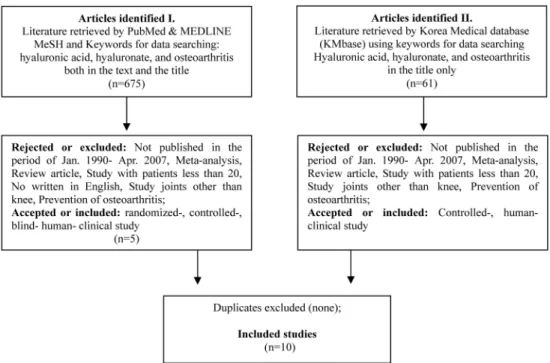
국내문헌은, 한국의학논문데이터베이스(KMbase)에서 osteo- arthritis, hyaluronic acid, hyaluronate, 골관절염, 히알우론산 이 표제어로 각각 사용된 경우를 검색하여 61건의 문헌을 추출하였다. 그리고, 국외자료 선별기간과 동일하게 1990년 이후 발표된 자료에 국한하여, 인체 무릎관절에서의 HA의 치료 및 위해성 평가연구 만으로 한정하고, 20명 미만의 환 자대상 소규모 연구, 타 약제와의 비교연구, 무릎관절 이외 에 사용한 경우를 제외시키고 얻은 총 5건의 자료만을 분석 에 사용하였다(Figure 1).
연구결과 및 고찰
수집된 자료와 시험설계의 특성
수집된 자료는 1992년부터 2004년까지 국내외에서 수행된 임상효능시험연구 10건이었고, 최근 5년내 발표된 연구결과 는 국내 2건을 포함하여 5건(50%) 이었다(Table 1). 9건의 자료는 제품의 시판을 허가한 나라에서 진행된 시판후 임상 연구였으며, 허가전 단계의 임상시험(1-3상) 자료는 포함되지 않았다. 국내에서는 아직 다수의 환자를 대상으로 HA의 OA 치료효과를 검증한 체계화된 임상연구나 메타분석연구가 보 고된 바 없었다.
연구설계에는 동질성이 없었는데, 3건은 다기관 임상시험
Fig. 1. Steps and criteria for the search strategy and the number of trials evaluated at the systemic review
Kor. J. Clin. Pharm., Vol. 17, No. 1, 2007 Table 1. Data source and the characteristics of the patients in different 10 studies
Source
Average MW,
kDa
Intent to treat population (enrolled-, randomized)
Analyzed-, effectiveness population Data,
yr HA
Treatment group Placebo group
n Female,
n (%)
Dropped out,
n (%) n Female,
n (%)
Age, yr
OA
duration n Female,
n (%)
Age, yr
OA duration Song et al7)
1992 ARTZ® - - - - 20 18 (90) 59 57 mo - - - -
Lee et al6)
1999 Hyruan® - 53 - 5 (9.4) 48 44 (92) 59.6±1.1 4.6±0.7 yr - - - -
Ko et al8)
1999 Atri® - - - - 25 21 (84) 61 54 mo - - - -
Lee et al3)
2002 Hyruan® 1,000 - - 6 53 40 (66) 63±6.8 59.8 mo 20 17 (85) 63±7.2 49.5 mo
Noh et al5)
2004 Hyruan® - - - - 35 29 (83) 63.9±9.3 - - - - -
Dahlberg et al13)
1994 Hyaluronan 600-1,200 52 - 4 (7.7) 28 - 46±8 - 24 - 44±9 -
Lohmander et al 10)
1996 Artzal® 1,000
Baseline:
240
134
(55.8) - 120 67 (55.8) 58.5±8.34* - 120 67 (55.8) 58.03±8.44* -
Safety:
(239) - 1 (0.4) 119 - - - 120 - - -
Efficacy:
(189) - 51 (21.3) 96 - - - 93 - - -
Brandt et al 11) 2001
ORTHO-
VISC® 1,000-2,900 226 144 91 (40.3) 66 40 (61) 65±8.2 - 69 43 (62) 67±8.4 -
Karlsson et al 12) 2002
Artzal®, Synvisc®
A: ~1,000
S: ~7,000 246
A: 67%
S: 65%
PL: 61%
4 (1.6)
A: 39/66/90 S:
38/70/86
A: 71%
S: 68% 71 - 22/48/66 (65) 71 -
Petrella et al 14)
2002 Suplasyn® - 120 71 12 25 9 67.3±8.9* - 28 12 62.6±9.5* -
Values are Mean±SEM, Mean±SD*
Abbreviations: HA (hyaluronic acid; sodium hyaluronate); MW (molecular weight); kDa (kilo-dalton); OA (osteoarthritis); PL (placebo); yr (year); mo (month); wk (week); SEM (standard error of the mean); SD (standard deviation)
이었고,10-12) 6건은 대조군(placebo)과 비교한 시험이었으며,
3,10-14) 4건은 이중맹검,10-12,14) 1건이 단일맹검이었고, 국내
연구는 1건을 제외하고는4) 단순히 효능을 입증하는 시험이었 다. 따라서 국내에서 수행된 연구는 환자 모집과 무작위 배 정과정이 상세하지 못했고, 탈락한 이유 및 시험의 제반 요 건의 설명은 간략히 기술되었다(Table 2).
피험자 규모는 기관의 수와는 연계성이 없었고, 최대 246 명까지 모집한 경우도 있었으나 모집 인원중 실제효능분석에 쓰인 임상사례의 탈락 정도가 0.4에서 40%로 다양하였고, 치료효과 분석에 사용된 실제 사례는 최소 20에서 최대 120 예였다. 총 10건의 연구자료에 포함된 피험자 집단은, 질병 보유기간이 50개월 이상인 60세 이상(1건 예외) 연령의(여성 비율 56% 이상, 최대 92%) 외래환자(1건은 입원환자 대상) 로 요약되며, 대조군이 사용된 연구의 경우는, 치료군과 비 교하여 환자의 숫자와 성별, 연령분포 등이 동질성을 가지도 록 설정되었다(Table 1).
약제의 처치내역은, 총 주입량이 2 ml (2건)와 2.5 ml (8건) 였으며 이중 HA함유량은 25 mg (7건), 30 mg, 20 mg, 3 mg (각 1건)으로 상이했으나, 모두 주 1회씩, 5회(7건)에서 3회(3 건) 반복 투여하였고, vehicle로는 생리식염수를 사용하였다 (Table 2). 3회만 투여한 연구는 모두 2001년 이후에 시행되 었으므로, 이는 연구수행 당시에 제기되어 현재 국내외에서 많이 채택하고 있는, 매주 1회씩 총 3회 처치요법의 투여횟수 -치료효과와의 관계를 찾으려는 시도라고 유추할 수 있다.3)
주사부위는 무릎관절강 내부였는데(intra-articular), 1건을 제외하고는3) 공히 정확한 해부학적 위치가 명시되지 않았고, 주입시의 통증 경감을 위해 HA 주입부 근방에 lidocaine을 경피 투여한 경우도 있었다.5,11)
시험연구의 기간은 최소 6주에서 최장 52주까지 진행하여 HA의 장기간 효과를 추적 관찰하였는데, 시험기간이 길수록 중증도 이상 OA환자에서 치료효과 관찰이 용이했다. 임상의 사들의 보고에 따르면, HA의 Visco-supplementation 요법은 약 6개월 정도 효과가 지속된다고 알려져 있으며,2,4) 본 연 구에 쓰인 자료 중 7건도 약 26개월 전후의 시험기간이 소 요되었다(Table 2). 2건을 제외5,11) 하고 시험기간 중 피험자 들이 시험개시 이전부터 사용 중이던 진통제의 투여는 모두 허용됐는데, HA주입으로 인한 OA 증세의 호전을 경험한 피 험자에서 시험도중 병용하던 약물을 중단한 경우가 다수 발 생하였고, 시험개시 후에 추가로 병용약물요법이 필요한 경 우는 없었다.
HA주입치료의 효과검색은 주로 통증의 개선과 관절기능이 호전된 정도를 피험자에게 판단하는 방법이 사용되었는데, 이런 효과개선 정도를 표현하는 데에는 모두 피험자의 주관 성이 많이 관여되는 것이라 객관화가 필요한 사항이므로 VAS (Visual Analogue Scale, 통증시각상사척도)와 WOMAC (Western Ontario and McMaster Universities Osteoarthritis Index)등 계층화된 정량지표를 사용하여 개선 및 호전된 정
도를 수치화하여 분석하였다(Table 2).
치료효과와 부작용
HA는 분자량과 비례적으로 점탄성이 상승하며 관절활액으 로서 효율도 상승하므로 OA 치료효과와의 연관성이 크다고 보고되었다.2,3) 10건의 연구에 사용된 HA는 9종 이었으며, 이중 5건 연구에서만 분자량이 언급되었는데, 모두 60만-700 만 범위로서 평균 100만 달톤(dalton) 수준이었다(Table 1).
1건의 연구결과를 제외하면,13) 모든 연구에서 HA는 OA로
인한 통증과 관절기능이 개선되는 효과를 보였다. 경증-중증 도 OA 환자에서의 치료효과가 중증환자의 경우보다 우수하 였고, 더 신속히 발현하였다.6,7,11,12)전반적으로 증세가 호전 되는 시점은 처음 처치후 약 12주는 경과해야 유의성 있는 결과가 얻어졌으며,5,6,10,11,13,14) 일부는 측정한 시험기간이 6 주 정도로 짧았거나,3,7,8) 30주 이상 장기간이 경과된 후였다.
15) 그리고, 대조군과 비교한 시험 6건중 5건에서는3,10-12,14)
치료군이 대조군보다 효과가 우수했고, 나머지 1건에서는 통 계적 유의성이 확인되지 않았다.13)
HA의 관절강내 주사는 많은 부작용이 보고되어 있으나, 이번 10건의 연구자료에는 심각한 부작용 사례가 보고되지 않았다. 주된 부작용 사례는 주사부위의 동통이었는데,3,5,7,8,
13) 발생빈도는 최대 15%였고, 특별한 치료없이 48시간내 자
연 소실되는 경우가 대부분이었으며, 그 외 5%의 빈도로 종 창이 발생하였다고 보고되었다(Table 3).
결 론
지난 15년간 HA는 전세계적으로 OA의 새로운 치료법의 하나로 사용되어 왔으며,1,9) 모든 환자에서 만족할 수준의 효 과가 있는 것은 아니지만, 이번 조사연구에 따르면 HA가 OA에 수반되는 통증을 포함한 관절기능 저하, 생활능력 저 하 등 질병에 의한 직, 간접 증상들의 발생빈도를 경감시키 거나 정도를 호전시키는데 유효하였고, 심지어 NSAID보다 더 우수하다는 평가도 있었다.6) 더욱이 심각한 부작용이 발 생하지 않았으므로, 비약물적인 혹은 약물요법에 반응하지 않거나 진통소염제 사용이 제한된 경우, 슬관절치환 같은 수 술치료가 불가능한 OA 환자들에게 치료적 대안으로 선택될 수 있다.2,5,6,16)
비록 본 연구에 인용된 자료 모두가 대규모 피험자를 대 상으로 이중맹검, 다기관 임상시험이 아닌 한계를 가지나 (Table 3), 1992년부터 HA가 가진 OA 치료효과에 대한 국 내외에서 시행, 보고된 임상연구의 결과로서 고령화 사회에 진입한 국내 상황에 시사하는 바가 있다고 사료되며, 향후 국내에서도 HA에 의한 OA치료와 기존 치료요법들과의 효 능비교 및 비용-효과 검증시험 연구가 계속되어 HA가 OA 의 약물치료적 대안으로 적극 활용되기를 기대한다.
Kor. J. Clin. Pharm., Vol. 17, No. 1, 2007
study type duration pharmacotherapy
Song et al7) 1992
2.5 ml (25 mg HA); 2.5 ml saline vehicle; total of 5 injections, 1 inj / wk
24 wk Permitted for reducing
symptoms - Candidates were selected in the hospitalized
patients
Lee et al6) 1999
2.5 ml (25 mg HA); 2.5 ml saline vehicle; total of 5 injections, 1 inj / wk
19 wk Permitted for reducing symptoms
VAS for pain; Lequesne’s index for articu- late
dysfunction; lab tests for tenderness and swelling count
In the beginning, excluded patients who need any surgery, injected intraarticularly in 8 wk, and any pharmacotherapy in 2 wk.
Ko et al8) 1999
2.5 ml (3 mg HA); 2.5 ml saline vehicle; total of 5 injections, 1 inj / wk
27 wk Permitted for reducing symptoms
Subjective and objective symptoms (scored 0 to 3 on 3 items each); ADL (scored 0-4 on 4 items); Compared these data between pre- injection and at post-injection2, 4, and 5 weeks
Candidates were selected in the outpatients;
Excluded patients with any ia Tx in 2 wk, and any hyper-sensitive reactions.
Lee et al3) 2002
2.5 ml (25 mg HA); 2.5 ml saline vehicle; total of 5 injections, 1 inj / wk; PL is saline
27 wk Permitted for reducing symptoms
VAS for pain; Tegner activity score (TAS) for activity capacity; algofunctional index (AI) for the function of joints
Candidates were outpatients;
Excluded patients with any ia Tx in 1 yr, and any joint-care therapy in 3 wk.
Noh et al5) 2004
2.5 ml (25 mg, 1% HA); 2.5 ml saline vehicle; total of 5 injections, 1 inj / wk; 2% lidocaine 1 ml as a local anesthesia on inj site
6 wk Not allowed Pain at rest and pain on walking using VAS;
tenderness of the joint line
Candidates were outpatients;
Excluded patients with any ia Tx in 2 wk, and under any pharmacotherapy or hyper- sensitive reaction.
Dahlberg et al13) 1994 Single blind- RCT
2.5 ml (25 mg HA); 8.5 mg/ml saline with other substances as vehicle; total of 5 injections, 1 inj / wk; PL was injected vehicle only
26 wk Permitted for reducing symptoms
• Primary parameters: Lysholm scale, Pain, Mobility, Function, Activity
• Secondary parameters: Tegner score, One- leg jump, Cybex II isometric power, Isoki- netic power, QPR, HKA
Excluded patients included previous frac- ture, liver or kidney or blood disease, alco- hol or drug abuse, or other invasive Tx within 6 mo.
Lohmander et al10) 1996 DB, PC, MC RCT
2.5 ml (25 mg HA); 1% solution in 2.5 ml phosphate buffered saline as a vehicle; total of 5 injections, 1 inj / wk; PL was injected vehicle only
20 wk Allowed during the trial
Ahlback stage, HKA angle, joint space width, joint fluid, VAS (for pain, activity, function, mobidity) Lequesne’s index, Lysh- olm score, Tegner score, clinical exam score
Both inclusion and exclusion criteria were stated
Brandt et al11) 2001 Prospective, MC, DB
RCT
2 ml (30 mg HA); physiologic saline as a vehicle; total of 3 injec- tions, 1 inj / wk; PL was 2 ml vehi- cle only; 3-5 ml of 1% lidocaine SC for anesthesia before Tx.
27 wk
Before the study enrollment, required to discontinue all analgesics or NSAIDs;
Acetaminophen was the only pain med permitted in the 2 wk and during the 27-week study period
WOMAC (pain, stiffness, function) score, time to walk 50 ft; patient and investigator global
assessments
Exclusion criteria were stated;
91 (80%) in HA group and 84 (75%) com- pleted the 27-wk study.
Karlsson et al12) 2002 DB, MC, parallel-
design RCT
A: 2.5 ml (1% HA); S: 2 ml (0.8%
HA); total of 3 injections, 1 inj / wk; buffered saline
vehicle; PL was 3 ml vehicle only
1st study: 26 wk 2nd : f/up at 39,
52 wk
See Remarks
VAS (wt-bearing pain, resting pain, max pain); WOMAC (total score, pain, physical function, stiffness); Lequesne index (total score, ADL, max walking distance, pain)
Washout period was 2 wk;
During this time, patients allowed ace- taminophen and other analgesics if nec- essary
Petrella et al14) 2002 DB, RCT
2 ml (20 mg HA); saline as a vehi- cle; administered once weekly over 3 wks; PL was 2 ml of saline; con- trol (100 mg of lactose)
12 wk See Remarks
WOMAC (pain, stiffness and disability);
VAS (pain at rest and following functional walking and stepping activities); functional performance (exercise time, heart rate, and predicted maximum oxygen uptake)
The study was done with 4 groups for the efficacy and safety in HA, PL, NSAID, and control
Abbreviations: HA (hyaluronic acid; sodium hyaluronate); inj (injection); wk (week); DB (double blind); PC (placebo controlled); MC (multicenter); RCT (randomized controlled trial); Tx (treatment);
PL (placebo); VAS (Visual Analogue Scale); ADL (activities of daily living); Cybex II data (refer to quadriceps muscle strength); QPR (Questor Precision Radiography); HKA (Hip-Knee-Ankle angle);
WOMAC (Western Ontario and McMaster Universities Osteoarthritis Index); ia (intraarticular); SC (subcutaneous)
치료제 히알우론산 임상연구결과의 Systemic Review43
Source, year Results
Study limitation
Efficacy Side effects
Song et al 7) 1992
• 2 patients out of 20 (10%) were rated marked improved, 6 (30%) moderately improved, 7 (35%) slightly improved, 5 (20%) unchanged;
• Patients classified with as Kellgren’s radiographic stage I (2/3, 67%) and II (9/10, 90%) showed much better improvement in global assessment, pain, and stiffness than those classified as stage III (4/7, 57.1%); stage I+II (11/13, 84.6%); stage II+III (13/17, 76.5%)
Temporary pain: 2 cases (10%);
Localized knee pain: 1 case (5%);
Disappeared without any Tx in 24 hrs
Single- open-labeled, controlled study
Lee et al 6) 1999
• Significant improvements in VAS, Lequesne’s index, tenderness and swollen joint counts were noted from the 1st wk and maintained until the end of 3 mo follow-up period.
• At 3 mo post-injection, 68.8% of patients had 20 mm reduction in the VAS.
• The patients with Kellgren’s stage III showed significant response in VAS and Lequesne’s index as patients with Kellgren’s stage I and II.
• The clinical improvement after Tx was slower in patient (n=16) with late (5 yrs) OA than in patients (n=32) with early (<5 yrs) OA, but it was statistically significant in either groups, compared to baseline.
No severe adverse reactions;
Revealed no evidence of toxicity
Single-, open-labeled controlled study
Ko et al 8) 1999
• Subjective and objective symptoms, and ADL with time progression were significantly increased at post-injection 4, 5 wk compared with pre-injection status (p<0.05).
• Subjective and objective symptoms, and ADL according to Kellgren’s X-ray classification were signif- icantly increased at stage II an III (p<0.05).
• VAS is significantly decreased after injection (p<0.05)
Transient pain: 5 cases (20%);
Disappeared without any Tx
Single-, open-labeled controlled study
Lee et al 3) 2002
• Relieve the symptom of OA and improve the function of knee joint.
• In the Tx group, patients classified as Kellgren’s stage II and III showed much better improvement in efficacy for pain, function and activity compared with group IV; Best symptomatic improvement accord- ing to the subjective symptom revealed at 3 wk in 25 patients (47.2%).
• PL treated patients had slight pain and improved functional performance but less effect in compared with HA treated patients.
• Tx group: localized pain is 8 (15%), effuse on injection site is 4 (7.5%);
• PL group: localized pain 4 (20%), effuse on injection site 1 (5%)
-
Noh et al 5) 2004
• Ia injections of HA is generally well tolerated in patient with OA of the knee, and results in significant reductions in the knee pain of such patients.
• The pain at rest, showed a statistically significant (p<0.05) reduction from that at the baseline through to the follow-ups at the 2nd, 4th, and 6th wk.
• The pain on walking also showed a statistically significant (p<0.05) reduction with a similar pattern as that for pain at rest. However, the pain with pressure did not show a statistically significant reduction.
Transient pain;
Disappeared simultaneously
Single-, open-labeled controlled study
Dahlberg et al
13)
1994
• The effects if ia HA do NOT differ significantly from those of PL in patients with knee pain and cartilage disease.
• Primary parameters: Continuous improved in all groups over time until 13 wk except VAS in placebo at 13 wk and mobility in 26 wk. At 26th wk, 18/26 patients in Tx group and 11/22 in PL showed the same degree of improvement.
• Secondary parameters: In the 2 groups showed the same pattern as was seen with the primary parame- ters, and were similar in all parameters at all follow-up visits.
• No severe side effects were seen;
• In Tx-group: Candida arthritis (1 case, withdrawn), intolerable pain at injection site (1, withdrawn)
• In both groups: transient swell- ing and rash
-
Kor. J. Clin. Pharm., Vol. 17, No. 1, 2007 Table 3.
Source, year Results Study
limitation
Efficacy Side effects
Lohmander et al 10)
1996
• Patients older than 60 yrs with knee OA comprise the group most likely benefit fromTx with ia HA injections.
• At 20 wk, both Tx groups were improved compared with baseline, with no difference between unstratified groups treated with placebo or HA.
• Comparison of Tx groups stratified by age and baseline algofunctional index revealed a signifi- cant difference in favor of HA over PL (pain activity, algofunctional index, global evaluations by patient and investigator) for patients older than 60 years and with a baseline algofunctional index greater than 10.
No serious side effects were reported -
Brandt et al 11)
2001
• HA injection is well tolerated and produces statistically and clinically significant improvement of symptoms in patients with mild-to-moderate knee OA in whom pain in the contralateral knee is rel- atively modest.
• Among patients who completed at least 15 wk of the study and whose WOMAC score was less than 12 at baseline, HA injection resulted in improvement in WOMAC (pain) score, patient and investigator global assessments and pain on standing from wk 7 to 27.
• 58% of HA group achieved a 5-unit or greater improvement in mean pain score from wk 7 to 27, compared with 40% of PL patients.
Few side effects were attributed to Tx;
The incidence of injection site reactions was low
-
Karlsson et al 12)
2002
• Produced a significant reduction in wt-bearing pain, resting pain, max pain, and Lequesne and WOMAC scores after 26 wk.
• Either of two HAs or PL showed clinical improvement during the 1st 26 wk of Tx, though neither HAs gave a longer duration of clinical benefit than PL. However, there was a significantly longer duration of clinical benefit for HA Tx than for PL (p=0.047).
A total of 314 adverse events were reported in 132 patients;
A total of 55% of the patients reported at least 1 adverse event;
Reported adverse events were 61% in Artzal®, 51% in Synvisc®, 50% in placebo
-
Petrella et al 15)
2002
• For resting pain relief, HA seems to be effective as NSAIDs. Further, for pain with physical activ- ity and functional performance, HA may be superior toPL alone or NSAID alone.
• At wk 12, showed significantly greater improvement in WOMAC pain subscale score and VAS for resting pain
No serious adverse events occurred during the
study -
Abbreviations: OA (osteoarthritis); ADL (activities of daily living); VAS (Visual Analogue Scale); Tx (treatment); PL (placebo); WOMAC (Western Ontario and McMaster Universities Osteoarthritis Index); NSAIDs (non-steroidal anti-inflammatory drugs); ia (intraarticular); HA (hyaluronic acid; sodium hyaluronate)
참고문헌
1. Arrich J, Piribauer F, Mad P, et al. Intra-articular hyalu- ronic acid for the treatment of osteoarthritis of the knee:
systemic review and meta-analysis. CMAJ 2005; 172(8):
online1-13.
2.서정탁. Hyaluronic Acid의 임상적 의미와 적용. 가정의 학회지 2002; 23(9): 1071-1079.
3.이동철, 백승희, 손욱진, 등. 퇴행성 슬관절염에서 히야루 론산의 효과. 대한슬관절학회지 2002; 14(2): 213-221.
4.송영욱. 퇴행성 관절염의 약물치료. 대한의사협회지 2003;
46(11): 958-964.
5.노성숙, 이재준, 황성미, 등. 퇴행성 슬관절염에 대한 히 알우론산 나트륨의 치료효과. 대한통증학회지 2004; 17(2):
170-174.
6.이신석, 주영실, 김완욱, 등. 슬관절 골관절염 환자에서 Hyruan® (Sodium Hyaluronate)의 유효성 및 안정성 평가.
대한류마티스학회지 1999; 6(1): 53-61.
7.송은규, 정재윤, 박진균. 히야루론산 나트륨 (ARTZ®)의 골관절염에 대한 치료효과. 최신의학 1992; 35(3): 91-96.
8.고재영, 윤석봉, 소은하, 등. 퇴행성 슬관절염 환자에 대 한 Sodium Hyaluronate (Arti®)의 치료효과. 대한재활의 학회지 1999; 23(4): 842-847.
9. Lo GH, LaValley M, McAlingdon T, et al. Intra-articular Hyaluronic Acid in Treatment of Knee Osteoarthritis: A Meta-analysis. JAMA 2003; 290(23): 3115-3121.
10. Lohmander LS, Dalen N, Englund G. Intra-articular hyalu- ronan injections in the treatment of osteoarthritis of the knee: a randomized, double blind, placebo controlled mul-
ticentre trial. Annals of the Rheumatic Diseases 1996; 55:
424-431.
11. Brandt KD, Block JA, Michalski JP, et al. Efficacy and Safety of Intraarticular Sodium Hyaluronate in Knee Osteoarthritis. Clinical Orthopedics and Related Research 2001; 385: 130-43.
12. Karlsson J, Sjogren LS, Lohmander LS. Comparison of two hyaluronan drugs and placebo in patients with knee osteoarthritis. A controlled, randomized, double-blind, par- allel-design multicentre study. Rheumatology 2002; 41:
1240-1248.
13. Lohmander LS, Ryd L. Intraarticular Injections of Hyaluro- nan in Patient with Cartilage Abnormalities and Knee Pain:
A One-Year Double-Blind, Placebo-Controlled Study.
Arthritis & Rheumatism 1994; 37(4): 521-8.
14. Petrella RJ, DiSilvestro MD, Hildebrand C. Effects of Hyaluronate Sodium on Pain and Physical Functioning in Osteoarthritis of the Knee: A Randomized, Double-blind, Placebo-Controlled Clinical Trial. Arch Intern Med. 2002;
162: 292-298.
15. Petrella RJ. Hyaluronic Acid for the Treatment of Knee Osteoarthritis: Long-Term Outcomes from a Naturalistic Primary Care Experience. Am J. Phys. Med. Rehabil.
2005; 84(4): 278-283.
16. Wang CT, Lin J, Chang CJ, et al. Therapeutic Effects of Hyaluronic Acid on Osteoarthritis of the Knee: A Meta- Analysis of Randomized Controlled Trials. Journal of Bone and Joint Surgery 2004; 84-A(3): 538-545.