www.labmedonline.org 187 eISSN 2093-6338
garded as an emerging pathogen, L. lactis subsp. lactis is thought to have very low virulence to humans. Herein, we report a case of septic shock resulting from catheter-related infection caused by L.
lactis subsp. lactis. To the best of our knowledge, this is the first case of bacteremia caused by L. lactis subsp. lactis in an adult.
CASE REPORTS
A 64-yr-old male presenting with fever and chills for one week, was admitted to our hospital. He had surgery for adhesive ileus approximately 40 yr ago and subsequently has had three addi- tional colorectal surgeries and an ileostomy. Upon arrival, he had fever and chills, but did not have respiratory symptoms or nau- sea/vomiting, and exhibited no weight loss. Upon examination, his temperature was 36.5°C due to an antipyretic drug that he had taken before the visit. His initial blood pressure of 70/60 mmHg dropped to 60/30 mmHg in one hour; his pulse rate was 45/min, and his respiratory rate was approximately 20 breaths/min. Physi-
INTRODUCTION
Lactococcus species are among the most important microor- ganisms for the industrial production of fermented dairy products.
Lactococcus lactis and Lactococcus garvieae have been reported to cause human infections and are considered opportunistic pathogens. While L. lactis subsp. cremoris is known to be a pathogen, causing several human infections, and L. garvieae is re-
성인에서 발생한 Lactococcus lactis subsp. lactis 카테터 관련 패혈성 쇼크 1예
A Case of Septic Shock Following Catheter-related Infection Caused by Lactococcus lactis subsp. lactis in an Adult
배태원1·이재현1,2·이혜수1,2,3·조용곤1,2,3
Tae Won Bae, M.D.1, Jaehyeon Lee, M.D.1,2, Hye Soo Lee, M.D.1,2,3, Yong Gon Cho, M.D.1,2,3
전북대학교 의학전문대학원 진단검사의학교실1, 전북대학교병원 의생명연구원2, 전북대학교병원 병원체자원은행3
Department of Laboratory Medicine1, Chonbuk National University Medical School, Jeonju; Research Institute of Clinical Medicine of Chonbuk National University-Biomedical Research Institute of Chonbuk National University Hospital2, Jeonju; Chonbuk National University Hospital Branch of National Culture Collection for Pathogens3, Jeonju, Korea
증례보고
Lab Med Online
Vol. 6, No. 3: 187-190, July 2016
http://dx.doi.org/10.3343/lmo.2016.6.3.187 임상미생물학
Corresponding author: Yong Gon Cho
Department of Laboratory Medicine, Chonbuk National University Medical School, 20 Geonjiro, Deokjin-gu, Jeonju 54907, Korea
Tel: +82-63-250-2388, Fax: +82-63-250-1200, E-mail: [email protected] Received: July 20, 2015
Revision received: August 17, 2015 Accepted: August 19, 2015
This article is available from http://www.labmedonline.org 2016, Laboratory Medicine Online
This is an Open Access article distributed under the terms of the Creative Commons Attribution Non-Commercial License (http://creativecommons.org/licenses/by-nc/4.0/) which permits unrestricted non-commercial use, distribution, and reproduction in any medium, provided the original work is properly cited.
Lactococcus lactis is a gram-positive cocci used extensively in the dairy industry, but considered an unusual pathogen in humans. Among its five subspecies, L. lactis subsp. lactis in particular has rarely been reported as a pathogen. We report a case of septic shock caused by L. lactis subsp.
lactis in an adult patient. A 64-yr-old male patient was admitted to outpatient clinics, with chief complaints of fever and chills for one week after convalescent hospital admission. He had severe ileus requiring surgery. He had a peripherally inserted central catheter from convalescent hospi- tal, which was immediately removed. From two sets of blood and catheter tip cultures, we identified L. lactis subsp. lactis using the Vitek 2 system (bioMerieux Inc., USA), and confirmed this result by 16S rRNA sequencing. The patient was empirically treated with ciprofloxacin, and he recov- ered and was discharged.
Key Words: Lactococcus lactis subsp. lactis, Catheter-related infections, Septic shock
배태원 외: A Case of Septic Shock Related with Lactococcus lactis subsp. lactis
http://dx.doi.org/10.3343/lmo.2016.6.3.187 188 www.labmedonline.org
cal examination revealed unremarkable findings. The white blood cell count was 16.22×10⁹/L (segmented neutrophil 85.5%), hemoglobin was 11.2 g/dL, and platelet count was 173×109/L in initial complete blood cell counts. C-reactive protein was 68.99 mg/L, blood urea nitrogen was 55 mg/dL, and creatinine was 1.75 mg/dL. A coagulation study showed a slightly prolonged pro- thrombin time of 12.7 seconds (INR 1.13). Vital signs and labora- tory findings suggested systemic inflammatory response syn- drome with shock. Upon radiologic studies, a chest X-ray showed nonspecific findings and computed tomography without en- hancement of the abdomen showed findings of postoperative ad- hesive ileus without any mass or fluid collection. Nelaton-cathe- terized urine culture and two sets of blood culture (Bact/Alert, bioMerieux Inc., Hazelwood, USA), from a peripheral vein, were conducted. In addition, his peripherally inserted central catheter (PICC) that was thought to be the infection source was removed and sent to the clinical laboratory for tip culture. The urine cul- ture was negative but blood culture was positive after 2 days.
From the PICC tip culture, 1-2 mm non-hemolytic whitish-gray colonies were observed on a blood agar plate incubated at 35°C in conditions of 5% CO2 for 24 hr. Based on Gram staining, the colonies were gram-positive cocci and were catalase-negative.
Similar colonies were obtained from subculturing both sets of blood cultures. These colonies were subsequently identified as L.
lactis subsp. lactis using a GP identification card with the Vitek 2 system (99% probability, bioMerieux Inc., Hazelwood, USA), with Vitek MS (99.9% probability, bioMerieux Inc., Hazelwood, USA), and through 16S rRNA sequencing (9F: 5′-GAGTTTGATCCTG- GCTCAG-3′, 1512R: 5′-ACGGCTACCTTGTTACGACTT-3′) in Gen- Bank (99% homology with Accession number: NR_103918). The minimal inhibitory concentration (MICs) for penicillin, gentami-
cin, ciprofloxacin, clindamycin, and vancomycin were 0.5, 1, 4, 0.5, and 1 μg/mL, respectively, by E-test (bioMerieux Inc., Hazel- wood, USA). The patient was empirically treated with ciprofloxa- cin, starting at hospital day 1. On hospital day 4, two blood cul- ture sets were negative and the patient recovered. He was symp- tom-free at an outpatient clinic visit 1 month after discharge.
DISCUSSION
L. lactis is a catalase-negative gram-positive cocci with five sub- species. L. lactis subsp. lactis, L. lactis subsp. cremoris, and L.
lactis subsp. lactis biovar diacetylactis are used for the produc- tion of fermented dairy products and cheddar cheese [1], and are considered to have low pathogenic potential for human infec- tions. However, there have been some reports of infection in im- munocompromised adults, which presented as peritonitis, liver abscess, endocarditis, and cerebellar abscesses [2-5]; however, to the best of our knowledge, these bacteria have rarely caused bac- teremia in adults, especially catheter-related infections that pro- gressed to septic shock. Cases of bacteremia, sepsis, or catheter- related infection are very rarely reported in infants [6-8]. Most cases in humans are caused by L. lactis subsp. cremoris [9, 10].
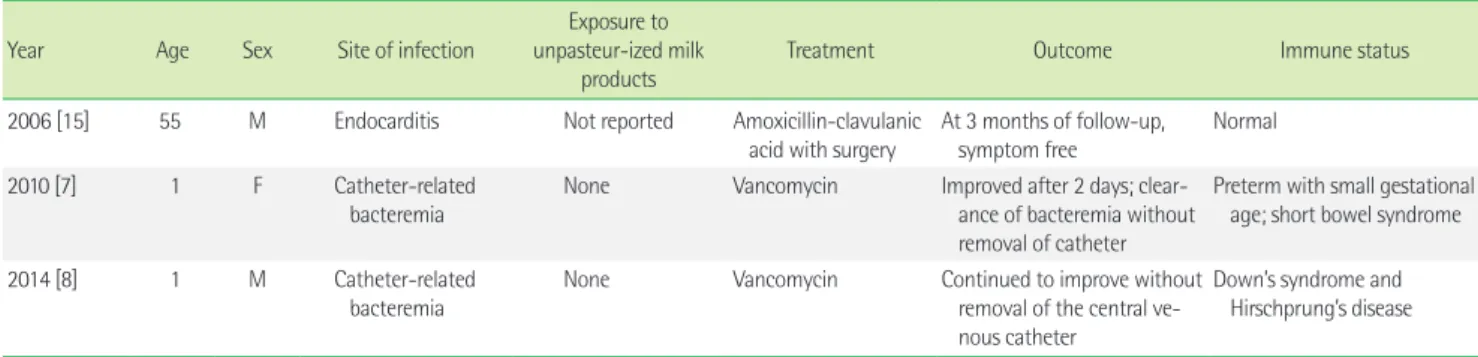
Herein, we report a case of L. lactis subsp. lactis induced septic shock resulting from catheter-related infection, in an adult. Fur- thermore, we reviewed cases of L. lactis subsp. lactis infection, and the results are shown in Table 1.
To date, the pathogenesis of L. lactis infection is not well un- derstood [6, 11]. Generally, most bacteria in dairy products are killed during pasteurization. However, outbreaks related to the use of unpasteurized dairy products have been reported [12]. In this case, the lactococci could remain viable after transit through
Table 1. Cases of L. lactis subsp. lactis-associated infections reported to date
Year Age Sex Site of infection
Exposure to unpasteur-ized milk
products Treatment Outcome Immune status
2006 [15] 55 M Endocarditis Not reported Amoxicillin-clavulanic
acid with surgery At 3 months of follow-up,
symptom free Normal
2010 [7] 1 F Catheter-related
bacteremia
None Vancomycin Improved after 2 days; clear- ance of bacteremia without removal of catheter
Preterm with small gestational age; short bowel syndrome
2014 [8] 1 M Catheter-related
bacteremia None Vancomycin Continued to improve without
removal of the central ve- nous catheter
Down’s syndrome and Hirschprung’s disease Abbreviations: M, male; F, Female
배태원 외: A Case of Septic Shock Related with Lactococcus lactis subsp. lactis
http://dx.doi.org/10.3343/lmo.2016.6.3.187 www.labmedonline.org 189
the gastrointestinal tract [13]. Therefore, exposure to unpasteur- ized dairy products and damaged mucosa could be risk factors [9]. In this case, the patient had a PICC and had received long- term hospital care. Hence, we could not check diet or parenteral supplements used before his visit to our outpatient clinic. In addi- tion, we could not determine the source of infection or related risk factors, except for ileus with ileostomy that could be consid- ered as mucosal damage.
The antimicrobial susceptibility of L. lactis subsp. lactis is well known in animal infections [14], with susceptibility to widely used beta-lactams such as penicillin, ampicillin, and amoxicillin. In hu- mans, there is limited data. In a case of catheter-related bactere- mia in an infant, the strain showed MIC values for vancomycin, ceftriaxone, and penicillin as 0.5, 0.125, and 0.25 μg/mL, respec- tively [7]; our finding was similar to these. There have been rare antibiograms of L. lactis subsp. lactis in human infection and thus we thought more data would be needed.
This study represents a very rare report of septic shock result- ing from catheter-related bacteremia caused by L. lactis subsp.
lactis. This occurred despite the low pathogenicity of this species.
Thus, clinicians should consider L. lactis subsp. lactis as a patho- gen, especially when the patient is immunocompromised and has risk factors such as gastrointestinal problems, or exposure to un- pasteurized dairy products.
요 약
Lactococcus lactis는 유산균의 발효에 광범위하게 이용되는 그 람양성구균으로 특히 5개의 아종 중 L. lactis subsp. lactis에 의한 감염은 매우 드물게 보고되어 있다. 이에 저자들은 성인에서 발견 된 L. lactis subsp. lactis에 의한 카테터감염 후 패혈쇼크로 진행 한 증례를 보고하는 바이다. 요양병원에 입원하고 있던 64세 남성 환자가 일주일간 지속되는 발열, 오한을 주소로 외래를 경유하여 입원하였다. 환자는 이전에 받았던 수술에 의한 심한 장폐색증 이 외에 특이소견은 없었으며, 요양병원에서 삽입하고 있던 말초삽입 중심정맥관을 즉시 제거하였다. 말초혈액 2쌍 및 말초삽입중심정 맥관의 카테터팁 배양을 실시한 결과, L. lactis subsp. lactis로 동 정(Vitek 2, bioMerieux Inc., USA)되었고, 16S rRNA 유전자 염기서 열분석결과도 일치하였다. 환자는 경험적 항생제인 ciprofloxacin 을 투여하여 성공적으로 치료되었다.
REFERENCE
1. Lodics TA and Steenson LR. Phage-host interactions in commercial mixed-strain dairy starter cultures: practical significance―a review.
Journal of Dairy Science 1993;76:2380-91.
2. Guz G, Colak B, Hizel K, Suyani E, Sindel S. Peritonitis due to Lacto- coccus lactis in a CAPD patient. Scand J Infect Dis 2006;38:698-9.
3. Lee JY, Seo MY, Yang J, Kim K, Chang H, Kim SC, et al. Polymicrobial peritonitis with Lactococcus lactis in a peritoneal dialysis patient.
Chonnam Med J 2014;50:67-9.
4. Guz G, Yegin ZA, Dogan I, Hizel K, Bali M, Sindel S. Portal vein thrombosis and liver abscess due to Lactococcus lactis. Turk J Gastro- enterol 2006;17:144-7.
5. Inoue M, Saito A, Kon H, Uchida H, Koyama S, Haryu S, et al. Subdu- ral empyema due to Lactococcus lactis cremoris: case report. Neurol Med Chir (Tokyo) 2014;54:341-7.
6. Uchida Y, Morita H, Adachi S, Asano T, Taga T, Kondo N. Bacterial meningitis and septicemia of neonate due to Lactococcus lactis. Pedi- atr Int 2011;53:119-20.
7. Glikman D, Sprecher H, Chernokozinsky A, Weintraub Z. Lactococ- cus lactis catheter-related bacteremia in an infant. Infection 2010;38:
145-6.
8. Karaaslan A, Soysal A, Sarmis A, Kadayifci EK, Cerit K, Atici S, et al.
Lactococcus lactis catheter-related bloodstream infection in an infant:
case report. Jpn J Infect Dis 2015;68:341-2.
9. Hadjisymeou S, Loizou P, Kothari P. Lactococcus lactis cremoris in- fection: not rare anymore? BMJ Case Rep 2013.
10. Mofredj A, Bahloul H, Chanut C. Lactococcus lactis: an opportunistic bacterium? Med Mal Infect 2007;37:200-7.
11. Lin KH, Sy CL, Chen CS, Lee CH, Lin YT, Li JY. Infective endocarditis complicated by intracerebral hemorrhage due to Lactococcus lactis subsp. cremoris. Infection 2010;38:147-9.
12. Langer AJ, Ayers T, Grass J, Lynch M, Angulo FJ, Mahon BE. Nonpas- teurized dairy products, disease outbreaks, and state laws-United States, 1993-2006. Emerg Infect Dis 2012;18:385-91.
13. Drouault S, Corthier G, Ehrlich SD, Renault P. Survival, physiology, and lysis of Lactococcus lactis in the digestive tract. Appl Environ Micro- biol 1999;65:4881-6.
14. Plumed-Ferrer C, Barberio A, Franklin-Guild R, Werner B, McDonough P, Bennett J, et al. Antimicrobial susceptibilities and random amplified polymorphic DNA-PCR fingerprint characterization of Lactococcus lactis ssp. lactis and Lactococcus garvieae isolated from bovine intra-
배태원 외: A Case of Septic Shock Related with Lactococcus lactis subsp. lactis
http://dx.doi.org/10.3343/lmo.2016.6.3.187 190 www.labmedonline.org
mammary infections. J Dairy Sci 2015.
15. Zechini B, Cipriani P, Papadopoulou S, Di Nucci G, Petrucca A, Teggi A. Endocarditis caused by Lactococcus lactis subsp. lactis in a patient
with atrial myxoma: a case report. Diagn Microbiol Infect Dis 2006;56:
325-8.