Health Inequalities Policy in Korea: Current Status and Future Challenges
In recent years, health inequalities have become an important public health concern and the subject of both research and policy attention in Korea. Government reports, as well as many epidemiological studies, have provided evidence that a wide range of health outcomes and health-related behaviors are socioeconomically patterned, and that the magnitude of health inequalities is even increasing. However, except for the revised Health Plan 2010 targets for health equity, few government policies have explicitly addressed health inequalities. Although a number of economic and social policies may have had an impact on health inequalities, such impact has scarcely been evaluated. In this review, we describe the current status of research and policy on health inequalities in Korea. We also suggest future challenges of approaches and policies to reduce health inequalities and highlight the active and intensive engagement of many policy sectors and good evidence for interventions that will make meaningful reduction of health inequalities possible.
Key Words: Economic Recession; Educational Status; Epidemiologic Studies; Health Policy; Income; Korea; Occupations; Poverty; Social Policy; Socioeconomic Factors Young-Ho Khang and Sang-il Lee
Department of Preventive Medicine, University of Ulsan College of Medicine, Seoul, Korea Received: 15 May 2011
Accepted: 16 October 2011 Address for Correspondence:
Young-Ho Khang, MD
Department of Preventive Medicine, University of Ulsan College of Medicine, 88 Olympic-ro 43-gil, Songpa-gu, Seoul 138-736, Korea
Tel: +82.2-3010-4290, Fax: +82.2-477-2898 E-mail: [email protected]
http://dx.doi.org/10.3346/jkms.2012.27.S.S33 • J Korean Med Sci 2012; 27: S33-40
INTRODUCTION
In recent years, health inequalities have become an important public health concern internationally and the subject of both research and policy attention in South Korea (1). Government reports and epidemiological studies have reported on the so- cioeconomic patterns of a wide range of health outcomes, and, in fact, socioeconomic gaps in several health outcomes are in- creasing (2, 3). However, government policies explicitly address- ing health inequalities are scant, although a number of econom- ic and social policies may have inadvertently had a socioeco- nomically differentiated impact. The purpose of this review was to briefly describe the current status and future challenges in research and policy on health inequalities in Korea.
SOCIOECONOMIC CONTEXTS IN KOREA
Remarkable economic growth has occurred in Korea over the past several decades. During the Korean War between 1950 and 1953, its economy could not even provide the basic needs of food and housing. At that time, Korea’s per capita gross national in- come was less than the equivalent of US$100, but by 2010 it had surpassed US$20,000 (4). Korea joined the Organization for Eco- nomic Co-operation and Development in 1996. The World Bank called it the “miracle economy” (5). However, despite its unin- terrupted economic growth for decades, the Korean economy
was not immune to the economic crisis of the late 1990s, which struck many Asian countries (6). This economic crisis changed Korean society in many ways. The structural re-adjustment and the resulting economic policies heavily influenced by neo-liber- alism expanded ‘flexible’ labor markets, which resulted in a rapid rise in the number of workers in precarious employment (6-8).
While precarious workers have been experiencing job insecuri- ty, disadvantages in wages and benefits, and social discrimina- tion, the Korean government has provided a very limited social safety net for them (6-8). In addition, as seen in Fig. 1, the dispos- able income Gini coefficient, a measure of income inequality, soared during the economic crisis period and has persistently increased up to the present. Accordingly, the prevalence of rela- tive poverty (less than 50% of median disposable income) near- ly doubled between 1990 and 2010. With these sobering statis- tics, social polarization, social division, and social inequality became major items on the policy agenda after the late 1990s in Korea. This social divide has compelled many Korean research- ers to study socioeconomic health inequalities and social de- terminants of health.
THE EXTENT OF SOCIOECONOMIC INEQUALITIES IN HEALTH IN THE PAST AND PRESENT
Despite controversy over the sampling of income data, it has often been argued that income distribution before the econom-
ic crisis was relatively equitable in Korea compared to other de- veloped Western countries and had maintained an equitable trend since the 1970s (9, 10). Suggested contributors to this eq- uitable trend were the history of Japanese colonial occupation and the Korean War ironically resulting in relatively equitable distribution of human and physical assets (and land reforms in 1947 and 1949), as well as export-oriented economic develop- ment since the 1960s, which provided a steadily expanding pool of job opportunities to the unemployed and the underemployed (9, 10). In a similar vein, there exists an assumption that socio- economic inequalities in health may be a recent phenomenon related to new economic instability or the recent influx of minor- ity ethnic groups, which, unlike in Western countries, have been a negligible proportion of the population until the past few years.
However, Fig. 2 indicates that health inequalities existed in the 1950s after the Korean War (11). This study on infant mor- tality employed representative random samples of Korean rural areas and found that infant mortality rates in 1954-1959 were
inversely associated with maternal education and farmland size.
This study is also important in that the proportion of the rural population in 1955 was 75.6% in Korea (12) and the contribu- tion of infant mortality to life expectancy in the 1950s would be definitively greater than now. The 1970s and 1980s, when income Gini coefficients reportedly decreased (9, 10), were no excep- tion. Using census and mortality data, Kwon (13) and Kim (14) showed educational and occupational differentials in childhood and adulthood mortality rates in the 1970s and 1980s, although these studies have limitations of numerator-denominator bias (due to the use of unlinked data) and the use of mortality data with less than optimal death certification. As shown in Fig. 3, recent data also reveal increased mortality risks among disad- vantaged Korean people in terms of education, occupational class, and equivalized household income (15). After adjusting for confounders (survey year, gender, and age), the mortality risk was 2.47 times (95% confidence interval, CI: 1.61-3.77) greater for those with no education than those with a high school edu- cation or greater. Lower occupational class had a 1.92 times (95%
CI: 1.21-3.04) greater risk of dying than upper and middle classes.
In addition, those with the lowest income quintile had a mortal- ity risk 1.56 times (95% CI: 1.05-2.31) greater than those with the highest income quintile and a linear relationship between in- come and mortality was found (P value for linear trend = 0.003).
This study is of importance regarding research design because it used nationally representative mortality follow-up data and thus is free from the numerator-denominator bias of prior un- linked mortality studies.
Here, we are not suggesting that income inequality is unim- portant for health inequality. Income inequality is of crucial importance in creating health gaps between social classes. How- ever, evidence shows that temporal and cross-national relation- ships between income inequality and health inequality are complex (16, 17). Redistributing income may not be enough to achieve equity in health (18-20). By presenting historical evi- Fig. 1. Trends in (A) Gini coefficient for disposable income and (B) prevalence of relative poverty (less than 50% of median disposable income) in Korea, 1990-2010. Source:
Statistics Korea, Korean Statistical Information Service.
Gini coefficient %
Year Year
1990
1990 1995
1995 2000
2000 2005
2005 2010
2010 0.300
0.280
0.260
0.240
0.220
0.200
14.0 12.0 10.0 8.0 6.0 4.0 2.0 0.0
A B
Rates per 1,000 live births 120 100 80 60 40 20 0
Mother’s education Farmland size No education
≥ 1,000 Pyeong Middle
2001-3000 Pyeong Elementary
1001-2000 Pyeong High
≥ 3001 Pyeong
Fig. 2. Differences in infant mortality rates by mother’s education and farmland size (1 Pyeong = 3.3 square meter) in 1955-1959 (14,325 live births and 1,187 infant deaths).
Source: Adapted from reference 11.
dence of socioeconomic differentials in mortality, we indicate here that health inequalities have been persistent societal phe- nomena in Korea.
International comparison studies on the magnitude of health inequalities as well as studies on time trends in health inequali- ties would be helpful for policy agenda setting on health inequal- ities (21). Some Korean researchers have suggested that, based on the magnitude of mortality differentials by education and occupation found in Korean studies and Western studies, the magnitude of mortality inequalities are expected to be greater in Korea than the West (22, 23). However, a direct comparison has been rare until now. Meanwhile, there has been a surge in studies on time trends in health inequalities in Korea. Several research attempts using several rounds of nationally represen- tative data have been made to trace the magnitude of health in- equalities over recent years (2, 3, 24-28). Meanwhile, there has been a lack of studies examining longer-term trends covering the early 1980s and before.
RESEARCH: CURRENT STATUS AND FUTURE CHALLENGES
Research interests in socioeconomic inequalities in health have grown significantly over a relatively short period in Korea. As shown in Fig. 4, there has been a remarkable increase in the num- ber of articles on health inequalities since the early 2000s, when issues on social inequalities emerged in Korea (21). This figure also suggests that research interests measured by the number of publications have lagged behind Western countries by about 10-15 yr (29). With this increasing interest in health inequalities, the Korean Society for Equity in Health (http://www.healthequi- ty.or.kr/) was established in 2003 and has sponsored regular ac- ademic meetings and provided educational programs on mon- itoring health inequalities. The society published a book on the measurement of health inequalities (30). Government-funded research activities were performed (25-28, 31). Health inequality research was also conducted by governmental and non-govern- mental research institutes (32, 33). Monitoring health inequali- ties has become a key element of official government reports.
For example, a recent national health report from the Korea Cen- ters for Disease Control and Prevention included age-standard- ized prevalences (for dichotomous outcomes) or means (for con- tinuous outcomes) by income quartiles and urbanity levels in a wide range of health behaviors, healthcare utilization, and chronic diseases, using four rounds of the Korean National Health and Nutrition Examination Survey (KNHANES) between 1998 and 2009 (2).
Increased research activities on health inequalities in Korea in the past decade may be partly attributed to improved research infrastructure for the measurement of health inequality. Several national cross-sectional data sets (most importantly KNHANES) have been constructed and became publicly available. KNHANES contains socioeconomic variables such as education, occupa- tion, employment, and household income, as well as data on a variety of health outcomes. The Korean census and mortality data contain information about education and occupation, which Ralative rist
3.0 2.5 2.0 1.5 1.0 0.5 0.0
Education Occupational class Equivalized income
High school +
I (highest) Upper/middle
Primary/middle Lower II IV
No education III
V (lowest)
Fig. 3. Mortality differentials (measured by adjusted relative risks) according to education, occupational class, and equivalized household income: Mortal- ity follow-up of 1998 and 2001 Korea National Health and Nutrition Examina- tion Survey data. Source: Adapted from reference 15.
Year 1964
1970
1980
1990
2000
2010 120
100 80 60 40 20 0 No. of publications
Fig. 4. Trends in the number of publications on health inequalities in Korea: Search results in Pubmed with MESH terms being “socioeconomic factors” and “Korea”.
made unlinked mortality studies possible. In Korea, all citizens have their own unique personal identification numbers, which allows for efficient longitudinal follow-ups with nationwide sec- ondary data such as mortality data, healthcare utilization data, and national cancer registry data (32, 34-39). In addition, many government-funded research institutes have started to establish panel data (e.g., Korea Labor and Income Panel Study, Korean Longitudinal Study of Aging, Korean Welfare Panel Study) since the late 1990s, which are now used for health inequality research (8, 40, 41).
Despite the growth in health inequality research, most of the research in this field has been devoted to describing and moni- toring socioeconomic differentials in health in Korea, mostly using secondary public data. There has been a paucity of stud- ies exploring the mechanisms of health inequalities and evalu- ating the interventions or policies on the magnitude of health inequalities. Primary data specifically focused on a health in- equality issue (e.g., Whitehall study in the UK) have rarely been established in Korea. Although life-course approaches using information during an individual’s early life and multilevel ap- proaches including neighborhood characteristics may have the potential to reveal the structural mechanisms in creating health inequalities, such research designs have been uncommon, part- ly due to a lack of data on neighborhood characteristics and ear- ly life factors in the secondary data.
POLICIES: CURRENT STATUS
Many policies are likely to have had an impact on the magnitude of health inequalities. For example, Korea’s national family plan- ning campaign, which started in the 1960s with successive gov- ernmental economic development plans, might have widened social gradients in the quantity and quality of schooling, and sub- sequently health inequalities, because more educated and eco- nomically advantaged families participated more in the cam- paign and thus could provide higher per child expenditures for education (42). Historically, the marked reduction of commu- nicable diseases associated with improvements in clean water supply and hygiene may have reduced the disease burden of the disadvantaged and contributed to the decrease in absolute in- equalities in associated mortality (43). The introduction of na- tional health insurance achieved by 1989 and subsequent insur- ance coverage expansion may have reduced the unmet needs of the economically disadvantaged and ultimately affected the health status of the poor, although there has understandably been a scarcity of studies examining the potential policy effects on inequalities in health outcomes rather than healthcare utili- zation (44). The economic crisis and associated economic and social policies may have had an impact on health inequalities (6) and recent studies have shown increasing inequalities in self- rated health (2, 27, 45), suicide (46-48), low birth weight (49), and
infant mortality (28).
In the past decade, the occasional airing of health inequalities in the media based on a single study has drawn public attention.
This public attention peaked when a major newspaper (Hanky- oreh) of Korea, academically supported by the Korean Society for Equity in Health, published an eight part ‘health inequality series’ (http://www.hani.co.kr/arti/SERIES/7/) in January and February of 2006, dealing with a wide range of health inequality issues (50). A similar effort was also made recently (between De- cember 2010 and February 2011) by a weekly magazine (Han- kyoreh 21) (http://h21.hani.co.kr/arti/SERIES/62/). Although there have been several government-funded research activities on health inequalities, research findings have sometimes been ignored and are rarely publicized by the government or associ- ated funding agencies. A national report on disparities in health- care utilization and quality such as the US National Healthcare Disparity Report has not been made.
The most important government action on health inequality in the past decade would be that national targets for health eq- uity have been included for the first time in the revised Health Plan 2010 by the Ministry of Health and Welfare (51). Increasing health expectancy and achieving health equity have been set as the two major goals in the revised Health Plan 2010 (51). These two major goals remained in the recent National Health Plan 2020 (52). A fundamental reason why targets for health equity have became a component in the revised Health Plan 2010 and the National Health Plan 2020 may lie in Korean society, which has experienced widening gaps in education, occupation (espe- cially precarious employment), and income and subsequently increasing health inequalities. The US Healthy People 2010, where eradication of health disparities was included as one of the two overarching goals, has provided a good example since the revised Health Plan 2010 was partly based on the framework of the US Healthy People 2010. However, limitations should be noted (53).
During the establishment process of the revised Health Plan 2010, the ‘health equity’ issue was exclusively dealt with in the
‘health equity’ section, one of 12 sections for the revised Health Plan 2010. Subsequently, specific health equity targets were only set for mortality and two health behaviors (smoking and physi- cal exercise). In addition, explicit governmental action plans to achieve health equity were not made even in major health pro- motion areas (smoking, alcohol consumption, physical exercise, and nutrition) of the revised Health Plan 2010. Despite these lim- itations, the health equity target in the revised Health Plan 2010 had a symbolic value in raising awareness and inspiring and mo- tivating related research and policies.
To characterize one nation’s stage of diffusion of ideas on health inequalities, Margaret Whitehead (54) proposed an ac- tion spectrum on inequalities in health, which was used to eval- uate policy developments in European countries (55). The spec- trum covers the stages of ‘measurement’, ‘recognition’, ‘aware-
ness raising’, ‘concern’, ‘denial/indifference’, ‘will to take action’,
‘isolated initiatives’, ‘more structured developments’, and ‘com- prehensive coordinated policy’. Based on policy changes that have occurred in Korea during the past decade, we can suggest that Korea is beyond the ‘measurement’ stage but not into the
‘will to take action’ stage. The Korean government has some- times shown concern about health inequalities but has often ignored these problems. This swing in the stages of governmen- tal position in terms of actions on health inequalities has been affected by the characteristics of the administration and its po- litical will (the centrist administration of 2003-2008 and the con- servative administration of 2008-2013), as has also been seen in European experiences in the UK and Spain (in Barcelona) (56).
FUTURE CHALLENGES FOR POLICIES TO REDUCE HEALTH INEQUALITIES
Recently, health inequalities have gained worldwide attention (1).
Policy efforts are exercised at national and international levels (57, 58). However, in Korea, the most crucial policy issue regard- ing health inequalities today lies in how to put health inequali- ties policy on the government agenda. Although the presence of political will is crucial and is a function of political administration characteristics, it should be noted that initiation of the process toward governmental action on health inequalities can be facil- itated by the availability of convincing data. Dutch experience provides an example that a broad consensus across political par- ties regarding health inequality issues could be achieved by de- liberate efforts by those promoting the issue (56). Continuous monitoring of the magnitude of health inequalities and explo- ration of newly emerging problems (e.g., health of the minority ethnic population, the working poor, single mothers, etc.) are im- portant. Moreover, communication on research findings among key players in agenda setting and subsequent policy processes (across media, researchers, non-governmental organizations, political parties, and government) should be further strength- ened.
Policies for health equity require the development of new pro- grams. For example, the Strategic Review of Health Inequalities in England post-2010, also known as the Marmot Review, high- lighted the importance of early childhood development in re- ducing health inequalities (57). Early childhood development has also been supported by high profile economists, who sug- gested that intervention in early childhood is a rare social pro- gram free from efficiency/equity trade-off (59, 60). Some West- ern countries have started to recognize the importance of early childhood development in government policies (61-63). How- ever, the Korean government has no experience in developing intensive intervention programs for early childhood (e.g., the Nurse Family Partnership program). A minimum income for healthy living (MIHL) can be a useful tool to improve the stan-
dard of living for the poor and has been suggested as a measure for health equity in the Marmot review (57). In Korea, a research effort was made to calculate the MIHL (64). However, consen- sus building processes for the MIHL among key players in de- ciding the minimum income standard as well as improved cal- culation and regular revision of the MIHL will be required. Pre- carious employment and associated health problems are emerg- ing as an important policy agenda item (7, 8). Alternative labor market policies to provide better access and quality of jobs and intervention programs to improve the work environment need to be developed. Health impact assessment, if given an equity focus, may have an important potential to raise awareness of health inequalities among policy-makers in other policy areas.
However, the institutionalization of this approach in government policy processes will be a daunting task.
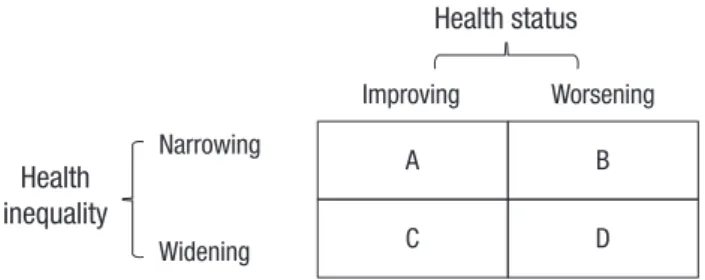
Health behavior- and health problem-oriented approaches, on which the Korean government’s Health Plan has largely been based, should also be developed. Fig. 5 shows the relationship of changes in health status (mean) with changes in health inequal- ities (distribution) and provides information on policy priority areas (25). If the mean and inequality levels are improved and narrowed, respectively, the policy priority would be low (A in the Fig. 5). On the other hand, the policy priority will increase when those mean and inequality measures simultaneously deterio- rate (D in the Fig. 5). This latter case can be found for suicide in Korea (46-48). If the mean value for a health indicator is being improved but the level of inequality widens (C in the Fig. 5, e.g., men’s smoking), more specific policy measures should be di- rected toward disadvantaged groups of the Korean population.
To be informed of the policy priority areas, it is warranted to mon- itor the current status and time trends of socioeconomic differ- entials in all indicators included in the Health Plan of Korea. Re- garding equity-sensitive interventions related to health behav- iors and health problems, the importance of programs for reduc- ing socioeconomic inequalities in cigarette smoking and suicide need to be highlighted. Cigarette smoking is the most important factor among established cardiovascular risk factors in explain- ing relative and absolute inequalities in all-cause mortality, es- pecially among men in Korea (65). Governmental policy efforts to reduce smoking during the past 15 yr have not succeeded in reducing socioeconomic differentials in smoking in men and
Health inequality
Narrowing
Widening
Improving
Health status Worsening A
C
B D
Fig. 5. A framework for prioritizing health problems, taking into account changes in health status and health inequalities.
women (66-69). With skyrocketing increases in average mortal- ity rates, especially among the elderly population (48), suicide showed widening socioeconomic inequalities in Korea (46-48).
Thus, interventions to decrease social gaps in suicidal deaths would also contribute to the reduction of average suicide mor- tality rates.
Reducing health inequalities is not an easy task, as recently seen in the UK, where the target for health inequalities, the 10%
reduction of the gaps in life expectancy and infant mortality, was not achieved despite long-term governmental engagement with socioeconomic inequalities in health. Tackling health inequali- ties requires a broad response from all government departments, not just the health sector. In addition to ‘upstream’ policies, ‘mid- stream’ and ‘downstream’ policies and programs are also nec- essary. ‘Good intention and received wisdom’ is not necessarily a good guide toward health equity (70). Policies should be in- formed by evidence-based interventions.
CONCLUSIONS
Health inequalities are an important aspect of social injustice.
Health inequalities are not only an ethical issue but also a pub- lic health problem. Reducing health inequalities should be a major objective of governmental health, social, and economic policies in Korea. The magnitude of health inequalities needs to be monitored to evaluate policies and guide the future directions of the policies. Upstream, midstream, and downstream mecha- nisms in the creation of health inequalities should be extensive- ly explored to indicate entry points of policies. Intervention pro- grams intensive enough to significantly improve the health sta- tus of the disadvantaged should be newly developed, tested, and applied. Considering the unabated trends in the social divide in Korea, active and intensive engagement of many policy sectors equipped with good evidence are needed to realize a meaning- ful reduction of health inequalities in the future.
REFERENCES
1. CSDH (Commission on Social Determinants of Health). Closing the gap in a generation: health equity through action on the social determi- nants of health. Final report of the commission on social determinants of health. Geneva: WHO, 2008.
2. Ministry of Health and Welfare and Korea Centers for Disease Control and Prevention. 2009 Nation’s Health Statistics: findings of Korea nation- al health and nutrition examination survey IV-3 (2009). Seoul: Ministry of Health and Welfare and Korea Centers for Disease Control and Pre- vention, 2010.
3. Kim YM, Kim MH. Health inequalities in Korea: current conditions and implications. J Prev Med Public Health 2007; 40: 431-8.
4. Statistics Korea. Korean Statistical Information Service. Available at http://kosis.kr/[accessed on 2 May 2011].
5. World Bank. The East Asian Miracle: economic growth and public poli-
cy. New York: Oxford University Press, 1993.
6. Khang YH, Lynch J. Asian economic crises and health: population health impacts and policy responses. J Epidemiol Community Health 2010; 64:
282-3.
7. Kim IH, Muntaner C, Khang YH, Paek DM, Cho SI. The relationship be- tween nonstandard working and mental health in a representative sam- ple of the South Korean population. Soc Sci Med 2006; 63: 566-74.
8. Kim MH, Kim CY, Park JK, Kawachi I. Is precarious employment dam- aging to self-rated health? Results of propensity score matching methods, using longitudinal data in South Korea. Soc Sci Med 2008; 67: 1982-94.
9. Choo H. Economic growth and income distribution in Korea. Seoul:
Korea Development Institute, 1978.
10. Suh SM. Economic growth and change in income distribution: the Korean case. Seoul: Korea Development Institute, 1985.
11. Park HJ. A study on infant deaths in Korean rural area. Seoul J Med 1962;
3: 41-51.
12. Population Division of the Department of Economic and Social Affairs of the United Nations Secretariat. World population prospects: the 2006 revision and world urbanization prospects: the 2007 revision, Available at http://esa.un.org/unup [accessed on 4 May 2011].
13. Kwon TH. The trends and patterns of mortality and health in the Repub- lic of Korea. Asian population studies series. No. 76. Bankok: Economic and Social Commission for Asia and the Pacific, 1986.
14. Kim TH. Mortality transition in Korea: 1960-1980. Seoul: Seoul National University, The Population and Development Studies Center, 1990.
15. Khang YH, Lynch JW, Harper S, Yang S, Yun SC, Jung-Choi K, Kim HR.
The contribution of material, psychosocial, and behavioral factors to ex- plain educational and occupational mortality inequalities in a nation- ally representative sample of South Koreans: relative and absolute per- spectives. Soc Sci Med 2009; 68: 858-66.
16. Mackenbach JP, Stirbu I, Roskam AJ, Schaap MM, Menvielle G, Leinsalu M, Kunst AE; European Union Working Group on Socioeconomic In- equalities in Health. Socioeconomic inequalities in health in 22 Europe- an countries. N Engl J Med 2008; 358: 2468-81.
17. Regidor E, Ronda E, Pascual C, Martínez D, Calle ME, Domínguez V.
Decreasing socioeconomic inequalities and increasing health inequali- ties in Spain: a case study. Am J Public Health 2006; 96: 102-8.
18. Blakely T, Wilson N. Shifting dollars, saving lives: What might happen to mortality rates, and socio-economic inequalities in mortality rates, if in- come was redistributed? Soc Sci Med 2006; 62: 2024-34.
19. Deaton A. Policy implications of the gradient of health and wealth. Health Aff (Millwood) 2002; 21: 13-30.
20. Starfield B, Birn AE. Income redistribution is not enough: income inequal- ity, social welfare programs, and achieving equity in health. J Epidemiol Community Health 2007; 61: 1038-41.
21. Khang YH. Historical advances in health inequality research . J Prev Med Public Health 2007; 40: 422-30.
22. Khang YH. Lifecourse approaches to socioeconomic health inequalities.
J Prev Med Public Health 2005; 38: 267-75.
23. Son M. Commentary: why the educational effect is so strong in differen- tials of mortality in Korea? Int J Epidemiol 2004; 33: 308-10.
24. Jung-Choi KH. Contribution of causes of death to socioeconomic mor- tality inequalities: current status and time trends in Korea [dissertation].
Seoul: University of Ulsan, 2008.
25. Khang YH, Kang MA, Kim MH, Kim YM, Shin YJ, Yoo WS, Yoon TH,
Jang SN, Jeong BG, Jungchoi KH, Cho SI, Cho HJ, Choi YE, Choi YJ, Heo SI. Developing indicators of equity in health and monitoring magnitude of socioeconomic inequalities in health. Seoul: University of Ulsan & Man- agement Center for Health Promotion, 2006.
26. Kwon SM, Son M, Lee EJ, Cho SI, Cho YT, Ku MJ, Kim YH, Oh J, Chung HJ. Developing performance indicators of equity in health. Seoul: Seoul National University & Management Center for Health Promotion, 2006.
27. Shin YJ, Kim MH, Yoon TH. Health promotion strategies and programmes development for health inequalities alleviation. Seoul: Hanyang Univer- sity & Management Center for Health Promotion, 2009.
28. Son M, Kim SJ, Lee JH, Kim JO, Bae SH, Oh JH, Hwang SS, Kim YJ, Jung SM, Lee WJ, Lee SY, Park JH, Park JH, Lim DO, Park IS, Yoon CK. Reduc- ing inequalities in cancer incidence and mortality: developing epidemio- logic health inequality index and health policy in Korea. Seoul: Kang- won National University & Ministry of Health and Welfare, 2008.
29. Kaplan GA, Lynch JW. Whither studies on the socioeconomic founda- tions of population health? Am J Public Health 1997; 87: 1409-11.
30. The Korean Society for Equity in Health. Methods in health inequalities measurement. Seoul: Hanul Publishing Group, 2007.
31. Lee SY, Kim SY, Kim CW, Park HK, Yoon TH, Kim JH. Inequality on med- ical service utilization among stroke patients across income groups. Seoul:
Cheju National University & Management Center for Health Promotion, 2007.
32. Kim HR, Khang YH, Yoon KJ, Kim CS. Socioeconomic health inequali- ties and counter policies in Korea. Seoul: Korea Institute for Health and Social Affairs, 2004.
33. Kim MH, Seo JH, Son JI, Cho HJ, Choi YJ. PHI health equity report 2010.
Anti-smoking policies and health inequalities in Korea. Seoul: People’s Health Institute, 2010.
34. Cho HJ. Mortality differentials of government officers and private school teachers by social stratification in Korea [dissertation]. Seoul: Seoul Na- tional University, 1997.
35. Kim CW, Lee SY, Moon OR. Inequalities in cancer incidence and mor- tality across income groups and policy implications in South Korea. Pub- lic Health 2008; 122: 229-36.
36. Kim HR, Khang YH, Park EJ, Choi JS, Lee YH, Kim YS. Socioeconomic, behavioral, nutritional, and biological determinants of morbidity, mor- tality, and medical utilization in South Korea. Seoul: Korea Institute for Health and Welfare, 2006.
37. Song YM, Ferrer RL, Cho SI, Sung J, Ebrahim S, Davey Smith G. Socio- economic status and cardiovascular disease among men: the Korean na- tional health service prospective cohort study. Am J Public Health 2006;
96: 152-9.
38. Yim J, Hwang SS, Yoo KY, Kim CY. Contribution of income-related in- equality and healthcare utilisation to survival in cancers of the lung, liver, stomach and colon. J Epidemiol Community Health 2012; 66: 37-40.
39. Yoon TH, Lee SY, Kim CW, Kim SY, Jeong BG, Park HK. Inequalities in medical care utilization by South Korean cancer patients according to income: a retrospective cohort study. Int J Health Serv 2011; 41: 51-66.
40. Jang SN, Cho SI, Chang J, Boo K, Shin HG, Lee H, Berkman LF. Employ- ment status and depressive symptoms in Koreans: results from a baseline survey of the Korean Longitudinal Study of Aging. J Gerontol B Psychol Sci Soc Sci 2009; 64: 677-83.
41. Seo JH, Kim H, Shin YJ. Analysis for the impact of adulthood and child- hood socioeconomic positions and intergenerational social mobility on
adulthood health. J Prev Med Public Health 2010; 43: 138-50.
42. Khang YH, Lynch JW, Kaplan GA. Health inequalities in Korea: age- and sex-specific educational differences in the 10 leading causes of death. Int J Epidemiol 2004; 33: 299-308.
43. Yang S, Khang YH, Harper S, Davey Smith G, Leon D, Lynch J. Under- standing rapid increase in life expectancy in Korea. Am J Public Health 2010; 100: 896-903.
44. Bae JY. Impacts of health insurance coverage expansion on healthcare utilization and health status [dissertation]. Seoul: Seoul National Uni- versity, 2009.
45. Khang YH, Lynch JW, Yun S, Lee SI. Trends in socioeconomic health in- equalities in Korea: use of mortality and morbidity measures. J Epidemi- ol Community Health 2004; 58: 308-14.
46. Lee WY, Khang YH, Noh M, Ryu JI, Son M, Hong YP. Trends in education- al differentials in suicide mortality beforebetween 1993-2006 in Korea.
Yonsei Med J 2009; 50: 482-92.
47. Khang YH, Hwang IA, Yun SC, Jo MW, Lee MJ, Lee MS, Lee SI. Changes in mortality inequality in relation to the South Korea economic crisis: use of area-based socioeconomic position. J Prev Med Public Health 2005;
38: 359-65.
48. Kim MH, Jung-Choi K, Jun HJ, Kawachi I. Socioeconomic inequalities in suicidal ideation, parasuicides, and completed suicides in South Korea.
Soc Sci Med 2010; 70: 1254-61.
49. Son M. The effects of the parents’ social class on the low birthweight among the births, 1995-2001. Korean J Health Policy Adm 2004; 14: 148-68.
50. Lee CG. Tracking health inequalities in Korea. Reports for agenda set- ting. Seoul: Mim Books, 2007.
51. Ministry of Health and Welfare and Korea Institute for Health and Social Affairs. Establish of new health plan 2010. Seoul: Ministry of Health and Welfare and Korea Institute for Health and Social Affairs, 2005, p42-6, 883.
52. Ministry of Health and Welfare. The national health plan 2020. Seoul:
Ministry of Health and Welfare, 2011.
53. Yoon TH. The proposal of policies aimed at tackling health inequalities in Korea. J Prev Med Public Health 2007; 40: 447-53.
54. Whitehead M. Diffusion of ideas on social inequalities in health: a Euro- pean perspective. Milbank Q 1998; 76: 469-92, 306.
55. Mackenbach JP, Bakker MJ; European Network on Interventions and Policies to Reduce Inequalities in Health. Tackling socioeconomic in- equalities in health: analysis of European experiences. Lancet 2003; 362:
1409-14.
56. Mackenbach, Bakker M, editors. Reducing inequalities in health. A Eu- ropean perspective. London: Routledge, 2002.
57. The Marmot Review. Fair society, healthy lives. London: UK Department of Health, 2010.
58. European Review on the Social Determinants of Health and the Health Divide. Available at http://www.marmotreview.org/european-review- of-hi/description.aspx [accessed on 11 May 2011].
59. Heckman JJ. Skill formation and the economics of investing in disad- vantaged children. Science 2006; 312: 1900-2.
60. Cunha F, Heckman JJ. The economics and psychology of inequality and human development. J Eur Econ Assoc 2009; 7: 320-64.
61. UK Department of Education. Every child matters. London: UK Depart- ment of Education, 2003.
62. UK Department of Children, Schools, and Families and UK Department
of Health. Healthy lives, brighter futures. London: UK Department of Children, Schools, and Families and UK Department of Health, 2009.
63. Australian Government. Investing in the early years: a national early childhood development strategy. An initiative of the council of Austra- lian governments. ACT, Australia: Australian Government, 2009.
64. Kim MH, Kim IA, Park YJ, Park JW, Son JI, Lee SI, Jung MS. A report on the calculation of the minimum income for hHealthy living in Korea.
Available at http://www.healthequity.or.kr/ [accessed on 11 May 2011].
65. Khang YH, Lynch JW, Jung-Choi KH, Cho HJ. Explaining age specific inequalities in mortality from all causes, cardiovascular disease and isch- aemic heart disease among South Korean male public servants: relative and absolute perspectives. Heart 2008; 94: 75-82.
66. Cho HJ, Song YM, Smith GD, Ebrahim S. Trends in socio-economic dif-
ferentials in cigarette smoking behaviour between 1990 and 1998: a large prospective study in Korean men. Public Health 2004; 118: 553-8.
67. Khang YH, Cho HJ. Socioeconomic inequality in cigarette smoking: trends by gender, age, and socioeconomic position in South Korea, 1989-2003.
Prev Med 2006; 42: 415-22.
68. Khang YH, Yun SC, Jung-Choi K, Cho HJ. The impact of governmental anti-smoking policy on socioeconomic disparities in cigarette smoking in South Korea. Nicotine Tob Res 2009; 11: 262-9.
69. Kim HR. Socioeconomic inequality and its trends in cigarette smoking in South Korea, 1998-2005. Health Soc Welf Rev 2007; 27: 25-43.
70. Macintyre S. Good intentions and received wisdom are not good enough:
the need for controlled trials in public health. J Epidemiol Community Health 2010; 65: 564-7.