Received:August 13, 2018, Revised:(1st) October 18, 2018, (2nd) November 12, 2018, Accepted:November 13, 2018 Corresponding to:Shin-Seok Lee http://orcid.org/0000-0001-6810-7355
Division of Rheumatology, Department of Internal Medicine, Chonnam National University Medical School & Hospital, 42 Jebong-ro, Dong-gu, Gwangju 61469, Korea. E-mail:[email protected]
*These authors contributed equally to this work.
Copyright ⓒ 2019 by The Korean College of Rheumatology. All rights reserved.
This is a Open Access article, which permits unrestricted non-commerical use, distribution, and reproduction in any medium, provided the original work is properly cited.
Original Article
https://doi.org/10.4078/jrd.2019.26.1.57
Comparison of Renal Responses to Cyclophosphamide and Mycophenolate Mofetil used as Induction Therapies in Korean Patients with Lupus Nephritis
Sung-Eun Choi1,*, Dong-Jin Park1,*, Ji-Hyoun Kang1, Kyung-Eun Lee1, Haimuzi Xu1, Ji Shin Lee2, Yoo-Duk Choi2, Shin-Seok Lee1
1Division of Rheumatology, Department of Internal Medicine, and 2Department of Pathology, Chonnam National University Medical School &
Hospital, Gwangju, Korea
Objective. Although intravenous cyclophosphamide (IVC) is generally accepted as the standard therapy for induction treatment of active proliferative lupus nephritis (LN), several clinical trials have suggested that mycophenolate mofetil (MMF) is at least as effective as IVC. Because few Asian studies have compared the two treatment modalities, we compared the efficacies of MMF and IVC as LN remission induction treatments in Korean patients. Methods. We enrolled 39 patients with class III and IV LN who received MMF or IVC as LN induction therapy. The renal outcomes (i.e., complete response [CR], partial response [PR], and no response [NR]) at 6 and 12 months were defined using the ACR 2006 response criteria. Results. Of 39 patients, 23 (59.0%) were treated with IVC, and 16 (41.0%) were treated with MMF. Demographics, clinical characteristics, laboratory data, and adverse events did not significantly differ between the two groups. However, C3 levels were lower and activity scores in renal biopsy were higher in IVC-treated patients. CRs were achieved by 11 (47.8%) of the patients receiving IVC and 7 (43.8%) of the patients receiving MMF after 6 months of treatment (p=0.961) and by 11 (47.8%) of those who received IVC and 9 (56.2%) of those who received MMF at 12 months of treatment (p=0.713). Neither the PR rate nor the NR rate differed sig- nificantly at 6 or 12 months between the two groups. Conclusion. The efficacy of MMF does not differ from that of IVC in terms of induction of LN remission in Korean patients. (J Rheum Dis 2019;26:57-65)
Key Words. Lupus nephritis, Cyclophosphamide, Mycophenolic acid, Induction of remission
INTRODUCTION
Systemic lupus erythematosus (SLE) is a chronic, mul- ti-organ autoimmune disease characterized by the pres- ence of autoantibodies and various clinical manife- stations. Renal injury is one of the most common and se- rious manifestations of SLE. Lupus nephritis (LN) devel- ops in up to 60% of patients during the course of SLE, and it is the principal cause of mortality and morbidity be- cause of the associated complications and progression to end-stage renal disease [1].
Many immunosuppressive agents have been developed
to inhibit the progression of LN patients to renal failure.
Conventionally, active proliferative LN has been managed using high doses of intravenous cyclophosphamide (IVC) combined with corticosteroids [2]. IVC has improved LN outcomes, but its use is limited by its severely toxic side effects, which can lead to hemorrhagic cystitis, opportun- istic infections, bone marrow suppression, premature go- nadal failure, and increased risk for malignancy [3]. To avoid such serious side effects, alternative treatments have been sought. Of the various immunosuppressants, mycophenolate mofetil (MMF) has emerged as a useful therapeutic modality. A randomized, controlled trial per-
formed in 2005 showed that MMF was superior to IVC in terms of inducing a complete response (CR) in patients with active LN, and it had a more favorable safety profile [4]. However, other studies and meta-analyses have not found significant differences between MMF and IVC in these contexts; both treatments have been associated with clinical improvements [5,6]. Notably, the Aspreva Lupus Management Study (ALMS) tested the hypothesis that MMF was superior to IVC as an LN remission in- duction therapy but found that the two treatments did not differ in terms of renal response or safety profile [7].
Interestingly, the ALMS found that the efficacy of IVC var- ied among different racial and ethnic groups, being less effective for patients of African and Hispanic descent [8].
MMF and IVC demonstrated similar efficacy and were used as induction treatment in previous trials in Hong Kong [9,10], Malaysia [11], China [12,13], Japan [14], and India [15,16]. Unfortunately, no randomized con- trolled trials have compared MMF and IVC to induce re- mission in Korean patients. Thus, in the present study, we retrospectively compared the efficacy of MMF and IVC as LN remission induction treatments in ethnically homo- geneous Korean patients.
MATERIALS AND METHODS
Patients
This study was a retrospective observational study.
Between January 2008 and January 2012, we evaluated 79 patients with LN from the lupus cohort of Chonnam National University Hospital. All patients fulfilled the re- vised 1997 criteria for SLE [17]. The inclusion criteria in- cluded a visit to our hospital within 6 months of SLE diag- nosis, presence of adequate renal biopsy material, and a renal biopsy report suggestive of LN. Renal biopsy reports were used to confirm LN in all patients, and renal biopsy specimens were reclassified using the system of the International Society of Pathology/Renal Pathology Society (ISN/RPS) [18] by two renal pathologists blinded to previous biopsy data and clinical features. Patients were excluded if they exhibited advanced comorbidities or other diseases associated with kidney dysfunction, in- cluding diabetic or primary kidney disease. Patients for whom medical records were inadequate or who were fol- lowed up for <1 year were also excluded. Finally, of the 79 patients, we selected 39 patients with class III and IV lupus nephritis who received MMF or IVC as an LN in- duction therapy. The study was approved by the
Institutional Review Board of Chonnam National University Hospital (approval no. CNUN-2014-239), which waived the need for informed consent because of the retrospective nature of the study.
Data collection
Baseline demographic and clinical data were collected from medical records created at the time of renal biopsy.
Demographic data (age, sex, educational level, hyper- tension and diabetes mellitus status, and disease dura- tion at LN onset) were included. Hypertension was de- fined as systolic blood pressure >140 mmHg and/or dia- stolic blood pressure >90 mmHg on two or more occa- sions and/or the use of anti-hypertensive drugs. Diabetes mellitus was considered present if the fasting blood glu- cose level was >126 mg/dL or the patient receiving in- sulin or taking oral hypoglycemic agent.
Laboratory data were based on a complete differential blood count, the erythrocyte sedimentation rate (ESR), C-reactive protein (CRP), urinalysis data, proteinuria (g/day) data, lipid profiles (levels of total cholesterol, high-density lipoprotein [HDL] cholesterol, low-density lipoprotein [LDL] cholesterol, and triglycerides), and the serum levels of albumin, and creatinine. Kidney function parameters were measured every 1∼3 months during fol- low-up. The glomerular filtration rate (GFR) was calcu- lated according to the Modification of Diet in Renal Disease (MDRD) study equation: estimated GFR (eGFR, mL/min/1.73 m2)=186×(SCr [mg/dL])−1154×(age)−0203× (0.742 if female). Serological markers (the levels of auto- antibodies, complement components [C3, C4, and CH50], anti-phospholipid antibodies [lupus anticoagulant, IgG/M anticardiolipin (aCL), and IgG anti-beta2-glycoprotein I (β2GPI)]) were also measured. The levels of autoanti- bodies, including anti-Smith (Sm), anti-ribonucleopro- tein (RNP), anti-Ro, and anti-La autoantibodies, were as- sessed using enzyme-linked immunosorbent assays (ELISAs). Anti-nucleosome and anti-ribosomal P anti- bodies were measured using anti-extractable nuclear an- tigen (ENA). Disease activity was assessed using the SLE disease activity index (SLEDAI) 2000 [19].
The renal biopsy results were separately classified by two blinded renal pathologists based on the 2004 ISN/RPS criteria [18]. Activity and chronicity indices were determined by reference to the scoring systems of the US National Institutes of Health [20]. Patients with mixed-type LN were assigned to the predominant type.
For example, type III+V cases were classified as type III
Table 1. Demographic and laboratory characteristics of the two different treatment groups at the time of renal biopsy
Variables IVC group (n=23) MMF group (n=16) p-value
Age at onset of LN (yr) 31.7±8.86 32.3±14.33 0.832
Female, sex 20/23 (87.0) 15/16 (93.8) 0.452
Disease duration at onset of LN (mo) 4.87±4.25 7.44±5.50 0.143
Education (yr) 12.78±3.75 13.25±3.24 0.789
Hypertension at onset of LN 3/23 (13.0) 4/16 (25.0) 0.294
Diabetes mellitus at onset of LN 1/23 (4.0) 0/16 (0) 0.590
SLEDAI-2000 12.13±4.79 11.12±4.25 0.437
Laboratory findings
White blood cells (/mm3) 5,634.8±2,913.7 8,468.8±4,962.9 0.050
Lymphocytes (/mm3) 1,143.0±523.1 1,474.4±992.6 0.251
Hemoglobin (g/dL) 10.2±2.00 11.3±1.46 0.074
Platelets (×103/mm3) 196.3±74.5 214.3±74.5 0.471
ESR (mm/h) 38.5±28.8 46.3±40.1 0.662
CRP (mg/dL) 0.53±0.44 0.75±0.84 0.976
Albumin (mg/dL) 2.86±0.77 3.26±0.74 0.168
Total cholesterol (mg/dL) 198.8±48.1 212.9±59.5 0.582
HDL cholesterol (mg/dL) 48.9±17.3 57.8±20.7 0.128
LDL cholesterol (mg/dL) 123.1±43.4 133.1±49.8 0.329
Triglycerides (mg/dL) 159.4±57.2 154.6±56.6 0.899
Serum creatinine (mg/dL) 0.92±0.80 0.85±0.39 0.810
eGFR (mL/min/1.72 m2) 104.7±37.8 103.4±43.8 0.582
Proteinuria (g/24 h) 3.34±3.12 4.24±3.34 0.315
Autoantibodies
Antinuclear 23/23 (100) 15/16 (93.8) 0.410
Anti-dsDNA 521.9±1,303.7 267.0±763.7 0.065
Anti-Sm 9/23 (39.1) 7/16 (43.8) 0.515
Anti-RNP 8/23 (34.8) 8/16 (50.0) 0.267
Anti-Ro/SS-A 14/23 (60.9) 11/16 (68.8) 0.437
Anti-La/SS-B 6/23 (26.1) 3/16 (18.8) 0.446
Anti-nucleosome 14/20 (70.0) 10/15 (66.7) 0.560
Anti-ribosomal-P 5/20 (25.0) 4/15 (26.7) 0.606
Lupus anticoagulant 0/21 (0.0) 1/15 (6.7) 0.417
IgG-aCL 2/21 (9.5) 3/15 (20.0) 0.337
IgM-aCL 0/20 (0.0) 0/14 (0) 1.000
IgG anti-β2GP1 6/19 (31.6) 8/14 (57.1) 0.133
Complement levels
C3 47.2±24.0 67.9±22.8 0.011
C4 9.6±5.0 19.3±24.9 0.207
CH50 21.4±15.4 29.2±14.9 0.107
Values are presented as mean±standard deviation or number (%). IVC: intravenous cyclophosphamide, MMF: mycophenolate mofetil, LN: lupus nephritis, SLEDAI: systemic lupus erythematosus disease activity index, ESR: erythrocyte sedimentation rate, CRP: C-reactive protein, HDL: high-density lipoprotein, LDL: low-density lipoprotein, eGFR: estimated glomerular filtration rate, aCL: anti-cardiolipin, β2GPI: beta2-glycoprotein I.
and type IV+V cases as type IV.
We recorded medications used as induction and main- tenance therapies, as well as all medications taken for >3 months prior to LN onset, such as hydroxychloroquine (HCQ) and prednisolone (>5 mg/day). We reviewed whether HCQ was taken continuously (for >8 months of the 1-year follow-up period) after LN onset. The use of
angiotensin converting enzyme inhibitors (ACEis) and/or angiotensin receptor blockers (ARBs) (which re- duce proteinuria) was also reviewed.
Treatment and definition of remission
Treatment was at the discretion of the responsible rheu- matologist and included corticosteroids with high-dose
Table 2. Renal biopsy findings in the two different treatment groups
Variable IVC group (n=23) MMF group (n=16) p-value
Activity index
Endo-capillary hypercellularity 22 (95.7) 12 (75.0) 0.080
Leukocyte infiltration 19 (82.6) 12 (75.0) 0.425
Sub-endothelial hyaline deposits 22 (95.7) 14 (87.5) 0.363
Fibrinoid necrosis/Karyorrhexis 19 (82.6) 7 (43.8) 0.014
Cellular crescents 9 (39.1) 4 (25.0) 0.285
Interstitial inflammation 22 (95.7) 15 (93.8) 0.659
Chronicity index
Glomerular sclerosis 7 (30.4) 9 (56.2) 0.100
Tubular atrophy 13 (56.5) 12 (75.0) 0.200
Interstitial fibrosis 17 (73.9) 13 (81.2) 0.446
Fibrous crescents 2 (8.7) 2 (12.5) 0.548
Activity score 9.65±3.10 6.25±3.72 0.007
Active score (≥12) 9 (39.1) 2 (12.5) 0.070
Chronicity score 1.87±1.33 2.50±1.55 0.159
Chronic score (≤4) 3 (13.0) 6 (37.5) 0.082
Values are presented as number (%) or mean±standard deviation. IVC: intravenous cyclophosphamide, MMF: mycophenolate mofetil.
IVC (500∼1,000 mg/m2 body surface area in monthly pulses) or corticosteroids with MMF (up to 3 g/day), fol- lowed by quarterly IVC or MMF [21,22]. Corticosteroids were administered as prednisolone 30∼60 mg/day, with or without intravenous methylprednisolone pulse ther- apy (500∼1,000 mg/day×3 days).
Treatment responses after 6 and 12 months were de- fined using the ACR 2006 clinical trial criteria [23]. A CR was defined as a normal GFR (90 mL/min/1.73 m2) or a
>25% increase from baseline or, if the baseline estimated GFR (eGFR) was abnormal, as a urine protein-to-crea- tinine ratio <0.2, a dipstick test result of 0 or trace, and no urinary sediment (≤5 red blood cells [RBCs]/
high-power field [HPF] and no cellular casts). A partial response (PR) was defined as a stable eGFR, a >50% re- duction in the urinary protein-to-creatinine ratio (or a ra- tio in the range of 0.2∼2.0), and no urinary sediment. No response (NR) was defined as a failure to meet the re- mission criteria.
Statistical analysis
All statistical analyses and data processing were per- formed using SPSS software (ver. 23.0; IBM Co., Armonk, NY, USA). Continuous variables are expressed as mean±standard deviation, and categorical variables as percentages. The Mann-Whitney U-test was used to com- pare continuous variables, and chi-square test and Fisher’s exact tests were used to compare categorical
variables. The Mantel-Haenszel method was employed to compare the renal responses of the IVC and MMF groups at 6 and 12 months. p-values <0.05 were considered to be statistically significant.
RESULTS
We included a total of 39 patients with biopsy-proven LN. The mean age at LN onset was 31.92±11.2 years, and 89.7% of all the patients were women. The mean disease duration at the time of biopsy-confirmed LN onset was 5.92±4.90 months. Among the patients, 17.9% had hy- pertension at the time of LN onset, and 2.6% diabetes mellitus. In all, 23 patients (59.0%) were treated with IVC as induction therapy, and 16 (41.0%) were treated with MMF; both groups were also prescribed corticosteroids.
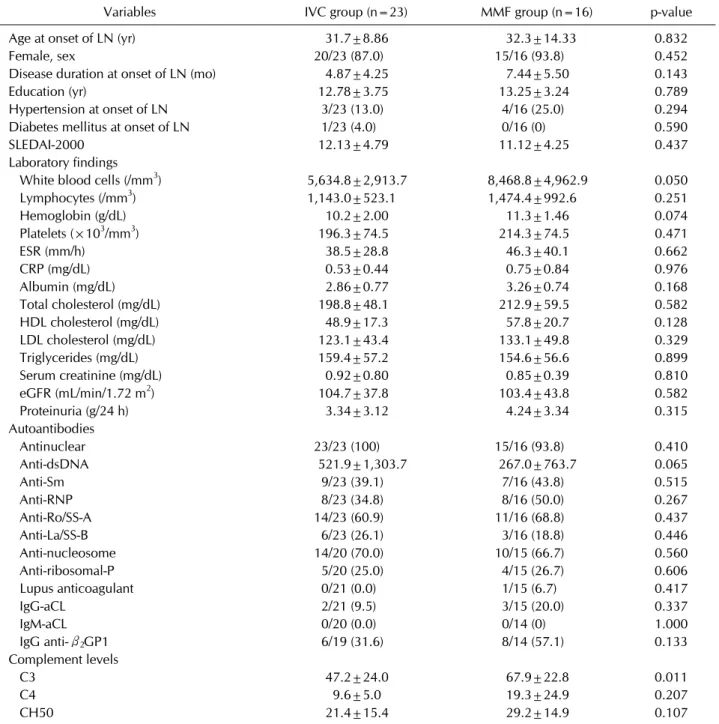
The baseline demographic and clinical characteristics of all the patients at the time of renal biopsy are shown in Table 1. The mean age at LN onset was 31.7 years in the IVC-treated patients and 32.3 years in the MMF-treated patients. The mean disease duration at the time of LN on- set was 4.87 months in the IVC-treated patients and 7.44 months in the MMF-treated patients. In terms of labo- ratory findings, the IVC-treated patients had lower white blood cell counts (p=0.050) than the MMF-treated patients. No other laboratory measurements (of in- flammatory markers, lipid profiles, or kidney function pa-
Table 3. Medications used by LN patients in the two different treatment groups
Variable IVC group (n=23) MMF group (n=16) p-value
Treatment before diagnosis of LN
Prednisolone (>5 mg/day) 12 (52.1) 12 (75.0) 0.134
Hydroxychloroquine 12 (52.1) 10 (62.5) 0.379
ACEi or ARB 2 (8.7) 0 (0.0) 0.341
Hydroxychloroquine during follow-up 19 (82.6) 15 (93.8) 0.305
ACEi or ARB during follow-up 16 (69.6) 8 (50.0) 0.184
Values are presented as number (%). LN: lupus nephritis, IVC: intravenous cyclophosphamide, MMF: mycophenolate mofetil, ACEi: angiotensin converting enzyme inhibitor, ARB: angiotensin receptor blocker.
Table 4. Renal responses in the two different treatment groups at 6 and 12 months
Variable IVC group (n=23) MMF group (n=16) p-value
6-month outcome 0.961
CR 11 (47.8) 7 (43.8)
PR 5 (21.7) 4 (25.0)
NR 7 (30.4) 5 (31.2)
12-month outcome 0.713
CR 11 (47.8) 9 (56.2)
PR 7 (30.4) 3 (18.8)
NR 5 (21.7) 4 (25.0)
Reduction of 24 h proteinuria, >50% 18 (78.3) 12 (75.0) 0.554
Time to reduction, >50%, days 145.3±170.8 198.9±231.7 0.917
Reduction of proteinuria, <500 mg/day 16 (69.6) 12 (75.0) 0.500
Time to reduction, <500 mg/day, days 257.7±341.8 318.3±288.7 0.537
Reduction of proteinuria, <200 mg/day 14 (60.9) 10 (62.5) 0.593
Time to reduction, <200 mg/day, days 486.0±515.6 609.2±433.7 0.335
Values are presented as number (%) or mean±standard deviation. IVC: intravenous cyclophosphamide, MMF: mycophenolate mofetil, CR: complete response, PR: partial response, NR: no response.
rameters) differed between the two groups. The autoanti- body levels did not differ between the two groups. In terms of complement components, the C3 level was sig- nificantly lower in the IVC-treated patients than in the MMF-treated patients (p=0.011).
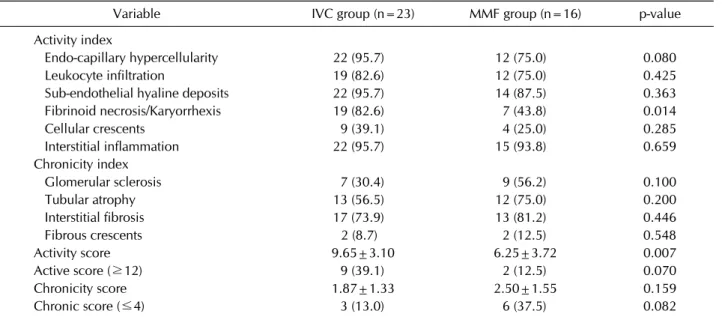
The renal biopsy findings of the two groups are com- pared in Table 2. Of the various activity indices, fibrinoid necrosis/karyorrhexis was more common in the IVC-treated patients than in the MMF-treated patients (p=0.014). Similarly, the activity score was significantly higher in the IVC-treated patients than in the MMF-treat- ed patients (p=0.007). No other chronicity indices or scores differed between the two groups. However, when patients with an activity score greater than 12 were eval- uated, there was no difference in number of patients be- tween the two treatment groups. To conclude, the renal responses for the two different treatments at 6 and 12 months in patients with higher activity scores in the renal
biopsy (activity score >12) were not significantly differ- ent (p=0.973 for the 6-month outcome, p=0.708 for the 12-month outcome).
Table 3 lists the medications taken before LN onset and during the follow-up period. There were no significant be- tween-group differences in the use of prednisolone, HCQ, ACEi, or ARB. In addition, the medications used during follow-up, including HCQ, ACEi, and ARB, did not differ between the groups. During induction treat- ment, two patients from IVC group were treated with ste- roid pulse therapy. However, no patient in MMF group re- ceived steroid pulse therapy. For maintenance therapy, IVC, MMF, Azathioprine (AZA), and glucocorticoids were considered according to the ACR guidelines for the management of lupus nephritis class III/IV induction therapy. In this study, as maintenance therapy, 16/16 (100%) patients in the MMF group treated with MMF as maintenance therapy. In the IVC group, 4/23 (17.4%) pa-
Table 5. Adverse events in the two different treatment groups over 12 months
Variable IVC group (n=23) MMF group (n=16) p-value
Any adverse event 15 (65.2) 11 (68.8) 0.548
Death 0 (0.0) 0 (0.0) -
Major infection requiring hospitalization
Pneumonia 0 (0.0) 3 (18.8) 0.061
Minor infection
Cellulitis 1 (4.3) 0 (0.0) 0.590
Herpes zoster 1 (4.3) 1 (6.2) 0.659
Upper respiratory tract infection 2 (8.6) 2 (12.5) 0.548
Amenorrhea 0 (0.0) 1 (6.2) 0.410
Menstrual irregularities 2 (8.6) 0 (0.0) 0.341
Leukopenia, WBC count <1,500/μL 2 (8.6) 0 (0.0) 0.341
Values are presented as number (%). IVC: intravenous cyclophosphamide, MMF: mycophenolate mofetil, WBC: white blood cell.
tients received quarterly IVC, 5/23 (21.7%) received MMF, 7/23 (30.4%) received AZA, and 5/23 (21.7%) re- ceived steroids as maintenance medication.
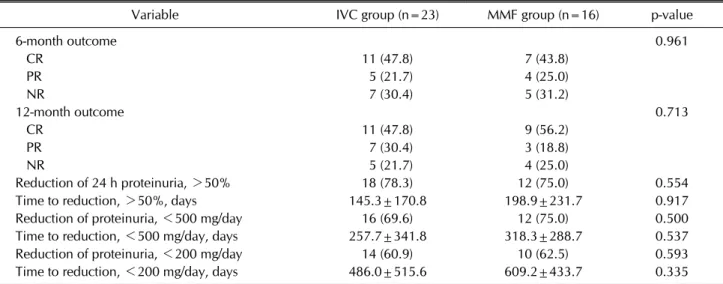
The renal responses of the two groups at 6 and 12 months are presented in Table 4. At 6 months, 11 of the 23 IVC-treated patients (47.8%) and 7 of the 16 MMF-treated patients (43.8%) had attained a CR. PRs were evident in 5 of the 23 IVC-treated patients (21.7%) and 4 of the 16 MMF-treated patients (25.0%). The renal responses at 6 months did not differ significantly between the groups (p=0.961). At 12 months, 11 (47.8%) and 7 (30.4%) of the IVC-treated patients exhibited either a CR or a PR, respectively, as did 9 (56.2%) and 3 (18.8%) of the MMF-treated patients. Similarly, the renal responses at 12 months did not differ significantly between the two groups (p=0.713). The renal outcomes at 6 and 12 months were defined using the ACR 2006 response criteria. Renal dysfunction (GFR <60) at the secondary endpoint occurred in 3/23 (13.0%) IVC patients and 5/16 (31.3%) MMF patients. No other chronicity indices or scores differed between the two groups.
Additional analyses were performed of patients who ex- hibited a renal response, defined as a >50% reduction of 24 hours proteinuria, <500 mg/day proteinuria, or
<200 mg/day proteinuria (Table 4). Importantly, similar numbers of patients in the two groups met these criteria;
no significant between-group differences were apparent.
Furthermore, the time until proteinuria reduction, de- fined as a >50% reduction of 24 hours proteinuria, <500 mg/day proteinuria, or <200 mg/day proteinuria, did not differ between the groups.
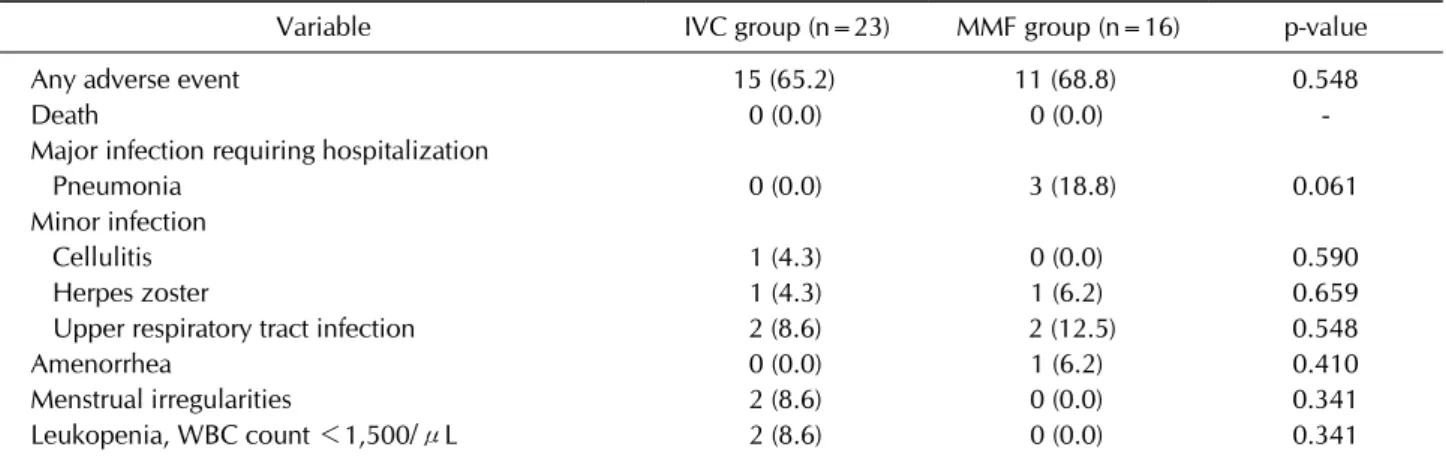
The adverse events experienced by the patients over 12 months are shown in Table 5. No patients died during the
treatment period. The incidence of adverse events was similar in the two groups: 65.2% (15 of the 23 IVC-treat- ed patients) and 68.8% (11 of the 16 MMF-treated pa- tients, p=0.548). The proportion of patients with major infections requiring hospitalization did not differ sig- nificantly between the groups (p=0.061).
DISCUSSION
We found no significant differences between IVC and MMF used as remission induction therapies for LN. In other words, MMF and IVC were equally effective in terms of inducing remission in an ethnically homogenous Korean population.
According to the LN management guidelines proposed by the ACR, European League Against Rheumatism (EULAR), and Kidney Disease Improving Global Outcomes (KDIGO) [21,22,24], patients with active LN are recom- mended to take IVC or MMF in combination with oral glucocorticoids, with or without three pulses of intra- venous methylprednisolone at the start of remission in- duction therapy. Because these guidelines are based on clinical trials conducted in Western countries and treat- ment responses vary by geographical region, race, and ethnicity, it is important to perform randomized, con- trolled trials in Asian populations to derive meaningful guidelines. Unfortunately, a few studies have yet com- pared the efficacy and safety of IVC and MMF as re- mission induction therapies in Asian. Although our work was retrospective in nature, this report is the first to com- pare the efficacy of IVC and MMF in Korean patients with LN. We believe that our results could guide the manage- ment of LN patients in our region. However, because of
the small sample size, a larger-scale, multi-center, nation- wide prospective study is needed to confirm our findings.
We found that MMF and IVC were similarly effective when used as remission induction therapy for manage- ment of active LN. In 2012, Li et al. [13] conducted 24-week prospective study in China, including 60 pa- tients with LN randomly assigned to receive MMF, tacro- limus, or IVC in combination with corticosteroids. This pilot study suggested that both MMF and tacrolimus are viable alternatives to IVC as induction therapies for acute LN in Chinese patients. In 2018, Sahay et al. [16] com- pared the efficacy and side effects of cyclophosphamide- based (low- and high- dose) and MMF-based regimens with 144 LN patients in India. The MMF- and IVC-based regimens were equally effective for the treatment of LN.
Moreover, this study suggested that the low-dose IVC re- gime may be equally efficacious, but with a further reduc- tion in cost and drug toxicity. In 2005, a 24-week, randomized, open-label, non-inferiority trial showed that remission induction therapy with MMF was superior to that afforded by IVC in inducing a CR [4]. In contrast, the multinational ALMS study found that renal responses to MMF remission induction therapy were comparable to those afforded by IVC at 6 months [7]. Although a ten- dency toward a better response with IVC rather than with MMF was evident when the analyses were limited to Asian patients, statistical significance was not attained.
Hanaoka et al. [14] recently conducted a single-center retrospective study comparing four different induction therapies in Japanese LN patients, and they found that the CR rate over 3 years did not differ significantly among the groups. When the renal responses of 22 IVC-treated pa- tients were compared to those of 11 MMF-treated pa- tients, no significant between-group differences were apparent.
Our results are in agreement with those of the ALMS and Japanese studies. Because our work was retrospective in nature, some selection bias might have occurred.
Although the baseline clinical characteristics, except complement level, did not differ between the two groups, the activity score derived from renal pathology was sig- nificantly higher in the IVC group. Thus, we adjusted for the activity score, but the renal responses at 6 and 12 months did not change. A randomized, controlled trial is better than a retrospective study. However, it is difficult to conduct clinical trials with SLE patients to issues includ- ing disease heterogeneity, inadequate trial size, short trial duration, insufficient information on appropriate dosage
or guidelines to address background medications, and difficulty in setting a primary endpoint [25]. Thus, we must use information derived from observational studies.
We found that MMF could be a good therapeutic option for LN patients, particularly women of childbearing age, because it does not cause gonadal toxicity. Ideally, deci- sion-making should be shared by physicians and patients, who together choose an appropriate regimen by balanc- ing the benefits and risks of treatment.
In this study, we did not detect significant differences between the MMF- and IVC-treated patients with regard to the rates of adverse events, serious adverse events, or infections. Although our study was retrospectively ana- lyzed, the overall adverse event profiles of both MMF and IVC in this study were consistent with previous studies [4,7,26-28]. However, it should be noted that under-re- porting of some adverse events might have occurred due to the retrospective study design.
Our study had several limitations. First, it was a retro- spective study, which might limit the generalizability of the results. Second, the number of LN patients allocated to each treatment arm was relatively small, creating pow- er issues in terms of analysis. Any difference in the renal response between the IVC- and MMF-treated patients may have failed to attain statistical significance because of the small sample size. Third, the IVC-treated patients had more active disease compared to the MMF-treated pa- tients; the C3 level, fibrinoid necrosis/karyorrhexis com- ponents of the activity indices, and activity scores were significantly higher in the IVC-treated patients than in the MMF-treated patients. Although we adjusted for the activity scores, some potential confounding factors could not be fully controlled because of the nature of the study.
Finally, the work was conducted at a single center in the Republic of Korea, and thus, the results may not be repre- sentative of the entire SLE population of Asian ethnicity.
Therefore, a larger-scale, multi-center, nationwide pro- spective study is needed to confirm our findings.
CONCLUSION
In conclusion, we found that the efficacy and safety of MMF at 6 and 12 months did not differ from that of IVC when the drugs were used as LN induction treatments in ethnically homogeneous Korean patients. Both IVC and MMF can be used for LN remission therapy.
ACKNOWLEDGMENTS
This work was supported by the Bio & Medical Technology Development Program of the NRF funded by the Korean government, MSIP (2017M3A9E8023014), and by a grant (CRI13904-24 and CRI18043-21) from the Chonnam National University Hospital Biomedical Research Institute.
CONFLICT OF INTEREST
No potential conflict of interest relevant to this article was reported.
REFERENCES
1. Tsokos GC. Systemic lupus erythematosus. N Engl J Med 2011;365:2110-21.
2. Illei GG, Austin HA, Crane M, Collins L, Gourley MF, Yarboro CH, et al. Combination therapy with pulse cyclo- phosphamide plus pulse methylprednisolone improves long-term renal outcome without adding toxicity in patients with lupus nephritis. Ann Intern Med 2001;135:248-57.
3. Mok CC, Chan PT, To CH. Anti-müllerian hormone and ovarian reserve in systemic lupus erythematosus. Arthritis Rheum 2013;65:206-10.
4. Ginzler EM, Dooley MA, Aranow C, Kim MY, Buyon J, Merrill JT, et al. Mycophenolate mofetil or intravenous cy- clophosphamide for lupus nephritis. N Engl J Med 2005;353:2219-28.
5. Kamanamool N, McEvoy M, Attia J, Ingsathit A, Ngamjanyaporn P, Thakkinstian A. Efficacy and adverse events of mycophenolate mofetil versus cyclophosphamide for induction therapy of lupus nephritis: systematic review and meta-analysis. Medicine (Baltimore) 2010;89:227-35.
6. Touma Z, Gladman DD, Urowitz MB, Beyene J, Uleryk EM, Shah PS. Mycophenolate mofetil for induction treatment of lupus nephritis: a systematic review and metaanalysis. J Rheumatol 2011;38:69-78.
7. Appel GB, Contreras G, Dooley MA, Ginzler EM, Isenberg D, Jayne D, et al. Mycophenolate mofetil versus cyclo- phosphamide for induction treatment of lupus nephritis. J Am Soc Nephrol 2009;20:1103-12.
8. Isenberg D, Appel GB, Contreras G, Dooley MA, Ginzler EM, Jayne D, et al. Influence of race/ethnicity on response to lupus nephritis treatment: the ALMS study. Rheumatology (Oxford) 2010;49:128-40.
9. Chan TM, Li FK, Tang CS, Wong RW, Fang GX, Ji YL, et al.
Efficacy of mycophenolate mofetil in patients with diffuse proliferative lupus nephritis. Hong Kong-Guangzhou neph- rology study group. N Engl J Med 2000;343:1156-62.
10. Chan TM, Tse KC, Tang CS, Mok MY, Li FK; Group HKNS.
Long-term study of mycophenolate mofetil as continuous induction and maintenance treatment for diffuse pro- liferative lupus nephritis. J Am Soc Nephrol 2005;16:
1076-84.
11. Ong LM, Hooi LS, Lim TO, Goh BL, Ahmad G, Ghazalli R, et
al. Randomized controlled trial of pulse intravenous cyclo- phosphamide versus mycophenolate mofetil in the in- duction therapy of proliferative lupus nephritis. Nephrology (Carlton) 2005;10:504-10.
12. Hu W, Liu Z, Chen H, Tang Z, Wang Q, Shen K, et al.
Mycophenolate mofetil vs cyclophosphamide therapy for patients with diffuse proliferative lupus nephritis. Chin Med J (Engl) 2002;115:705-9.
13. Li X, Ren H, Zhang Q, Zhang W, Wu X, Xu Y, et al.
Mycophenolate mofetil or tacrolimus compared with intra- venous cyclophosphamide in the induction treatment for active lupus nephritis. Nephrol Dial Transplant 2012;27:
1467-72.
14. Hanaoka H, Kiyokawa T, Iida H, Ishimori K, Takakuwa Y, Okazaki T, et al. Comparison of renal response to four dif- ferent induction therapies in Japanese patients with lupus nephritis class III or IV: a single-centre retrospective study.
PLoS One 2017;12:e0175152.
15. Rathi M, Goyal A, Jaryal A, Sharma A, Gupta PK, Ramachandran R, et al. Comparison of low-dose intra- venous cyclophosphamide with oral mycophenolate mofetil in the treatment of lupus nephritis. Kidney Int 2016;89:
235-42.
16. Sahay M, Saivani Y, Ismal K, Vali PS. Mycophenolate versus cyclophosphamide for lupus nephritis. Indian J Nephrol 2018;28:35-40.
17. Hochberg MC. Updating the American College of Rheumatology revised criteria for the classification of sys- temic lupus erythematosus. Arthritis Rheum 1997;40:1725.
18. Weening JJ, D'Agati VD, Schwartz MM, Seshan SV, Alpers CE, Appel GB, et al. The classification of glomerulonephritis in systemic lupus erythematosus revisited. Kidney Int 2004;65:521-30.
19. Gladman DD, Ibañez D, Urowitz MB. Systemic lupus eryth- ematosus disease activity index 2000. J Rheumatol 2002;29:
288-91.
20. Austin HA 3rd, Muenz LR, Joyce KM, Antonovych TA, Kullick ME, Klippel JH, et al. Prognostic factors in lupus nephritis. Contribution of renal histologic data. Am J Med 1983;75:382-91.
21. Bertsias GK, Tektonidou M, Amoura Z, Aringer M, Bajema I, Berden JH, et al. Joint European League Against Rheumatism and European Renal Association-European Dialysis and Transplant Association (EULAR/ERA-EDTA) recommendations for the management of adult and paedi- atric lupus nephritis. Ann Rheum Dis 2012;71:1771-82.
22. Hahn BH, McMahon MA, Wilkinson A, Wallace WD, Daikh DI, Fitzgerald JD, et al. American College of Rheumatology guidelines for screening, treatment, and management of lu- pus nephritis. Arthritis Care Res (Hoboken) 2012;64:
797-808.
23. Renal Disease Subcommittee of the American College of Rheumatology Ad Hoc Committee on Systemic Lupus Erythematosus Response C. The American College of Rheumatology response criteria for proliferative and mem- branous renal disease in systemic lupus erythematosus clin- ical trials. Arthritis Rheum 2006;54:421-32.
24. Radhakrishnan J, Cattran DC. The KDIGO practice guide- line on glomerulonephritis: reading between the (guide) lines--application to the individual patient. Kidney Int 2012;82:840-56.
25. Mahieu MA, Strand V, Simon LS, Lipsky PE, Ramsey- Goldman R. A critical review of clinical trials in systemic lu- pus erythematosus. Lupus 2016;25:1122-40.
26. Moore RA, Derry S. Systematic review and meta-analysis of randomised trials and cohort studies of mycophenolate mo- fetil in lupus nephritis. Arthritis Res Ther 2006;8:R182.
27. Walsh M, James M, Jayne D, Tonelli M, Manns BJ,
Hemmelgarn BR. Mycophenolate mofetil for induction therapy of lupus nephritis: a systematic review and meta-analysis. Clin J Am Soc Nephrol 2007;2:968-75.
28. Zhu B, Chen N, Lin Y, Ren H, Zhang W, Wang W, et al.
Mycophenolate mofetil in induction and maintenance ther- apy of severe lupus nephritis: a meta-analysis of randomized controlled trials. Nephrol Dial Transplant 2007;22:1933-42.