Res. Plant Dis. 17(3) : 405−409 (2011) © The Korean Society of Plant Pathology
Rhizoctonia solani에 의한 큰물개구리밥(Azolla japonica) 마름병
이정한·차재율1·노길한1·한기수1·배동원2·권영상3·임채신4·정성우5· 권진혁4·박정규1·곽연식1,6*
경상대학교 화학과, 1경상대학교 응용생물학과, 2경상대학교 공동실험실습관, 3경상대학교 응용생명과학부,
4경상남도농업기술원, 5경상대학교 원예학과, 6경상대학교 농업생명과학연구원
Rhizoctonia Blight of Azolla japonica Caused by Rhizoctonia solani
Jung-Han Lee, Jea-Yul Cha1, Gil-Han Noh1, Ki-Soo Han1, Dong-Won Bae2, Young-Sang Kwon3 Chae-Shin Lim4, Sung-Woo Jeong5, Jin-Hyeuk Kwon4, Chung-Gyoo Park1 and Youn-Sig Kwak1,6* Department of Chemistry and Research Institute of Life Science, Gyeongsang National University, Jinju 660-701, Korea
1Department of Applied Biology, College of Agriculture and Life Science, Gyeongsang National University, Jinju 660-701, Korea
2Central Instrument Facility, Gyeongsang National University, Jinju 660-701, Korea
3Division of Applied Life Science (BK21 Program), Plant Molecular Biology and Biotechnology Research Center, Gyeongsang National University, Jinju 660-701, Korea
4Gyeongsangnam-do Agricultural Research and Extension Service, Jinju 660-360, Korea
5Department of Horticulture, Gyeongsang National University, Jinju 660-701, Korea
6Institute of Agriculture and Life Science, Gyeongsang National University, Jinju 660-701, Korea (Received on July 15, 2011; Revised on September 29, 2011; Accepted on October 2, 2011)
Azolla Lam. is a small aquatic fern with deeply bilobed leaves, which are consisted of a thick greenish, with chlorophyll, upper (dorsal) lobe and a thinner, translucent lower (ventral) lobe, without chlorophyll, submerged in the water. Azolla blight was observed at a lotus pond. Mycological characteristics of the fungus associated with Azolla blight was immediately determined as Rhizoctonia sp. by the thickness and branching of hypha at right angles at the point toward the distal end of septa, with branching hypha is constricted. The fungus produced brown mycelia and dark brown sclerotia on PDA. The optimum temperature for mycelial growth and sclerotia formation were 25oC and 30oC, respectively. The optimum temperature for fungal infection was 30oC, when spray inoculated. Phylogenetic analysis of rDNA-ITS revealed that the fungus was identified as Rhizoctonia solani (AG-1 IA) closest to one causing rice sheath blight disease. This is the first report on the blight disease of Azolla caused by R. solani in Korea.
Keywords : Azolla japonica, Green manure plants, Rhizoctonia solani
큰물개구리밥(Azolla japonica)은 물개구리밥과(Azollaceae) 에 속하며 물 표면을 떠 다니며 번식하는 작은 수생 양 치식물로 질소고정능력을 가지고 있는 cyanobacterium 속 의 Anabaena azollae와 공생한다. 현재 알려진 Azolla종 은 A. pinnata, A. nilotica, A. filiculoides, A. rubra, A.
microphylla, A. mexicana, A. caroliniana 등이 있으며 (Metzgar 등, 2007), 국내에서는 물개구리밥(A. imbricata) 과 큰물개구리밥(A. japonica) 두 종류가 알려져 있다(Lee, 1979). 또한 번식이 빠른 식물로 생체량이 두 배가 되기 까지 3−5일, 표면적이 2배가 되는데는 7−10일 정도 소요 되며 식물체가 자라 밀집하여 이루어진 매트의 두께가 5−
20 cm까지 형성될 수 있다고 알려져 있다(Lumpkin과 Plucknett, 1982). 이러한 특성으로 인하여 질소비료로서 의 농업적 이용가치가 높게 평가되는데 보고에 의하면 토
*Corresponding author
Phone) +82-55-772-1922, Fax) +82-55-772-1929 Email) [email protected]
http://dx.doi.org/10.5423/RPD.2011.17.3.405 Note Open Access
양에 1년 동안 110−330 kgN/hm2의 질소를 공급할 수 있 으며 중국과 동남아시아 지역에서는 벼를 재배할 때 Azolla 를 번식시키는 방법으로 질소비료 대용으로 사용한다 (Becking 등, 1979; Liu 등, 1989; Lumpkin 등, 1982;
McConnachie 등, 2003; Singh 등, 1977). 외국의 보고에 의하면 R. solani, Fusarium sp., Sclerotium sp., 그리고 Rhizopus sp.가 Azolla에 병을 발생시키는 균으로 보고되 어 있다(Kannaiyan, 1987). 또한 R. solani에 대한 Azolla 의 저항성은 종에 따라 차이가 있는 것으로 알려져 있다.
A. pinnata NE 13, A. nilotica와 A. filiculoides의 경우 감수 성으로 나타났고, A. caroliniana, A. pinnata NE 6(Bangkok) 의 경우 저항성으로 나타났다. R. solani에 의한 병 발생을 줄이기 위하여 50 µg/g의 카벤다짐을 처리하면 병 발생을 감소시킬 수 있다는 연구결과가 보고되었다(Kannaiyan, 1987). 국내에서는 Azolla를 농업에 이용하고 있지 않으 나 외국의 사래에 따르면 논물에 Azolla를 방치할 경우 관행질소량(11 kg/10a)의 25% 매몰 시에는 50% 절감효과 가 나타난다는 보고(Lee 등, 2004)가 있어 국내에서도 친 환경 생물 비료로 이용할 가치가 크다고 할 수 있다. 본 연구는 경남 함안군 연 재배지에서 발견된 큰물개구리밥 이 국지적으로 고사하는 현상을 관찰하여 원인균을 분리 하고 균학적 특징과 병원성을 검정하였다.
병징. 경남 함안군의 연 재배연못에서 관찰된 큰물개 구리밥은 5−10 cm 정도의 매트를 형성하고 있었으며, 국 지적으로 고사하는 현상을 관찰하였다(Fig. 1A). 고사된 부분을 확대하였을 때 흰색의 균사가 관찰되었으며, 병원 균에 감염되지 않은 큰물개구리밥은 연한 녹색을 띠고 있 었으며(Fig. 1B), 병원균에 감염되어 시간이 경과할수록 엽록소가 파괴되어 점차 갈색으로 마르는 현상이 나타났 다. 또한 수생식물인 개구리밥은 병원균에 의해 고사한 큰물개구리밥 사이에서 계속 생존하는 것으로 보아 Rhizoctonia에 저항성인 것으로 판단되었으며, 연의 생장 에도 아무런 영향을 미치지 않는 것으로 나타났다(Fig. 1C).
균학적 특성 및 염기서열 분석. 병원균을 분리하여 PDA에 7일간 배양한 결과 균총은 전형적인 Rhizoctonia 의 균총과 같은 형태였으며(Fig. 1D), 균사는 두께가 5−
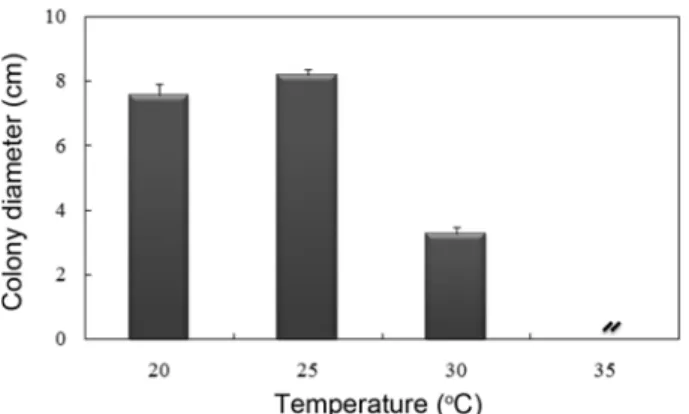
6µm이고 둔각분지를 하고 있었으며 핵형은 다핵형이었 다(자료 미제시). 균사생육은 25oC에서 8.18 cm로 가장 왕 성하였고 20oC와 30oC에서는 각각 7.56과 3.28 cm으로 나 타났으며, 35oC에서는 전혀 생장하지 못하는 것으로 관 찰되었다(Fig. 2). 또한 20oC와 25oC에서는 배지에 밀착하 여 생장하였으나 특징적으로 30oC에서 배양 4일째부터 기중균사가 관찰되었다. 균핵 형성은 20o에서는 petri-dish (87Ø× 15 mm)당 약 50개 정도였으며 지름이 약 2−5 mm
Fig. 1. Symptoms of Rhizoctonia blight disease occurred on Azolla japonica caused by Rhizoctonia solani. A, typical symptom occurred on dense mats of A. japonica; B, close-up view of the discolored area shown with arrow in A; C, single plants of A. japonica; D, mycelial growth and sclerotial formation on potato dextrose agar medium.
였다. 25oC에서는 20개 정도였으며 지름이 1−3 mm였고, 30oC에서는 약 400개 정도의 가장 많은 수의 균핵이 형 성된 반면 지름이 0.5−1.5 mm로 가장 작았다. 35oC에서 는 균사생장 및 균핵이 전혀 형성되지 않는 것으로 관찰 되었다. 본 실험에서 분리한 큰물개구리밥과 병원균을 유 전자 수준에서 동정하기 위해 ITS 영역을 PCR을 이용하
여 증폭한 결과 620 bp의 PCR 산물을 확인하였다. 염기 서열 분석은 Genebank blast 및 MEGA의 Neighbor-Joining (Tamura 등, 2007) 방법을 이용하여 균의 계통을 비교 분 석하였다. 본 연구에서 분리 동정된 Rhizoctonia solani는 AHL1으로 명명하고 Genebank에 ITS 염기서열을 등록하 였다(Accession number: JN790939). 계통분류분석을 수행 한 결과 NCBI에 등록되어 있는 R. solani와 같은 종으로 분류되었다(Fig. 3).
병원성 검정. 큰물개구리밥에 대한 Rhizoctonia solani AHL1의 병원성과 온도조건에 따른 발병정도를 조사를 한 결과 기주식물의 agar disk와 스프레이 접종방법으로 나누어 균을 접종하여 1주 후 생체중을 조사하여 발병정 도를 평가한 결과 두 처리 모두 무처리구에 비해 처리구 의 생체중이 약 17 g 낮게 나타났으며, 균의 접종방법에 따라서는 agar disk와 스프레이 접종방법 차이가 약 1 g 으로 거의 차이가 없는 것으로 나타났다. 또한 온도에 따 른 병원성을 평가하기 위하여 생체중을 조사한 결과 20oC, 25oC와 30oC의 처리온도별 무처리간 차이가 없었고, agar disk와 스프레이 접종을 한 것에서는 20oC, 25oC와 30oC 에서 약 34 g, 31 g, 26 g으로 온도가 높을수록 R. solani AHL 1에 의해 고사되어 생체중이 낮아지는 것을 조사되 Fig. 2. Effect of temperature on mycelial growth of Rhizoctonia
solani isolated from Azolla japonica. Mycelial growth was measured 3 days after inoculation of R. solani on potato dextrose agar medium (Error bars represent the standard deviation of the mean, n = 5).
Fig. 3. Phylogenetic tree of the present isolate, Rhizoctonia sp. isolated from the Azolla japonica based on ITS sequences. The tree was constructed from neighbor-joining analysis of rDNA-ITS sequence. The numbers above the nodes represent bootstrap values of > 60%
(out of 1,000 bootstrap replication).
었다(Fig. 4A). 또한 R. solani AHL1를 접종하여 1주일 후 20oC, 25oC와 30oC에서 무처리구[Fig. 4B(a, b, c)]에 비 해 agar disk를 접종한 처리구[Fig. 4B(a-1, b-1, c-1)]에서 갈색으로 고사하였으며, 스프레이 접종방법으로 처리한 구[Fig. 4B(a-2, b-2, c-2)]는 agar disk를 접종한 것 보다 Azolla가 좀더 고사된 것을 관찰할 수 있었다. 또한 병이 진행이 될수록 잎 부분이 마르기 때문에 Azolla의 크기가 작아지는 것을 관찰하였다[Fig. 4B(d)]. Azolla는 종에 따 라 생존범위가 다르지만 일반적으로 −5−35oC까지 생존할 수 있으며 25oC에서 질소고정과 산소 방출이 가장 활발 하게 이루어진다는 보고가 있다(Wong 등, 1987). 본 실 험에서는 R. solani AHL1의 균사생장은 30oC에서 보다 25oC에서 더 잘 자라는 것으로 나타났지만 A. filiculoides 는 Azolla의 다른 종인 A. microphylla 및 A. mexicana와 는 달리 열에 대한 내성이 낮기 때문에(Cagauan와 Pullin, 1991) A. japonica에 대한 병원성은 기주식물이 약해지는
30oC에서 높게 나타난 것으로 판단된다.
요 약
연 재배연못에서 발견된 큰물개구리밥에 R. solani AHL1 에 의해 국지적으로 말라 고사하는 것을 관찰하였다. 병 원균을 분리하여 형태적 특징을 조사한 결과 균사는 두 께가 5−6 µm이고 둔각분지를 하고 있었으며 핵형은 다 핵형이었다. 배양적 특성으로 균사생육은 25oC에서 가장 왕성하였으며 30oC에서 가장 많은 균핵이 형성되었다. 온 도에 따른 병원성과 발병정도를 조사한 결과 20oC, 25oC 와 30oC에서 모두 병원성이 나타났으며 발병정도는 30oC 에서 가장 높게 나타났다. 병원균을 유전자 수준에서 동 정하기 위해 ITS 영역을 Neighbor-Joining 방법을 이용하 여 계통분류분석을 수행한 결과 R. solani로 동정되었다.
본 연구에서 분리된 R. solani AHL1은 벼잎집무늬마름병 Fig. 4. Change of fresh weight (A) and disease incidences (B) of Azolla japonica according to two inoculation methods (agar disk &
spray inoculation) and different temperature (Error bars represent the standard deviation of the mean, n = 5). B (a, b, c), non-treatment at 20oC, 25oC, 30oC; B (a-1, b-1, c-1), agar disk inoculation; B (a-2, b-2, c-2), spray inoculation; B (d), disease incidences progressing of A.
japonica.
을 유발하는 병원균과 유사하여 벼에 대한 병 발생 여부 는 추가적으로 연구가 필요하다. 현재 농업은 화학비료의 사용을 억제하는 추세로 녹비를 이용한 유기농업으로, 주 요 녹비인 Azolla 안정적인 사용을 위하여 Azolla에 발생 하는 병에 대한 연구가 더 이루어져야 된다고 사료된다.
References
Becking, J. H. 1979. Environmental requirements of Azolla for use in tropical rice production. In: Nitrogen and Rice, pp. 345−
374. International Rice Research Institute, Los Baños, Laguna, Philippines.
Cagauan, A. G. and Pullin, R. S. V. 1991. Azolla in aquaculture:
Past, present and future. In: Recent Advances in Aquaculture, ed. by J. Muir and R. J. Roberts, pp. 104−130. Blackwell Science, Oxford, UK.
Kannaiyan, S. 1987. Azolla Utilization: Proceedings of the workshop on Azolla Use, Fuzhou, Fujian, China, 31 March-5 April 1985. International Rice Research Institute, Philippines.
pp. 107−118.
Lee, C. H., He, S. B., Lee, Y. C., Oh, D. M. and Kim, S. H. (eds) 2004. Manuals for organic and eco-friendly farming. National Academy of Agricultural Science. Suwon, Korea. (In Korean)
Lee, T. B. 1979. Illustrated flora of Korea. Hyang Mun Sa, Seoul, Korea. (In Korean)
Liu, C. C. and Zheng, W. W. 1989. Azolla in China. Agriculture Publishing House, Beijing, (In Chinese)
Lumpkin, T. A. and Plucknett, D. L. 1982. Azolla as a green manure: Use and management in crop production. Westview Press, Bolder, CO. 162 pp.
McConnachie, A. J., de Wit, M. P., Hill, M. P. and Byrne, M. J.
2003. Economic evaluation of the successful biological control of Azolla filiculoides in South Africa. Biol. Control 28: 25−32.
Metzgar, J. S. Schneider, H. and Pryer, K. M. 2007. Phylogeny and divergence time estimates for the fern Genus Azolla (Salviniaceae). Int. J. Plant Sci. 168: 1045−1053.
Singh, P. K. 1977. Multiplication and utilization of fern Azolla containing nitrogen-fixing algal symbiont as green manure on rice cultivation. Riso 26: 125–137.
Tamura, K., Dudley, J., Nei, M. and Kumar, S. 2007. MEGA4:
Molecular evolutionary genetics analysis (MEGA) software version 4.0. Mol. Biol. Evol. 24: 1596−1599.
Wong Fong Sang, H. W., Vu, V. V., Kijne, J. W., Tam, V. T. and Planque, K. 1987. Use of Azolla as a test organism in a growth chamber of simple design. Plant Soil 99: 219−230.