Epidemiological Study of Outbreak of Gastroenteritis Associated with Norovirus and Astrovirus in Busan, Korea
Hee Soo Koo
1, Hyeon Cheol Jo
1and Hyung Suk Baik
2*
1
Busan Metropolitan Government Research Institute of Public Health & Environment, Busan 46616, Korea
2
Department of Microbiology, Pusan National University, Geumjeong-gu, Busan 46241, Korea
Received July 20, 2016 /Revised September 7, 2016 /Accepted September 23, 2016
This paper studies an infection of norovirus and astrovirus in outbreaks in Korea. In March 2016, gas- troenteritis outbreaks occurred in Busan. 522 students of three departments at university D had meet- ing at a restaurant near the university. Some of them had symptom such as diarrhea, vomiting.
Epidemiological, laboratory and environmental investigations were performed to identify the agents of the outbreaks. Fecal specimens were collected from 35 students and 7 food handlers to identify caus- ative viral agents. Norovirus genogroup GI and GII were detected from diarrhea patients. Astrovirus was also detected from some of them. In particular, these outbreaks were the first occurrence asso- ciated with astrovirus in Busan. Total of 42 samples were collected, and 24 samples resulted in pos- itive to norovirus (16 cases) and astrovirus (8 cases). To identify the molecular genetic information of norovirus, we carried out sequences analysis of the detected strains. Norovirus genotypes were classified into GI.3, GI.4, GII.4, GII.13, GII.17 and GII.21. Astrovirus genotypes were seven astrovirus type 5 and one astrovirus type 2. We performed environmental investigation about water at the kitch- en, but norovirus and astrovirus were not detected. The statistical analysis was conducted to evaluate the association between illness and risk factors. The results of this study may contribute to accumulate more the epidemiological data and develop the public health and hygiene.
Key words : Astrovirus, molecular epidemiology, outbreaks
*Corresponding author
*Tel : +82-51-510-2271, Fax : +82-51-514-1778
*E-mail : [email protected]
This is an Open-Access article distributed under the terms of the Creative Commons Attribution Non-Commercial License (http://creativecommons.org/licenses/by-nc/3.0) which permits unrestricted non-commercial use, distribution, and reproduction in any medium, provided the original work is properly cited.
Journal of Life Science 2016 Vol. 26. No. 9. 999~1006 DOI : http://dx.doi.org/10.5352/JLS.2016.26.9.999
Introduction
Acute gastroenteritis has been known as one of the most frequent diseases and became a major public health issue worldwide. The surveillance of gastroenteritis in Korea has revealed that gastroenteritis caused by viruses becomes more common and viral infections increase [7]. Now nor- ovirus becomes a major causative agent of gastroenteritis outbreaks reported worldwide. Norovirus is a non-envel- oped, single-stranded RNA virus, classified into five gen- ogroups, so called GI~GV, based on amino acid identities in the VP1 (ORF2) [5]. According to a previous study [13], norovirus can be classified into genotypes, with 9 genotypes belonging to genogroup GI and 22 genotypes of genogroup GII, which is used as the classification standard in this paper.
In recent decades, norovirus GII.4 has been reported as the
most common circulating genotype worldwide [8]. Recently, norovirus GII.17 is becoming the remarkable type causing large-scale outbreaks of gastroenteritis [14]. The symptom of norovirus is characterized by acute onset, nonbloody diar- rhea, vomiting, nausea and abdominal pains.
Astrovirus is a causative enteric pathogens, and it can be classified genetically into eight genotypes based on the cap- sid protein precursor (ORF2) [17]. Astrovirus type 1 has been reported as a predominant type in the world. Astrovirus is a small, non-enveloped, round, single-stranded RNA virus [15]. Astrovirus induces a watery mild diarrhea that is last- ing during 2~3 days and may be related to vomiting, fever and abdominal cramp [16]. However, astrovirus is clinically less severe than norovirus infections [3, 21].
There are some researches about astrovirus outbreaks in
various countries. Astrovirus infection was very common in
children more than 3 years old in France [2]. 80% of as-
trovirus infections occurred in children less than 3 years old
in Spanish [6]. In contrast, there was an outbreak of as-
trovirus gastroenteritis in residential care home for elder
people in Scotland [9]. In Korea, the outbreak of the as-
trovirus infection was occurred in riot police camp in 2014
[8]. Astrovirus may be a major cause of gastroenteritis in
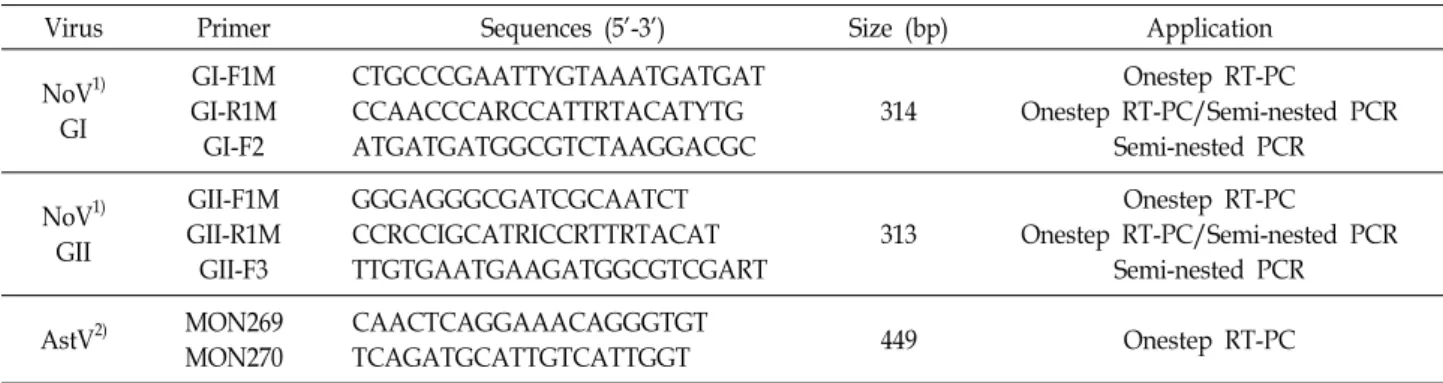
Table 1. The primers used for the detection of NoV and AstV
Virus Primer Sequences (5'-3') Size (bp) Application
NoV
1)GI
GI-F1M GI-R1M GI-F2
CTGCCCGAATTYGTAAATGATGAT CCAACCCARCCATTRTACATYTG ATGATGATGGCGTCTAAGGACGC
314
Onestep RT-PC
Onestep RT-PC/Semi-nested PCR Semi-nested PCR NoV
1)GII
GII-F1M GII-R1M GII-F3
GGGAGGGCGATCGCAATCT CCRCCIGCATRICCRTTRTACAT TTGTGAATGAAGATGGCGTCGART
313
Onestep RT-PC
Onestep RT-PC/Semi-nested PCR Semi-nested PCR
AstV
2)MON269
MON270
CAACTCAGGAAACAGGGTGT
TCAGATGCATTGTCATTGGT 449 Onestep RT-PC
1)
NoV : Norovirus,
2)AstV : Astrovirus
young children, elderly people and immunocompromised adults [18]. The public health authority needs to give more close attention to astrovirus because of the outbreaks in adults [1, 19].
This study conducts an epidemiological analysis on the outbreaks incidence of acute gastroenteritis of the university students in March 2016, Busan. We collected data associated with the outbreak information including dates, locations, number of patients, patient symptoms and contributing factors. We identified the epidemic characteristics of nor- ovirus and astrovirus from the oubreaks. In this study, we report firstly that astrovirus was the causative agent to the acute gastroenteritis outbreaks in Busan until now.
Materials and Methods
Epidemiological investigation
On March in 2016, some students of department A in uni- versity D attended a meeting at a restaurant, and some pa- tients with diarrhea, vomiting, chills visited the public health center. The epidemiological investigation team recognized that there were similar cases of department B and depart- ment C in the university. All outbreaks occurred at the same restaurant. The epidemiological investigation team had a site survey, and obtained the menu of the restaurant, and inves- tigated other external factors. The restaurant used the water supplied by mixing tap water and underground water. We collected the water 1.8 l by using the water sampler at the kitchen in the restaurant.
Specimens and RNA extraction
Fecal specimens were collected from 35 acute gastro- enteritis patients and 7 food handlers. The specimen was diluted in phosphate buffered saline and vortexed for 3 min,
centrifuged at 3,000 rpm, for 20 min, and collected the supernatant. Viral RNA was extracted using a GM-autoprep Kit (Green Mate, Korea) according to the manufacturer's instructions. The environmental sample was tested accord- ing to the Food code of the ministry of food and drug safety.
The detection and genotyping of norovirus and astrovirus
Norovirus detection was conducted using an Real-time reverse transcriptase-polymerase chain reaction (Real-time RT-PCR) and RT-PCR using Real-time RT-PCR Kit (Bioneer, Korea) with the following conditions: reverse transcription at 45°C for 30 min, predenaturation at 95°C for 10 min, 45 cycles of denaturation at 95°C for 15 sec, annealing and ex- tension at 56°C for 1 min. RT-PCR and Semi-nested RT-PCR were performed to identify genotypes. Astrovirus was de- tected by RT-PCR using a one-step premix kit (SNC, Korea) under the followed conditions: 48°C, 40 min; 94°C, 15 min;
94°C, 30 sec; 58°C, 30 sec; 72°C, 60 sec for 35 cycles; and 72°C 7 min. The primers of oligo nucleotide sequence for detection of norovirus, astrovirus are shown in Table 1.
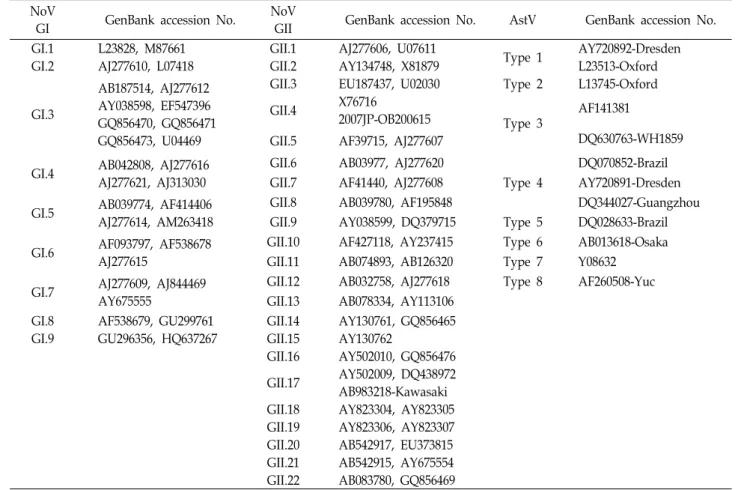
Nucleotide sequencing and phylogenetic analysis The PCR products were purified using a QIAquick Gel Extraction kit (Qiagen, Germany). Sequencing analysis was performed using a Terminator v3.1 Cycle Sequencing Kit (Applied Biosystems, USA) in ABI 3730XL Genetic Analyzer (Applied Biosystems, USA). The partial sequences of the cap- sid genes of norovirus and astrovirus isolates were aligned by Cluster W and compared to reference strains (Table 2).
The phylogenetic analysis was determined using MEGA
program based on the neighbor-joining method with 1,000
bootstrap replicates for genotype classification.
Table 2. Norovirus reference strains (GenBank accession No.) used for sequencing analysis NoV
GI GenBank accession No. NoV
GII GenBank accession No. AstV GenBank accession No.
GI.1 L23828, M87661 GII.1 AJ277606, U07611
Type 1 AY720892-Dresden
GI.2 AJ277610, L07418 GII.2 AY134748, X81879 L23513-Oxford
GI.3
AB187514, AJ277612 AY038598, EF547396 GQ856470, GQ856471 GQ856473, U04469
GII.3 EU187437, U02030 Type 2 L13745-Oxford
GII.4 X76716
2007JP-OB200615 Type 3
AF141381
DQ630763-WH1859 GII.5 AF39715, AJ277607
GI.4 AB042808, AJ277616 AJ277621, AJ313030
GII.6 AB03977, AJ277620
Type 4
DQ070852-Brazil
GII.7 AF41440, AJ277608 AY720891-Dresden
GI.5 AB039774, AF414406 AJ277614, AM263418
GII.8 AB039780, AF195848 DQ344027-Guangzhou
GII.9 AY038599, DQ379715 Type 5 DQ028633-Brazil
GI.6 AF093797, AF538678 AJ277615
GII.10 AF427118, AY237415 Type 6 AB013618-Osaka
GII.11 AB074893, AB126320 Type 7 Y08632
GI.7 AJ277609, AJ844469 AY675555
GII.12 AB032758, AJ277618 Type 8 AF260508-Yuc
GII.13 AB078334, AY113106
GI.8 AF538679, GU299761 GII.14 AY130761, GQ856465
GI.9 GU296356, HQ637267 GII.15 AY130762
GII.16 AY502010, GQ856476 GII.17 AY502009, DQ438972
AB983218-Kawasaki GII.18 AY823304, AY823305 GII.19 AY823306, AY823307 GII.20 AB542917, EU373815 GII.21 AB542915, AY675554 GII.22 AB083780, GQ856469
Table 3. The summary of the outbreaks
Visit date 2016.3.10 2016.3.11 2016.3.15 Total Group Group A Group B Group C Exposed persons
Patients Positive rates
122 15 12.3%
320 16 5.0%
80 4 5.0%
522 35 6.7%
Statistical analysis
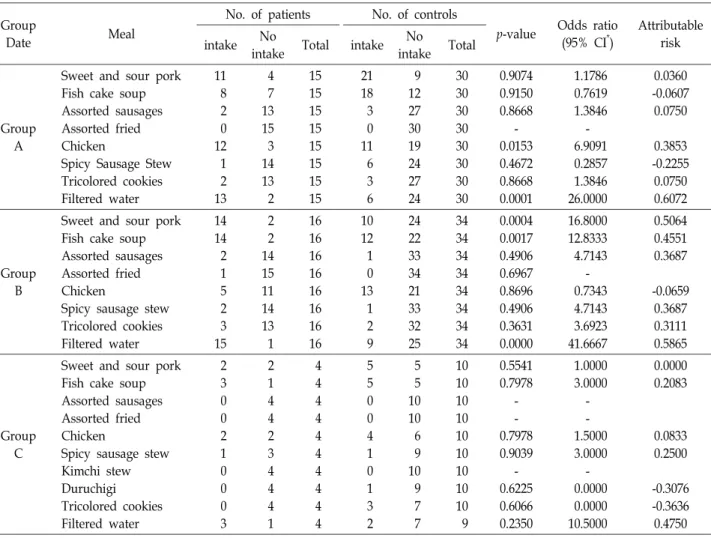
We conducted statistical analysis such as odds ratio test, attributable risk test and the chi-square test to analyze the characteristics of the infection trends by using SPSS software. From the statistical results, we can conclude that the associated food with p-value (<0.05) is considered sig- nificantly associated with illness.
Results
Epidemic distribution of the outbreaks
Cases were defined as patients with at least two symp- toms within 24 hours. The number of patients was 15 of group A, 16 of group B, and 4 of group C. The infection rates are 12.3%, 5.0%, and 5.0% respectively, which is pre- sented as in Table 3.
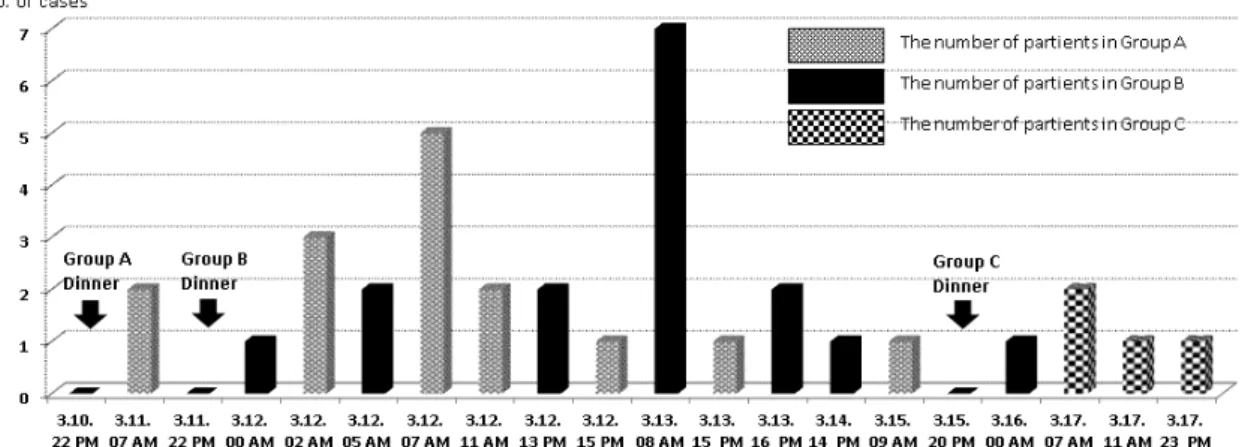
The first patients in group A with symptoms of diarrhea, abdominal pain, nausea and fever appeared on March 11 and the number of patients peaked on March 12. The disease onset of group B was on March 12 and the number of cases peaked on March 13. By the way, illness onset of group C
was on March 17 and number of peaked case on same date (Fig. 1).
The symptoms of the outbreaks were diarrhea, nausea, abdominal pain, vomiting, chills, fever, headache. All the pa- tients from groups A, B, C had mainly diarrhea, and patients had abdominal pain 77.1% and nausea 71.4%, which can be observed as in Table 4.
Laboratory analysis
For fecal specimens and environmental sample, the labo-
ratory tests were performed and shown in Table 5. Among
35 samples from patients, 16 patients were norovirus pos-
itive and 8 patients were astrovirus positive. For norovirus
Fig. 1. The number of patients on each date of groups A, B, C.
Table 5. The detected viruses related to outbreaks in Busan
Group A (n=15) Group B (n=16) Group C (n=4) Total (n=35) No. of Norovirus detection
No. of Astrovirus detection
8 (53.3%) 0
5 (31.3%) 6 (37.5%)
3 (75%) 2 (50%)
16 (45.7%) 8 (22.6%)
Table 6. The genotypes of distribution cases
Virus Genotypes No. of
Norovirus GI
No. of
Norovirus GII No. of Astrovirus Total
Norovirus
GI.3 GI.4 GII.4 GII.13 GII.17 GII.21
2
*)1
*)1 2 7 3
*)2
*)1
*)1 2 7 3
*)Astrovirus type 2
type 5
1 7
**)1 7
**)Total 3 13 8 24
*)
One of figure is co infection with astrovirus.
**)
Three of figure are co infection with norovirus.
Table 4. Symptom-wise distribution of patients
Symptom
No. of patients Group A
(n=15)
Group B (n=16)
Group C (n=4)
Total (n=35) Diarrhea
Fever Chills Nausea Vomiting Abdominal pain Headache other
15 4 7 11
6 14
3 1
16 5 7 11 10 10 1 1
4 2 2 3 3 3 1 0
35 (100%) 11 (31.4%) 16 (45.7%) 25 (71.4%) 19 (25.7%) 27 (77.1%) 5 (14.3%) 2 (5.7%)
detection, 53.3% were norovirus positive in group A, 31.3%
in group B, 75% in group C. For astrovirus detection in each
group, there was no astrovirus positive in group A, but, 37.5% in group B and 50% in group C.
The distributed genotypes of norovirus and astrovirus are presented in Table 6. Norovirus genotypes were GI.3, GI.4, GII.4, GII.13, GII.17 and GII.21. Norovirus GII.17 was mostly detected among all genotypes (43.8%, 7/16). The genotype of astrovirus was identified as type 5 in seven patients and type 2 in only one patient. There are three patients infected with norovirus and astrovirus simultaneously. The first pa- tient was infected with GI.3 and astrovirus type 5, and the second patient with GI.4 and astrovirus type 5, the last pa- tient with GII.21 and astrovirus type 5.
Phylogenetic analysis of the astrovirus and norovirus was
performed based on the primers and reference stains in
BS-16-03-P0003 BS-16-03-P0019 BS-16-03-P0007 BS-16-03-P0006 BS-16-03-P0009 GII 17 AB983218 Kawasaki
BS-16-03-P0004 BS-16-03-P0005 GII 17 AY502009 GII 17 DQ438972 GII 13 AB078334 GII 13 AY113106
BS-16-03-P0015 BS-16-03-P0016 GII 21 AB542915
GII 21 AY675554 BS-16-03-P0011
BS-16-03-P0001 BS-16-03-P0012 GII 16 AY502010 GII 16 GQ856476
GII 01 AJ277606 GII 01 U07611
GII 12 AB032758 GII 12 AJ277618 GII 22 AB083780
GII 22 GQ856469 GII 02 AY134748 GII 02 X81879 GII 05 AF397156 GII 05 AJ277607 GII 10 AF427118 GII 10 AY237415
GII 18 AY823304 GII 18 AY823305 GII 11 AB074893 GII 11 AB126320 GII 19 AY823306 GII 19 AY823307 GII 06 AB039778
GII 06 AJ277620 GII 20 AB542917 GII 20 EU373815
BS-16-03-P0002 GII 04 X76716
GII 4 2007JP OB200615 GII 03 EU187437
GII 03 U02030
GII 15 AY130762 GII 14 AY130761
GII 14 GQ856465 GII 07 AF414409 GII 07 AJ277608
GII 08 AB039780 GII 08 AF195848
GII 09 AY038599 GII 09 DQ379715
100
82 100
100
100
100 100
100
100 100
100
100
100 100
100
100 99
100 100
90 99
100 100
72 100
32 58 61
87 49 100
99 94
59 96
73 50
58
30 81 47
63 64
18 20
21 40
8 22
26
12 19
16
0.02
Fig. 4. Phylogenetic analysis of identified norovirus based on GII and strains from patients are indicated by the shad- ed black circles.
BS-16-03-P0010 BS-16-03-P0012 BS-16-03-P0020 BS-16-03-P0013 BS-16-03-P0014 BS-16-03-P0021 BS-16-03-P0018
HAstV5-DQ028633-Brazil HAstV7-Y08632-Oxford HAstV3-AF141381-Berlin
HAstV3-DQ630763-WH1859 HAstV8-AF260508-Yuc-8 HAstV4-DQ070852-Brazil
HAstV4-AY720891-Dresden HAstV4-DQ344027-Guangzhou
HAstV2-L13745-Oxford BS-16-03-P0017 HAstV6-AB013618-Osaka HAstV1-AY720892-Dresden
HAstV1-L23513-Oxford HAstV1-Z25771-Newcastle 100
100 100
78 79 100
99 59
44 44
86
100 100
0.02
Fig. 2. Phylogenetic analysis of the astrovirus and strains from patients are indicated by the shaded black circles.
GI 03 A J277612 GI 03 A Y 038598
GI 03 U04469 GI 03 GQ856473
GI 08 A F538679 GI 08 GU299761 GI 03 E F547396 GI 03 GQ856471
GI 07 A Y 675555 GI 07 A J844469 GI 03 GQ856470
GI 03 A B 187514 B S -16-03-P 0008 B S -16-03-P 0020
GI 07 A J277609 GI 09 GU296356
GI 09 HQ637267 GI 02 L07418
GI 02 A J277610
GI 04 A J313030 GI 04 A J277621 GI 04 A B 042808 GI 04 A J277616 B S -16-03-P 0021
GI 01 M 87661
GI 01 L23828 GI 06 A F093797
GI 06 A F538678 GI 06 A J277615
GI 05 A B 039774 GI 05 A J277614
GI 05 A F414406 GI 05 A M 263418 100
100 100
100
100 99
100 100
86 61 100
100
97
99 100
100 100
51 100
71 85
36 22 41
29
64 28
32 19
24
0.02
Fig. 3. Phylogenetic analysis of identified norovirus based on GI and strains from patients are indicated by the shaded black circles.
Table 1, 2. Phylogenetic analysis of astrovirus revealed
that the detected type 5 strains tend to be closely related
to each other and are classified into Brazil strains. Thus, it
Table 7. Association of illness with foods Group
Date Meal
No. of patients No. of controls
p-value Odds ratio (95% CI
*)
Attributable intake No risk
intake Total intake No
intake Total
Group A
Sweet and sour pork Fish cake soup Assorted sausages Assorted fried Chicken
Spicy Sausage Stew Tricolored cookies Filtered water
11 8 2 0 12 1 2 13
4 7 13 15 3 14 13 2
15 15 15 15 15 15 15 15
21 18 3 0 11 6 3 6
9 12 27 30 19 24 27 24
30 30 30 30 30 30 30 30
0.9074 0.9150 0.8668
- 0.0153 0.4672 0.8668 0.0001
1.1786 0.7619 1.3846
- 6.9091 0.2857 1.3846 26.0000
0.0360 -0.0607 0.0750 0.3853 -0.2255 0.0750 0.6072
Group B
Sweet and sour pork Fish cake soup Assorted sausages Assorted fried Chicken
Spicy sausage stew Tricolored cookies Filtered water
14 14 2 1 5 2 3 15
2 2 14 15 11 14 13 1
16 16 16 16 16 16 16 16
10 12 1 0 13 1 2 9
24 22 33 34 21 33 32 25
34 34 34 34 34 34 34 34
0.0004 0.0017 0.4906 0.6967 0.8696 0.4906 0.3631 0.0000
16.8000 12.8333 4.7143
- 0.7343 4.7143 3.6923 41.6667
0.5064 0.4551 0.3687 -0.0659 0.3687 0.3111 0.5865
Group C
Sweet and sour pork Fish cake soup Assorted sausages Assorted fried Chicken
Spicy sausage stew Kimchi stew Duruchigi Tricolored cookies Filtered water
2 3 0 0 2 1 0 0 0 3
2 1 4 4 2 3 4 4 4 1
4 4 4 4 4 4 4 4 4 4
5 5 0 0 4 1 0 1 3 2
5 5 10 10 6 9 10 9 7 7
10 10 10 10 10 10 10 10 10 9
0.5541 0.7978
- - 0.7978 0.9039
- 0.6225 0.6066 0.2350
1.0000 3.0000
- - 1.5000 3.0000
- 0.0000 0.0000 10.5000
0.0000 0.2083
0.0833 0.2500 -0.3076 -0.3636 0.4750
*)