Biological Control of Plant Growth Using the Plant Growth-Promoting Rhizobacterium Bacillus mojavensis KJS-3
Jae Sung Pyo, Sarmila Shrestha (Amatya), Song Hee Park and Jae Seon Kang*
College of Pharmacy, Kyungsung University, Busan 608-736, Korea
Received August 22, 2014 /Revised November 28, 2014 /Accepted December 1, 2014
Biological control using the plant growth-promoting Rhizobacterium (PGPR) has received significant attention in recent years. PGPR has been linked with promoting growth in economically important crops, such as potatoes, tomatoes, and rice. Bacillus mojavensis KJS-3 (Moja-3), isolated from food waste, possesses antifungal properties against Aspergillus terreus, A. fumagatus, A. flavus, and Fusarium redolense, and it may have potential in the development of products for industrial applications. The main purpose of this study was to determine the effects of spraying the PGPR Bacillus mojavensis KJS-3 on the growth of altari radish (leaf number, leaf length, leaf weight, root length, and rhizome length, adjacent portion diameter, and weight) and lettuce (leaf number, length, width, and weight). Three different concentrations of the foliar spray treatment of B. mojavensis KJS-3 were applied to the altari radish and lettuce: the recommended standard concentration of 1×10
9cfu/g, half the standard concen- tration of 0.5×10
9cfu/g, and double the standard concentration of 2×10
9cfu/g). The B. mojavensis strain foliar spray treatment increased the growth of the leaves and roots of the altari radish and in- creased the growth of the lettuce leaves. For both plants, the recommended concentration of B. moja- vensis KJS-3 produced better growth than half the standard concentration, and the growth was similar with the double dose. This study demonstrates positive effects of Moja-3, suggesting it may be a po- tential new bio-fertilizer for improving the growth of altari radish and lettuce.
Key words : Altari radish, biological control, lettuce, mojavensis, PGPR (Plant Growth Promoting Rhizobacterium)
*Corresponding author
*Tel : +82-51-663-4882, Fax : +82-51-663-4809
*E-mail : [email protected]
This is an Open-Access article distributed under the terms of the Creative Commons Attribution Non-Commercial License (http://creativecommons.org/licenses/by-nc/3.0) which permits unrestricted non-commercial use, distribution, and reproduction in any medium, provided the original work is properly cited.
Journal of Life Science 2014 Vol. 24. No. 12. 1308~1315 DOI : http://dx.doi.org/10.5352/JLS.2014.24.12.1308
Introduction
In modern agriculture field, increase in use of chemical pesticides and chemical fertilizers has resulted in deterio- ration of soil fertility and manifestation of pesticide-re- sistant mutants of insects and plant pathogens, ultimately causing harm to human body. To overcome these problems, biological control using PGPR has gained increased atten- tion and much research works have been carried out in re- cent years. PGPR is a specific group of (bacterial and fun- gal) microorganisms that can be found located inside wide varieties of plant tissue types: fruit [30], seeds and ovules [23], stems [22], roots [13, 16] and tubers [15, 33]. Most of these PGPRs are members of common soil bacterial genera such as Bacillus, Pseudomonas and Burkholderia [21]. The
PGPR has been found promoting growth in several essen- tial crops such as wheat, soybean, lettuce, bean, maize, bar- ley [19], potatoes [6, 12, 24, 33], tomato [20, 28], and tomato and cucumber [9]. Bacillus subtilis (Ehrenberg), the oldest gram-positive spore-forming bacterium, has proven to be safe as a non-pathogenic species and have been used enor- mously in various human food preparations for many years. The bacterium isolated from several botanical envi- ronments, mainly from the soil, has displayed properties similar to that of antibiotics with biological control potential. A strain of B. subtilis (RRC101) initially identified as Enterobacter cloacae and recently reported as a corn endo- phytic [14] is intercellular, nonpathogenic and growth en- hancer, protecting the plants against fungi. Also, the report suggests that this strain can colonize plants from the seed application. This strain has been patented (Patent No.
5,994,117; ATCC 55732) as a biological control for treating
the fungal infections in maize [4]. Subsequently, this isolate
was found closely related B. subtilis like phenotype that was
recently described as Bacillus mojavensis [27]. The mojavensis
strain is a relatively new member of the genus Bacillus, and
is known to be a PGPR of plants that can be distinguished
Table 1. Treatment area and test methods for altari radish and lettuce
Test
method Level Frequency Area/plot Total
area
Random 4 3 times 5.00 m2 60 m2
Table 2. Overview of altari radish and lettuce
Plant Name No. of production variety and sales report Company name
Altari radish Lettuce
Altari radish Chuncheon
2-01-97-034
01-0013-2002-21 Seminis Korea Inc
from its closest relative Bacillus subtilis, with divergence on- ly in their DNA sequences and fatty acid compositions [27].
The study of B. mojavensis appears to be profoundly val- uable due to its effect on plant diseases and mycotoxins, possessing antifungal activity against pathogenic fungi in plants. Antifungal agent as a cyclic lipopeptide produced in Bacillus mojavensis was recently identified by Dr. Bacon [31].
Bacillus mojavensis presents additional qualities of being competitive with some fungi, mostly those that are also PGPR by the production of isomers of the surfactins, a bio- surfactant that is described as being the most potent famil- iar of lipopeptide group. The surfactins are very active, readily degradable thus becoming more attractive for use in biocontrol [3]. On the other hand, Bacillus mojavensis KJS-3 (B. mojavensis KJS-3) was identified by Prof. Jae Seon Kang from the food wastes, and its antimicrobial activity was examined against some harmful fungi such as Aspergillus terreus, A. fumagatus, A. flavus and Fusarium redolense, adopt- ing the spot-on-lawn method [17]. This strain has been pa- tented as a biological control for diseases in human caused by fungi, MRSAs, and vancomycin-resistant Enterococci [18].
The aim of this study was to determine the biological con- trol for the growth of altari radish and lettuce, by using PGPR Bacillus mojavensis KJS-3.
Materials and methods
Materials to study effects on growth of altari radish and lettuce
Bacterial strains, culture condition, media
The bacterial strain, B. mojavensis KJS-3 KCCM10961P was produced in Tryptic Soy Broth (TSB, Bacto) media and propagations generated in TSB on a rotating shaker (200 rpm/min) at 42
oC. The formation of spores of B. mojavensis KJS-3 was done in medium containing corn starch 15 g/l, yeast extract 5 g/l, K
2HPO
42.5 g/l, KH
2PO
42.5 g/l, KCl 0.5 g/l, NaCl 0.3 g/l, MgSO
4·7H
2O 0.5 g/l, MnSO
4·H
2O 0.03 g/l and CaCl
2·2H
2O 0.2 g/l. Then, all the spores were cultivated under experimental conditions for 5-6 days at 42
oC. All of the media utilized in this study were auto- claved at 121
oC for 15 minutes.
Plant site for cultivation
The cultivation of altari radish and lettuce were done in the farm of Dong-A University, Gimhea, South Korea and the effect of B. mojavensis KJS-3 was studied by comparing the growth of altari radish and lettuce.
B. mojavensis KJS-3 treatment method Foliar spray treatment
100 g, 50 g and 200 g of B. mojavensis KJS-3 each were suspended separately in 20 liter water to prepare the three samples in the concentration of 1×10
9CFU/g, 0.5×10
9CFU/g and 2×10
9CFU/g respectively. The standard con- centration sample of 1×10
9CFU/ g bacterial suspension was sprayed on day 7 for three times, when 3-4 leaves of altari radish were developed.
Treatment area
As shown in Table 1, twelve different plots (with total area of 60 m
2) were allocated for altari radish as well as lettuce, separately. These plots were randomly treated with three different samples of Moja-3, for three times.
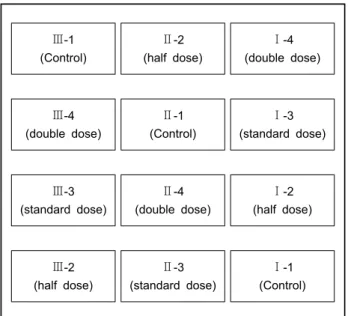
Area layout for Moja-3 test in altari radish and lettuce To evaluate Moja-3 effects, 12 testing areas were divided to control, half dose, standard dose and double dose treatment. The areas are shown in Fig. 1.
Cultivation methods
For the cultivation of altari radish and lettuce, their seed were taken from Heungnong province and their specifica- tions have been shown in Table 2.
Planting, cultivation and harvesting of altari radish We cultivated altari radish following to the timeline shown in Table 3.1.
Planting, cultivation, and harvesting of lettuce
Timeline for the lettuce cultivation is shown in Table 3.2.
Ⅲ-1 (Control)
Ⅱ-2 (half dose)
Ⅰ-4 (double dose)
Ⅲ-4 (double dose)
Ⅱ-1 (Control)
Ⅰ-3 (standard dose)
Ⅲ-3 (standard dose)
Ⅱ-4 (double dose)
Ⅰ-2 (half dose)
Ⅲ-2 (half dose)
Ⅱ-3 (standard dose)
Ⅰ-1 (Control)
Fig. 1. Test area layout for cultivation of altari radish and lettuce. 12 testing areas are divided to 4 sections for cultivation of altari radish and another 12 areas were tested for lettuce. Control, half dose, standard dose and double dose treatments were applied to each section and the divided areas are shown in Fig. 1.
Table 3.1. Timeline for altari radish cultivation and harvesting
Days Processes undertaken
1 3 4 9 39 45 46 52 70
1,000 kg fertilizer/10a was used in the field
Field was divided into 12 different plots (1.2 m × 3.6 m) Moja-3 treatment was done in 3 different concentrations
Seeds of altari radish were sowed with 30 cm × 12 cm space between two lines Destroyed the unwanted altari radish followed by 1st foliar treatment
Second foliar treatment Second decimation Third foliar treatment
Harvesting followed by growth comparison test 20 altari radish with average length were selected for the testing and total weight was taken
Number of leaves more than 2 cm was counted and leaf length, leaf width and the highest leaf length and highest leaf width was measured
Table 3.2. Timeline for altari radish cultivation and harvesting
Days Processes undertaken
1 2 3 42 47 53 60 82
1,000 kg fertilizer/ 10a was used in the field 12 different 1.2 m × 3.6 m/ plot was made
Lettuce seeds were sowed with 30 cm × 12 cm space between two lines Decimated the unwanted lettuce followed by 1st foliar treatment First foliar treatment was done
Second foliar treatment was done
Third foliar treatment was done and unwanted lettuce were decimated
Harvesting followed by growth comparison test 20 lettuces with average length was selected for the testing.
Number of leaves more than 2 cm was counted and also the leaf length and leaf width and the highest leaf length and leaf width were measured.
Results and Discussion
Effect of Moja-3 foliar treatment on altari radish Effect of Moja-3 foliar treatment on the characteristics of altari radish leaves
The results of Moja-3 foliar treatment (up to three weeks, once each week) on leaves of altari radish have been sum- marized in Table 4.1a below. After harvesting, the growth characteristics of three different groups of altari radish treated with half, standard and double concentration of Moja-3 were tested by comparing the number, length and weight of the leaves with untreated control group. The number of leaves of control group was 15.21, and those treated with half dose, standard dose and double dose were 16.84, 18.22 and 18.21 respectively. While, the length of leaves of control group was 57.17 cm, those treated with half dose, standard dose and double dose of Moja-3 foliar spray were 61.28 cm, 63.78 cm and 63.74 cm respectively.
The weight of leaves of control group was 191.14 g and
those treated with half dose, standard dose and double
dose were 202.14 g, 225.28 g and 222.04 g. These results
Table 4.1.a Characterization of Altari radish leaves after Bacillus mojavensis KJS-3 treatment
Study groups Quantity Length (cm) Weight (g)
Control group
Group treated with half dose Group treated with standard dose Group treated with double dose
15.21 b 16.84 ab 18.21 a 18.22 a
57.17 b 61.28 ab 63.78 a 63.74 a
191.14 b 202.14 ab 225.18 a 222.04 a
Mean Value 17.12 61.49 210.12
* Means in a column followed by same letter are not significantly different according to Duncan’s multiple range test at the 1%
level (p≤0.01).
Table 4.1.b Characterization of altari radish root after Bacillus mojavensis KJS-3 treatment (Foliar spray)
Study groups Length (cm) Rhizomes (cm) Adjacent portion (cm) Dry weight (g)
Control group
Group treated with half dose Group treated with standard dose Group treated with double dose
13.35 b 14.27 ab
14.51 a 14.48 a
6.54 b 7.61 a 7.75 a 7.70 a
4.61 b 4.75 a 4.85 a 4.81 a
201.21 c 226.85 ab
235.08 a 233.18 a
Mean Value 14.15 7.40 4.75 224.08
* Means in a column followed by same letter are not significantly different according to Duncan’s multiple range test at the 1%
level (p≤0.01).
suggest that, compared to untreated control group, the Moja-3 foliar spray group showed an increase in growth of altari radish leaves. As there were no significant differences in the growth characteristics (number, length and weight) of altari radish leaves when treated with the recommended standard and double concentration of Moja-3, the standard dose of foliar spray treatment was the preferred one over half dose test sample.
Effect of Moja-3 foliar treatment on the characteristics of altari radish roots
After harvesting the altari radish, roots of altari radish were compared between the untreated control group and 3 different foliar spray Moja 3 treatment groups. Length of the root of control group was found to be 13.35 cm whereas the length of altari radish treated with half concentration, standard concentration and double concentration of Moja-3 foliar spray group were 14.27 cm, 14.51 cm and 14.48 cm respectively. Rhizomes of the control group was 6.54 cm and the altari radish treated with half dose, standard dose and double dose of Moja-3 foliar spray group were 7.61 cm, 7.75 cm and 7.70 cm respectively. Similarly, the diameter of adjacent portion of control group of altari radish was compared with Moja 3 treated group and found higher (4.85 cm) in case of standard dose of Moja-3 treated group.
Weight of the root of control group altari radish was 201.21 g, while those of half dose, standard dose and double dose were 226.85 g, 235.08 g and 233.18 g. The growth in weight
of the altari radish roots due to standard dose was more acceptable; it was higher than the growth in weight of the roots due to half dose (226.85 g) and even similar to double dose (233.18 g). In the present work, the use of 1×10
9CFU/g concentration of Moja-3 treatment group showed the higher impact on the growth of root of altari radish.
Bacillus mojavensis KJS-3 foliar spray treatment for the
growth of altari radish
Result of Moja-3 foliar spray in the altari radish, for three weeks once each week, did not showed any inhibitory effect on the growth of altari radish, and the results observed have been shown in Fig. 2 below.
Effects of Moja-3 foliar treatment on the characteristics of the lettuce leaves
Result of Moja-3 foliar treatment on the lettuce leaves
have been summarized in Table 4.2 below. After harvesting
three different groups of lettuce treated with half, standard
and double doses of Moja-3, growth characteristics were ex-
amined by comparing the quantity, length and weight of
the leaves with the control group. The number of leaves of
control group was 20.15, while those treated with half dose,
standard dose and double dose were 22.14, 23.84 and 23.71
respectively. The length of control group leaves was 22.17
cm, while the length of the leaves treated with half dose,
standard dose and double dose were 24.18 cm, 26.29 cm
and 26.07 cm respectively. The width of the control group
2.1 Growth appearance after Bacillus mojavenis KJS-3 treatment (Foliar Spray)
2.1 Day 1 of Moja-3 treatment 2.2 Devastating 2.3 Growing
2.4 Before harvesting 2.5 After harvesting 2.6 Comparison of study groups
Fig. 2. Altari radish during and/or after Bacillus mojavensis KJS-3 treatment.Cultivation procedure and altari radish growth appear- ance after Bacillus mojavenis KJS-3 treatment (Foliar Spray) : 2.1-day 1 of Moja-3 treatment, 2.2-devastating, 2.3-growing, 2.4-before harvesting, 2.5-after harvesting, 2.6-comparison of study groups.
Table 4.2. Growth effects after Bacillus mojavensis KJS-3 treatment (Foliar spray) on lettuce leaves
Study groups Quantity Length (cm) Width (cm) Weight (g)
Control group
Group treated with half dose Group treated with standard dose Group treated with double dose
20.15 b 22.14 a 23.84 a 23.71 a
22.17 b 24.18 ab
26.29 a 26.07 a
13.51 b 15.02 ab
16.14 a 16.08 a
157.58 b 170.10 ab
174.86 a 170.44 a
Mean Value 22.46 24.68 15.19 168.24
* Means in a column followed by same letter are not significantly different according to Duncan’s multiple range test at the 1%
level (p<0.01).
leaves was 13.51 cm while those treated with Moja-3 foliar spray half dose, standard dose and double dose were 15.02 cm, 16.14 cm and 16.08 cm respectively. The weight of con- trol group leaves was 157.58 g and those treated with half dose, standard dose and double dose were 170.10 g, 174.86
and 170.44 g. The growth in weight of the lettuce leaves
due to standard dose (174.86 g) was more acceptable; it
gained higher growth compared to the growth from half
dose (170.10 g) and double dose (170.44 g). These results
suggest that, compared with untreated control group the
3.1 Growth appearance of lettuce after Bacillus mojavenis KJS-3 treatment (Foliar Spray)
3.1 Making of plot 3.2 1st foliar treatment with Moja-3 3.3 2nd foliar treatment with Moja-3
3.4 3rd foliar treatment with Moja-3 3.5 Measuring width after harvesting 3.6 Comparison of study groups
Fig. 3. Lettuce during and/or after Bacillus mojavensis KJS-3 treatment. Cultivation procedure and lettuce growth appearance after Bacillus mojavenis KJS-3 treatment (Foliar Spray) : 3.1-day 1 of Moja-3 treatment, 3.2-devastating, 3.3-growing 3.4-before har- vesting, 3.5-after harvesting, 3.6-comparison of study groups.
Moja-3 foliar spray group showed an increase in growth of the leaves of lettuce, and among there different group standard foliar spray treatments group showed the good result.
Bacillus mojavensis KJS-3 foliar spray treatment for the
growth of lettuce
Result of Moja-3 foliar spray in the lettuce, for three weeks once each week, did not showed any inhibitory effect on the growth of lettuce, and the results observed have been shown in figure 3 below.
This is the very first study on growth promoting effects of bacterial application in the growth parameters of plants such as altari radish and lettuce. Though, similar inves- tigations were conducted in different plant species, their
studies suggested that, bacterial applications including Pseudomonas and Bacillus strains can stimulate growth and increase the yield in pepper and tomato [20, 28], in beans [32], in sugar beet [5], in spring barley [29], in sweet cherry [10], apricot [1], in raspberry [25] in apple [2], in rocket [8]
and in tomato and cucumber [9]. The key reason for the growth promoting effect of bacterial applications on plant growth is that they affect on fixation capacity of Nitrogen [7, 26, 34] and is one of the most prominent mechanism of action with high probability of affecting plant growth [10].
In modern agriculture field, increase in use of chemical
pesticides and chemical fertilizers has resulted in deterio-
ration of soil fertility and manifestation of pesticide-re-
sistant mutants of insects and plant pathogens damaging
human body. To overcome these problems, biological con- trol using endophyte is becoming more and more attentive and much research has been carried out in recent years. The species mojavensis is a relatively new member of the genus Bacillus and is known to be a PGPR of plants. Bacillus moja- vensis KJS-3 discovered from food waste has been inves- tigated as potential for developing the product in the in- dustrial applications and found to possess antifungal prop- erty against Aspergillus terreus, A. fumagatus, A. flavus and Fusarium redolense. The effects produced by three different B. mojavensis strain foliar spray treatment method resulted increase in the growth of both altari radish and lettuce. The standard recommended dose of B. mojavensis KJS-3 (1X10
9CFU/g) was found to be more effective than half of the dose and similar to the double dose, for the growth of both altari radish and lettuce. The present study demonstrates a significant positive effect of B. mojavensis KJS-3 as a poten- tial agent of new bio-fertilizer for growth of altari radish and lettuce cultivation.
Acknowledgement
This research was supported by Kyungsung University Research Grants in 2014.
References
1. Altindag, M., Sahin, M., Esitken, A., Ercisli, S., Guleryuz, M., Donmez, M. F. and Sahin, F. 2006. Biological control of brown root (Moniliana laxa) on apricot (Prunus armeniaca L.) by Bacillus, Burkholdria and Pseudomonas application un- der in vitro and in vivo conditions. Bio Control 38, 369-372.
2. Aslantas, R., Cakmakci, R. and Sahin, F. 2007. Effect of plant growth promoting rhizobacteria on young apple tree growth and fruit yield under orchard conditions. Sci Hortic 111, 371-377.
3. Bacon, C. W., Hinton, D. M., Mitchell, T. R., Snook, M. E.
and Olubajo, B. 2012. Characterization of endophytic strains of Bacillus mojavensis and their production of surfac- tin isomers. J Biocontrol 62, 1-9.
4. Bacon, C. W., Yates, I. E., Hinton, D. M. and Meredlth, F.
2001. Biological control of Fusarium moniliforme in maize.
Environ Health Perspect 109(Suppl 2), 325-332.
5. Cakmakci, R., Kantar, F. and Sahin, F. 2001. Effect of N2-fixing bacterial inoculations on yield of sugar beet and barley. J Plant Nutr Soil Sci 164, 527.
6. Conn, K. L., Nowak, J. and Lazarovits, G. 1997. A gnoto- biotic bioassay for studying interactions between potatoes and plant growth-promoting rhizobacteria. Can J Microbiol 43, 801-808.
7. Dobereiner, J. 1997. Biological nitrogen fixation in the trop- ics: social and economic contributions. Soil Biol Biochem 29, 771-774.
8. Dursun, A., Ekinci, M. and Dönmez, M. F. 2008. Effects of inoculation bacteria on chemical content, yield and growth in Rocket (Eruca vesicaria subsp. sativa). Asian J Chemistry 20, 3197-3202.
9. Dursun, A., Ekinci, M. and Dönmez, M. F. 2010. Effects of foliar application of plant growth promoting bacterium on chemical contents, yield and growth of tomato (Lycopersicon esculentum) and cucumber (Cucumis sativus). Pak J Bot 42, 3349-3356.
10. Esitken, A., Karlidag, H., Ercisli, S., Turan, M. and Sahin, F. 2003. The effect of spraying a growth promoting bacte- rium on the yield, growth and nutrient element composi- tion of leaves of apricot (Prunus armeniaca L. cv.
Hacihaliloglu). Aust J Agric Res 54, 377-380.
11. Esitken, A., Pirlak, L., Turan, M. and Sahin, F. 2006. Effects of oral and foliar application of plant growth promoting rhizobacteria (PGPR) on yield, growth and nutrition of sweet cherry. Sci Hortic 110, 324-327.
12. Frommel, M. I., Nowak, J. and Lazarovits, G. 1991. Growth enhancement and developmental modifications of in vitro grown potato (Solanum tuberosum ssp. tuberosum) as af- fected by a non-fluorescent Pseudomonas sp. Plant Physiol 96, 926-938.
13. Germida, J. J., Siciliano, S. D., de Freitas, R. and Seib, A.
M. 1998. Diversity of root-associated bacteria associated with field-grown canola (Brassica napus L.) and wheat (Triticum aestivum L.). FEMS Microbiol Ecol 26, 43-50.
14. Hinton, D. M. and Bacon, C. W. 1995. Enterobacter cloacae is an endophytic symbiont of corn. Mycopathologia 129, 117- 125.
15. Hollis, J. P. 1951. Bacteria in healthy potato tissue. Phytopa- thology 41, 350-366.
16. Jacobs, M. J., Bugbee, W. M. and Gabrielson, D. A. 1985.
Enumeration, location, and characterization of endophytic bacteria within sugar beet roots. Can J Bot 63, 1262-1265.
17. Kim, D. H., Kim, H. K., Kim, K. M., Kim, C. K., Jeong, M.
H., Ko, C. Y., Moon, K. H. and Kang, J. S. 2011. Antibacte- rial activities of macrolactin a and 7-O-succinyl macrolactin a from Bacillus polyfermenticus KJS-2 against vancomycin-re- sistant enterococci and methicillin-resistant Staphylococcus aureus. Arch Pharm Res 34, 147-152.
18. Kim, K. M., Choi, S. M., Kim, D. U., Yoon, S. J., Lee, D.
K. and Kang, J. S. 2009. Acute oral toxicity and identi- fication of antimicrobial and antifungal effects of Bacillus mojavensis KJS-3 as novel strain isolated from food wastes.
Mol Cell Toxicol 5, 54.
19. Kloepper, J. W., Zablotowicz, R. M., Tipping, E. M. and Lifshitz, R. 1991. Plant growth promotion mediated by bac- terial rhizosphere colonizers. In: Keister, D. L., Cregow, P.
B. (eds.), The Rhizosphere and Plant Growth. Kluwer Academ- ic Publishers, Dordrecht 14, 315-326.
20. Kotan, R., Sahin, F., Demirci, E., O¨zbek, A., Eken, C. and Miller, S.A. 1999. Evaluation of antagonistic bacteria for bi-
초록: Bacillus mojavensis KJS-3를 이용한 식물의 생육촉진 활성연구 표재성․사밀라 스레스타(아마티아)․박송희․강재선*
(경성대학교 약학대학)
식물성장촉진 뿌리박테리아(PGPR)을 사용한 생물학적 조절(Biological control)은 최근 몇년 동안에 주목 받게 되었다. PGPR은 산업적으로 중요한 감자, 토마토 그리고 쌀과 같은 경제적으로 중요한 작물의 성장촉진과 관련되 어있다. 음식물 쓰레기에서 발견된 Bacillus mojavensis KJS-3은 Aspergillus terreus, A. fumagatus, A. flavus and Fusarium redolense에 대해 항진균작용을 가지고 있는 균주로, 이미 여러 산업적인 측면에서 유용한 가능성이 확인 된 균주이다. 본 연구에서는 Bacillus mojavensis KJS-3를 알타리무와 상추에 0.5×10
9cfu/g, 1.0×10
9cfu/g 및 2.0×10
9cfu/g의 3가지 농도로 분무, 재배한 후, 잎의 수, 길이, 무게, 뿌리와 근경의 길이, 넓이 및 무게를 비교함으 로써, 이들에 대한 생육촉진작용을 확인해보았다. 그 결과, 처리하지 않은 군에 비하여 Bacillus mojavensis KJS-3를
처리한 군이 더 높은 생육성장을 보였으며, 1.0×10
9cfu/g농도에서의 재배는 저농도에서의 재배보다 더 높은 생육
성장을 그리고 고농도에서의 재배와 비슷한 생육성장을 나타내었다. 이러한 결과를 토대로 B. mojavensis KJS-3의 생물학적 비료로서의 가능성을 확인할 수 있었으며, 또한 B. mojavensis KJS-3의 다른 작물에 대한 생육조절제의 적용도 가능할 것으로 예상된다.
ological control of Fusarium dry rot of potato.
Phytopathology 89, 41.
21. Lodewyckx, C., Vangronsveld, J., Porteous, F., Moore, E. R.
B., Taghavi, S., Mezgeay, M. and van der Lelie, D. 2002.
Endophytic bacteria and their potential applications. Crit Rev Plant Sci 21, 583-606.
22. Misaghi, I. J. and Donndelinger, C. R. 1990. Endophytic bacteria in symptom-free cotton plants. Phytopathology 80, 808-811.
23. Mundt, J. O. and Hinkle, N. F. 1976. Bacteria within ovules and seeds. Appl Environ Microbiol 32, 694-698.
24. Nowak, J., Asiedu, S. K., Bensalim, S., Richards, J., Stewart, A., Smith, C., Stevens, D. and Sturz, A. V. 1998. From labo- ratory to applications: challenges and progress with in vitro dual cultures of potato and beneficial bacteria. Plant Cell Tissue Organ Culture 52, 97-103.
25. Orhan, E., Esitken, A., Ercisli, S., Turan, M. and Sahin, F.
2006. Effects of Plant Growth Promoting Rhizobacteria (PGPR) on yield, growth and nutrient contents in organ- ically growing raspberry. Sci Hortic 111, 38-43.
26. Reis, V. M., Olivares, F. L. and Döbereiner, J. 1994.
Improved methodology for isolation of Acetobacter diazo- trophicus and confirmation of its endophytic habitat. World J Microbiol Biotechnol 10, 401-405.
27. Roberts, M. S., Nakamura, L. K. and Cohan, F. M. 1994.
Bacillus mojavensis sp. nov., distinguishable from Bacillus subtilis by sexual isolation, divergence in DNA sequence, and differences in fatty acid composition. Int J Syst Bacteriol 44, 256-264.
28. Sahin, F., Kotan, R., Demirci, E. and Miller, S. A. 2000.
Domates ve biber bakteriyel leke hastaligiile biyolojik sa- vasta actigard ve bazi antagonistlerin etkinligi. Ataturk Universitesi Ziraat Fakultesi Dergisi 31, 11-16.
29. Salantur, A., Ozturk, A., Akten, S., Sahin, F. and Donmez, F. 2005. Effect of inoculation with nonindigenous and indigenous rhizobacteria of Erzurum (Turkey) origin on growth and yield of spring barley. Plant Soil 275, 147-156.
30. Samish, Z., Etinger-Tulczynska, R. and Bick, M. 1961.
Microflora within healthy tomatoes. Appl Microbiol 9, 20-25.
31. Snook, M. E., Mitchell, T., Hinton, D. M. and Bacon, C. W.
2009. Isolation and characterization of Leu7-surfactin from the endophytic bacterium Bacillus mojavensis RRC 101, a biocontrol agent for Fusarium verticillioides. Agric Food Chem 57, 4287-4292.
32. Stajkovic, O., Delic, D., Josic, D., Kuzmanovic, Ð., Rasulic, N. and Knezevic-Vukcevic, J. 2011. Improvement of com- mon bean growth by co-inoculation with Rhizobium and plant growth-promoting bacteria. Roman Biotechnol Lett 16, 5919-5926.
33. Sturz, A. V., Christie, B. R. and Matheson, B. G. 1998.
Associations of bacterial endophyte populations from red clover and potato crops with potential for beneficial allel- opathy. Can J Microbiol 44, 162-167.
34. Vance, C. P. 1997. The molecular biology of nitrogen metabo- lism, pp. 449-476. In: Dennis, D. T., Turpin, D. H., Lefeb- vre, D. D. and Layzell, D. B. (eds.), Plant Metabolism.
Longman Scientific, Essex, UK.