• 검색 결과가 없습니다.

Cloning and Characterization of a Novel Carboxylesterase Gene from Cow Rumen Metagenomic Library

N/A
N/A
Protected

Academic year: 2021

Share "Cloning and Characterization of a Novel Carboxylesterase Gene from Cow Rumen Metagenomic Library"

Copied!
8
0
0

로드 중.... (전체 텍스트 보기)

전체 글

(1)

Cloning and Characterization of a Novel Carboxylesterase Gene from Cow Rumen Metagenomic Library

Shah Md. Asraful Islam

1

, Min Keun Kim

3

, Renukaradhya K. Math

1

, Srinivasa Reddy R.N.

1

, Eun Jin Kim

1

, Jungho Kim

4

, Hoon Kim

4

and Han Dae Yun

1,2

*

1

Division of Applied Life Science (BK21 Program), Gyeongsang National University, Chinju 660-701, Korea

2

Research Institute of Agriculture and Life Science, Gyeongsang National University, Chinju 660-701, Korea

3

Gyeongsangnam-do Agricultural Research and Extension Service, Chinju 660-360, Korea

4
Department of Agricultural Chemistry, Sunchon National University, Suncheon 540-742, Korea Received July 23, 2010 /Accepted August 10, 2010

The gene encoding esterase enzyme was cloned from a metagenomic library of cow rumen bacteria.

The esterase gene (est1R) was 2,465 bp in length, encoding a protein of 366 amino acid residues, and the molecular weight of the enzyme was 61,166 Da. Est1R of rumen cosmid library shared 5.9% amino acid identity with Est1R (P37967) of PNB carboxylesterase, 6.1% with Est1R (1EEAA) of acetylcholines- terase and 6.1% with Est1R (1H23A) of chain A. BlastP in NCBI database analysis of Est1R revealed that it was not homologous to previous known lipases and esterases. Est1R showed optimum activity at pH 7.0 and 40

o

C. On the other hand, the enzyme was found to be most active without organic solvent, followed by 95% activity with methanol, and the enzyme activity was highly affected by hex- ane (lost 51% activity). Therefore, the novel esterase gene est1R is likely obtainable from cow rumen metagenome and may be utilized for industrial purposes.

Key words : Metagenomic library, cow rumen, est1R gene, new group esterase

*Corresponding author

*Tel:+82-55-751-5469, Fax:+82-55-751-0178

*E-mail : [email protected]

Introduction

Screening of novel biocatalysts from isolated micro- organisms using traditional cultivation techniques has limits in exploring the vast genetic diversity of environmental mi- croorganisms because more than 99% microbes present in various environments cannot be cultured [8,25,33]. Recently, there has been an increase in the number of studies using a metagenomic approach to investigate the catalytic poten- tial of non-cultured microorganisms [34]. In search for novel biocatalysts, there are various metagenomic strategies that are used for targeting specific catalyst characteristics such as substrate range or temperature and pH optima [7,9]. This approach has been used successfully to find a wide variety of novel catalysts and secondary metabolites [26,39].

Microbial lipases and esterases are currently receiving con- siderable attention because of their potential applications in biotechnology for food processing, surfactant composition, detergents, oil manufacture, diagnostics, and optically active drugs [5,24]. Recently, novel lipolytic enzymes and genes have been identified from metagenomic libraries of soil

[7,23], hot spring sediments [30], pond water [29], and alka- line soda lakes [28]. Lipolytic enzymes, including lipases (EC 3.1.1.3) and esterases or carboxylesterases (EC 3.1.1.1), have been found in a wide range of organisms from bacteria to humans [18,19].

Natural substrates for esterase in ruminal contents are not well established. There is evidence that ruminal contents contain esterase that degrades aliphatic esters to their con- stituents [17] and triglycerides to their component fatty acids and glycerol [6]. Plant triglycerides and other lipid-like ma- terials are not extensively degraded in the rumen, but are subjected to partial hydrolysis. Strains of ruminal Butyrivibrio fibrisolvensare known to hydrolyze saponins [13] and tribu- tyrin [22]. Morris and Bacon [15] found that in pasture-fed ruminants, most of the neutral lipids in feedstuffs are in the form of galactosyl-diglycerides, which could be first de- graded by galactosidases to yield diglycerides [27]. These diglycerides could then be degraded by esterases or lipases, or both [17,27]. Other suggested esterase substrates found in feed-stuffs or in rumen microorganisms, or both, include plant sterols, lechithin, lyolecithin, and aliphatic esters [27].

Also, Lanz and Williams [22] showed that B. fibrisolvens de-

graded an aliphatic insecticide, di-n-butyl succinate, and also

a carbamate insecticide, benzo(α)thien-4-yl-methylcarbamate

(2)

[36]. These findings suggest that bacterial esterases play a role in the degradation of agricultural chemical esters. At present, B. fibrisolvensis the only rumen bacterium in which fatty acid hydrogenases have been studied in detail [20].

Hespell and O’bryan [16] isolated thirty strains of B. fi- brisolvens in diverse geographical locations and examined them for esterase activity against naphthyl esters of acetate, butyrate, caprylate, laurate, and palmitate. All strains pos- sessed some esterase activity. Esterase activity was also de- tected in other ruminal bacteria such as Bacteroides ruminico- la, Selenomonas ruminantium, Ruminobacter amylophilus, and Streptococcus bovis [16]. Furthermore, Fay et al. [10] inves- tigated the ability of seventy-four strains of rumen bacteria comprising 20 genera for the ability to hydrolyze p-nitro- phenylpalmitate (pNPP, C16).

There are many reports on the cloning and expression of microbial lipases and esterases [20,21], but very little has been reported on rumen bacteria as a source of enzymes.

In this study, a novel carboxylesterase gene has been cloned and characterized from a cow rumen metagenomic library.

Material and Methods Sampling

Samples of rumen content were obtained from a closed herd at the Chinju National University (Chinju, Korea). The animals were rumen-fistulated Korean cows (HANWOO) with the body weight of 400±10 kg, fed a mixed ration (rice hull and concentrate in a 4:1 ratio) twice a day. The concen- trate was purchased from Daehan Food (Ulsan, Korea).

Representative samples of total rumen contents were col- lected from the animal via the ruminal fistula before the morning feeding. The samples on ice were immediately transferred into an anaerobic box and stored at -80°C.

Media and growth conditions

Escherichia coli DH5α was cultured in Luria-Bertani (LB) medium (Bacto-tryptone 10 g, yeast extract 5 g, NaCl 5 g per ml), and recombinant E. coli DH5α cells was cultured in LB medium containing appropriate antibiotics (ampicillin, 50 μl ml

-l

kanamycin 50 μl ml

-l

chloramphenicol, 12.5 μl ml

-l

) at 37°C [32].

Recombinants DNA techniques

Plasmid DNAs were isolated by an alkaline method [14]

and NucleoGen Plasmid Purification Kit (NucleoGen, Seoul,

Korea). Large scale chromosomal DNA from rumen were isolated by the method described by Frederick et al. [11].

Standard procedures for restriction of endonuclease diges- tions, agarose gel electrophoresis, and purification of DNA from agarose gels, DNA ligation, and other cloning related techniques were followed as described by Sambrook et al.

[32]. Restriction enzymes and DNA modifying enzymes were purchased from Gibco-BRL (Gaithersburg, MD, USA), Promega (Madison, WI, USA), and Boehringer Mannheim (Indianapolis, IN, USA). Other chemicals were purchased from Sigma Chemicl Co. (St. Louis, MO, USA). Restriction enzymes were purchased from Promega and used according to the manufacturer`s specifications.

Construction of cow rumen metagenomic library A genomic library was constructed in the fosmid vector pCC1FOS as previously described [35]. Total genomic DNA from cow rumen was sheared into approximately 40 kb frag- ments using a syringe needle, size-fractionated on a 5 to 40%

linear sucrose gradient and then end-repaired to yield blunt, 5'-phosphorylated ends. The resulting DNA fragments were ligated with the cloning-ready pCC1FOS vector, and then packaged using a lambda DNA packing kit (Epicentre, Wisconsin, USA). We constructed cow rumen metagenomic library following Cho et al. [2]. The BLAST program was used to find the protein coding regions. The esterase activity showing clones were screened on LB agar medium- supplemented with 1% tributyrin. The DNA library of ester- ase cosmid DNA was constructed in pBluescript II SK+. We partially digested the size of 2 to 5 kb to the cosmid DNA with Sau3AI. The plasmid SK+ DNA was digested with BamHI and CIP treatment. The SK+/BamHI/CIP (10 μg li- gated with 2 to 5 kb cosmid DNA fragments. After ligation reaction, this sample was transformed into E. coli DH5α. The pooled DNA of library clones was selected as active clones.

To screen esterase activity in E. coli harboring cloned esterase gene, bacterial colonies were grown on an esterase activity indicator medium [LB agar plates containing appropriate an- tibiotics and 1% (V/V) tributyrin (Sigma)]. After growth at 37

o

C for 24 hr, positive clones for cellular esterase activity were appeared clear zone.

Cloning and sequencing of esterase genes

The PCR primers used for first amplification, which am-

plified rDNA fragments, were the est1R primer (#1102)

5'-GCCTGTACCTGAACGTCTGG-3' (sense) and primer

(3)

(#1103) 5'-TGGCTGTATGGATGTCGTACTC-3' (antisense) and est2R #1264F 5'-GCCCCTCTATGACCTTACCC-3' and

#1274R 5'-CTTCTTCCACTCGTATTTGCC-3'. Subsequently, rDNAs were amplified by PCR using the extracted DNA, Super-Therm DNA polymerase (JMR, Side Cup, Kent, UK), 1.5 mM MgCl

2

, 2 mM dNTP, and primers in a final volume of 50 µl. Thirty-five cycles (denaturation at 94

o

C for 30 sec, annealing at 50

o

C for 30 sec, and extension at 72

o

C for 30 sec) were followed by a final incubation at 72

o

C for 10 min.

The anticipated product of approximately 1,500 bp, 900 bp, 600 bp, and 1,300 bp were isolated afteragarose gel electro- phoresis of the amplified mixture using a gel extraction kit (NucleoGen, Seoul, Korea). PCR products were directly cloned into the pBluescript II KS+ & SK+ (Stratagene

®

) and the recombinant colonies were randomly picked up. Plasmid DNA was purified as previously described [14]. Nucleotide sequences were determined by the dideoxy-chain termi- nation method using the PRISM Ready Reaction Dye termi- nator/primer cycle sequencing kit (Perkin-Elmer Corp.).

Purification and characterization of esterase enzyme For high expression of enzymes, the PCR products gen- erated with primers [5´- TTT TGA ATT CAG GAA TTC AGG ACA AGA A -3´ (sense, BamHI sites are indicated by underline) and 5´- TTT TAA CGT TAG GCA TAT AAT AGT TGG T -3´ (antisense, HindIII sites are indicated by under- line)] were cloned into expression vector pET-28a(+) (Novagen), resulting in the addition of a C-terminal (His)

6

tag. E. coli BL21 (DE3) carrying pET-28a(+)/est1R was grown at 37

o

C to mid-log phase in LB medium containing 50 μg mL

-1

kanamycin. Expression was then induced by adding IPTG to a final concentration of 0.5 mM, and further growth was continued for 5 hr. The cells were harvested by cen- trifugation (6,000× g, 10 min) and washed twice with 10 mM Tris-HCl buffer (pH 7.0). The cells were resuspended in the same buffer and stored at -20

o

C. The frozen cells were mixed with 50 mM Tris-HCl buffer (pH 7.5) containing 1 mg of bovine DNase I and incubated at 37

o

C for 30 min. Triton X-100 was added to the suspension to attain a final concen- tration of 2.5%. The supernatant was collected and stored at 4

o

C. The solubilized recombinant OpdB with His-tag was applied on a HisTrap kit (Amershan Pharmacia Biotech).

Purification of expressed His

6

-tagged protein was carried out accordingly as previously described by Guo et al. [12] and protein (OpdB) was eluted with 100 mM imidazole with 0.1% Triton X-100. The purified protein sample was analyzed

by sodium dodecyl sulfate-polyacrylamide gel electro- phoresis (SDS-PAGE). The protein concentration was de- termined by the method of Bradford [3].

Optimization of pH, temperature, effects of inhibitor substances on enzyme activity

The esterase activity for pNP-butyrate was measured over a pH range from 3.0 to 11.0 by using different buffers. For the preparation of 100 ml sodium phosphate buffer for pH 3.0, 79.45 ml 0.1M citrate and 20.55 ml 0.2M Na

2

HPO

4

for pH 4.0, 61.45 ml 0.1M citrate and 38.55 ml 0.2M Na

2

HPO

4

for pH 5.0, 48.50 ml 0.1M citrate and 51.50 ml 0.2M Na

2

HPO

4

for pH 6.0, 36.85 ml 0.1M citrate and 63.15 ml 0.2M Na

2

HPO

4

for pH 7.0, 17.65 ml 0.1M citrate and 82.35 ml 0.2M Na

2

HPO

4

for pH 8.0, 95.51 ml 0.1M Na

2

HPO

4

and 4.49 ml 0.1M HCl;

for pH 9.0, 95.50 ml 0.1M Na

2

HPO

4

and 4.50 ml 0.1M HCl;

for pH 10.0, 50.00 ml 0.2M NaHCO

3

, 21.4 ml 0.2M NaOH, and 28.60 ml H

2

O and for pH 11.0, 50.00 ml 0.2M NaHCO

3

, 21.4 ml 0.2M NaOH, and 4.60 ml H

2

O were mixed. The opti- mum temperature was determined by performing pNP-bu- tyrate assays at a temperature range from 0 to 80

o

C. To study the inhibitory effect of organic solvents on the activity of Est1R, 10% concentration of acetone, acetonitrile, butanol, ethanol, hexane, methanol, and propanol were incubated with the enzyme for 30 min at 37

o

C. The reaction was stop- ped by chilling on ice, and aliquots were assayed for enzyme activity.

Results

Construction of a metagenomic library

Rumen microbial DNA was prepared from rumen fluid (RF), epithelium (RE), and solid (RS) to construct a rumen metagenomic library. The prepared DNA ranged mostly from 10 kb to 35 kb in size as confirmed by pulsed-field gel electrophoresis. The DNA was size-fractionated and fur- ther purified to construct a cosmid library. Most of the puri- fied DNA ranged from over 30 kb, which is the optimum size for cloning in a cosmid. We obtained 200,000 clones from rumen metagenome DNA and maintained these for ac- tivity-based screening. The average insert DNA size was es- timated at 40 kb when 60 randomly picked clones were ana- lyzed by preparative pulsed-field gel electrophoresis after BamHI digestion. Clones conferring esterase activity on E.

coli were selected on LB agar supplemented with 1% tribu-

tyrin by screening the rumen cosmid library. Among 61

(4)

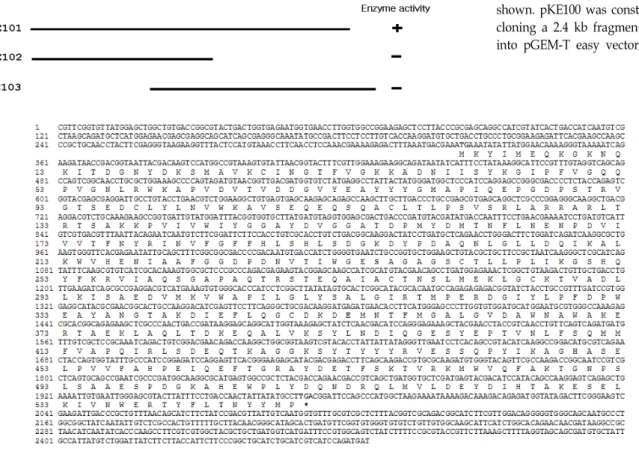
Fig. 1. Physical map of recombinant DNA pKE100 carrying est1R gene of Rumen cosmid library. The cleavage sites of restriction enzymes SacI, DraI, HindIII, BglI and DraIII are shown. pKE100 was constructed by cloning a 2.4 kb fragment of est1R into pGEM-T easy vector.

Fig. 2. Nucleotide sequence and deduced amino acid sequence of est1R gene. The nucleotide sequence is numbered from the total bases. The stop codon is indicated by astracts. Initiation and termination codons are shaded. Weakly shaded portion is conserved region of esterase.

clones showing a clear zone around the colonies, a total of 3 unique clones were finally chosen by restriction endonu- clease digestion analysis for further analysis of esterase activity. Since most of the clones carried insert DNA over 35 kb in size, secondary shotgun libraries were generated from the individual esterase clones to select the esterase sub- clones with smallest DNA insert (Data not shown).

Cloning of est1R gene

A clone showing esterase activity was isolated from 1%

tributyrin containing agar plates. The clone was found to contain an inserted DNA fragment of 2.4 kb. The pGEM-T vector containing 2.4 kb insert was designated pKE100 (Fig.

1). To further localize esterase gene in the insert, HindIII, BglI, and DraIII digested fragments of pKE100 were subcl- oned into pGEM-T vector. The ligation mixture was used to transform E. coli DH5α and the transformants showing

esterase enzyme activity were screened on LB agar plates containing 1% tributyrin by staining of the plates. pKE102 and pKE103 clones did not show esterase enzyme activity.

pKE100 was selected for further characterization.

Primary structure of est1R

The est1R is 2,465 bp in size and the ORF of est1R starts the ATG initiation codon and the reading frame ends with the opal stop codon TGA (Fig. 2). The est1R encodes a pro- tein of 549 amino acids with a predicted molecular mass of 61,166 Da (Fig. 3). Calculated pI of Est1R is 5.34. The four conserved regions among the esterase enzyme were shown in Table 1.

Comparison of amino acid sequence similarity of Est1R with other esterases

The amino acid sequence of the esterase enzyme from ru-

(5)

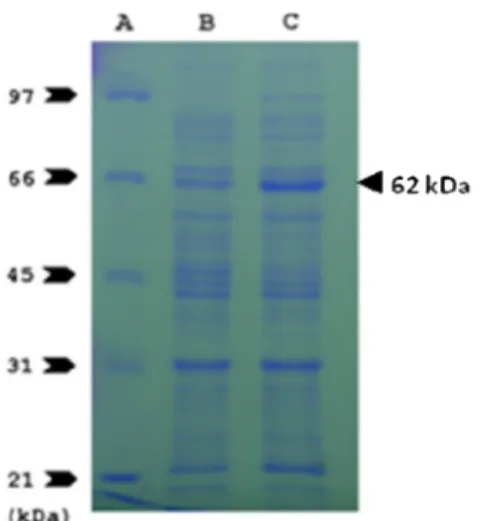
Table. 1. The two conserved regions found in the esterase enzymes catalytic triad Fig. 3. SDS-PAGE of Est1R produced in E.coliBL21 cells harbor-

ing pET-Est1R. Lane A, the molecular weight standard was cut off after electrophoresis and stained with 0.025%

Coomassie blue R-250. Molecular weight markers used were phosphorylase b (97,400), bovine serum albumin (66,200), ovalbumin (45,000), carbonic anhydrase (31,000), soybean trypsin inhibitor (21,500), and lyso- zyme (14,400). Lane B, crude cell extract of pET-28a(+) plasmid induced by IPTG. Lane C, crude cell extract of pET-28a(+)/est1R plasmid induced by IPTG. Molecular weight of fusion protein showed 62 kDa, approximately.

men cosmid library was compared with the sequences of other esterase enzymes. Protein sequence databases (SWISS-PROT, PIR, and GenBank) were searched using the standard search algorithms (programs FASTA and BLASTP) to find polypeptides related to Est1R. Est1R of rumen cosmid library shared 5.9% amino acid identity with Est1R (P37967) of PNB carboxylesterase, 6.1% with Est1R (1EEAA) of acetylcholinesterase and 6.1% with Est1R (1H23A) of Chain A. We have constructed a phylogenetic tree of the esterase enzymes by the DNAMAN analysis system using above sequences, as shown in Fig. 4.

Fig. 4. Phylogenetic tree showing the evolutionary relationship of the Est1R amino acid sequences.

Effect of pH, temperature and organic solvents on Est1R activity

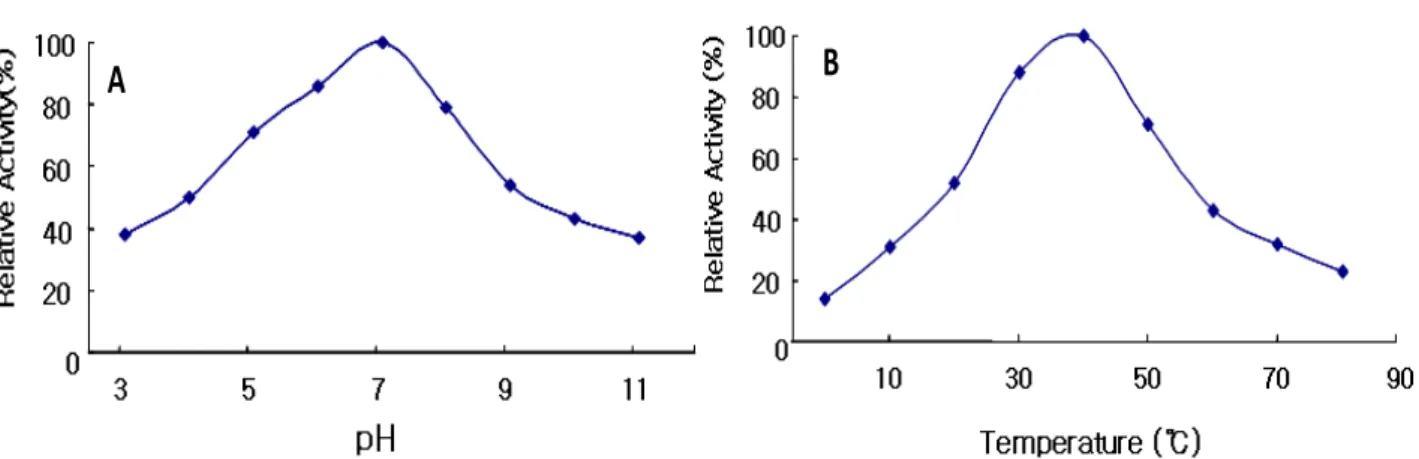
The effects of pH, temperature and organic solvent on the Est1R activity were studied. The Est1R showed highest relative activity at pH 7.0 (Fig. 5A). The Est1R was most active at 30 to 50

o

C, and showed optimum activity at 40

o

C (Fig. 5B). At 40

o

C, the esterase was stable for more than 10 hr with a half-life of about 14 hr. To test the effects of organic solvents on Est1R activity, assays were performed at 1 hr intervals in various organic solutions. The enzyme was found to be most active without any organic solvent (100%), followed by 95% active with methanol and highly affected by the hexane (lost 51% activity) (Table 2)

Discussion

Metagenomics is the culture-independent genomic analy-

sis of microbial communities. The term is derived from the

statistical concept of meta-analysis (the process of statisti-

cally combining separate analyses) and genomics (the com-

(6)

A B

Fig. 5. Activity assay for pH and temperature effect. (A) pH effect of substrate hydrolysis. Activity measurement was performed spectrophotometrically in various buffers containing 3 mM p-NP butyrate as a substrate and 5 mM CaCl

2

at different pH values and at 40℃ The data presented were based on comparisons to maximum activity (100%). (B) Effect of temperature on Est1R activity. The effect of temperature on Est1R activity was determined spectrophotometrically at various temperatures in Tris-HCl buffer (3 mM p-NP caproate as a substrate, 5 mM CaCl

2

and 20 mM Tris-HCl, pH 10). Activities given were the average values of triplicate measurements.

Table 2. The effects of organic solvents on Est1R activity.

Activities were measured spectrophotometrically in mixed buffer (3 mM p-NP butyrate, 5 mM CaCl

2

and 20 mM Tris-HCl, pH 10) at varying organic solutions and the average values of triplicate measurements were given

Organic solvents Concentration Relative Activity (%) None

Acetone Acetonitrile Butanol Ethanol Hexane Metanol Propanol

10%

10%

10%

10%

10%

10%

10%

100.0 77.6 74.8 61.4 71.9 49.0 95.4 60.9

prehensive analysis of an organism's genetic material) [31].

Metagenomics can be used to address the challenge of study- ing prokaryotes in the environment that are, as yet, un- culturable and which represent more than 99% of the organ- isms in some environments [1]. In this study, a cow rumen metagenomic library was constructed and screened for the esterolytic clones. Some previous environmental DNA li- braries contained several hundred of thousand clones with small inserts and required screening of a large number of clones [25,33]. However, our approach of library preparation in a fosmid and subsequent subcloning was more efficient in searching for esterolytic activity. Fosmids are good vec- tors for constructing metagenomic libraries because of their high cloning efficiency, improved stability in E. coli, and large insert size [23]. Screening of this library led to an iden-

tification of an esterase named as Est1R. Unlike other ester- ase, Est1R has several novel features; first, it has no sig- nificant homologies to published esterases or lipases.

From the rumen, we obtained 200,000 clones with an ap- proximate average insert size of 30 to 50 kb. This repre- sented almost 1.2 Gb genomic DNA, representing some 300 microbial genome equivalents. An alternative strategy for improving the probability of finding desirable genes in the metagenomic library would be to construct the library after certain enrichment processes. It may be necessary to take enrichment steps to obtain more genes for novel biocatalysts.

Some other previous environmental DNA libraries con- tained several hundred of thousand clones with small insert DNA and required screening of a large number of clones to search for enzymes. Previously, genes encoding α-amylase and cellulase had been isolated from cow rumen meta- genome [4,38].

Our results indicate that the esterase activity obtained in this study could be somewhat different from the esterase of previously cultured bacteria. Therefore, there is a high probability of obtaining novel biocatalysts from the rumen cosmid metagenome; this probability was also indicated in a recent study. Previously, esterase active genes were ob- tained from rumen [37]. In this respect, we examined the esterase activity of the three enzymes from the rumen meta- genome at similar temperature (40

o

C). The results revealed that all the enzymes showed the highest hydrolysis activity toward p-nitrophenyl butyrate at 40

o

C.

In conclusion, the esterolytic enzyme obtained in this

(7)

study is novel, suggesting that isolating enzymatic activities from metagenomes such as the rumen is supposed to be a useful approach to identifying novel biocatalysts. Thus met- agenomic approaches are not only useful solely for the dis- covery of diversity but also have practical applications in the discovery of novel enzymes for industrial and agricul- tural use. The list of reported enzyme activities discovered via metagenomics (lipase, esterase, amylase, nuclease, chiti- nase, and xylanase) is still rather small, but will undoubtedly grow rapidly.

Acknowledgements

This research was supported by Basic Science Research Program through the National Research Foundation of Korea (NRF) funded by the Ministry of Education, Science and Technology (2008-0061310) and was carried out with the support of "Cooperative Research Program for Agriculture Science & Technology Development (PJ007449201007)" Rural Development Administration, Republic of Korea. Srinivasa Reddy R.N. is supported by scholarships from the BK21 Program, Ministry of Education & Human Resources Development, Korea.

References

1. Amann, R. I., W. Ludwig, and K. Schleifer.1995.

Phylogenetic identification and in situ detection of in- dividual microbial cells without cultivation. Microbiol. Rev.

59, 143-169.

2. Arpigny, J. L. and K. E. Jacger. 1999. Bacterial lipolytic en- zyme :classification and properties. Biochem. J. 343, 177-183.

3. Bradford, M. M. 1976. A rapid and sensitive method for the quantization of microgram quantities of protein utilizing the principle of protein-dye binding. Anal. Biochem. 72, 248- 254.

4. Cho, S. J. and H. D. Yun. 2005. Cloning of α-amylase gene from unculturable bacterium using cow rumen metagenome.

J. Life Sci. 15, 1013-1021.

5. Choi, Y. J., C. B. Miguez, and B. H. Lee. 2004.

Charaterization and heterologous gene expression of a novel esterase from Lactobacillus casei CL96. Appl. Environ.

Microbiol. 70, 3213-3221.

6. Clarke, D. G. and J. C. Hawke. 1970. Studies on rumen metabolism. VI. In vitro hydrolysis of triglyceride and iso- lation of a lipolytic fraction. J. Sci. Food Agr. 21, 446-452.

7. Curtis, T. P. and W. T. Sloan. 2005. Exploring microbial di- versity-a vast below. Science 309, 1331-1333.

8. Daniel, R. 2004. The soil metagenome-a rich resource for the discovery of novel natural products. Curr. Opin.

Biotechnol. 15, 199-204.

9. Elend, C., C. Schmeisser, C. Leggewie, P. Babiak, J. D.

Carballeira, H. L. Steele, J. L. Reymond, K. E. Jaeger, and W. R. Streit. 2006. Isolation and biochemical characterization of two novel metagenome-derived esterases. Appl. Environ.

Microbiol. 72, 3637-3645.

10. Fay, J. P., K. D. Jakober, K. J. Cheng, and J. W. Costerton.

1990. Esterase activity of pure cultures of rumen bacteria as expressed by the hydrolysis of p-nitrophenylpalmitate.

Can. J. Microbiol. 368, 585-589.

11. Frederick, M. A., B. Roger, M. David, J. G. Seidmal, A. S.

John, and S. Kevin. 1999. Short protocols in molecular biol- ogy 4, 2-13.

12. Guo, P., L. Zhang, Z. Qi, R. Chen, and G. Jing. 2005.

Expression in Escherichia coli, purification and character- ization of Thermoanaerobacter tengcongensis ribosome re- cycling factor. J. Biochem. 138, 89-94.

13. Gutierrez, J., R. E. Davis, and I. L. Lindahl. 1959.

Characteristics of saponin-utilizing bacteria from the rumen of cattle. Appl. Microbiol. 7, 304-308.

14. Hardy, K. G. 1987. Purification of bacterial plasmid. 1-6, Plasmid IRL Press.

15. Henderson, C. 1971. A study of the lipase produced by Anaerovibrio lipolytica, a rumen bacterium. J. Gen. Microbiol.

65, 81-89.

16. Hespell, R. B. and P. J. O'Bryan. 1992. Purification and char- acterization of an α-l-arabinofuranosidase from Butyrivibrio fibrisolvens GS113. Appl. Environ. Microbiol. 58, 1082-1088.

17. Hill, F. D., J. H. Saylor, R. S. Allen, and N. L. Jacobson.

1960. In vitro lipolysis by rumen ingesta. J. Anim. Sci. 19, 1266-1270.

18. Jaeger, K. E., B. W. Dijkstra, and M. T. Reetz. 1999. Bacterial biocatalysts: molecular biology, three-dimensional struc- tures, and biotechnological applications of lipases. Annu.

Rev. Microbiol. 53, 315-351.

19. Jaeger, K. E., S. Ransac, B. W. Dijkstra, C. Colson, M. van Heuvel, and O. Misset. 1994. Bacteria lipase. FEMS Microbiol.

Rev. 15, 29-63.

20. Khalmeyezer, V., I.Fischer, U. T. Bornscheuer, and J.

Altenbuchner. 1999. Screening, nucleotides sequence, and biochemical characterization of an esterase from Pseudomonas fluorescens with high activity towards lactones.

Appl. Environ. Microbiol. 65, 477-482.

21. Kim, H. K., S. Y. Park, J. K. Lee, and T. K. Oh. 1998. Gene cloning and characterization of thermostable lipase from Bacillus stearothermophilus L1. Biosci. Biotechnol. Biochem. 62, 66-71.

22. Lanz, W. W. and P. P. Williams. 1973. Characterization of esterase produced by a ruminal bacterium identified as Butyrivibrio fibrisolvens. J. Bacteriol. 113, 1170-1176.

23. Lee, S. W., K. H. Won, H. K. Lim, J. C. Kim, G. J. Choi, and K. Y. Cho. 2004. Screening for novel lipolytic enzymes from uncultured soil microorganisms. Appl. Microbiol.

Biotechnol. 65, 720-726.

24. Lidija, T. I. Z., D. G. C. Gordana, R. G. Kristina, M. V.

Miroslav, and M. K. Ivanka. 2009. Enzymatic character-

(8)

ization of 30 kDa lipase from Pseudomonas aeruginosa ATCC 27853. J. Basic Microbiol. 49, 452-462.

25. Lorenz, P. and C. Schleper. 2002. Metagenome-a challenging source of enzyme discovery. J. Mol. Catal. B. 20, 13-19.

26. MacNeil, I. A., C. L. Tiong, C. Minor, P. R. August, T. H.

Grossman, K. A. Loiacono, B. A. Lynch, T. Phillips, S.

Narula, R. Sundaramoorthi, A. Tyler, T. Aldredge, H. Long, M. Gilman, D. Holt, and M. S. Osburne. 2001. Expression and isolation of antimicrobial small molecules from soil DNA Libraries. J. Mol. Microbiol. Biotechnol. 3, 301-308.

27. Morris, E. J. and J. S. Bacon. 1976. Digestion of acetyl groups and cell-wall polysaccharides of grasses in the rumen. Proc.

Nutr. Soc. 35, 94-95.

28. Nandwani, R. and S. S. Dudeja. 2009. Molecular diversity of a native mesorhizobial population of nodulating chickpea (Cicer arietinum L.) in Indian soils. J. Basic Microbiol. 49, 463-470.

29. Ranjan, R., A. Grover, R. K. Kapardar, and R. Sharma. 2005.

Isolation of novel lipolytic genes from uncultured bacteria of pond water. Biochem. Biophys. Res. Commum. 335, 57-65.

30. Rhee, J. K., D. G. Ahn, Y. G. Kim, and J. W. Oh. 2005. New thermophilic and thermostable esterase with sequence sim- ilarity to hormone-sensitive lipase family, cloned from a metagenomic library. Appl. Environ. Microbiol. 71, 817-825.

31. Rondon, M. R., P. R. August, A. D. Bettermann, S. F. Brady, T. H. Grossman, M. R. Liles, K. A. Loiacono, B. A. Lynch, I. A. MacNeil, and C. Minor. 2000. Cloning the soil meta- genome: a strategy for accessing the genetic and functional

초록:소 반추위 메타게놈에서 새로운 carboxylesterase 유전자 클로닝 및 유전산물의 특성 아스라풀 이스람

1

․김민근

3

․아라디아

1

․스리니 래디

1

․김은진

1

․김정호

4

․김훈

4

․윤한대

1,2

*

(

1

경상대학교 응용생명과학부 (BK21),

2

경상대학교 농업생명과학연구원,

3

경남농업기술원,

4

순천대학교 농화

학과)

한우의 반추위에서 게놈 DNA를 분리하여 메타게놈 은행을 구축한 다음 carboxylesterase를 암호화하는 유전 자를 클로닝 및 유전자를 선별하였다. 선별된 유전자의 DNA 염기서열 및 아미노산 서열을 분석하고 유전산물의 생화학적인 특성을 조사하였다. est1R 유전자는 2,465 bp로 366개의 아미노산 잔기를 가진 단백질을 암호화하였 으며 이 단백질의 이론적인 분자량은 61,166 Da이었다. Est1R단백질은 PNB carboxylesterase (P37967), acetylcho- linesterase (1EEAA) 및 chain A (1H23A)와 각각 5.9%, 6.1%, 6.1% 상동성을 가지고 있었다. 이러한 검색 결과 기존의 알려진 lipase 및esterase와의 상동성이 낮은 것으로 보아 새로운 그룹의 효소로 추정된다. Est1R효소의

최적 pH는 7.0 근방이었으며 최적 온도는 40

o

C 부근이었다. 한편 10% 유기용매를 함유한 기질의 효소활성측정에

서 대조구에 비해 methanol은 95%의 상대적인 활성을 가진 반면에 hexane 용액에서는 그 활성이 반으로 감소하 였다. 따라서 유기용매 농도의 작용성에 따라 이 효소의 산업적 이용성도 가능하리라 추정된다.

diversity of uncultured microorganisms. Appl. Environ.

Microbiol. 66, 2541-2547.

32. Sambrook J. and D. W. Russell. 2001. Molecular Cloning: A Laboratory Manual, 3th ed. Cold Spring Harbor Laboratory Press, Cold Spring Harbor, NY.

33. Schloss, P. D. and J. Handelsman. 2003. Biotechnological prospects from metagenomics. Curr. Opin. Biotechnol. 14, 303-310.

34. Streit, W. R., R. Daniel, and K. E. Jaeger. 2004. Prospecting for biocatalysts and drugs in the genomes of non-cultured microorganisms. Curr. Opin. Biotechnol. 15, 285-290.

35. Vazquez-Laslop, N., J. Lee, R. Hu, and A. A. Neyfakh. 2001.

Molecular sieve mechanism of selective release of cytoplas- mic proteins by osmotically shocked Escherichia coli. J.

Bacterili. 183, 2399-2404.

36. Williams, P. P. and R. L. Stolzenberg. 1972. Rumen bacterial degradation of benzo(β)thien-4-yl methyl-carbamate (Mobam) and effect of Mobam on ruminal bacteria. Appl.

Microbiol. 23, 754-749.

37. Wolin, M. J. 1974. Metabolic interactions among intestinal microorganisms. Am. J. Clin. Nutr. 27, 1320-1328.

38. Yun, H. D. and S. J. Cho. 2005. Cloning and characterization of cellulase gene (cel5A) from cow rumen metagenome. J.

Agric. Life Sci. 39, 1-8.

39. Yun, J., S. Kang, S. Park, H. Yoon, M. J. Kim, S. Heu, and S. Ryu. 2004. Characterization of a novel amylolytic enzyme encoded by a gene from a soil-derived metagenomic library.

Appl. Environ. Microbiol. 70, 7229-7235.

수치

Fig.  2.  Nucleotide  sequence  and  deduced  amino  acid  sequence  of  est1R  gene.  The  nucleotide  sequence  is  numbered  from  the  total  bases
Fig.  4.  Phylogenetic  tree  showing  the  evolutionary  relationship  of  the  Est1R  amino  acid  sequences.
Fig.  5.  Activity  assay  for  pH  and  temperature  effect.  (A)  pH  effect  of  substrate  hydrolysis

참조

관련 문서

- A novel lactic acid bacterium for the production of high purity l-lactic acid, Lactobacillus paracasei subspL. helveticus - Production of Lactic Acid from Water Hyacinth

(Attached to a noun) This is used to indicate the topics, to compare two information or to emphasize the preceding noun in a sentence.. (Attached to a noun) This is used

짝과 같이 말하기 연습을 하도록 하고 교사는 교실을 돌아다니면서 말하기 활동이 제대로 이루어지고 있 는지 확인하고 도움을 준다.. 평소에 누구하고 무엇을 하는지

(Attached to a verb or an adjective) This is used to indicate a succeeding action or situation. This is used

(Attached to a verb or an adjective) This is used to reflect on a past situation. (Attached to an adjective) This is used to show another

발표를 듣고 느낀 점이나 서로의 생각을 이야기해 보 게 하면서

We determined the nucleotide sequences of the mitochondrial DNA (mtDNA) control region using cloning and sequencing, and obtained the complete sequence from the cattle bones

Full genome cloning and nucleotide sequence analysis of hepatitis C virus from sera of chronic hepatitis patients in Korea. Detection of hepatitis C virus RNA