Anti-obesity Effects of Black Soybean Doenjang in C57BL/6 Mice
Jiyoung Kim*
Departments of Food Science and Nutrition Pusan National University, Busan 46241, Korea Received November 20, 2017 /Revised November 22, 2017 /Accepted December 28, 2017
Doenjang is a traditional korean fermented soybean paste made from meju (fermented soybean), which are fermented by diverse microorganisms including Bacillus subtilis and molds such as Rizopus, Mucor, and Aspergillus species The purpose of this study was to investigate the antiobesity effect of the black soybean doenjang (Korean fermented soybean pastes) in C57BL/6 mice. The anti-obesity effect was de- termined by measuring the release of adiponectin, leptin and adipogenic transcription factors by using reverse transcription-polymerase chain reaction and western blot. Weight gain was significantly re- duced in the mice fed high fat diets (HFD) plus black soybean doenjang (HBD) compared to HFD mice. The HBD were also effective in improving the lipid profile. They significantly decreased the lev- els of serum triglyceride and cholesterol. In addition, they had a significantly down regulated impact on antiobesity factors; leptin level and increased adiponectin level. Also, mRNA and protein ex- pression of two adipogenic transcription factors, SREBP-1c and PPAR-γ, in high fat with black soybean fed mice were markedly down regulated. These results indicate that the black soybean doenjang poten- tiates an anti-obesity effect by modulating lipid metabolism, thereby inhibiting adipogenic transcrip- tional activation.
Key words : Anthocyanin, antiobesity, black soybean, Doenjang, isoflavone
*Corresponding author
*Tel : +82-51-510-1718, Fax : +82-51-583-3648
*E-mail : [email protected]
This is an Open-Access article distributed under the terms of the Creative Commons Attribution Non-Commercial License (http://creativecommons.org/licenses/by-nc/3.0) which permits unrestricted non-commercial use, distribution, and reproduction in any medium, provided the original work is properly cited.
Journal of Life Science 2017 Vol. 27. No. 12. 1486~1493 DOI : https://doi.org/10.5352/JLS.2017.27.12.1486
Introduction
Rapidly rising obesity rates have become a world-wide problem. With this growing trend and concern, obesity has become an important health issue. Obesity is a key element that increases the risk of serious diseases such as hyper- tension, heart disease, diabetes, stroke, cancer, and osteo- arthritis [7, 14, 15]. There have been many reports regarding the effects of soybean on obesity [11, 16]. It has been reported that soy protein slows down the low-density lipoprotein (LDL) oxidation and lipid peroxidation [17, 25, 33]. In addi- tion, the extract from the black soybean has a longer LDL oxidation lag time than that from the yellow soybean be- cause of the high total polyphenols contained in its seed coat [35]. Soybean seed is diverse in its color of seed coat.
Soybean have variant color such as yellow, brown, green, and black. Black soybean contains considerable amount of dietary fiber and functional ingredients such as anthocya-
nins. The black soybean’s seed coat contains 0.87-3.52 mg/g anthocyanins, in which the highest ingredient concentration is cyanidin-3-glucoside (80.9% of total content [11]. Anthocy- anins are glycosides or acylglycosides of polyhydroxy 2-phe- nylbenzopyrylium cations belonging to a larger group of compounds known as flavonoids, a subgroup of polyphenols [1, 10]. Anthocyanins play critical roles as antioxidant, che- mo preventive, and anti-inflammatory agents [1, 16]. Some recent studies [9, 26, 33, 35] have shown that anthocyanins have an anti-obesity effect. For example, dietary cyanidin 3-glucoside-rich purple-colored corn pigments effectively suppressed the high fat diet (HFD)-induced increase in body weight, and hampered the increase in adipose tissue weights [35]. Cornelian cherry of anthocyanins is also reported to improve obesity and insulin resistance in high fat-fed mice [9]. Anthocyanin showed antihyperglycemic effect because it slows down the digestion of carbohydrates via-glucosidase inhibition [26]. Anthocyanin from blueberries and strawber- ries reduces obesity in the C57BL/6J mice fed a high-fat diet [33].
Doenjang is a traditional korean fermented soybean paste made from meju (fermented soybean), which are fermented by diverse microorganisms including Bacillus subtilis and molds such as Rizopus, Mucor, and Aspergillus species [20].
Doenjang has strong anti-mutagenicities against various car-
cinogens and anticancer activities [21-24]. As already in-
dicated, anthocyanins showed antiobestic effects [9, 26, 33, 35]. To evaluate the beneficial effect of black soybean doen- jang against obesity in male C57BL/6 mice, subjects were divided into four groups and maintained on a normal diet (ND), high fat diet (HFD), high fat diet with black soybean doengjang (HBD), high fat diet with yellow soybean doenjang (HYD) for 8 weeks. Thus, the objective of this study was to investigate the anti-obesity effect and lipid-regulating ef- fects of black soybean doenjang in C57BL/6J mice.
In this study, we determined whether the black soybean doenjang improves the lipid profiles, gene and protein ex- pression levels of obesity-related genes of PPAR- and SREBP-1c in the liver of the mice. Given this clinical rele- vance of black soybean doenjang to obesity, this study will provide evidence for lipid-lowering effects of dietary supple- mentation of black soybean doenjang for inducing weight loss in diet-induced obese mice.
Materials and Methods
Animals
Fifty 5-week-old male C57BL/6 mice, weighing approx- imately 14-16 g each, were purchased from the Korean Experimental Animal Center (Orient Co., Seoul, Korea). Mice were acclimated to the experimental facility for 1 week be- fore they were divided into four groups of eight and placed in polycarbonate cages in a room maintained at 22±1°C with 55±5% relative humidity. The room was exposed to alternat- ing 12 hr periods of light and dark. All mice were allowed free access to their respective diets and drinking water for eight weeks. This work supported by the Technology Development Program for Agriculture and Forestry and con- ducted in 2007 before the committee for animal care was launched; so that there is no animal care approve number.
Diets
Mice were randomized by weight and assigned to one of five dietary treatments.
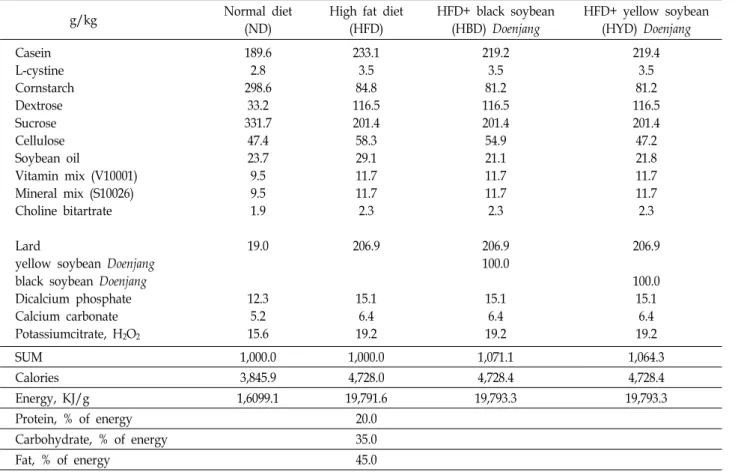
Normal diet (D12450B) and high fat diets (D12451) used in this experiment were purchased from Research Diets Inc (New Brunswick, New Jersey, USA) [37]. The experimental diets consisted of; (1) normal diet (ND) [containing 4%
(wt/wt) soybean oil], based on the DC diet; (2) HFD [ND supplemented with 23%(wt/wt) lard] (3); HFD with 10%
freeze-dried black soybean doenjang powder (HBD); (5) HFD with freeze-dried yellow soybean doenjang powder (HYD).
The compositions of diets are listed in Table 1.
Preparation of Doenjang
The process for making doenjang was as follows: soybeans were sorted, washed, soaked in water for 12 hr and then are cooked in an autoclave at 121°C for 2 hr. The cooked soybeans were cooled to 40°C, then inoculation with Aspergillus oryzae (0.2%), and fermented at 30°C for 48 hr.
After drying at 40°C for 24 hr, meju was prepared. The meju was placed in a jar and water and salt were added (meju:
salt: water =33:12:55, wt/wt/wt). The mixture was then fer- mented for 2 months.
Measurement of body weight and food consumption Body weight was measured every week and rounded to the second decimal place. Feed consumption was measured every second day. Feed efficiency ratio (FER) was calculated as weight gain in grams divided by dietary intake in grams.
Preparation of blood for lipid analysis
After 8 weeks on the experimental diets, the mice were sacrificed with ethyl ether. Blood samples were collected into heparin treated tubes. Plasma was separated by centrifuga- tion at 3,000 rpm for 15 min (VS-15CFU refrigerated cen- trifuge, Vision, Gyeonggi, Republic of Korea).
Quantitation of plasma triglyceride, total cholesterol and glucose
Concentration for total cholesterol (AM202K, Asan Pham, Seoul, Korea) and triglyceride (AM1575K, Asan Pham, Seoul, Korea) in the plasma were determined using commer- cially available kits.
Quantitation of plasma leptin and adiponectin Determination of leptin and adiponectin levels in the plas- ma was performed with sandwich enzyme-linked immun- osorbent assay (ELISA). For the leptin analysis, anti-mouse leptin, recombinant mouse leptin, biotinylated anti-mouse leptin antibodies (MOB00), and adiponectin analysis, a kit (MRP300) was purchased from R&D Systems (R&D Systems, Minneapolis, USA).
Reverse transcription-PCR analysis of mRNA ex- pression
Gene expression was measured by RT-PCR in an Exi-
Cycler (Bioneer, Daejeon, Korea). Briefly, total RNA was iso-
Table 1. Composition of experimental diets
g/kg Normal diet
(ND)
High fat diet (HFD)
HFD+ black soybean (HBD) Doenjang
HFD+ yellow soybean (HYD) Doenjang Casein
L-cystine Cornstarch Dextrose Sucrose Cellulose Soybean oil
Vitamin mix (V10001) Mineral mix (S10026) Choline bitartrate
Lard
yellow soybean Doenjang black soybean Doenjang Dicalcium phosphate Calcium carbonate Potassiumcitrate, H2O2
189.6 2.8 298.6
33.2 331.7
47.4 23.7 9.5 9.5 1.9 19.0
12.3
5.2 15.6
233.1 3.5 84.8 116.5 201.4 58.3 29.1 11.7 11.7 2.3
206.9
15.1 6.4 19.2
219.2 3.5 81.2 116.5 201.4 54.9 21.1 11.7 11.7 2.3
206.9 100.0
15.1 6.4 19.2
219.4 3.5 81.2 116.5 201.4 47.2 21.8 11.7 11.7 2.3
206.9
100.0 15.1
6.4 19.2
SUM 1,000.0 1,000.0 1,071.1 1,064.3
Calories 3,845.9 4,728.0 4,728.4 4,728.4
Energy, KJ/g 1,6099.1 19,791.6 19,793.3 19,793.3
Protein, % of energy 20.0
Carbohydrate, % of energy 35.0
Fat, % of energy 45.0
lated from the liver in C57BL/6J mice using Trizol reagent (Invitrogen, Carlsbad, CA, USA). One microgram of total RNA was used for first-strand cDNA synthesis using Superscript II reverse transcriptase (BD Bioscience, Palo Alto, CA, USA). Reverse transcription was performed at 30
oC for 10 min, 42
oC for 30 min, and 99
oC for 5 min to in- activate the avian myeloblastosis virus RTXL. Amplification was performed in a master-cycler (Eppendorf, Hamburg, Germany) with denaturing at 94
oC for 1 min, annealing at 54
oC for 1 min, extension at 72
oC for 30 sec for 25 cycles and finally 72
oC for 7 min. The amplified PCR products were run in 1.0% agarose gels and stained with ethidium bromide (EtBr), and visualized under UV light. The intensities of the bands were estimated by densitometry (Multi Gauge V3.0 software, Fujifilm Life Science, Tokyo, Japan). The primer sequences specific for the genes examined were: GAPDH, forward primer, 5'-TGTGTCCGTCGTGGATCTGA-3, reverse primer, 5-CCTGCTTCACCACCTTCTTGAT-3'; SREBP-1c, forward primer, 5‘-AGCAGCCCCTAGAACAAACAC-3’, re- verse primer, 5‘-CAGCAGTGAGTCTGCCTTGAT-3'; PPAR- γ, forward primer, 5’-TCGCTGATGCACTGCCTATG-3‘, re- verse primer, 5’-GAGAGGTCCACAGAGCTGATT-3‘.
Measurement of protein expression
Hepatic tissue lysates were lysed in an RIPA buffer (25 mM Tris · HCl pH 7.6, 150 mM NaCl, 1% NP-40, 1% sodium deoxycholate, 0.1% SDS, PIERCE, Rockford, IL, USA) as pre- viously described. Protein concentration was determined with Bio-Rad protein assay kit (Bio-Rad, Hercules, CA, USA).
For western blot analysis, proteins were separated by so- dium dodecyl sulfate (SDS)-polyacrylamide gel electro- phoresis and then electrotransferred to a nitrocellulose where subjected to immunoblot analysis with desired anti- bodies and protein visualized by the enhanced chem- iluminescence (ECL) method (Abcam, MA, USA). Antibodies use SREBP-1 (Abcam), PPAR-γ (Cell signaling), and β-actin (Santa Cruz Biotechnology). Peroxidase-labeled secondary antibodies were purchased from Abcam.
Statistical analysis
All statistical analyses were performed using SAS (Cary,
NC) version 8.0. Significant differences among the treatment
means were determined using analysis of variance (ANOVA)
and Duncan’s multiple range test at p<0.05.
Table 2. Changes of body weight, food intake and food efficiency ratio(FER) of mice fed experimental diets for 8 weeks
ND HFD HBD HYD
Body weight Initial weight (g) Final weight Weight gain (g/day) Food intake (g/day) Food efficiency ratio
21.51±1.36b 31.32±2.28b 0.16±0.01b 3.2±0.3a 0.05±0.003b
23.78±1.27a 40.41±3.33a 0.26±0.03a 3.1±0.3ab 0.08±0.006a
23.24±1.06a 32.94±1.99b 0.15±0.01b 3.0±0.2ab 0.05±0.005b
23.56±1.35a 34.29±4.53ab 0.17±0.05b 2.8±0.3b 0.06±0.005ab Data are expressed as mean ± SD. Means with different letters are significantly different (p<0.05) by Duncan's multiple range test.
Table 3. The weight of tissue and Fat pad weight in mice fed with experimental diets for 8 weeks
Organ weight (g) ND HFD HBD HYD
Liver Kidney
Epididymal fat pad Perirenal fat pad
1.53±0.03b 0.67±0.03b 1.52±0.12b 0.87±0.07b
1.79±0.06a 0.76±0.05a 2.76±0.13a 1.49±0.16a
1.33±0.04c 0.65±0.04b 1.57±0.32b 0.87±0.1b
1.38±0.09c 0.75±0.06a 1.70±0.64b 0.92±0.35b Data are expressed as mean ± SD. Means with different letters are significantly different (p<0.05) by Duncan's multiple range test.
Results
Weight gain, food intake and FER
C57BL/6 mice were fed high fat diets and other ex- perimental diets plus high fat diets for 8 weeks. The body weights and food intakes levels of the mice are shown in Table 2. In the beginning of the raising, there was not a sig- nificant difference in the average weight between each group. However, after four weeks, the weight in every group increased. The average weight gains (g/day) by mice fed normal diets, high-fat diets, high-fat diets plus black soybean doenjang and high-fat diets plus yellow soybean doenjang were 0.16±0.01, 0.26±0.03, 0.15±0.01 and 0.17±0.05, respectively (p<0.05). Weight gains of the HFD mice were significantly higher than the other groups. Weight gains of HBD mice were similar with ND mice. There was no significant alter- ation in the food intake of ND, HFD, and HBD groups.
Organ and fat tissue weight
Organ and fat weight are shown in Table 3. The HFD group differs on liver, kidney, epididymal fat pad, and peri- renal fat pad weights when compared to other groups. Liver, epididymal fat pad and perirenal fat pad weights were sig- nificantly higher in the HFD groups. The HBD (26%) and HYD (23%) group had liver weights that decrease sig- nificantly more than the HFD group (p<0.05). The epi- didymal fat pad weight of ND, HBD and HYD groups were significantly decreased by 45, 43 and 38%, respectively, com- pared to that of the HFD group (p<0.05). The perirenal fat
pad weight of ND, HBD, and HYD groups were significantly reduced by approximately 42, 42, and 38% respectively, com- pared to that of the HFD group (p<0.05). Adipose tissue weights of the HBD group were the same as those of ND group. Liver weights of HBD group were significantly lower than the other groups. Kidney, epididymal fat pad, and peri- renal fat pad weights of the HBD group were similar to the ND group.
Plasma lipid parameter
Plasma triglyceride (TG) and total cholesterol (TC) were measured by enzymatic assay. Concentration of plasma TG and TC are shown in Table 4. TG levels were significantly higher in the HFD mice. The TG level in the ND, HBD and HYD group were significantly lower than the HFD group by 30, 40 and 24% respectively (p<0.05). TG level of HBD group was lower than the other group. The TC level of ND, HBD and HYD group were significantly lower than the HFD group by approximately 31, 40 and 24% respectively (p<0.05).
TC levels in the HBD mice were similar to the ND mice.
The levels of plasma leptin and adiponectin were de- termined in C57BL/6 mice (Table 5). After 8 weeks feeding, the leptin levels of HBD group was significantly lower than the HFD group by 31%(p<0.05). The secretion of plasma adi- ponectin of ND and HBD group were significantly higher than the HFD group by 41 and 18% respectively (p<0.05).
Interestingly, there was no significant alteration in adipo-
nectin secretion of the HYD group compared to the HFD
group. There has been reported that adiponectin has certain
A B
Fig. 1. Effect of lipogenesis-related mRNA expressions level in the liver. Data are expressed as mean ± SD. Means with different letters are significantly different (p<0.05) by Duncan's multiple range test.
Table 4. The effect of Balck soybean Doenjang diets on serum TG, TC, leptin and adiponectin concentrations in mice fed experimental diets for 8 weeks
ND HFD HBD HYD
Triglyceride (mg/dl) Total cholesterol (mg/dl) Leptin (pg/ml)
Adiponectin (ug/ml)
105.5±22.9b 102.6±1.5bc 100.9±11.9d 8.5±0.3a
150±12.8a 161.5±13.5a 233.8±9.7a 6±0.5c
90.1±5b 97±7.4c 161.3±7.0c 7.1±0.2b
114.4±25.2ab 122.7±14.7b 181±9.2b 6.5±0.2c Data are expressed as mean ± SD. Means with different letters are significantly different (p<0.05) by Duncan's multiple range test.
effect on insulin sensitivity the regulation of glucose [27].
Even though we did not measure glucose and insulin levels in this study which might be a limitation of this study, fur- ther studies are warranted to confirm the possible associa- tion between adiponectin and glucose homeostasis levels.
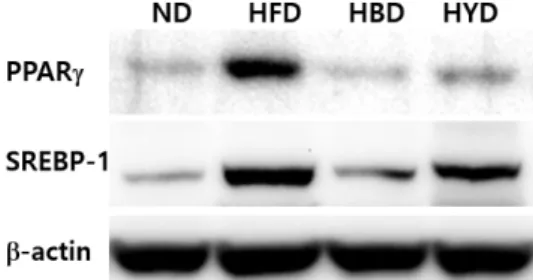
Expression of PPAR-γ and SREBP1c mRNA in liver To investigate how lipogenesis are regulated in black soy- bean doenjang, we examined expression of PPAR-γ and SREBP-1 in the liver (Fig. 1, Fig. 2). PPAR-γ levels in the HFD group were the highest. Its level decreased in the HYD group and more so in the black soybean doenjang. The ND group showed the lowest level of PPAR-γ. The mRNA levels of PPAR-γ on ND, HBD, and HYD groups were significantly lower than the HFD group by 61, 54, and 44%, respectively (p<0.05). The level of SREBP-1 mRNA dramatically increased in HFD group whereas it demonstrated lower-than-average value in the yellow and black soybean doenjang. SREBP-1 mRNA levels of the HBD group were lower than other groups. The mRNA level of SREBP-1c on ND, HBD, HYD and HE groups were significantly lower than the HFD group by 53, 67, 55, and 49%, respectively (p<0.05).
Expression of PPAR-γ and SREBP1c Protein in liver The protein levels of PPAR-γ and SREBP-1 in the liver
of mice that fed with black soybean doenjang were analyzed by western blot. Protein levels showed trends similar to mRNA levels. The PPAR-γ and SREBP-1 protein levels were highest in the HFD group. Expressions of PPAR-γ and SREBP-1 protein levels from liver demonstrated decreases in the HBD group. Interestingly, the HYD group markedly higher than HBD group (Fig. 2).
Discussion
A previous study on the anthocyanins extract of the black
soybean showed that anthocyanins suppressed hypolipi-
demic effects [12, 17, 25, 33]. There was a report that in-
dicated a protective effect of fermented soybean paste
against the development of overweight and oxidative stress
in adipose tissue of diet-induced obese mice [4, 8]. Ferment-
ed black soybean paste is a viable candidate to improve
physiological function due to its high anthocyanin content
compared to yellow soybean paste. The purpose of the pres-
ent study was to verify the anti-obesity effects of dietary
black soybean doenjang with in a population of high fat diet
fed C57BL/6 mice. In this study, a significant reduction in
body weight gain with black soybean doenjang supplementa-
tion indicates that the black soybean doenjang suppresses the
HFD-induced increase in body weight gain and fat weight
Fig. 2. Effect of lipogenesis-related protein expressions level in the liver.
(Table 2, Table 3). Despite similar food intakes between the HFD and the HBD groups, weight gain trends were sig- nificantly different. There has been a report that a high-fat/cholesterol diet leads to hyperlipidemia, charac- terized as elevated levels of triglyceride and total cholesterol [36]. We observed the levels of TG and TC in the plasma.
Plasma triglyceride and total cholesterol levels were sig- nificantly higher in the HFD mice than the HBD mice (Table 4). It is likely due to increase of liver and fat weight in HFD group. Whereas the reduction of TG and TC in HBD group is decreased which is comparable with ND group. There have been some reports that plasma levels of TG and TC were significantly increased in HFD-fed mice. In the present study, it was shown that supplementation of black soybean doenjang in mice under an 8 weeks high fat diet yielded bene- ficial effects in triglycerides and total cholesterol which are associated with leptin, adiponectin, and adipogenic tran- scription factors as well as more body weight loss. Leptin levels of the HFD group were significantly lower than the other group (p<0.05). The levels of leptin in adipocytes is transcriptionally regulated. It is also determined mainly by the status of triglyceride stores in white adipose tissue and the size of adipocytes [6]. Leptin is a fat-derived key regu- lator of appetite and energy expenditure, and leptin concen- tration is usually positively correlated with general adiposity [30]. In this study, leptin levels in the HBD group were sig- nificantly down regulated, and there was a correlation be- tween leptin concentration and fat mass in Table 2. In addi- tion, in the HBD group, plasma adiponectin levels up regu- lated by 27% compared to the HFD group (p<0.05).
Adiponectin is secreted by fat cells and circulates in the blood. The hormone has antiatherosclerosis and in- sulin-sensitizing properties that suppress hepatic glucose production and enhance glucose uptake into skeletal muscle [31]. The increase of plasma adiponectin may have been caused by decreased visceral fat mass. This result suggested
by the fact that lipid metabolism changes occurred in the HBD group. This finding was further supported by the hep- atic lipogenesis studies that showed reductions in hepatic lipid accumulation with black soybean doenjang. To examine the basis for the difference in hepatic fat accumulation be- tween groups, we observed the mRNA and protein levels of PPAR-γ, SREBP-1c in the liver of the mice. Transcription factors, such as PPAR-γ, SREBP-1 were related with lipogenesis. Lipid metabolism is regulated by the activity of peroxisome proliferator-activated receptors (PPARs) [38].
It is reported that PPAR-γ enhances the activity of some adi-
pogenic genes despite the very small amount of manifes-
tation in liver tissue [5, 13]. The PPAR-γ signaling pathway
might be involved in the high fat diet induced fatty liver,
indicating that PPAR-γ expression plays a key role in the
development of fat accumulation in hepatocytes [2]. Sterol
regulatory element binding proteins (SREBPs) regulate lipid
metabolism [3]. SREBP-1c controls the transcription of genes
involved in fatty acid and TG syntheses [29]. Therefore, to
find out the mechanism that influences weight change in
a body and fat tissue as well as TC and TG level in the
blood, we measured the level of mRNA and protein in
PPAR-γ and SREBP-1. The mRNA levels in PPAR-γ and
SREBP-1 dramatically increased in the HFD group, whereas
it decreased in the HBD group. The expression level of tran-
scription factors that regulate fatty acid metabolism in
mRNA was measured which was followed by the measure-
ment of expression level in protein. Along with mRNA, the
protein level also demonstrated similar tendencies. The pro-
tein level in PPAR-γ increased the most in the HFD group
whereas it decreased in the HBD group. Protein level in
SREBP-1 increased the most in the HFD group, whereas it
decreased in the HBD group. It was possible to confirm that
the high fat diet of black soybean doenjang led to the de-
creased manifestation of transcription factors which take
part in fat accumulation and lipid metabolism. In the initial
measurement of weight change, there was similar level of
decrease in the HBD group, whereas the level of TG, TC,
leptin, and adiponectin in plasma measured lower in the
HBD group than in the HFD group. The manifestation level
of lipogenesis-related transcription factor such as mRNA in
PPAR-γ and SREBP-1 along with protein was the lowest in
the HBD group. From these results, it can be concluded that
black soybean doenjang can contribute to an effective diet,
by regulating the lipid metabolism and to bringing down
the level of transcription factors related to fatty acid metabo-
lism to normal levels. Therefore, black soybean doenjang can regulate the various complications caused by a high fat diet including weight increase, obesity of organ and fat tissue, lipid dysfunction, and lastly the manifestation level of tran- scription factors related to fatty acid metabolism. Our stud- ies demonstrate that consumption of black soybean doenjang ameliorates obesity in diet induced obesity.
Acknowledgments
This study was supported by the Technology Develop- ment Program for Agriculture and Forestry, Ministry of Agriculture and Forestry, Republic of Korea. I would like to acknowledge Kun-Young Park for reviewing the manu- script.
References
1. Abdel-Aal-el, S. M., Abou-Arab, A. A., Gamel, T. H., Hucl, P., Young, J. C. and Rabalski, I. 2008. fractionation of blue wheat anthocyanin compounds and their contribution to an- tioxidant properties. J. Agric. Food. Chem. 56, 11171-11177.
2. Angulo, P. 2002. Nonalcoholic fatty liver disease. New Engl.
J. Med. 320, 1221-1232.
3. Brown, M. S. and Goldstein, J. L. 1997. The SREBP pathway:
Regulation of cholesterol metabolism by proteolysis of a membrane bound transcription factor. Cell 89, 331-340.
4. Cha, Y. S., Park, Y. S., Lee, M. S., Chae, S. W., Park, K.
M., Kim, Y. S. and Lee, H. S. 2014. Doenjang, a korean fer- mented soy food, exerts antiobesity and antioxidative activ- ities in overweight subjects with the PPAR-γ2 C1431T poly- morphism: 12-Week, double-blind randomized clinical trial.
J. Med. Food. 17, 119-127.
5. Everett, L., Galli, A. and Crabb, D. 2000. The role of hepatic peroxisome proliferator-activated receptors (PPARs) in health and disease. Liver 20, 191-199.
6. Friedman, J. M. and Halaas, J. L. 1998. Leptin and the regu- lation of body weight in mammals. Nature 22, 763-770.
7. Hruby, A.and Hu, F. B. 2015 The epidemiology of obesity:
a big picture. Pharmacoeconomics 33, 673-689.
8. Hong, W., Guohua, Cao. and Ronald, L. P. Oxygen radical absorbing capacity of anthocyanins. 1997. J. Agric. Food.
Chem. 45, 304-309.
9. Jayaprakasam, B., Olson, L. K., Schutzki, R. E., Tai, M. H.
and Nair, M. G. 2006. Amelioration of obesity and glucose intolerance in high-fat-fed C57BL/6 mice by anthocyanins and ursolic acid in Cornelian cherry (Cornus mas). J. Agric.
Food. Chem. 11, 243-248.
10. Kähkönen, M. P. and Heinonen, M. 2003. Antioxidant activ- ity of anthocyanins and their aglycons. J. Agric. Food. Chem.
51, 628-633.
11. Kim, S. L., Kim, H. B., Chi, H. Y., Park, N. K., Son, J. R.,
Yun, H. T. and Kim, S. J. 2005. Variation of anthocyanins and isoflavones between yellow-cotyledon and green-coty- ledon seeds of black soybean. Food. Sci. Biotechnol. 14, 778- 782.
12. Kwon, S. H., Ahn, I. S., Kim, S. O., Kong, C. S., Chung, H. Y., Do, M. S. and Park, K. Y. 2006 Anti-obesity and hypo- lipidemic effects of black soybean anthocyanins. J. Med. Food 4, 459-467.
13. Matsusue, K., Haluzik, M., Lamber,t G., Yim, S. H., Gavrilo- va, O., Ward, J. M., Brewer, B. J., Reitman, M. L. and Gonza- lez, F. J. 2003. Liver-specific disruption of PPARgamma in leptin-deficient mice improves fatty liver but aggravates di- abetic phenotypes. J. Clin. Invest. 111, 737-747.
14. Must, A., Spadano, J., Coakley, E. H., Field, A. E., Colditz, G. and Dietz, W. H. 1999. The disease burden associated with overweight and obesity. JAMA. 282, 1523-1529.
15. Labib, M. 2003. The investigation and management of obesity. J. Clin. Pathol. 56, 17-22.
16. Lee, J. Y., Aravinthan, A., Park, Y. S., Hwang, K. Y., Seong, S. I. and Hwang, K. T. 2016. Supplementation of a fermented soybean extract reduces body mass and prevents obesity in high fat diet-induced C57BL/6J obese mice. Prev. Nutr. Food Sci. 21, 187-196.
17. Mona, A. A. E. L., Naglaa, H. M., Nahed, L. Z., Mohamed, S. A. and Hassan, M. S. 2014. Effects of soybean isoflavone on lipid profiles and antioxidant enzyme activity in strepto- zotocin induced diabetic rats. Global J. Pharmacol. 8, 378-384.
18. Nam, Y. R., Won, S. B., Chung, Y. S., Kwak, C. S. and Kwon, Y. H. 2015. Inhibitory effects of Doenjang, Korean traditional fermented soybean paste, on oxidative stress and inflamma- tion in adipose tissue of mice fed a high-fat diet. Nutr. Res.
Pract. 9, 235-41.
19. Neto, C. C. 2007. Cranberry and blueberry: Evidence for protective effects against cancer and vascular diseases. Mol.
Nutr. Food. Res. 51, 652-664.
20. Park, K. Y. and Jung, K. O. 2005. Fermented soybean prod- ucts as functional foods: functional properties of doenjang (fermented soybean paste). Asian Functional Foods 20, 555- 596.
21. Park, K. Y., Jung, K. O., Rhee, S. H. and Choi, Y. H. 2003.
Antimutagenic effects of doenjang (Korean fermented soy- paste) and its active compounds. Mutat. Res. 523, 43-53.
22. Park, K. Y., Lee, J. M., Moon, S. H. and Jung, K. O. 2000.
Inhibitory effect of doenjang (fermented Korean soy paste) extracts and linoleic acid on the growth of human cancer cell lines. J. Food. Sci. Nutr. 5, 114-118.
23. Park, K. Y., Moon, S. H., Baik, H. S. and Cheigh, H. S. 1990.
Antimutagenic effect of doenjang (Korean fermented soy paste) toward aflatoxin. J. Kor. Soc. Food. Nutr. 19, 156-162.
24. Park, K. Y., Moon, S. H. and Rhee, S. H. 1994. Antimutagenic effect of doenjang (Korean soy paste) inhibitory effect of doenjang stew and soup on the mutagenicity induced by aflatoxin B1. Environ. Mutat. Carcinogen. 14, 145-152.
25. Pereira, I. R., Faludi, A. A., Aldrighi, J. M., Bertolami, M.
C., Saleh, M. H., Silva, R. A., Nakamura, Y., Campos, M.
F., Novaes, N. and Abdalla, D. S. 2006. Effects of soy germ
초록:고지방식이로 유도된 비만 마우스에서 검정콩 된장의 항비만 효과
김지영*
(부산대학교 식품영양학과)
된장은 콩 발효식품으로 주원료인 콩류에 Bacillus subtilis, Rizopus, Mucor와 Aspergillus species를 접종하여 발 효시킨 메주를 소금물과 혼합하여 숙성 시킨 한국의 전통적인 발효식품이다. 본 연구에서는 동물실험을 통하여 검정콩 된장의 항비만 효과를 확인하였다. 항비만 효과의 확인은 혈중 TG, TC, 아디포넥틴과 렙틴의 레벨을 측정 함과 동시에 지방합성에 관여하는 전사인자인 SREBP-1c과 PPAR-g의 mRNA와 단백질 발현 정도를 측정하였다.
고지방 식이에 검정콩 된장을 첨가한 그룹에서는 고지방식이로 인해 증가된 체중을 유의적으로 감소시킴을 확인 하였다. 혈중 중성지방, 콜레스테롤과 렙틴의 레벨은 고지방식이를 섭취한 마우스에 비하여 검정콩 된장을 섭취한 마우스에서 감소하였으며 아디포넥틴의 분비량은 유의적으로 증가하였다. 이러한 결과가 지방 생성의 억제로부 터 유도되는지를 조사하기 위하여 지방 합성에 관여하는 전사인자인 SREBP-1c과PPAR-g의 mRNA양과 단백질 발현을 측정한 결과 검정콩 된장을 섭취한 마우스에서 현저하게 감소하는 것을 확인하였다. 이러한 결과는 검정 콩 된장의 섭취가 지방대사와 지방 전사 인자의 활성을 감소시킨다는 것을 확인함으로써 검정콩 된장이 비만의 예방과 진행을 개선시킬 수 있음을 증명하였다.
isoflavones and hormone therapy on nitric oxide de- rivatives, low-density lipoprotein oxidation, and vascular reactivity in hypercholesterolemic postmenopausal women.
Menopause 13, 942-950.
26. Prior, R. L., Wu, X., Gu, L., Hager, T. J., Hager, A. and Howard, L. R. 2008. Whole berries versus berry anthocya- nins: interactions with dietary fat levels in the C57BL/6J mouse model of obesity. J. Agric. Food. Chem. 56, 647-53.
27. Qi, Y., Takahashi, N., Hileman, S. M., Patel, H. R., Berg, A. H., Pajvani, U. B., Scherer, P. E. and Ahima, R. S. 2004.
Adiponectin acts in the brain to decrease body weight. Nat.
Med. 10, 524-529.
28. Satue-Gracia, M., Heinonen, M. and Frankel, E. N. 1997.
Anthocyanins as antioxidants on human low-density lip- oprotein and Lecithin-liposome systems. J. Agric. Food.
Chem. 45, 3362-3367.
29. Shimano, H., Yahagi, N., Amemiya, K. M., Hasty, A. H., Osuga, J., Tamura, Y., Shionoiri, F., Iizuka, Y., Ohashi, K., Harada, K., Gotoda, T., Ishibashi, S. and Yamada, N. 1999.
Sterol regulatory element binding protein-1 as a key tran- scription factor for nutritional induction of lipogenic en- zyme genes. J. Biol. Chem. 274, 35832-35839.
30. Staiger, H. and Häring, H. U. 2005. Adipocytokines: fat-de- rived humoral mediators of metabolic homeostasis. Exp.
Clin. Endocrinol. Diabetes. 113, 67-79.
31. Staiger, H., Tschritter, O., Machann, J., Thamer, C., Fritsche, A., Maerker, E., Schick, F., Häring, H. U. and Stumvoll, M.
2003. Relationship of serum adiponectin and leptin concen
trations with body fat distribution in humans. Obes. Res.
11, 368-372.
32. Srivastava, A., Akoh, C. C., Fischer, J. and Krewer, G. 2007.
Effect of anthocyanin fractions from selected cultivars of Georgia-grown blueberries on apoptosis and phase II en- zymes. J. Agric. Food. Chem. 55, 3180-3185.
33. Takahashi, R., Ohmori, R., Kiyose, C., Momiyama, Y., Ohsuzu, F. and Kondo, K. 2005. Antioxidant activities of black and yellow soybeans against low density lipoprotein oxidation. J. Agric. Food. Chem. 53, 4578-4582.
34. Tall, J. M., Seeram, N. P., Zhao, C., Nair, M. G., Meyer, R.
A. and Raja, S. N. 2004. Tart cherry anthocyanins suppress inflammation induced pain behavior in rat. Behav. Brain Res.
153, 181-188.
35. Tsuda, T., Horio, F., Uchida, K., Aoki, H. and Osawa, T.
2003. Dietary cyanidin3-O-beta-D-glucoside-rich purple corn color prevents obesity and ameliorates hyperglycemia in mice. J. Nutr. 133, 2125-2130.
36. Tzang, B. S,, Yang, S. F,, Fu. S. G., Yang, H. C., Sun, H.
L. and Chen, Y. C. 2009. Effects of flaxseed oil on cholesterol metabolism of hamsters. Food. Chem. 114, 1450-1455.
37. Yun, J. W., Lee, B. S., Kim, C. W. and Kim, B. H. 2007.
Comparison with 3 high-fat diet for studying obesity in C57BL/6 mouse. Lab. Anim. Res. 23, 245-250.
38. Wierzbicki, M., Chabowski, A., Żndzian-Piotrowska, M., Harasim, E. and Góski, J. 2009. Chronic, in vivo, PPARα acti- vation prevents lipid overload in rat liver induced by high fat feeding. Adv. Med. Sci. 54, 59-65.