논문 2012-49-10-8
MIMO 간섭 채널에서 셀 가장자리 사용자를 위한 벡터 코드북 기반 협력 전처리 기법
( Coordinated Precoding With Vector Codebook for Cell Boundary Users of MIMO Interference Channel )
김 명 석*, 이 충 용***
( Myoung-Seok Kim and Chungyong Lee )
요 약
다중 안테나를 이용한 송수신 기술은 전송 효율을 높이거나 오차율을 낮추기 위해 사용되지만 인접한 셀로부터 강한 간섭 의 영향을 받게 되면 그 효용성은 떨어진다. 특히, 셀 가장자리 사용자를 위해서는 다른 셀로부터의 간섭을 고려한 고급의 송 수신 처리 기술이 필요하다. 정확한 간섭 채널 정보는 송신단에서 보다 수신단에서 얻기 용이하므로, 본 논문에서는 수신단에 서 간섭 채널 정보와 다중 안테나를 이용하여 간섭을 제거하는 수신기의 사용을 가정하였으며, 이러한 수신기에 적합한 코드 북 기반 협력 전처리 기법을 제안하였다. 협력 정도에 따라 중앙집중형 협력 기법과 분산형 협력 기법을 제안하였다. 모의실험 을 통해서 기존 비협력 기법과 피드백 양이 동일하고 추가적인 셀 간 정보 교환이 필요 없는 분산형 협력 기법도 기존 비협력 기법에 비해 성능이 뛰어남을 확인하였다.
Abstract
Multiple antenna transmission and reception, whose principal merits are significant increase in spectral efficiency and/or reduction in error rate, lose much of their effectiveness in high levels of interference from other cells. Incorporating the other cell interference into advanced signal processing at transmitter and receiver is one of the key challenges for cell boundary users in cellular system. Since receiver can obtain exact knowledge of interference channels more easily than transmitter, an interference-aware multiple antenna receiver that can significantly attenuate interferences is considered.
Based on the receiver, codebook-based coordinated precoding schemes are proposed. According to the level of cooperation, centralized and distributed schemes are proposed. We verified by the simulation results that even the distributed schemes, which have same amount of feedback and no cooperation between cells, have performance gain compared to the conventional non-coordinated scheme.
Keywords: interference channel, coordinated precoder, quantized precoder, interference suppression filter
Ⅰ. Introduction
Space-time processing with multiple antennas can significantly increase capacity and/or reduce error
* 학생회원, ** 정회원-교신저자, 연세대학교 전기전자 공학과
(Department of Electrical and Electronic Engineering, Yonsei University)
접수일자: 2012년5월8일, 수정완료일: 2012년10월10일
rate by mitigating the effects of multi-path fading.
Closed-loop multiple input multiple output (MIMO) techniques obtain these benefits by adapting the transmitted signal to current forward link channel[1]. As feedback channel is limited in practice, the quantized precoder (QPC) using a codebook has been investigated[2~3].
However, since a cellular system consists of many
cells with a channel reused at spatially separated locations, transmissions in a cell produce inter-cell interference to users in adjacent cells. Especially for cell boundary users, which have similar interference power to desired signal power, it is difficult to transmit data symbols successfully with a single cell precoder which considers only desired link[4]. As a result, a coordinated precoder which not only boosts desired link but also suppresses interference links must be considered in cellular system. The optimal coordinated precoder for MIMO interference channel is still an unsolved problem despite of the intensive researches over the past few decades. Recently, it was shown that the interference alignment[5~6] can achieve optimality in sum-rate for asymptotically high SNR. Without any restriction on SNR, iterative algorithms[7~9] jointly optimize precoders and receivers by applying a gradient descent algorithm, but these algorithms do not guarantee the global optimal solution. The codebook-based coordinated precoding schemes are investigated in this paper since they can reduce not only channel information feedback but also search space of precoder.
In order to cancel other cell interference (OCI) in practice by using codebook-based precoding, the interference suppression filter[4~8, 10] is suggested for MIMO receivers of cell boundary users. The partial zero-forcing receiver exploits a specified number of degrees of freedom for signal boosting and the remainder for OCI cancelation[5, 7]. The minimum mean-square error (MMSE) receiver optimally balances signal boosting and OCI supression[7~8, 10], and it is proved that the receiver is information lossless and optimal for user capacity[8]. Thus, the MMSE suppression filter is used at the receiver in this paper.
Since the conventional QPC does not consider OCI, the precoder selection is not appropriate for effective channel that contains the MMSE suppression filter.
Thus, coordinated precoding schemes which consider the filter are proposed. Since sending a single stream
using transmit beamforming is usually optimal from sum-rate perspective for the system with strong interference[9~10], vector codebook is used in the proposed coordinated QPCs (CQPCs). According to the level of cooperation, we classify the proposed schemes into centralized full-cooperative scheme and distributed scheme.
Ⅱ. System Model of Multiple Cell MIMO
In multi-user interference channel, each base-station (BS) transmits signals simultaneously to the intended users in the same frequency band. Let
and be the number of transmit antennas at BSs and receive antennas at users, respectively. Also, let ∈× be the channel coefficients between BS and user . Then, the received signal of user is represented as
(1)
where is an × vector of transmitted signal at BS and is an × additive white Gaussian noise vector with zero mean and variance
. A symbol is precoded by an × vector prior to transmission. At each user , the received signal
is filtered by an × vector . Assuming as serving BS for user , the input-output relation is
≠
(2)
where .
1. Optimum Receiver: MMSE OCI suppression The receive filter can be used to boost power of the desired signal or to cancel OCI, or to combine these two. The MMSE receiver optimally balances signal boosting and OCI cancelation, and does not lose any information of the desired signal in the process of reducing the dimensional to a single dimensional [8]. For a given set of precoders,
the MMSE receiver is given by
(3)
where
(4)
2. Optimum Precoder
The user throughput and average symbol error probability are characterized by signal power to interference power plus noise power ratio (SINR) of user which is given by
(5)
where
≠
(6)
For a user with given , the optimal precoding vector is the largest eigenvector of
, which maximizes (5).However,
is not fixed since it is related to canceling OCI and is determined by other cell precoders (∀ ≠ ). In other words, the choice of precoder in one cell influences the choices in neighboring cells. Thus, coordinated precoder is essential for cell boundary users when the MMSE filter is used at receiver. Unfortunately, finding an optimal set of precoders over continuous search space is a hard problem and has no general solution due to the interacting nature between neighboring cells[7~9]. Even if there exists a numerical method to search an optimal solution, global channel state information (CSI) is required to all transmitters, which is a burden to feedback and backhaul links. To efficiently reduce a large amount of CSI feedback and to make the search space discrete, the QPC[2~3] is introduced to multiple cell system.
2. Conventional QPC Without OCI Information The QPC has a predetermined codebook which contains channel information quantized into codewords . The receiver chooses a precoding vector from and conveys the index of the chosen codeword back to the transmitter over feedback link.
The conventional QPCs[2~3] do not share any CSI between cells. The best beamforming strategy is to choose a precoder which maximizes the signal power of the user without regarding the OCI such as
∈
∥
∥ (7)
This strategy works in decentralized manner without any signaling overhead on backhaul.
However, the performance is not optimum because the OCI is not considered.
Ⅲ. Coordinated Quantized Precoders
The CQPCs which consider not only the desired channel but also the interference channel are proposed.
1. Centralized-CQPC (C-CQPC)
Without any restriction on cooperation, the optimum combination of precoders is
⋯
∈∀
⋯
(8)
where is arbitrary performance metric: average per-cell throughput and error probability are considered in this paper.
가. Average Throughput
The average throughput is the most basic performance metric that tells efficiency of total system and is expressed as
⋯
∼
(9)
where
. However, it does not consider user fairness.나. Worst User Throughput or Error Rate
The worst user throughput is also important metric to guarantee the basic service of the worst user and is given as
⋯
∼ (10)
Since single-stream transmission is assumed, maximizing the metric also minimizes the error rate of the system.For an arbitrary performance metric, the optimum solution should be searched by combinatorial optimization which requires an exhaustive search over all possible configurations. Since the computational complexity increases exponentially with the network size, this strategy is technically infeasible for large networks. Thus, the strategy is only applicable to small-scale networks which can be realized by cell clustering. In general cases, cell boundary users have dominant interferences from at most three adjacent cells. It is sufficient to gather 2 to 4 cells for a cluster and apply C-CQPC to the cluster. However, it is required to share performance metrics within the cluster.
While the cooperative scheme finds the optimum combination, it is required to feed back performance metrics and to share them through high capacity backhaul link. Each user can estimate only his own performance metric, which has different values from the combinations of
for each user . These values must be fed back from users to BSs and shared among BSs through backhaul link. It could be a burden especially for a large codebook case even it is applied to a small cluster.
2. Distributed-CQPC (D-CQPC)
Unlike the centralized schemes, distributed schemes work independently with only codeword index feedback and no backhaul usage, which is same to the conventional QPC.
가. CQPC With Statistical OCI Information With the MMSE filter, not only the interference channels from adjacent cells but also the choice of adjacent cells’ precoding vector are essential to suppress the OCI. A performance parameter which substitutes the instantaneous information with a statistical information
is suggested as
(11)
where
≠
(12)
and is transmit power of user . Codeword selection using this parameter enables the decentralized control of the network without any information of the adjacent cells’ choice.
나. CQPC With Wort-case OCI Information Since symbol error rate is determined by minimum SINR, the combination of independently chosen codewords must not have small minimum SINR. To prevent this, each user assumes the worst case that other BSs select codewords which make its minimum SINR be the smallest. User selects its precoder by comparing SINR of user for all when all the other are in the worst case as
∈
∈∀ ≠
(13)
Even for large-scale networks, considering a few strongest interferences gives performance gain and reasonable complexity. However, this scheme does not guarantee that the combination of precoders is optimum in system throughput, but avoids the poor combination.
Ⅳ. Simulation Results
In this section, performance of the proposed
schemes are evaluated numerically. The simulations are carried out in case of 3 cells with 3 users located in the cell boundary. Each BS and user has 4 antennas, and there is no correlation between antennas. It is assumed that all of schemes use the MMSE interference suppression filter at receiver for perfect interference cancelation from neighboring cells.
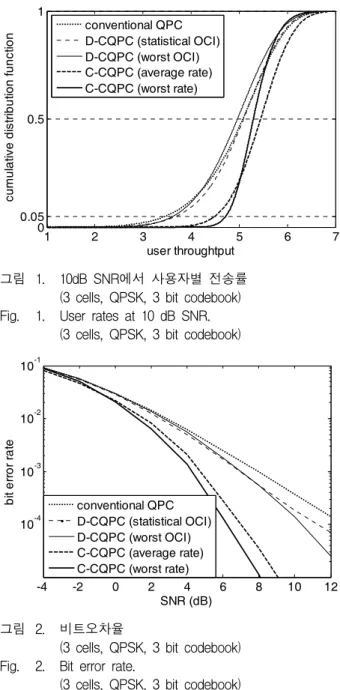
Cumulative distribution functions of user throughput are depicted in Fig. 1. for 10 dB SNR.
The C-CQPCs have better performance than the
1 2 3 4 5 6 7
0.050 0.5 1
user throughtput cumulative distribution function conventional QPC
D-CQPC (statistical OCI) D-CQPC (worst OCI) C-CQPC (average rate) C-CQPC (worst rate)
그림 1. 10dB SNR에서 사용자별 전송률 (3 cells, QPSK, 3 bit codebook) Fig. 1. User rates at 10 dB SNR.
(3 cells, QPSK, 3 bit codebook)
-4 -2 0 2 4 6 8 10 12
10-4 10-3 10-2 10-1
SNR (dB)
bit error rate
conventional QPC D-CQPC (statistical OCI) D-CQPC (worst OCI) C-CQPC (average rate) C-CQPC (worst rate)
그림 2. 비트오차율
(3 cells, QPSK, 3 bit codebook) Fig. 2. Bit error rate.
(3 cells, QPSK, 3 bit codebook)
D-CQPCs and the conventional non-coordinated QPC.
The D-CQPCs outperform the conventional QPC for the worst 5% user. The C-CQPC which is designed to maximize the worst is expected to have the lowest error rate. Error rate performance of the proposed schemes are compared to that of the conventional scheme in Fig. 2. For fair comparison, all the schemes transmit data with the same system throughput of 6 bps/Hz. The proposed CQPCs have diversity gain against the non-coordinated QPC. Even the D-CQPCs, which have same amount of feedback and no cooperation between cells, have better performance than the QPC. Both the C-CQPC and the D-CQPC which are designed to maximize the worst has better performance than those designed to maximize system throughput because error rate is determined by minimum SINR.
V. Conclusion
For successful decoding of cell boundary users in cellular system, CQPCs are proposed when MMSE interference suppression filter is used at receiver. To find an optimum combination of precoders, the centralized schemes that require feedback and backhaul to share performance metrics are proposed.
Also, the distributed schemes which require only codeword index feedback and do not require any cooperation between BSs are proposed. All of the proposed CQPC schemes provide diversity gain against the conventional QPC scheme.
참 고 문 헌
[1] A. Paulraj, R. Nabar, and D. Gore, Introduction
to Space-Time Wireless Communications,
Cambridge University Press, 2003.[2] A. Narula, M. J. Lopez, M. D. Trott, and G. W.
Wornell, “Efficient use of side information in multiple-antenna data transmission over fading channels,” IEEE J. Sel. Areas Commun., vol. 16, no. 8, pp. 1423-1436, Oct. 1998.
저 자 소 개 김 명 석(학생회원)
2005년 연세대학교 전기전자 공학과 학사 졸업.
2007년 연세대학교 전기전자 공학과 석사 졸업.
2007년∼현재 연세대학교 전기 전자공학과 박사 과정.
2012년∼현재 삼성전자 선임연구원.
<주관심분야 : 통신, 신호처리>
이 충 용(정회원)-교신저자 1987년 연세대학교 전기전자
공학과 학사 졸업.
1989년 연세대학교 전기전자 공학과 석사 졸업.
1995년 Georgia Tech. 전자공학 과 박사 졸업.
1996년∼1997년 삼성전자 선임연구원.
1997년∼현재 연세대학교 전기전자공학과 교수.
<주관심분야 : 통신, 신호처리>
[3] D. J. Love and R. W. Heath, Jr., “Limited feedback unitary precoding for spatial multiplexing systems,” IEEE Trans. Inf. Theory, vol. 51, no. 8, pp. 2967-2976, Aug. 2005.
[4] 장재원, 진귀언, 성원진 “셀 간 협조적 공간 다중 화 및 빔포밍을 이용한 하향링크 전송 효율 증대 방안,” 전자공학회논문지, 제45권 TC편, 제7호, 45-52쪽, 2008년 7월
[5] V. R. Cadambe and S. A. Jafar, “Interference alignment and degrees of freedom of the K-user interference channel,” IEEE Trans. Inf. Theory, vol. 54, no. 8, pp. 3425-3441, Aug. 2008.
[6] 서종필, 이윤주, 권동승, 이명훈, 정재학, “부분공간 간섭 정렬을 이용한 다중 셀 상향링크 시스템에서 합용량 향상을 위한 레퍼런스 벡터 다이버서티,”
전자공학회논문지, 제47권 TC편, 제7호, 23-28쪽, 2010년 7월
[7] H. Sung, S.-H. Park, K.-J. Lee, and I. Lee,
“Linear precoder designs for K-user interference channels,” IEEE Trans. Wireless Commun., vol.
9, no. 1, pp. 291.301, Jan. 2010.
[8] F. Negro, S. P. Shenoy, I. Ghauri, and D. T. M.
Slock, “Weighted sum rate maximization in the MIMO interference channel,” in Proc. 21st IEEE
Int. Symp. Personal, Indoor and Mobile Radio Communications, pp. 684-689, Istanbul, Turkey,
Sep. 2010.[9] S. Ye and R. S. Blum, “Optimized signaling for MIMO interference systems with feedback,”
IEEE Trans. Signal Process., vol. 51, no. 11, pp.
2839-2848, Nov. 2003.
[10] J. G. Andrews, W. Choi, and R. W. Heath, Jr.,
“Overcoming interference in spatial multiplexing MIMO cellular networks,” IEEE Trans. Wireless Commun., vol. 14, no. 6, pp. 95-104, Dec. 2007.