DOI: https://doi.org/10.14579/MEMBRANE_JOURNAL.2018.28.4.252
1. Introduction
1)Metal-plating wastewater is one of the major sources of contaminants and it is often characterized as acidic or basic solution containing very high concentrations of
organic, colloids and heavy metals[1-5]. Some of the heavy metals are complexed with the organic com- pounds and they can be bound strongly, thereby not being removed by conventional physicochemical treat- ment processes easily[3,6]. In addition, high concen-
†
Corresponding author(e-mail: [email protected], http://orcid.org/0000-0002-4252-6153)
도금폐수처리를 위한 입상활성탄 유동 메디아 적용 유동상 멤브레인 여과기술의 적용가능성 평가에 관한 연구
장 수 민⋅권 대 은⋅김 정 환†
인하대학교 환경공학과
(2018년 8월 20일 접수, 2018년 8월 20일 수정, 2018년 8월 24일 채택)
Study on Feasibility of Fluidized Bed Membrane Reactor with Granular Activated Carbon Particles as Fluidized Media to Treat Metal-plating Wastewater
Soomin Chang, Deaeun Kwon, and Jeonghwan Kim
†Department of Environmental Engineering, Inha University, Inharo 100, Incheon 22212, Republic of Korea (Received August 20, 2018, Revised August 20, 2018, Accepted August 24, 2018)
요 약: 실 산성 도금폐수를 입상활성탄(GAC)이 유동메디아로 첨가된 유동상 멤브레인 반응기를 이용하여 처리하였다.
GAC 유동조건에서 적용 투과플럭스에 대해 시간에 따른 흡입압의 증가는 관찰되지 않았다. 폐수의 중성 pH에서 파울링 속 도는 산성 조건에 비해 GAC 유동조건에서 크게 감소하였다. 해당 폐수의 용액 pH 증가는 입자크기의 증가를 가져왔고 이는 멤브레인 표면에서 상대적으로 성긴 구조의 케이크층 형성을 야기시켰다. 유동상 멤브레인 반응기에서 GAC 유동 하에 95%
이상의 COD 제거율이 관찰되었으며 총부유물질은 거의 완벽하게 제거되었다. 실 도금폐수의 pH에서, 유동상 멤브레인 반응 기의 구리 및 크롬의 제거는 거의 관찰 되지 않았다. 그러나 pH를 중성으로 증가 시켰을 시 구리와 크롬의 제거율은 각각 99%와 94%까지 증가를 하였다. 적용해 준 pH에 상관 없이, 시안의 경우 95% 이상의 제거율을 달성하였다. 이는 유기물과 시안 착물 형성으로 인해 유동상 멤브레인 반응기 내 GAC의 강한 흡착으로 제거된 것으로 사료된다.
Abstract: An acidic, real metal-plating wastewater was treated by a fluidized bed membrane reactor introduced with granular activated carbon (GAC) as fluidized media. With GAC fluidization, there was no increase in suction pressure with time at each flux set-point applied. At neutral solution pH, much less fouling rate was observed than acidic pH under GAC fluidization. Higher solution pH resulted in the increase in particle size in metal-finishing wastewater, thus producing a less dense cake structure on membrane. More than 95% of chemical oxygen demand was observed from the fluidized bed mem- brane reactor under GAC fluidization. Total suspended solid concentration in membrane permeate was near zero. At the raw wastewater pH, no removal of copper and chromium by the fluidized bed membrane reactor was observed. As the pH was increased to 7.0, removal efficiency of copper and chromium was increased considerably to 99 and 94%, respectively.
Regardless of solution pH tested, more than 95% of cyanide was removed possibly due to the strong adsorption of organ- ic-cyanide complex on GAC in fluidized bed membrane reactor.
Keywords: Metal-finishing wastewater, fluidized bed membrane reactor, GAC, organic removal, heavy metals
tration of suspended solids and dissolved organic com- pound should require significant pretreatments to re- duce burdens encountered by post-treatment processes for metal-plating wastewater treatment.
There has been upsurges of interests in membrane technology for the treatment of industrial wastewater due to the excellent quality of the effluent (permeate) produced and smaller foot print required than conven- tional treatment processes[7,8]. However, polymeric membranes widely adopted lack resistance against a high concentration of the recalcitrant chemical com- pounds often encountered in the industrial wastewater such as metal-plating wastewater. Ceramic membranes are characterized as well-organized pore structure and hydrophilicity compared to polymeric membranes. They are durable and less prone to failure due to rupturing and fouling less. The resistance to the membrane foul- ing observed in ceramic membrane is due to the fact that hydroxyl species on the oxide surface produce hy- drophilic surface with a low water contact angle [9-11]. Nevertheless, there has been limited interest in ceramic membrane because of the high cost of ceramic membrane filtration system and fouling control.
In this study, new approach using a fluidized bed membrane reactor introduced with granular activated carbon (GAC) particles as fluidized media was applied with the flat-tubular ceramic membrane to treat met-
al-plating wastewater. The GAC particles are fluidized by recirculating the bulk wastewater alone through the reactor without any external functionality to suspend them (i.e., aeration). The fluidized bed membrane re- actor was originally developed for the treatment of do- mestic sewage in anaerobic condition[12]. In this case, the GAC particles can play roles as providing not only high surface area for microbial growth but also scour- ing agents to reduce membrane fouling. For the in- dustrial wastewater, the GAC particles in fluidized bed reactor are expected to be associated with synergistic effects of adsorption functionality for the removal of organic compounds and scouring actions to clean the membrane. This study focused on the feasibility tests of the fluidized bed membrane reactor using the GAC particles as scouring agents firstly for the treatment of metal-plating wastewater to extend its application.
2. Materials and Methods
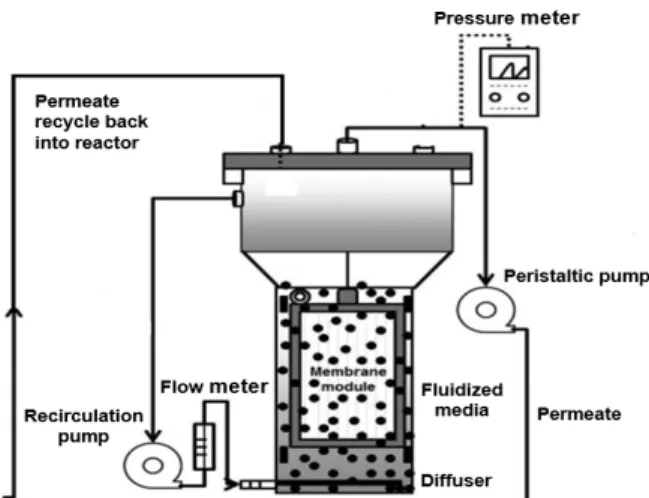
Fig. 1 shows schematics of the fluidized bed mem- brane reactor used in this study. Flat-tubular ceramic membrane was submerged into the fluidized reactor at constant flux mode of operation. The reactor was 4.7 L as an effective volume at the top of it to catch carry over GAC as fluidized media. In this study, two types of ceramic membranes were tested. First one was a flat-tubular ceramic membrane substrate consisting of 20% of alumina and 80% of pyrophillite materials, termed as UPM here and second was coated one with alumina active layer, termed as CPM. Both membranes had surface area of 0.037 m
2with 0.23 m height, 0.076 m length and 0.004 m width. Nominal pore size of UPM and CPM tested was 1.0 and 0.1 µm, respectively.
The fluidized bed membrane reactor was operated at a set-point flux of 45 L m
-2hr
-1by using peristaltic pump during 1 d operation. Ceramic membrane was submerged into the reactor with 4.7 L of total effective volume. Permeate produced by the membrane was re- turned to the reactor to maintain constant water level.
Fig. 1. Schematics of experimental set-up of fluidized bed
membrane reactor.
Granular activated carbon (GAC, MRX-M, Calgon Carbon Corp. Pittsburg, PA) was introduced into the reactor at the packing ratio of 10, and 30%, respectively. The GAC particles were fluidized by re- circulating the wastewater as a bulk phase through the reactor using recirculation pump (PAN World Magnetic Pump) at 6.5 L min
-1of flow rate to cover the whole membrane area. The size of GAC particles applied in this study was 0.84 mm.
Real, acidic metal-plating wastewater was taken and applied as a feed wastewater to the fluidized bed membrane reactor. The wastewater had 1,572 ± 50 mg/L of COD
crand 348 ± 10 mg/L of Total Suspended Solids with pH of 2.0. Samples were taken from the feed and permeate from the membrane in flu- idized bed membrane reactor for the measurement of COD
crand TSS concentration based upon the proce- dure by Standard Methods. In order to analyze TSS, the samples were filtered through pre-weighted GF/C filter. The residue retained on the filter was dried in an oven at 105°C for 2 h. The TSS was calculated by subtracting initial weight of the filer from the final weight of the filer at known volume of water filtered.
After experiments, recovery cleaning was sequenced with the ceramic membrane by applying 2,000 mg/L of NaOH, citric acid and NaOCl solution for 30 min each orderly. The recovery cleaning of the membrane re- sulted in more than 95% recovery of the initial perme- ability of new membrane.
3. Results and Discussion
3.1. Effect of GAC fluidization on critical flux Critical flux is defined as the permeate flux at which there is no fouling on membrane. Experimental meas- ure of critical flux was made by flux-step method us- ing a raw metal plating wastewater. A series of experi- ments was conducted in which the suction pressure was monitored with time at each fixed value of flux, as shown in Fig. 2. The critical flux was determined as the lowest flux set-point at which the suction pres- sure was noted to increase with filtration time of 30
min rather than remain constant. Without GAC fluid- ization, the suction pressure remained constant until 45 L m
-2hr
-1above which the suction pressure started in- creasing with time. With GAC fluidization, there was no increase in suction pressure with time at each flux set-point applied. Membrane fouling was not occurred due to the convective flux of the contaminants toward the membrane surface because the suction pressure was less than the back-transport of the contaminants away from the membrane due to scouring actions by the GAC fluidization on membrane surface. In addition, the GAC particles played a role to adsorb organic con- taminants present in the wastewater. Fouling rate tend- ed to decrease with increasing particle size in raw wastewater. The surface fouling caused by the cake formation on membrane surface was significant.
Therefore, the influence of scouring action to remove the fouling layer by GAC fluidization should not be overlooked. Results on the effect of particle size on membrane fouling will be discussed later.
3.2. Effect of solution pH on membrane fouling
The importance of pH adjustment on membrane
fouling was investigated for the metal-plating waste-
water in fluidized membrane reactor. The pH in the
raw wastewater was adjusted to neutral value of 7.0 by
using 2 M NaOH. After pH adjustment, it was found
that the membrane fouling was reduced significantly
for both UPM and CPM membrane without GAC flu-
Fig. 2. Determination of critical flux with ceramic mem-
brane (CPM) without and with GAC fluidization with raw
metal plating wastewater (pH = 2). GAC packing ratio was
30%.
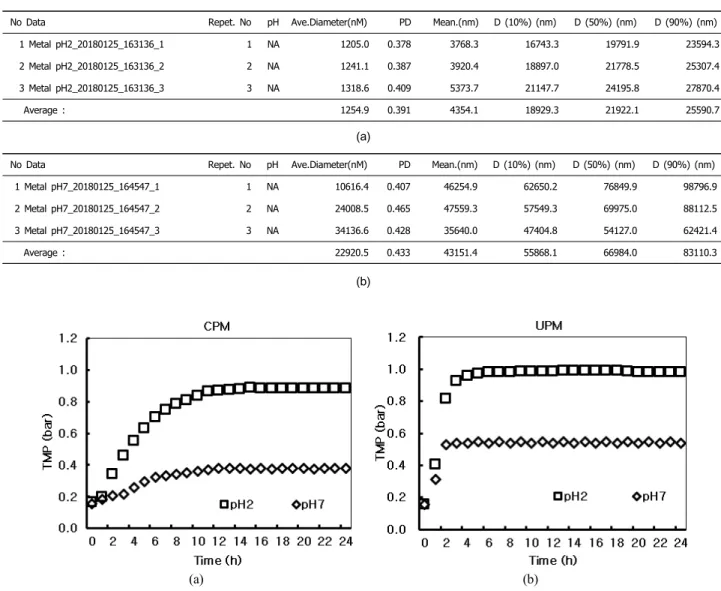
idization, as shown in Fig. 3 (a) and (b). The size dis- tribution of feed wastewater was not the same as that in the raw wastewater after pH adjustment. Table 1 compares the particle size distribution of the met- al-plating wastewater measured at pH 2 and 7. At neu- tral pH, the average particle size in the wastewater was found to have larger than that at pH 2 (22.9 vs. 1.25 µm). As solution pH increased, particles can be ag- gregated by the reduction of electrostatic repulsion due to surface charge neutralization. Less fouling rate was observed as particles became larger because larger par-
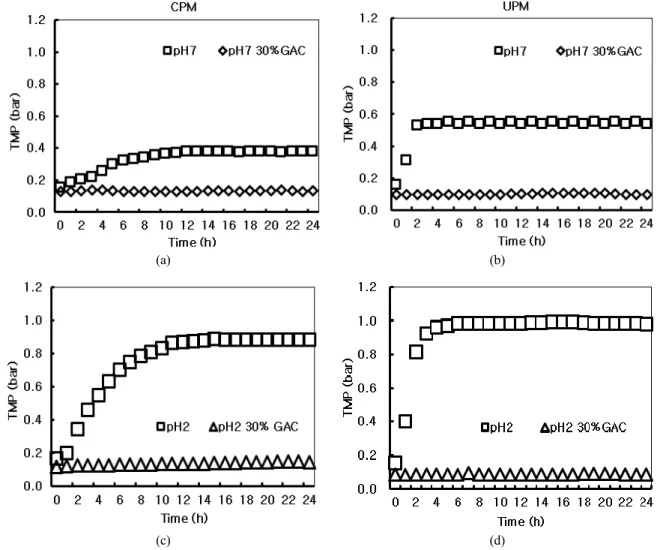
ticles might produce a less dense cake structure, which caused less cake resistance. As also shown in Fig. 3 (a) and (b), the increase in suction pressure with time was relatively faster with the UPM than that observed with the CPM for both pH values. The fouling rate in- to membrane pore and the resulting pore blocking were higher with the UPM since the pore size was relatively larger than CPM (0.1 vs. 1 µm). Regardless of the pH values and membrane types tested, however, the GAC fluidization did not result in the occurrence of suction pressure increase during 1 d operation, as shown in Table 1. Particle Size Distribution of Metal-plating Wastewater at pH 2 (a) and pH 7 (b)
No Data Repet. No pH Ave.Diameter(nM) PD Mean.(nm) D (10%) (nm) D (50%) (nm) D (90%) (nm)
1 Metal pH2_20180125_163136_1 1 NA 1205.0 0.378 3768.3 16743.3 19791.9 23594.3
2 Metal pH2_20180125_163136_2 2 NA 1241.1 0.387 3920.4 18897.0 21778.5 25307.4
3 Metal pH2_20180125_163136_3 3 NA 1318.6 0.409 5373.7 21147.7 24195.8 27870.4
Average : 1254.9 0.391 4354.1 18929.3 21922.1 25590.7
(a)
No Data Repet. No pH Ave.Diameter(nM) PD Mean.(nm) D (10%) (nm) D (50%) (nm) D (90%) (nm)
1 Metal pH7_20180125_164547_1 1 NA 10616.4 0.407 46254.9 62650.2 76849.9 98796.9
2 Metal pH7_20180125_164547_2 2 NA 24008.5 0.465 47559.3 57549.3 69975.0 88112.5
3 Metal pH7_20180125_164547_3 3 NA 34136.6 0.428 35640.0 47404.8 54127.0 62421.4
Average : 22920.5 0.433 43151.4 55868.1 66984.0 83110.3
(b)
(a)
(b)
Fig. 3. TMP change with time at two different pHs for CPM membrane (a) and UPM membrane (b) without GAC
fluidization.
Fig. 4 (a) through (d). In addition, there was no differ- ence in suction pressure with time at two GAC dos- ages (10 and 30%), suggesting that optimal value of GAC dosage to reduce membrane fouling should exist for fluidized membrane reactor.
3.3. Organic removal efficiency
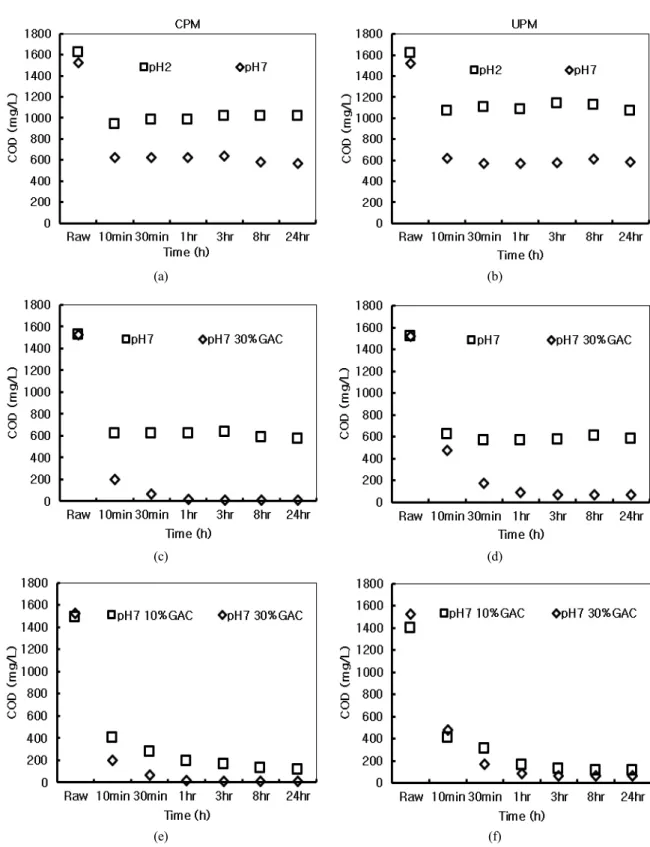
Organic concentrations as COD values were meas- ured in permeate of each ceramic membrane over the period of operation with the fluidized bed membrane reactor. Results are shown in Fig. 5 (a) through (f).
The COD concentrations in membrane permeate de- creased rapidly within a 10 min of operation and then remained during the rest of it. Without GAC fluid-
ization and pH adjustment in the raw wastewater, there was only about 20% of COD removal efficiency for both UPM and CPM. The organic removal efficiency was slightly increased to about 30% after pH was ad- justed to 7.0 probably due to the formation of cake layer on membrane which can play a role as secondary membrane to improve organic rejection. With GAC fluidization at 30% of packing ratio, the organic re- moval efficiency for both membranes increased consid- erably to more than 95%. The COD removal efficiency was slightly higher with the CPM that that with the UPM with smaller pore size, but the effect was marginal. Results show clearly that the role of GAC particles as adsorbent to remove organic compounds is
(a)(b)
(c)
(d)
Fig. 4. TMP change with time at two different pHs for CPM membrane (a), (c) and UPM membrane (b), (d) with GAC
fluidization.
apparent. At neutral pH, effects of GAC dosages on COD removal efficiency were also investigated for the
CPM used. Lower dosage of GAC led to lower COD removal efficiency. Under GAC fluidization, the pH
(a)(b)
(c)
(d)
(e)
(f)