Kor. J. Hort. Sci. Technol. 28(5):757-761, 2010
단감 ‘부유’의 과실 비대 및 착색에 대한 에테폰의 영향
김호철ㆍ김태춘* 원광대학교 원예・애완동식물학부
Effect of Ethephon on Fruit Enlargement and Coloring of ‘Fuyu’ Persimmon
Ho Cheol Kim and Tae-Choon Kim*
Division of Horticulture and Pet Animal-Plant Science, Wonkwang University, Iksan 570-749, Korea
Abstract. This research was conducted to investigate effect of ethephon on fruit enlargement and coloring of ‘Fuyu’ persimmon (Diospyros kaki). At 7 weeks after ethephon treatment, fruit weight and diameter became significantly heavier and longer in 80 and 100 mg・L-1 than the other concentrations of ethephon. Fruit peel hardness decreased with increasing ethephon concentration. The decreased levels were apparent with the treatments beyond 40 mg・L-1 at the beginning, and then with those beyond 60 mg・L-1. Hunter a* and Chroma*
of fruit peel treated with ethephon over 20 mg・L-1 were significantly higher compared to those with control (0 mg・L-1), but there were no significant differences among those with the ethephon treatments over 20 mg・L-1. The increased levels of the Chroma* were apparent with the treatments beyond 60 mg・L-1 at the beginning and then with those of 20 and 40 mg・L-1. β-Carotene and lycopene contents of fruit peel were higher with the ethephon treatment beyond 40 mg・L-1. Although the ethephon application at 20 and 40 mg・L-1 had no effects on fruit enlargement, but fruit coloring was advanced by 2 weeks with the application at 40 mg・L-1. Additional key words: β-carotene, coloring improvement, Diospyros kaki, hardness, lycopene
*Corresponding author: [email protected]
※ Received 30 March 2010; Accepted 30 July 2010. 본 논문은 농촌진흥청 공동연구사업(과제번호: PJ005920201003)의 지원에 의해 이루어진 것임.
서 언
일반적으로 과실의 성숙과 익음은 호흡 및 에틸렌 합성 양상 에 의해 호흡급등형과 비호흡급등형으로 구분된다(Giovannoni, 2004). 감은 성숙과 익음 단계에서 호흡 및 에틸렌 합성 증 가가 현저하게 나타나지 않는 비호흡급등형 과실에 속한다 (Pang 등, 2007). 감의 과실 생장은 주로 세포 분열기 직후부 터 급격하게 증가하지만, 성숙기가 동반되는 10월 상순 이후 에도 크게 증가한다(Rho, 2000; Sugiura 등, 1991). 감의 착색 은 성숙 과정에 동반되며(Ebert와 Gross, 1985), 착색 정도는 엽록소 파괴 및 색소 생합성의 정도 차이에 의해 좌우된다.
특히, 성숙 마지막 단계에 카로티노이드계 색소에 의해 결정 되며 초기에는 황색 색소인 크립토크산틴(cryptoxanthin), 후 기에는 붉은 색소인 라이코펜(lycopene)에 의해 좌우된다 (Ebert와 Gross, 1985; Gross 등, 1984).
감 과실의 비대 및 착색을 인위적으로 촉진시켜 수확기를
앞당기거나 착색을 증진시켜 품질을 개선하기 위해 수확 전 결박, 환상박피(Choi 등, 2009) 등 광합성 산물의 하부 이동 억제, 시비 조절(Choi 등, 2008; Kim 등, 2003), 수체 내 광 량 개선(Moon 등, 1999), 생장조절물질 살포(Lee와 Kim, 1991) 등 다양한 부분에서 연구가 진행되었다. 이들 중 생장조 절물질은 사과(Yim 등, 2000), 포도(Han 등, 1996), 밀감 (Oh 등, 1979) 등 다양한 과종에서 연구되었으며, 과실 비대 및 착색 촉진에 효과가 있는 것으로 알려져 왔다. 특히, 감에서 는 수확 전 에테폰, 에틸렌 및 CPTA[2-(4-chlorophenylthio)- triethyl-amine hydrochloride] 등의 처리가 성숙을 촉진시키 고, 카로티노이드 색소 발현이나 과피의 Hunter a값을 뚜렷 이 향상시키는 것으로 보고되었다(Lee와 Chujo, 1991; Park 과 Kim, 2002a, 2002b). 하지만 처리 후 연화가 촉진되는 문제점(Lee와 Chujo, 1991; Park과 Kim, 2002b)으로 인하 여 재배 현장에서 거의 활용되지 못하고 있다. 또한 아직까 지 단감에서 에테폰의 처리 농도에 따른 과실 비대 및 착색
Fig. 1. Chroma values change in fruit peel of ‘Fuyu’ persimmon after ethephon treatments. Chroma values = (a*2 + b*2)1/2. Vertical bars show standard error (n=5).
에 미치는 영향에 대한 연구는 보고된 바 없는 실정이다. 대 부분 노지에서 재배되고 있는 단감 현장에서 과실 품질에 영향을 미치는 환경 요인은 다양하여 제어가 매우 어렵다고 할 수 있다. 이에 본 연구는 단감의 상품성 및 생산성 향상을 위한 재배 기술 개발의 일환으로 단감 ‘부유’를 대상으로 에 테폰 처리 농도가 과실의 비대 및 착색에 미치는 영향을 구 명하고자 수행하였다.
재료 및 방법
경남 진주에서 재배되고 있는 단감 ‘부유’를 대상으로 과 실의 왕성한 비대와 성숙을 동반하는 과실 생장 3기 직전인 2009년 9월 23일에 에틸렌 발생제인 에테폰(MB-E5360, MB Cell Co., Los Angeles, CA, USA)을 처리하였다. 처리 농도 는 고체 상태인 에테폰을 증류수에 녹여 20, 40, 60, 80 및 100mg・L-1으로 조제한 후 전착제를 20L 당 10mL를 넣어 충분히 혼합하였다. 그리고 난괴법 3반복으로 하여 처리 농 도별로 과실과 주변 잎에 조제액이 흘러 떨어질 정도로 충 분히 살포하였다.
에테폰 처리 후 과실의 색 및 과피 경도 변화를 알아보기 위해 2주마다 착과된 상태의 동일 과실의 색을 측정하였고, 5과씩을 수확하여 경도를 측정하였다. 그리고 처리 7주 후 인 11월 13일에 처리별로 10과씩 수확하여 과중, 과고, 과 경, 과피색, 과육 경도 및 과피 색소 함량을 조사하였다. 과 중은 전자 저울, 과고 및 과경은 캘리퍼스, 과피색은 색차계 (CR-200, Minolta Co., Ltd., Tokyo, Japan), 과육 경도는 물 성 측정기(Compact-100 II, Sun Scientific Co., Ltd., Tokyo, Japan)를 이용하여 측정하였다. 색소 중 베타카로틴과 라이 코펜 함량은 과정부에서 1mm로 얇게 박피한 과피 0.5g에 아세톤:에탄올:헥산(250:250:500, v/v/v) 추출 용액을 25mL 가하여 homogenizer로 마쇄한 후 4℃에서 2,000rpm으로 10분간 원심 분리하여 얻은 상징액을 각각 448과 472nm에 서 비색계(UV/Visible Spectrophotometer, V-560, JASCO Co., Tokyo, Japan)로 측정하였고(Park과 Kim, 2002), 표준 품으로 각각 라이코펜(Sigma, L 9879)과 베타카로틴(Sigma Chemical Co., St. Louis, MO, USA)을 이용하였다. 엽록소 a 및 b 함량은 1mm로 과정부를 얇게 박피한 과피 100mg을 dimethyl sulphoxide 7mL에 넣어 65℃ 온탕기에 30분간 중 탕하여 10mL로 정용한 후 645와 663nm에서 비색 정량으로 측정하였다(Hiscox와 Israelstam, 1979). 엽록소 함량(mg・cm-2) 은 Arnon(1949)의 방법으로 구하였다.
Chlorophyll a = 0.0127・A663 - 0.00269・A645
Chlorophyll b = 0.0229・A645 - 0.00468・A663
통계 분석은 SPSS 11.5 Version을 이용하여 Duncan의 다중 검정으로 수행하였다.
결과 및 고찰
에테폰 농도별 처리 후 7주 동안 과실의 색 변화를 살펴 보았다(Fig. 1). 과피의 Chroma 값은 처리 1주 후 조사에서 는 처리 농도 간 차이를 나타내지 않았으나, 3주 후 조사에 서는 40mg・L-1 이하와 초과 처리구 간 뚜렷한 차이를 나타 내었다. 이후 20과 40mg・L-1 처리구에서 60mg・L-1 이상 처 리구보다 상승폭이 더 커지면서 무처리를 제외한 처리구들 간 Chroma 값의 차이가 줄어들었다. 이에 따라 처리 7주 후 조사에서는 무처리구를 제외한 처리구들 간 유의한 차이 를 나타내지 않았다. 이러한 경향은 40mg・L-1 이상 처리 시 과실의 급격한 성숙 및 과정부 착색 촉진으로 과피색이 어 두워졌고, 무처리구와 20mg・L-1 처리구에서는 조사 기간 동 안 성숙 과정과 함께 꾸준히 착색이 진행되었기 때문으로 생각된다. Park과 Kim(2002b)도 조기 수확한 ‘청도반시’에 에틸렌 처리 시 일정 기간 이후에는 과피색 a값이 오히려 감소하였다고 보고하였다.
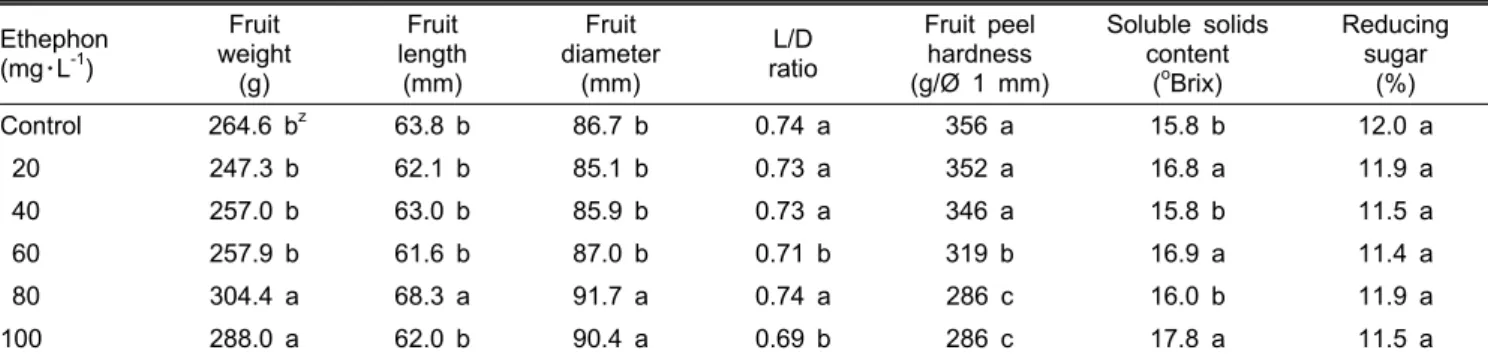
에테폰 농도별 처리 후 7주 동안 과실의 과피 경도 변화 를 살펴보았다(Fig. 2). 과피 경도는 처리 3주 후 조사에서 40mg・L-1 이상 처리구에서 뚜렷하게 낮아졌다. 이후 40mg・L-1 처리구에서는 감소폭이 작았고, 나머지 처리구에서는 다소 컸 다. 이에 따라 처리 7주 후 조사에서는 무처리, 20 및 40mg・L-1 처리구 간에는 차이를 나타내지 않았고, 60mg・L-1 이상 처
Fig. 2. Fruit hardness change of ‘Fuyu’ persimmon after ethephon treatments. Vertical bars show standard error (n=5).
Table 1. Fruit characteristics of ‘Fuyu’ persimmon harvested at 7 weeks after ethephon treatments.
Ethephon (mg・L-1)
Fruit weight (g)
Fruit length (mm)
Fruit diameter
(mm)
L/D ratio
Fruit peel hardness (g/Ø 1 mm)
Soluble solids content
(oBrix)
Reducing sugar
(%)
Control 264.6 bz 63.8 b 86.7 b 0.74 a 356 a 15.8 b 12.0 a
20 247.3 b 62.1 b 85.1 b 0.73 a 352 a 16.8 a 11.9 a
40 257.0 b 63.0 b 85.9 b 0.73 a 346 a 15.8 b 11.5 a
60 257.9 b 61.6 b 87.0 b 0.71 b 319 b 16.9 a 11.4 a
80 304.4 a 68.3 a 91.7 a 0.74 a 286 c 16.0 b 11.9 a
100 288.0 a 62.0 b 90.4 a 0.69 b 286 c 17.8 a 11.5 a
zMean separation within columns by Duncan’s multiple range test at 5% level.
Table 2. Fruit color changes of ‘Fuyu’ persimmon harvested at 7 weeks after ethephon treatments.
Ethephon (mg・L-1)
Peel color
Hunter a* Hunter b* Chromay
Control 14.0 c 42.2 b 44.6 b
20 17.6 b 47.2 a 50.5 a
40 22.4 a 43.3 b 49.0 a
60 23.8 a 43.7 ab 49.9 a
80 25.7 a 41.6 b 49.0 a
100 24.5 a 43.5 ab 50.2 a
zMean separation within columns by Duncan’s multiple range test at 5% levels.
yChroma = (Hunter a*2 + Hunter b*2)1/2.
리구에서 유의하게 낮았다. Kang 등(1998a)은 감의 연화에 는 세포벽 구성 물질 중 galactan이나 arabino galactan을 분 해하여 galactose를 유리시키는 β-galactosidase가 중요한 역할을 한다고 보고하였는데, 이러한 외부의 에테폰 처리 농도가 β-galactosidase의 활성화에 어떠한 영향을 주는지 추가적인 세밀한 연구가 진행되어야 할 것으로 생각된다.
에테폰 농도별 처리 7주 후 수확한 과실의 특성을 조사한 결과(Table 1), 과중은 80과 100mg・L-1 처리구에서 각각 304.4g과 288.0g으로 다른 처리구의 247.3-264.6g에 비해 월등히 무거웠다. 과고와 과경도 과중과 비슷한 경향으로 높은 농도 처리구에서 길었으며, 이들의 과실은 편원형에 더욱 가까웠다. 감의 생장조절물질 중 GA, daminozide 및 CPTA 처리 시 농도 및 횟수, 병합 살포 방법 등에 따라 과 실 비대에 뚜렷한 효과는 없으나(Lee와 Chujo, 1991), GA3
처리 시 오히려 과실 비대를 뚜렷이 감소시킨다는 보고가 있다(Choi 등, 1999). 그러나 포도에서는 과실 성숙에 에틸 렌이나 ABA 농도가 깊이 관여하고, 외부 처리 시 과방 및 과립의 비대를 촉진시킨다는 보고가 있다(Coombe, 1973;
Han 등, 1996; Kim과 Chung, 2000).
과피 경도는 40mg・L-1 이하와 60mg・L-1 이상 처리구 간 뚜렷한 차이를 나타내었다. 과실 당도는 무처리구에 비해 40mg・L-1을 제외한 다른 처리구들에서 다소 높은 경향을 나타내었지만, 농도 증가에 따른 일정한 경향을 나타내지는 않았다. 환원당도 저농도 처리구에서 다소 높은 경향이었으 나 처리 농도 간 유의한 차이를 나타내지 않았다. Lee와 Chujo(1991)는 단감에서 고농도 CPTA 처리 시 성숙이 촉 진되고 과실 경도는 감소되나, 비환원당과 환원당은 뚜렷한 차이를 나타내지 않았다고 보고하였다. 그리고 Oh 등(1979) 도 감귤에서 에틸렌 및 에테폰 처리 시 처리하지 않은 과실 과 과실 내 당 및 산 함량이 차이를 나타내지 않았다고 보고 하였다.
에테폰 농도별 처리 7주 후 수확한 과실의 색을 조사하였 다(Table 2). 과피의 붉은 색 정도를 나타내는 Hunter a값은 무처리구에 비해 20mg・L-1 이상 처리구에서 유의하게 높았 고, 40mg・L-1 이상 처리구에서는 큰 차이를 나타내었다. 노 란색 정도를 나타내는 Hunter b값은 20mg・L-1 처리구에서 가장 높았으나 농도 간 일정한 경향을 나타내지 않았다. 이 에 따라 색의 선명도를 나타내는 Chroma 값은 에테폰 처리
Table 3. Fruit pigment concentrations of ‘Fuyu’ persimmon harvested at 7 weeks after ethephon treatments.
Ethephon (mg・L-1)
β-Carotene (mg・L-1)
Lycopene (mg・L-1)
Chlorophyll (μg・cm-2)
a b Total (a+b)
Control 269.2 cz 85.7 b 0.29 a 2.22 a 2.51 a
20 286.4 c 91.9 b 0.20 bc 1.48 ab 1.68 ab
40 418.8 b 160.1 a 0.12 c 0.89 c 1.01 c
60 553.0 a 198.7 a 0.21 b 1.10 b 1.32 b
80 535.7 a 209.5 a 0.20 bc 0.78 c 0.98 c
100 452.1 b 206.4 a 0.20 bc 0.89 c 1.09 bc
zMean separation within columns by Duncan’s multiple range test at 5% level.
Fig. 3. Fruit coloring of ‘Fuyu’ persimmon harvested at 7 weeks after ethephon treatments.
유무 간 유의한 차이를 나타내었으나 처리 농도 간에는 차 이를 나타내지 않았다. 감에 CPTA(Lee와 Chujo, 1991), 감 귤에 에테폰 또는 에틸렌(Oh 등, 1979)을 처리하면 과피의 Hunter a값 또는 라이코펜 발현이 뚜렷이 향상된다는 연구 결과가 보고되어 있다.
외적인 과피 색에 대한 색소 함량의 관계를 알아보고자 과피의 베타카로틴, 라이코펜 및 엽록소 함량을 조사하였다 (Table 3). 베타카로틴과 라이코펜 함량은 40mg・L-1 이상의 처리구에서 뚜렷하게 많았다. 특히, 60과 80mg・L-1 처리구 에서는 가장 낮은 무처리구보다 2.0-2.4배 정도 높았다. 총 엽록소 함량도 높은 농도 처리일수록 낮은 경향을 나타내었 다. 이는 Table 2에서의 처리 농도 간 과피색 a값 및 Chroma 값의 결과와 동일하였다. Ebert와 Gross(1985), Gross 등 (1984)은 감의 착색에는 엽록소 파괴 및 카로티노이드 생합 성 정도가 좌우하며, 이에 착색 마지막 단계에서는 라이코 펜이 좌우한다고 하였다.
상기 결과들을 고려하면, 단감 ‘부유’의 착색 증진에 대한 에테폰의 효과는 기존 연구들과 마찬가지로 전반적으로 뚜 렷하였다. 특히 60mg・L-1 이상의 처리구에서는 과실 비대나 착색 증진 효과가 높았고, 과피 경도가 크게 감소하는 문제 점을 여전히 나타내었다. 그러나 20과 40mg・L-1 처리구에 서는 과실 비대 촉진 효과는 없었으나 처리되지 않은 과실 보다 과피의 색이나 색소 함량이 유의하게 높았고 육안상으
로도 차이를 나타내었다(Fig. 3). 또한 기존 연구에서 문제 점으로 제시되었던 과실 연화도 처리하지 않은 과실과 유의 한 차이를 나타내지 않았다. 특히, 상기 결과와 관계하여 Fig. 1과 2의 과피의 색 및 경도 변화를 고려하면 에테폰 40mg・L-1을 수확 7주 전에 처리하면 수확 시기를 2주 정도 앞당길 수 있을 것으로 생각된다. 그러나 본 연구에서는 수 확 후 저장 중 과실 연화에 대한 관찰을 하지 않았으므로 차후 이에 대한 연구는 진행되어야 할 것이다.
초 록
본 연구는 단감 ‘부유’를 대상으로 에테폰 처리 농도에 따른 과실의 비대 및 착색 효과를 구명하기 위해 수행하였 다. 에테폰 처리 7주 후 수확한 과실에서 과중, 과경은 80과 100mg・L-1 처리구에서 유의하게 무겁고 길었다. 그리고 과 피 경도는 그 농도에서 유의하게 낮았는데, 과피 경도의 감 소 폭은 처리 후 초기에는 40mg・L-1 이상 처리구에서, 이후 에는 60mg・L-1 이상 처리구에서 컸다. 과피의 Hunter a값 및 Chroma 값은 무처리구에 비해 20mg・L-1 이상의 처리구 에서 유의하게 높았지만, 그 농도 간에는 차이를 나타내지 않았다. Chroma 값의 증가폭은 처리 후 초기에는 60mg・L-1 이상 처리에서 뚜렷하게 컸으나, 이후부터는 20이나 40mg・L-1 처리에서 컸다. 과실의 베타카로틴 및 라이코펜 함량은 40
mg・L-1 이상의 처리구에서 유의하게 높았다. 특히, 처리 7 주 후 무처리구에서 수확한 과실과 비교하여 20이나 40mg・L-1 처리는 과실 비대의 효과를 나타내지 않았으나, 40mg・L-1 처리는 착색 정도를 2주 정도 촉진시키는 효과를 나타내었다.
추가 주요어 : 베타카로틴, 착색 향상, 감, 경도, 라이코펜
인용문헌
Aron, D.I. 1949. Copper enzymes in isolated chloroplasts poly- phenoloxidase in Beta vulgaris. Plant Physiol. 24:1-15.
Choi, S.T., G.H. Ahn, Y.C. Lee, and S.M. Kang. 2008. Effect of different autumnal nitrogen application dates on fruit characteristics and storage reserves of ‘Fuyu’ persimmon.
Hort. Environ. Biotechnol. 49:25-29.
Choi, S.T., S.M. Kang, K.H. Ahn, D.S. Park, G.M. Son, and C.W. Ro. 1999. Fruit set and fruit growth of ‘Fuyu' persimmon (Diospyros kaki) as applied GA3. Kor. J. Hort. Sci. Technol.
17 (Suppl. 2):238. (Abstr.)
Choi, S.T., W.D. Song, D.S. Park, and S.M. Kang. 2009. Effect of girdling dates on dry matter increase and reserve accumula- tions in permanent parts of ‘Nishimurawase’ persimmon trees.
Kor. J. Hort. Sci. Technol. 27:218-225.
Coombe, B.G. 1973. The regulation of set and development of the grape berry. Acta Hort. 34:261-273.
Ebert, G. and J. Gross. 1985. Carotenoid changes in the peel of ripening persimmon (Diospyros kaki) cv. Triumph. Phyto- chemistry 24:29-32.
Giovannoni, J.J. 2004. Genetic regulation of fruit development and ripening. Plant Cell 16:S170-S180.
Gross, J., H. Bazak, A. Blumenfeld, and R. Ben-Arie. 1984.
Changes in chlorophyll and carotenoid pigments in the peel of ‘Triumph’ persimmon (Diospyros kaki L.) induced by pre-harvest gibberellin (GA3) treatment. Sci. Hort. 24:305-314.
Han, D.H., S.M. Lee, C.H. Lee, and S.B. Kim. 1996. Effects of ABA and ethephon treatments on coloration and fruit qualith in ‘Kyoho’ grape. J. Kor. Soc. Hort. Sci. 37:416-420.
Hiscox, J.D. and G.F. Israelstam, 1979. A method for the extraction of chlorophyll from leaf tissue without maceration.
Can. J. Bot. 57:1332-1334.
Kang, I.K., K.H. Chang, and J.K. Byun. 1998a. Changes in cell wall components during ripening and softening in persimmon fruits. J. Kor. Soc. Hort. Sci. 39:46-50.
Kang, I.K., K.H. Chang, and J.K. Byun. 1998b. Solubilization
and depolymerization of pectic and neutral sugar polymers during ripening and softening in persimmon fruits. J. Kor.
Soc. Hort. Sci. 39:51-64.
Kim, W.S. and S.J. Chung. 2000. Effect of GA3, ethephon, girdling, and wiring treatment on the berry enlargement and maturity of 'Himrod' grape. J. Kor. Soc. Hort. Sci. 41:75-77.
Kim, Y.S., Y.G. Na, Y. Kim, K.J. Choi, and W.S. Kim. 2003.
Influence of coloring and fruit quality by monopotassium- phosphate foliar application in ‘Fuyu’ persimmon. Kor. J. Hort.
Sci. Technol. 21 (Suppl. l):63. (Abstr.)
Lee, Y.M. and C.C. Kim. 1991. Effects of plant growth regulators on the maturation of sweet persimmon. J. Kor. Soc. Hort. Sci.
32:173-177.
Lee, Y.M. and T. Chujo. 1991. Effect of growth regulators on ripening and storage life in sweet persimmon (Diospyros kaki L.). J. Kor. Soc. Hort. Sci. 32:66-72.
Moon, D.Y., C.H. Kim, H.D. Suh, and M.S. Kim. 1999. Effect of mulching films on fruit quality of Nishimurawase persimmon in heated plastic house. Kor. J. Hort. Sci. Technol.
17:239. (Abstr.)
Oh, S.D., Y.Y. Kim, S.B. Hong, and S.K. Chung. 1979. Effect of postharvest application of ethephon, ethylene, and methionine on color and quality of satsuma orange fruit (Citrus unshiu Marc.). J. Kor. Soc. Hort. Sci. 20:142-147.
Pang, J.H., B. Ma, H.J. Sun, G.I. Ortiz, S. Imanishi, S. Sugaya, H. Gemma, and H. Ezura. 2007. Identification and characteri- zation of ethylene receptor homologs expressed during fruit development and ripening in persimmon (Diospyros kaki Thumb.). Postharvest Biol. Technol. 44:195-203.
Park, S.J. and C.C. Kim. 2002a. Influence of ethylene generator on fruit color in ‘Cheongdobansi’ persimmon (Diospyros kaki).
J. Kor. Soc. Hort. Sci. 43:725-727.
Park, Y.S. and S.R. Kim. 2002b. Effects of prestorage conditioning and hot water dip on fruit quality of nonastringent Fuyu persimmons during cold storage. J. Kor. Soc. Hort. Sci. 43:
58-63.
Rho, C.W. 2000. Studies on tree growth and fruit characteristics as affected by cultivation environment in persimmon ‘Fuyu’.
PhD Diss., Dong-A Univ., Busan, Korea.
Sugiura, A., G.H. Zheng, and K. Yonemori. 1991. Growth and ripening of persimmon fruit at controlled temperatures during growth stage III. HortScience 26:574-576.
Yim, Y.J., J.Y. Jang, and H.C. Lee. 2000. Effect of optically active ABA and its synthetic intermediate STC4771 on defoliation and fruit color in ‘Fuji’ apple trees. J. Kor. Soc.
Hort. Sci. 41:53-55.