요소 및 제일인산칼륨 엽면시비가 초가을 잎 손실 감나무의 과실 특성과 저장양분 축적에 미치는 영향
최성태*ㆍ박두상ㆍ안광환ㆍ김성철ㆍ최태민 경상남도농업기술원 단감연구소
Foliar-application Effects of Urea and Potassium Phosphate on Fruit Characteristics and Reserve Accumulations of Persimmon Trees
75%-defoliated in Early Autumn
Seong-Tae Choi*, Doo-Sang Park, Gwang-Hwan Ahn, Sung-Chul Kim, and Tae-Min Choi
Sweet Persimmon Research Institute, Gyeongsangnam-do Agricultural Research and Extension Services, Gimhae 621-802, Korea
A severe defoliation by typhoon in early autumn reduces fruit quality for the current season and reserve accumulations for the next season. This study was conducted to determine the effects of foliar applications during the autumn on alleviating the damages after defoliation. Leaves of 2-year-old ‘Fuyu’ trees, grown in 50-L pots under a rain-shelter, were 75%-defoliated on September 9. In mid-September and early October, trees were treated either with eight foliar applications of urea or with four alternating applications of urea and KH2PO4 (urea + KP application), all at 0.5% (w/v). Trees untreated after the defoliation served as the control.
The urea applications slightly increased N and P concentrations of the leaves collected on November 6, while urea + KP applications significantly increased P and K concentrations. Foliar applications did not affect fruit growth, but tended to decrease skin coloration. Fruit soluble solids increased by 1.5 and 1.0 °Brix for urea and urea + KP applications, respectively. There was a significant increase in dry weight of fine root for the foliar application treatments but not in those of aerial woods and larger roots. With the foliar applications, N concentration tended to increase in the permanent organs but not P and K, whereas soluble sugars and starch notably increased in shoot, trunk, or fine root regardless of the different applications. Results indicated that the foliar applications could partially help to restore fruit quality and carbohydrate accumulations in the defoliated trees.
Key words: Persimmon, Defoliation, Foliar application, Fruit characteristic, Reserve accumulation
접수 : 2013. 1. 15 수리 : 2013. 2. 11
*연락저자 : Phone: +82552541564 E-mail: [email protected]
서 언
초가을 우리나라 남부지방에 태풍으로 인한 감나무의 잎 손실 피해가 빈번하다. 조기 잎 손실은 탄소동화량 부족을 유발하여 과실 비대, 착색, 당도를 떨어뜨리고, 수체 생장 및 영구기관의 저장양분 축적을 감소시킨다 (Hirata and Kurooka, 1974; Choi et al., 2005a). 따라서 잎 손실 후 과 실은 상품가치가 하락하며, 나무는 영구기관의 저장양분 축 적 감소로 겨울에 동해를 받거나 이듬해 초기 생장이 나빠 지기 쉽다 (Park, 2002b; Choi et al., 2005a, 2005b). 9월 상순에 잎 손실이 심할수록 이러한 피해가 증가하며 75% 이 상 손실일 때는 그 정도가 심각해진다 (Choi et al., 2005a).
잎 손실 나무의 과실품질을 높이고, 저장양분의 축적을 늘
리기 위해서는 과실을 솎아내는 방법이 효과적이나 수량 감 소가 불가피하다 (Choi et al., 2005b).
한편, 감 과원에서 추비는 여름과 가을에 질소 (N)와 칼 륨 (K)을 시용하도록 권장되고 있지만 (RDA, 2001), 만생종
‘부유’ 품종에서는 나무세력이 양호하면 가을 시비를 생략하 거나 엽면시비로 대체하는 경우가 많다. 가을철 엽면시비는 잎의 활력을 높여 과실품질을 향상시키고 (Ferree and Cahoon, 1987; Wargo et al., 2004; Hossain and Ryu, 2009), 나무 의 저장양분 축적에도 효과가 있는 것 (Sanchez et al., 1992;
Rosecrance et al., 1998)으로 알려져 있다. 어떤 경우에는 엽면시비만으로 토양시비와 비슷한 영양 생장과 과실 생장 결과를 가져오기도 하지만 (Park et al., 2009), 효과가 일정한 경향으로 나타나지 않을 수도 있다 (Johnson and Samuelson, 1990; Fallahi et al., 1997). 태풍으로 잎 손실이 심한 나무 에서는 잎을 통한 양분의 흡수량이 많지 않을 것으로 예상 되지만, 엽면시비 효과가 높다면 적과량을 줄일 수 있을 것
Table 1. Effect of foliar applications of urea and potassium phosphate to 75%-defoliated ‘Fuyu’ persimmon trees on chlorophyll, specific leaf weight (SLW), and concentrations of inorganic elements in the remaining leaves.†
Foliar
application Chlorophyll SLW N P K
SPAD value mg cm-2 --- % DW# ---
Control 55.1 a‡ 11.04 a 1.76 a 0.11 b 0.45 b
Urea 56.5 a 11.21 a 1.85 a 0.14 ab 0.40 b
Urea+KH2PO4 54.6 a 11.03 a 1.70 a 0.18 a 0.61 a
†Defoliated 75% on September 9 and measured on November 6.
‡Mean separation within columns by LSD test at P ≤ 0.05.
#DW: dry weight
이다. 그러나 이에 대해 구체적으로 연구된 바가 없으므로, 본 연구에서는 초가을 잎 손실이 심한 나무에서 과실품질, 수체 생장, 저장양분 축적에 미치는 엽면시비 효과를 검토 하였다.
재료 및 방법
비가림하우스 내 50 L 용기에서 재배한 2년생 ‘부유’ 감 나무를 대상으로 시험을 수행하였다. 균일한 결실을 위해 7 월에 엽과비 20 정도, 주당 착과수는 7±1개가 되도록 적과 하였다. 시험수에 양분 공급을 위하여 4월에 퇴비를 주당 500 g씩 표토에 뿌려주었고, 7월에는 복합비료를 사용하여 주당 N 10 g, K 10 g 정도를 관수와 함께 시용하였다. 시험 전까지 나무는 양분의 과부족이나 병해충 피해 증상이 없이 건강한 상태였다. 잎 손실을 유발하기 위해 9월 9일에 각 신초 당 하부로부터 선단쪽으로 잎 3개를 제거하고 1개를 남기는 방법으로 75%를 적엽하였다. 엽면시비는 단감 과원 에서 주로 사용되는 요소와 제일인산칼륨 (KH2PO4)을 (1) 요소 엽면시비, (2) 요소와 제일인산칼륨 교호 엽면시비 (요 소+KP)로 나누어 처리하되, 잎 손실을 감안하여 시비횟수 를 총 8회씩으로 관행보다 많게 하였다. 요소 엽면시비는 요소 5%액을 9월 11일부터 2~3일 간격으로 4회, 10월 11일 부터 2~3일 간격으로 4회씩 살포하였다. 요소+KP 처리는 9월과 10월 같은 시기에 각각 요소 5%액을 4회, 제일인산칼 륨 5%액을 4회씩 번갈아 살포하였다. 엽면시비를 할 때 소 형분무기로 잎의 앞면과 뒷면에 용액이 흘러내릴 정도로 고 루 뿌렸다. 각 처리마다 3주씩 처리를 하였으며, 엽면시비 를 하지 않은 3주 (대조구)와 함께 모든 시험수를 1.5×1 m 거리로 완전 임의로 배치하였다. 일반적인 용기재배 관리방 법에 따라 주기적으로 시험수에 관수를 하였고, 처리 이후 별도의 시비나 병해충 방제는 하지 않았다.
11월 6일 나무 전체를 채취하여 지상부는 과실, 잎, 신초, 1년생 가지, 주간으로 나누고, 뿌리는 직경을 기준으로 세 근 (<2 mm), 중근 (2-10 mm), 대근 (>10 mm)으로 구분하
였다. 수확한 전체 과실을 대상으로 평균과중, 과피색, 경 도, 당도를 조사하였다. 과피색은 휴대용색도계 (CM-508i, Konica Minolta Sensing Inc., Japan)로 적색도 Hunter a 값을 구하였고, 과육의 경도는 직경 5 mm 탐침을 사용하여 경도계 (TA-XT2, Stable Micro Systems Ltd., Surrey, U.K.) 로 측정하였다. 당도는 과실의 적도부 과피로부터 약 2 cm 깊이까지의 과육에서 착즙하여 굴절당도계 (N1, Atago Co., Japan)로 측정하였다. 잎은 엽록소계 (SPAD-502, Minolta Co., Japan)로 SPAD 값을 측정하고 엽면적과 비엽중을 구 하였다. 과실을 제외한 채취 시료는 수돗물에 씻은 후 80℃
에서 48시간 건조시켜 건물중을 조사하고 일부를 분리하여 분석에 사용하였다. 분석시료는 20 mesh를 통과하도록 분 쇄하여 N은 Kjeldahl 법, P (인)는 vanadate 반응, K는 원자 흡광장치 (AA-6501F, Shimadzu Co., Tokyo)로 측정하였 다. 가용성당과 전분은 포도당 (glucose)을 표준당으로 사용 하여 Anthrone 반응 (McCready 등, 1950)으로 분석하였다.
시험성적은 SAS 프로그램 (Ver. 8.01, SAS Institute Inc., Cary, N.C., 1999~2000)을 이용하여 최소유의차 (LSD)검정 으로 통계 분석을 하였다.
결과 및 고찰
Table 1은 9월 상순에 잎이 75% 손실된 나무에서 엽면시 비가 잎에 미친 영향을 나타낸 것이다. 엽록소 값, 비엽중, N 농도는 요소 엽면시비에 의해 증가하였으나 유의적인 수 준은 아니었다. P 농도는 대조구에서 0.11%이었으나 요소 또는 요소+PK 시비로 각각 0.14, 0.18%로 높아졌다. K 농 도는 대조구에서 0.45%였는데, 요소 시비의 영향은 없었고 요소+PK 시비에 의해 0.65%로 유의적으로 증가하였다. 잎 의 P와 K 증가로 보아 엽면시비 후 잎이 양분을 어느 정도 흡수한 것으로 볼 수 있다. 그러나 요소 엽면시비로 N이 공 급되었음에도 불구하고 엽록소 값이나 N 농도가 뚜렷하게 높지 않았던 것은 시료를 채취한 11월에 잎의 노화와 함께 상당량의 N이 수체의 다른 부위로 이동했기 때문 (Choi et
Table 2. Fruit characteristics on November 6 affected by foliar applications of urea and potassium phosphate to 75%-defoliated ‘Fuyu’ persimmon trees.
Foliar application
Diameter†
increment Average weight Color Firmness Soluble
solids
mm g Hunter a N °Brix
Control 12 a‡ 164 a 28.3 a 17.7 a 12.7 b
Urea 12 a 176 a 27.3 ab 18.2 a 14.2 a
Urea+KH2PO4 12 a 169 a 26.0 b 17.6 a 13.7 ab
†Diameter incrementrs are the difference between September 9 and November 6.
‡Mean separation within columns by LSD test at P ≤ 0.05.
Table 3. Dry weights in aerial woods and roots as affected by foliar applications of urea and potassium phosphate to 75%-defoliated ‘Fuyu’ persimmon trees.†
Foliar application
Aerial wood Root
Total
Shoot 1-yr-old Trunk Total Fine Medium Large Total
--- g DW#/tree ---
Control 40.0 a‡ 22.7 a 46.6 a 109.3 a 21.4 b 21.0 a 65.7 a 108.1 a 217.4 a
Urea 44.7 a 33.5 a 50.5 a 128.7 a 48.1 a 25.3 a 57.4 a 130.8 a 259.5 a
Urea+KH2PO4 41.1 a 24.7 a 52.5 a 118.3 a 45.5 a 18.4 a 68.8 a 132.7 a 251.0 a
†Defoliated 75% on September 9 and measured on November 6,
‡Mean separation within columns by LSD test at P ≤ 0.05,
#DW: dry weight
al., 2011; Park, 2002a)일 수 있다.
엽면시비는 과실 비대에 영향을 주지 못하였으며, 그 결 과 과중에 유의적인 차이가 없었다 (Table 2). 적색도 Hunter a값은 대조구에서 28.3이었으나 요소 시비구에서 27.3으로 낮아졌고, 요소+KP 시비구에서는 26으로 유의적인 착색 감 소를 나타내었다. 대조구의 과실 당도는 12.7°Brix로 비슷 한 조건에서 재배한 나무의 잎 손실이 없을 때 과실 당도 (Choi et al., 2005b)에 비해 3°Brix 이상 낮았다. 그러나 요 소 또는 요소+NK 시비로 대조구보다 각각 1.5, 1.0°Brix가 높아졌다. 이러한 효과는 엽면시비 후 광합성 활성이 높아져 동화산물의 공급이 활발해졌기 때문으로 추측된다 (Iimuro et al., 1974; Doroshenko and Alyoshin, 2002). 착색은 엽면시비 구에서 오히려 낮은 경향을 보였는데, 질산칼슘 엽면시비 후 감 과실의 착색이 나빠진 결과 (Agustí et al., 2004)와 마찬가지로 질소 흡수 후 나타나는 성숙 지연 (Choi et al., 2012)의 영향으로 여겨진다. 요소 엽면시비로 사과의 과중, 착색, 당도가 증가할 수 있지만 (Ferree and Cahoon, 1987;
Wargo et al., 2004), 본 연구에서는 그러한 효과가 당도에 서만 나타났다. 이는 나무의 양분 부족이 심하지 않았고 토 양을 통해 필요로 하는 양분을 어느 정도 흡수할 수 있었기 때문으로 생각된다.
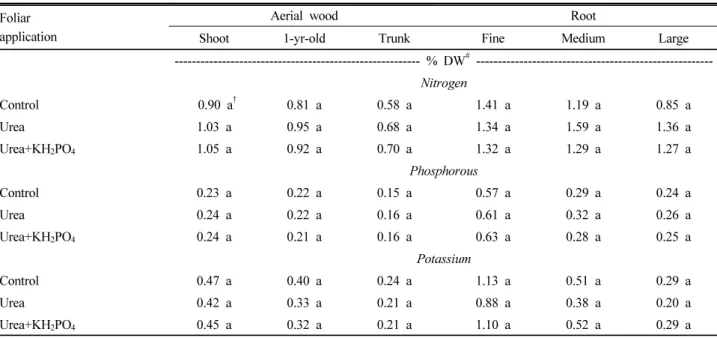
영구기관인 지상부 목질과 뿌리의 총 건물중은 대조구에 비해 엽면시비구에서 증가하는 경향이었으나 유의적인 증 가는 세근에서만 나타났다 (Table 3). 영구기관에 저장양분
으로 축적된 N, P, K 농도를 조사한 결과 (Table 4), N 농도 는 엽면시비구의 지상부 목질부와 세근을 제외한 뿌리에서 높은 경향이었고, P와 K 농도는 뚜렷한 변화를 찾을 수 없 었다. 요소 엽면시비는 나무의 N 저장양분을 증가시키는 것 으로 알려져 있지만 (Cheng and Fuchigam, 2002; Dong et al., 2002), 본 연구에서 그러한 효과가 뚜렷하지 않은 것으 로 보아 잎 손실로 인해 엽면시비 양분의 흡수가 많지 않았 던 것으로 추측된다.
9월에 잎의 75%를 손실한 나무의 영구기관의 탄수화물 농도는 선행 연구의 정상적인 나무들 (Choi et al., 2005b) 에 비해 낮았으며, 전분 감소가 더 심하였다 (Table 5). 시 비구간에는 유의적인 차이는 없었지만 엽면시비를 했을 때, 가용성당이 신초, 주간, 세근에서 증가하여, 대조구에서 각 각 6.7, 4.8, 9.8%인 것이 엽면시비로 각각 9.3~10.7, 7.6, 13.6~14.8%로 높아졌다. 전분은 세근에서만 증가하였는데, 대조구가 3.3%인데 반해 요소 시비구 4.8%, 요소+KP 시비 구는 5.7%로 높아졌다. N이 수체에 흡수되면 탄수화물이 질소대사에 소모되어 적어지기도 하지만 (Xia and Cheng, 2004), 본 연구의 일부 영구기관에서 탄수화물 농도가 증가 한 것은 질소 흡수량은 그리 많지 않은 반면 잎의 활력 증가 로 광합성이 촉진되었기 때문으로 생각된다. 탄수화물 농도 와 건물중 변화 (Table 3)를 감안하면 총 탄수화물 함량도 증가했을 것으로 짐작된다.
본 연구결과로 잎 손실이 심한 나무에서 엽면시비 후 과
Table 4. Effect of foliar applications of urea and potassium phosphate on concentration of inorganic elements in aerial woods and roots of 75%-defoliated ‘Fuyu’ persimmon trees.
Foliar application
Aerial wood Root
Shoot 1-yr-old Trunk Fine Medium Large
--- % DW# --- Nitrogen
Control 0.90 a† 0.81 a 0.58 a 1.41 a 1.19 a 0.85 a
Urea 1.03 a 0.95 a 0.68 a 1.34 a 1.59 a 1.36 a
Urea+KH2PO4 1.05 a 0.92 a 0.70 a 1.32 a 1.29 a 1.27 a
Phosphorous
Control 0.23 a 0.22 a 0.15 a 0.57 a 0.29 a 0.24 a
Urea 0.24 a 0.22 a 0.16 a 0.61 a 0.32 a 0.26 a
Urea+KH2PO4 0.24 a 0.21 a 0.16 a 0.63 a 0.28 a 0.25 a
Potassium
Control 0.47 a 0.40 a 0.24 a 1.13 a 0.51 a 0.29 a
Urea 0.42 a 0.33 a 0.21 a 0.88 a 0.38 a 0.20 a
Urea+KH2PO4 0.45 a 0.32 a 0.21 a 1.10 a 0.52 a 0.29 a
†Mean separation within columns by LSD test at P ≤ 0.05, #DW: dry weight
Table 5. Effect of foliar applications of urea and potassium phosphate on soluble sugars and starch in aerial woods and roots of ‘Fuyu’ persimmon trees 75%-defoliated on September 9.
Foliar application
Aerial wood Roots
Shoot 1-yr-old Trunk Fine Medium Large
--- % DW# --- Soluble sugars
Control 6.7 b† 6.5 a 4.8 b 9.8 b 9.2 a 6.7 a
Urea 10.7 a 7.0 a 7.6 a 13.6 ab 10.4 a 7.5 a
Urea+KH2PO4 9.3 a 7.5 a 7.6 a 14.8 a 10.8 a 7.0 a
Starch
Control 2.7 a 1.4 a 1.4 a 3.3 b 3.4 a 4.6 a
Urea 3.0 a 1.2 a 1.6 a 4.8 ab 5.5 a 2.5 a
Urea+KH2PO4 3.0 a 1.3 a 1.5 a 5.7 a 3.9 a 3.9 a
†Mean separation within columns by LSD test at P ≤ 0.05, #DW: dry weight.
실 당도, 영구기관의 저장 탄수화물의 증가가 확인되었다.
그러나 시비 전 나무 영양 상태가 가을 시비가 필요하지 않 을 정도였거나 비가림을 하지 않았다면 시비효과가 나타나 지 않을 수도 있었을 것이다. 또한 토양시비가 더 효과적일 가능성도 있다. 그러므로 비가림하우스 내 유목과 다른 노 지 성목을 대상으로 한 엽면시비 효과의 확인이 필요할 것 으로 판단된다.
요 약
초가을 태풍에 의해 잎 손실이 심해지면 감나무의 과실 품질이 나빠지고 이듬해 생장에 필요한 저장양분이 감소한
다. 본 연구에서는 비가림하우스 내 50 L 용기에서 재배한 2년생 ‘부유’ 감나무를 대상으로 9월 상순에 인위적으로 적 엽한 후 엽면시비 효과를 검토하였다. 9월 9일에 나무 전체 잎 수의 75%를 고루 적엽한 후 9월 중순과 10월 중순에 요 소 0.5%액을 8회 엽면시비하거나 요소와 제일인산칼륨을 교호로 4회씩 엽비시비 (요소+KP 시비구)하는 처리를 하였 다. 적엽한 나무 일부는 시비를 하지 않고 대조구로 두었다.
요소 엽면시비로 11월 6일 잎의 N과 P 농도가 대조구에 비 해 약간 증가한 반면, 요소+PK 시비에 의해 P와 K농도는 유의적으로 증가하였다. 엽면시비는 과실 비대에 영향을 끼 치지 않았으나 과피의 착색을 감소시키는 경향이었다. 과실 당도는 요소 또는 요소+NK 시비로 대조구보다 각각 1.5,
1.0°Brix가 높아졌다. 엽면시비로 세근의 건물중이 증가한 것을 제외하면 영구기관인 지상부 목질과 뿌리의 건물중은 유의적인 변화가 없었다. 영구기관의 N 농도는 엽면시비구 에서 높은 경향인 반면 P와 K의 변화는 뚜렷하지 않았다.
가용성당 또는 전분 농도는 엽면시비 방법에 관계없이 신 초, 주간 또는 세근에서 증가하였다. 본 연구의 결과는 엽면 시비가 잎 손실 감나무의 과실품질과 저장양분 회복에 부분 적으로 유용할 수 있음을 나타내었다.
사 사
본 연구는 농림수산식품기획평가원 (전 농림기술관리센 터) 연구사업 (과제번호 202069-03-3-HD110)의 연구비 지 원에 의해 수행되었음.
인 용 문 헌
Agustí, M., M. Juan, A. Martíinez-Fuentes, C. Mesejo, and V.
Almela. 2004. Calcium nitrate delays climacteric of persimmon fruit. Ann. Appl. Biol. 144:65-69.
Cheng. L. and L.H. Fuchigami. 2002. Growth of young apple trees in relation to reserve nitrogen and carbohydrates. Tree Physiol. 22:1297-1303.
Choi, S.T., S.M. Kang, D.S. Park, Y.W. Yoon, and G.H. Ahn.
2005a. Tree responses of ‘Fuyu’ persimmon to different degrees of early defoliation on fruit characteristics at harvest and tree development the next season. J. Kor. Soc. Hort. Sci.
46:136-139.
Choi, S.T., D.S. Park, W.D. Song, and S.M. Kang. 2005b.
Effect of thinning degrees on fruit characteristics and carbohydrate accumulations of persimmon trees defoliated in early autumn.
Acta Hort. 685:105-112.
Choi, S.T., D.S. Park, S.M. Kang, and S.J. Park. 2011. Use of a chlorophyll meter to diagnose nitrogen status of ‘Fuyu’
persimmon leaves. HortScience 46:821-824.
Choi, S.T., D.S. Park, S.M. Kang, and S.K. Kang. 2012.
Influence of leaf-fruit ratio and nitrogen rate on fruit characteristics, nitrogenous compounds, and nonstructural carbohydrates in young persimmon trees. HortScience 47:410-413.
Dong, S., L. Cheng, C.F. Scagel, and L.H. Fuchigami. 2002.
Nitrogen absorption, translocation and distribution from urea applied in autumn to leaves of young potted apple (Malus domestica) trees. Tree Physiol. 22:1305–1310.
Doroshenko, T. and E. Alyoshin. 2002. Influence of foliar nutrition with macroelements on apple tree generative activity:
physiological aspects. Acta Hort. 594:641-646.
Fallahi, E., W.S. Conway, K.D. Hickey, and C.E. Sams. 1997.
The role of calcium and nitrogen in postharvest quality and
disease resistance of apples. HortScence 32:831-834.
Ferree, D.C. and G.A. Cahoon. 1987. Influence of leaf to fruit ratios and nutrient sprays on fruiting, mineral elements, and carbohydrates of apple trees. J. Amer. Soc. Hort. Sci. 112:
445-449.
Hirata, N. and H. Kurooka. 1974. Physiological studies of developing and ripening fruits of the Japanese persimmon.
I. The effects of degrees or times of artificial defoliation during last fall on carbohydrate contents in shoot, fruit growth and fruit quality. Bull. Fac. Agr., Tottori Univ. 26:1-14.
Hossain, M.B. and K.S. Ryu. 2009. Effect of foliar applied phosphatic fertilizer on absorption pathways, yield and quality of sweet persimmon. Sci. Hort. 122:626-632.
Iimuro, S., T. Okamura, Y. Sawamura, Y. Matsumoto, and S.
Fukunaga. 1974. Studies on nutrition of persimmon trees and the sugar content of the fruit. I. Relationship between leaf nitrogen and fruit sugar content in the autumn. Bull.
Nara Agr. Expt. Sta. 6:9-15.
Johnson, D.S. and T.J. Samuelson. 1990. Short-term effects of changes in soil management and nitrogen fertilizer application on ‘Bramley’s Seedling’ apple trees. I. Effects on tree growth, yield and leaf nutrient composition. J. Hort. Sci. 65:489-493.
Park, S.J. 2002a. Changes of inorganic elements in senescing Fuyu leaves at two locations differing the time of abscission.
Kor. J. Hort. Sci. Technol. 20:106-109.
Park, S.J. 2002b. Effect of different degrees of defoliation on fruit quality, reserve accumulation and early growth of young Fuyu persimmon. Kor. J. Hort. Sci. Technol. 24:
110-113.
Park, D.S., S.T. Choi, and S.M. Kang. 2009. Effect of soil and foliar applications of supplemental nitrogen on tree growth and yield of ‘Fuyu’ persimmon. Kor. J. Hort. Sci. Technol.
27:365-370.
Rosecrance, R.C., R.S. Johnson, and S.A. Weinbaum. 1998.
The effect of timing of post-harvest foliar urea sprays on nitrogen absorption and partitioning in peach and nectarine trees. J. Hort. Sci. Biotechnol. 73:856-861.
Rural Development Administration (RDA). 2001. Standard agricultural manual - persimmon growing. RDA, Suwon, Korea. (In Korean)
Sanchez, E.E., T.L. Righetti, D. Sugar, and P.B. Lombard.
1992. Effects of timing of nitrogen application on nitrogen partitioning between vegetative, reproductive, and structural components of mature ‘Comice’ pears. J. Hort. Sci. 67:51-58.
Wargo, J.M., I.A. Merwin, and C.B. Watkins. 2004. Nitrogen fertilization, midsummer trunk girdling, and AVG treatments affect maturity and quality of ‘Jonagold’ apples. HortScience 39:493-500.
Xia, G. and L. Cheng. 2004. Foliar urea application in the fall affects both nitrogen and carbon storage in young ‘Concord’
grapevines grown under a wide range of nitrogen supply. J.
Amer. Soc. Hort. Sci. 129:653-659.