인
인삼 삼 재 재배 배 예 예정 정지 지의 의 A Arrb buussccuullaarr 균 균근 근균 균((A AM MFF)) 번 번식 식체 체 밀 밀도 도 향 향상 상
Improvement of Arbuscular Mycorrhizal Fungi(AMF) Propagule at the Preplanting Field for Ginseng Cultivation
손보균·진서영·김홍림1·조주식·이도진2,*
Bo-Kyoon Sohn, Seo-Young Jin, Hong-Lim Kim
1, Ju-Sik Cho, and Do-Jin Lee
2,*순천대학교 생명환경과학부, 1농촌진흥청 남해출장소, 2순천대학교 농업교육과
Division of Environmental and Agricultural Science, Sunchon National University, Suncheon 540-742, Korea
1
Namhae Sub-Station, National Horticultural Research Institute, RDA, Suwon 441-440, Korea
2
Department of Agricultural Education, Sunchon National University, Suncheon 540-742, Korea
This study was carried out to improve density of arbuscular mycorrhizal fungi (AMF) propagule and physiochemical properties of soil by planting crops at the preplanning field for ginseng cultivation. Winter crops, such as barley and rye and summer crops, such as sudangrass and soybean were cultivated in combination to improve AMF propagation and soil aggregation at the fields. Yield of harvested crops by plating with winter or/and summer crops was 3,045 kg 10a
-1of the only rye cultivation, 2,757 kg 10a
-1of sudangrass cultivation in combination with rye growing (rye/sudangrass) and 1,628 kg 10a
-1of soybean cultivation in combination with barley growing (barley/soybean), respectively. Soil aggregation rate was improved by cultivation with barley (45.7%) and with rye/sudangrass (45.1%), respectively. The density of AMF spores in soil was increased slowly by cultivating with winter crops. In summer crops cultivation system, density of AMF spores at sudangrass cultivated field was 64.0 spores g
-1dried soil and it was higher than that at soybean cultivated field. External hyphae length (EHL) was 1.5~2.0 m g
-1air-dried soil at winter crops cultivated field. However, in summer crops cultivation systems, EHL was 2.6~2.9 m g
-1air- dried soil at sudangrass cultivated field and was 1.7~2.2 m g
-1air-dried soil at soybean cultivated filed, showing these were higher than those in non-cultivated field (control). Glomalin content of soil cultivated with crops was higher than that of control soil. Especially, the highest glomalin content was shown to 1.7 mg g
-1air-dried soil in the barley/soybean cultivation systems. These results suggested that the most effective soil management to improve AMF propagule density and soil physical properties by planting crops system was cultivating sudangrass followed by barley at the preplanning fields for ginseng cultivation.
Key words: Arbuscular mycorrhizal fungi (AMF), Propagule, Ginseng, Summer and winter crop, Preplanning field
서 언
최근 인삼의 주산지로 알려진 기존 재배지역에서 다 른 지역으로 옮겨가는 신규 재배가 행해지고 있으나 인삼은 재배특성상 생육이 느리고 노동집약적인 관리 를 해야 하며 속효성비료나 화학비료의 시용이 제한 적일 뿐만 아니라 동일한 장소에서 다년간 생육, 관리 되기 때문에 근권 관리에 상당한 전문성이 요구된다 (Kim, 2000).
특히 산삼이 자라는 환경과 유사한 여건을 조성하기 위해 재배에 맞는 토양을 미리 선정하여 활엽수의 낙 엽과 같은 양질의 유기물을 투입하여 1-2년 동안 인 삼의 생장에 알맞은 토양으로 개량한 뒤 묘삼을 이식, 관리하고 있다. 이와 같이 인삼재배지의 토양관리 중 요성은 재배 농가의 경험과 인삼관련 재배지침(Kim, 2000)에서도 강조되고 있지만 재배지 토양의 선정과 토양조성 작업이 중요하며, 이를 위해 양질의 유기질 성분 투입과 토양 물리성 개선을 위한 통기성 개선 방안이 요구된다. 인삼재배지 토양의 물리적 환경을 개선하는데 토성이나 배수성과 같은 기존의 입지환경 조성 외에도 토양입단의 안정성 개선과 유기질 비료 접 수 : 2008. 5. 1 수 리 : 2008. 6. 8
*연락저자 : Phone: +82617503354, E-mail: [email protected]
를 중요시하는 재배관리 특성상 토양미생물의 역할과 혜택을 간과할 수 없다.
한편 근권 토양에 서식하며 토양물리성에 영향을 미 칠 수 있는 여러 생물체는 유기 영양분의 무기화에 관 여할 뿐만 아니라 여러 가지 활성물질의 생성 및 토양 입단화 증진물질의 합성, 또는 식물뿌리와 특별한 관 계인 협생구조를 구축함으로서 수분 및 영양분의 흡수 를 증진시키는 등의 다양한 혜택을 기주식물에 제공한 다. 그 중 기주식물의 뿌리에 감염되어 기주식물의 생 육에 유익한 영향을 미치는 토양미생물인 Arbuscular 균근균(AMF)이 알려져 있으며(Kapulnik and Douds, 2000), AMF 균사에 의해 생산되는 Glomalin이 토양입 자와 유기물질을 서로 결착시켜 토양을 안정화시키는 역할이 보고되어 있다(Hooker et al., 1994; Azcon- Aguilar and Barea, 1994; Wright et al., 1996). 또한 인 삼재배에 AMF 이용에 대한 연구(Zeuske and Weber, 2000)나 AMF 접종 연구(Li, 1995) 등과 같이 인삼과 AMF 간의 협생관계가 보고되면서 생육이 더디고 다 년간 집약적 관리로 재배되는 인삼 재배 특성상 AMF 활용 잠재력이 클 것으로 생각된다.
따라서 본 연구에서는 토착 AMF 번식체의 밀도를 제고하기 위해 인삼재배 예정지 관리 단계에서 AMF 기주식물의 효과적인 작부체계 방안에 대하여 검토하 였다.
재료 및 방법
작부체계 내용 기주식물 재배 유형에 따른 AMF 포자밀도의 경시적인 변화를 파악하고자 토심이 깊고 배수가 양호한 지점을 선정(순천대학교 부속농장 밭 포장)한 다음, 대조구(Control Ⅰ, Control Ⅱ)와 겨울 작물 / 여름작물로 기주식물의 작부방식을 달리하여 겨울작물인 보리나 호밀 및 여름작물인 수단그라스나 콩을 이어짓기로 재배하였다.
녹비작물 생산 토양의 유기물 함량을 높이기 위 해 여름작물을 파종하기 전에 겨울작물을 2~3cm 정 도로 절단하여 토양에 혼입한 뒤 경운하였다.
토양의 물리화학적 특성 토양의 화학적 특성은 수소이온농도(pH), 토양유기물함량(O.M), 유효인산
(Av-P2O5), 총질소(T-N), 치환성염기(K, Ca, Na, Mg), 염기치환용량(CEC)을 토양화학 분석법(RDA, 1989)에 준하여 분석하였다. pH는 초자전극법, 토양유 기물함량은 Tyurin법, 유효인산은 Lancaster법, 총질 소는 Kjeldahl 증류법, 치환성염기를 측정하기 위해서 1N-NH4OAC 용 액 으 로 침 출 시 켜 ICP(Optima 3300DV, Perkin-Elmer, U.S.A)를 이용하여 분석하였 다. 또한 미량원소(Fe, Mn, Zn)는 풍건한 시료 5 g을 100 mL 삼각플라스크에 넣고 DTPA법으로 침출시킨 후 No.2 여지로 여과하여 ICP(Optima 3300DV, Perkin-Elmer, U.S.A)로 분석하였다.
토양의 물리적 특성인 내수성 입단화율은 입단 분 석기(DIK 700, Kiya Seisakusho, Japan)를 이용하여 수중 사별법으로 분석하였다. 즉 2.0, 1.0, 0.5, 0.25, 0.1 mm의 체로 구성된 체 꾸러미 상단에 자연토양 10 g 을 넣고 10분간 정치하여 팽윤시킨 다음 수중에서 30 분간 상하운동 시켰다. 상하운동이 끝나면 체 꾸러미 를 105℃ 열풍건조기에서 7~8시간 건조 후 채 눈금 별로 평량하여 입단크기별로 백분율(%) 표시하였다.
AMF 밀도 변화와 감염율 기주식물의 재배 유형에 따른 처리내용(Table 1)과 같이 대조구와 재배작물별 토양 중 AMF 포자밀도 및 감염양상을 조사하였다.
포자 분리는 습식 사별법(Daniels and Skipper, 1982) 으로 토양내의 포자를 분리하여 4℃에 보관하면서 실 체 현미경(Zeiss, Stemi 200-C, Germany)하에서 계수 하였으며, AMF의 크기별 분포조사를 위해 각 지역별 로 대표지점에서 채취한 토양시료를 1차 사별 후 체 크기(500㎛, 354㎛, 250㎛, 106㎛, 45㎛)별로 분획하고 실체 현미경하에서 계수하여 포자밀도를 조사하였다.
AMF 감염율 조사는 Phillips and Hayman(1970)의 방법에 따라 formalin acetic acid(FAA)용액에 저장한 인삼뿌리를 약 1cm 길이로 자른 후 10% KOH 용액 으로 90℃에서 뿌리의 생태에 따라 20∼30분간 처리 하여 증류수로 3∼4회 헹구어낸 다음, 0.1% chlorazal black E 염색액(Brundurtt et al., 1994)으로 염색하고 50% glycerol로 탈색하였다. 감염율 및 감염특성은 McGonigle et al.(1999)의 방법으로 염색한 뿌리절편 을 AMF의 감염구조인 수지상체(arbuscule), 낭상체 (vesicle), 균사(hyphae)에 대해 현미경(Olympus, PM-20, Japan)하에서 관찰하여 5 mm 내의 감염구조
Plot Remarks
Plowing only
Sow a field with summer crops after plowing
Heading stage/sowing of summer crops after winter crops in compound with soil Same as above
Control
Soybean or sudangrass Soybean or sudangrass Soybean or sudangrass Control Ⅰ
Control Ⅱ Barley Rye Control Ⅰ
Control Ⅱ Barley Rye
Summer crop Winter crop
Table 1. Cropping system by winter and summer crops at the experimental fields.
존재여부를 백분율로 나타내었다.
AMF 외생균사(external hyphae) 추출 및 길이 Hyphae 추출은 Miller and Jastrow(1992)의 방법으로 생토 5 g에 증류수 250 mL과 분산제(Calgon) 31 ml 넣고 30분간 방치한 후 1분 동안 교반한 다음 일정 높이에서 12 mL 취하였다. 그리고 증류수 125 mL을 넣어 교반한 후 동일한 높이에서 5~30 mL 취하여 0.45 ㎛ membrane filter로 여과한 다음 0.05% trypan blue 용액으로 염색하여 현미경(Olympus, PM-20, Japan)하에서 계수 후 환산하였다(Tennant, 1975;
Abbott and Robson, 1984).
Glomalin 추출 토양입단 안정화 등에 관련되는 Glomalin을 대상 토양에서 추출하여 함량을 조사하기 위해 2 mm체를 통과한 풍건토양 1 g에 50 mM sodium citrate를 넣고 멸균(121℃, 60~90분)한 다음, 원심분리(5000xg, 15분)하여 단백질이 담겨있는 상등 액을 모아 4℃ 조건에 보관하였다(Wright et al., 1996; Wright and Upadhyaya, 1996; 1998). Bovine serum albumin(BSA)을 이용하여 표준곡선을 도출하 고 phosphate buffer saline(PBS)와 시료량을 200 ㎕ 가 되게 하였다. Bio-Rad protein dye 50 ㎕를 넣고 5 분 후 결과를 측정하여 BSA의 표준곡선을 이용해 함 량을 환산하였다(Bradford, 1976; Wright et al., 1996). Bradford 분석으로 계산된 농도를 고려하여 ELISA(32B11 antibody)를 이용한 정량분석을 통하여
추출하였다(Wright et al., 1987; 1996).
결과 및 고찰
녹비작물 생산량 인삼재배 예정지의 작부체계 유 형에 따른 녹비작물 생산량과 투입량은 Table 2 와 3 과 같다. 예정지의 녹비작물 재배 목적은 토양물리성 개선과 유기물 공급을 위하여 실시하였으며 일반 농 가의 관리방법에 준하였다.
재배작물의 지상부와 지하부 전체 건물 생산량은 겨울작물의 호밀과 보리에서 각각 3,045 kg 10a-1 및 2,104 kg 10a-1으로서 대조구( Control Ⅰ, Control Ⅱ) 의 510 kg 10a-1 정도에 비해 4~6배 정도 높게 나타 났다(Table 2). 겨울작물의 호밀과 여름작물의 수단그 라스를 재배한 건물의 총량은 5,802kg 10a-1, 여름작물 의 콩을 재배한 건물의 총량은 4,605 kg 10a-1이었다.
겨울작물의 보리를 재배한 뒤 후작으로 여름작물의 수단그라스를 재배한 건물 총량은 4,246 kg 10a-1, 후 작으로 콩을 재배한 건물 총량은 3,732 kg 10a-1으로 서 겨울작물/여름작물의 작부체계 유형에서는 호밀/
수단그라스 > 보리/수단그라스 > 호밀/콩 > 보리/콩 재배구 순으로 많은 생산량을 보였다(Table 3).
이러한 결과는 토양의 물리·화학성에서도 설명되 겠지만 토양의 유기물 함량과 토양의 입단 안정성을 높여줄 수 있을 것으로 예측되며 본 결과에서 유기물 투입량의 중요성을 고려한다면 겨울작물로는 보리보 다 호밀 재배가 유리할 수 있으며, 여름작물로는 콩을
Treatments Shoot dry weight Root dry weight Total
--- kg 10a
-1---
sudangrass soybean sudangrass
soybean sudangrass
soybean Control
ⅠControl Ⅱ
Rye
Barley
854.52 1,156.98 1,319.98 1,721.59 1,282.25 1,386.15 1,293.66
297.46 886.28 74.95 1,035.17 277.25 755.92 334.66
1,151.98 2,043.26 1,394.93 2,756.76 1,559.50 2,142.07 1,628.32 Table 3. Green manure yield of summer crops.
Treatments
Control Ⅰ Control Ⅱ Barley Rye
423.4 405.1 2,312.0 1,583.2
90.9 105.4 733.3 520.5
514.3 510.4 3,045.3 2,103.8 Total Root dry weight
Shoot dry weight
--- kg 10a
-1---
Table 2. Green manure yield of winter crops.
재배하는 것보다 수단그라스를 재배하는 작부체계에 서 유기물 투입량이 많은 것으로 확인되었다.
토양 입단화율 토양의 입단화는 작물생육에 필요 한 지하환경에 지대한 영향을 미치는 통기성, 통수성 과 밀접한 관계가 있으며 입단생성에 영향을 주는 요 인은 토양의 물리화학적 특성과 함께 토양생물의 활 동과 관련이 깊다. 토양의 입단화 정도를 표시하고자 할 때 내수성 입단을 측정하여 백분율로 환산하는데 이를 입단 크기별로 측정한 뒤 0.1 mm 이하부터 2 mm이상까지 6 단계로 구분하여 Table 4에 나타내었 다. 전체적인 입단화도 형성 경향으로서는 큰 차이를 보이지 않았으나 입단화율 기준(Hujiwara et al., 1996)으로 보는 입단직경 1 mm 전후의 백분율을 살 펴보면 겨울작물의 호밀을 재배한 뒤 여름작물의 수
단그라스를 재배한 포장에서 45%로 가장 높았은 것 으로 조사되었다. 전체적인 경향으로서 수단그라스 재배구는 37~45%, 콩 재배구는 26~35%의 입단화율 을 나타내었다. 그 밖에도 대조구인 Control Ⅰ이 40%의 높은 입단화율을 나타내었는데 이는 자연상태 로 유지시켜 토양의 교란이 없기 때문에 인위적인 토 양 입단 파괴가 이루어지지 않은 점에 기인하는 것으 로 판단된다.
토양의 화학적 특성 작부체계 유형에 따른 녹비작 물 처리 후 토양의 화학적 특성에 대한 분석 결과는 Table 5와 6과 같다. 전반적으로 살펴 볼 때 큰 변화는 없었으나 기주작물을 체계적으로 재배함에 따라 대조 구와 비교하였을 때 유효 인산이 다소 감소하는 경향 을 보였다. 작물을 투입한 후의 유기물 함량은 3 g kg-1
Treatments
Control
ⅠControl Ⅱ
Rye
Barley
sudangrass soybean sudangrass
soybean sudangrass
soybean 5.8 5.7 5.8 5.9 6.0 5.8 5.5
31.4 28.6 30.0 32.1 31.6 35.0 34.1
0.18 0.19 0.21 0.20 0.18 0.19 0.19
263.71 258.28 221.73 246.06 236.87 236.28 249.79
0.55 0.52 0.49 0.50 0.51 0.53 0.55
2.59 2.30 2.45 2.51 2.72 2.65 2.69
0.53 0.60 0.58 0.43 0.52 0.58 0.53
0.22 0.17 0.22 0.20 0.22 0.19 0.29
10.24 10.97 11.06 11.52 11.77 12.10 11.28
22.45 27.85 27.85 16.85 20.00 21.95 27.55
5.75 8.70 8.20 3.81 4.89 6.25 7.35
15.80 30.00 24.45 18.05 15.85 17.00 21.70 Mn Zn
Fe Na CEC
Mg Ca
K
Ex.-cations
--- cmol
ckg
-1--- --- mg kg
-1--- Av-P
2O
5mg kg
-1g kg
-1%
1:5
T-N O.M pH
Table 6. Chemical properties of soil after winter crop followed by summer crop cultivation.
Treatments
Control Ⅰ Control Ⅱ Rye Barley
5.8 5.9 5.7 5.8
30.3 31.5 30.3 33.1
0.18 0.19 0.17 0.17
263.20 264.41 250.90 253.43
0.53 0.56 0.59 0.58
2.62 2.35 2.52 2.57
0.58 0.56 0.61 0.63
0.20 0.25 0.23 0.28
10.3 10.4 10.4 10.71
19.77 20.90 17.58 20.15
9.45 8.35 5.98 8.17
19.45 21.52 18.10 16.38 Mn Zn
Fe Na CEC
Mg Ca
K
Ex.-cations P
2O
5T-N O.M
pH
1:5 g kg
-1% mg kg
-1--- cmol
ckg
-1--- --- mg kg
-1--- Table 5. Chemical properties of soil after winter crops cultivation.
2.0mm <
1.0~2.0 0.5~1.0
0.25~0.5 0.1~0.25
<0.1mm
sudangrass soybean sudangrass
soybean sudangrass
soybean
16.98 25.11 16.29 14.26 17.44 11.52 12.50
6.11 7.89 7.67 5.31 5.98 5.84 4.31
7.13 10.06 8.16 8.13 6.82 7.18 6.94
13.58 16.77 15.66 16.92 11.46 15.19 12.64
26.83 21.04 19.92 28.19 20.76 22.71 14.31
29.37 19.13 32.30 27.19 37.54 37.56 49.30 Treatments
Control Ⅰ Control
ⅡRye
Barley
--- % ---
Table 4. Aggregate percentage of soil after summer crops cultivation.
수준으로서 처리구마다 큰 차이를 보이지 않았다.
AMF 포자 밀도와 균근균 감염율 작부체계 유형 에 따른 AMF 밀도의 경시적인 변화를 파악하고자 기주작물 재배 유형별 AMF 포자밀도 변화를 조사 하였다(Fig. 1 과 2) 겨울작물 재배 후의 포자밀도 변화를 살펴보면 생육초기에서부터 4월 16일 조사 시까지는 대조구와 작물 재배 포장간의 포자밀도 차 이가 거의 나타나지 않았으나 1개월 후의 조사 결과 에서는 대조구와 보리를 재배한 포장 간에 포자밀도 차이를 보였다.
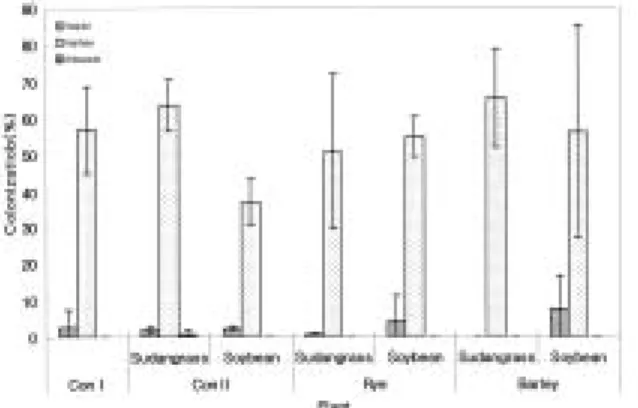
작부체계에 따른 기주식물별 생육후기 건토 1 g당 AMF 포자밀도는 보리 재배구에서 10개, 호밀 재배구 에서 6개로 조사되어 보리가 가장 많은 AMF 포자밀 도를 보였다. 여름작물은 콩 재배구와는 다르게 9월 21일 조사 시 수단그라스 재배구의 포자밀도가 증가 되어 콩 재배구 보다는 수단그라스 재배구가 더 많은 포자밀도를 나타냈으며, 그 중 보리를 재배했던 포장 의 수단그라스 재배구가 건토 1 g당 64개로 가장 높 은 포자밀도를 보였다(Fig. 3). 이상의 결과를 종합하 여 볼 때, 겨울작물로는 보리를 재배하고 이어서 여름 작물의 수단그라스를 재배하는 작부체계가 AMF 포 자밀도의 증가에 효과적인 것으로 나타났다.
한편 Fig. 3에 나타낸 대조구를 포함한 기주작물에 의한 작부체계 유형에 따른 평균 감염율은 40~70%
범위에 있었으며, 특히 겨울작물로 수단그라스를 재배 한 포장에서 높은 감염율을 보였다. 그리고 감염율을 나타내는 주요 감염구조는 뿌리의 내부균사(internal hyphae)임이 확인 되었으며 작부체계 처리 유형에 따 른 감염율에는 뚜렷한 경향을 보이지 않았다.
AMF 외생균사(external hyphae) 길이 작부체계 유형 에 따른 기주작물의 재배 토양별 건토 1 g당 외부균 사 길이를 Table 7과 8에 나타내었다. 겨울작물의 호 밀과 보리를 재배한 포장의 외부균사 길이는 건토 1 g당 1.5~2.0 m 범위였으며, 대조구(1.5 m g-1)보다 호 밀(2.096 m g-1)이나 보리(2.071 m g-1)를 재배한 포 장에서 높게 나타났다(Table 7). 겨울작물 재배 후 여 름작물을 재배한 포장 또한 수단그라스 재배구에서 건토 1 g당 2.6~2.9 m, 콩 재배구에서 건토 1 g당 1.7~2.2 m 수준으로 대조구에 비해 높게 나타났고, 콩을 재배한 포장보다는 수단그라스를 재배한 포장에 서 건토 1 g당 0.9 m 정도 긴 것으로 확인되었다. 특 히, 겨울작물의 보리를 재배한 다음 여름작물의 수단 그라스(2.9 m g-1)나 콩(2.2 m g-1)을 재배하는 작부 체계 유형에서 높게 나타났다.
Fig. 1. Changes of AMF spore density at soil during the growing stage of winter crops (vertical line is standard error).
Fig. 3. AMF colonization rate in the root of summer crops (vertical line is standard error).
Fig. 2. Change of AMF spore density at soil during the growing stage of summer crops (vertical line is standard error).
Treatments
Control Ⅰ Control Ⅱ Rye Barley
1.514 1.535 2.096 2.071 Hyphae length
m dry soil g
-1Table 7. Length of AMF external hyphae in the soil after
winter crop cultivation.
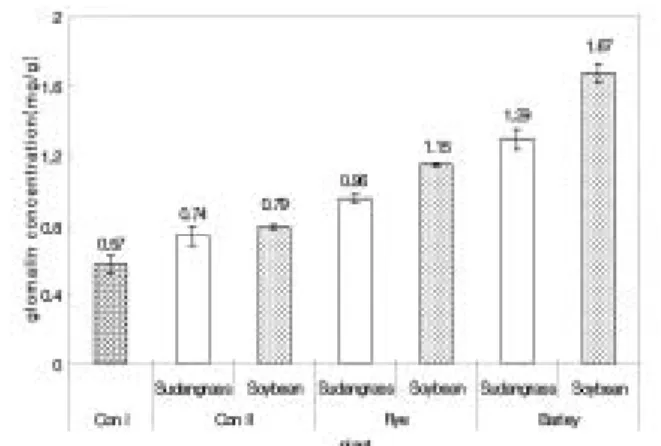
토양 중 Glomalin 함량 토양 중의 Glomalin을 ELISA를 이용하여 정량 분석한 결과에서 전체적인 수준은 건토 1 g당 0.57∼1.67 mg 범위를 보였으며, 대조구의 Control Ⅰ 보다는 작물을 재배하는 경우의 포장에서 Glomalin 함량이 높은 것으로 확인되었다 (Fig. 4). 특히, 겨울작물인 보리를 재배한 후 이어서 여름작물의 콩을 재배하는 작부체계에서 건토 1 g당 1.67 mg 수준으로 가장 높은 함량을 보임으로서 입단 안정화를 위해서는 겨울작물/여름작물의 보리/콩의 작부체계 작물이 우수한 것으로 나타났다. Glomlain은 토양 탄소를 저장하며 탄소가 대기 중으로 유실되는 것을 방지하고 식물의 흡수 이용이 도움을 주며 AMF 균사에 의해 생성되는 물질로 알려져 있을 (Wright and Upadhyaya, 1996) 뿐만 아니라 AMF 균사에 빠르게 축적되어 토양의 물리성 즉, 입단화 안 정에 영향을 주는 물질로 보고되어 있다(Degens et al., 1996; Jastrow et al., 1998; Tisdall, 1991).
요 약
대학 부속농장의 밭 토양을 선정하여 토양 중 AMF 밀도 향상과 토양 물리성 개선을 위하여 기주 작물로서 겨울작물인 보리와 호밀, 여름작물인 수단 그라스와 콩을 재배하는 작부체계 유형별로 AMF 밀 도 변화와 토양특성을 조사하였다. 재배작물의 생산 량은 겨울작물 중 호밀을 재배한 포장 (3,045.3 kg 10a-1)이 가장 높았으며, 호밀 재배 후 여름작물 중 수단그라스를 재배한 포장 (2,756.8 kg 10a-1)과 보리 를 재배한 후 콩을 재배한 포장 (1,628.3 kg 10a-1) 순 으로 건물 생산량을 보였다. 유기물 함량에서는 큰 변 화는 인정되지 않았으나 입단화율은 보리를 재배한 포장이 45.7%, 호밀을 재배한 후 수단그라스를 재배 한 포장에서 45.1%로 높아졌다. 포자밀도는 겨울작물 을 재배한 포장이 전체적으로 증가하는 경향을 보였 고, 여름작물은 수단그라스를 재배한 포장에서 건토 1 g당 64개로 콩을 재배한 포장보다 증가하였다. AMF
외생균사 길이는 겨울작물이 건토 1 g당 1.5∼2.0 m 수준이었으며, 여름작물은 수단그라스를 재배한 포장 이 건토 1 g당 2.6∼2.9 m, 콩을 재배한 포장이 건토 1 g당 1.7∼2.2 m 수준으로 대조구보다 높게 나타났 다. 토양 중 Glomalin 함량은 작물을 재배한 포장이 대조구보다 높은 함량을 나타내었다. 그 중에서도 보 리를 재배한 후 이어 콩을 재배한 포장에서 건토 1 g 당 1.7 mg로 가장 높게 나타났다. 이상의 결과에서 인삼 재배 예정지의 토양관리를 위한 작부체계는 겨 울작물의 보리를 재배한 다음 여름작물의 수단그라스 를 재배하는 유형이 AMF 포자밀도 향상과 토양 물 리성 개선에 효과적인 것으로 밝혀졌다.
사 사
본 연구는 농림부 농림기술개발사업의 지원에 의해 이루어진 것임.
인 용 문 헌