In vitro Rumen Fermentation Patterns of Environment Friendly Whole Crop Barley,
Italian Ryegrass and Rice Straw Silages*
1)
David Tinotenda Mbiriri**․Oh, Sung-Jin**․Lee, A-Reum**․Chae, Jung-Il***․
Choi, Chang-Weon****․Choi, Nag-Jin**
친환경 청보리, 이탈리안 라이그라스, 볏짚사일리지의 In vitro 반추위 발효성상 비교연구
David Tinotenda Mbiriri․오성진․이아름․채정일․최창원․최낙진
Rumen fermentative characteristic is useful indicators of the quality of ruminant feed stuffs and diets. An in vitro rumen fermentation experiment was therefore carried out to compare fermentation patterns among three forage sources. These were whole crop barley (WCBS), Italian ryegrass silage (IRGS) and rice straw silages (RSS). Rice straw (RS) was the control, making the treatments 4 in total.
Forages were randomly allocated to serum bottles. The incubation times were arranged 0, 3, 6, 9, 12, 24, 48 and 72h at 39 ℃, respectively. Each forage source was replicated 3 times per incubation time. At each sampling time, total gas and pH were measured, whilst individual volatile fatty acids (VFAs), total volatile fatty acids (TVFAs) and ammonia nitrogen (NH
3-N) were determined later after storing samples at -20 ℃. Acetate: Propionate ratio (A/P) was then calculated. Forage source had a significant effect (P<0.001) on pH and NH
3-N. RSS maintained higher pH values than the rest of the forage sources. A decreasing pH trend with increased time of incubation, in agreement with literature, was observed for all forage sources. WCBS recorded NH
3-N values higher than all the other treatments.
Total gas, individual and total VFA and A/P ratio were not affected by forage
* This work was supported by “Cooperative Research Program for Agriculture Science & Technology Development (Project No. PJ906934)” Rural Development Administration, Republic of Korea.
** Corresponding author, Department of Animal Science, Chonbuk National University ([email protected]) *** Department of Oral Pharmacology, School of Dentistry and Institute of Dental Bioscience, Chonbuk
National University
**** Department of Animal Resources, Daegu University
source. However, there was a significant difference in all parameters (p<0.05) among forage sources at sampling periods at 3 to 72h. Therefore, the present results indicating that WCBS, IRGS, RS and RSS maintained in vitro rumen pH above the critical value. Also, WCBS produced the highest NH3-N and on this merit could be of better nutritive value, in vivo, in the ruminant.
Key words : in vitro fermentation, rumen, forage
Ⅰ. Introduction
Forage quality is the basis of the formulation of productively efficient ruminant diets that supply sufficient nutrients to rumen microbes and the host (Van Saun, 2007). Good quality forage sources for ruminants, among other things, provide highly digestible energy and protein even when concentrate is provided for at low levels. Such forage sources have the potential of reducing feed costs, which generally account for up to 65% of production costs in beef enterprises. In an effort to improve beef production, farmers in South Korea have made it a priority to formulate high quality fattening diets. This has resulted in the introduction of other forage sources that include barley and Italian ryegrass, in an effort to replace the commonly used rice straw. Rice straw is of relatively low nutritive value. Low nitrogen content, high level of lignin and the slow and limited degradation of its carbohydrates have been pointed out as the major limitations (Sarnklong et al., 2010). South Korean weather patterns are favourable for the production of barley and Italian ryegrass.
Whole crop barley and Italian ryegrass are widely used in beef diets in temperate climates.
They can be fed alone or in total mixed rations (TMR). Fibrous components of ruminant diets can be fed as fresh, hay, haylage or silage. Ensiling is a common method of preserving the nutritional quality of forages. It also improves digestibility, palatability and nutritive value of straws (Gao et al., 2008). This ensures a guaranteed supply of high quality forage throughout the year. An evaluation of forage sources is necessary before incorporating them into animal diets.
Rumen fermentation parameters are good indicators of the quality and the potential of the feed component to supply nutrients to rumen microbes and the host. In vitro fermentations are generally considered sufficient approximators of in vivo fermentations (Mans field et al., 1995;
Mould et al., 2005). Gizzi et al. (1998) noted that in vitro fermentation is a useful tool in evaluating individual feedstuffs.
The objective of this study was to compare in vitro rumen fermentation parameters among
rice straw silage (RSS), whole crop barley silage (WCBS) and Italian ryegrass silage (IRGS).
Ⅱ. Materials and methods
Forage silages and rice straw were collected from Chonbuk Hanwoo Association and frozen dried. The forages were then ground through a 1mm sieve on the day they were used in the in vitro fermentation experiment. Rumen contents were collected from a rumen fistulated Hanwoo steer weighing 350Kg. Rumen content was collected just before morning feeding. The steer was receiving a roughage:concentrate ration of (50:50). These contents were squeezed through four layers of cheese cloth into an Erlenmeyer flask with an O
2-free CO
2headspace. On reaching the lab, the liquor was further strained through four layers of cheese cloth again. The particle-free liquor was transferred into a medium, McDougal buffer (pH 6.5), prepared according to Troelsen and Donna (1966). It contained 9.8g NaHCO
3, 4.62g Na
2HPO
4.2H
2O, 0.57g KCl, 0.47g NaCl, 0.12g MgSO
4.7H
2O and 4(5.3)g CaCl
2(CaCl
2.2H
2O) per 100ml H
2O. Fifty mL of the inoculum were anaerobically transferred into 96 serum bottles, each containing about 50g of ground (1mm sieve) forage source. The in vitro incubation was carried out according to method outlined by Tilley and Terry (1963).
Each forage source was replicated 3 times per sampling period (0, 3, 6, 9, 12, 24, 48 and 72h). All serum bottles, except for 0h sampling time bottles, were immediately incubated into an incubator (VS-1203P3N) at 39 ℃. At each sampling period, total gas was measured first by reading the displacement of a syringe plunger. Serum bottles were then uncapped and pH measured immediately using a calibrated pH meter (Mettler Toledo, seven easy). The inoculum in each bottle was emptied into a conical tube and centrifuged (10,000rpm for 15min) and cell-free supernatant stored at -20 ℃ for further analyses.
Ammonia was measured using calorimetry as specified by Chaney and Marbach (1962).
Rumen inoculum was centrifuged (3,000rpm × 15min). 20µL of cell-free supernatant was super- natant was collected from each conical tube and transferred to test tube. 1ml of each of the 2 reagents, Phenol colour reagent and Alkali-hypochlorite reagent were added into the test tube and thoroughly mixed using a voltex mixer. The test tube contents were then incubated for 7 minutes at 50 ℃ in a water bath. Readings were then obtained from a spectrophotometer (spectrophotometer, optizen 2120UV, Mecasys Co., LTD).
VFAs were determined using gas liquid chromatography according to Erwin et al. (1961). A Varian GC-3400 (Walnut Creek, California, 94598, USA) gas chromatograph (column temper- ature = 120 ℃ to 170℃ at 10℃/min, injector temperature = 170℃, detector temperature = 190℃) equipped with an auto sampler and Stabilwax-DA (30m × 0.5mm I.D. × 0.5film) column (Resteck).
An ANOVA was carried out using the R- statistical passage (Version 2.15.0) to determine
effect of the forage sources on fermentation parameters.
Ⅲ. Results
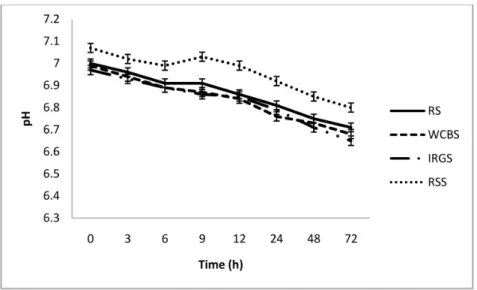
Forage source had a significant effect (P<0.001) on in vitro ruminal pH values. RSS with an overall mean of 6.96, was significantly higher than the other forage sources. IRGS and WCBS tended to have lower values than RS, although the difference among these three was not significant (p>0.05). Figure 1 shows a decreasing trend in pH that was observed among all forage sources with increased incubation time.
Figure 1. Effect of forage source on pH values over time. RS=Rice straw, WCBS=Whole crop barley silage, IRGS=Italian ryegrass silage, RSS=Rice straw silage.
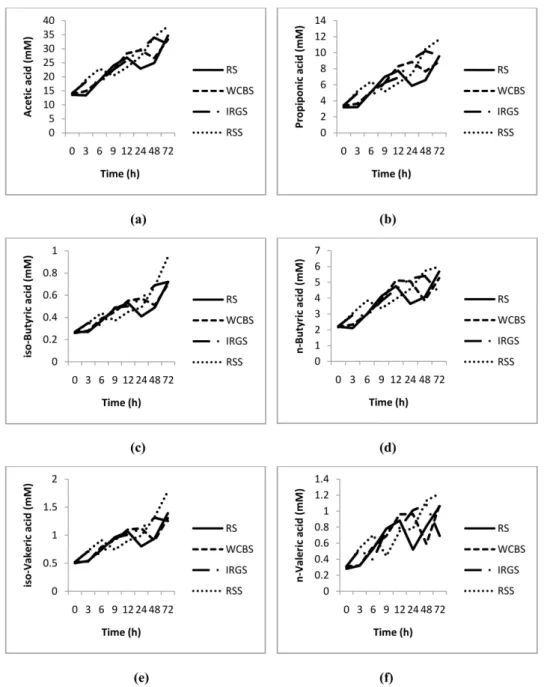
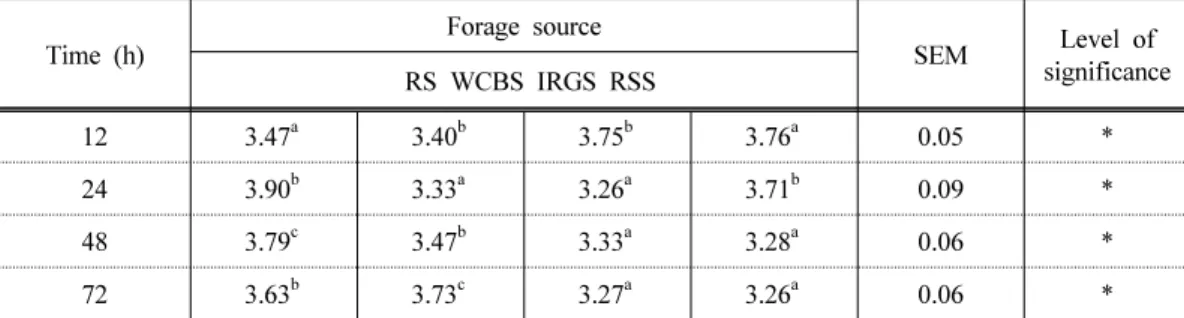
Forage source had no effect (p>0.05) on TVFAs, the molar proportions of VFAs and also the A/P ratio. However, there were significant differences (p<0.05) between treatments in the same parameters in fermentation time periods from 3 to 72h (Figure 2. and Table 1). The amount of individual VFAs and subsequently TVFAs increased as sampling time increased, whilst the A/P ratio showed a decreasing trend in that same period. The amount of individual VFAs and TVFAs differed significantly (p<0.05) in the different sampling periods except for 0h.
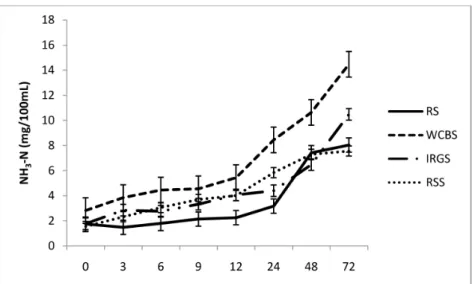
WCBS had significantly higher (p<0.001) NH
3-N production than other forage sources.
Significant interactions (p<0.01) between incubation time and forage source were noted. As
incubation time increased (from 12 - 72h) the rate of NH
3-N production varied among forage sources also (Figure 3).
Figure 2. Changes in individual VFA production (a) acetic acid, (b) propionic acid, (c)
iso-butyric acid, (d) n-butyric acid, (e) iso-valeric acid (f) n-valeric acid in
different forage sources over time. RS=Rice straw, WCBS=Whole crop barley
silage, IRGS=Italian ryegrass silage, RSS=Rice straw silage.
Figure 3. Changes in NH
3-N production in different forage sources over time. RS=Rice straw, WCBS=Whole crop barley silage, IRGS=Italian ryegrass silage, RSS=
Rice straw silage.
Table 1. Effect of forage source on TVFA (mM) and Acetate:Propionate ratio (A/P ratio)
Time (h)
Forage source
SEM Level of
significance RS WCBS IRGS RSS
TVFAs (mM)
0 20.40 20.40 20.89 20.09 0.17 NS
3 19.80
a21.97
b27.62
c28.80
c1.15 *
6 28.38
a28.39
a26.48
a35.15
b1.06 *
9 37.27
b34.54
b34.76
b30.47 0.85 *
12 41.38
bc44.36
c39.52
ab35.69
a1.12 *
24 34.13
a45.99
c46.85
c41.39
b1.63 *
48 37.78
a40.14 52.60
b53.60
b2.24 *
72 53.06
c50.50
b48.24
a59.60
d1.31 *
A/P ratio
0 4.24 4.10 4.12 4.11 0.02 NS
3 4.17
b4.10
b3.68
a3.64
a0.07 *
6 3.67
b3.65
b3.97
c3.57
a0.05 *
9 3.43
a3.58
b3.60
b3.96
c0.06 *
Time (h)
Forage source
SEM Level of
significance RS WCBS IRGS RSS
12 3.47
a3.40
b3.75
b3.76
a0.05 *
24 3.90
b3.33
a3.26
a3.71
b0.09 *
48 3.79
c3.47
b3.33
a3.28
a0.06 *
72 3.63
b3.73
c3.27
a3.26
a0.06 *
abcd