허브부식토 및 비타민 C 급여가 홀스타인 송아지의 면역력 및 증체에 미치는 영향
1)
김홍윤*․박중국**․안종호***
Effects of Dietary Herbaceous Peat and Vitamin C on Immunity and Growth Performance in Holstein Calves
Kim, Hong-Yun․Park, Joong-Kook․Ahn, Jong-Ho
This study was conducted to determine the effects of supplementing herbaceous peat preparation and vitamin C in order to find out its effects on immunity and growth performance in Holstein calves. Twenty Holstein calves (39.3±4.21kg average initial body weight) were allocated into four treatments by completely randomized design. Dietary treatments included: 1) control (Basal diet), 2) treatment 1 (control +5% herbaceous peat), 3) treatment 2 (control+10g vitamin C) and 4) treatment 3 (control+10g herbaceous peat+10g vitamin C). The duration of the experiment was 38 days in this experiment, and blood metabolism, dry matter intake, body weight and diarrhea frequency were investigated. For blood metabo- lism, white blood cells (WBC), neutrophils (NE), lymphocytes (LY), and red blood cells (RBC) did not show any significant differences among treatments. Average daily gain and feed conversion were highest in T1 group feeding with the herbaceous peat preparation compared to the control groups and diarrhea frequency showed lowest in T3 group. Overall results of the present experiment indicated that dietary supplementation with herbaceous peat influenced positively on growth performances in Holstein calves.
Key words : holstein calves, herbaceous peat, immunity, growth performance, diarrhea
* 한경대학교 동물생명환경과학부
** 농협중앙회 축산연구원
*** Corresponding author, 한경대학교 동물생명환경과학부([email protected])
연구보문
Ⅰ. 서 론
우리나라의 목장들은 대부분 좁은 공간에서 가축을 밀집 다두 사육하는 특성을 가지고 있다. 특히 송아지의 경우, 생후 1개월 전후 설사 발생률이 가장 높을 뿐 아니라(황, 1993), 장기적으로 상태가 악화되어 발육부진을 초래하며 열악한 영양상태의 악순환으로 생산성 도 저하되는 요인이 되고 있다(박, 1996). 이와 같이 축우를 좁은 공간에서 밀집, 다두 사육 하는 경우 대부분의 축사에는 각종 병원체에 의해 오염될 수밖에 없고, 환경 조건만 맞으 면 이 병원체들이 언제든지 발병할 수 있으므로, 송아지가 질병에 저항할 수 있도록 면역 기능을 증가시킬 필요가 있다.
최근 축산업은 친환경 축산물에 대한 소비자의 관심증가로 관행사육에서 벗어나 유기축 산 농가가 증가하고 있는 실정이며, 유기축산에서는 환축을 제외한 일반 가축 사육시 항생 물질을 사용하지 않고 가축의 면역 기능을 향상시킬 수 있는 식물추출물, 효소제 및 생균 제 등을 이용한 천연 항균물질이 개발되고 있다(안, 2003). 송아지의 면역 기능 향상 방안으 로 상업적으로 주로 미량광물질(Cr, Zn, Se 등)이나 비타민(A, D, E, C 등) 등이 사용되고 있으며(Bringnole과 Stott, 1980; 한, 1994), 그 밖에도 생균제, 효소제 및 생리활성물질 등 다 양한 첨가제가 개발되고 있는 실정이지만, 초유에 대한 면역력이 감소하는 시점인 생후 2 주 후 부터는 지속적인 치료효과는 낮다고 볼 수 있다(Osame 등, 1991).
한편, 부식토(humic substances)는 humic acid, fulvic acid 및 ulmic acid로 토양유기물의 주 요성분으로 이루어져 있으며, 다양한 동물의 면역을 개선시키고 생리적인 변화를 통한 건 강증진 효과와 깊은 관계가 있다고 보고되고 있다(김 등, 2011). 또한 비타민 C는 신생 송 아지의 설사를 감소시키고 증체수준을 향상시킨다고 하였지만(Cummins와 Brunner, 1989), 생리적으로 생후 3주령 까지는 비타민 C를 합성할 수 없다(Cummins와 Brunner, 1991). 한 편, 실내(In door) 사양에서의 송아지는 여름철 열 스트레스에 의해 혈장 비타민 C 수준이 감소되었으며(Cummins와 Brunner, 1991), 결국 어린 송아지의 비타민 C 섭취는 외부에서 공급되는 영양소 즉, 우유 및 송아지사료에 의지해야 하지만 공급수준이 낮은 실정이다 (Wegga와 Moustgaard, 1982). 한편 송아지를 대상으로 한 허브부식토 및 비타민 C 연구는 국외에서 일부만 보고되고 있으며(Griban, 1988), 국내에서는 전무한 실정이다. 따라서 본 연구에서는 허브부식토가 동물 장내의 유해 세균의 장상피세포의 흡착을 줄이고 유해 가스 를 흡착하여 질병 발생을 억제하고, 면역력과 항병력을 증진시킨다는 연구 결과를(Enueme 등, 1987; Roost 등, 1990; Shermer 등, 2002) 바탕으로 허브부식토와 비타민 C를 어린송아지 에 급여하였을 때 면역성 및 증체에 미치는 영향을 알아보고자 본 연구를 수행 하였다.
Ⅱ. 재료 및 방법
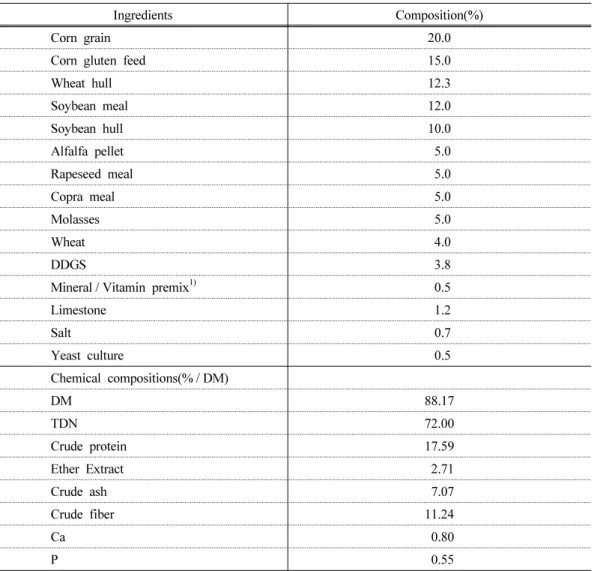
1. 공시재료공시사료는 어린송아지용 시판사료(CJ Feed, Korea)로서 대조구와 처리구 전 두수에 급 여하였으며, 비타민 C제제(화신이엔비, Korea)와 허브부식토제제(늘푸름, Korea)를 공시하 여 처리구에 급여하였다. 본 연구에 사용된 공시사료의 일반성분 함량은 국립축산과학원 분석실에서 60℃의 drying oven을 이용하여 48시간 동안 건조시켜 건물함량을 측정하였으 며 조단백질, 조지방, 조섬유, 조회분 등의 일반성분 및 Ca과 P의 함량은 AOAC법(1990)에 준하여 분석하였다. 공시사료의 배합비와 성분비는 Table 1과 같다.
2. 시험기간 및 공시동물
본 시험의 공시동물은 생후 10일령의 Holstein 수송아지 20두(평균체중 39.3±4.21kg)를 이 용하였다. 사양시험은 2009년 10월 29일부터 2009년 12월 4일까지 총 38일간 충남 보령시 천북면에 소재한 목장에서 실시하였다. 송아지의 사육공간은 철재 파이프를 이용하여 4m×
6m 크기로 제작하였으며, 콘크리트 바닥에 깔짚으로 톱밥을 사용하였다. 또한 사조는 바닥 지면으로부터 30cm 높이로, 음수를 위한 자동 급수통과 함께 설치하였다.
3. 시험설계 및 사양관리
시험구 배치에 있어서는 대조구(Control), 허브부식토제제 첨가구(T1), 비타민 C제제 첨가 구(T2), 비타민 C제제(10g)와 허브부식토제제(10g)의 50 : 50 혼합 첨가구(T3)로 나누고 시 험축은 각 시험구당 5두씩 임의 배치하여 수행하였다. 공시사료는 시판 어린송아지사료의 급여기준에 맞춰 자유 급여하였고, 대용유(CJ feed; DM 89%, crude protein 22%, crude fat 12%, Ca 0.5%, P 0.4%, TDN 82%)는 NRC(1998) 권장량을 고려하여 15일령까지는 두당 380g의 대용유를 37.8℃의 온수 3ℓ에 완전히 희석한 다음 1일 2회로 나누어서 급여하였다.
15일령부터 35일령까지는 매일 300g의 대용유를 37.8℃의 온수 1.8ℓ에 희석한 다음 1일 2회 나누어서 급여하였으며, 36일령부터는 대용유를 중단하였다.
각 처리구별 첨가물질의 첨가수준은 일일급여량기준에 있어서 시험동물 1두당 비타민 C 제제는 10g, 허브부식토제제는 공시사료 일일급여량의 5%를 오전 공시사료와 함께 급여하 였다. 조사료는 티머시 건초를 사용하였으며, 물과 함께 자유 섭취토록 하였다.
4. 조사항목 및 시험방법
1) 사료섭취량, 증체율 및 설사유무
사료섭취량은 매일 아침 당일 사료 급여 전 오전 07:00에 군별 잔량을 조사하였으며, 증 체율은 전체 시험기간 동안 개시체중과 종료체중을 측정하여 증체량을 산출하였다. 또한 사료효율은 증체량과 사료섭취량을 이용하여 계산하였으며, 홀스타인 송아지의 설사 발생 두수 및 발생일자를 조사하여 분변유동성스코어지수의 경우 매일 아침 사료급여 전 Larson 등(1977)이 제시한 4단계의 측정방법을 통해 측정하였다.
Table 1. Formulas and chemical compositions of diets for Holstein calves
Ingredients Composition(%)
Corn grain 20.0
Corn gluten feed 15.0
Wheat hull 12.3
Soybean meal 12.0
Soybean hull 10.0
Alfalfa pellet 5.0
Rapeseed meal 5.0
Copra meal 5.0
Molasses 5.0
Wheat 4.0
DDGS 3.8
Mineral / Vitamin premix
1)0.5
Limestone 1.2
Salt 0.7
Yeast culture 0.5
Chemical compositions(% / DM)
DM 88.17
TDN 72.00
Crude protein 17.59
Ether Extract 2.71
Crude ash 7.07
Crude fiber 11.24
Ca 0.80
P 0.55
1)
Contained per kg diet: vitamin A, 2,500,000 IU; vitamin D3, 500,000 IU; vitamin E, 1,000 IU; I, 140mg
Fe, 5600mg; Mn, 4,000mg; Zn, 1,500mg; Cu, 375mg and Co, 100mg.
2) 혈액검사
혈액채취는 송아지 목 부위의 경정맥을 20 gauge의 needle을 사용하여 20ml의 혈액을 채 취한 후 heparin이 첨가된 vacutainer tube(BD, USA)와 혈액응고 방지제가 첨가되지 않은 vacutainer tube에 각각 10ml씩 나누어 채취하였다. 혈액응고 방지제가 첨가되지 않은 vacutainer tube에 넣은 혈액을 실온에서 응고시킨 후에 4℃ 냉장고에 24시간 보관한 다음 3,000rpm에서 15분간 원심분리하여 혈청을 분리하였으며, 다음 검사에 이용할 때까지 -70
℃의 초저온냉장고에 보관하였다. Heparin이 첨가된 vacutainer tube는 균질하게 혼합 후, 실 험실로 옮겨와 자동 혈액분석기(Hitachi 747, Japan)로 적혈구(Red Blood Cell, RBC), 백혈구 (White Blood Cell, WBC), 헤모글로빈(Hemo-globin, HB) 등의 혈액성상을 측정하였다.
5. 통계분석
본 시험의 모든 결과들은 SAS package program(2000, release. 8.1 version)의 GLM(General Linear Model) procedure를 이용하여 처리구별로 분산 분석을 실시하였으며, 처리구간 유의 성의 검정은 Duncan’s multiple range test에 의해 처리 평균간 유의성(p<0.05)을 검정하였다.
Ⅲ. 결과 및 고찰
1. 사료섭취량, 증체율 및 설사유무허브부식토 및 비타민 C 급여 사료섭취량 및 증체율의 결과는 Table 2에 나타내었다. 건 물섭취량은 처리구에서 대조구와 비교하여 수치적으로 높았지만, 유의한 차이는 없었다.
부식토를 육계(Kocabagli 등, 2002)와 이유자돈(Fuchs 등, 1995)에 급여한 결과, 대조구와 비 교하여 사료효율이 증가하였으며, 이러한 원인은 부식토가 동물의 소화관, 위 및 소장의 민 감한 점막을 보호하는 기능을 담당하고 있기 때문이라는 보고(Enueme 등, 1987)와 일치한 다고 볼 수 있다. 한편, 이와 유사하게 여러 다른 연구에서도 동물에 있어 부식물질을 급여할 경우 증체와 도체특성을 향상시키고(Roost 등, 1990; Stepchenko 등, 1991; Zhorina와 Stepchenko, 1991; Fuchs 등, 1995) 폐사율 발생도 감소시킨다고 보고하였다(Lenk와 Benda, 1989; Stepchenko 등, 1991).
송아지 증체율 및 사료효율은 T1구와 T3구에서 대조구에 비해 유의하게 높게 나타났다 (p<0.05). Roost 등(1990) 및 Fuchs 등(1995)은 이유자돈에 부식토를 음수에 혼합하여 급여 시 성장과 건강상태가 개선되었고 특히, 설사 발생률이 낮아졌다고 하였으며 Enueme 등 (1990)도 면양을 대상으로 사료내 부식토를 각각 10, 20 및 30%를 혼합 급여 시 사료효율이
각각 6.16, 8.46 및 9.81%로 직선적으로 증가했다고 보고하여 본 연구와 유사한 결과를 보 였다.
Table 2. Feed intake, body weight and daily gain influenced by supplementation of herbaceous peat and vitamin C in Holstein calves
Item Control T1 T2 T3 SEM
1)Dry matter intake, g/d 599.0 673.7 678.2 649.0 81.699
Initial body weight, kg 39.8±1.3 36.5±2.1 42.5±1.9 38.2±0.9 3.253 Final body weight, kg 56.5±3.1 58.0±3.1 62.5±1.2 59.0±1.0 3.596 Average daily gain, g/d 465±57
b597±47
a556±49
ab578±24
ab23.387 Feed conversion(ADG/DMI) 0.75
b0.89
a0.82
ab0.89
a0.285 T1 : Herbaceous peat, T2 : Vitamin C, T3 : Herbaceous peat+Vitamin C.
1)
Standard error of means.
송아지 설사유무에 대한 결과는 Table 3과 같다. 대조구의 경우 사양시험 1주째 설사 후 폐사한 개체가 발생하여 수치가 높게 나타났으며, 처리구인 T1 및 T2구의 경우 시험 3주째 설사 후 폐사가 발생하여 수치가 높게 나타났다. T3구는 전체적으로 연변, 설사 발생 개체 가 지속적으로 낮게 나타났다.
Table 3. Diarrhea occurrences and mortality influenced by supplementation of herbaceous peat and vitamin C in Holstein calves
Item Control T1 T2 T3 SEM
1)……… Diarrhea Index
1)………
1 wk 1.80±0.20 1.51±0.23 1.77±0.45 1.43±0.42 0.051
2 wk 0.83±0.31 0.94±0.36 0.60±0.23 0.83±0.55 0.029
3 wk 0.80±0.20 1.06±0.36 1.31±0.66 0.40±0.57 0.035
Mortality, head 1 1 1 0
T1 : Hebaceous peat, T2 : Vitamin C, T3 : Hebaceous peat+Vitamin C.
1)
0, firm, not remarkable feces; 1.0, slightly loose diarrhea; 2.0, moderately loose diarrhea; 3.0, profuse watery diarrhea.
1 )
Standard error of means.
부식토의 설사예방 효과는 어린동물의 소화관, 위 및 소장의 민감한 점막을 보호하는 기 능을 제공하기 때문이며(Shermer 등, 1998), 비타민 C 공급은 송아지의 설사를 감소시키고
(Cummins와 Brunner, 1989) 젖소의 급성유선염증을 회복시킨다(Chaiyotwittayakun 등, 2002).
한편, 송아지를 대상으로 부식토 일일 200g을 우유에 첨가하여 급여 시 설사 발생과 폐사 율이 감소하였다(Lenk와 Benda, 1989). 본 연구에서 비록 T3구에서 3주차까지 설사발생 빈 도가 지속적으로 낮았지만, 처리간 유의한 차이는 없었으며, 이러한 결과는 처리간 시험 개 체수가 적어 설사 개체수 유무에 따라 편차가 커진 것으로 판단된다.
2. 혈액성상
본 연구에서 송아지에게 허브부식토 및 비타민 C를 급여하였을 때 질병에 강한 정도를 나타내는 혈액성상은 Table 4와 같다. 백혈구수는 8.88∼10.07K/㎕로 모두 정상범위에 있어 서 유의한 차이는 나타내지 않았으며(p<0.05), 호중구 수치도 대조구 4.00K/㎕와 T1, T2, T3 처리구에서 각각 4.41K/㎕, 4.16K/㎕ 및 4.25K/㎕로 나타냈고, 림프구 역시 대조구 3.84k/㎕
와 T1, T2 및 T3구에서 각각 4.55K/㎕, 4.26K/㎕ 및 4.40K/㎕로 정상범위에 속하였다. 그러 나 전반적인 경향으로는 호중구와 림프구는 T3구인 부식토급여구와 비타민 C 급여구에서 높은 경향을 나타냈다.
적혈구수는 대조구와 처리구 모두 정상범위로 유의한 차이가 없었으며, 혈색수치는 대조 구보다 처리구에서 높게 나타나는 경향을 나타냈다. 항병력과 관련된 송아지의 정상 혈액 성상의 범위는 leukocytes의 경우 WBC 4.0∼12.0K/㎕, NE 0.6∼4.1K/㎕, LY 2.5∼7.5K/㎕이 며, erythrocytes는 RBC 5.0∼10.0K/㎕이고(강, 1986; 조 등, 1988; 김 등, 1989) 이들은 또한 생리적인 변화에도 차이가 있다고 하였는데(김 등, 1989), 본 연구에서는 처리구간 유의성 이 인정되지 않았다.
전반적으로 본 연구에서 송아지에 대한 부식토 급여는 혈액성상에서는 유의한 변화를 보이지 못하였지만 송아지의 사료 효율이 개선되는 경향을 보였으며 증체 효과가 뚜렷하 게 나타났다. 반면 비타민 C 공급 효과는 뚜렷한 특성을 나타내지 않았다. 송아지의 연변 및 설사 발생 빈도도 비타민 C와 부식토를 함께 급여한 구(T3)에서 3주까지 지속적으로 감 소하였지만, 처리간 유의한 차이는 없었다. 결과적으로 송아지에게 허브부식토 급여 효과 는 증체량과 사료효율이 개선되는 것으로 판단되며 앞으로 효과적인 사용을 위해 포유기 및 이유송아지를 대상으로 추가연구 및 적정 첨가수준 연구가 수행 되어야 할 것으로 판단 된다.
Table 4. Leukocytes, erythrocytes and thrombocytes as influenced by supplementation of herbaceous peat and vitamin C in Holstein calves
Items Control T1 T2 T3 SEM
1)Leukocytes
WBC(K/ ㎕) 8.88±0.97 10.07±1.05 9.48±0.69 9.73±1.08 0.225 NE(K/ ㎕) 4.00±0.42 4.41±0.43 4.16±0.35 4.25±0.53 0.097 LY(K/ ㎕) 3.84±0.48 4.55±0.54 4.26±0.28 4.40±0.46 0.114 MO(K/ ㎕) 0.44±0.06 0.48±0.05 0.45±0.03 0.47±0.06 0.011 EO(K/ ㎕) 0.50±0.05 0.56±0.06 0.53±0.05 0.55±0.05 0.013 BA(K/ ㎕) 0.04±0.02 0.04±0.01 0.04±0.01 0.04±0.01 0.002 NE(%) 45.09±0.74 43.89±1.00 43.94±0.71 43.70±0.75 0.214 LY(%) 43.39±1.02
b45.19±1.20
a45.05±0.80
a45.29±0.64
a0.273 MO(%) 5.02±0.28 4.78±0.07 4.83±0.20 4.84±0.16 0.046 EO(%) 5.66±0.21 5.65±0.22 5.63±0.28 5.65±0.18 0.048 BA(%) 0.45±0.14 0.43±0.06 0.44±0.10 0.43±0.06 0.020 Erythroctyes
RBC(M/ ㎕) 9.02±0.71 8.57±1.04 8.56±0.68 8.57±0.64 0.173 Hb(g/ ㎗) 9.56±0.92
b11.44±1.20
a11.46±0.49
a11.48±0.63
a0.268 HCT(%) 28.86±2.60 28.80±3.48 28.84±1.49 28.23±2.72 0.561 MCV(f ℓ) 36.12±2.00 35.72±1.04 36.22±2.23 37.18±3.74 0.505 MCH(pg) 13.42±1.20 13.44±0.30 13.40±0.66 13.43±1.35 0.198 MCHC(g/ ㎗) 39.76±0.88 39.90±0.80 40.10±0.75 39.95±0.97 0.179 RDW(%) 29.44±1.62 30.06±2.38 30.12±2.73 29.98±1.84 0.467 Thermobocytes
PLT(K/ ㎕) 461.80±55.37 430.80±65.260 418.20±66.66 404.25±75.35 14.561 MPV(f ℓ) 4.60±0.48 4.66±0.37 4.64±0.39 4.78±0.13 0.081 Note : Mean±S.D with the same letter are not significantly different at p<0.05 within a row.
T1 : Hebaceous peat, T2 : Vitamin C, T3 : Hebaceous peat+Vitamin C.
1)
Standard error of means.
WBC, white blood cells; NE, neutrophils elastase; LY, lymphocytes; MO, monocytes; EO, eosinophils; BA,
basophils; RBC, red blood cells; Hb, hemoglobin; HCT, hematocrit; MCV, mean corpuscular (erythrocyte)
volume; MCH, mean corpuscular (erythrocyte) hemoglobin; MCHC, mean corpuscular (erythrocyte)
hemoglobin concentration; RDW, red cell (erythrocyte volume) distribution concentration; PLT, platele-
tcrits; MPV, mean platelet (thrombocyte) volume.
Ⅳ. 적 요
본 실험은 허브부식토 및 비타민 C 공급에 따른 송아지의 면역력, 증체 및 건강에 미치 는 영향을 조사하기 위하여 대조구, 허브부식토제제 첨가구(T1), 비타민C제제 첨가구(T2), 비타민 C제제와 허브부식토제제의 50 : 50 혼합 첨가구(T3)로 나누고 시험축은 각 시험구 당 5두씩 임의 배치하여 수행하였다. 조사항목으로 혈중 대사물질, 사료섭취량, 체중 및 설 사빈도를 측정하였다. 혈액성상으로 WBC, NE, LY 및 RBC은 처리간 유의한 차이를 나타 내지 않았으나 증체율 및 사료효율은 허브 부식토를 급여한 T1구에서 다른 처리구와 비교 하여 유의하게 가장 높았으며, 설사빈도는 허브 부식토+비타민 C 급여한 T3구에서 낮았지 만 유의한 차이는 없었다. 따라서 본 연구에서의 Holstein 송아지에게 부식토 급여는 송아 지의 면역성 향상에는 분명한 효과를 보이지 못하였으나 증체율과 사료효율에 있어 긍정 적인 효과가 있는 것으로 판단되었다.
[논문접수일 : 2012. 6. 21. 논문수정일 : 2012. 9. 24. 최종논문접수일 : 2012. 9. 27.]
인 용 문 헌
1. Ahn, J. H., I. H. Cho, and J. S. Lee. 2003. Case studies of organic livestock farming in europe and strategies for development of organic livestock farming in Korea. Kor J. Organ.
Agric. 11: 75-92.
2. AOAC. 1990. Official methods of analysis(15th) of the association of official analytical chemists. Washington DC.
3. Bringnole, T. J. and G. H. Stott. 1980. Effect of suckling followed by bottle feeding colostrum on immunoglobulin absorption and calf survival. J. Dairy Sci. 63: 451-456.
4. Chaiyotwittayakun, A., R. J. Erskine, P. C. Bartlett, T. H. Herd, P. M. Sears, and R. J.
Harmont. 2002. The effect of ascorbic acid and L-histidine therapy on acute mammary inflammation in dairy cattle. J. Dairy Sci. 85: 60-67.
5. Cho, S. S., H. J. Yoon, W. C. Lee, and T. J. Kim. 1988. Studies on the Hematology and Blood Chemistry of Korean Native Cattle. J. Vet. Sci. 24: 632-237.
6. Cummins, K. A. and C. J. Brunner. 1989. Dietary ascorbic acid and immune response in dairy calves. J. Dairy Sci. 72: 129-134.
7. Cummins, K. A. and C. J. Brunner. 1991. Effect of calf housing on plasma ascrobate and endocrine and immune function. J. Dairy Sci. 74: 1582-1588.
8. Enueme, J. E., P. E. Waibel, and R. S. Farnham. 1987. Use of peat as a bedding material and dietary component for turkey. Poult. Sci. 66: 1508-1516.
9. Enueme, J. E., P. E. Waibel, and R. D. Goodrich. 1990. A note on the nutritive- value and acceptability of peat in the diet of lambs. Anim. Prod. 51: 415-417.
10. Fuchs, B., J. Orda, J. Pres, and M. Muchowicz. 1995. The effect of feeding piglets up to the 100th day of their life with peat preparation on their growth and physiological and biochemical indices. Arch. Vet. Pol. 35: 97-107.
11. Griban, V. G., L. M. Stepchenko, and L. V. Zhorina. 1988. The live weight gain and disease resistance of young cattle and poultry stock as influenced by physiologically active peat preparation. In: Proc VIII Int Peat Congr, Leningrad, Rusia. pp. 45-50.
12. Han. I. K. 1994. Feed resource handbook. Kor. Feed Ingredients Association. p. 420.
13. Hwang, I. G. 1993. Calf dihrrhea. Bayer AG. p. 32.
14. Kang, J. B. 1986. Blood. J. Vet. Sci. 22: 217-222.
15. Kim, H. S., J. K. Park, H. Y. Kim, S. B. Kim, S. H. Yang, C. H. Kim, and J. H. Ahn.
2011. Effects of dietary herbaceous peat on in vitro fermentation and milk production in dairy cows. J. Kor. Grassl. Forage Sci. 3: 177-190.
16. Kim, J. K., K. H. Jang, T. J. Kim, and H. J. Yoon. 1989. Studies on the hematology of Korea native cattle in the Kangwon province. J. Vet. Sci. 25: 102-128.
17. Kocabagli, B., M. Alp, N. Acar, and R. Kahraman. 2002. The effects of dietary humate supplementation on broiler growth and carcass yield. Poult. Sci. 81: 227-230.
18. Larson, L. L., F. G. Owen, J. L. Albright, R. D. Appleman, R. C. Lamb, and L. D. Muller.
1977. Guidelines toward more uniformity in measuring and reporting calf experimental data.
J. Dairy Sci. 60: 989-1003.
19. Lenk, T. and A. Benda. 1989. Peat paste-humic acid containing animal health agent for prophylaxis and treatment of calves for diarrhoea (in German). Monatsh. Vet. 44: 563-565.
20. Osame, S., S. Ichijje, C. Ohata, W. Watanabe, and H. Goto. 1991. Efficacy of colostral immunoglobulin for therapeutic and preventive treatments of calf diarrhea. J. Vet. Med. Sci.
53: 87-91.
21. Park, B. K. 1996. Vital diarrhea virus from Korean calves. J. Vet. Sci. 20: 147-153.
22. Roost, H., I. Dobberstein, G. Kuntsch, H. Berber, H. Tardel, A. Benda, and E. Helms. 1990.
Results and experience obtained from use of peat paste in industrialized piglet raising (in German). Monatsh. Vet. 45: 239-243.
23. SAS. 2003. SAS/STAT® Software for PC. SAS Institute Inc., Cary, NC, USA.
24. Shermer, C. L., K. G. Maciorowski, C. A. Bailey, F. M. Byers, and S. C. Ricke. 1998.
Caecal metabolites and microbial population in chickens consuming diets containing a mined humate compound. J. Sci. Food Agric. 77: 479-486.
25. Stepchenko, L. M., L. V. Zhorina, and L. V. Kravtsova. 1991. The effect of sodium humate on metabolism and resistance in highly productive poultry (in Russian). Nauchnye Doklady Vysshei Shkoly. Biologicheskie Nauki. 10: 90-95.
26. Wegga, I. and J. Moustgaard, 1982. Age related variations in plasma ascorbic acid in calves.
Annu. Rep. Stail. Res. Inst., R. Vet. Agric. Univ. Copenhagen, 25: 16.
27. Zhorina, L. V. and L. M. Stepchenko. 1991. The content of free amino acids in the tissues of broiler chicks administered sodium humate in the ration (in Russian). Nauchnye Doklady Vysshei Shkoly. Biol. Nauki. 10: 147-150.