Corresponding Author: Hyeonkyeong Lee
Yonsei University College of Nursing, Nursing Policy Research Institute 134 Sinchon-dong, Seodaemun-gu. Seoul 120-752, Korea
Tel: +82-2-2228-3373, Fax: +82-2-392-5440, E-mail: [email protected]
* This work was supported by Yonsei University Faculty Research Fund of 2006.
Article submitted 10 September 2009, Revised 30 November 2009, Approved 12 December 2009
Factors Influencing Stress Coping Behaviors of Elementary Students in Korea
Chung-Yul Lee*, Gyu-Young Lee**, Kyoung-Mi Jeon***, So-Hyun Park****, Yoon-Mi Hong*****, Hyeonkyeong Lee*†
* College of Nursing, Yonsei University, Nursing Policy Research Institute
** Red Cross College of Nursing
*** Department of Health Service Management, Kyungwoon University
**** College of Nursing, Yonsei University
***** Department of Nursing College of Medicine, Kwandong University
Ⅰ. Introduction
Stress has been found to be associated with children's mental and physical health (Howell et al., 2007; Sung, Puskar, and Sereika, 2006), adaptation to school (Hong, 2000), and school connectedness (Rice et al., 2008). Chronicity of stress increases the risk of developing various health problems such as depression, obesity, and heart disease among children (Chrousos and Gold, 1992). In addition, elementary students with more stress experience more psychosomatic symptoms, headache, and poor school adaptation than students with less stress (Chung and Hong, 2000; Hong, 2000; Tanaka et al., 2000). In Korea, about one-third of students from ages 12 to 14 years perceived very high or high stress in their lives (Ministry for Health, Welfare and Family Affairs, 2008) and ineffective coping increased the risk of suicide attempts in Korean adolescents (Kim and Kim, 2008). However, only a few studies have focused on stress coping behaviors
in the context of stressful situations faced by elementary students.
Coping describes constantly changing cognitive and behavioral efforts to manage stressful situations (Lazarus and Folkman, 1984), including physical and mental change, desire, frustration, conflicts, and objectives (Selye, 1956). Individuals appraise such stressors and make efforts to manage their emotional responses (eg, praying to God, wishful thinking) or actively alter the stressors (eg, seeking advice from teachers, problem-oriented behaviors such as exercise) (Folkman and Lazarus, 1986). The better students cope with stress, the better they have outcomes such as good adaptation to their schools (Hong, 2000).
In earlier studies, the type of stress coping
behaviors in elementary students varied according to
gender, academic achievement, stress level, and
regions of residence. In a longitudinal study, there
were differences in types of stress coping behaviors
between boys and girls. For example, girls more
frequently used “cry or feel sad” and “pray”, while boys more frequently used “bite my nails” and
“watch TV or listen to music”(Sharrer and Ryan-Wenger, 1995). In a separate study, positive stress coping behaviors were used more frequently by elementary students in Korea with particularly high or low levels of academic achievement than by those with a middle-level of academic achievement (Kim and Ryu, 2003). As described in earlier publications, stress levels and coping behaviors were positively correlated (Kim, 2005; Cho and Park, 1998). In different studies, sixth-grade students living in a medium-sized city in Korea more commonly used positive coping behaviors than passive and mystic coping behaviors (Cho and Park, 1998). The passive coping behaviors were less commonly used by students living in a large city (Kim, 2005) and were more commonly used in rural towns than medium-sized cities (Kim and Ryu, 2003). The findings suggest that school health professionals need to consider stress coping behaviors in a multidimentional manner to develop successful stress-management programs that meet the needs of elementary students (Dombrowski, 1999). Most studies on stressors and coping behaviors have been limited to one or two regional levels of residence with a relatively small number of settings and sample sizes. There is a need to examine stress coping behaviors that elementary students use to manage specific developmental stressors in large populations from different regions.
The purpose of this study was to compare stress coping behaviors of elementary students by general characteristics and stress levels as well as geographical region (large city, medium-sized city, and rural town). The specific aims were to (1) analyze the relationship between general characteristics, stress levels, and geographical regions and coping
behaviors, and (2) identify factors influencing coping behaviors.
Ⅱ. Methods
1. Design and Participants
This study used a descriptive comparative survey design and convenience sampling methods. Three regional categories included large city (> 1 million), medium-sized city (0.2- < 1 million), and rural town (< 0.2 million) by population size. The largest city in South Korea with over ten million people was selected for the large-city category. One medium- sized city from Kyunggi-do was identified based on proximity to the large city. One rural town from Kyunggi-do province and two rural towns from Kangwon-do were selected for participation in the study. Three or four schools by each regional category were contacted by researchers in collaboration with school nurses.
A total of 1,500 fifth- and sixth-grade students from 10 elementary schools participated in the study: 600 students from 3 schools in a large city;
450 students from 4 schools in a medium-sized city in Kyunggi-do; and 450 students from 3 schools in rural towns (2 from Kangwon-do, 1 from Kyunggi- do). The number of students per school participated in the study ranged from 50 to 250. Out of the 1,500 students, 339 whose responses were incomplete were excluded, and 1,161 (487 from the large city, 324 from the medium-sized city, and 350 from the rural towns) remained in the study.
2. Instruments
A structured survey questionnaire was used to
collect data. The questionnaire consisted of 97 items, including 10 general characteristics, 56 stress level items, and 31 stress coping behavior items.
The general characteristics included grade, gender, whether both parents worked, having siblings, school performance, private educational institutions attended after school, study hours after school per day, game hours per day, and life satisfaction.
Stress level was measured with a modified version of the stress-level scale used in earlier studies (Kim, 2005; Yi, 2004). The scale consisted of 4 subscales: individual (9 items); family (17 items); school (13 items); and peer factors (16 items). Each item was scored on a 5-point Likert scale ranging from 1(not at all) to 5 (severe stress).
Mean scores of each subscale were obtained by summing all scores and dividing by the number of items per scale. The higher the mean scores of the each subscale, the greater the stress levels. The scale had high internal consistency with Cronbach's alpha coefficients of 0.71 (personal), 0.84 (family), 0.82 (school), and 0.85 (peer).
Stress coping was measured by the revised Ways of Coping Checklist in Korean (Choe, 1989), which was initially developed by Lazarus and Folkman (1984). The Choe's checklist consisted of separate dimensions: positive/problem-focused coping (8 items), negative/emotion-focused coping (8 items), and mystic coping/avoidance coping (8 items).
Positive coping was defined as activities that aim to reduce the stressfulness of the situation. Negative coping was defined as activities that aim to alleviate negative emotions by reinterpreting the situation or by distancing oneself from the stressors. Mystic coping was defined as activities that aim to directly avoid experiencing stressful situations by depending on mysticism and faith. The scale was modified for
this study based on interviews of 50 fifth-grade students and consisted of 31 items (11 positive coping, 15 negative coping, and 5 mystic coping).
Items were rephrased to reflect specific coping efforts commonly reported by the fifth graders. For examples, the positive coping subscale included items such as “listening music”, “discussing with parents”, and “exercising”. The negative coping subscale included items such as “getting angry at friends”, “crying”, and “playing computer games”.
The mystic coping subscale items included items such as “trying not to think about what has happened”, “ignoring what has happened”, and
“wishing it would happen”. Each item was scored on a 5-point Likert scale ranging from 1(not at all) to 5 (very much). The mean score of each subscale ranging from 1 to 5 was calculated by dividing the sum of all scores of each subscale by the number of items of each subscale. Higher scores indicated a greater use of coping behaviors. Chronbach's alphas for each of the scales were 0.74, 0.83, and 0.70, respectively, in this study.
3. Data Collection
Data were collected between May 8 and May 30,
2006. In collaboration with school principals,
teachers or school health nurses explained the
purpose of the study to the students and that the data
were only for research purposes. Pontential
participants were told that participation in the study
was voluntary and there would be no penalty for
refusal. Only students who verbally agreed to
participate in the study received the questionnaires
and were told instructions for completing the
questionnaires. Teachers or school nurses assisted with
classroom management and survey administration. It
took approximately 10 minutes to complete the
questionnaire.
4. Data Analysis
The statistical analysis for the study was conducted using SPSS 13.0. Data were summarized using descriptive statistics (mean, standard deviation, frequency, and percentage). Comparison of general characteristics of participants, stress level, and stress coping behaviors by geographical regions were analyzed by Chi-Square, t-test, analysis of variance (ANOVA), and post-hoc test (Scheffé test). The relationship between stress level and stress coping was analyzed using correlation analyses. To determine factors influencing stress coping behaviors, stepwise multiple regression analysis was used.
Ⅲ. Results
1. General Characteristics of the Participants
General characteristics of the participants are presented in Table 1. The proportion of 6th grade students was almost parallel to that of 5th grade students (50.3% vs. 49.7%, respectively). The majority (90.8%) of the participants had siblings and the mean number of family members was 4.37.
More than half of the students (53%) reported that both parents were employed. Over a quarter of the participants (28%) perceived that their school performance was high, while a small portion of the participants (10.3%) perceived school performance as low. On average, students attended at least 2 private educational institutions after school (2.15 + 1.91) and studied a total of 3.4 hours per day after school. The participants spent on average 1.22 hours
playing Internet games.
Variable Category N (%)
Grade 5th
6th 577(49.7)
587(50.3)
Gender Male
Female 625(53.8)
536(46.2) Whether having
sisters & brothers Yes
No 1,054(90.8)
107( 9.2) Whether both
parents working Yes
No 619(53.3)
542(46.7) Perceived school
performance
High Middle Low
325(28.0) 716(61.7) 120(10.3) Perceived life
satisfaction Yes
No 898(77.3)
263(22.7)
Region Large city 487(41,9)
Medium-sized city 324(27.9)
Rural town 250(30.2)
M±SD Number of educational institutions
attended after school 2.15±1.91
Average number of family members 4.37±0.90 Average study hours after school per
day 3.40±2.25
Average game hours per day 1.22±1.12 Stress level Individual
Family School Peer Total
2.66±0.75 3.13±0.70 2.98±0.76 3.07±0.75 2.95±0.64 Table 1. General Characteristics and Stress
Level of the Participants
(N=1,161)
2. Stress Level of the Participants
The mean score of stress level was close to the
midpoint of the 5-point scale. Among the 4
dimensions of the stress level, stress level due to
family factors was the highest (3.13+0.70), followed
by peer (3.07+0.75), school (2.98+0.76), and
individual factors (2.66+0.75). General
characteristics of the participants and stress level by
three geographical regions were described in detail
elsewhere (Lee et al., 2007). The proportion of
students with both parents working and the number
of family members was significantly higher in the
rural town than the large city. In contrast, the self-perception of school performance, the average number of private educational institutions attended after school, and the average number of study hours were significantly highest among urban students. All four factors of grade, gender, having siblings, and playing Internet games, however, were not statistically different between the three different geographical regions of residence.
3. Stress Coping Behaviors by General Characteristics of the Participants and Stress Level
Stress coping behaviors were analyzed by general characteristics of the participants and stress levels as presented in Table 2. The most commonly used stress coping behavior by the participants was mystic coping (3.01+ 1.06), followed by positive coping (2.61+ 0.72), and negative coping (2.01+
0.72). Factors related to all three stress coping behaviors were school performance, life satisfaction, geographical regions, number of private educational institutions after school, study hours after school, and game hours. Female students used all three coping behaviors significantly more than male students (t=-4.262, p<.001). Students who perceived their school performance as high were more likely to use mystic coping behaviors (t=4.958, p= .007) while those who perceived their school performance as low tended to use negative coping behaviors (t=1.095, p= .335). The participants who reported satisfaction with their lives were significantly more likely to use positive coping behaviors (t=4.657, p<.001), while those who did not were more likely to use negative coping behaviors (t=-4.083, p<.001).
Additional analyses were conducted to determine the regional differences in stress coping behaviors.
There were no significant differences in positive coping behaviors, but negative coping scores reported by students living in the medium- sized city were significantly lower than that those reported by students living in the other regions. Mystic coping behaviors were used by students living in the large city significantly more than students living in the other regions, indicating that their stress coping behaviors tended to be less positive and more mystic (F=6.805, p= .001). There were also significant differences in stress coping behaviors by the number of educational institutions attended after school and number of hours spent studying. The more private institutions students attended after school, the more positive and mystic coping behaviors they used (r=
.086, p= .003 vs. r= .071, p= .015, respectively).
Students who spent more hours playing Internet games tended to use negative coping behaviors (r=
.077, p= .008) and were less likely to use mystic coping behaviors (r=-.121, p<.001). There was a significant positive correlation between stress level and each of the three coping behaviors (p<.001). The other factors (grades, both parents working, and having siblings) were not significantly related to stress coping behaviors.
4. Regression Models for Predicting Stress Coping Behaviors in Elementary Students
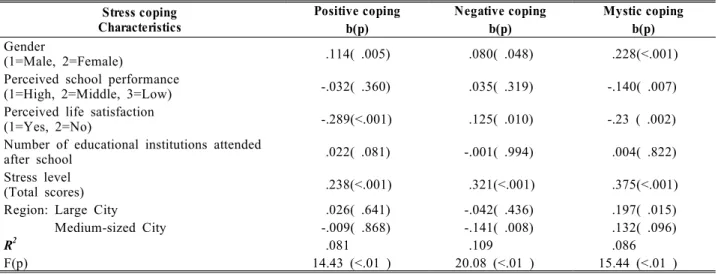
As shown in Table 3, stepwise multiple regression models were constructed to explain and predict each of the three stress coping behaviors.
Out of 6 factors entered into the analyses, gender,
life satisfaction, and stress level were all
significantly and positively associated with positive
stress coping behaviors, accounting for 8% of the
variance. That is, students who were female and
Variable Category n
Positive coping Negative coping Mystic coping mean±SD t/F/r
(p) mean±SD t/F/r
(p) mean±SD t/F/r (p)
Gender Male 625 2.54±0.74 -3.376
( .001)
1.95±0.71 -2.667 ( .008)
2.88±1.06 -4.262 (<.001)
Female 536 2.68±0.68 2.07±0.72 3.15±1.04
Perceived school performance
High 325 2.62±0.71
2.820 ( .060)
1.96±0.73
1.095 ( .335)
3.11±1.06
4.958 ( .007)
Middle 716 2.63±0.72 2.02±0.71 3.00±1.05
Low 120 2.46±0.72 2.03±0.70 2.75±1.06
Perceived life satisfaction
Yes 898 2.66±0.71 4.657
(<.001)
1.96±0.69 -4.083 (<.001)
3.04±1.05 1.845 ( .065)
No 263 2.43±0.69 2.16±0.77 2.90±1.09
Region
Large city(a) Medium-sized city(b) Rural town(c) Total
2.66±0.68 2.57±0.72 2.57±0.76 2.61±0.72
2.605 ( .074)
2.05±0.72 1.90±0.72 2.04±0.74 2.01±0.72
4.977
1( .007)
3.12±1.05 2.99±10.5 2.85±1.06 3.01±1.06
6.805
2( .001)
Number of educational institutions
attended after school 1,161 .086
( .003) .012
( .69) .071
( .015) Average study hours after school per
day 1,161 r= .067
( .022) r= .029
( .324) r= .068
( .020)
Average game hours per day 1,161 r=-.038
( .199) r= .077
( .008) r=-.121
(<.001)
Stress level 1,161 r= .199
(<.001) r= .307
(<.001) r= .229
(<.001) Scheffe's test
1: a>b,
2: a>b,c
Table 2. Relationship Between General Characteristics, Stress Level, and Geographical Region of the Participants and Stress Coping
(N=1,161)
reported satisfaction with their lives and high stress levels were more likely to use positive coping behaviors than male students who reported dissatisfaction with their lives and low stress levels.
In addition to those factors, geographical region was also among the significant predictors, explaining 10.9% of variance in negative stress behaviors. Thus, female students reporting dissatisfaction with their lives and high stress levels who lived in the rural town were more likely to use negative coping behaviors than their counterparts in the other geographical areas.
Unlike the positive and negative coping behavior models, perceived school performance explained 8.6% of the variance in mystic coping behavior in combination with gender, perceived life satisfaction, stress level, and geographical region. Females who reported dissatisfaction with their lives, a high stress
level, and living in a large city were significantly and positively related to the use of mystic coping behaviors.
In sum, female students who reported
experiencing high levels of stress were more likely
to use all three stress coping behaviors than male
students or students who reported experiencing low
levels of stress. Participants reporting satisfaction
with their lives tended to use more positive and
mystic coping behaviors and fewer negative coping
behaviors. Perceiving school performance as low
was a significant predictor of mystic coping
behaviors, but not a significant predictor of positive
and negative coping behaviors. Students living in
the large city used mystic coping behavior
significantly more than rural students, while rural
students used a negative coping style significantly
more than students living in the medium-sized city.
Stress coping Characteristics
Positive coping Negative coping Mystic coping
b(p) b(p) b(p)
Gender
(1=Male, 2=Female) .114( .005) .080( .048) .228(<.001)
Perceived school performance
(1=High, 2=Middle, 3=Low) -.032( .360) .035( .319) -.140( .007)
Perceived life satisfaction
(1=Yes, 2=No) -.289(<.001) .125( .010) -.23 ( .002)
Number of educational institutions attended
after school .022( .081) -.001( .994) .004( .822)
Stress level
(Total scores) .238(<.001) .321(<.001) .375(<.001)
Region: Large City .026( .641) -.042( .436) .197( .015)
Medium-sized City -.009( .868) -.141( .008) .132( .096)
R
2.081 .109 .086
F(p) 14.43 (<.01 ) 20.08 (<.01 ) 15.44 (<.01 )
Table 3. Three Regression Models Predicting Stress Coping in Elementary Students
Ⅳ. Discussion
To date, most of the studies on stress level and coping behaviors of elementary students and adolescents in Korea have had relatively small sample sizes (Hong, 2000; Kim, 2005; Kim and Cho, 2004; Lee, 2005) and limited information on general student characteristics. The studies have also compared fewer groups, with limited comparisons between urban and rural towns (Kim and Cho, 2004) or a medium-sized city and a rural town (Hong, 2000). The use of a large sample of over 1,000 students, examination of multiple characteristics of participants, and sampling from three different geographical regions were all strengths of the current study.
Only a few published studies have investigated the differences in stress level and coping behaviors of elementary students according to geographical regions. Family-related stress level was significantly higher among rural (farming and fishing villages) students than urban students (Kim and Cho, 2004;
Jang, 2006). On the other hand, urban elementary
students perceived a higher level of stress due to academic achievement and school environment than rural elementary students (Jang, 2006). As addressed elsewhere (Lee et al., 2007), overall, stress levels reported by the participants in the current study revealed were higher among students living in the large city than among students living in either the medium-sized city or rural town. The findings are in agreement with a study by Weist et al. (2000) that showed the urban youth population, including elementary students, experienced more stress (eg, exposure to violence, parental unemployment, and domestic conflict) than suburban and rural students.
The differences in stress levels between urban and rural students can be inferred, somewhat, from the disparity of social, cultural and educational resources between urban and rural areas in Korea.
In terms of stress coping, Kim and Cho (2004)
found that positive coping was more commonly
used by rural students than urban students, while
negative coping and diversion were used more by
urban students than rural students. In contrast, the
current study showed that positive, negative, and
mystic coping behaviors were used significantly
more by students living in the large city than by rural students. Choi (2004) also found that elementary students who experienced high levels of stress more commonly used positive, negative, and unrealistic coping behaviors. Consistently, both elementary (Im, 2006) and adolescents (Rhu and Hyun, 2006) with high levels of stress tended to cope with stress well. Taking all of these results together, it is no surprise that the current study found that students living in a large city with high stress coped better than rural students.
Importantly, gender was found to be a significant factor related to all three types of stress coping behaviors in this study. Like other studies of Korean elementary students (Yoon, 2004) and adolescents (Lee, 2005) and of American elementary students (Fouladi, Rew, and Horner, 2006), the female participants in the current study reported experiencing significantly greater stress. Female students showed significantly higher stress levels and more coping behaviors than their male counterparts. This result was inconsistent with Kim and Ryu's finding (2003) of no significant relationship between gender and stress level and coping behaviors. The gender differences in both stress level and coping behaviors may be explained by the nature of stressors and preferences of coping styles between male and female students.
Female students tend to involve in more life events or daily hassles and they tend to involve in more diverse coping strategies than male students (Williams and Lisi, 2000). It is true that female Korean adolescents perceived higher stress than male adolescents but the mental health status in the areas of emotion, concentration, behavior, and socialization was better in female students than male students (Ministry for Health, Welfare and Family Affairs, 2008), indicating that female students get a
better handle on dealing with stress. An approach to building a coping behavior that is specifically tailored to the gender subsets of population is recommended. It may be successful to emphasize a variety of coping behaviors for male students while for female students, emphasize more positive coping behaviors than negative or mystic coping behaviors.
The findings from the current study suggest that interventions should be directed towards encouraging positive coping behaviors and discouraging negative coping behaviors among fifth- and sixth-grade students who are in an important period of transitions and changes, both psychologically and physically. The participants who reported higher life satisfaction were more likely to use positive coping behaviors such as exercising and discussing stressful events with parents, and less likely to use negative coping behaviors such as fighting friends and playing computer games. According to the Korea National Health and Nutrition Examination Survey 2005 (Ministry for Health, Welfare and Family Affairs, 2008), the most serious concerns of students from ages 12 to 14 years are academic achievement, possibly implying low satisfaction with their lives.
In the highly competitive school environment in Korea, students must be taught to deal appropriately with stressful situations. Of particular interest were that there were associations between negative or mystic coping behaviors and unhealthy lifestyle behaviors or health problems (Cho and Park, 1998;
Kim, 2005). Students tended to play more internet games, tried suicide more frequently, and were less active, particularly in urban areas (Ministry for Health, Welfare and Family Affairs, 2008).
Accordingly, the findings of relatively low use of
positive coping behaviors in this study population
could be explained in part by current trends in
school environment and lifestyle behaviors of
Korean students. As well as coping effectively with stress, it is suggested that reducing health risk behaviors such as lack of physical activity and actions that increase stress should be placed in the center of school health programs.
Although the study has limited generalizability beyond the selected population because of the convenience sampling method, it is worth noting that including more than two regional comparison groups in studies of geographical differences in stress levels and coping behaviors would help public health professionals to understand region- specific aspects for stress and coping behaviors. A school-based group intervention would be a useful way to prevent mental health problems for fifth and sixth graders but its feasibility and acceptability need to be carefully examined. It is true that a perspective on the characteristics related to program retention and logistics from the target population is important to develop effective coping interventions (Garcia, Pintor, and Lindgren, 2009). Social and physical environments such as peer interactions and recreation facilities are different among large cities, medium-sized cities and rural towns. It is encouraged for public health professionals to identify available resources within the community and to develop a partnership among community, public health centers and schools for developing and implementing coping interventions. School administrators, parents and community need to engage in advocacy and support for stress coping interventions among the student groups.
V. Conclusion
In this study population, elementary students
who are males, dissatisfied with their lives, or living in large cities or rural towns may be particularly at risk for poor coping. Interventions should be developed that appropriately target such specific populations and their needs. The findings suggest an approach to building a successful coping behavior that is specifically tailored to the gender subsets of population and region-specific social and physical environment. In terms of low use of positive coping behaviors such as exercising, it is recommended to incorporate coping interventions into school- or public health center-based health promotion programs. Health care professionals play key roles to develop a partnership among community, school, and parents for successful coping interventions.
References
Choi, E.K. 2004. Analysis of parent attachment, stress, coping in elementary students. Master dissertation, School of Education, SeoKang University, Seoul, Korea.
Cho, N.J. and Park, I.S. 1998. A study of stress, stress coping style and health symptoms in 6
thgrade elementary school children. J Korean Acad Child Health Nurs 4(2):193-206.
Cho, M.J. 1989. Relations between personality dimension and stress coping style. Master dissertation, School of Education, Han Yang University, Seoul, Korea.
Chrousos, G.P., and Gold, P.W. 1992. The concepts of stress and stress system disorders: overview of physical and behavioral homeostasis. JAMA 267(9):
1244-1252.
Chung, B.Y., and Hong, Y.L. 2000. Comparisons of stressor and coping style between headache- suffering children and headache-free children. J Korean Acad Child Health Nurs 6(3):354-361.
Dombrowski, M.A. 1999. Preventing disease with
stress management in elementary school. J Sch
Health 69(3):126-127.
Folkman, S., and Lazarus, R.S. 1986. Stress process and depressive symptomatology. J Abnorm Psychol 95:107-113.
Fouladi, R.T., Rew, L., and Horner, S.D. 2006.
Comparison of three modes of measuring stress, coping, and humor in school-age children. J Nurs Meas 14(2):79-98.
Garcia, C., Pintor, J.K., and Lindgre, S. 2009. Feasibility and acceptability of a school-based coping intervention for Latina adolescents. J Sch Nurs 22:1-11.
Hong, Y.L. 2000. Stressor, Coping Style, Communication with mother & school adaptation in 6th grade elementary school children. J Korean Acad Child Health Nurs 6(3):362-371.
Howell, C.C., Rice, M.H., Carmon, M., and Hauber, R.P. 2007. The relationships among anxiety, anger, and blood pressure in children. Appl Nurs Res 20(1):17-23.
Im, K.H. 2006. The effects of the practical intelligence and stress on children's stress coping behaviors.
Korean J of Child Studies 27(3):241-254.
Jang, Y.A. 2006. Analysis of elementary school children's stress and coping behavior in urban and rural areas. Korean J. Community Living Science 17(1):39-53.
Kim, H.S., and Kim, H.S. 2008. Risk factors for suicide attempts among Korean adolescents.
Child Psychiatry Hum Dev 39:221-235.
Kim, J.S., and Ryu, S.H. 2003. A study on stressor and stress-coping pattern of elementary school students. Journal of Practical Education 16(1):
105-117.
Kim, K.S., and Cho, O.W. 2004. The relationship between stress, coping and school adjustment of city and rural students. Education Theory &
Practice 13(3):385-404.
Kim, M.H. 2005. A study on stress factors of students in elementary school. Master dissertation, Kwandong University, Gangneung, Korea.
Kim, M.Y. 2005. A study of stress, coping behaviors and health problems in school age children. J Korean Acad Child Health Nurs 11(1):83-89.
Lazarus, R.S., and Folkman, S. 1984. Stress, appraisal and coping. New York: Springer Publishing. Co.
Lee, C.Y., Lee, G.Y., Ahn, Y.H., and Lee, H.K. 2007.
A comparison of stress levels of elementary students by geographical regions. J Korean Acad Nurs 37(6):986-993.
Lee, M.R. 2005. Interaction effects of stress and coping strategies on adolescent. Korean J of Child Studies 27(5):67-78.
Ministry for health, welfare and family affairs. 2008.
Korea national health & nutrition examination survey.
Rhu, J.S and Hyun, E.M. 2006. Emotional intelligence and stress coping styles of adolescents: A comparative study between normal adolescents and juvenile delinquents. Journal of Korean Home Management Association 24(1):209-221.
Rice, M., Kang, D.H., Weaver, M., and Howell, C.C.
2008. Relationship of anger, stress, and coping with school connectedness in fourth-grade children. J Sch Health 78(3):149-156.
Selye, H. 1956. The stress of life. New York:
Mcgrew-Hill Co.
Sharrer, V.W., and Ryan-Wenger, N.M. 1995. A longitudinal study of age and gender differences of stressors and coping strategies in school-aged children. J Pediatr Health Care 9(3):123-130.
Sung, K.M., Puskar, K.R., and Sereika, S. 2006.
Psychosocial factors and coping strategies of adolescents in a rural Pennsylvania high school.
Public Health Nurs 23(6):523-530.
Tanaka, H., Tamai, H., Terashima, S., Takenaka, Y., and Tanaka, T. 2000. Pediatr Int 42(4):354-358.
Weist, M.D., Myers, C.P., Danforth, J., McNeil, D.W., Ollendick, T.H., and Hawkin, R. 2000.
Expanded school mental health services:
assessing needs related to school level and geography. Community Ment Health J 36(3):
259-273.
Williams, K., and Lisi, A.M-D. 2000. Coping strategies in adolescents. J Appl Dev Psychol 20(4):537-549.
Yi, K. 2004. A Study of Elementary School Students'
Stress Factors, Their Coping Behavior and
School Adjustment. Master dissertation, Catholic
University of Daegu, Daegu, Korea.
Yoon, S.K. 2004. The relationship between self respect and stress coping of elementary and
middle school students. Child Education 13(2):
239-251.
ABSTRACT
Objectives: The purpose of this study was to examine factors influencing stress coping behaviors of elementary students in Korea.
Methods: This study used a descriptive comparative survey design. A total of 1,161 elementary students voluntarily participated in the study from 10 schools at three regional levels (large and medium-sized cities, and rural towns). Coping behaviors were measured by the modified Ways of Coping Checklist. The data were analyzed using descriptive statistics, t-test, ANOVA, and multiple regression.
Results: The most commonly used stress coping behavior reported by the participants was mystic coping, followed by positive coping, and negative coping. Students living in the large city and female students tended to use more coping behaviors than students living in the medium-sized city or rural towns and male students, respectively. Positive coping behaviors were associated with high school performance while myotic coping behaviors were associated high life satisfaction.
Conclusion: Elementary students who are males, dissatisfied with their lives, or living in large cities or rural towns tended to be at risk for poor coping. There were differences in factors influencing coping behaviors by type of coping behaviors. An approach to building a successful coping behavior that is specifically tailored to the gender subsets of population and region-specific social and physical environment is recommended.
Key Words: Elementary students, Stress levels, Stress coping
<국문초록>