염류집적 유형이 다른 토양의 교환성 양이온 측정
이예진·윤홍배·김록영·이종식·송요성·성좌경·양재의1* 농촌진흥청 국립농업과학원 토양비료관리과, 1강원대학교 바이오자원환경학과
Determination of Exchangeable Cations in Soils Affected by Different Types of Salt Accumulation
Ye-Jin Lee, Hong-Bae Yun, Rog-Young Kim, Jong-Sik Lee, Yo-Sung Song, Jwa-Kyung Sung, and Jae E. Yang
1*
Division Soil & Fertilizer Management, National Academy of Agricultural Science, RDA, Suwon 441-707, Korea
1
Department of Biological Environment, Kangwon National University, Chuncheon 200-701, Korea
Exchangeable cations are often overestimated especially in salt-affected soils due to the presence of high levels of soluble ions in soil solution. Thus, quantitative analysis of the soil exchangeable cation based on ammonium acetate extraction method {(Exch. Cation)
total} requires additional process to remove the free ions (pre-washing) in soil with distilled water or alcohol {(Exch. Cation)
pw} or subtraction of the soluble ion contents from the total exchangeable cations {(Exch. Cation)
ref}. In this research, we compared the three different methods for the determination of exchangeable cations in soils affected by different types of salt accumulation such as the soils from upland, plastic film house, and reclaimed tidal land. In upland soils, non-saline and non-sodic soils, the regular ammonium acetate extraction method did not have any problem to determine the content of exchangeable cations without any additional process such as the pre-washing method or the subtraction method. However, the contents of exchangeable cations in the salt-affected soils might be determined better with the pre-washing method for the plastic film house soils and with the subtraction method for the reclaimed tidal land soils containing high Na.
Key words: Exchangeable cations, Salt-affected soils, Salt prewashing, Soluble salts, EC
e접수 : 2011. 11. 15 수리 : 2012. 4. 19
*연락저자 : Phone: +82332506446
E-mail: [email protected]
서 언
교환성 양이온은 토양입자 표면에 전기적 인력으로 흡착된 양이온으로서 식물이 이용할 수 있다. 교환성 양이온을 측정 하는 것은 토양비옥도 뿐 아니라 영양소의 공급과 완충용량을 평가하는데 매우 중요하다 (Sumner and Miller, 1996). 그러 나 염류가 집적된 토양의 경우 토양용액에 수용성 이온 함 량이 높기 때문에 염기포화도가 100%를 초과하는 결과를 초래하여 교환성 양이온을 정확하게 측정하는데 걸림돌이 되고 있다.
비염류토양은 확산2중층 밖의 자유용액에 존재하는 수용 성 양이온이 적어 교환성 양이온 측정 시 총 양이온을 추출 하여 측정해도 오류가 적지만 염류집적 토양은 토양용액 중 수용성 이온이 많기 때문에 수용성 양이온을 제거하지 않을
경우 교환성 양이온함량이 높게 평가될 수 있다 (Menzies and Bell, 1988; So et al., 2006).
이론적으로 염이 집적된 토양의 교환성 양이온을 측정하 기 위해서는 과잉의 염을 제거해야 한다. 미국 U.S. Salinity Laboratory Staff (1954)에 의하면 염류 토양의 교환성 양이 온을 측정할 때는 포화추출 토양용액에 녹아있는 수용성 양 이온을 빼야 한다고 보고하였다. 그 외에도 최적의 교환성 양이온 분석연구에 의하면 전처리 과정에서 알콜이나 증류 수 등으로 수용성 염을 제거한 후 교환성 양이온을 측정해 야 한다는 결과가 있다 (Rengasamey and Churchman, 1999;
Tucker, 1985).
우리나라의 염류집적 토양은 크게 시설재배지와 간척지 토양으로 나눌 수 있다. 시설재배지 토양은 유기물이 많고 시비에 의한 비료성분이 많은 반면 간척지 토양은 바닷물에 의한 염, 특히 Na의 집적으로 양이온의 조성과 양이온교환 용량이 다르다 (Kim et al., 1997; Yuk et al., 1993). 그리 고 염류집적 토양의 교환성 양이온을 측정할 때 전처리 과 정을 거칠 경우 이온의 조성이나 용해도, 토양 특성에 따라
Table 1. Chemical properties of soils collected from upland, plastic film house and reclaimed tidal lands.
Soils (sample numbers) pH ECe† OM‡ Total N Avail.
P2O5 CEC* 1:5 dS m-1 --- g kg-1 --- mg kg-1 cmolc kg-1
Upland (n = 10) 6.8 0.8 12.47 0.14 544 11.71
Plastic film house (n = 21) 6.3 18.7 44.17 0.37 1250 15.18
Reclaimed land (n = 20) 7.6 33.9 1.97 0.05 47 6.99
†electrical conductivity (saturated paste), ‡organic matter, *cation exchange capacity.
이온의 손실 정도가 다르게 나타날 것으로 예상된다.
본 연구는 염류집적 유형이 다른 노지 밭토양, 시설재배 지 토양과 간척지 토양을 대상으로 측정 방법 간 교환성 양 이온 농도 차이를 비교하고, 유리 수용성 염 (free soluble salts) 제거를 위한 전처리 영향을 밝히는 것을 목적으로 하 였다.
재료 및 방법
시험토양 시험토양은 노지 밭토양, 시설재배지 토양과 간척지 토양으로 구분하여 채취하였다. 노지 밭토양은 염류 집적 영향이 비교적 적은 수원의 국립농업과학원 시험포장 과 천안 지역의 밭토양에서, 시설재배지 토양은 안산, 평택 지역의 과채류 재배 단지에서, 간척지 토양은 농경지로 활 용할 예정인 새만금 신간척지에서 표토 (0∼15cm)를 채취하 였다. 시험에 이용된 시료 수는 노지 밭토양 10점, 시설재배 지 토양 21점, 간척지 토양 20점이며, 시험토양의 화학성은 Table 1과 같다.
시험토양은 풍건한 후 2 mm 체를 통과시켜 분석에 사용 하였다. pH는 토양과 증류수 비율을 1:5로 측정하였고, 전 기전도도 (electrical conductivity, EC)는 포화반죽에서 추 출한 토양용액 (ECe)으로 측정하였다. 토양의 유기물과 총 질소는 C/N analyzer (Elementar, Germany), 유효인산은 Lancaster법 (NIAST, 1988)으로 분석하였다. 양이온 교환 용량 (cation exchange capacity, CEC)은 ammonium acetate (1M NH4OAc, pH 7) 방법으로 mechanical vacuum extractor (Sampletek, USA)를 이용하여 분석하였다 (Soil Survey Laboratory Staff, 1992).
교환성 양이온의 측정 교환성 양이온은 ammonium acetate (NH4OAc) 용액으로 침출한 용액을 분석하여 환산 하였다 (Soil Survey Laboratory Staff, 1992). 총 양이온 {(Exch. Cations)total}은 전처리 과정에서 염을 세척하지 않 고 1M NH4OAc로 추출하여 분석하였다. 수용성 양이온은 포화반죽으로부터 토양용액을 추출하여 측정하였다. 풍건 토양 250 g과 증류수를 사용하여 포화반죽을 조제한 후 24
시간 동안 평형을 유지시켰다. 이후 -80 kPa의 압력에서 Buchner funnel로 토양용액을 추출하였다. 감압 추출로 포 화반죽이 함유하고 있는 용액 전부를 추출하는 것은 어렵지 만 포화반죽의 토양용액은 평형상태에서 추출되었고, 추출 되지 않고 포화반죽에 남아있는 양이온들은 확산2중층 근 처에 위치하여 교환성 양이온과 치환될 수 있기 때문에 추 출된 용액의 양이온이 수용성 양이온을 대표한다는 전제 하 에 포화반죽의 수분함량을 측정하여 수용성 양이온으로 환 산하였다. 총 양이온에서 수용성 양이온을 뺀 값을 교환성 양이온의 기준 (Reference point)으로 정하였다 {(Exch.
Cations)ref} (U.S. Salinity Laboratory Staff, 1954). 염 을 제거하는 전처리 후 교환성 양이온을 측정하는 방법 (prewashing)은 과잉의 염을 70% ethanol과 10% ethylene glycol로 씻어낸 후 1M NH4OAc로 추출하여 교환성 양이온 {(Exch. Cations)pw}을 분석하였다 (Lee et al., 2010; Rengasamey and Churchman, 1999; Sumner and Miller, 1996). 교환성 양이 온, 총 양이온 및 수용성 양이온 농도는 inductively coupled plasma optical emission spectrophotometer (ICP-OES, GBC, Australia)로 측정하였다. 측정 방법별 양이온을 비교하기 위하여 교환성 양이온으로 염기포화도 (base saturation percentage, BSP), 교환성 나트륨 퍼센트 (exchangeable sodium percentage, ESP), 교환성 칼륨 퍼센트 (exchangeable potassium percentage, EPP)를 계산하였고, 수용성 양이온 으로 나트륨 흡착비 (sodium adsorption ratio, SAR), 칼륨 흡착비 (potassium adsorption ratio, PAR)를 계산하였다 (식 1-5).
× (1)
× (2)
× (3)
(4)
(5)
Table 2. Comparisons of exchangeable cation contents measured by three different methods.
Soils (sample numbers) (Exch. Cations)total† (Exch. Cations)pw‡ (Exch. Cations)ref*
Upland (n = 10)
--- cmolc kg-1 ---
K 0.89 n.s. 0.78 n.s. 0.86 n.s.
Ca 6.39 n.s. 6.02 n.s. 6.31 n.s.
Mg 1.93 n.s. 1.95 n.s. 1.89 n.s.
Na 0.14 a** 0.06 b 0.12 a
Plastic film house (n = 21)
K 2.61 a 1.54 b 1.68 b
Ca 17.32 a 10.59 b 13.21 b
Mg 7.09 a 2.90 b 3.05 b
Na 1.16 a 0.21 b 0.19 b
Reclaimed land (n = 20)
K 1.10 a 0.84 b 0.88 b
Ca 0.85 a 0.93 a 0.60 b
Mg 4.57 a 2.81 b 2.01 b
Na 11.13 a 1.83 b 1.58 b
LSD, p=0.05.
†exchangeable cation before prewashing. ‡exchangeable cation after prewashing.
*exchangeable cations calculated from [{(Exch. Cations)total}-(soluble cations)].
**The same letter in column of exchangeable cation in three soils stands for non-significant difference.
통계분석 염을 제거하지 않고 측정한 교환성 양이온 {(Exch. Cations)total}, 전처리에서 염을 제거한 후 측정한 교환성 양이온 {(Exch. Cations)pw}, 총 양이온에서 수용성 양이온을 뺀 교환성 양이온 {(Exch. Cations)ref}의 차이를 비교하기 위하여 최소유의차 검정 (LSD test, p=0.05) 통계 분석을 하였다. 통계프로그램은 R ver. 2를 사용하였다.
결과 및 고찰
토양 종류별 교환성 양이온 측정방법의 비교 밭, 시설, 간척지 토양의 교환성 양이온을 염을 제거하지 않고 측정하는 방법, 전처리에서 염을 제거하는 방법, 총 양이온 에서 수용성 양이온을 빼는 방법, 총 세 가지 방법으로 측정 하여 각각의 양이온들의 측정 방법 간 유의성을 비교하였다 (Table 2). 밭토양에서는 K, Ca, Mg에서 유의한 차이가 없 었으나, Na은 전처리에 영향을 받는 것으로 나타났다. 시설 재배지 토양은 K, Ca, Mg, Na 모두 염을 제거하지 않고 측 정한 것과 염을 제외한 것이 유의한 것으로 나타나 전처리 가 필요한 것으로 판단되었다. 간척지 토양 역시 전처리가 필요하다고 판단되었으며, Ca은 예외적으로 알콜 세척 전 처리를 한 후 측정한 양이온 {(Exch. Cations)pw}이 전처리 를 하지 않은 양이온 {(Exch. Cations)total}보다 높게나와 세 척의 영향을 받는 것으로 나타났다.
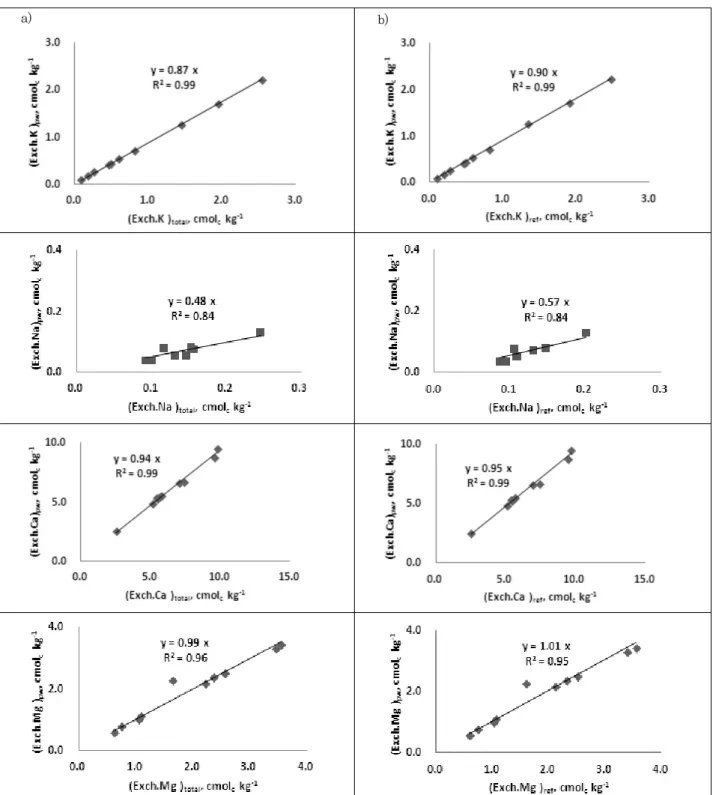
또한 전처리에서 염을 제거한 것 {(Exch. Cations)pw}과 제거하지 않고 측정한 교환성 양이온 {(Exch. Cations)total} 의 차이와 염을 제거한 것 {(Exch. Cations)pw}과 총 양이온 에서 수용성 양이온을 뺀 교환성 양이온 {(Exch. Cations)ref}
의 차이는 Fig. 1에 나타나 있다. 그림 a)의 기울기가 1에 가 까울수록 염을 제거할 필요가 없으며, 그림 b)의 기울기가 1 에 가깝다면 염을 제거하는 전처리 과정이 교환성 양이온 측정에 미치는 영향은 미미하다고 할 수 있다. 밭토양의 경 우 K, Ca, Mg에서 {(Exch. Cations)total}과 {(Exch.
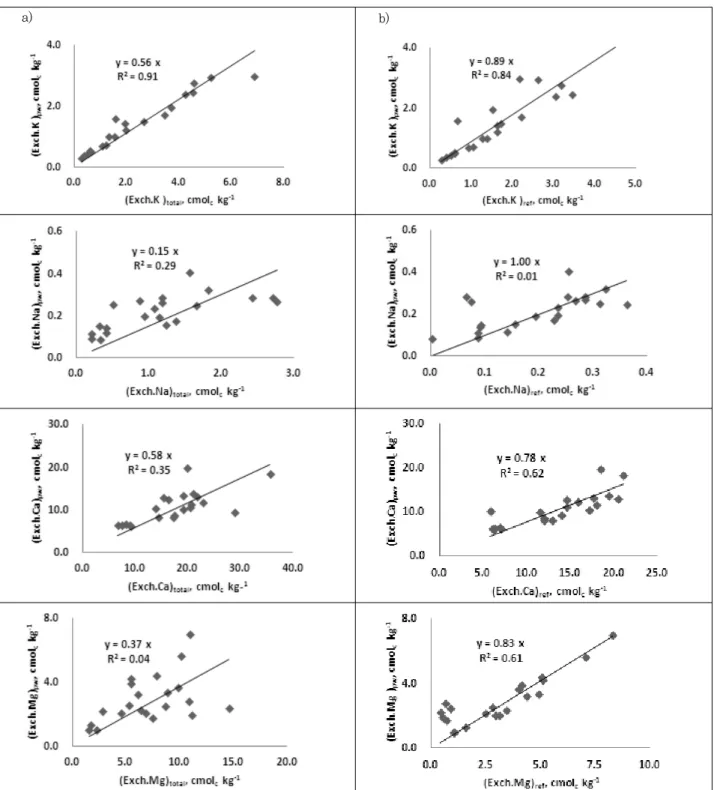
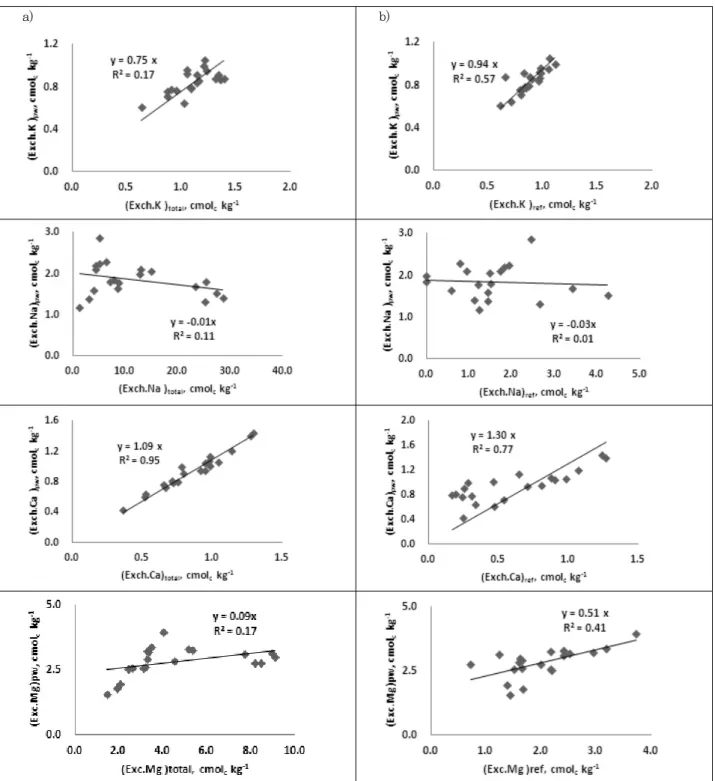
Cations)pw}, {(Exch. Cations)ref}와 {(Exch. Cations)pw}의 기울기가 거의 1에 가깝게 나타난 반면, Na은 세척과정에서 많은 손실이 있는 것으로 나타났다 (Fig. 1). 시설재배지 토 양과 간척지 토양 모두 그림 a의 기울기 차이가 크게 나타 나 전처리가 필요한 것으로 판단되었다 (Fig. 2). 그림 b에 서 {(Exch. Cations)ref}와 {(Exch. Cations)pw}의 기울기를 비교하였을 때는 시설재배지의 경우 K, Na, Ca, Mg의 기울 기가 모두 0.7에서 1.0 사이에 해당되어 전처리에서 과잉의 수용성 염을 제거한 후 교환성 양이온을 측정해도 될 것으 로 판단되었다. 그러나 간척지 토양 중 Na은 {(Exch.
Cations)ref}와 {(Exch. Cations)pw}의 관계에서 뚜렷한 경향 이 나타나지 않아 세척과정을 거쳐 교환성 양이온을 측정하 는 것은 오류를 범할 수 있다고 판단된다.
전기전도도와 염기포화도와의 관계 수용성 양이온 의 전처리 여부에 따른 염기포화도 차이를 알아보기 위하여 전기전도도와 {(Exch. Cations)total}, {(Exch. Cations)pw}, {(Exch.
Cations)ref}로 구한 염기포화도를 비교하였다. 밭토양은 {(Exch. Cations)total}, {(Exch. Cations)pw}, {(Exch. Cations)ref} 방법에 근거하여 산출한 BSP값이 모두 일치하는 경향을 나 타내 교환성 양이온 측정 시 별도의 세척과정이 필요하지 않은 것으로 판단되었다 (Fig. 4).
a) b)
Fig. 1. Comparison of exchangeable cation contents measured by the three different methods in upland soils (a: x – total extraction, y – prewashed extraction), (b: x – reference method, y – prewashed extraction).
시설재배지 토양은 ECe 4 이하에서 {(Exch. Cations)total}, {(Exch. Cations)pw}, {(Exch. Cations)ref}로 구한 염기포화 도가 비교적 일치하는 경향이었으나 전기전도도가 높을수록 방법 간 구한 BSP는 차이가 컸다. 그러나 {(Exch. Cations)pw} 와 {(Exch. Cations)ref}로 구한 BSP는 일치하는 것으로 나타 났다 (Fig. 5). {(Exch. Cations)total}에 의해 구한 BSP 값은 100을 넘기 때문에 염류가 집적된 토양에서 교환성 양이온 을 측정함에 있어서 수용성양이온에 의한 과다 산출이 우려
된다. {(Exch. Cations)pw}와 {(Exch. Cations)ref}로 구한 BSP는 100이하의 값을 보여주었고 전기전도도에 크게 영향 을 받지 않는 경향이었다.
간척지 토양은 ECe 10 이상부터 {(Exch. Cations)total}과 {(Exch. Cations)pw}, {(Exch. Cations)ref}의 차이가 크게 나 타났다 (Fig. 6). 이는 ECe 4 dS m-1 이상에서 총 양이온으 로부터 교환성 양이온을 정확히 계산하기 어렵다는 연구결 과와 유사하였다 (So et al., 2006). 간척지 토양의 경우 시
a) b)
Fig. 2. Comparison of exchangeable cation contents measured by the three different methods in plastic film house soils (a: x – total extraction, y – prewashed extraction), (b: x – reference method, y – prewashed extraction).
설재배지 토양과 유사하게 {(Exch. Cations)total}에 의해 구 한 BSP 값은 100을 크게 상회하였는데 이는 주로 수용성 Na의 농도에 기인된 것으로 판단된다. 따라서 간척지 토양 이나 염류집적 토양의 교환성 양이온을 정량함에 있어서 수 용성 이온들을 제외하는 과정이 필요한 것으로 사료된다.
{(Exch. Cations)pw}와 {(Exch. Cations)ref}로 구한 BSP는 100이하의 값을 보여주었고 전기전도도에 크게 영향을 받 지 않았으며 두 방법 간의 차이는 없는 경향이었다.
ECe가 높아질수록 {(Exch. Cations)total}와 {(Exch. Cations)ref} 에 의해 산출한 BSP 값은 차이가 나타났으나, {(Exch. Cations)ref} 와 {(Exch. Cations)pw}에 근거하여 산출한 BSP 값은 비슷한 경향을 나타내어 토양의 전기전도도가 주로 수용성 염류에 기인됨을 알 수 있었다. 시설재배지 토양의 일부는 {(Exch.
Cations)ref}와 {(Exch. Cations)pw}로 구한 염기포화도의 차 이가 있었는데, 이는 토양의 유기물함량, 주요 구성이온의 용해도 차이로 인하여 전처리 과정에서 알콜에 의해 세척된
a) b)
Fig. 3. Comparison of exchangeable cation contents measured by the three different methods in reclaimed tidal land soils (a: x – total extraction, y – prewashed extraction), (b: x – reference method, y – prewashed extraction).
것으로 판단된다 (Juo et al., 1976).
수용성 양이온과 교환성 양이온 평형상태의 토양에 서 2가 양이온과 1가 양이온은 토양-교환성 이온 복합체를 형성하고 있는데, 토양 용액 중 2가 양이온에 대한 1가 양이 온의 비율과 교환성 양이온은 직선적 관계가 있다 (U.S.
Salinity Laboratory Staff, 1954). 이 관계는 염류집적 토양 의 교환성 양이온을 어떻게 분석하는가에 따라 달라질 수
있다. 분석 방법에 따른 관계의 차이를 비교하기 위하여 평 형상태의 토양 용액 중 2가 이온 (Ca2++Mg2+)에 대한 1가 이 온의 비율을 구하고, 양이온교환용량 (CEC)에 대한 교환성 양이온의 비율을 {(Exch. Cations)ref}와 {(Exch. Cations)pw} 로 구하여 비교하였다. 시설재배지와 간척지 토양에 많이 존재하는 1가 이온이 다른 것을 고려하여 시설재배지 토양 은 K를 기준으로, 간척지 토양은 Na를 기준으로 비교하였 다. 시설재배지 토양은 토양용액 중 Ca2++Mg2+에 대한 K+
Fig. 4. Relationship between ECe and base saturation percentage (BSP) in upland soils obtained from the three different methods (Exch. Cations)
total, (Exch. Cations)
pw, and (Exch. Cations)
ref.
Fig. 5. Relationship between ECe and base saturation percentage (BSP) in plastic film house soils obtained from the three different methods (Exch. Cations)
total, (Exch.
Cations)
pw, and (Exch. Cations)
ref.
Fig. 6. Relationship between ECe and base saturation percentage (BSP) in reclaimed tidal land soils obtained from the three different methods (Exch. Cations)
total, (Exch.
Cations)
pw, and (Exch. Cations)
ref.
Fig. 7. Relationship between potassium adsorption ratio (PAR) and exchangeable potassium percentage (EPP) in plastic film house soils measured from (Exch. Cations)
pwand (Exch. Cations)
refmethods.
Fig. 8. Relationship between sodium adsorption ratio (SAR) and exchangeable sodium percentage (ESP) in reclaimed tidal land soils measured from (Exch.
Cations)
pwand (Exch. Cations)
refmethods.
의 비율인 PAR을 구하고, 교환성 양이온은 CEC 중 K+의 비 율인 EPP를 구하였는데, 토양용액에서 수용성 칼륨의 비율 이 높아질수록 교환성 칼륨의 비율 또한 높아졌고, {(Exch.
Cations)ref}와 {(Exch. Cations)pw} 모두 비슷한 경향치를 보 였다 (Fig. 7). 간척지 토양은 토양용액 중 Ca2++Mg2+에 대 한 Na+의 비율인 SAR이 높아질수록 {(Exch. Cations)ref}로 구한 ESP가 높아졌으나, {(Exch. Cations)pw}로 구한 ESP는
SAR에 관계없이 20∼40% 정도로 나타났다 (Fig. 8).
일반적으로 Na이 많은 토양에서 SAR과 ESP는 직선적인 관계를 나타내는데 (U.S. Salinity Laboratory Staff, 1954), 간척지 토양에서 {(Exch. Cations)pw}는 그러한 관계를 보이 지 않았다. So 등 (2006)에 의하면 전처리 세척 과정에서 나트륨의 용해로 교환성 나트륨이 감소할 수 있다고 보고되 었으며, Na이 많은 토양의 경우 세척보다는 총 이온에서 수 용성 이온을 빼는 방법이 유리할 것으로 판단되었다.
요 약
염류집적 토양의 교환성 양이온을 분석할 때 수용성 양 이온이 많이 존재하는 경우 교환성 양이온이 높게 측정될 수 있으므로 수용성 양이온을 제외한 교환성 양이온을 측정 하여야 한다. 수용성 양이온을 제거하기 위하여 전처리 과 정 중 알콜 등으로 세척을 하거나 전체 양이온을 구한 후 포 화 용액 중 녹아있는 수용성 양이온을 빼는 방법이 있다. 본 실험 결과 시설재배지 토양의 경우 전처리에서 세척하는 방 법을 사용해도 타당할 것으로 판단되나, Na 함량이 높은 간 척지 토양은 포화용액에 녹아있는 수용성 양이온을 빼야 정
확한 교환성 나트륨을 구할 수 있다고 판단되었다. 또한 ECe가 4 이하인 토양에서는 수용성 양이온을 제외할 필요가 없었다.
사 사
본 연구는 농촌진흥청 국립농업과학원 농업과학기술 연 구개발사업 (과제번호: PJ006400201004) 의 지원에 의해 이루어진 것임.
인 용 문 헌
Juo, A.S.R., S.A. Ayanlajaa, and J.A. Ogunwaleb. 1976. An evaluation of cation exchange capacity measurements for soils in the tropics. Commun. Soil Sci. Plant Anal.
7(8):751-761.
Kim, P.J., D.K. Lee, and D.Y. Chung. 1997. Vertical distribution of bulk density and salts in a plastic film house soil. Korean J. Soil Sci. Fert. 30(3):226-233.
Lee, Y.J., J.S. Lee, and J.E. Yang. 2010. The comparison of electrical conductivity for soil solutions extracted in field capacity and saturation-paste. Korean J. Soil Sci. Fert.
43(6):776-781.
Menzies, N.W. and L.C. Bell. 1988. Evaluation of the influence of sample preparation and extraction technique on
soil solution composition. Aust. J. Soil Res. 26:451-464.
NIAST. 1988. Methods of soil chemical analysis. National Institute of Agricultural Science and Technology, RDA, Suwon, Korea.
Rengasamey, P. and G.J. Churchman. 1999. Soil analysis an interpretation manual: 9. cation exchange capacity, exchangeable cations and sodicity. p.148-149.
So, H.B., N.W. Menzies, R. Bigwood, and P.M. Kopittke.
2006. Examination into the accuracy of exchangeable cation measurement in saline soils. Commun. Soil Sci.
Plant Anal. 37:1819-1832.
Soil Survey Laboratory Staff. 1992. Soil Survey Laboratory Methods Manual. USDA-SCS Soil Survey Investment Report No. 42, Version 2. U.S. Government Printing Office, Washington, DC
Sumner, M.E. and W.P. Miller. 1996. Cation exchange capacity and exchange coefficients. Part 3. Chemical methods. Soil Sci. Soc. Am. and Agron. Soc. Am. SSSA Book Ser. No. 5, Madison, WI, USA.
Tucker, B.M. 1985. Laboratory procedure for soluble salts and exchangeable cations in soils. CSIRO Australia, Division of Soils, Technical Paper No.47.
U.S. Salinity Laboratory Staff. 1954. Diagnosis and improve- ment of saline and alkali soils. L.A. Richards (ed.) USDA Handbook. 60. U.S. Gov. Print. Office, Washington, DC.
Yuk, C.S., J.J. Kim, S.D. Hong, and B.G. Kang. 1993. Salt accumulation in horticultural soils of PE film house in Chungbuk area. Kor. J. Soil Sci. Fert. 26(3):172-180.