Selective -Cell Loss and ␣-Cell Expansion in Patients with Type 2 Diabetes Mellitus in Korea
KUN HO YOON, SEUNG HYUN KO, JAE HYOUNG CHO, JUNG MIN LEE, YU BAE AHN, KI HO SONG, SOON JIB YOO, MOO IL KANG, BONG YUN CHA, KWANG WOO LEE,
HO YOUNG SON, SUNG KOO KANG, HEE SEUNG KIM, IN KYU LEE,
ANDSUSAN BONNER-WEIR
Department of Endocrinology and Metabolism, Immunology, and Cell Biology Core Laboratory, Institutes of Medical Science (K.H.Y., J.H.C.), and College of Nursing (H.S.K.), The Catholic University of Korea, Seoul, Korea 137-701; Keimyung University Dongsan Medical Center (I.K.L.), Daegu, Korea 700-712; and Joslin Diabetes Center (S.B.-W.), Boston, Massachusetts 02215In the presence of obesity,-cell mass needs to be increased to compensate for the accompanying demands and maintain euglycemia. However, in Korea, the majority of type 2 diabetic patients are nonobese. We determined the absolute masses, relative volumes, and ratio of␣- and -cell in the pancreas and islets in normal and diabetic Korean subjects to correlate these findings with the clinical characteristics. Whole pan- creases procured from organ donors were divided into 24 parts (control 1, nⴝ 9). Tissue was also obtained by surgical resection after 35 partial pancreatectomies: in 25 diabetic pa- tients, 10 age- and body mass index (BMI)-matched patients of benign or malignant pancreatic tumor without diabetes mel- litus (DM) (control 2). Morphometric quantifications were performed. In control 1, the relative volume of-cells was 2.1 ⴞ 0.9%, and the total-cell mass was 1.3 ⴞ 0.3 g. The relative
volume of -cells was found to be variable (control 1, 2.1 ⴞ 0.9%; control 2, 1.9 ⴞ 0.7%; DM, 1.4 ⴞ 1.0%; P < 0.05 DM vs.
control 1 and 2) and showed good correlation with BMI (con- trol 1, r2ⴝ 0.64; DM, r2ⴝ 0.55; all subjects, r2ⴝ 0.38; P < 0.05).
Notably, in type 2 diabetic patients, the ratio of␣-cell area to
-cell area in the islet was higher than in control 1 and 2 (0.81 ⴞ 0.4 vs. 0.29ⴞ 0.2, 0.20 ⴞ 0.1, P < 0.05). Additionally, significant
␣-cell expansion and a decreased -cell fraction were predom- inantly observed in larger islets (islet area,>6415m2; P<
0.05) in control 1 and diabetic patients. The relative volume of
-cell was found to be correlated with BMI in diabetic patients and normal organ donors. Moreover, decreased-cell but in- creased␣-cell proportion in the islets suggests for a selective
-cell loss in the pathogenesis of Korean type 2 diabetes.
(J Clin Endocrinol Metab 88: 2300 –2308, 2003)
 -CELL DYSFUNCTION and insulin resistance are two central, interrelated defects in the pathophysiology of type 2 diabetes (1). -Cell dysfunction related to impaired insulin secretion may be induced by insufficient -cell mass and/or functional defects of the -cells, such as reduced insulin secretion or the processing of proinsulin conversion (2– 4). In terms of morphological changes of islets in type 2 diabetes, several common findings have been noted, includ- ing islet hyalinization or islet amyloid polypeptide deposi- tion in islets (5–7), fibrosis, a reduction of -cell mass up to 30% (8 –10), and an increased proportion (relative volume) of
␣-cells in animal models of diabetes (8, 11–13).
Obesity is one of the important factors for insulin resis- tance. Recently, in normal rodents -cell mass and body mass were shown to be linearly correlated, suggesting a compen- satory -cell mass increase with obesity (14); similar human data are limited. About 65% of type 2 diabetic subjects in Korea are nonobese, even with obesity defined as a body mass index (BMI) of more than 25 kg/m
2(15). Furthermore, a recent report on the pathogenesis of type 2 diabetes mellitus in Korea suggests that impaired insulin secretion is more prominent than insulin resistance, even in the stage of im- paired glucose tolerance (16). Insufficient -cell mass could be the basis of this impairment and thus could contribute to the development of type 2 diabetes mellitus, but quantitative
data of pancreatic ␣- and -cell masses in normal Korean subjects and patients with type 2 diabetes mellitus are lacking.
The aim of this study was to determine the absolute masses, relative volumes, and ratio of ␣- and -cell in pan- creas and islets of normal and diabetic Korean subjects and correlate these findings with the clinical characteristics.
Materials and Methods
For the control group 1, human pancreases, free of clinical or pathological evidence of pancreatic disease, were obtained from nine heart-bearing brain-dead organ donors with the approval of the uni- versity’s ethical committee and informed consents from relatives.
First, each whole pancreas was weighed and divided into three seg- ments: head, body, and tail. Then each segment was further subdi- vided equally into eight parts, which were also weighed. From each of the 24 parts so obtained, about half of tissue was fixed in 10%
buffered formalin and embedded in paraffin for immunostaining, and remnant pancreatic tissue was used for extraction of insulin content. Tissue blocks were obtained from 35 patients who under- went partial or total pancreatectomy for a variety of reasons, namely pancreatic rupture, pancreatic cancer, cholangiocarcinoma, and pan- creatic cyst. Among these, 25 subjects were type 2 diabetic patients and 10 subjects were without diabetes (control group 2). We corrected the information of the body weight and height of the study subjects at the day of admission for operation. Control group 2 was used to control for effects of the benign or malignant pancreatic tumor itself or changes in nutritional status. In the case of these latter two groups, the total pancreatic weight could not be obtained.
Abbreviations: A/B ratio, Ratio of the area of␣-cells and -cells; BMI, body mass index; DM, diabetes mellitus.
doi: 10.1210/jc.2002-020735
2300
Measurement of insulin content
After homogenizing part of pancreatic tissues, insulin was extracted with 10 ml acid ethanol solution. After overnight incubation in a re- frigerator, supernatants were collected and the remaining tissues were rehomogenized and reextracted by the same method. To calculate the insulin content of the whole pancreas, the insulin value in the suspension was corrected for the weight of each segment, and the values obtained for the individual segments of each pancreas were summed. The insulin assay was performed using a RIA kit (Dainabot, Tokyo, Japan).
Immunohistochemistry
Immunohistochemical staining was performed on 7-m-thick paraf- fin sections using streptavidin-biotin-peroxidase and alkaline phospha- tase methods (17) with antiinsulin antibody (guinea pig antihuman insulin antibody, Linco Research, Inc., St. Charles, MO) and antigluca- gon antibody (rabbit antiporcine glucagon antibody, DAKO Corp., Glostrup, Denmark). After overnight incubation with primary anti- bodies at 4 C, sections were developed with liquid BCIP/NBT (Zymed Laboratories, Inc. Corp., San Francisco, CA) and AEC (red) (Zymed Laboratories, Inc. Corp.) and counterstained with hematoxylin.
Quantification of endocrine cells
Point count for quantification of relative volumes and cell masses of␣- and
-cells in the pancreas. The relative volume of the ␣- and -cells in the pancreas were counted by the point-counting method (18, 19) using a BH-2 microscope (Olympus Corp., Tokyo, Japan) connected to a video camera (Samsung Aerospace Ind., Seoul, Korea) equipped with a color monitor with a 90-point transparent overlay. Briefly, immunostained slide sections of pancreas were visualized under⫻200 magnification and positioned under a regular lattice overlaid on a color monitor. The␣- and
-cells were counted simultaneously in the double-immunostained slides. An average of 295 fields and 25,132 points in nonoverlapping fields were counted systematically from each section; one section was counted per tissue block. In total, nine sections per pancreas for␣-cell and 24 sections per pancreas for-cell were counted from nine organ donors for control group 1. For control group 2 and diabetic patients,␣- and-cell relative volumes were measured in the normal portion of the pancreatic tissue and not along the margins of the pathological lesions from one slide section. Relative␣- and -cell volumes in pancreatic tissue were represented as: number of points corresponding to the antigluca- gon antibody-stained area/number of points corresponding to remain- ing pancreatic area and number of points corresponding to antiinsulin antibody-stained area/number of points corresponding to remaining pancreatic area, separately. Cell mass was calculated by multiplying the relative percentages of␣- and of -cells by the total pancreatic weight (14, 20). All 35 pancreas sections from control group 2 and diabetic patients belonged to the dorsal portion of the pancreas.
Planimetry for quantification of the relative volume of endocrine cells in the islets. To determine the relative volume of endocrine cells in the islets and the ratio of␣-cells to -cells, the area of each endocrine cell was mea- sured using an Image analyzer (Optimas 6.5; Media Cybernetics, Tempe, AZ) by planimetry. The ratio of the area of␣-cells and -cells (A/B ratio) was calculated in each double-stained islet by one experienced observer and analyzed with respect to each group, BMI, and islet size. With the same images, the area of non-␣- and non--endocrine cells including PP and D cells (NANB cell) in the islets were also measured. All islets were
sampled from each slide section in control group 2 and diabetic patients, but for control group 1, islets were selected systemically (i.e. alternative nonoverlapping field in the whole pancreas section). The relative vol- ume of the␣-, -, and NANB cells in the islets were determined by 2727 islets in the control group, 363 islets in control group 2, and 834 islets in the diabetic patients, using double-stained images. Scattered-cell units, described by Bouwens and Pipeleers (21) were excluded for anal- ysis of the relative volumes of each endocrine cell in the islet and A/B ratio.
Statistical analysis
Data are expressed as means⫾ sd. Differences between means were evaluated (10.0 program, SPSS, Inc., Chicago, IL). The independent t test was used to compare-cell percentages in normal and diabetic subjects and A/B ratios in normal and diabetic subjects. One-way ANOVA, with the Bonferroni correction, was used to analyze normal pancreases. Pear- son’s correlation coefficient was used to determine the correlation be- tween-cell percentage and quantitative variables. For islet size distri- bution and differences of median values among groups, we used Kruskal-Wallis test. A P value of less than 0.05 was considered significant.
Results Clinical characteristics of three groups
Normal pancreas donors (control group 1, n ⫽ 9). Whole pan- creases were obtained from organ donors (six men and three women) between 19 and 64 yr of age (average, 41.3 ⫾ 14.2 yr).
The main causes of death were cerebral hemorrhage, traffic accident, and myocardial infarction. Their mean height, weight, and BMI were 170.2 ⫾ 9.7 cm, 69.4 ⫾ 10.5 kg, and 23.8 ⫾ 1.9 kg/m
2, respectively (Table 1). The mean value of total pancreatic weight in normal subjects was 77.1 ⫾ 14.6 g (head 29.6 ⫾ 5.7 g, body 25.7 ⫾ 5.2 g, tail 22.5 ⫾ 5.6 g).
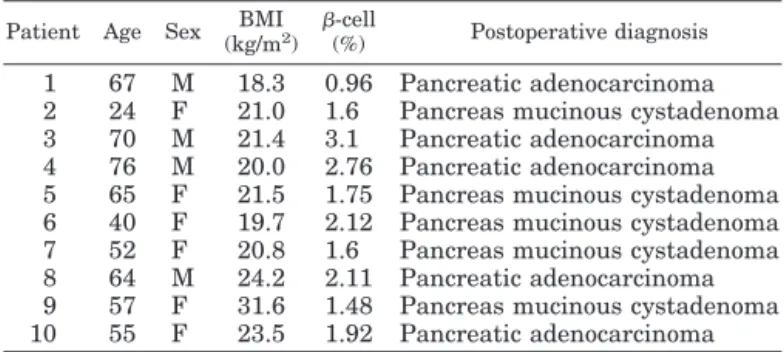
Patients with a pancreatic neoplasm but without diabetes (control group 2, n ⫽ 10). Pancreatic tissue of control group 2 was excised from 10 nondiabetic patients with a pancreatic neo- plasm (6 men and 4 women) (Table 2). Their mean age was 57.0 ⫾ 17.0 yr (range, 24–76 yr), and their mean BMI was 22.2 ⫾ 4.2 kg/m
2(range, 18.3–31.6 kg/m
2). BMI and age were well matched by patients with type 2 diabetes mellitus (DM).
Patients with type 2 DM. The 25 type 2 diabetic patients (15 men and 10 women) were of mean age 60.0 ⫾ 8.5 yr (range, 40 –70 yr) and had a mean diabetes duration of 4.9 yr, ranging from newly detected patients to those who had been suffer- ing from the disease for 20 yr (Table 3). Their mean BMI was 22.2 ⫾ 3.8 kg/m
2(17.8 –29.1 kg/m
2), and their general health was compatible with Whipple’s operation or pancreatec- tomy. In these patients, the mean value of hemoglobin A1c was 7.3 ⫾ 2.8%, and no significant correlation was found
TABLE 1. Clinical characteristics of normal donors (n⫽ 9)Patient Age Sex Height (m) Weight (kg) BMI (kg/m2) -cell (%) -cell mass (g) Cause of death
1 43 M 1.72 75 25.4 1.47 1.06 Cerebral hemorrhage
2 19 M 1.85 74 21.6 1.48 1.09 Traffic accident
3 40 M 1.65 63 23.1 1.55 1.20 Traffic accident
4 51 M 1.75 82 26.8 2.41 1.41 Myocardial infarction
5 49 M 1.68 66 23.4 2.26 1.34 Cerebral hemorrhage
6 64 M 1.54 51 21.5 1.96 1.29 Cerebral hemorrhage
7 34 F 1.60 58 22.7 2.11 1.30 Traffic accident
8 23 F 1.73 77 25.7 2.70 1.56 Traffic accident
9 49 F 1.80 79 24.4 2.45 1.42 Cerebral infarction
between the relative volume of the -cells and glycated he- moglobin levels.
Relative volumes and absolute masses of␣- and -cells and insulin contents in pancreas
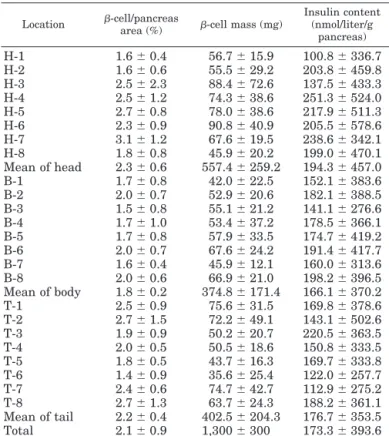
The mean relative volume of -cells in normal pancreases was 2.1 ⫾ 0.9%, ranging from 1.4 to 3.1%, with head 2.3 ⫾ 0.6% (range, 1.6 –3.1%), body 1.8 ⫾ 0.2% (range, 1.6–2.0%), and tail 2.2 ⫾ 0.4% (range, 1.4–2.7%) (Table 4). No significant differences of -cell relative volumes were found among the regions of pancreas (head, body, and tail). The -cell mass, which was calculated from the relative volume of -cells and weight of each portion, was 1.3 ⫾ 0.3 g and ranged from 1.1 g to 1.6 g (Table 4). The mean relative volume of ␣-cells in normal pancreases was 0.5 ⫾ 0.2%, ranging from 0.4 to 0.5%, with head 0.5 ⫾ 0.3%, body 0.4 ⫾ 0.3%, and tail 0.5 ⫾ 0.2%.
The mean value of the ␣-cell mass was 0.4 ⫾ 0.01 g. The mean value of the insulin content per gram of pancreas was 173.3 ⫾ 393.6nmol/liter (Table 4). As was found for the -cell dis- tribution, the insulin contents were similar in the different pancreatic regions.
In control group 2, the relative volumes of -cell in these tissue samples varied from 0.96% to 3.1% (mean, 1.94 ⫾ 0.7%), and that of the type 2 diabetic patients varied from 0.4% to 2.8% (mean, 1.37 ⫾ 1.0%; DM group vs. control groups 1 and 2, P ⬍ 0.05). When relative volume of the pancreas was measured, ␣-cells accounted for 1.1 ⫾ 1.0% of the pancreas in type 2 diabetic patients, compared with 0.5 ⫾ 0.2% in control group 1 and 0.5 ⫾ 0.2% in control group 2 (DM group vs. control groups 1 and 2, P ⬍ 0.05).
Relationship between relative volume of-cell and BMI
The BMI and -cell mass were linearly correlated in control group 1 (r
2⫽ 0.64; P ⫽ 0.003) and diabetic patients (r
2⫽ 0.55, P ⬍ 0.05. Fig. 1). In case of analyzing as a whole (control groups 1 and 2 and diabetic patients), positive correlation was maintained (r
2⫽ 0.38, P ⬍ 0.05). However, there was no correlation between relative volume of -cells and BMI in control group 2.
The mean relative volumes of the -cells of diabetic pa- tients with BMIs between 21 and 25 kg/m
2(n ⫽ 8) were about 40% lower than those of the two control groups, and this difference was statistically significant (Fig. 2, P ⬍ 0.05). The relative -cell volumes in 16 diabetic patients whose BMIs were less than 25 kg/m
2(64%) were lower than 50% of the mean value of the two control groups. The mean relative volume of the -cells, in relatively obese type 2 diabetic patients (BMI, ⬎25 kg/m
2, n ⫽ 4), reached 80% of the mean value of the control groups. However, no significant rela- tionship was found between the relative volume of -cells and duration of diabetes (r
2⫽ 0.118, P ⫽ 0.70).
Morphological characteristics of islets
Changes of islet morphology in diabetic patients. Some destruc- tive changes in the pancreatic islets of diabetic patients were
TABLE 2. Clinical characteristics and quantitation of-cell ofcontrol group 2 (n⫽ 10) Patient Age Sex BMI
(kg/m2) -cell
(%) Postoperative diagnosis 1 67 M 18.3 0.96 Pancreatic adenocarcinoma 2 24 F 21.0 1.6 Pancreas mucinous cystadenoma 3 70 M 21.4 3.1 Pancreatic adenocarcinoma 4 76 M 20.0 2.76 Pancreatic adenocarcinoma 5 65 F 21.5 1.75 Pancreas mucinous cystadenoma 6 40 F 19.7 2.12 Pancreas mucinous cystadenoma 7 52 F 20.8 1.6 Pancreas mucinous cystadenoma 8 64 M 24.2 2.11 Pancreatic adenocarcinoma 9 57 F 31.6 1.48 Pancreas mucinous cystadenoma 10 55 F 23.5 1.92 Pancreatic adenocarcinoma
TABLE 3. Clinical characteristics and quantitation of-cell of type 2 diabetes (n ⫽ 25)
Location Age Sex -cell (%) BMI (kg/m2) Duration (yr) HbA1c (%) Underlying disease
Head 51 M 1.89 21.9 1 UA Periampullary carcinoma
65 M 0.64 18.7 New UA Pancreatic head cancer
68 M 2.77 28.5 5 UA Pancreatic head cancer
57 M 0.7 23.6 2 UA Cholangiocarcinoma
64 F 2.07 29.1 3 UA Ampulla of Vater cancer
59 F 0.89 22.8 New UA Common bile duct cancer
40 M 0.73 18.2 8 UA Pancreas cystadenoma
65 F 0.38 17.8 3 UA Pancreas head cancer
72 F 0.63 24.5 7 UA Common bile duct cancer
64 M 0.76 19.0 3 UA Pancreatic head cancer
54 F 1.01 26.8 New UA Mucinous cystadenoma
65 F 2.42 23.7 10 5.3 Mucinous cystadenoma
70 F 1.15 18.3 20 UA Mucinous cystadenoma
68 F 1.19 22.3 1 6.2 Trauma
47 M 0.89 23.1 New 7.0 Pancreatic head cancer
63 M 0.63 17.8 2 UA Periampullary cancer
44 M 0.71 22.6 5 7.8 Cholangiocarcinoma
60 M 0.53 18.8 20 5.3 Cholangiocarcinoma
Body 53 M 1.33 18.4 1 8.8 Gall bladder cancer
72 M 1.15 27.9 10 7.8 Lymphoma
Tail 62 M 0.64 18.8 1 UA Stomach cancer
64 M 0.89 UA 4 UA Pancreatic cancer
62 F 0.76 UA 5 4.2 Ampulla of Vater cancer
57 M 2.43 20.2 3 14.8 Pancreatic cancer
58 F 0.63 18.6 6 7.6 Trauma
New, Newly detected before operation; UA, unavailable.
observed, including a variable degree of deposition of hya- lin-like pinkish material and islet fibrosis. Islet size and mor- phology were quite well preserved, and the most significant
finding was of selective -cell loss in the islets (Fig. 3, A and B). Remarkable heterogeneity of islet morphology was ob- served even in adjacent islets (Fig. 3D), and the selective
-cell loss was more prominent in the larger islets (Fig. 4A).
Some insulin-positive cells were scattered in the small ducts of the pancreas, suggesting -cell neogenesis in diabetic pa- tients (Fig. 3C). Similar evidence of ␣-cell neogenesis was also found (Fig. 4B). Lymphocytic infiltration was not observed in the pancreatic islets of any of the 25 diabetic patients.
Islet size distribution in three groups. Because the distribution of the islet size showed a skewed deviation, we obtained the median value of the size of the islets in each group [median (range): in control group 1, 6415 m
2(336 –95, 291); in control group 2, 6022 m
2(335– 80, 753); in diabetic patients, 7447
m
2(326 – 86, 994)]. The median value of islet size in diabetic patients was significantly larger than those of other groups (P ⬍ 0.05). There was no significant difference in the median value of islet size between control groups 1 and 2. Their curve of islet size distribution seemed to be slightly shifted to the right in diabetic patients (Fig. 5).
Islet size and BMI correlation. The relationship between islet size and BMI was examined in the three groups. There was no significant correlation between the median value of islet size and BMI in the three groups (control group 1, r ⫽ ⫺0.201, P ⬎ 0.05; control group 2, r ⫽ ⫺0.241, P ⬎ 0.05; diabetic patients, r ⫽ ⫺0.182, P ⬎ 0.05). There was no significant difference of islet size between the obese and nonobese type 2 diabetic patients (obesity defined as a BMI of more than 25 kg/m
2).
␣-, -, and NANB-cell area in islets. In control group 1, the area of -cells in the islets was 59.0 ⫾ 10.3% (head 55.3 ⫾ 11.0%, body 60.1 ⫾ 10.0%, and tail 60.5 ⫾ 11.4%). There were no
FIG. 1. The BMI and-cell mass were linearly correlated in control group 1 (r2⫽ 0.64, P ⫽ 0.003) and diabetic patients (r2⫽ 0.55, P ⬍ 0.05).
In case of analyzing as a whole (control groups 1 and 2 and diabetic patients), positive correlation was also observed (r2⫽ 0.38, P ⬍ 0.05). However, there was no correlation in control group 2. Remarkably, the mean value of the relative volume of-cells in diabetic patients was lower than those of other control groups.䡬, Relative volume of-cells in control group 1; 䡺, relative volume of -cells in control group 2; F, relative volume of-cells in diabetic patients. Mean values represent the means ⫾SD.
TABLE 4. -Cell mass and insulin content in normal pancreas (n⫽ 9)
Location -cell/pancreas
area (%) -cell mass (mg) Insulin content (nmol/liter/g
pancreas)
H-1 1.6⫾ 0.4 56.7⫾ 15.9 100.8⫾ 336.7
H-2 1.6⫾ 0.6 55.5⫾ 29.2 203.8⫾ 459.8
H-3 2.5⫾ 2.3 88.4⫾ 72.6 137.5⫾ 433.3
H-4 2.5⫾ 1.2 74.3⫾ 38.6 251.3⫾ 524.0
H-5 2.7⫾ 0.8 78.0⫾ 38.6 217.9⫾ 511.3
H-6 2.3⫾ 0.9 90.8⫾ 40.9 205.5⫾ 578.6
H-7 3.1⫾ 1.2 67.6⫾ 19.5 238.6⫾ 342.1
H-8 1.8⫾ 0.8 45.9⫾ 20.2 199.0⫾ 470.1
Mean of head 2.3⫾ 0.6 557.4⫾ 259.2 194.3⫾ 457.0
B-1 1.7⫾ 0.8 42.0⫾ 22.5 152.1⫾ 383.6
B-2 2.0⫾ 0.7 52.9⫾ 20.6 182.1⫾ 388.5
B-3 1.5⫾ 0.8 55.1⫾ 21.2 141.1⫾ 276.6
B-4 1.7⫾ 1.0 53.4⫾ 37.2 178.5⫾ 366.1
B-5 1.7⫾ 0.8 57.9⫾ 33.5 174.7⫾ 419.2
B-6 2.0⫾ 0.7 67.6⫾ 24.2 191.4⫾ 417.7
B-7 1.6⫾ 0.4 45.9⫾ 12.1 160.0⫾ 313.6
B-8 2.0⫾ 0.6 66.9⫾ 21.0 198.2⫾ 396.5
Mean of body 1.8⫾ 0.2 374.8⫾ 171.4 166.1⫾ 370.2
T-1 2.5⫾ 0.9 75.6⫾ 31.5 169.8⫾ 378.6
T-2 2.7⫾ 1.5 72.2⫾ 49.1 143.1⫾ 502.6
T-3 1.9⫾ 0.9 50.2⫾ 20.7 220.5⫾ 363.5
T-4 2.0⫾ 0.5 50.5⫾ 18.6 150.8⫾ 333.5
T-5 1.8⫾ 0.5 43.7⫾ 16.3 169.7⫾ 333.8
T-6 1.4⫾ 0.9 35.6⫾ 25.4 122.0⫾ 257.7
T-7 2.4⫾ 0.6 74.7⫾ 42.7 112.9⫾ 275.2
T-8 2.7⫾ 1.3 63.7⫾ 24.3 188.2⫾ 361.1
Mean of tail 2.2⫾ 0.4 402.5⫾ 204.3 176.7⫾ 353.5
Total 2.1⫾ 0.9 1,300⫾ 300 173.3⫾ 393.6
H, Head; B, body; T, tail portion of the pancreas.
statistical differences of -cell area in the islets among the regions of pancreas, although the large proportion of the NANB cells in the head decreased the -cell relative volume in the head. In addition, the average area of the ␣-cells with respect to the islet area was 16.6 ⫾ 2.8% (head 17.7 ⫾ 3.5%, body 17.2 ⫾ 6.7%, and tail 15.0 ⫾ 4.6%). There was no re- gional difference of ␣-cell area in the islets. NANB cell area fraction in islet was 6.0 ⫾ 2.6%. In head portion, NANB cell percentage was significantly higher than body or tail portion
(head 11.6 ⫾ 8.6%, body 3.6 ⫾ 3.1%, and tail 3.2 ⫾ 2.2%, head vs. body and tail, P ⫽ 0.001, Fig. 6A).
For control group 2, mean -cell area in islet area was 68.8 ⫾ 12.2%. The mean relative volume of ␣-cell in the islet area was 12.9 ⫾ 1.3%. NANB cell area fraction in islet was 5.9 ⫾ 3.2%. The relative volume of -cell in islet area was not statistically different between control groups 1and 2 (P ⬎ 0.05); neither was that of ␣-cells (P ⬎ 0.05) (Fig. 7A).
But in type 2 diabetic patients, mean -cell area in islets
FIG. 2. The pattern of distribution of-cell (%) amonggroups whose BMI ranges were between 21 and 25 kg/m2. The mean value of the relative volume of-cells in diabetic patients was lower than those of other con- trol groups. 䡬, Relative volume of -cells in control group 1;䡺, relative volume of-cells in control group 2; F, relative volume of -cells in diabetic patients.
Mean values represent the means⫾SD.
FIG. 3. The morphological changes of pancreatic islets in diabetic patients. Immunostaining of-cells with antiinsulin antibody (brown).
Although the islet size and morphology were quite well preserved, selective loss of-cells in pancreatic islets was observed (A and B, ⫻400).
Some hyalin-like pinkish stained material and fibrous tissue were also observed in the islets (A and B). Scattered insulin-positive cells located in the duct suggest-cell neogenesis (C, ⫻200). Remarkable heterogeneity of morphological changes of islets was observed between adjacent islets (D,⫻200).
FIG. 4. Double-immunohistochemical staining in diabetic patients. A, Large islet with ␣-cell (dark blue) dominant pattern, but the right side was smaller islet with-cell (red) dominant pattern in same field. B, Evidence of␣-cell neo- genesis in duct cells (arrow) (⫻400).
Each slide was counterstained with he- matoxylin.
was 38.3 ⫾ 12.4%. The mean area of ␣-cell and NANB cell to islet area were 26.1 ⫾ 6.1% and 6.27 ⫾ 3.0%, respectively. The relative volume of -cell in islet area was statistically lower than those of the control groups 1 and 2 (P ⬍ 0.05). The relative volume of ␣-cell in islet area was significantly higher than those of the control groups 1 and 2 (P ⬍ 0.05). There was
no significant difference in the ratio of NANB cell area to total islet area among all three groups (P ⫽ 0.935, Fig. 7A).
A/B ratio and relationship between A/B ratio and islet size. The islet A/B ratio was found to be significantly elevated in the patients with type 2 DM vs. the two control groups (0.81 ⫾ 0.4 type 2 DM vs. 0.3 ⫾ 0.2 control group 1 and 0.2 ⫾ 0.1 control group 2, P ⬍ 0.01, Fig. 7B).
In control group 1 and diabetic patients, the mean value of the islet A/B ratio in large islets, which were larger than 6415 m
2, the median value of islet size in control group 1 was significantly higher than that of the small islets (Fig. 7C, P ⬍ 0.05). This ratio was also significantly higher in diabetic patients, for both classifications of islets, suggesting the possibility of selective -cell loss in this group (control groups 1 and 2 and DM group: in large islets, 0.28 ⫾ 0.2, 0.22 ⫾ 0.2 vs. 1.00 ⫾ 1.0, P ⬍ 0.05; in small islets, 0.21 ⫾ 0.2, 0.19 ⫾ 0.1 vs. 0.46 ⫾ 0.5, P ⬍ 0.05, respectively).
Discussion
In rodents, it is clear that -cell mass can be regulated to maintain euglycemia in various metabolic conditions (22).
-Cells change dynamically in mass and function throughout life (23, 24) in response to variations in demand for insulin.
Moreover, -cell mass is known to be regulated by a balance between -cell growth (-cell replication and neogenesis) and -cell death (apoptosis) (25–29). Glucose infusion for 96 h caused a 50% increase in -cell mass resulting from enhanced -cell replication and hypertrophy (30). In preg- nancy, -cell mass also increases about 50% with higher
-cell sensitivity to glucose (31–34). -Cell mass expansion has also been described in the nondiabetic obese Zucker fa/fa rat, with evidence of -cell hyperplasia and hypertrophy (17, 20, 35). However, diabetes results from a failure to compen- sate for insulin resistance or insulin demand.
Relatively few human studies have been performed on
-cell mass, and it is difficult to obtain clear medical records of autopsied pancreases in cases of diabetes. With some exceptions, -cell mass in patients with type 2 DM shows a 40 – 60% reduction in human autopsy studies (7–9, 13). Be- cause, as seen in rodents, there may be compensatory in- creases in -cell mass with obesity, it is important to analyze
-cell mass in association with body weight in the human (22). In one study (7) that took into account body weight,
FIG. 6. Comparison of relative volume of␣-cell and -cell and A/Bratio in the islets in control group 1. A,␣-Cell and -cell fraction in islet area showed no regional differences according to pancreatic por- tion. But NANB cell area in islets in head portion showed a significant increase, compared with their other portions (*, P⬍ 0.05). 䡺, Relative volume of-cell; f, relative volume of ␣-cell; u, relative volume of NANB cell in islets. B, A/B ratio seemed to be increased in head portion, but that was not statistically significant (P⬎ 0.05). Values represent the means⫾SD.
FIG. 5. The pattern of islet size distribution in three groups. The distribution of the islet size showed a skewed deviation. The median value of islet size in diabetic patients was significantly larger than those of other groups [control group 1, 6,415 m2 (range, 336 –95,291); control group 2, 6022 m2 (range, 335– 80,753): diabetic patients, 7,447
m2(range, 336 – 86,994); diabetic patients vs. control groups 1 and 2, P ⬍ 0.05]. The curve of islet size distribution seemed to be slightly shifted to the right in diabetic pa- tients.
-cell mass was found to increase with obesity. A comparison of lean diabetics with lean nondiabetics and obese diabetics with obese nondiabetics showed that the -cell mass of di- abetic subjects was about half that of nondiabetic subjects, after controlling by body weight.
In the Korean population, most patients with type 2 DM are not obese. Cultural habits make it difficult to obtain autopsied pancreas specimens when the -cell mass is al- lowed to be determined in this population. Therefore, to assess -cell mass in Korean subjects, we analyzed the whole pancreases obtained from nondiabetic pancreas organ do- nors. In these nine pancreases, we found that ␣- and -cells accounted for 0.5% and 2.1% of the pancreas weight, respec- tively, and those cells were homogenously distributed in whole pancreases. We then compared the relative volume data from samples from 10 partially resected pancreases of nondiabetic pancreatic tumor patients with similar BMIs. No significant differences in the relative volumes of ␣- or -cells were evident between these two control groups. These re- sults suggest that pancreatic tumors did not remarkably in- fluence the endocrine pancreas. With this validation of the use of partial pancreatic samples for assessing islet cell mass, we then analyzed the relative volumes of - and ␣-cells in surgically resected samples from 25 Korean patients with type 2 DM, with BMIs similar to those of control group 2.
Three important findings were obtained from this analysis.
First, in most of the nonobese type 2 DM patients, the relative volume of -cells was less than 50% of that of BMI-matched normal subjects, and the relative volumes of -cell correlated significantly with their BMIs. Second, our data showed that in type 2 DM patients, the median value of islet size and A/B ratio in the islets was higher than those of two control groups.
Third, there was remarkable heterogeneity of morphological changes of islets, which were located even in the same or adjacent lobe of the pancreas.
However, it is unclear whether impaired -cell function is necessarily related to the loss of -cell mass in these subjects because it is difficult to estimate -cell function, given the inevitable stressful circumstances associated with organ do- nation. As a result, neither the insulin nor glucose levels were reliable and therefore could not be used to make compari- sons. However, according to our unpublished data and a number of Korean publications, nonobese type 2 DM Korean patients are clearly hypoinsulinemic and hyperglycemic (14, 15).
We were not able to observe any relationship between the relative volume of -cells and glycated hemoglobin levels in this study. However, although chronic hyperglycemia might influence -cell mass, the process of -cell loss in the islets should be very slow and insidious in type 2 DM. Moreover, glycated hemoglobin values could represent relative long- term glycemic control; the level of glycemic control over a few months is not sufficient to cause any changes in the islets of diabetic patients. A long-term prospective study is needed to resolve the issue.
Several reports (36–39) have noted characteristic morpho- logical changes in the islets of type 2 DM patients. These include islet fibrosis, -cell distribution within islets, and the reduced size and number of islets. In addition, amyloid deposits were identified in islets in histological sections of the pancreas in
FIG. 7. Comparison of relative volume of␣- and -cells and A/B ratioin islets among groups. A,-Cell fraction in islet area in diabetic patients was significantly decreased, compared with other groups (*, P⬍ 0.05). But␣-cell fraction was remarkably increased in diabetic patients (†, P⬍ 0.05). NANB cell area in the islets showed no sig- nificant difference among groups. 䡺, relative volume of -cell; f, relative volume of␣-cell; u, relative volume of NANB cell in islets. B, A/B ratio was remarkably increased in diabetic patients, compared with other groups (‡, P⬍ 0.05). Values represent the means ⫾SD. C, The average A/B ratio was significantly higher in the islets larger than 6415m2than those in the islets smaller than 6415m2, es- pecially in control group 1 and diabetic patients (P⬍ 0.05). Values represent the means⫾SD.
57–90% of patients with type 2 DM (36, 40). However, a recent study suggested that amyloid deposition did not seem to be the main pathogenesis of type 2 DM (3). In the present study, islet fibrosis and deposition of hyalin-like pinkish material replacing islet -cells were detected in some samples. However, more prominent findings in the diabetic patients were increased
␣-cell proportions in the islets and remarkable heterogeneity of morphological changes of islets, which were located in the same or even adjacent lobe of the pancreas. The islet A/B ratio was significantly elevated in type 2 DM patients and tended to increase with islet size.
Absolute cell mass could not be measured in our diabetic patients because the tissue was obtained by partially resected pancreas tissue. Nonetheless, we believe that this significant increase in the ␣-cell fraction reflects an absolute ␣-cell mass increase in type 2 DM for the following reasons. First, ac- cording to previous reports, pancreatic weight in type 2 DM patients is similar to that of normal subjects (9, 10, 13, 37).
Second, in our data, a significant difference was not found in the distribution of ␣-cells in the dorsal portion of pancreases of the nine organ donors (control group 1). Third, Sakuraba et al. (10) reported that larger islets were predominantly distributed in the head portion of the pancreas, and the major proportion of the cells in islets distributed in the head portion were PP cells. When we calculated the masses of the islets in each portion of the pancreas based on the data provided by these workers, we found that the - and ␣-cells were evenly distributed in the whole pancreas; therefore, their findings are compatible with those of the present study. With these evidences, we could assume that relative volume of ␣-cell should reflect the absolute ␣-cell mass in the pancreas.
Some glucagon or insulin positive cells were observed in the pancreatic ducts in type 2 DM in our study. As previously described by Clark et al. (4), -cell neogenesis might be in- creased in type 2 DM because larger numbers of duct cells were found to be insulin immunoreactive in type 2 DM than in normal controls. These findings support ␣- and -cell neogenesis from precursor duct cells in adult human type 2 DM patients, in the face of a low -cell replication rate (41–
43). During the prediabetic period, -cell mass should be increased to compensate for insulin demand, via neogenesis, replication, and hypertrophy.
In summary, this study shows that -cell mass is both markedly reduced and variable in Korean type 2 DM patients and pancreatic -cell fractions and BMIs are linearly related in humans as they are in rodents. The observed -cell area reduction and corresponding ␣-cell area increase in the islets add further support to the notion of selective -cell loss.
Further evaluation of -cell mass changes include a set of subjects with type 2 DM who have been simplified at autopsy and did not have severe illnesses such as carcinoma may lead to a better understanding of the pathogenesis of type 2 DM and therapeutic applications.
Acknowledgments
We thank Dr. Gordon C. Weir for valuable comments and advice and Sun-Hee Suh and Myung-Mee Kim for expert technical assistance.
Received May 10, 2002. Accepted February 3, 2003.
Address all correspondence and requests for reprints to: Kun-Ho Yoon, M.D., Division of Endocrinology and Metabolism, Department of Internal Medicine, The Catholic University of Korea, Kangnam St.
Mary’s Hospital, #505, Banpo-Dong, Seocho-Ku, Seoul, Korea 137-701.
E-mail: [email protected].
This work was supported by grants from the Korean Ministry of Science and Technology (Critical Technology 21 on “Life Phenomena and Function Research”) (00-J-LF-01-B-63) and the Korea Science and Engineering Foundation (R01-2001-000-00114-0).
References
1. Welsh M, Mares J, Oberg C, Karlsson T 1993 Genetic factors of importance for-cell proliferation. Diabetes Metab Rev 9:25–36
2. Leahy JL, Bonner-Weir S, Weir GC 1992 Beta cell dysfunction induced by chronic hyperglycemia. Diabetes Care 15:442– 455
3. Sempoux C, Guiot Y, Dubois D, Moulin P, Rahier J 2001 Morphological evidence for abnormal-cell function. Diabetes 50(Suppl 1):S172–S177 4. Clark A, Jones LC, de Koning E, Hansen BC, Matthews DR 2001 Decreased
insulin secretion in type 2 diabetes: a problem of cellular mass or function?
Diabetes 50(Suppl 1):S169 –S171
5. Gepts W, Lecompte PM 1981 The pancreatic islets in diabetes. Am J Med 70:105–115
6. Ken S, Nobuhisa Y, Tohru T 1979 Differential volumetry of A, B and D cells in the pancreatic islets of diabetic and nondiabetic subjects. Tohoku J Exp Med 129:273–283
7. Kloppel G, Lohr M, Habich K, Oberholzer M, Heitz P 1985 Islet pathology and pathogenesis of type 1 and type 2 diabetes mellitus revisited. Surv Synth Path Res 4:110 –125
8. Clark A, Wells CA, Buley ID, Cruickshank JK, Vanhegan RI, Matthews DR, Cooper GJ, Holman RR, Turner RC1988 Islet amyloid, increased A-cells, reduced B-cells and exocrine fibrosis: quantitative changes in the pancreas in type 2 diabetes. Diabetes Res Clin Pract 4:151–159
9. Stefan Y, Orci L, Malaisse-Lagae F, Perrelet A, Patel Y, Unger RH 1982 Quantitation of endocrine cell content in the pancreas of nondiabetic and diabetic humans. Diabetes 31:694 –700
10. Sakuraba H, Mizukami H, Yagihashi N, Wada R, Hanyu C, Yagihashi S 2002 Reduced-cell mass and expression of oxidative stress-related DNA damage in the islets of Japanese type II diabetic patients. Diabetologia 45:85–96 11. O’Reilly LA, Gu D, Sarvetnick N, Edlund H, Phillips JM, Fulford T, Cooke
A1997␣-cell neogenesis in an animal model of IDDM. Diabetes 46:599–606 12. Li Z, Karlsson FA, Sandler S 2000 Islet loss and alpha cell expansion in type 1 diabetes induced by multiple low-dose streptozotocin administration in mice. J Endocrinol 165:93–99
13. Rahier J, Goebbels RM, Henquin JC 1983 Cellular composition of the human diabetic pancreas. Diabetologia 24:366 –371
14. Montanya E, Nacher V, Biarnes M, Soler J 2000 Linear correlation between
-cell mass and body weight throughout the lifespan in Lewis rats: role of
-cell hyperplasia and hypertrophy. Diabetes 49:1341–1346
15. Park YS, Lee KU, Kim CH, Kim HK, Hong SK, Park KS, Lee HK, Min HK 1997 Past and current obesity in Koreans with non-insulin-dependent diabetes mellitus. Diabetes Res Clin Pract 35:49 –56
16. Kim DJ, Lee MS, Kim KW, Lee MK 2001 Insulin secretory dysfunction and insulin resistance in the pathogenesis of Korean type 2 diabetes mellitus.
Metabolism 50:590 –593
17. Lu WG, Pipeleers DG, Kloppel G, Bouwens L 1996 Comparative immuno- cytochemical study of MHC class II expression in human donor pancreas and isolated islets. Virchows Arch 429:205–211
18. Weibel ER 1978 Stereologic methods. In: Practical methods for biologic mor- phometry, vol 1. London: Academic Press; 101–161
19. Montana E, Bonner-Weir S, Weir GC 1993-Cell mass and growth after syngeneic islet cell transplantation in normal and streptozotocin diabetic C57BL/6mice. J Clin Invest 91:780 –787
20. Montana E, Bonner-Weir S, Weir GC 1994 Transplanted cell response to increased metabolic demand: changes in cell replication and mass. J Clin Invest 93:1577–1582
21. Bouwens L, Pipeleers DG 1998 Extra-insular cells associated with ductules are frequent in adult human pancreas. Diabetologia 41:629 – 633
22. Bonner-Weir S 2001-Cell turnover: its assessment and implications. Diabetes 50(Suppl 1):S20 –S24
23. Bonner-Weir S 2000 Islet growth and development in the adult. J Mol Endo- crinol 24:297–302
24. Bonner-Weir S 1994 Regulation of pancreatic-cell mass in vivo. Recent Prog Horm Res 49:91–104
25. Pick A, Clark J, Kubstrup C, Levisetti M, Pugh W, Bonner-Weir S, Polonsky KS 1998 Role of apoptosis in failure of-cell mass compensation for insulin resistance and-cell degects in the male Zucker diabetic fatty rat. Diabetes 47:358–364 26. Bernard-Kargar C, Ktorza A 2001 Endocrine pancreas plasticity under phys-
iological and pathological conditions. Diabetes 50(Suppl 1):S30 –S35 27. Bernard C, Berthault MF, Saulnier C, Ktorza A 1999 Neogenesis vs. apoptosis
as main components of pancreatic cell mass changes in glucose-infused normal and mildly diabetic adult rats. FASEB J 13:1195–1205
28. Vinik A, Pittenger G, Rafaeloff R, Rosenberg L, Duguid W 1996 Determi- nants of pancreatic islet cell mass: a balance between neogenesis and senes- cence/apoptosis. Diabetes Rev 4:235–263
29. Corbett J, Serup P, Bonner-Weir S, Nielsen JH 1997 Beta-cell ontogeny:
growth and death. Diabetologia 40:B27–B32
30. Bonner-Weir S, Deery D, Leahy JL, Weir GC 1989 Compensatory growth of pancreatic-cells in adult rats after short-term glucose infusion. Diabetes 38:49 –53
31. Parsons JA, Brelje TC, Sorenson RL 1992 Adaptation of islet to pregnancy:
increased islet cell proliferation and insulin secretion correlates with the onset of placental lactogen secretion. Endocrinology 130:1459 –1466
32. Parsons JA, Bartke A, Sorenson RL 1995 Number and islet size of islets of Langerhans in pregnant human growth hormone-expressing transgenic, and pi- tuitary dwarf mice: effect of lactogenic hormones. Endocrinology 136:2013–2021 33. Scaglia L, Smith FE, Bonner-Weir S 1995 Apoptosis contributes to the involution of cell mass in the post partum rat pancreas. Endocrinology 136:5461–5468 34. Marynissen G, Malaisse WJ, Van Assche FA 1987 Influence of lactation on
morphometric and secretory variables in pancreatic-cell of mildly diabetic rats. Diabetes 36:883– 891
35. Milburn Jr JL, Hirose H, Lee YH, Nagasawa Y, Ogawa A, Ohneda M, Bel-
trandel-Rio H, Newgard CB, Johnson JH, Unger RH1995 Pancreatic-cells in obesity: evidence for induction of functional, morphologic, and metabolic abnormalities by increased long chain fatty acids. J Biol Chem 270:1295–1299 36. Saito K, Takahashi T, Yaginuma N, Iwama N 1978 Islet morphometry in the
diabetic pancreas of man. Tohoku J Exp Med 125:185–197
37. Wittingen J, Frey CF 1974 Islet concentration in the head, body, tail and uncinate process of the pancreas. Ann Surg 412– 414
38. Baetens D, Malaisse LF, Perrelet A, Orci L 1979 Endocrine pancreas: three dimensional reconstruction shows two types of islets of Langerhans. Science 206:1323–1325
39. Orci L, Malaisse-Lagae F, Amherdt M, Ravazzola M, Weisswange A, Dobbs R, Perrelet A, Unger R1975 Cell contacts in human islets of Langerhans. J Clin Endocrinol Metab 41:841– 844
40. Westermark P 1994 Amyloid and polypeptide hormones: what is their inter- relationship? Int J Exp Clin Invest 1:47– 60
41. Bouwens L, Kloppel G 1996 Islet cell neogenesis in the pancreas. Virchows Arch 427:553–560
42. Bouwens L 1998 Transdifferentiation versus stem cell hypothesis for the re- generation of islet-cells in the pancreas. Microsc Res Tech 43:332–336 43. Rosenberg L 1995 In vivo transformation: neogenesis of cells from pancreatic
ductal cells. Cell Transplant 4:371–383