Texas Heart Institute Journal Emergency One-Stage Hybrid Surgery for Aortic Arch 343
© 2013 by the Texas Heart ® Institute, Houston
Emergency One-Stage Hybrid Surgery
for Ruptured Aneurysm of the Distal Aortic Arch
Rupture of an aortic arch aneurysm is a life-threatening condition that requires emergen- cy operation. For rupture of a distal arch aneurysm, we performed—with the patient under total circulatory arrest—an emergency total arch replacement with an elephant-trunk pro- cedure, followed by one-stage antegrade stent-grafting. Prompt institution of cardiopul- monary bypass and total circulatory arrest has the advantage of lessening the risk of overt aortic rupture in this emergency situation. (Tex Heart Inst J 2013;40(3):343-6)
R upture of an aneurysm of the aortic arch is a life-threatening condition that necessitates emergency surgery. Recent advances in the field of hybrid surgery have led many surgeons to choose a procedure less invasive than conventional open surgery, especially in cases of ruptured aneurysm of the arch.
This report was approved by the institutional research board and ethics committee at Sejong Heart Institute, Sejong General Hospital, and patient consent was waived.
Case Report
A 71-year-old man with hypertension presented at the emergency department of our hospital with ongoing back pain. He had experienced an initial loss of consciousness when the back pain had begun abruptly, 5 hours earlier, but he recovered soon after.
His vital signs were relatively stable; he maintained a systolic blood pressure within the range of 70 to 110 mmHg. A chest radiograph showed a mediastinal widening.
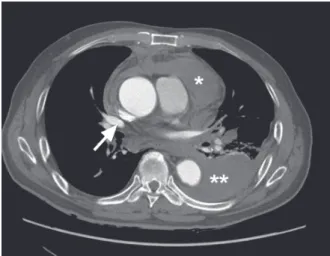
Chest computed tomography (CT) revealed an aneurysm involving the distal aortic arch and the proximal descending aorta. A periaortic mediastinal hematoma and a left hemothorax, which were consistent with aortic rupture, were observed (Fig. 1).
The maximal diameter of the aneurysm was 65 mm.
We performed an emergency one-stage hybrid arch operation. After median sternot- omy, we encountered a large number of mediastinal hematomas. Heparin (5,000 IU) was given intravenously before clamping of the brachiocephalic artery. An 8-mm Vas- cutek
®Gelweave graft (Vascutek Ltd., a Terumo company; Renfrewshire, Scotland) was anastomosed to the proximal side of the brachiocephalic artery. After the anasto- mosis, the remaining dose of intravenous heparin (3 mg/kg) was administered. Using the arterial cannula connected to the extended graft and the single 2-stage venous can- nula in the right atrium, we instituted cardiopulmonary bypass (CPB) (Fig. 2A).
Case Reports
Jae Hyun Kim, MD Jin Sung Yang, MD Sam Sae Oh, MD Chan-Young Na, MD
Key words: Aorta, thoracic/
surgery; aortic aneurysm, thoracic/surgery; aortic arch/
surgery; aortic rupture/sur- gery; blood vessel prosthe- sis implantation/methods;
endovascular procedures;
stents
From: Department of Tho- racic and Cardiovascular Surgery, Sejong Heart Institute, Sejong General Hospital, Bucheon, Republic of Korea
Drs. Kim and Na are now at the Department of Thoracic and Cardiovascular Surgery, Keimyung University Dong- san Medical Center, Daegu, Republic of Korea.
Address for reprints:
Jae Hyun Kim, MD, Dalseong-ro 56, Jung-gu, Daegu 700-712, ROK
E-mail:
jaemax31@gmail.com
Fig. 1 Preoperative computed tomogram shows a distal arch aneurysm, measuring 65 mm in diameter, at the level of the right superior pulmonic vein (arrow).
Double asterisk = left hemotho- rax; single asterisk = mediasti- nal hematoma
Volume 40, Number 3, 2013 344
Emergency One-Stage Hybrid Surgery for Aortic Arch
At the nasopharyngeal temperature of 20 °C, hypo- thermic circulatory arrest was initiated. During that arrest, bilateral antegrade cerebral perfusion was per- formed. For myocardial protection, blood cardioplegic solution was infused intermittently through the ret-
rograde cannula every 15 to 20 minutes. A total arch replacement with an elephant-trunk procedure was performed using a 24-mm Gelweave 4-branch collared graft. The deeply seated left subclavian artery was ligat- ed (Fig. 2B). In consideration of the urgent situation,
Fig. 2 Schematic drawings after each stage of the operative sequence. A) Cannulation for cardiopulmonary bypass (arterial cannula to the brachiocephalic artery, venous cannula from the right atrium); B) view after total arch replacement with elephant trunk graft; C) ante- grade deployment of the thoracic stent-graft after weaning from cardiopulmonary bypass; and D) completion of the hybrid arch operation.
A B
C D
Texas Heart Institute Journal Emergency One-Stage Hybrid Surgery for Aortic Arch 345
we did not perform a carotid–subclavian artery bypass.
The CPB time, cardiac ischemic time, and total circu- latory arrest times were 191, 149, and 42 minutes, re- spectively.
After weaning the patient from CPB, we partially re- versed the heparin with protamine. Thoracic endovas- cular repair was performed using the remaining 10-mm branch of the 4-branch graft as a conduit (Fig. 2C).
A 30 × 30 × 200-mm Valiant
®Thoracic Stent Graft (Medtronic Vascular, Inc.; Santa Rosa, Calif ) was de- ployed antegrade. A C-arm fluoroscope was used to guide the wire and the stent-graft. The proximal land- ing zone was marked with a radiopaque material su- tured onto the graft. A Reliant
®Stent Graft Balloon (Medtronic Vascular) was used for the ballooning of the stent. The stent was seated proximally on the elephant trunk and was landed distally on the T7 level. After its deployment, the conduit graft was ligated and resected.
Heparin was fully reversed with protamine (Fig. 2D).
The left hemothorax, which had been caused by rup- ture of the aneurysm, was drained 3 days after the op- eration. Through the left chest tube, 1,000 cc of dark blood was drained initially. The postoperative course of treatment was uneventful. Extubation and ward trans- fer occurred on postoperative days 1 and 3, respectively.
A one-week course of antibiotics for a mild pneumonic infiltration of the right lung further extended the pa- tient’s hospital stay until postoperative day 20.
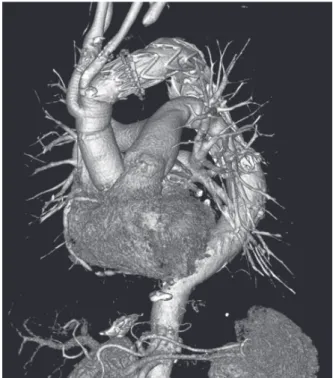
The last CT image, taken 4 months after the oper- ation, showed a well-seated thoracic stent without en- doleak or stent migration (Fig. 3).
Discussion
Conventional surgical repair of a ruptured aneurysm of the thoracic aorta carries high morbidity and mortality rates.
1However, thoracic endovascular stenting proce- dures have shown encouraging outcomes for the treat- ment of ruptured aneurysms of the thoracic aorta.
2,3When a ruptured thoracic aneurysm involves arch vessels, emergency hybrid surgery can be an alterna- tive to open surgery. One type of hybrid operation, the arch-debranching procedure complemented by tho- racic endovascular stenting, can circumvent the need for CPB.
4,5However, that alternative carries the risk of overt rupture, because it is performed under the con- ditions of heparinization and uncontrolled blood pres- sure. To reduce the risk of total aortic rupture while opening the sternum, some investigators have used temporary femorocarotid bypass.
6,7Temporary femo- rocarotid bypass can be applied in a small number of very limited situations, but it is a time-consuming pro- cedure that still carries the risk of overt rupture during its performance.
Total arch replacement with an elephant-trunk graft, complemented by thoracic stenting—the so-called “fro- zen elephant-trunk procedure”—carries risks related to the use of CPB and total circulatory arrest.
4,5Howev- er, data collected from meta-analyses
5,8have revealed results that are equivalent to those of the debranching type of hybrid operation. For repair of a ruptured arch aneurysm, the frozen elephant-trunk procedure can maintain blood pressure at less than 80 mmHg: CPB is begun immediately after sternotomy, thereby prevent- ing overt aortic rupture.
For the patient whose case we describe here, we de- ployed the thoracic stent-graft after weaning him from CPB, because we did not have a suitable stent-graft for the frozen elephant-trunk procedure. In addition, we avoided the risk of aortic injury or rupture that would have accompanied blind deployment of the stent-graft under total circulatory arrest. Moreover, nitinol-based stent-grafts preclude ballooning on landing zones when the patient is under deep hypothermia, a disadvantage that could lead to endoleak after the initial procedure.
Although concerns regarding overt aortic rupture after weaning from CPB could be raised, we assumed that the 8- to 10-cm length of elephant trunk would cover the ruptured aneurysmal arch and prevent overt rupture before thoracic stent-grafting could be accomplished.
Conclusion
Emergency total arch replacement with elephant-trunk placement and one-stage thoracic stenting can be an option for the treatment of ruptured aneurysms of the aortic arch. The risks and benefits of CPB and total cir- culatory arrest should be evaluated on the basis of each patient’s condition.
Fig. 3 Follow-up computed tomogram at 4 months shows a well-seated stent-graft with no endoleak.
Volume 40, Number 3, 2013 346
Emergency One-Stage Hybrid Surgery for Aortic Arch
References
1. Schermerhorn ML, Giles KA, Hamdan AD, Dalhberg SE, Hagberg R, Pomposelli F. Population-based outcomes of open descending thoracic aortic aneurysm repair. J Vasc Surg 2008;
48(4):821-7.
2. Xenos ES, Minion DJ, Davenport DL, Hamdallah O, Abedi NN, Sorial EE, Endean ED. Endovascular versus open repair for descending thoracic aortic rupture: institutional experi- ence and meta-analysis. Eur J Cardiothorac Surg 2009;35(2):
282-6.
3. Jonker FH, Trimarchi S, Verhagen HJ, Moll FL, Sumpio BE, Muhs BE. Meta-analysis of open versus endovascular repair for ruptured descending thoracic aortic aneurysm. J Vasc Surg 2010;51(4):1026-32.
4. Milewski RK, Szeto WY, Pochettino A, Moser GW, Moeller P, Bavaria JE. Have hybrid procedures replaced open aortic arch reconstruction in high-risk patients? A comparative study of elective open arch debranching with endovascular stent graft placement and conventional elective open total arch and distal aortic arch reconstruction. J Thorac Cardiovasc Surg 2010;140(3):590-7.
5. Koullias GJ, Wheatley GH 3rd. State-of-the-art of hybrid procedures for the aortic arch: a meta-analysis. Ann Thorac Surg 2010;90(2):689-97.
6. Coppola R, Bonifazi R, Gucciardo M, Pantaleo P. Ruptured aortic arch aneurysm: transposition of aortic arch branches after insertion of thoracic endovascular stent with extra-ana- tomic brain perfusion. Interact Cardiovasc Thorac Surg 2007;
6(3):376-8.
7. Joyeux F, Canaud L, Hireche K, Berthet JP, Marty-Ane C, Alric P. Temporary extra-anatomic brain perfusion followed by total rerouting of the supra-aortic vessels for hybrid repair of a ruptured aortic arch aneurysm. J Vasc Surg 2011;54(4):
1145-7.
8. Ius F, Hagl C, Haverich A, Pichlmaier M. Elephant trunk procedure 27 years after Borst: what remains and what is new?
Eur J Cardiothorac Surg 2011;40(1):1-11.